When Depression Wins
Originally published August 11, 2014
 I just received news about two hours ago that the famous actor Robin Williams has died in what looks to be a suicide. This has not been confirmed. Williams has been suffering from severe depression of late according to reports. I am not able to write about this tomorrow because of a project, but as a two-time survivor of severe depression, I would like to write a short essay on this before I turn in.
I would not wish severe depression on anyone, not even the most brutal of terrorists like the ones wreaking havoc in Iraq right now—that should put it in perspective for you. Serious depression is one of those experiences that you really have to experience to understand. The tragic news about Williams should turn our attention to those who may come our way. Can we help them? We most certainly can. Please, don’t just talk about this problem and move on. And, I don’t care how great you think the guy was—why does that matter now? While eulogies abound to show people how caring we are, conspicuously absent are questions about the problem itself.
And Williams forgot something: he wasn’t just fighting for himself—his loss does not give hope to others in his shoes.
 There is a lot for Christians to learn about this problem, but unfortunately, the present-day church believes sanctification is pretty much the same thing as justification and depression is definitely a sanctification issue. No, preaching the gospel to yourself will not end the depression. No, prayer alone will not end depression; God cares, but you have to participate in the cure.
I wish I could refer people someplace, but I really can’t. In the 70’s, 80’s and 90’s, the biblical counseling movement was having great success in helping people with severe depression, but the fundamentals that drove that counseling have been discredited as “not vertical enough.” As far as finding a counselor, sorry to say, you are on your own, but I can share with you what I have learned about this very serious problem.
1. If you have lost interest in everything that gives you joy, feel like you are losing your mind, and are harassed and tormented by horrible thoughts, seek medical help as soon as possible. Depression can be caused by several different medical conditions and bad reactions to certain medications.
2. Be open to encouragement and help from non-Christians. Non-believers and Christians both played an important role in my recovery.
3. Though depression can be a medical problem, in most cases depression becomes a medical problem because of a person’s outlook on life. Specifically, wrongheaded thinking. I have no doubt at all, that depression is caused from chemical imbalance, but the question is, “Can one’s thinking and outlook on life cause those imbalances?” I think the answer is, “yes.”
4. If you struggle with anxiety problems, get the problem under control—anxiety can lead to severe depression.
5. Deal with guilt and relationship problems with others.
6. You are probably going to need medications to get you through the toughest part of your depression while you work on personal issues. Some doctors will say that you will need these medications for the rest of your life, but I know of many situations where this is not the case at all, including my own.
7. Put yourself under the care of a medical doctor and a good counselor. Do not isolate yourself, even if you feel like doing so. It will be necessary to do certain things whether you feel like it or not. Seek out friends that understand your problem.
 8. Remember that thoughts invoke feelings and feelings invoke thoughts. Don’t think thoughts that make you feel bad for no good reason. When feelings invoke thoughts, talk back to them. Have a conversation with your thoughts. For me, when oppressed by horrible thoughts, I prayed a lot. Yes, find promises in the Bible and cling to them—by all means. Those horrible thoughts and bad feelings sure do make a strong case that you are helpless against them, but I do not think that is the case. Fight to think other thoughts by getting your mind on something else. Do not leave the thoughts unchallenged. One must ask when he considers what these loud, strong feelings are saying…
“are they telling the truth?”
9. Feelings are VERY important to life, but during a time of severe depression, feelings are your worst enemy. You must temporarily make feelings a lower priority during this time. Whether you feel like it or not, be other-person focused. Whether you feel like it or not, accomplish things. With the help of medications, you can stay productive, and this is important. Right feelings follow right doing, and especially right thinking.
10. This post may help: http://wp.me/pmd7S-Eu
We have much to learn about depression. Suicide is tragic for many reasons, but if people who feel like they are at the end of their rope would just wait one more day, in many cases a new day brings a totally different perspective. I am going to leave you with something very simple if you are a depressed person reading this. In the midst of my struggle, a man who had been through depression himself smiled at me and said, “You are going to be alright.” Oddly, if someone ambushed me with the question, “Right now, name the one thing that was most important in your recovery,” without even thinking about it, I would have to point to that one instance. I would add that life is worth fighting for. I would add that you need to fight because your family wants you to; fight to love them more than you hate your suffering. Win the fight for them. My friend, our great God assures us that trials are only for a time. Death will come soon enough…fight for the joy that will return. When depression wins, hope loses, and the world needs nothing more than hope. And…
“you are going to be alright.”
paul
Simple Theological Math: Protestantism’s Age-Old Gospel of Death and Misery
 Originally published June 6, 2014 “When it gets right down to the nitty gritty there is NO difference between John MacArthur Jr. and Joseph Prince. The theological math equation is exactly the same…
Source: Simple Theological Math: Protestantism’s Age-Old Gospel of Death and Misery
The Gospel is Indeed Simple
 Where should we start in explaining the good news? We could start by acknowledging that every human being ever born into the world will see God one day. There is no way around that. Then we could s…
Source: The Gospel is Indeed Simple
The PPT Counseling Archives
https://paulspassingthoughts.com/2016/03/25/christian-living-series-program-12/
https://paulspassingthoughts.com/2016/04/29/19680/
https://paulspassingthoughts.com/2016/05/06/christian-living-series-program-16-on-blog-talk-radio/
https://paulspassingthoughts.com/2015/02/04/counseling-the-unsaved/
https://paulspassingthoughts.com/2014/12/30/now-available-booklet-on-biblical-counseling-movement/
https://paulspassingthoughts.com/page/7/?s=counseling
https://paulspassingthoughts.com/2013/01/18/how-biblical-counseling-really-works-in-our-day/
https://paulspassingthoughts.com/2012/10/22/reformed-counseling-you-dont-change-you-cant-change/
https://paulspassingthoughts.com/2010/10/23/gospel-sanctification-counseling-part-2-3/
https://paulspassingthoughts.com/2016/11/20/blog-talk-radio-11202016-page-two-the-divorce-standoff/
How to Un-Confuse Religious Questions: Know That It’s Philosophy
 Why is religion so confusing? Because in most cases it’s not religion. People can’t make heads or tails out of religion in general because they don’t understand that most religions flow from world philosophy. And really, politics as well. If schools taught solid world philosophy there wouldn’t be a Democratic Party and religion would be easily understood.
I was reminded of this as I received a question by email yesterday concerning the religious doctrine of antinomianism. This is a religious doctrine that rejects the law of God in Christian living. Well, most Christians don’t even have a good working knowledge of what “law” is from a biblical perspective to begin with. At any rate, I will answer the antinomian question after I am done ranting.
Going to church is like going to a psychologist. Lots of people go to psychologists for “help,” but now ask them what school of thought their psychologist comes from…nothing but crickets. There are 200 to choose from by the way, and like religion, it comes from philosophy as well. In both cases, faith in expertism negates any concern for whatever ideology is driving the counsel. It’s about authority and not truth.
TTANC Ministries gets its share of grief from evangelicals because of our association with John Immel; well, they can get over it, because if you don’t understand world philosophy you are totally out of school in your discussion of religion in general and theology in particular. Sorry.
Most religious scholars are the scum of the earth because they know their religious commentary is orthodoxy. Of course, most Christians think orthodoxy is a stated clarification of a religion’s truth. Nope, and you can add that piece of trash onto the ignorance heap. Orthodoxy is mythology’s “noble lie.” It is a bedtime storybook for serfs. For example, if the great knowers want to teach the serfs about self-confidence, they write a catechism titled, “The Little Blue Engine That Could.”
Go to church if you will, believe that you are getting the “meat of the word” if you will, but it is really The Little Blue Engine That Could orthodoxy. The demeaning presupposition you agree to is that the pastor is feeding you milk that your poor little juvenile soul can digest. Be like me; when I lost my first family because they didn’t respect me as one that knows anything, I took responsibility for being stupid and letting others think for me. I suggest you do the same; it doesn’t mean you have to be stupid for the rest of your life. Stop being intellectually lazy and grow up. And for crying out loud, stop paying an institution 10% of your income to relegate your life to total destruction or mediocracy at best.
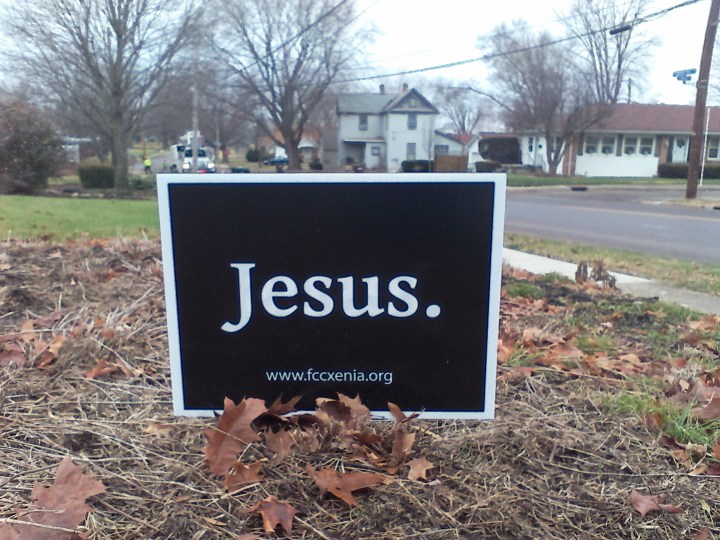
Let’s take the yard sign we have seen around Xenia lately. It is the article marque up top. I went out and took a picture of a couple of them this morning for this article. Jesus. What is that saying?
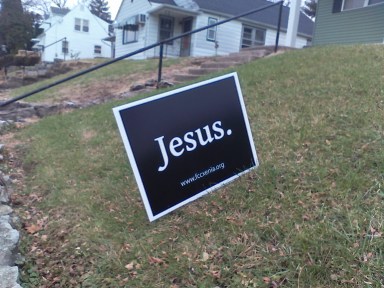
With soft gentle voice: “Well Paul, it is saying that our faith is childlike and simply focuses on ‘Jesus’ (pronounce like this: “geeeeeee-ja [strong emphasis on the “ja”] uuuus). Ya man, Jesus PERIOD! Ahhhmeeen (Strong emphasis on the “ah”)”.
Begin tough love here: ‘no silly, you who delights in proclaiming yourself a simpleton, this one word with a period is a statement concerning a vast body of philosophical thought.’ But let’s pause here for a moment to interject a nugget. The Bible actually explains why churchians like these spiritual bumper stickers so much; it’s a form of idle worship. You see, you can really make this sign say anything about Jesus that you want it to say because it is a one-word prism. This is how idles operate. A prime example is another local one. A church in nearby Monroe, Ohio has a 60-foot statue of Jesus adjacent to the I-75 corridor. Many people have been interviewed in regard to what the statue means to them. It shouldn’t surprise you that the statue has a different meaning for every person they interviewed. This is how idols work; so, that is in play as well.
What does all of this have to do with antinomianism? Like all other religious debates, you can present a biblical argument, but the philosophical premise of the biblical argument is rarely discussed and this is why religious debate is a gargantuan quagmire that rarely leads to any substantive resolution.
So first, let’s explain the sign, and then how the sign relates to the religious perspective on antinomianism. The sign actually represents a world philosophy with a religious label. This is the foundational philosophical premise of Protestantism in particular. It is an interpretation of reality or state of being, not the Bible. This is a worldview of reality dressed in biblical garb. Here it is:
Christocentrality.
Definition: all of reality is interpreted through the person of Christ and His works. How does that work? It works through the philosophy of metaphysical narrative. What’s that? It is the belief that reality is only experienced because reality is a predetermined narrative written by some higher power. So, though it feels like you are doing life, you are not doing life, you are only experiencing what has been predetermined in the script. You are an actor in a “divine drama.” In the specific case of Protestantism, REALITY is a metaphysical narrative about God’s salvation in Christ. EVERYONE has been written into the script and the life they have lived or will live is predetermined by the metaphysical script. Again, it is experienced like we are doing life through freewill choices, but we are really ONLY EXPERIENCING the prewritten story.
This is what is really behind all of the freewill/sovereignty of God debates among evangelicals that never resolve anything because people don’t really understand the philosophy behind it. The contemporary, more or less, nomenclature for this Protestant doctrine is, the centrality of the objective gospel outside of us which is said to be “experienced subjectively.”
Look, if you pay attention you will begin to see it everywhere. Just google, “divine drama” for starters and look at Bible study programs like The Gospel Project and Bible Mesh. They are all based on interpreting reality from a redemptive prism. The historical-redemptive hermeneutic is also based on this worldview.
What does this have to do with antinomianism? It enables Protestant scholars to claim an allegiance to God’s law on the one hand, while in their reality God’s law is just part of God’s prewritten gospel narrative. The narrative glorifies God when His wrath is poured out on the law-breakers who were written into the script by Him, and he is also glorified by those who love the law according to His metaphysical script.
But, they are antinomian from this viewpoint because the dirty little secret follows: any decision to follow God’s law is predetermined by God’s prewritten gospel narrative; i.e., reality. This is why Martin Luther suggested that a true Christian should be indifferent to whether or not they keep God’s law because it is really God keeping it to begin with:
He, however, who has emptied himself through suffering no longer does works but knows that God works and does all things in him. For this reason, whether God does works or not, it is all the same to him. He neither boasts if he does good works, nor is he disturbed if God does not do good works through him. He knows that it is sufficient if he suffers and is brought low by the cross in order to be annihilated all the more (The Heidelberg Disputation: thesis 24).
So, why go to church or even try to be saved? According to them, this is “working out your salvation with trembling and fear.” Stay faithful to church and this buys you assurance of salvation because you are persevering; but while persevering you can claim that it is God doing it and not you. This is why the whole I didn’t do it, God did it is so prevalent among Christians. It is doubtful they understand the ideology behind their mere experience of doing things they are supposedly not doing, but orthodoxy leads to a functioning apart from intellectual understanding.
This is nothing new. Jesus’ specific beef with the Pharisees is that they “relaxed” the law; i.e., they were deficient in acts of love according to the law (Matthew 5:19 ESV, 23:23, Galatians 5:6). This is because they were inundated with these same types of philosophical ideas.
What is antinomianism? It is the relaxing of the law’s use for love in Christian living without any fear of condemnation. Antinomian philosophies and the theological doctrines driven by them usually teach a condemnation of law while claiming an endearment for it. This makes love a fearful works salvation.
That’s antinomianism in a nutshell.
paul

 Paul's Passing Thoughts
1 comment