Dee Parsons of Wartburg Watch: The Personification of Everything Wrong with Church
 When Paul’s Passing Thoughts .com was started in 2009, the goal was to find out why church turned on me with a vengeance despite my best efforts. Second to that was the question, “What now, where does one go from the point of diagnosing the problem?” You have to properly diagnose the problem before you can fix it.
This article will not wear you out with points leading up to a final conclusion; I will begin by stating what I have found. Church produces the fruit of its ideology. What is wrong with church? Answer: church is what’s wrong with church. Christ’s mandate to his followers was never intended to look anything like church. The solution is to depart from church and pursue Christ’s mandate to His followers. You can’t fix church. There is nothing there that is salvageable.
Let me back up a tad because this post is not the least bit personal, but seeks to sharpen the objectives of TANC Ministries. This is some information that I have not shared before. PPT was primarily a blog for the express purpose of sharing my research. My focus was research. I had to know why—how could dozens of pastors stand by and watch Clearcreek Chapel do to my family what they did?
Clearly, obviously, from a literal interpretive standpoint in regard to the Bible, what they were doing was dead wrong and unbiblical. During the episode, I was even under the counsel of a church that was part of the same fellowship of churches that Clearcreek Chapel belongs to. The pastor, the late Rick Wilson, was a former associate pastor at CCC. The present pastor of the church, Paul Craig, was an elder at the time and according to Wilson found the situation, “unsettling.” Grace Covenant (Beavercreek, Ohio) was obviously stuck in the middle, and was also the recipient of a significant exodus of people from CCC at the time. Though I was clearly under church discipline at CCC, I was allowed to attend Grace Covenant on a regular basis. I even thought about applying for membership which would have forced the Grace Covenant elders into making a judgment regarding the veracity of CCC discipline. I should have; watching that play out would have been priceless.
Eventually, Wilson instructed me to go back and play along in order to get my wife back, but I had already tried that for four months. During that time, I was subjected to cult-like break sessions conducted by CCC elder and Psychiatrist Dr. Devon Berry. The CCC elders knew that I had overcome serious depression in the past, and it was obvious they thought they could use Berry and the circumstances they were bringing to bear in my life to drive me into debilitating despair. It was very apparent to me at the time: that is what they were trying to do.
I want to stop right here and thank God publically for something right now—I want to give Him the glory. At the time, I was working out of town and laid in bed at night before going to work the next day…in perfect peace. My favorite time of the day during that time period was bedtime. Why? I laid there in the quiet darkness, not really thinking about anything except how peaceful it was. I was doing nothing but laying there soaking up the peacefulness. Do I have any theories regarding this experience? One: I had begun a long journey in search for the truth. God is with one on such journeys. That’s my best shot at answering that question. By all reasoning, I should have been a basket case.
Let’s now pause here for some simple clarification. It all boiled down to two things:
AUTHORITY, and how I interpreted reality versus how they interpreted reality.
I have discovered something in my research—research enables you to come to a point more and more where you can explain complex problems in simple terms. In the 2500 + articles I have written on Reformed ideology, you can see the focus move from the what to the why. My first book articulated the what and how it contradicted a grammatical interpretation of reality, though I didn’t understand the latter dynamic. My second book articulated the contemporary history of the Neo-Calvinism movement and added some more data about grammatical contradictions.
My third book and subsequent booklets articulate the grammatical contradictions in regard to soteriology. They also describe the dynamics between the Old Calvinism/New Calvinism question and how the interpretation of reality drives that debate.
Including time spent prior to PPT, eight years later, I can now put all of this in simple terms. It boils down to AUTHORITY vested in the interpretation of reality.
And, the established credential thereof known as “orthodoxy.” What is the premise of orthodoxy? Nothing more or less than the claims of men that people choose to believe. You can put any number of things in place of “naked” in regard to the following question posed by God, “Who told you that you are_____?” Be very, very, very wary of what men say God told you. And that’s orthodoxy. And the place we go to get certified in orthodoxy is called “seminary.” In case you haven’t noticed, God isn’t the dean or an adjunct professor in any of these schools.
 Here is something else that should be evident: you, and only you alone will answer to God. Therefore, pick your orthodoxy well. There are no attorneys in God’s court save Christ, “hear ye Him.” “God has spoken to us in these last days through His Son”, not a horde of academics.
So, what do we have in the recent dust-up between PPT and Wartburg Watch? Be advised, I am not going to rehash all of the gory details. Dee Parsons is right and I am wrong because she has college degrees, and holds to orthodoxy. Paul Dohse does not have college degrees, and does not hold to orthodoxy. Paul Dohse holds to a grammatical interpretation of realty, and therefore asks, “How can those who proclaim themselves ‘wicked’ lay claim to salvation?”
Be sure of this: NOTHING has changed since Christ ministered on earth. The primary pushback against Christ was clearly the orthodoxy of the day. Christ deliberately avoided the lauded academia of that day. I just don’t know what is more obvious. In addition, he had to personally reeducate the apostle Paul who was the only religious academic that He used for foundational purposes.
I am weary of documenting the steroidal cognitive dissonance that takes place over at Wartburg and their e-church hosted by the Barney Fife of pastors, Wade Burleson. Regardless of his credentials, from a standpoint of interpreting reality grammatically, his theological snafus are just plain embarrassing. For example, you can’t make the point that a biblical author was teaching something based on the analysis of a word that didn’t exist in the first century. This all takes place in the face of common sense for the same reason I experienced what I experienced at CCC:
AUTHORITY vested in a particular interpretation of reality.
Because one is credentialed in knowing how to lead those who cannot know reality, one should have authority over you for your own good and the common good of people in general.
In varying degrees, CHURCH, established in the 4th century by St. Augustine et al, is the expression of this primary root, and the fruit doesn’t fall far from the tree. Chaos and drama will continue in the church with no solution in sight because of its foundational presuppositions concerning the interpretation of reality and the authority vested in its epistemology.
This ministry’s series on the Heidelberg Disputation focuses on the following fact: at issue with the Reformation was a debate about the interpretation of reality. Of course that spoke to how the Bible is interpreted, but the issue started with how reality itself is to be interpreted. Let me give you the thumbnail:
Words don’t necessarily mean things.
By and large, there are two kinds of Protestants roaming about, Calvinists and functioning Calvinists. Susan and I often have conversations with people who hate Calvinism, but verbally espouse Calvinism unawares constantly. We don’t even address the particulars anymore because we know a complete reeducation is needed. This is what we are attempting to do with the HD series. This series reexamines the roots of the poisonous tree.
This is why Dee Parsons, in the recent dust-up, insinuated that I am mentally ill. What is the definition of a person who does not properly perceive reality? Hence, the CCC elders involved a Psychiatrist in my situation because they honestly believe I am mentally ill because I interpret reality grammatically. Reformed scholars such as Geerhardus Vos have stated such openly. Pastor Russ Kennedy told me I was “mad” and begged me to allow them to “shepherd” me. I believe the guy honestly meant well and still does. Unfortunately, as the saying goes, the road to hell is paved with good intentions.

By the way, I am not talking about grammatical interpretation that leads to a redemptive outcome. I am talking about the interpretation of reality beginning with exegetical presuppositions in the purest sense. I realize Reformed scholars interpret a verse literally when it can serve a redemptive historical outcome…
…that doesn’t make you a proponent of interpreting reality grammatically.
One of the accusations that flowed from the recent dust-up was that TANC Ministries is merely developing its own orthodoxy. Not so. Orthodoxy fundamentally interprets reality according to Martin Luther’s Heidelberg Disputation which was expanded upon by John Calvin’s Institutes of the Christian Religion. Seminary degrees guarantee that individuals will not do independent research that will reveal the real tenants of orthodoxy:
- It is a metaphysical redemptive narrative that interprets all reality through a dualism of good and evil.
- It demands the fusion of faith and force for the common good of mankind.
- It is predicated on spiritual caste that adds additional mediators between God and man other than Christ.
- All of reality progresses as predetermined by manifestations of good completely outside of man.
Dee Parsons’ response to me that “I don’t believe what you say I believe” is most likely due to her ignorance regarding the true sum and substance of the same Reformed orthodoxy that she promotes. Perhaps. While claiming to be an advocate for the spiritually abused, she picks and chooses from orthodoxy what she wants to acknowledge.
The Westminster Confession is just wonderful, but its call to control the free press and execute those who are heterodox is due to the authors being “men of the time.” Of course, their politics and ethics had nothing to do with their ideology. Perish the thought, and no, American Jurisprudence isn’t the only difference between Calvin’s Geneva and the present-day church. It’s absurd to think Dee Parsons would actually have you committed to a mental institution because she thinks you are mentally ill. It’s absurd to think Mark Driscoll would really put you in a wood chipper just because he said that’s what ought to be done. It’s absurd to think James MacDonald would catapult you into the next county, and to your certain death just because he said he wishes he could.
Church is a place where professional clergy interpret reality in a completely different way than most parishioners. Congregants follow the dictates of church leaders while being clueless in regard to their interpretation of reality. They are given elements to follow while being totally unaware as to what those elements are based on. Hence, chaos and confusion reign. Duggar-like drama is paraded before the world constantly like an out-of-control stampede of rats. Yet, that isn’t the madness; the madness is suggesting that we rethink how church is done. After all, Catholicism and Protestantism have had only 1500 + years to get it right. Not only that, the Neo-Calvinist movement has been in total control of the church for at least ten years. Growing steadily since its conceptual resurgence in 1970, discernment/spiritual abuse blogs exploded in 2009 when the movement shifted into 4th gear. Starting in 2008, a historical phenomenon of mediation organizations to keep churches out of court exploded onto the scene as well.
With all of this considered, I think I have heard the best assessment of Wartburg Watch yet:
Subconsciously or consciously, Dee uses her blog as a means to leverage her desire for a seat at the American church’s authoritarian table. Period. Whether this was an initial objective of her blog or merely a pitfall of unforeseen success, who knows? But the reality is obvious:
Dee creates better soldiers, not better souls. And the irony is thus that the “victims” who frequent her site often become the very image of that which they initially despised: manipulative self-appointed God-proxies who claim that the only legitimate doctrinal discussions are with those whom already concede their reformed hermeneutic (Muff Potter, anyone?).
My point is that the cognitive dissonance, the categorical rejection of reason as a yard stick for measuring reality (the efficacy of existence), makes contending with her an almost perfect waste of time.
So what’s the solution? I believe the solution is an utter rejection of orthodoxy and church as we know it. The immense ramifications of that is not the issue—truth is the issue. The church has had its chance to make a case for hope, and has not measured up.
I believe the task ahead is daunting, but will supply a freedom and joy beyond our wildest imaginations. It is a call for Christians to submit themselves to the one mediator Jesus Christ. It is a call for Christians to stop listening to men, and “hear ye Him.” Orthodoxy has NO authority, ALL authority has been given to Christ and no one else.
Past this, God’s people must gather together for mutual encouragement and edification in the ways prescribed by the Bible and not the traditions of men.
When is the misery and suffering produced by orthodoxy enough to make us question everything?
That time is well past.
paul
The Potter’s House: Lesson 71 of Romans Series

The Potter’s House: Romans 15:1-14; Points About Authority and the One Body of Jews and Gentiles
We are finally back to our study in the book of Romans. We have the last two chapters left, and this morning we resume at verse one in chapter 15. The first eleven chapters are a heavy dose of justification, and what we have learned from them has radically transformed our lives. A lot of Bible “learning” unfortunately comes from second hand knowledge rather than God speaking directly to us. After learning many things about justification in the first eleven chapters, we are now learning many things about the roles of Christians in kingdom living. One we should take note of is that there is NO horizontal authority among God’s people. Elders aid believers in exploiting the full potential of their hope—they have no authority.
God’s assembly is not an institution. Institutions are always defined by some kind of authority structure. Authority necessarily needs something to be in charge of, and at least within the walls of the institutional church, it is in charge of truth which leads to orthodoxy. An explanation of truth that is a commentary between God and everyday people is a troubling idea in and of itself. Once you concede that there is horizontal authority in the church, the logical questions that follow are not only troubling, but are answered by the slippery slope of Protestant tyranny. Authority is conceded, but the specific bounds are the elephant in the room because history shows that the church is utterly unable to restrain its own authority. As John Immel often notes, “polity,” or church polity is a soft term for church government. This all implies an authority over truth on behalf of God. There is no orthodoxy—only truth. There is no church government—only gifts, and there is no authority other than Christ.
And as we progress in Romans from chapter 12, we see this reality more and more, beginning with verse 1 here in chapter 15:
We who are strong ought to bear with the failings of the weak and not to please ourselves. 2 Each of us should please our neighbors for their good, to build them up. (NIV)
“Neighbors” is really a word that refers to someone close. It doesn’t exclude the literal neighbors of the hearers, but primarily refers to the fellow believers at Rome. Notice that this verse is an exhortation to the “strong,” and “each of us” in general should focus on building others up. This is a glaring pattern in the New Testament. The call to build up the body is to everyone and those we usually deem as God’s authoritarians are conspicuously missing throughout Scripture. In regard to the all-important elders and pastors, where are they? An inspection of Scripture in regard to this question reveals a stunning reality: elders and pastors have little significance in the New Testament. The emphasis is everyone working together for the building up of the body which as we will see includes a call to ministry usually ascribed to pastors and elders. Where are the elders? And who are all of these people who are supposed to be doing their jobs?
Let’s look at the word, “shepherd,” as in, you know, John MacArthur’s annual “Shepherd’s Conference.” The word (poimēn) appears 17 times in the New Testament and mostly refers to Christ or literal shepherds of herds. As far as I can tell, the word is only used once in regard to a pastor and that is in Ephesians 4:11. Think about that, reference to pastors as a shepherd appears ONCE in the New Testament.
Let’s look at “overseer.” The word (episkopos) appears five times in the New Testament. It refers to pastors once in Acts, once in 1Timothy, Once in Titus, Once in Philippians, and a reference in 1Peter about Christ.
Let’s look at the word “pastor.” It is the same word as “shepherd.” The two are used interchangeably in English translations. Both together represent the aforementioned 17 citations of which one speaks directly to the idea of “pastor.”
Let’s look at the word “bishop.” See, “overseer.” Again, these two words are used interchangeably for the same Greek word in the English translations.
But most telling is where these words are not used. In the magnum opus of justification, Romans, elders are not spoken of in any way, shape, or form. In the magnum opus of correction, the two letters to the Corinthians, again, there is no mention of pastors or their supposed roles even in Christianity gone wild. Of the 27 New Testament letters, at least 19 are corrective and address false doctrine, yet as mentioned before, a direct reference to pastors only occur in about five books. Only three books address leadership specifically with the remainder always addressing the congregation as a whole. Even in regard to the letters addressed to individuals, they were obviously intended to be made very public as well.
But most astounding is the fact that throughout the Scriptures those who are primarily addressed, the general congregation of God’s people, are called on to do ministries that we usually attribute to the “qualified pastorate.” And we will continue to see that throughout this study as well.
Romans 15:3 – For even Christ did not please himself but, as it is written:
“The insults of those who insult you have fallen on me.” (Psalm 69:9)
4 For everything that was written in the past was written to teach us, so that through the endurance taught in the Scriptures and the encouragement they provide we might have hope. (NIV)
The Scriptures were written to “teach us.” This is a direct line of sight from the Bible to believers in general. Nowhere in Scripture is there any merit for an orthodoxy overseen by elitist teachers or elders.
Romans 15:5 – May the God who gives endurance and encouragement give you the same attitude of mind toward each other that Christ Jesus had, 6 so that with one mind and one voice you may glorify the God and Father of our Lord Jesus Christ. (NIV)
Listen, this is it in a nutshell: the goal of one mind in Christ resulting in one voice. You decide from what we have learned in the past two lessons; does Paul say that is a result of blind obedience to authority, or is everyone to be convinced in their own mind? Granted, persuading those who are free to follow their own conscience is hard work. But that is the calling of a true elder. The New Testament does not endorse the dictation of truth in any way, shape, or form.
7 Accept one another, then, just as Christ accepted you, in order to bring praise to God. 8 For I tell you that Christ has become a servant of the Jews on behalf of God’s truth, so that the promises made to the patriarchs might be confirmed 9 and, moreover, that the Gentiles might glorify God for his mercy. As it is written: (NIV)
“Therefore I will praise you among the Gentiles;
I will sing the praises of your name.” (2 Sam. 22:50; Ps. 18:49)
10 Again, it says,
“Rejoice, you Gentiles, with his people.” (Deut. 32:43)
11 And again,
“Praise the Lord, all you Gentiles let all the peoples extol him.” (Psalm 117:1)
12 And again, Isaiah says,
“The Root of Jesse will spring up, one who will arise to rule over the nations; in him the Gentiles will hope.” (Isaiah 11:10)
When Paul writes, “Accept one another, then, just as Christ accepted you, in order to bring praise to God” he is talking about Jew and Gentile, he is writing about the mystery of the gospel. Remember what that is? It is God’s promise that He would bring Jew and Gentile together into one body for His praise and glory. And I do not think that goal has ceased—this is still the mystery of the gospel. This is why anti-Semitism is completely unacceptable among confessing Christians. Listen, any separation gospel or supersessionism is a blatant denial of the gospel. And this is yet another lost aspect of Christianity that must be recultivated; that is, the mystery of the gospel. Jew and Gentile worshipping together in unity is a major source of glorification. This opportunity is probably lost to a great degree because of Jewish customs that are no longer recognized by Christians. We know that Christ’s assemblies recognized Passover for at least 200 years after Christ’s ascension.
As home fellowships learn and grow, I think we will see the power of God’s word come alive to His glory in many-faceted ways. Also, let’s note Paul’s use of the Scriptures to make his case in citing three Old Testament passages. This speaks to the continuity and truth that guides us.
13 May the God of hope fill you with all joy and peace as you trust in him, so that you may overflow with hope by the power of the Holy Spirit. 14 I myself am convinced, my brothers and sisters, that you yourselves are full of goodness, filled with knowledge and competent to instruct one another. 15 Yet I have written you quite boldly on some points to remind you of them again, because of the grace God gave me 16 to be a minister of Christ Jesus to the Gentiles. He gave me the priestly duty of proclaiming the gospel of God, so that the Gentiles might become an offering acceptable to God, sanctified by the Holy Spirit. (NIV)
Once again, on the one hand, we see a sparse emphasis on elders in the New Testament while God’s people in general are told to do the tasks and ministries that are usually attributed to the “expertise” of the elder.
I myself am convinced, my brothers and sisters, that you yourselves are full of goodness, filled with knowledge and competent to instruct one another.
The fact that the institutional church pays pastor’s CEO-like wages for something that God’s people are called on to do leaves one dumbfounded in the face of how powerful the traditions of men are. The Scriptures are clear as to what roles pastor’s play in Christ’s assembly.
Ephesians 4:11 – So Christ himself gave the apostles, the prophets, the evangelists, the pastors and teachers, 12 to equip his people for works of service, so that the body of Christ may be built up 13 until we all reach unity in the faith and in the knowledge of the Son of God and become mature, attaining to the whole measure of the fullness of Christ.
14 Then we will no longer be infants, tossed back and forth by the waves, and blown here and there by every wind of teaching and by the cunning and craftiness of people in their deceitful scheming. 15 Instead, speaking the truth in love, we will grow to become in every respect the mature body of him who is the head, that is, Christ. 16 From him the whole body, joined and held together by every supporting ligament, grows and builds itself up in love, as each part does its work.
First of all, some of these gifts are starter gifts. Prophets were a temporary gift to the church to get things started. But at any rate, these are “gifts” and not offices of authority. Pastors are not mediators or authoritarians. The office of mediator between man and God and the authority thereof is the exclusive office of Christ. Unity in regard to a single truth is not by authority, but as each Christian is “convinced in their own mind” (Rom 14:5). The apostles who were the forerunners of the elders (1Pet 5:1), and continually beseeched the saints to be “one mind in Christ” (Rom 15:6, Phil 2:2, 1Cor 1:10, 1Pet 3:8, 1Cor 2:16).
Key to this unity and cooperation is a proper biblical ministry model. Listen, if the mystery of the gospel is the joining of Jew and Gentile into one body, who’s in charge? That’s an interesting question, no? The answer is that no one in these two groups has authority—it’s a cooperation of gifts under one head which is Christ. What is the biblical ministry model?
Ephesians 4:4 – There is one body and one Spirit—just as you were called to the one hope that belongs to your call— 5 one Lord, one faith, one baptism, 6 one God and Father of all, who is over all and through all and in all.
When Christ arrived on the scene and began preaching the good news of the kingdom of God, it was in the midst of a Jewish religious community heavily predicated on hierarchy and authority. Judaism was an institutional monstrosity fraught with the traditions of the Jewish sages and ruling sects. The issue of Jesus’ lack of formal authority in institutional Judaism is a constant theme throughout the gospels. This is the reason Jesus came performing authenticating miracles—if you were not a recognized religious authority in that day, your ministry was going nowhere. Jesus broke the cycle and ushered in a new ministry model. Today, we don’t have authenticating miracles to validate our message, but we do have the testimony of the Scriptures.
Regardless of the massive religious system of that day, Christ made it clear that the people were “sheep without a shepherd.” They were not led. Jesus was not talking about a lack in the people being ruled over, there was plenty of that, He was talking about the people not being led in the truth.
The new way is a body of believers working together in mutual edification according to the gifts given them by God—a faith working through love. It is unity in one truth according to the way the one master thinks, and that one master is Christ. We are baptized once into one body with one head—one master—one Lord.
Our calling is unity in the one body and its maturity to God’s glory. Over and over and over again the apostles “appeal” to love and unity—NOT authority. It is a cooperation of gifts that are obedient to the one Master. In the rest of chapter 15 and also chapter 16, we see this in action bigtime.
American Clergy Brilliance: “The Gospel of Jesus Christ: An Evangelical Celebration”

“Look, think about this; even an adolescent Sunday school student can see it: if the righteousness of God is revealed apart from the law (Romans 3:21), why would Christ need to keep it for our justification? For crying out loud, what does ‘apart’ mean?”
My theses for this year’s TANC conference highlights the fact that the Reformers taught from a totally different reality than a normative reality that draws logical conclusions from the arrangement of verbs, nouns, prepositions, adjectives, conjunctions, etc. taken at face value. The Reformers created their own metaphysical premise for interpreting reality. The authentic Reformed gospel is predicated on a contra reality. This is one of four reasons that the authentic Reformed gospel experiences a social death periodically throughout church history, and then periodic resurgence movements like the one we are presently in via New Calvinism. There have been five of these resurgence movements sense Calvin’s theocracy in Geneva. They will be documented in volume two of The Truth About New Calvinism. As Christians read their Bibles, they are naturally drawn away from the authentic Reformed gospel because the human tendency is to interpret reality from the normative perspective. They become uncomfortable with the contradictions. However, as each resurgence dies a social death, Protestant traditions of men continue to be a significant part of what emerges from the ashes. A Reformed hybrid emerges that apes the anemic sanctification spawned by Reformed thought. This lays the ground work for the resurgences that follow. Protestantism, historically, oscillates between the weak sanctification of the hybrid and the despotic resurgence movements that temporarily replace the hybrid. Basically, the vicious cycle must be stopped if revival is going to be possible. God sanctifies with truth, not the traditions of men. Part and parcel is a dumbed-down Christianity saturated with the traditions of Reformed men—primarily dead ones. Men of old that are deemed geniuses are often mindless Kool-Aid drinking followers of John Calvin and his ugly stepchildren, the murdering despotic Puritans. Part of the Protestant tradition that carries on is the big “O,” ORTHODOXY. A synonym for “truth” in American churchianity, it is really the repackaging of truth interpreted by the Protestant elite for consumption by the unenlightened masses. The American church follows the tradition of Protestantism when the arrogant, elitist who’s who of evangelicalism come together and publish declarations, i.e., the confessions and creeds of traditional Reformed thought. A recent example of this is the third edition of The Gospel of Jesus Christ: An Evangelical Celebration (1994, 1997, 1999) signed and/or endorsed by, for example, the following: John Ankerberg, Kay Arthur, Tony Evans, Jerry Falwell, Bill Hybels, David Jeremiah, D. James Kennedy, Max Lucado, Woodrow Kroll, Tim & Beverly LaHaye, Erwin Lutzer, Bill McCartney, Luis Palau, Pat Robertson, Ronald Sider, Charles Stanley, John Stott, Joseph Stowell, Chuck Swindoll, Bruce Wilkinson, Ravi Zacharias, Jack Hayford, Steven Strang, John MacArthur Jr., RC Sproul, Charles Colson, Bill Bright, and JI Packer. Only problem is, the document denies the new birth and describes Christians as being under the law as opposed to being under grace. In other words, the authentic gospel of the Reformation. First, the document speaks from the perspective of the authentic Reformed gospel that only recognizes the possibility of a linear gospel, ie., the “golden chain of salvation.” Because sanctification is the links of a chain that stretches from justification to glorification, the links must stay intact by the same gospel that saved us. Hence, grace cannot be inside of the believer because that makes him/her a participant in the completion of justification. Justification is only a finished work if we live among the sanctification links in the same way we were saved—by faith alone. The Reformers only recognized this reality, and judged all other gospels from the same reality. Grace is either infused within the believer, making him/her a participant in finishing justification, or grace remains completely outside of the believer. The alternative that sanctification is completely separate, a parallel gospel, is not considered to be a possible reality. Accordingly, note the following statement in said GEC document:
We deny that we are justified by the righteousness of Christ infused into us or by any righteousness that is thought to inhere within us.
The Reformers believed that ALL grace and righteousness must remain OUTSIDE of the believer or it by default made him/her a participant in the completion of justification. They got around the mass of prepositions throughout Scripture that clearly state that grace is within us by utilizing the emphasis hermeneutic (the redemptive historical hermeneutic). This hermeneutic is a Gnostic concept derived from Plato’s theory of forms. I will delve into this in detail during my second session at this year’s TANC conference. Granted, many of the signers probably didn’t, and still don’t understand what the Reformers believed, and I believe other signers such as RC Sproul deliberately play on that confusion. Secondly, the doctrine propagates the Reformed mainstay of Christ’s perfect obedience to the law being imputed to our sanctification so that “sanctification is not the ‘ground’ of our justification.” See the chain thing going on there? Our enablement in sanctification necessarily makes sanctification the GROUND of our justification because sanctification finishes justification. It’s a “chain.” Here is what the document states:
God’s justification of those who trust in him, according to the Gospel, is a decisive transition, here and now, from a state of condemnation and wrath because of their sins to one of acceptance and favor by virtue of Jesus’ flawless obedience culminating in his voluntary sin-bearing death.
And….
We affirm that Christ’s saving work included both his life and his death on our behalf (Gal. 3:13). We declare that faith in the perfect obedience of Christ by which he fulfilled all the demands of the Law of God on our behalf is essential to the Gospel. We deny that our salvation was achieved merely or exclusively by the death of Christ without reference to his life of perfect righteousness.
Look, think about this; even an adolescent Sunday school student can see it: if the righteousness of God is revealed apart from the law (Romans 3:21), why would Christ need to keep it for our justification? For crying out loud, what does ‘apart’ mean? Worse yet is the idea that this perfect obedience is imputed to our sanctification if we live our Christian lives by faith alone because sanctification is a progressive process that finishes justification. James refuted this idea in no certain terms, which is why the Reformers questioned its rightful place in the New Testament canon. Moreover, this idea keeps Christians “under the law,” which is the biblical designation for the unregenerate. I don’t know much about the theologian William R. Newell, but with that disclaimer, I will say that I agree with his opinion in regard to this issue:
The fatal result of this terrible error is to leave The Law as claimant over those in Christ: for, “Law has dominion over a man as long as he liveth” (7.1). Unless you are able to believe in your very heart that you died with Christ, that your old man was crucified with Him, and that you were buried, and that your history before God in Adam the first came to an utter end at Calvary, you will never get free from the claims of Law upon your conscience (William R. Newell: Verse by Verse Commentary on Romans).
Hence, the law remains a claimant over the believer at any point where he/she stops living their life by faith alone in the same gospel that saved them rather than belief in the new birth followed by the death of the old us that died with Christ and is no longer under the law. We must now fear that our obedience in sanctification is making the law the “ground” of our justification. Likewise, Calvin stated the following: Another principal part of our reconciliation with God was that man, who had lost himself by his disobedience, should by way of remedy oppose to it obedience, satisfy the justice of God, and pay the penalty of sin. Editor’s note: For our redemption, Christ kept the Law for us and died upon the Cross. By this, Christ obtained forgiveness of sins for us (Calvin on the Mediator: Chapel Library press, 2009). This is also known as “vicarious law-keeping.” A definition of vicarious is:
Adjective Experienced in the imagination through the feelings or actions of another person: “vicarious pleasure.” Acting or done for another: “a vicarious atonement”.
Christians need to stop following men in general, and Reformed men in particular. God only sanctifies with truth, and Reformed doctrine does not save or sanctify accordingly. It calls for a salvation by law-keeping and who keeps it is not the issue. The law as a standard for justification is the issue. It also denies the different relationship of the law to believers as opposed to unbelievers: the law provokes the former to righteousness, and provokes the latter to sin. It skews the very biblical definition of the regenerate.
paul
Absolutely Critical to Effective Ministry: Knowing the Two Realities of Protestantism
 If we are to accomplish anything in contemporary Christianity, we must begin to live by a basic hard-fast rule: our actions must be guided by the knowledge that there are two realities in contemporary Christianity; grammatical-historical and redemptive-historical.
These are usually discussed as methods of Bible interpretation, but they are really much more than that according to Protestant tradition. These are two different ways of interpreting reality itself.
We will begin by defining the redemptive-historical interpretation of reality along with this caution: one of the most powerful influences that this view of reality has is the dismissal of its basic premise as mere mysticism held by fringe elements of Protestantism. Those who dismiss it out-of-hand then proceed to function by its tenets unawares. The who’s who of Protestantism care little that the masses understand this ideology, just so they function by it.
In fact, Protestant leaders assume most parishioners are unable to grasp its tenets. Therefore, redemptive-historical reality must be explained in a way that will enable congregants to apply it to their lives and function a certain way within church culture. Redemptive-historical reality is primarily the crux of Protestant orthodoxy and its spiritual caste system.
In mythology, we often link the bizarre narratives to the philosophy itself, but that’s a mistake. Roman, Greek, and Babylonian culture was not developed by superstitious idiots. What we fail to understand is the narratives are stories that convey principles to the spiritual underlings so they can apply principles of higher knowledge to their lives. They cannot understand the higher knowledge, but those who can need to tell the underlings how to live in order to obtain the best possible society.
“Orthodoxy” can be likened to mythological narratives that teach those of lesser spiritual understanding how they should live, but they are based on well thought out metaphysical (state of being) systems of knowledge. We shouldn’t be surprised that what seems to be superstition has ruled the greatest empires on earth. This is because the core ideology is always a succinct system of thought that is greatly underestimated. The ancient philosophers were not idiots. Democritus (circa 400 BC) was the originator of atomic theory. The sophist class of philosophers were the first to apply philosophy to sociology in an in-depth way (circa 500 BC). ALL present-day psychologies are founded on the basic theories of that day. For example, the basic ideology that drives the theory of rehabilitation in our modern-day prison systems came from Socrates.
Let’s now define redemptive-historical reality. I will be using a quote from Graeme Goldsworthy who is considered to be the contemporary father of redemptive-historical hermeneutics:
If the story is true, Jesus Christ is the interpretative key to every fact in the universe and, of course, the Bible is one such fact. He is thus the hermeneutic principle that applies first to the Bible as the ground for understanding, and also to the whole of reality (Graeme Goldsworthy: Gospel-centered Hermeneutics; p.48).
This is a pretty straight forward statement and accurately depicts what Protestantism is really founded on; not a theology per se, but a way to interpret reality itself. How in the world does one interpret all of reality through the one person Jesus Christ? You MUST understand: Martin Luther articulated the answer in the foundational treatise of Protestantism, the Heidelberg Disputation.
The Heidelberg Disputation is a concise systematic ideology that explains how all of reality is to be interpreted through redemption, or if you will, the man of redemption, Jesus Christ. Again, the power of this ideology is a dismissal of it out-of-hand by those who proceed to sit under its “theology.” The theology of the metaphysics redefines biblical terms, and uses them to lead the masses into a functioning Christocentric view of reality.
We will not plunge the depths of the Heidelberg Disputation in this writing, but the principles will be outlined and their inevitable functionality among Christians. Before we move forward, let’s examine additional statements that confirm this approach among Christians. This testimony was given in a recent email to me:
An old acquaintance of ours (Presbyterian as they get) has said more times than I can remember something like this: “Every verse in the Bible, from Genesis 1 through Revelation, is talking about Jesus.” Years ago that sounded so intellectual, holy; today it sounds like hogwash. I mean, are we really expected to believe that the passages talking about incestuous rape are talking about Jesus? Come on, really?
Well, as ridiculous as it sounds, the answer is, “yes.” Many function according to the theology that is predicated on this foundational interpretive method for not only the Bible, but reality itself.
Pause: keep in mind that those who function according to this interpretation of reality without understanding its premise will reflect back the resulting interpretation of Scripture. They repeat pulpit talking points without ever investigating the source of them, or the logical conclusions of the talking points. Sometimes, such people are referred to as “useful idiots.” But again we need to be cautious: people who blindly follow others do not do so for the sake of following blindly—they are functioning according to some sort of ideology that leads to the blind following.

Let’s look at some more examples from proponents of New Covenant Theology:
New Covenant Theology insists on the priority of Jesus Christ over all things, including history, revelation, and redemption. New Covenant Theology presumes a Christocentricity to the understanding and meaning of all reality (1st tenet of NCT according to the Earth Stove Society, a NCT think tank).
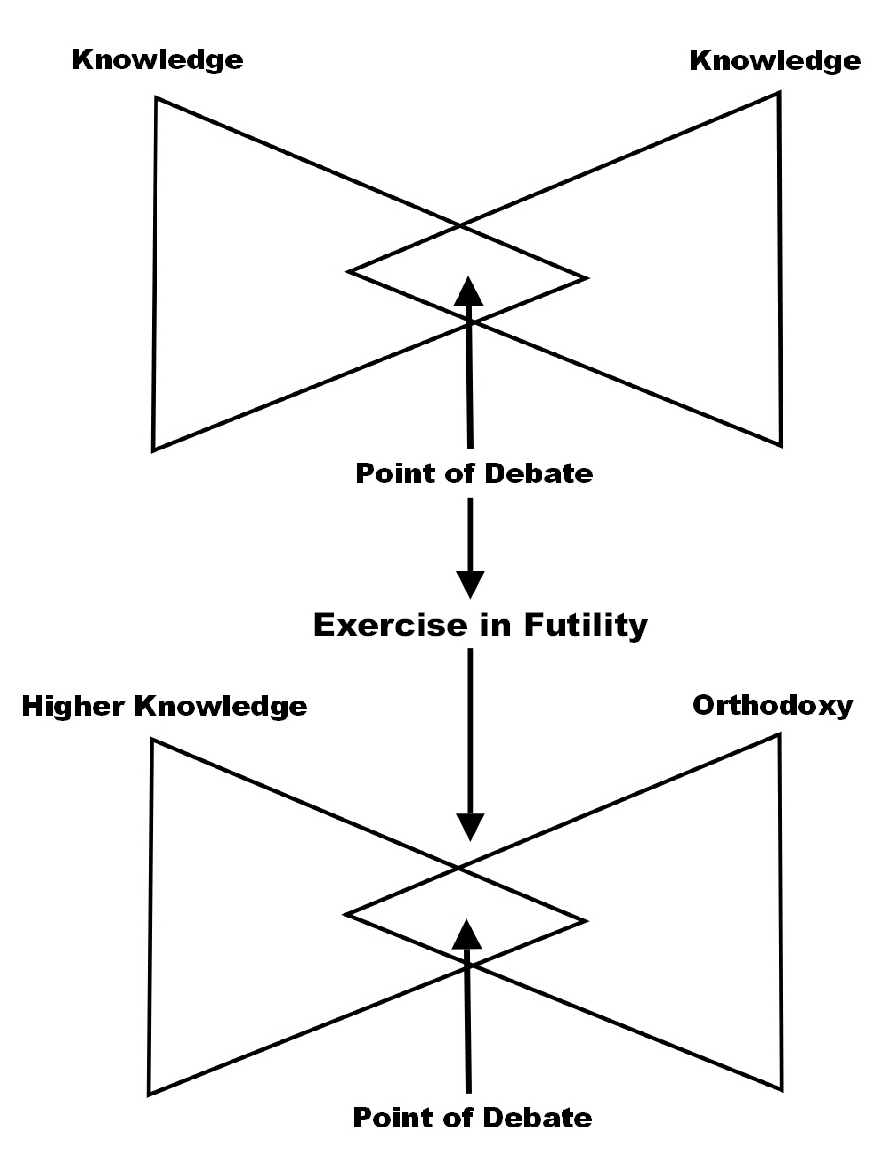
Not much ambiguity in that statement. Pretty clear on its face except for how one would apply it to real life. Again, many might scratch their head in regard to that statement, but proceed to let the theological orthodoxy that flows from it shape their life and thinking. At the point of debate with such people, their orthodoxed talking points will reflect the metaphysical premise. They will absolutely not be swayed in their thinking because they concede that they cannot understand the higher knowledge, and the authority of the higher knowledge is part of the orthodoxy.
Pause: I used to be involved in a ministry that evangelized Jehovah Witnesses. Debating the Bible with them led nowhere because their orthodoxy reinterprets all biblical terms and phraseology. When Christ is referred to, it is assumed that their presuppositions regarding Christ are the same, and they are not. Instead, we challenged their orthodoxy, i.e., the Watchtower publication. Likewise, let me reveal a concluding theme of this study: never debate the Bible with a Protestant; instead, bring their authority into question. Refuse to discuss anything else for it will be futile for reasons yet to be examined.
Let’s look at another statement from the New Covenant Theology camp:
At this time, resist the temptation to utilize subsequent passages to validate the meaning or to move out from the immediate context. Remembering that all exegesis must finally be a Christocentric exegesis.
Look for Christ even if He isn’t there directly. It is better to see Christ in a text even if He isn’t, than to miss Him where He is (The Biblical Theological Study Center: A Christo-Presuppositional Approach to the Entire Scriptures; Max Strange. Online source: http://goo.gl/5sGjP).
The question quickly becomes, “How can you see Jesus in every verse in the Bible?” This is where the Bible becomes a “meta-narrative.” That can mean, “grand narrative,” but in this case it means “metaphysical narrative.” The Bible is a narrative, or story that depicts redemptive reality. You will get confused unless you understand that the theory also posits the inclusion of multi-purpose perspectives into the metaphysical story (a story that depicts true reality). The text grammar doesn’t determine the perspective resulting in a particular objective outcome, but the assumed outcome determines the perspective. So, can “passages talking about incestuous rape” say something about redemption? Of course. In this example, the passage is not talking about Jesus specifically, but denotes why His redemptive works are needed. In some way, according to the prism, the verse always speaks of Jesus and His redemptive works.
This approach to interpreting reality (state of being, or metaphysics), what we call epistemology, plugs into the basic ancient philosophy of total inability. This proffers the idea that man cannot know or comprehend reality. The metaphysic follows: man dwells in a realm apart from true reality that he cannot comprehend. Secondly, somehow, usually via a theory of predeterminism, there are a select few that can ascertain truths from the other realm. Usually, the delineation of the realms is the material versus invisible with mankind residing in the material realm.
The Reformers recognized a reality that man functions in, but deemed it “subjective,” or shadowy. Focusing on this shadowy realm leads to despair. In the aforementioned foundational document of Protestantism, Luther contended that man’s material realm only feeds “the glory story,” or the story of man.
In Luther’s construct, ALL reality is interpreted through two stories: the glory story (the story of man), and the cross story (the story of redemption). Giving any credence to the material world or the belief that man can know the material world empirically only contributes to the story of man and his glory. Yes, man functions in this world, but it does not possess any objective wisdom that can bring true wellbeing. Only an ever-clearer understanding of the cross story can bring wellbeing.
What then is the cross story specifically? It is twofold: it is the holiness of God as set against the sinfulness of man. This is the only objective truth and reality that can bring wellbeing. The goal is a deeper and deeper understanding of how inept we are in every category of life as set against the glory and holiness of God.
Pause for main point: according to this philosophy, the sole purpose of the Bible is to lead us in seeing the cross story with more and more clarity. To the extent that we do that, we will have wellbeing. AND, to the extent that each individual lives according to the cross story, the wellbeing of society as a whole will increase. When Reformed folks talk about “transforming society with the gospel,” this is exactly what they are talking about. To the extent that the populous embraces the doctrine of inability, society will be transformed.
One reason for lauding this epistemology is unified agreement on interpretation. If every verse is about Jesus, there is no division in opinions. Secondly on this point, it gives Christianity a pass on defending inerrancy; e.g., narratives are not meant to be technical systems of theology that require consistency in logic. Thirdly on this point, if some sort of Christocentric conclusion is drawn from the text—it can’t be wrong. If the interpretation of the text somehow demeans man and exalts God, error is impossible.
Before we address the grammatical-historical approach to interpreting reality, let me add some thoughts to the redemptive-historical perspective. This perspective now dominates the institutional church. Just yesterday, I participated in a conversation on a social media site in which the following statement was made about Proverbs chapter 8:
The Old Testament reveals shadows of what Jesus Christ will be in the New Covenant. I can easily say that wisdom personified in Proverbs 8 is Jesus Christ.
If one reads Proverbs 8, the assertion that it is about Christ is beyond presumptuous at best. It is a complete rejection of the plain sense of the grammar; even in lieu of the personification being in the female gender.
Also, these two perspectives on reality are a salvific issue with the Reformed. A denial of total inability equates with the grammatical-historical view of reality which is supposedly an attempt by man to glorify himself by writing his own story. By believing that you can understand reality, you are in essence making yourself God.
The most common question is the issue of biblical imperatives that are clearly directed at mankind. This assumes that man is able to obey because grammatically, the commands are directed at him with a demand for obedience. But again, addressing these commands with the presupposition of total inability that equates with the redemptive-historical prism, the commands are supposedly meant to deliberately frustrate man and “drive him to despair of self-righteousness.”
The Reformed continually concede that the Bible states things in grammatical form, but that is always followed with the proper “gospel context” according to the redemptive-historical interpretation of reality. The classic example is this quotation from Neo-Calvinist Paul David Tripp:
….and the Bible does call us to change the way we think about things. But this approach again omits the person and work of Christ as Savior. Instead, it reduces our relationship to Christ to “think his thoughts” and “act the way Jesus would act.” (How People Change 2006, p.27).
Notice that Tripp concedes that the Bible calls us to do things according to the grammatical context, but goes on to say that is a denial of the gospel (omits the work of Christ as savior). On page 26 of the same book, Tripp calls obedience to the word of God a “behavioral approach” that “separates the commands of Scripture from their Christ-centered gospel context.”
Lastly before we move on, when one is able to wrap their minds around the redemptive-historical approach to interpreting reality, it will be recognized that this approach now saturates the Protestant institutional church.
What is the grammatical-historical approach to interpreting reality? As with the other prism, I am not going to elaborate on the “historical” part except to say that the redemptive-historical hermeneutic makes history part of the prewritten gospel narrative. History is simply the redemptive story playing out as scripted by God.
The political commentator Rush Limbaugh often notes that “words mean things.” This is a good working definition of grammatical-historical interpretation; it draws conclusions from a technical evaluation of the words in a sentence whether spoken or written. The many categories of language that give meaning are considered also, which speaks to the “historical” part of the term. Does the sentence mean the same thing today that it meant then? For instance a sentence written in 1940 might say, “Bob is gay.” History informs us of the meaning in that day: Bob is happy. Today that means Bob is a homosexual. The etymology of words and many other factors weigh-in, but all have this in common: they are empirical tools.
This interpretive method also assumes mankind is able to comprehend the realty he dwells in according to empirical observation and can draw conclusions on his own. Man has ability.
Pause: how did Luther get away with denying that mankind had any kind of ability at all? He chalked-it-up to man’s self-perceived ability that can accomplish things in the material world. These accomplishments are of no worth and only accomplish one thing and one thing only: they serve man’s lust to glorify himself. Luther believed that satisfaction from accomplishment was nothing more than sinful pride. To Luther, the only redeeming thing about the world was that heaven manifested its works on earth according to God’s sovereign will. If man lives life subjectively and professes that his evil “good” works cannot be distinguished from heavenly manifestations “experienced subjectively,” that is venial sin that can be forgiven. In accordance with authentic Reformed tradition, Luther believed the following: the belief that any man, including Christians, can perform a good work is mortal sin.
Therefore, the Reformed often define wisdom/knowledge according to two categories: “worldly knowledge” and “wisdom from above.” Sure, man can obtain worldly knowledge that improves his circumstances, but it is all prideful according to Luther. Wouldn’t this approach propagate a lot of death and misery due to a lack of science? Yes, but that was exactly Luther’s point. Many are perplexed by the embracing of ideologies that result in third world cultures, but those who are perplexed make the point for those in the other camp: what is the perplexity of the detractors? Answer: they are perplexed that other people do not lust after materialism as they do. Hence, third world cultures are often seen as being virtuous by the Reformed.
This is why Luther introduced suffering as a hermeneutic that interprets reality. There is true wisdom in the cross story because according to Luther, “all wisdom is hidden in suffering.” According to Luther, many reject this interpretation of reality and dub it the “foolishness of the cross.” Luther also stated that men call the good evil (suffering), and evil good (anything that prevents suffering). This is why Luther called reason an “ugly whore who should have dung rubbed in her face.”
The grammatical-historical perspective of reality assumes man can interpret his own reality, and the material world is not inherently evil. Believers and unbelievers share common realities that are simply practical and not evil.
Here is the challenge: to bring biblical knowledge to bear on grammatical-historical reality when the prevailing view of Protestantism has been the redemptive prism for hundreds of years.
But there is good news as well: the grammatical prism is what man utilizes intuitively. People assume they can interpret their own reality. Of course, the Reformed see this as the very problem.
Does this mean that grammatical-historical Christians should evangelize the lost world and forgo debate with Protestants? Yes it does, because it is a futile endeavor. You are trying to reach people who define reality itself differently. Protestants are redemptive-historical religionists.

Pope Francis’ Culture of Death is Looking a Lot Like Protestantism

“Dear Christian parents, will you save your children from this philosophical culture of death?”
The real difference between Catholicism and Protestantism is philosophical, and by no means a biblically based theological argument. If you want to discuss the difference in regard to orthodoxy for the serfs, there is no difference—both are progressive justification. Both propagate a need for the church to get people from salvation point A to salvation point B.
The functions of both camps are really determined by spiritual elitists who think they are above logic and all things material. Catholic philosopher kings tend to think knowledge beyond the material realm is within every being while Protestant philosopher kings believe all true knowledge is outside of the person.
Both appeal to Christ consciousness as the only immutable true form of goodness and truth. When it gets right down to it, you can barely slip a playing card between their definitions of faith.
Catholics seem to believe that the inner light gives everyone some potentiality for being good, while Protestants believe Christians can only see good and experience goodness that remains completely outside of them. They can experience it, but it is not a part of them. Man cannot be partially good enough to participate in his own salvation; it is a total work by God alone from beginning to end. Catholics believe that people can have enough goodness in them to participate in the finishing of their salvation.
In both cases, salvation is a process that needs the church to finish it. Catholics believe people can be made good enough to participate in the finishing while Protestants reject the idea that man can possess any goodness.
The point here is that they share a common belief that salvation is a process overseen by the church, and that affiliation with the church is efficacious to being saved.
Of late, and more and more, they also share a belief in Martin Luther’s doctrine of death. Both interpret all reality from the standpoint of the cross; i.e., “all wisdom is hidden in suffering.” Both see true discipleship as a complete emptying of self. Both see material as evil and only the invisible as good. Catholics believe inner goodness enables us to see ourselves as worthless, while Protestants believe faith enables us to see ourselves as worthless because we are worthless. Catholics believe good people will want to die to self and this material world, while Protestants believe we ought to die because we deserve nothing but death. But either way, it’s a culture of death.
Also, both believe that self-sacrifice shows forth the glory of the cross because all choices to sacrifice self are “living by the cross” or “walking according to the cross.” Self-denial and self-death demonstrate God’s cross-love and this is when the gospel is presented to people with power from on high. We hear this rhetoric in Protestant circles constantly.
So, what in the world inspired this post? Keep in mind that the following video is a Catholic production, and prepare yourself to be dumbfounded.
The same mentality can also be seen in Pope Francis’ collectivist views on economics and financial equality. Francis, who is loco popular with the Millennials, is leading a whole generation of our youth into socialist ideas. On the other side of the fence, the same. Collectivism gauges the total worth of people based on their ability to contribute to “the group” which is Platonic lingo for society at large.
Another aspect of death culture is the rising popularity of environmentalism among Catholic and Protestant youth. If you are a good Catholic, you know that your evil material body exhales carbon dioxide which pollutes the air, but the good trees absorb the carbon. If you are Protestant, you assume trees are better than humans because humans are totally depraved. In this video, it is suggested that we errantly worry more about ISIS killing people than saving trees.
The video was posted on my FaceBook page by a young Christian, and this was my response:
Well, wouldn’t worry about it too much. Apparently, shortly before the return of Christ there is plenty of earth left to destroy because God destroys it. I also find the notion that trees compensate for human pollution via breathing somewhat disturbing. It’s the idea that trees are important because they filter out the product of human living: trees good–humans bad. Fact is, what we exhale is only about 4% carbon. Also note the unqualified moral equivalency between those who kill people (ISIS) and those who cut down trees. lastly, if those who propagate this message really cared about the environment rather than their ulterior political motives, they would point to the science and example of Israel who have turned that desert terrain into a rich agriculture.
Dear Christian parents, will you save your children from this philosophical culture of death? This May, I will be teaching a series on Martin Luther’s Heidelberg Disputation on Blog Talk Radio. We will exegete this foundational document theses by theses. Let me also recommend our 2015 TANC conference where we delve into these issues as well.
paul

 Paul's Passing Thoughts
22 comments