How to Debate A Calvinist: Part 1 – By John Immel
The following is part one of a five-part series.
Taken from John Immel’s first session at the 2017 Conference on Gospel Discernment and Spiritual Tyranny
~ Edited by Andy Young
| Click here for part two Click here for part three |
Click here for part four Click here for part five |
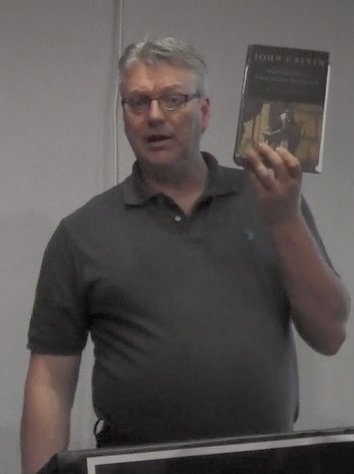
“Have you read Calvin’s Institutes today?”
(Watch original session video here)
I must confess, I really struggled this year with what I wanted to talk about. My brain bounced off about a dozen things. I originally thought I was going to dig deeper into the impact of John Locke on American civil government, American religion, the American Revolution. But at the end of the day it didn’t really catch and sustain my attention too much.
Then I thought I might actually discuss death and life and exegete the first four chapters of the book of Genesis. And that didn’t really stick with me very long. And I toyed with a half a dozen other things that just don’t bear mentioning.
Then about two or three months ago I was reading an interaction on Paul’s Passing Thoughts between Paul Dohse and a guy by the name of “GraceWriterRandy”. Now, trust me, this conference is not about GraceWriterRandy, but he is a fantastic anecdote. And so I decided to go ahead and talk about what he did and how that applies generally.
So here is what I noticed. And what so caught my attention was that Randy presumed to set the tone for the entire conversation, and frankly it didn’t matter what part of the conversation. He decided that he was going to dictate the moral and intellectual terms across the board. He reserved the right to make the discussion as narrow or as broad as he wanted.
And then what really bothered me is that everybody accepted the premise. Everybody tended to follow along. So if Randy reframed the conversation, everybody accepted the shift. If Randy argued scripture, everybody started stacking up scriptures. If Randy shifted to moral criticism, everybody started lobbing moral accusations. If Randy challenged a definition, everybody started parsing meanings.
And this is when I realized that I actually had my topic of conversation: Arguments with Calvinists, and trying to unravel the roots of their arguments.
And this is why no one ever gets anywhere in a debate with a Calvinist, because they let the Calvinist shape the direction of the conversation. People rarely ever challenge the Calvinist root assumptions. They let the Calvinist decide that it is their sole right to define all things moral, spiritual, and intellectual. And the foundation of all their arguments is the myth of their [Calvinists’] own authority and their entitlement to dictated force.
So I came up with a brief algebra of historic “Christian” authority:
The Algebra of Authority
Catholic Algebra:
Absolute Truth = Apostolic Authority + Scripture = Error Free Doctrine + Apostolic Succession = Papal Authority = Orthodoxy = Government Force
I want you to notice that the fulcrum of Catholic doctrine is Apostolic Authority PLUS Scripture. Everything else, how they get their doctrinal interpretations, is a direct product of this. Catholics had decided long ago that the reason that “Scripture Alone” got so much traction is because the Catholic church, specifically Papal Authority, decided that it was their job to interpret what it said. But at the end of the day, Orthodoxy is what determines Government Force. In other words, the Pope has the right to compel you to what you think.
Here’s what happened when Protestantism showed up:
Protestant Algebra:
Absolute Truth = Scriptural Authority = Predestined Elders = Error Free Doctrine + Ecclesiastical Force = Orthodoxy
It is very important that you see the relationship here. Predestined Elders inherit the implications of their own Absolute Truth. The function of Predestined Elders in the Protestant world is to compel you to think whatever it is they think they have the right to compel you to think.
This is crucial for you to understand: Authority = Force
Any time somebody says, “I am an authority,” what they are really saying is, “I have the right to force you to do something.” There is nothing elegant about it.
So then how do you debate a Calvinist?
The answer is: You challenge the roots.
This is why I insist, particularly with regard to GraceWriterRandy, no one ever successfully challenges the roots of the assertion.
 I have been talking about my web of tyranny now for the last six years. This is my contribution to the world of philosophy. I have identified what I believe are the five fundamental pillars of tyranny. It doesn’t matter what the ultimate end game is, all tyrannies have these five sub-categories or arguments: Dictated Good, Universal Guilt, Abolition of Ambition, Collective Conformity, and Incompetent Masses. The function of all these sub-categories is designed to create “Utopia,” or an alternate reality.
The reason I have rendered this as a web is because it is not specifically linear. In other words, there is not specifically a logical progression of one to the other. Instead there is a dynamic tension between all five, so all of the arguments act in harmony with all of the others to compel you down the path of this alternate reality; the right to determine some other realm of thinking.
What we have never really discussed is how the arguments fit into the web. On occasion over the last few years I have made reference to when an argument sits, but I want to have an overarching view. I want to start subdividing some of the arguments that you will hear. I’ve tried to pick archetypes of the arguments, and we will try to unravel them in later sessions.
If we are going to successfully debate Calvinist, we have to get good at identifying the foundational assumptions, because:
The Gospel According to John Immel, chapter 3:1-3
- All people act logically from their assumptions.
- It does not matter how inconsistent the ideas or insane the rationale. They will act until that logic is fulfilled.
- Therefore, when you see masses of people taking the same destructive actions, if you find the assumptions, you will find the cause.
Frankly, I don’t think we can have any better object lesson of this truth played out in our civil discourse than the logical assumption of a group of people tearing down historic monuments over wars that were fought long ago over offenses that are entirely manufactured. They are in actuality fulfilling a body of logic that produces some action.
Ideas are what drive human action. There is body of ideas, and a fundamental integration of those ideas, that produces your actions in any given day. This integration is called Philosophy.
Disciplines of Philosophy
– Metaphysics
– Epistemology
– Ethics
– Politics
– Aesthetics (art)
The roots are your metaphysical assumptions; whatever you accept about the nature of existence. Once you actually establish your foundation of metaphysical assumptions, you move to epistemology. That is what you believe your mind can understand. Once you identify what your mind can and cannot know, you move on to ethics. These are the moral judgments that you have about your actions; what is good and what is evil. This is how we define how we interact with other people through politics. Once man is able to establish these first four disciplines, he is able to refresh his existence with artistic expression. His art is a reflection of his most deeply held values.
The Orthodoxy Happy Dance
You might begin to talk to a Calvinist by presenting to him what Luther or Calvin said regarding a certain doctrine, and all is well and good until the Calvinist encounters something he doesn’t like. At this point he might respond by saying, “Well, Calvin might have believed that, but it was really the Synod of Dort that came up with this thing called T.U.L.I.P.” At this point they have made the Synod of Dort their authority over Calvin and Luther.
So then you proceed to point out a fallacy in T.U.L.I.P or the Synod of Dort, and now they might cite the Westminster Confession as being the final authority on the matter, rejecting the Synod of Dort. Notice what they are able to do. At any point in the argument that they don’t happen to like a given intellectual conclusion, no matter where it starts, they get to dance around between any given authority that suits them at any particular moment.
Take a look at the video below. This is an excerpt from a breakout session at the 2016 Cross for the Nations Conference in Indianapolis, IN. In this clip, you will hear John Piper make a reference to being committed to “the whole Calvinistic scheme.” Watch then, as Paul Dohse challenges Piper on the matter of election, Piper proceeds to engage in this orthodoxy happy dance.
Did you catch it? What you just saw Piper do is exactly what Calvinist do with impunity. They want the right to pick any given authority as their intellectual forbearers and then disown those intellectual forbearers whenever it suits their purpose. And this is why I call it the Orthodoxy Happy Dance, because orthodoxy at the end is this amorphous concept to which they get to appeal. They make an appeal to something that has no functional definition. At the end of the day, the real root of what they are advocating is their right to their own authority.
Notice that when pressed on the Calvin Institutes, Piper immediately became a Biblicist. What you will eventually realize, if you care to pay attention, is that Calvinists don’t read the Calvin Institutes ever. They read a few select excerpt here and there and then pretend that it is their intellectual pedigree, which they then believe gives them the license to tell you what to think. You peg them down on what they think and then they just jump to some other source of intellectual pedigree.
This sort of intellectual two-step is a direct violation of Aristotle’s Law of Identity; that A is A. Something cannot be “A” and “not A” at the same time. But with Calvinists, orthodoxy can be anything they want it to be. They have no intellectual integrity. They are not committed to anything specific. This is why every time you start debating Calvinists your conversations go nowhere.
Any time you have such a conversation, what you must do is make them responsible for their intellectual pedigree. If at any point they want to reject any point of Calvinism, they are rejecting the roots of orthodoxy. You will see this comment consistently:
“Calvinists don’t believe everything that John Calvin said…The Bible says blah, blah, blah…”
This is a glittering gem of colossal ignorance. It kills me every time I see it. I guarantee if you read anybody’s blog and you take somebody to task you will get a similar response. Pay attention to this. This is the formulation. They will identify themselves as Calvinists, and then they will pretend that they don’t believe what Calvin said. Suddenly they are independent thinkers and Biblicists. This is a gambit to what they believe they control – Biblical interpretation.
The next time you hear this line of logic, what you must say is, “So, you reject John Calvin’s ideas? Excellent! We agree on something. In your copy of Calvin’s Institutes, show me specifically to what you object.” This must be the only answer you will accept, but here is the thing; they will never do it. They will want to play their gambit of Biblical interpretation because they believe they own it.
Your rebuttal when they go back to the Bible, you say, “So, you are really saying that Calvin’s ideas are not in the Bible, right?” If they have to constantly run back to the Bible, then that means they cannot find those ideas in the Calvin’s Institutes. The moment they concede that point, then the next question you ask is, “So that means that Calvin’s teachings are unbiblical, right? That would make him a heretic, right?” Follow this progression of questioning, and don’t let them leave this point! They must commit to what they are advocating.
You want to make sure they can never escape either an acceptance of Calvin or a rejection of Calvin. They must either accept that there is a synonymous relationship between Calvin and the Bible or there is not one. The moment you drive that wedge they are stuck. They use Calvin to establish their historic pedigree – “I have authority because I believe what all these other historic thinkers think.” Yet at the same time they want to turn around and claim intellectual autonomy whenever they choose. So which is it; historical authority or your own intellectual authority? That is the fulcrum of the debate.
If the truth is defined as “authority,” then there is no such thing as “I think…” The assumption is Authority = No Doctrinal Error; that the only way you can hedge against doctrinal error is to have authority. So the reason they argue “authority” is because they insist that they are the ones who get it all right. But the moment you confront them with something that isn’t right, they want to renounce the very thing that gives them authority. This is what you can never let them get away with.
The real argument here is that they have abandoned the right to the Aristotelian Law of Identity. They are constantly trying to say that “A” can be “B” and “B” can be “A”. They want to have a “both/and” reality.
- Both final authority and error-filled humans.
- Both defender of orthodoxy and an individual thinker denouncing Calvin’s doctrine.
- Both herald of God’s mystic revelation and defender of “objective” truth.
- Both lowly unoriginal mind slave and epitome of rational judgment.
- Both champion of God’s hard truth and pitiful victim of undeserved criticism.
The way to defeat Calvinists is to deny them their authority and hammer away at reality. Reality is their enemy. The reason they engage in the Orthodoxy Happy Dance is because the moment they are confronted with the specifics of history they are toast.
But be forewarned:
- Try to rebuff a Calvinist’s right to define all things and they pretend that no is their equal.
- Try to reject a Calvinist’s monopoly on moral virtue, and they snarl that no man is righteous.
- Try to refuse to let a Calvinist define reality, and they resort to force.
…To be continued
| Click here for part two Click here for part three |
Click here for part four Click here for part five |
Inside the Mind of Tyranny
 Paul,
Paul,
My intent is to be helpful. To that end, you misspelled ‘definition’ in the title of your blog.
It seems to me that the ‘church gospel’ you’re fighting against doesn’t exist. You’re trying to catch people in their words through specifically formulated questions which creates the impression to the hearer / reader of your blogs that there is apostasy where there is none. Please stop. 2 Timothy 2:14 – “Remind them of these things, and charge them before God not to quarrel about words, which does no good, but only ruins the hearers.” There are CRYSTAL CLEAR forms of apostasy all around us (prosperity gospel, ‘New Apostolic Reformation’, etc). Why don’t we battle against that together, OK?
Scott, I am only replying for demonstrative purposes. At least in regard to myself, I have a strong tendency to interact with people based on my assumptions. And what are those assumptions? That people can be persuaded by sound logic. Actually, Scott, your email, this email, may be a historic event in my life because I am finally going to put feet to what I have seen for more than ten years now, but have never acted upon a final resolution. And what is that resolution? Tyrants can’t be reasoned with, and where applicable, they must be defeated. Once someone is defined as a tyrant, you avoid them, but if they are somehow interfering with your endeavor to accomplish the things that are self-evident, all resources must be invested towards their defeat while any attempt to persuade them is a fool’s errand.
Why is this, and how did I reach this and other related conclusions? By reading a lot of Martin Luther. The author John Immel inspired me to understand philosophy and gave me some important first principles, but Martin Luther, the consummate tyrant of the ages, is the one who enabled me to put it all together. And as demonstrated in your email, good people must understand that at times they are dealing with people who view reality differently. You can’t persuade someone who doesn’t share your perception regarding how the world works.
Let’s start with you correcting my grammar. This is such a basic, and telling principle. But first, let me explain something. I am not a laymen, that’s a bad word to use and feeds a whole church worldview that must be completely dismantled for saints who want to a leave a decent legacy in this life. The Bible makes no distinction whatsoever within the body of Christ concerning vocation or so-called “bi-vocational.” I am an elder in the body of Christ, that’s my gift, and I got it from the Spirit when I was born again. And by the way, because of that, I don’t need Al Mohler or any other disgusting stuffed shirt to give me permission to practice my gift. With that said, I practice that gift as an elder of this ministry, I am going to nursing school, and my wife and I are performing more ministry in the life of others than we ever did being under the thumb of the church lie. Hence, when someone like you, a typical overpaid sycophant of the church industrial complex, who has paid staff to boot, points out one of my errors in the midst of a dizzying life effort, it is offensive, but even more offensive is the motive behind the correction.
Such a tiny little detail, but really a gargantuan principle. In the Bible, a very important truth about sin is revealed; it’s not just doing naughty things that God disapproves of, sin seeks to control others. And the Bible is very specific about how that process works. Sin crouches in hiding waiting for a reason to condemn, and when everyday mortal weakness produces the reason, or outright sin, sin pounces with condemnation. Sin really doesn’t care if it was an honest mistake or outright sin, the goal is to use condemnation to enslave. That’s why slander is often used to condemn people; if said target doesn’t produce a reason, one will be made up. It goes something like this: “See what a loser you are? Hence, you need someone like me that is better than you, smarter than you, more moral than you, to rule over your life.” For ten years I have watched this in our marriage counseling: marriage counseling is two people bringing their condemnation lists to you as a case for why one should be able to rule over the other. The diminishing of other people’s self-esteem is also critical to controlling them which is behind the doctrine of total depravity…obviously. Once you understand this dynamic, you see it everywhere, particularly when a women shares with me that her husband says things like this: “You couldn’t make it without me.” This ministry has set several women free from financial slavery and we are happy to do it.
Love makes a legitimate marriage, not some law. Staying in a situation where there is no respect or love whether a job, a church, or a marriage is typical under-law thinking. Love fulfils the law, not law-keeping for the sake of law-keeping. Recently, in a meeting with a runaway slave wife, her tyrant husband, and the tyrant’s pastor, said pastor stated that the goal of the meeting was to “maintain the marriage covenant.” I saw straight away what the pastor’s agenda was going to be: husband confesses sin; wife confesses sin; and since “Christians” are obligated to forgive each other “the way we have been forgiven” the runaway slave wife must now go back to the tyrant husband. Like the church, such husbands refuse to repent of the essence of sin; a lust to control others through condemnation. It’s no accident then that Christ didn’t “come to condemn the world, but to save it.” No accident then that “there is now no condemnation for those who are in Christ.”
Again, this dynamic can be seen in the smallest milieus of life to the most epic examples of politics and statecraft. So, why did you correct my grammar? It goes something like this: “look at you, you are contending against men of God, men of renown (you can’t see it, but I am laughing right now), and you can’t even spell correctly!” Nice try Scott, but that doesn’t work on me. The most egregious example of this is ABWE’s public letter of response to the “Missionary Kids” who stood up to a church coverup of unspeakable crimes for something like 40 years. In quoting what the MKs had stated in a formal letter to ABWE previously, one or more “[sic]”s were included to indicate grammar corrections. You see, what had happened to the MKs was nether here nor there in light of the so-called greater church good, and leaving no attempt to regain control of the situation untried, they sought to shame the MKs by pointing out their supposed intellectual anemia. As an aside, for this reason and a book full of others; namely, our ministry’s latest publication, I believe the church to be utterly evil. And why is it evil? Because of its false gospel and skewed version of reality.
Now let’s look at that version of reality; the worldview of tyranny. It’s the oldest and only religion. All other religions flow from it; all politics flow from it. Of course, my illustration is a crassly simplistic version, but conveys the general idea. The material world and everything that can be ascertained by the five senses is evil. The invisible world and all things that cannot be ascertained by the five senses is good. The good, having grace and mercy, decided to save mankind. How all of this supposedly came about is the eschatology of philosophy and will not be included here. In doing so, the good chose those with special wisdom to lead the unwise to the good. And what is that wisdom of the wise? The knowledge that mortal man cannot know anything including reality. Wisdom is knowing that man cannot know. Believing that one can know is the height of all arrogance. Now, this doesn’t include “practical knowledge” that makes things work in the evil material world, and Luther, in the tradition of Dualism, divided that knowledge into “wisdom from above” and “wisdom from below.” Luther’s specific designation was his “Theology of the Cross” defined by the “glory story” versus the “cross story” and Christocentric philosophy which I have written on extensively and will not continue to do so here.
Supposedly, the greatest danger to the survival of mankind is mankind thinking that it has value and can know. The wise must therefore save humanity from itself. Hence, Plato’s philosopher kings, warriors, and producers. The warriors enforce the wisdom of the wise appointed by the good to save mankind. Until the Enlightenment Era produced Americanism, world history was little more than utter darkness accordingly. And what does this have to do with the rest of your email? Pretty much everything. Your email is a glaring example of what I have experience incessantly for ten years when dealing with church advocates. Regardless of what exemplifies our articles and books; ie., systematic arguments comprised of several points of persuasion, those are all summarily dismissed in exchange for some authoritative unction. In the article you write about in your email, you do not supply one counterpoint to the points made in the article. Why? Because the article uses logic and reason as a means to persuade, and the ideology of the tyrant rejects that view of reality out of hand. This is a pattern this ministry has seen over and over and over again for ten years. Salvation comes by doing one thing and one thing only: obeying the philosopher kings, or as Al Mohler states it, “those appointed by God to save his people from ignorance.” He was speaking of pastors. Therefore, dear tyrant, since you are appointed by God to save me from ignorance (because others paid for you to obtain a seminary degree and Al Mohler therefore christens you as such), why would any argument by me have any validity at all in your mind? It wouldn’t.
Like the so-called “looney left” in politics who are not looney at all and know exactly what they are doing, your lame arguments merely cover for the fact that you don’t think anyone who disagrees with you is in touch with reality. Even though I articulated the Protestant gospel in painstaking detail and backed it up with a Protestant holding a Doctorate degree in the discipline, you claim that no such gospel even exists! Does this not make my point in no uncertain terms? You go on to name the real apostates, but based on what? An objective evaluation of their doctrine? No, based strictly on your supposed God-given authority. It is also interesting to note that in our dialogue with parishioners, they respond in the exact same way; they see themselves as speaking with authority because they are repeating what their pastors tell them. Consequently, they also reject all reason out of hand.
This is my advice to all: when giving an account of the sum and substance of your life to the one who granted it to you, no one will be standing there in your defense, not even Christ. In this life, that is the only mind that can be yielded to that will make a difference. Even He seeks to persuade you, and not control you. Obviously, if Christ wanted to control you, He would. He is the only mediator between God and mankind, and when you die, His mediation role is over. “This is my Son, hear ye Him.” Read the Scriptures for yourself, what does Christ use to persuade? Over and over again; reason, period.
The apostle Paul asked rhetorically to the ekklesia at large: “What saith the Scriptures?” Not, “What saith the philosopher kings…and queens?” Christ said, “Consider carefully what you hear.” Clearly, the onus is on the individual alone. All people will stand before God as individuals and that’s where the responsibility ends.
In all life matters, identify the tyrant and avoid them. Do their offers result in you depending on them? Do they lift you up and bolster self-confidence or make you less confident? Do they advocate a forward look towards love or a backward look towards sin? Avoid them in your journey, and if they hinder your journey, defeat them, but waste no time in reasoning with them; it only delays your own journey towards God.
paul
The History of Western Philosophy and Its Societal Impact on the Church – Part 1
The following is part one of an eight-part series.
~ Edited by Andy Young
| Click here for part two Click here for part three Click here for part four |
Click here for part five Click here for part six Click here for part seven Click here for part eight |
 We have actually talked many times before about the challenges before us. I understand our obsession. The scope of this issue is vast. It seems a little conspiratorial and a little overwhelming to put it in those terms. When we start talking about Plato and him being a pagan and what John Calvin preached, it starts to come off as if we’re trying to find the boogie man in bad places.
While our challenge is lofty, it is much more personal, because our challenge deals with what happens in the pews. You show up at church, you hear doctrine, you get some people that shake your hand and look longingly into your eyes and say, “you belong.” That is hard to resist. Most people go to church because their kids have a place to stay, or they like the music, and they genuinely like the people. But that’s not where it ends. It is personal because at some point you may have ended up on the wrong side of the pastors. Something happens, it doesn’t matter what, but originally you have been told that you are part of this grand party, and then you find yourself under scrutiny, and suddenly the marketing and packaging is all wrong. You thought you were right to object or to challenge or to just be you, and one day that just was no longer so.
The problem that you have is that you look at your Bible and show supporting references for your objection, but you are told that’s not what that really says, and it really doesn’t matter because you should be submitting to some authority. Suddenly, you look around and life is now insane. All those people that hugged you and said “ye, verily, we are glad you are with us,” have now turned on you in less than a minute. All those friends you had, where’d they go? They have no interest in what you have to say. And the crazy part is the more you try to justify or to explain your position, the worse it gets. Without fail they accuse you of being “defensive”, and of course only “defensive” people are sinners. If you were really humble you wouldn’t dare walk down this line of self-defense.
You look around and you are bewildered. After you wade through the thousand and one emotions that have come out of you in ways that you could not have begun to fathom, you stand back incredulous and wonder, what the heck just happened? “God’s church is not supposed to be this way,” we tell ourselves. And yet here we are, dead square in the middle of a conflict that is almost unintelligible.
Of course these types of experiences within Christianity have been going on for generations. But in our modern age of blogs and the internet, we now have the ability to start comparing notes. Individuals are suddenly able to tell their story about what happened to them, and somebody else will read that and affirm those experiences with their own. As the solidarity among hurt and abused individuals grew, one day we stopped and said, wait a minute, there is a systemic problem here.
This is where we sit within Christianity today. We know we have a conflict, but we haven’t been able to identify the problem. The explanations run the gamut from:
“Doctrines of men” – Well, all doctrines are doctrines of men. God does not come down here, stand up in the public square and start talking. It’s all doctrines of men. Everybody is standing around all the time talking about the content of what they think and proclaiming that in general to the masses. What they really mean is it’s not authentic. If it were true doctrine we wouldn’t have a problem.
“God is testing you” – This one is fabulous. Basically what you are saying is the manifestation of reality is God’s intent. So why then are you seeking to solve the problem? This is how God means it to be.
“All churches have problems” – This a neo reformed classic. They like to pretend that people fussing over the color of the carpet is somehow the same thing as a child being molested and the pastor covering it up and refusing to let the parents go to the authorities. As if there is a moral equivalency.
“We’re all just sinners” – The tried and true “get out of jail free” card. We can’t really fuss and moan about the fact that somebody’s done bad things.
“It’s a failure of ‘polity’” – If you had the right government structure then these bad things wouldn’t happen because we’d have checks and balances, and of course Christians have come to believe that the nature of checks and balances is really designed to restrain our sinful appetites and desires, and so that’s what would make a better government structure that would prevent these bad things from happening, never once realizing that all governments are always in service to a series of values. And so it doesn’t matter the structure you put in place, at the end of the day, if you have the same values, you will continue to govern towards those values.
“If we just had the right people” – Which is ironic considering we assume the problem is the doctrines of men. By definition, if we’re just looking for the right person, what we’re really saying is there is an idealized person out there who somehow magically gets it all right and finally gets to come down from Mt. Sinai and tell us the truth. Well, that’s nutty, because that never works.
The one thing we never challenge is the doctrine itself. There is something wrong with that picture.
Some of you have experienced this tumult. You started looking for answers, and you’ve heard all of these points belabored in endless cycles – if we loved more, if we prayed more, if we prayed louder, if we prayed quieter. Finally you heard somebody say, “No, it’s not any of that. It is the doctrine.” You heard a man named Paul Dohse say, “No, it’s the doctrine.” You heard a guy by the name of John Immel say, “No, it’s the doctrine.” That’s the problem.
And it’s not just a problem. It is EVIL!
That one is a big one for a lot of people, because they want to sustain some kind of moral equivalency between doctrines, as if to say, well, it’s got some good ideas, but, you know, there are some things here that are good, and these guys aren’t all bad from top to bottom. And so we want to parse it out. We don’t want to take a position on the content of what they teach. The doctrine is evil. It is fundamentally and substantively hostile to human existence.
But this leads people to a serious problem. If it is the doctrine, if Calvinism is error, [gasp!] how can that be so? It’s orthodoxy. This is what the church has believed for 500 years, or at least the Protestant church. We would like to pretend that we’re different from the Catholics, but hey, how can you debate orthodoxy? Reformed theology is sacred. John Calvin and Martin Luther, are you kidding? They are at the base of God’s left hand, right beside Peter, James, and the other guys. How can you possibly begin to challenge who these guys are? The reformation, my goodness, if it hadn’t been for those guys we’d all still be Catholics. And those dastardly Catholics, my goodness, they’re just corrupt, and the Pope is of the devil.
Anybody ever heard that before?
Then you have to ask yourself, if that is the problem, if the Reformation is not what we’ve all been told that it is, and the people at the top of the intellectual food chain are not who we’ve been told they are, then we have to ask the really hard question; why has this happened?
Here is my challenge to you. Take a look in the mirror. You are the reason this happens. It isn’t any more complicated than that. Now you might say to me, but isn’t that what everybody else has told me? Everybody else told me that I was a sinner and that I was the reason there was this conflict. Yes, but this isn’t for the same reason.
To understand what really happened we need to start at the beginning. But before we can start that the beginning, people must take responsibility for the content of their own mind. I will bet money that very few people have ever heard a preacher say that before. A preacher might tell you to “think”, but maybe not so much. Here’s the thing. Paul and Susan Dohse and I can detail for you the list of doctrinal failures. We can detail all of the root issues and all of the spiritual manipulations. I have been thinking about these issues for almost twenty years of my life, so I have the ability to do this. But until you personally are committed to the content of your own mind, your own life, and your own purpose, nothing I say here will matter.
Here is why.
 At the end of the day, if you’re not willing to take responsibility for the content of your own mind, your worldview exempts you from everything that comes after that. You have capitulated. You have tossed up your hands and said, oh well, it’s not that big of a deal. At some point you’ll let your brain go tilt, you’ll shrug at the complexity of the world, and toss up your hands in surrender, and insist that Jesus’ message is just simple. All this “brainy” stuff is just added torture for your peaceful soul.
This sounds like a “churchy” answer. You will console yourself for a while, evading the reality that you are letting other men fill the blanks of your own mind. Eventually you will find someone else that will take up the cause of organizing your life yet once again. And not too long after that you will be confronted with the very same spiritual tyranny, the very same social conflicts, the very same church dynamic.
But maybe this time it’s worse. And maybe this time, the spiritual/church tyranny is actually joined with political power. Somehow the guy in front of the pulpit managed to get himself elected to office. And now, not only does he have a body of doctrine, but he has guns.
In Christianity we have failed to understand that government is force. Polity is force. When people start talking government, when people start talking about passing laws, what they are really saying that what they are entitled to do is force you, to compel you, to bring violence against you to bring a desired outcome. And then tyranny will have been joined with political power. And liberty will be dying under its assault.
What will you do then?
The options are very limited because you have already abandoned self-directed thinking. The only thing left will be a wail and a tumult of gnashing of teeth that men are just sinners and who can save us? You will toss up your hands in despair, retreat into some church where the intellectual barricades rule over the doors and you can fortify against the evil.
This all sounds very grim. That course of non-action is a dead end, and it has only one outcome. And that outcome is, you deserve what you get.
You are the reason tyranny happens, from top to bottom, throughout history. Not because you are a wretched old sinner who fails to submit to authority. The reason your interpersonal church relational problems happen is because you refuse to reason, because you refuse to be an independent mind, because you refuse to be an individual.
Now, how many people does that statement make nervous?
How many of you cringe at the notion that you should be more individualistic? How many of you think that having “ego” is deviant sin? How many of you equate being individualistic with “selfish”. How many of you equate selfishness with the greatest expression of moral failing?
 What if I told you that your reaction to self and “selfishness” and individuality and ego is by design? What if I told you that despots and tyrants throughout history the world over have specifically set out to persuade all of humanity that the problem is always the individual, and the only solution to the problem is sacrifice?
Disturbing thought, right?
So now we get to think. I need to bring you up to speed on some basic thoughts that most people have never heard before.
The Gospel According to John Immel, chapter 3:1-3
- All people act logically from their assumptions.
- It does not matter how inconsistent the ideas or insane the rationale. They will act until that logic is fulfilled.
- Therefore, when you see masses of people taking the same destructive actions, if you find the assumptions, you will find the cause.
Here is the underlying logic.
Verse 1 – Assumption + logic = action.
Verse 2 – Faulty logic, erroneous rationalizations, are still ideas that flow from one to the next, until they get to an outcome. That’s important. Just because something is “rational” doesn’t mean it’s not wrong.
Verse 3 – Mass action + destructive outcomes = common premise.
I want you to see the specific relationship between actions and ideas. I submit that man, as a rational, cognitive being, is specifically designed to operate from this standard. What makes man utterly unique in the world is his ability to cognitively and rationally approach the world. He is the only creature that does not automatically by nature adapt to an environment. The exact opposite is true. Man must adapt his environment to himself, and the only way he does that is by reason.
Once you understand that the nature of man’s existence requires him to integrate ideas, then it becomes amazingly simple to understand that the integration of ideas is what he is always after. He’s always trying to figure out how to take his ideas and put them together.
Unfortunately, most people have a big basket in their head, and they toss in this idea and that idea, and they shake it all up, and from time to time they will pull an idea out of this basket and decide, this is a good idea, and then they will act on it. It gets a little dangerous when they start pulling out two or three ideas. It doesn’t matter if they are mutually exclusive, they will try to force them together. They then look at the world, and it still makes no sense to them. Never once has it occurred to them to go back and check their premise; what is your assumption?
This study is called philosophy. Of course when I say “philosophy” in the context of Christians they immediately think of Paul’s major condemnation of “vain philosophies”, and they start to tune out because they think they have an intellectual “get out of thinking free” card.
Disciplines of Philosophy
– Metaphysics
– Epistemology
– Ethics
– Politics
These four studies drive all of human existence. The nature of existence is called metaphysics. How we know what we know is called epistemology. How we value what we know is called ethics. And how we interact with people is called politics.
Each of these disciplines of philosophy is a function of the previous one, forming a progression of thought. What you assume about man’s existence will ultimately impact what you believe man can know. What you believe man can know will ultimately impact how you think he should ethically act. How you think man should ethically act will ultimately form your government structure.
We can debate endlessly about the issues that create the problems within the church or fixing those problems with the right government structure, but government structure is always in service to ideas. This is the reason why. Politics is at the end of a philosophical progression of thought that begins with a metaphysical assumption.
Philosophy is the broad study of how man integrates his ideas. It is how we know what we know. It is where ideas come from, their objective value, and how those ideas impact our human interaction. With this in mind, you can grasp the implication of what I’m saying in the Gospel According to John Immel:
The Gospel According to John Immel, chapter 3:1-3
- All people act logically from their assumptions.
- It does not matter how inconsistent the ideas or insane the rationale. They will act until that logic is fulfilled.
- Therefore, when you see masses of people taking the same destructive actions, if you find the assumptions, you will find the cause.
This is why when you go to church you end up in the exact same spot. You find masses of people taking the same action. If you find their assumption, the roots of their ideas, you will find the cause of their actions.
So my goal last year at the 2012 TANC Conference was to introduce the systemic nature of human thought; to illustrate how this system dynamic impacts human action. Without this mindset it is almost impossible to understand what is happening. To be sure, without this intellectual tool, no specific doctrinal discussion will matter. It won’t matter how much we dissect sanctification, justification, and the centrality of the cross. It won’t matter how many scriptures we stack up in service to our pet doctrines. It won’t matter how much we rail against misplaced church government.
Ladies and gentlemen, that has been done over and over, council after council, synod after synod, internecine fight after internecine fight. And yet the church is a slow-motion train wreck of tyranny and counter-revolution. If you make even a cursory study of the evolution of Christianity from the mid-second century to about 1200 it is a laundry list of bloodshed and tyranny and counter-revolution.
To put this into “church speak”, church history is an endless cycle between legalism and revival. Revival in this instance is nothing more than the return of life, to revive what is actually dying, and the body politic continues to die because it keeps cycling through these same tyrannical ideas. But we have never broken out of the cycle because we have never understood the method underlying the madness.
“All men can see the tactics whereby I conquer, but what they cannot see is the strategy out of which victory has evolved.” ~ Sun Tzu, The Art of War
The tyrants and the mystic despots of the ages have been winning because we have never once challenged their assumptions. In the 21st century we are once again rolling through a philosophical cycle that has repeated itself over and over in history. This cycle is of course why Christians are living through ever-increasing manifestations of abuse.
People are confronted with the same tyranny that our forefathers set out to resist. As of now, the only real response has been to toss up our hands and look mystified at the stars. We know we are impotent. We remain impotent, caught in the cycle of doctrinal fight, church splits, and human tragedy. All we can do is wail about human depravity and mumble feebly about needing more faith. Pray harder. Sacrifice more.
Blah, blah, blah.
I tell you the truth, the answer to why this is happening is as easy to diagnose as the common cold. But the first thing we must do is dare to take responsibility for the content of our own minds. Mystic despots have ruled the world with portents of disaster for anyone with the ambition to live life beyond the substantive, beyond the mediocre.
Here’s where you come in. Autocrats rely on being able to compel outcomes because no one opposes their ideas. Tyrants only succeed when men refuse to think.
In then next session we are going to learn how tyrants have been so successful at waging war against liberty. Put on your thinking caps. We’re about to jump into the deep end of the pool.
~ John
| Click here for part two Click here for part three Click here for part four |
Click here for part five Click here for part six Click here for part seven Click here for part eight |
“Godly” Philosophy
Originally published March 14, 2015
 I used to be in the camp that views “philosophy” as “worldly”, “man-centered”, “evil”; all of those things as juxtaposed with “Biblical wisdom”, or “scriptural”, or “God’s Wisdom”. After all, it seemed to be a reasonable conclusion when confronted with verses of scripture like:
“Where is the wise? where is the scribe? where is the disputer of this world? hath not God made foolish the wisdom of this world? For after that in the wisdom of God the world by wisdom knew not God, it pleased God by the foolishness of preaching to save them that believe. For the Jews require a sign, and the Greeks seek after wisdom: But we preach Christ crucified, unto the Jews a stumblingblock, and unto the Greeks foolishness; But unto them which are called, both Jews and Greeks, Christ the power of God, and the wisdom of God. Because the foolishness of God is wiser than men; and the weakness of God is stronger than men. For ye see your calling, brethren, how that not many wise men after the flesh, not many mighty, not many noble, are called: But God hath chosen the foolish things of the world to confound the wise; and God hath chosen the weak things of the world to confound the things which are mighty; And base things of the world, and things which are despised, hath God chosen, yea, and things which are not, to bring to nought things that are:” ~ 1 Corinthians 1:20-28
What you choose to believe is a philosophical statement about what you believe about reality. Everyone has a philosophy whether they realize it or not. You cannot escape it. So to say that “philosophy is evil” is really a philosophy itself. It therefore unwittingly becomes its own metaphysical statement about man. If philosophy is evil, then man is evil because man has no relevance apart from his beliefs about reality. It should come as no surprise then that reformed theology holds such a metaphysical view of man with regard to its doctrine of total depravity. But that’s another topic altogether.
It is ironic that I had to get out of the church before I finally began to better understand just what the apostle Paul was addressing here with the Corinthians. Religious despots don’t see themselves as having “worldly wisdom”, but yet they are the very ones that Paul is criticizing. Religious orthodoxy is the epitome of “man’s wisdom”; crafted by the scholars and academics and elites who spend their years in seminary and other institutes of religious training for the so-called “right” that they think they have purchased for themselves in order to rule over the unenlightened.
I have come to realize that the notion of philosophy being evil is nothing more that organized religion’s attempt to keep man beholden to it; to keep him enslaved; to keep him from thinking. Those of us who call ourselves “Christians” must begin to shed this false notion of philosophy. Philosophy deals with things such as reality and the nature of existence. To believe God and what He tells us in His word is our own philosophical statement. It stems from our rational, thinking mind; a mind that is part of a creature made in the very image of God, made for the purpose of thinking and reasoning and coming to rational conclusions. I implore believers everywhere to consider what God Himself has told us: “Come, let us reason together.”
Andy
The Philosophy of the Rich Young Ruler
Originally published January 25, 2017

“…he went away sorrowful…”
“And, behold, one came and said unto him, ‘Good Master, what good thing shall I do, that I may have eternal life?’ And [Jesus] said unto him, ‘Why callest thou me good? There is none good but one, that is, God…’” ~ Matthew 19:16-17
To say that something is “good” is to refer to its intrinsic value or worth. When God said in proclaiming His creation “good” was that it had value, and not just value to Him, but value in and of itself.
That doesn’t mean that something that is “good” cannot be used for evil intent, and even if it is used for evil, that doesn’t change its intrinsic goodness.
Now contrast this with every philosophy, from Plato to Immanuel Kant, where the chief aim is the destruction of man. Such a philosophy was held by Philo who had a great influence on the Pharisees and Jewish religion, incorporating it into Jewish orthodoxy.
Given this understanding it is easy to see why Jesus would say what He said to the rich young ruler, who would have been a student of this philosophy under the Jewish orthodoxy of that time. Jesus was not making a definitive existential statement about man. He was sardonically pointing out the rational inconsistency of the rich young ruler in calling Jesus “good master” when his own philosophy taught that man is not good.
Nevertheless, unregenerate man is not under condemnation because he has somehow lost his value in being “good.” He is condemned because he is under law. The reality that God made a way for man to be reconciled to Himself is evidence of God recognizing man’s continued “goodness”, his value. That man in the weakness of flesh from time to time may break the law is not somehow indicative of his lack of “goodness”. This is why the Bible states that righteousness is apart from the law. Any attempt to define righteousness by some standard of law-keeping (even if Jesus “keeps the law for us”) is placing man right back under the very same law that can only condemn. The only way for man to escape condemnation is for him to get out from under the law.
This is exactly what the new birth accomplishes. It makes man a truly righteous being who is the literal offspring of God the Father, and one who is no longer condemned by the law because he his a new creature that is not made under the law. The old man who was under the law is dead, and you can’t condemn a dead man. This is the very reason why the apostle John can state unequivocally and without contradiction:
“Whosoever is born of God doth not commit sin; for his seed remaineth in him: and he cannot sin, because he is born of God.” ~ 1 John 3:9
~ Andy

 Paul's Passing Thoughts
1 comment