Holy Schmoly…Who Needs Holiness When You Have Authority?
 Afshin Ziafat holds the title of “lead” pastor and “elder” of Providence Church in Frisco, TX. He was part of a panel discussion along with Conrad Mbewe, John Folmar, and moderated by Kevin DeYoung at the 2016 Cross Conference in Indianapolis, IN. The clip below is an excerpt from that discussion. It happens pretty early on. There are several examples I could have used, but this particular exchange really caught my attention.
Here is a transcript of the above video clip.
KEVIN DEYOUNG: So let’s talk about some of these terms that are often given to describe church. This is sort of Ecclesiology, the study of Church 101. So sometimes there is a reference made to the four attributes of the church. One, holy, catholic, apostolic church. So just jump in who wants to just, 30 seconds, what does it mean, “one church”?
JOHN FOLMAR: Unified in the gospel. United to Christ by the power of the Spirit, and thus united to one another.
DEYOUNG: Okay. So Ephesians 4, there is one spirit, one body, one Lord, one baptism. What about “holy”? Afshin?
AFSHIN ZIAFAT: Um, I’m not sure exactly what you’re wanting from that.
STOP RIGHT THERE! HUH?
I’m not the smartest person in the world, and granted, as I go back and read the transcript, DeYoung doesn’t do a very good job at articulating what he’s asking, but even I understand the question. DeYoung wants to know what it means when we say the church is holy.
Yet here is a man who is supposed to have an academic and theological pedigree which supposedly qualifies him to sit on this panel of “experts”. Here is a man who is supposedly responsible for the “sheperding” of hundreds if not thousands of people every week. Here is a man to whom a room full of young people are looking for guidance and direction, a man whom people are supposed to submit to his “authority”. And yet Ziafat says he’s not sure what DeYoung is wanting? Does he mean he does not know what it means to say the church is “holy”, or does he not even know the definition of holy? I am beyond incredulous!
Like I said, I am not the smartest person in the world- I didn’t go to seminary, and I am not the pastor of a church of thousands. I did however give a session on the definition of holiness back at the 2014 TANC conference. Perhaps Mr. Ziafat might find it useful. Here are the links to those sessions.
TANC 2014 – Andy Young, Session 1
TANC 2014 – Andy Young, Session 2
TANC 2014 – Andy Young, Session 3
Now let’s look at the remainder of the transcript:
(ZIAFAT CONTINUING) But I would say just, you know, the fact that, if I may couple with what [FOLMAR] just said, the need for you to be in the church to be shepherded, because, as I see, you know, one catholic church, but yet there’s a need for the local church that you are involved in actually being cared for. Because from the very beginning God is known as a shepherd and His people the sheep of His pasture and Jesus taught His disciples how to shepherd and Peter tells fellow elders that you are to shepherd the flock of God among you. So all that to say, I would tell [the audience] that if they are not in a local church, that’s God’s setup for how He as the shepherd is gonna shepherd them through under-shepherds. And so I think that they need to be in that local church.
Ziafat never answers the question with respect to holiness. Instead he does what politicians do when there is a question they don’t want to answer. They try to distract you by rambling on and on over talking points that you would want to hear, hoping to impress you with their verbosity, all the while saying nothing of any substance. (Donald Trump did this very effectively during the last election campaign.)
But notice what he does choose to talk about: the authority of the church in the lives of Christians. “…the need for you to be in the church to be shepherded…”, “…need for…actually being cared for…”, a local church is how God is “gonna shepherd them through under-shepherds…”, “…they need to be in that local church.” Authority, authority, authority.
I am not the only one who notices that Ziafat doesn’t answer the question. DeYoung realized it too. But rather than put him on the spot, he bails him out by actually answering the question for him. I mean, these guys have to stick together, right?
DEYOUNG: Right, for the accountability, for, you know, if the leaders of the church are accountable before God for their people you need to have some kind of membership, or to whom or for whom are they accountable, and that holy aspect is called out ones out from the world into this fellowship, shepherded, guided…
This is just one example of how these guys perceive themselves and you. You need to be shepherded for your own good. I am reminded once again of what John Immel said at the 2012 TANC conference regarding the metaphysical assumptions of reformed theology – man is fundamentally incompetent to be able to comprehend truth and know good; he therefore needs have good dictated to him; that dictated good is accomplished by the institutional church through divine mediators who presume to stand in God’s stead. And this is all done under the pretense of being done for your own good, since you poor schlubs don’t know any better.
This was the tenor of this entire panel discussion, that we should just be so thankful that we have these “godly” men to guide us poor incompetent masses though our ignorance, and we should just listen to them so that we don’t screw up our lives. I find such arrogance and condescension appalling, especially since these men are such intellectual pinheads who couldn’t come up with an original thought among the four of them to save their lives. They are simply regurgitating what they themselves have been taught. That much is obvious from this example.
~ Andy
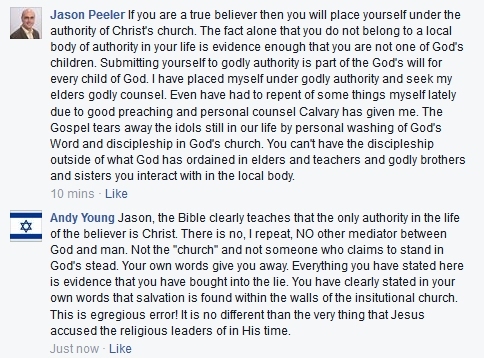
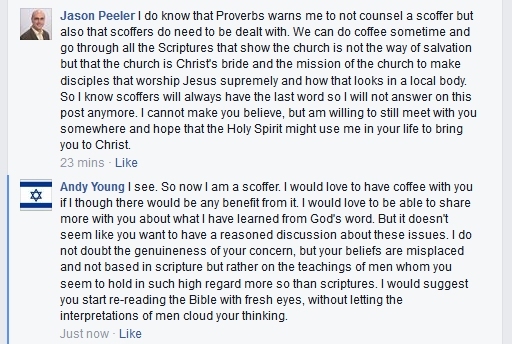
This Is What Happens When You Challenge a Calvinist
What follows is an exchange I had with a former Facebook “friend”. This conversation went the way every conversation goes with those who hold to Reformed/Calvinist theology. Take note of the following:
- An appeal to authority over reason
- “Ad hominem” attacks versus rational discussion
- The equivocation of orthodoxy with the “gospel”
The irony is that while Jason references “religious control freaks” in his post, he engages in the same kind of behavior.
Protestant orthodoxy is rooted in the same metaphysical premise as Platonism. You will never win a debate with a Calvinist because he begins with different assumptions about man and about reality. All his interpretive conclusions are based on these assumptions. The only thing you can do is expose the false teaching and faulty reasoning and allow others to come to their own conclusions.
I think the exchange below speaks for itself.
– Andy


The Assumption of Church Authority
The word “assumption” can have at least two meanings. It can mean to take on or take over for oneself as a responsibility. It can also refer to a starting point of an argument; a premise from which a logical conclusion is drawn. In the case of “church authority”, both definitions are applicable.
Protestants must be aware of the assumption, the beginning premise, held by the “church leadership”, the logical conclusions of which produce the resulting behavior observed by so many who come to this ministry seeking answers. Those in so-called “church leadership” have an assumption (self-appointed) of authority based on a faulty assumption (premise).
As a result there are some questions that must be asked:
- Is it reasonable to assume that elders and pastors, being fallible men (because after all doesn’t “total depravity” apply to them as well?), could ever possibly be in error regarding doctrine and Biblical interpretation?
- If the answer is yes, then what mechanism is there in place, either from Scripture itself or a “church’s” own documented governing principles, to be able to determine if the leadership is in error, thereby making their claim to authority void?
- Maybe the same question only stated another way, if a discerning church member were honestly persuaded by his own personal study and illumination of the Holy Spirit that a pastor or elder was in error and promoting false doctrine, and the elder/pastor refuses to hear him, what recourse does that church member have (aside from leaving the church)? (The assumption here being that the member loves his church so much that he is concerned for the spiritual well-being of the church in general and the pastor, elders, and the rest of the laity in particular).
- If, on the off chance that an elder or pastor ever conceded the fact that the possibility exists that he himself could be in error concerning doctrine or Biblical interpretation, how would he know that? How would an elder or pastor know if he was wrong? (Of course that begs the question, would he ever admit to it?)
 The answers are obvious because this is the assumption: the leadership is assumed to never be wrong because they are the authority! Their basis for authority IS authority. This of course is a logical fallacy. Nevertheless, an elder or pastor will ALWAYS defer to some other authority. His answers regarding doctrine and interpretation are never going to be based on sound reason from his own personal study. He will always make an appeal to the authority that instructed him (i.e. seminary, et al).
The only difference between you or me and the elder/pastor is the amount of money spent on certification training. The Bible clearly states that all authority rests with Christ. The elder/pastor gets his authority from a framed document hanging on a wall in his office.
Whenever the basis for truth is an appeal to authority, there is no need for persuasion or reasoned debate. Only force and coercion.
Andy
Church Re-Crucifies Christ and Puts Him to an Open Shame
 My original salvation experience was very powerful and full of joy as I sought to add to my faith with much zeal. Initially, a lot of sin that formally enslaved me seemed powerless, and many of the former sinful desires had disappeared. Then church happened.
While seeking for the “right” church to “worship” in, my interim experience between saving faith and seeking out a place of worship, as aforementioned, was marked by joy, zeal, and power. As I invested more and more in church; more and more confusion, doubt, and fear ensued. Church made me a pathetic, joyless, and broken person. And by the way, most churches will tell you that is a good thing! In fact, most churches are clear in regard to that being their very goal! This makes you see your need for more salvation. They say it plainly all of the time.
As I read my Bible more and more…more and more of my church experience failed to add up; particularly, the incessant weekly re-visitation of the gospel. And keep in mind this was well prior to the Neo-Calvinist movement. “Why are we always talking about the gospel at church? Aren’t we already saved?” I would often ask myself. If I would have only known way back then that the answer to that question is, “NO.”
Yes, according to orthodoxy, Protestants aren’t saved. Church is a “race of faith” and the prize for winning the race is salvation. And, the race only takes place at church. Sure, sure, they will tell you that you are already saved according to the Protestant doctrine of, “already—not yet.” What’s that? IF you are entered into the race by being faithful to church, you have hope that you are already saved, but not yet because you have not finished the race of faith alone in which the prize for winning the race is “final justification.”
If you are a freewill churchian, you earn your salvation by “continuing in the gospel” by faith alone. If you are a Calvinist churchian, you do the same for some measure of comfort, but you will only persevere in faith alone if you are God’s elect. Those in the church who do not persevere are only “the called” who do not persevere in faith alone. So, sure, churchians are “already” saved, but “not yet”: one must wait for the final judgement to obtain “complete salvation.”
This, in and of itself would be humorous if not so sad, but it gets better. Pastors, and this according to their own precious orthodoxy; in black and white, and in no uncertain terms, have authority to proclaim you an alreadian. Yep, this is the “power of the keys” doctrine that will bind in heaven whatever the church binds on earth, and the same for the loosing stuff as well. Do adults really fall for this stuff? Yep. Is this why pastors are so revered in the church and placed on a pedestal? Ya think? Ultimately, they decide where you spend eternity, and they are your wildcard that bypasses the uncertainty of Protestantism’s “already not yet.” Supposedly, there are two things standing between you and a wrathful God that hates humanity: Christ and His “undershepherds.”
Well, this is nothing new. Church is a mirror image of every foul thing that God’s prophets fought against as documented in the Scriptures. Before we go on, what is “church”? Church is the institutionalization of Christ’s assembly that occurred in the 4th century. Simply stated, it moved the temple of God from the bodies of believers to brick and mortar temples making worship a place, not a practice of truth wherever a believer is breathing. The fellowship of Christ’s body was replaced with authorities other than Christ operating in corporate temples. Authority replaced leadership, and membership replaced fellowship. “Follow me as I follow Christ” was replaced with “Obey God’s anointed or we will take your salvation away.”
So, there is a reason why you go to church and hear about the same gospel that saved you week, after week, after week. Whatever you might be instructed to do is “by grace” or in truth minus the nuance, “by salvation.” There is a reason why the Lord’s Table is a solemn ceremony marked by self-denigration. There is a reason for alter calls. There is a reason why the pastor speaks from a fancy podium on an alter raised above where the congregants sit. I like the alters where the other important dictators of the church sit in gaudy chairs behind the podium. It’s crazy; this stuff does not cause people to ask what in the heck is really going on.
Scriptural examples abound, but this post is about Hebrews 6. Let’s set the table. As Christ’s assemblies meeting in private homes (because we are God’s family not members of a corporate temple named Salvation Inc.) moved forward in true discipleship, they endured persecution from the pagan-state and Judaism. In essence, they were getting flak from every angle in regard to the culture of that time, but primarily from Judaism which was clearly salvation by temple ritual. And by the way, most of the persecution from the pagan-state was instigated by the Jews politically.
Hence, many Christ followers were hedging their bets and playing both sides of the fence. Like today’s institutional church, excommunication meant the loss of salvation, and in many cases, difficulty in obtaining financial income. Be sure of this; likewise, as the economy weakens in the U.S., many cling to the institutional church for career connections, viz, financial security. There is absolutely no new thing under the sun.
This is what the Hebrew writer was addressing specifically: the continued sacrifices for maintaining salvation versus the sacrifice of one’s own holy body in love (Rom 12:1). A return to the same gospel that saved us denies the new birth and the holiness of the believer. The holiness of the believer is part and parcel with “moving on to maturity” (HEB 6:1). A return to the basic, or elementary principles of salvation harkens back to the shame of the cross which Christ despised (Heb 12:2) and denies the purpose for which he endured it: the glory which was set before; ie., bringing many sons to glory. By striving for maturity and adding love to our faith, we fulfill the purpose for which Christ endured the cross. But, returning to the cross…
“seeing they crucify to themselves the Son of God afresh, and put him to an open shame.”*
Shockingly, in spite of Scriptural clarity on this issue, many Protestant scholars brazenly endorse a return to what Christ despised, and make that the replacement of the very purpose for which He endured the cross; to make many holy for purposes of offering themselves in love many times as opposed to worshiping what Christ despised. Offering our own holy bodies in love is our worship, or our “logical service.”
Hence, worship is redefined by returning to the basic principles of salvation in a temple, rather than the worship of offering ourselves as holy sacrifices in sanctification wherever we are found breathing. We then meet together to encourage each other in this worship (Heb 10:25). The Hebrew writer addressed those who ratcheted back from meeting in the home fellowships because of persecution from the temple worshipers.
And that’s church. And that’s what you do every time you go there: you sing praises to what Christ despised, and disparage the purpose for which He endured the shame.
And for some insane reason, you pay 10% of your income for the privilege.
paul
*”Those who cannot be restored to repentance” pertain to that time when they witnessed the power of the Spirit being manifested firsthand. Being exposed to the full light of the truth in such dramatic fashion and then afterward returning to a ritual of re-justification made it doubtful that they would ever be fully persuaded.

 Paul's Passing Thoughts
5 comments