The Church Doubles Down on its Last-Days Antinomian Gospel via New Movie
 It’s good that we call church, “church” because it is distinct from family, specifically, God’s family. Declaring myself a Dohse doesn’t make me a Dohse, being born into the Dohse family makes me a Dohse. Though there is legal adoption, there is only ONE way into the literal family of God; new birth through the one-time baptism of the Spirit established by Christ’s resurrection.
Church is an institution, and like all institutions, it can’t replace family. A good example is what I do for a living: skilled nursing facilities can take care of people who can’t care for themselves; but we cannot by any means replace family. Residents who have an involved family do demonstrably better mentally and physically than residents who don’t have an involved family.
However, unlike most institutions that aide families in being better families (in other words, they are a supplement) the church is an institution we can liken to gangrene—gangrene is an infection that eats away tissue undetected for a period leading to necessary amputation of limbs. One example among many ills we can liken this to is the “fallen pastor” epidemic. A church like Apex in Dayton, Ohio can seem to be soaring to new spiritual heights until it’s discovered the pastor was involved in a ten-year illicit affair. No one saw it or felt it coming, but amputation became necessary to save any credibility the ministry ever had.
Is it possible the epidemic could be a result of the church’s gospel? Gangrene doesn’t ask such questions.
What is the difference between church and the literal family of God? Two gospels. The church gospel is justification by faith; the family-of-God gospel is justification by new birth. These are two different gospels; one false, the other true.
A new movie, “The Heart of Man,” produced by the church will seek to further the justification by faith false gospel. Simply stated, what is that gospel? Answer: you are justified by faith in what you know alone, but not by any change in your state of being. Yes, yes, I know the church talks about the “new creature,” but again, you are a new creature because of what you know and perceive, not because you are a changed person resulting in different behavior.
In fact, attempts to please God through behavior is what the church is trying to save itself from, and this movie is the latest effort accordingly. The assumption, actually, what we call “assumptive deception” (allowing people to assume certain things in the process of deception) follows: this constant drumbeat heard in the church speaks against a salvation PROCESS of good works. Deceived churchians are allowed to assume that the church denies a salvation process, but this has never been true. The church’s gospel, Protestantism in particular, is a progressive justification and always has been.
When salvation is NOT a one-time miraculous act of God alone resulting from faith alone, a works salvation is the only thing that can follow. When we are living in the midst of a salvation process, our participation is unavoidable. We must participate by doing something, whether actually doing something, or doing nothing with intentionality, which is doing something. When you decide to do nothing, that’s a decision, and a decision is doing something.
But we could also talk about participating in the “means of grace” found only at church. Again, folks are allowed to assume that the “means of grace” only pertain to mere “blessings” enjoyed by churchians. Nope. The “blessings” being referred to is salvation itself. You go to church, and obey the church, to get more and more Jesus, viz, salvation. The progression of assumptive deception within the church has now reached the point where the who’s who of evangelicalism now say this in broad daylight with little or no ambiguity.
Recently, at a fellowship, Susan saw a book laying on a table and began to thumb through the pages. It was a newly published work by a former SBC president. She brought it to me and pointed out progressive justification, literally, on every other page. However, if you don’t know what to look for, you aren’t going to see it. A caveat that will help is reading the word, “grace” for what it is really intended to mean in church-speak, “salvation.”
Christ specifically names the false gospel of the last days: “anomia.” In the English rendering we call it, “antinomianism.” When you attempt to discuss the specific last-days false religion called out by Christ with churchians you will be accused of “using big theology words to bring glory to yourself.” Apparently, any word with more than four letters qualifies for such among this dumbed down horde.
But at any rate, what is anomia (anti-law)? According to church orthodoxy, it is the rejection of the law as the standard for justification. So, the standard for righteousness (justification/salvation) is perfect law-keeping lest you be called, “antinomian.”
In contrast, what is the true biblical definition of antinomianism? Answer: it is the removal of love from the life of the “believer” and makes all loving acts performed by Christ (or the Spirit) and not the “believer.” This is because church orthodoxy only has one perspective or definition of law; ie., the standard for justification. Hence, only those who can keep the law perfectly are just, and since no person can, the perfect law-keeping of Christ must be continually applied to the “saint” in order for the saint to remain saved, and this is accomplished by participating in the “means of grace.” Get the picture?
But the true new birth obtained by faith alone and through the Baptism of the Spirit changes the believer’s relationship to the law. How? It completely removes the condemnation of the law and makes the law a manual for love. It completely removes the death of the law, and makes it a law of life for the believer. It completely removes the bondage of the law, and makes it a law of liberty.
Therefore, is a proper understanding of Romans 8:2 paramount to understanding the whole Bible? absolutely.
Key to having life, and having it more abundantly is an aggressive endeavor to apply the law to one’s life as a way to love God and others with no fear of the law’s former condemnation. The true new birth transforms one from the death of the law to the life of the law. Nothing here has ever changed; in regard to the law, Moses exhorted us to “choose life.”
Back to the movie. It’s based on the Bible parable of the “Parodical Son.” Supposedly, this parable is meant to demonstrate the futility of attempting to keep the law for God’s approval. Well yes, if you are still under a single perspective on the law, and therefore still, “under law.” In other words, the church’s definition of “under grace” is being under law except that Jesus fulfills the law (think, “love”) for us as long as we partake in the “means of grace,” which, of course, can only be found in the church, which, of course, insists that we tithe at least 10% every week, which, by the way, is another “means of grace.” Just perfect; who knew?
In the promotion of the movie, premiering September 14th at selected theaters, we read:
It’s a story inviting us to leave behind our broken, moralistic and religious way of thinking and relating to God and to others. Once we begin to know who God is (and as a result who we are), we have something to invite the world into. Freedom from performance. Freedom from managing our behavior so we appear acceptable to God.
And by the way, Pastor Tullian Tchividjian, like so many others, was the sultan of this gospel and we know what his life ended up being about, right?
Well, far be it from the truly born-again to be free from the performance of love. And as true children of God, why would we attempt to appear acceptable to God when we are His children to begin with? Do we love our parents to gain their acceptance? No, we love them because they’re our parents, and we love other Christians because they’re our brothers and sisters.
True antinomianism removes the born-again perspective of the law from the sanctification of the believer and substitutes it with Jesus’s perfect law-keeping which is imputed to our account through ritualistic traditions of men. This is EXACTLY what the Pharisees were guilty of. No, truly born-again believers who obey the law of love are not Pharisees, the church is.
Also indicative of ills associated with this false gospel is an utter lack of justice in the church. Since we cannot love and are only saved by substituted love found in grace, we should “forgive the same way we were forgiven.” We find a hint of this in the movie promo as well:
It reveals the antidote to shame — grace. The grace of the Father for his children and the grace we can have for each other…in the midst of our darkest moments.
And trust me, the church has its share of “dark moments.” In fact, almost all wars recorded in human history flow from religious ideology. Historically, Protestants have murdered millions who refused to forgive the way they were forgiven.
And FYI, pedophilia also qualifies as a “dark moment” experienced by many. After all, “sin is messy, and churches are full of sinful people with messy sinful lives.” In contrast, the true household of God “walk[s] circumspectly, not as fools, but as wise, redeeming the time, because the days are evil. ”
How close are we to the return of Christ? If the rampant anomia in the church is any indication, close. And remember, residual details aside, the church’s disdain for individualism expressed in its total depravity doctrine shares a commonality with many other religions and secular politics.
paul
New Revision of the 47
This is a work in progress. I will continue to add new ones and progressively define each. Will probably be a published work. Add your input to the project in comments.


Home Fellowship Distinctives Will Continue to Develop
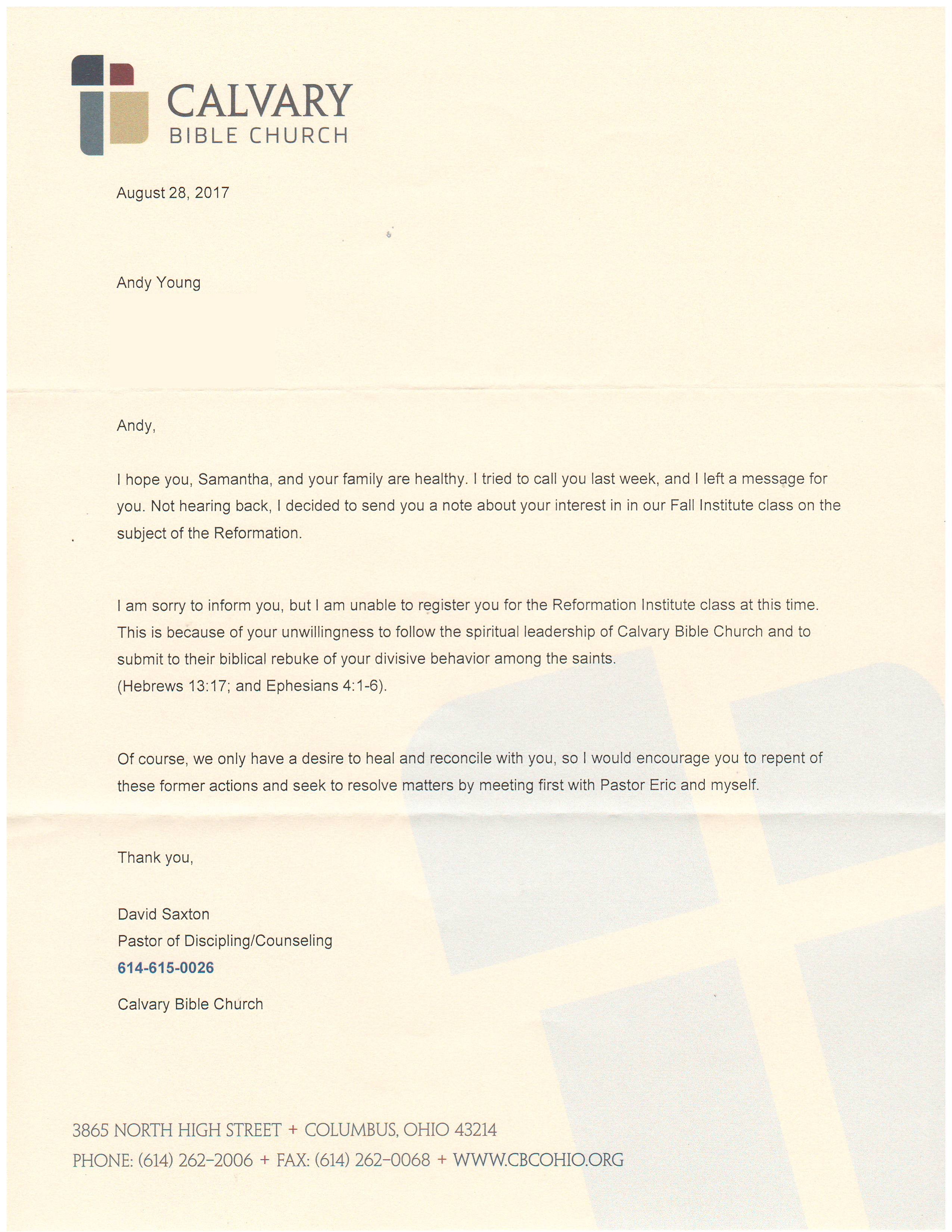 As TANC ministries launches into a focus on alternatives to the church this year, a major one was brought to the forefront this week. Andy Young, our contributing author, gave permission to address the attached letter sent to him recently. Andy himself will have much more to say about this letter in the coming days.
Before I address the letter, let’s review some developing distinctives. First, the fact that we meet in homes is a statement of our gospel. It says we are a literal “household of God,” and not an institution. We are a literal family; that is important.
Meeting in homes with an intentional avoidance of institutional religion proclaims the new birth. Institutions function by law and top-down authority. Home fellowships proclaim justification by new birth and not perfect law-keeping. We deny the supposed double atonement of Christ which is not an atonement to begin with; Christ came to end sin, not merely cover it up. The true gospel is not a cover-up.
Hence, home fellowships function as a cooperative body and not a top down authority. In contrast, those who meet in purpose build sanctuaries deny that individual members of Christ’s body are God’s temple in and of themselves.
Furthermore, the denial of individual bodies as God’s temple also denies the ability of the true saints to use their bodies to offer living sacrifices to God in all matters of life.
We deny, with extreme prejudice, that men appointed by virtue of buying seminary degrees have authority over our salvation. This is another home fellowship distinctive; the authority of Christ alone as the head of His one body. One authority, and one body.
In the attached letter, it is clear that these men believe they have authority over Andy’s salvation. This is a Protestant distinctive whether Baptist, Methodist, Charismatic, or any other stripe that came out of the Protestant Reformation.
In home fellowships, body members do not wait for permission to use their holy temples to offer living sacrifices to God in all matters of life, and the love we perform is from our own temples and not a substitution.
Keep in mind, by virtue of stated orthodoxy, a love performed by the “saints” themselves would deny the Protestant doctrine of double imputation.
paul
Matt Walsh Jumps on the Joel Osteen Scapegoat Bandwagon
“…being happy requires courage and risk.”
I said I was going to stop it altogether and I have been good until now; that is, playing the Protestant error Whack-A-Mole game. A key to Protestant survival thus far in history is keeping people busy arguing about “issues that scholars have debated for hundreds of years.”
Therefore, all is well because the religious experts are in the process of ironing out the wrinkles in the Reformation that turned the world right-side-up after being in darkness for thousands of years. Supposedly.
Hence, it is assumed that Protestant “essentials” are unarguable and the church is the undisputed moral compass of society that married reason and logic to religion; “In essentials, unity; in non-essentials, liberty; in all things, charity” (St. Augustine). This is why the bulk of Protestant activity is debate, if anyone would care to pay attention: Protestantism is the epitome of contradiction and doublespeak.
There is only one thing worse than being a Protestant; spending your whole life exposing the low-hanging poisonous fruit in its gargantuan forest. Nevertheless, I will take another bite at the apple after reading an article by Matt Walsh about Joel Osteen. After succumbing to temptation and eating from a forbidden tree one more time, I will tell you what we need to start dong instead.
Since Protestantism is supposedly the beacon of truth and goodness in Western culture, it must invest heavily in warning Churchianity against imposters. And seemingly, Joel Osteen is the chief of all imposters; the consummate “wolf in sheep’s clothing.”
And why is that? Because he preaches the worst false gospel of all, yes, the dreaded, “prosperity gospel.” This is so indicative of Protestantism; a prosperity gospel scorning those who propagate a prosperity gospel. A works salvation scorning works salvation. A Jesus plus something else gospel scorning Jesus plus something else gospels. A…, well, you get the point, and there is no room here to name the hundreds of other examples.
In its endeavor to keep followers busy looking at the church’s enemies lest someone would have time to stumble upon the simple theological math that makes Protestantism a house of cards, they focus on “heretics” that are soft theological targets and affect the church’s bottom financial line which makes Osteen a prime and favorite target. His following constitutes a significant GNP GCP (gross church product). In other words, Osteen is competition that affects the church’s bottom line, and his theology is easily refuted.
Joseph Prince, a close friend of Osteen who would normally fall into the high GCP category and a strong advocate of the prosperity gospel is barely addressed by church stalwarts and the reason is instructive for making the point of this article. Other than his prosperity gospel, Prince is also known as “the prince of grace.” Nobody, but nobody, preaches a more articulate version of the Reformation’s “justification by faith.” The only close second was Tullian Tchividjian who was disposed of for not using nuance enough. Tchividjian was easy to dispose of because his personal moral failures were known among powerful evangelicals. Apparently, Prince is not vulnerable in this regard so they stay clear of him; criticism would bring attention to him which would also reveal that he preaches the exact same gospel as Protestant darlings like John MacArthur Jr. et al. There is irony here that will be addressed later, but unlike Osteen, Prince emphasizes authentic Protestant law/gospel which would make his prosperity message a “non-essential.” By the way, Osteen believes the same gospel as well, but does not articulate it as well as Prince and not nearly as much. So, is accusing Osteen of teaching a “prosperity gospel” a distortion of truth and a false accusation? Absolutely. The issue is really a question of how Christianity is experienced, not how people get saved. But this is but a small whiff of what Protestants do.
Let’s sum up the thesis of this article so far and finish the defining of it: Protestantism, which is truly a prosperity gospel, accuses Osteen of preaching a prosperity gospel which is not true; it is truer to say he preaches an exaggerated prosperity sanctification. Moreover, Osteen is more righteous than his evangelical accusers. Lastly, all parties are guilty of teaching a false gospel. This is an epic example of the pot calling the kettle black on steroids with the kettle being much less worthy of damnation.
Now let’s put feet on the thesis.
We are using Walsh’s article, so let us begin; the subject of his article focuses on criticism that Osteen didn’t open his church building to victims of Hurricane Harvey:
I’m more eager to know why the good pastor hasn’t opened his 10 million dollar, 17,000 square foot mansion to the public. Actually I’d like to know how he justifies ever having bought it in the first place. Well, I know how he justifies it. He and his wife “positioned themselves for a blessing,” as they like to say. Those of us who don’t live in opulent estates just haven’t put ourselves in the right place to receive such rewards.
Um, this assumes that mainline evangelicals do not partake in the same “opulent” lifestyles. Seriously, the press on this is so vast we shouldn’t even have to go there, but we will partake in a short indulgence. James MacDonald, and the Chuck Swindoll 2-million-dollar vacation home controversy to name two among hundreds. Does Walsh wish to ask the same of them? Cognitive dissonance much?
This is the essence of the Prosperity Gospel preached by Osteen and his ilk. It’s insidious and heretical, but crowd pleasing. A Gospel that tells us to embrace suffering and poverty will not pack a 17,000 seat arena. It won’t sell books. It cannot be monetized. It won’t buy you mansions and private planes. It won’t make you famous. People don’t want to hear it. They want to hear something else. They want to hear that fortune and luxury are just around the corner — God wants us to have these things, as Osteen constantly insists — and all we need to do is be a little more positive and probably buy one or two more Joel Osteen books.
This is the Gospel of the World. The Gospel of Osteen. A Gospel specifically tailored to challenge no one, offend no one, and make everyone happy. And it fails miserably on every count.
Huh? Where to begin? A gospel that tells us to embrace suffering doesn’t sell? Is Walsh oblivious to the reality we are swimming in, viz, the massive Neo-Protestant movement of our day? John Piper doesn’t have money? Al Mohler doesn’t have money? They don’t have conferences in Palm Springs? John MacArthur doesn’t have Bible studies on lavish cruises? James MacDonald doesn’t live in a mansion? And they don’t sell a gospel that embraces suffering and the total depravity/inability of mankind?
What is Walsh smoking?
Now let’s talk about the real prosperity gospel of Protestantism and how it compares morally to Osteen’s. Osteen doesn’t sell salvation for a 10% temple tax, he sells “your best life now.” In contrast, Protestantism claims to be God’s authority on earth in regard to the “process of salvation” found only in the institutional church. The “means of grace (salvation)” can only be found in the institutional church, and one of the “means of grace” is none other than the good ole fashioned 10% tithe along with anything extra for good measure. Mainline evangelicals like John MacArthur Jr. routinely teach that there is no salvation apart from putting yourself under the authority of the local church, and tithing less than 10% is robbing God.
Furthermore, they advocate John Calvin’s “power of the keys” which gives the church authority over individual salvation; whatever the church binds on earth will be bound in heaven and whatever the church will loose on earth will be loosed in heaven. If the church likes you—you are in, and the church likes nothing more than a “cheerful giver.”
Joel Osteen sells no such thing. He simply requests donations based on perceived benefits received from his ministry and claims no authority over salvation. He sells a positive message as opposed to the fear of eternal damnation for those who would dare disagree with him which makes him the better of the two.
And there is another major difference between the two. Seemingly all but absent from the health and wealth venue is the Protestant child rape culture that evangelicals refuse to openly confront. Evangelicals who constantly berate Osteen remain silent against organizations like ABWE that partook in a criminal 20-year cover-up of rampant pedophilia amongst its missionaries. John MacArthur Jr., who routinely targets Osteen with his disdain, still endorses CJ Mahaney who covered up child molestation in his church for years and is on tape attempting to blackmail a former ministry associate. It is unclear how Osteen would respond to such scandals in his church because the opportunity has never presented itself, but is this telling if one wants to judge between the two?
The Protestant prosperity gospel is one of negative reward; it’s like a child who demands a reward for doing good and is told the reward is the absence of a spanking. If you obey the Protestant church, your reward is heaven and not hell. It’s the peddling of eternal wellbeing which is many times more valuable than present cash. It is the paramount prosperity gospel. It whispers its vile sins in the ears of goats like Osteen and sends them into the wilderness of social media.
But why does suffering sell? In contrast to Walsh’s cognitive dissonance treatise, why has nihilism, zero sum life, fear, and total depravity always been a dominant ideology of the world and religionists? Because it’s easy and requires less thinking, and doesn’t take courage. You see, being happy requires courage and risk. Like the person who avoids deep relationships for fear of getting hurt, the gospel of suffering and total depravity wishes to stand outside of life and look upon it as one emotionally detached while labeling such indifference “peace that passeth all understanding.” After all, life sucks and ALL people possess “hearts full of darkness.” And don’t you know, you need to get over it because you are no less a sinner saved by grace than the elder who raped your child.
As aforementioned, Osteen is not pushing a gospel to begin with, but more along the lines of a lifestyle that actually requires some effort in embracing life as something positive, albeit errant. And while Osteen receives riches from the freewill of others, evangelicals extract their wealth through tyranny and fear.
What should we do about this? Answer: not what I am doing here. Attempting to fully unravel the depths of Protestant folly is a fool’s errand. Our time needs to be spent reinstating the laity movement known in the first century as the “assembly of Christ.” We need to invest our time in proclaiming a justification by new birth, not a “legal declaration” which is not a righteousness “apart from the law” (obviously) and is a mere declaration—not a state of being. We need Christians to function as a cooperative body in a literal family fellowship, not according to the authority of a manmade institution that usurps the rightful place of Christ as the head of his body.
And this we will do if Christ wills, and He does.
paul
@ Todd Friel
@ToddFriel So brilliant U R misunderstanding what APART means. Justification by law ok if Jesus keeps it 4 us. Better hope Rob B. is right.
— Paul M. Dohse (@PaulMDohse) August 29, 2017

 Paul's Passing Thoughts
3 comments