Extreme Murder is No Big Mystery
 Unfortunately, no venue feeds our propensity to be lazy thinkers more than the mental health profession. Once we concede that a person can catch a cold mentally, we can bypass the hard work of pondering by merely declaring a perpetrator “crazy.” In lesser crimes against humanity on the level of being simply annoying, a handy shortcut is the declaration that one is “stupid,” and of course, “You can’t fix stupid.” That was easy.
And, since mental health is such a complex and deep subject that must be researched by so-called experts until the second coming, we slap the “crazy” label on people while conceding that we will never know why they did what they did. “Simplistic” answers are rejected out of hand for a simple label of complexity.
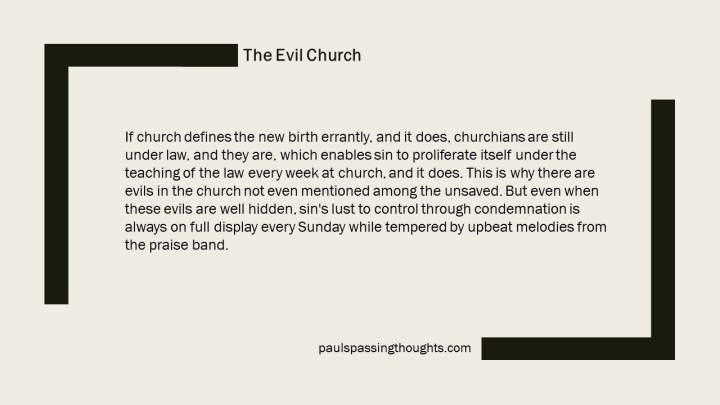
In regard to why a man murdered 58 people at a music concert in Las Vegas, the big-picture answer may be a short one, but not necessarily simple. The Bible states that mankind is plagued by sin, and that sin is driven by desires. The stated paramount desire that primarily drives sin is CONTROL.
As a former pastor in the institutional church who counseled my share of married couples, a complaint often heard about one’s spouse was, “He/she is a control freak.” It never computed in my mind although I had read the words describing the concept in Scripture hundreds of times. I dismissed the complaint as run of the mill demagoguery.
Sin can produce all kinds of desires within individuals. A great deal of what people do is driven by desire. In other words, people do what they do because they often want to. People have sex with animals because they desire to do so; yet, it’s probably a bad idea and not really very normal.
Why is homosexuality and bestiality so prevalent in some cultures? It starts with a desire for sex (which in fact is a natural desire) coupled with misogyny. If women are deemed second class citizens in a culture, it stands to reason that there will be a shortage of them leading to alternative fulfillment for sexual desire. On this point, it is apt to point out another element of sin described in the Bible: it is unreasonable and illogical. In the Bible, and in contrast, righteousness is often associated with reason and sound judgement.
Let’s take rape as another example. Here, you have two working desires: a desire for sexual fulfillment and a desire to control or master someone. It’s really not all that complicated. Determining factors that lead to certain desires within certain people can be a complex study, but not the basic concept. And certainly, you may add a possible hatred for women in the mix as well (emotions leading to a desire to punish as a distorted view of justice).
When a person does what was done in Vegas, it’s a sinful brew of desires, emotions, and logic. Often, ideology is just an excuse to fulfill sinful desires. I don’t believe many ISIS members are truly committed to the ideology, I believe it is a means/excuse for fulfilling sinful desires.
We might want to add the following as well: Sinful desires seem to believe that they have a right to be fulfilled, and the denial of their fulfillment will often lead to retaliation.
Also, according to the Bible, the practice of continually fulfilling these desires leads to the intensifying of the given desire. The intensity of the desire becomes so strong that the person cannot say “no” to it under any circumstances. This is where we get “addictions” and “serial” this, that, or the other.
The Bible has something else to say about sin; somehow, it is able to use God’s law to create sinful desires within people. This is the unsaved person. This is the person “born under law” (the biblical note that Jesus was born under law refers to His humanity). When a person is saved by believing on Christ, sin can still use the law to create sinful desires, but the saved person is able to say “no” to the sin and decline for the right motive. The ability to do so is increased by the application and practice of biblical wisdom.
This is because somehow, according to the Bible, sin’s ability to enslave depends on the law’s ability to condemn. Hence, Christ died for our sins and eleminated the law’s ability to condemn which also strips sin of its ability to enslave.
In addition, the new birth (salvation) changes the person’s affections towards God’s word/truth/law/Bible. Instead of something that condemns and is dreaded, it is now seen as a wealth of wisdom for loving God and others. It enables the believer to say “no” to sinful desires and control the body. We call this, “sanctification.”
paul
Kent Dohse Benefit Yard Sale Update
The Potter’s House and TANK Ministries is sponsoring a yard sale to raise medical funds for my brother. His story, and a link to his donation page can be found at kentdohse.com. Our goal is to raise $2000.
Due to the superb whether we are experiencing in October, we have decided to extend the sale until the middle of the month. We will post a link in updates if you want to peek at the sale live. Today’s link is here.
The sale will be closed on days when rain is forecasted. We have presently raised $800.
paul
The Definition of Sin and the Protestant/Evangelical Church False Gospel
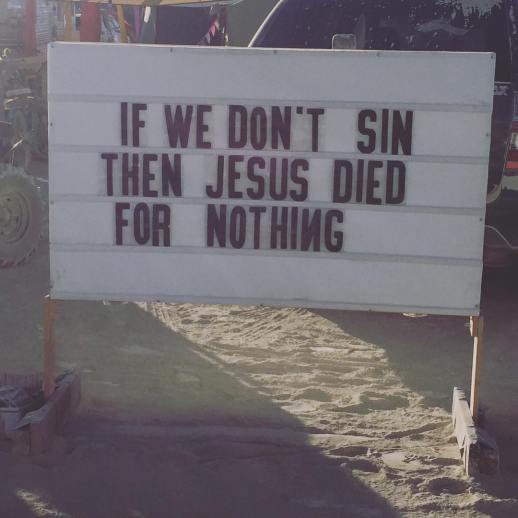
“Let’s be honest; what we accept as normal is going to be accepted and resistance seen as futile. For the born again believer sin is not only abnormal, but not sin as defined under the law of condemnation to begin with. For the believer, the law defines our love, not potential condemnation.”
The attached sign appeared at the exotic Burning Man Festival held yearly in the Nevada desert. It’s an alternative reality festival that emphasizes freedom. Hence, the point of the sign might be dark humor; in essence saying, “To abstain from sin is to make poor use of Jesus’ death in the least and to outright deny His death at most, so, sin-it-up people!”
Nevertheless, the wording of the sign is a treasured hub that links the spokes and rim of the salvation question for every religion. The crux is the definition of “sin.”
As the saying goes, all humor has an element of truth to it which causes the laughter. Comedy allows us to look at life on a lighter side, but what makes this humor particularly dark is the truth in it. Martin Luther wasn’t joking when he said, “sin boldly.” The wider context of what he said follows:
“If you are a preacher of mercy, do not preach an imaginary but the true mercy. If the mercy is true, you must therefore bear the true, not an imaginary sin. God does not save those who are only imaginary sinners. Be a sinner, and let your sins be strong [or sin boldly], but let your trust in Christ be stronger, and rejoice in Christ who is the victor over sin, death, and the world. We will commit sins while we are here, for this life is not a place where justice resides. We, however, says Peter (2. Peter 3:13) are looking forward to a new heaven and a new earth where justice will reign. It suffices that through God’s glory we have recognized the Lamb who takes away the sin of the world. No sin can separate us from Him, even if we were to kill or commit adultery thousands of times each day. Do you think such an exalted Lamb paid merely a small price with a meager sacrifice for our sins? Pray hard for you are quite a sinner.”
Evangelicals can play games by denying the father of their faith or “we don’t agree with everything Luther said,” but the fact remains that what Luther said is aped in every church on Sunday morning from coast to coast. And, the aforementioned citation is a classic example of how church has it both ways and is utterly unaccountable for a host of illogical contradictions.
Note: we sin, but Jesus took away sin; which is it? If you go to church, and per the normal for church, it’s both, and nobody blinks.
Furthermore, evangelicals are quick to point out that it only takes one sin to condemn us, so what would be the point in any effort to abstain from sin in general? Again, here is where church gets it both ways: it presents itself as society’s cultural moral compass while preaching a gospel that declares all of our works as “filthy rags.” And again, nobody blinks. On the one hand, it’s the “sinners saved by grace” gospel, but on the other hand, church leaders who get caught with their hands in the cookie jar have to resign from ministry.
Why is this? It’s part of church pretense. A literal new birth hope is advertised, but once people are drawn in, they are slowly assimilated into a pay-as-you-go salvation. Intuitively, the unregenerate are looking for the hope of real change. But, if a person is really transformed into a different person who is now a literal member of God’s family, what do we need the church for?
Fellowship? Perhaps, but the motive of fellowship will hardly pay for the massive infrastructure of the evangelical industrial complex. No, my friends, only the purchase of eternal salvation on the installment plan will pay those bills.
So, in one respect, it boils down to this: don’t put a lot of effort into not sinning; instead, put a lot of effort into having more trust in Jesus. That’s what Luther, and Calvin as well, taught…period. And, you can play the “we don’t agree with everything Luther/Calvin said” game till the cows come home, but this is the stuff heard in church, whatever the sign out front, every Sunday.
What’s the difference when you believe the true biblical gospel and its definition of sin? ALL effort is put into love and the more you love the less you sin, and all condemnation is stripped from sin and it is really a failure to love. And, you can focus on doing this without any fear of condemnation and the distraction of morbid introspection, or even the assumption that all of your love has some sin in it. If you believe that, because it’s true, real love actually happens.
By virtue of Protestant orthodoxy on its face, the claim that love takes place in the church is patently false. And if you pay attention to the news about church, that is apparent.
What then really happens at church? Luther stated it: “Pray hard for you are quite a sinner.” Don’t love hard, that would be, supposedly, works salvation. Instead, do church hard to have Christ’s sacrifice perpetually reapplied for your “present sin.” Clearly, it’s ongoing forgiveness from condemnation found in the “means of grace” that are only found in the institutional church.
Notice how church defines what’s work and not work: praying hard is not a work; but loving hard is a work because it is tainted with sin. Working hard at being faithful to church in order to obtain the ongoing “means of grace [salvation]” is not a work tainted by sin because everything that goes on at church is of faith. Supposedly. But in true realty, true faith “works through love” (Galatians 5:6).
If we are still under condemnation because sin still condemns, and the purpose of Christ’s death was to cover ongoing sin instead of ending it, He truly died for nothing if we don’t make it a point to sin, or at least passively accept it as normal. Let’s be honest; what we accept as normal is going to be accepted and resistance seen as futile. For the born again believer sin is not only abnormal, but not sin as defined under the law of condemnation to begin with. For the believer, the law defines our love, not potential condemnation. And, look, we see examples of this constantly like what happened to Susan and me just this week when church members told us boldface lies without a second thought.
Because Christ died to end sin, it is impossible for a believer to sin to begin with. The word, “sin,” rarely used in the Bible in conjunction with believers refers to a failure to love which can bring chastisement from our Father, but cannot bring condemnation. There is “NOW… NO condemnation” for those in Christ. Read 1John chapter 3 and see that these things are stated plainly.
paul




leave a comment