The Magnum Opus of the Reformation: Martin Luther’s Heidelberg Disputation; Part 3
 Listen to the audio or download the audio file in separate window.
Welcome truth lovers to Blog Talk radio .com/False Reformation, this is your host Paul M. Dohse Sr. Tonight, part 3 of “The Magnum Opus of the Reformation: Martin Luther’s Heidelberg Disputation.”
Greetings from the Potters House and TANC ministries where we are always eager to serve all of your heterodox needs. Our teaching catalog can be found at tancpublishing.com.
If you would like to add to our lesson or ask a question, call (347) 855-8317. Remember to turn your PC volume down to prevent feedback.
Per the usual, we will check in with Susan towards the end of the show and listen to her perspective.
Remember, you may remain anonymous. When I say, “This is your host; you are on the air, what’s your comment or question”—just start talking.
If you would like to comment on our subject tonight, you can also email me at paul@ttanc.com. That’s Tom, Tony, Alice, Nancy, cat, paul@ttanc.com. I have my email monitor right here and can add your thoughts to the lesson without need for you to call in. You can post a question as well.
Let’s start out with an interpretation prism that just struck me this week. Have you ever thought about this? Think about it: all of Reformed doctrine developed during the Reformation presumed a church state. That means the doctrine itself was tailored for an outcome that required oversight by the state. So, if Luther came back from the dead and visited the church today he would be delighted in regard to the doctrine being taught, but would be absolutely aghast that the church is functioning without the state enforcement of orthodoxy. When Luther is showed the carnage of today’s church in this scenario, he says in the modern vernacular, “Duh, there’s no enforcement of orthodoxy. The patients are running the Psych ward!”
In other words, the doctrine presupposes bad behavior necessarily restrained by the enforcement of orthodoxy, and by the way, that’s exactly how Calvin ran Geneva. So, what we have today is a Protestant doctrine designed for a theocracy functioning in a representative republic. Just a thought, now let’s move on to thesis 7.
Thesis 7: The works of the righteous would be mortal sins if they would not be feared as mortal sins by the righteous themselves out of pious fear of God.
This is clear from Thesis 4. To trust in works, which one ought to do in fear, is equivalent to giving oneself the honor and taking it from God, to whom fear is due in connection with every work. But this is completely wrong, namely to please oneself, to enjoy oneself in one’s works, and to adore oneself as an idol. He who is self-confident and without fear of God, however, acts entirely in this manner. For if he had fear he would not be self-confident, and for this reason he would not be pleased with himself, but he would be pleased with God.
In the second place, it is clear from the words of the Psalmist (Ps. 143:2), »Enter not into judgment with thy servant«, and Ps. 32:5, »I said: I will confess my transgressions to the Lord.« etc. But that these are not venial sins is clear because these passages state that confession and repentance are not necessary for venial sins. If, therefore, they are mortal sins and »all the saints intercede for them«, as it is stated in the same place, then the works of the saints are mortal sins. But the works of the saints are good works, wherefore they are meritorious for them only through the fear of their humble confession.
In the third place, it is clear from the Lord’s Prayer, »Forgive us our trespasses« (Matt. 6:12). This is a prayer of the saints, therefore those trespasses are good works for which they pray. But that these are mortal sins is clear from the following verse, »If you do not forgive men their trespasses, neither will your father forgive your trespasses« (Matt. 6:15). Note that these trespasses are such that, if unforgiven, they would condemn them, unless they pray this prayer sincerely and forgive others.
In the fourth place, it is clear from Rev. 21:27, »Nothing unclean shall enter into it« (the kingdom of heaven). But everything that hinders entrance into the kingdom of heaven is mortal sin (or it would be necessary to interpret the concept of »mortal sin« in another way). Venial sin, however, hinders because it makes the soul unclean and has no place in the kingdom of heaven. Consequently, etc.
Ok, this thesis is about as clear as mud. But in context, this is how I interpret it, and by the way, most Reformed scholars agree: everything a believer does is evil whether it appears good or bad by human standards. Let me get to the crux here: if any person saved or unsaved thinks they can do a good work that God would look upon and say, “That’s a good deed, it won’t save him/her, but the deed in and of itself is a good deed” that’s mortal sin; ie., condemning sin.
Hence, a Christian is in a state of perpetual sin of the mortal type. Believing such, and attending every good work with fear is venial or forgivable sin. Saving faith is the belief that Christians are under condemnation. This is what the Reformed mean by the Christian life being lived out “subjectively.”
Good and bad things happen and we don’t really know what’s really good or bad or who is doing it or what kind of good or bad works they are.
Let me explain: first, as we saw in the other theses, what appears good to man is really evil, and what appears evil is really good. Man can’t even judge good from evil. For example, man sees suffering as bad, but all wisdom is hidden in suffering. Secondly, we have no way of knowing whether God is doing the work or we are doing the work. Remember Luther’s old and rusty hatchet illustration from last week? So, you just kind of live out your life subjectively, and whatever happens is ok just so you realize that anything initiated by you is evil, and what appears to be good might be a manifestation of Christ’s righteousness or one of your evil works by virtue of the fact that you did the work. Either way, you have no way of knowing as you are “living out justification subjectively” or what is known as “subjective justification.” The key is to live your life in fear that you might come to believe that you can do anything that has merit with God.
Do we have examples of this in our day? Sure we do. How often have you heard a professing Christian say, “I didn’t do it! I didn’t do it! It was the Holy Spirit who did it!” Often, you can even see the fear in them that someone will believe they did the work. This also relates to other people. I once had a congregant (a financially poor single mother) tell me that a person who gave them a car didn’t really give them the car (and I am talking a new car by the way), but rather it was the Holy Spirit who gave her the car. You see, if you concede that someone else can do a good work, that is also saying you can do a good work, and that’s mortal sin. Here is another one: “Jesus did it THROUGH me.” What’s that? That’s Luther’s old rusty hatchet, right? Like a hatchet, you are completely passive and God just picks you up and starts whacking away on stuff.
Where do people get this in our day? Right here—you are looking at it. The Heidelberg Disputation 1518 practically applied in 2015.
We are going to look at thesis 7 in a little more detail, but first, let’s get another big picture; let’s address this idea of perpetual condemning sin and the traditional Reformed remedy. We are going to call on our good friend John Calvin to help us with this. Obviously, if Christians swim in the waters of condemnation, there needs to be a remedy, so let’s go to a trusty Reformed commentary:
…by new sins we continually separate ourselves, as far as we can, from the grace of God… Thus it is, that all the saints have need of the daily forgiveness of sins; for this alone keeps us in the family of God (John Calvin: Commentaries on the Catholic Epistles; The Calvin Translation Society 1855. Editor: John Owen, p. 165 ¶4).
So, daily we ask forgiveness for mortal sin (that which removes us from grace), and this “ALONE” keeps us in the family of God. But wait, did you know there is only one place where you can get that ongoing forgiveness? Let’s again consult John Calvin to find out where that place might be:
Nor by remission of sins does the Lord only once for all elect and admit us into the Church, but by the same means he preserves and defends us in it. For what would it avail us to receive a pardon of which we were afterwards to have no use? That the mercy of the Lord would be vain and delusive if only granted once, all the godly can bear witness; for there is none who is not conscious, during his whole life, of many infirmities which stand in need of divine mercy. And truly it is not without cause that the Lord promises this gift specially to his own household, nor in vain that he orders the same message of reconciliation to be daily delivered to them (The Calvin Institutes: 4.1.21).
To impart this blessing to us, the keys have been given to the Church (Mt. 16:19; 18:18). For when Christ gave the command to the apostles, and conferred the power of forgiving sins, he not merely intended that they should loose the sins of those who should be converted from impiety to the faith of Christ; but, moreover, that they should perpetually perform this office among believers (The Calvin Institutes: 4.1.22).
Secondly, This benefit is so peculiar to the Church, that we cannot enjoy it unless we continue in the communion of the Church. Thirdly, It is dispensed to us by the ministers and pastors of the Church, either in the preaching of the Gospel or the administration of the Sacraments, and herein is especially manifested the power of the keys, which the Lord has bestowed on the company of the faithful. Accordingly, let each of us consider it to be his duty to seek forgiveness of sins only where the Lord has placed it. Of the public reconciliation which relates to discipline, we shall speak at the proper place (Ibid).
This is what the crux of the Reformed gospel is: a perpetual justification for perpetual condemnation. Do we have present-day examples of this? Sure we do; specifically, the interpretation of 1John 1:9 by many in Presbyterian and Baptist circles.
If we confess our sins, he is faithful and just to forgive us our sins and to cleanse us from all unrighteousness.
The idea that this verse proffers a continued repentance for “present sin” is fairly common in Protestant circles of all stripes. Of course, this boils down to keeping yourself saved via repentance. How is that not works salvation? But at any rate, it begins with this idea that Christians dwell in constant mortal sin that needs continued forgiveness.
Here is another example from real life: Susan was at the grocery store and ran into an old friend who is a member of a mainstream evangelical Baptist church. Somehow, the subject got onto alter calls, and Susan wondered aloud why churches have alter calls. Here was the lady’s answer: “Well, I guess people have sin in their lives that needs confession.” Why do people need to go to church to get that forgiveness? Again, we may be far away from 1518, but that doesn’t mean the fruit falls far from the tree my friends.
Let’s now look at some of the finer points of thesis 7.
To trust in works, which one ought to do in fear, is equivalent to giving oneself the honor and taking it from God, to whom fear is due in connection with every work. But this is completely wrong, namely to please oneself, to enjoy oneself in one’s works, and to adore oneself as an idol. He who is self-confident and without fear of God, however, acts entirely in this manner. For if he had fear he would not be self-confident, and for this reason he would not be pleased with himself, but he would be pleased with God.
We begin the finer points with misplaced fear. Biblically, there is to be no fear of condemnation; in fact, love and fear of condemnation are mutually exclusive:
1John 4:18 – There is no fear in love, but perfect love casts out fear. For fear has to do with punishment, and whoever fears has not been perfected in love.
Christians do not fear eternal condemnation because there is “NOW no condemnation” for those who believe (Romans 8:1). In contrast, Luther, as well as Calvin, cited fear of condemnation as the primary motivator of the Christian life. Luther has stated it here in thesis 7, but Calvin was a little more to the point:
Certain learned men, who lived long before the present days and were desirous to speak simply and sincerely according to the rule of Scripture, held that repentance consists of two parts, mortification and quickening. By mortification they mean, grief of soul and terror, produced by a conviction of sin and a sense of the divine judgment. For when a man is brought to a true knowledge of sin, he begins truly to hate and abominate sin… By quickening they mean, the comfort which is produced by faith, as when a man prostrated by a consciousness of sin, and smitten with the fear of God, afterwards beholding his goodness, and the mercy, grace, and salvation obtained through Christ, looks up, begins to breathe, takes courage, and passes, as it were, from death unto life. I admit that these terms, when rightly interpreted, aptly enough express the power of repentance; only I cannot assent to their using the term quickening, for the joy which the soul feels after being calmed from perturbation and fear. It more properly means, that desire of pious and holy living which springs from the new birth; as if it were said, that the man dies to himself that he may begin to live unto God (CI 3.3.3).
This quotation by Calvin also revisits the doctrine of mortification and vivification that we discussed in prior lessons. But the main point for citing this text from the Calvin Institutes is to show that THE primary motivator of sanctification according to the Reformers was, and still is condemnation and fear of future eternal judgement.
Just please let that sink in for a while. You can’t chalk this up to a secondary disagreement with the heroes of the Protestant faith, this is the heart and soul of their soteriology. Granted, biblically, Christians are to fear present consequences in this life, and that is one of the motivators for Christian living. This is Moses’ “blessings and cursings’’ that apply to believers and unbelievers alike. However, for unbelievers, while a moral life does lead to blessings in this life, it only results in lesser condemnation in the end. For the Christian, it’s more and more life unto life. Christ came that we may have life, and have it more abundantly. But, also, “judgement begins in the household of God” right? Remember Ananias and Sapphira? That event made the assemblies “fear” which actually spurred growth in the assemblies. But this is not a fear of condemnation. That kind of fear stifles love.
So let that sink in as well. Love cannot thrive in the midst of condemnation and the fear thereof. Why is the institutional church so messed up? Are you beginning to see why? Susan and I were talking about something for our grandchild to do this summer and the idea of VBS came up. I shot the idea down; for better or worse, I have studied all of this long enough to know I do not want my grandson anywhere near an institutional church that considers itself Protestant. What’s the alternative? Well, not a lie because it’s the only game in town. Christians need to get busy building true Christian communities.
But this is completely wrong, namely to please oneself, to enjoy oneself in one’s works, and to adore oneself as an idol. He who is self-confident and without fear of God, however, acts entirely in this manner. For if he had fear he would not be self-confident, and for this reason he would not be pleased with himself, but he would be pleased with God.
We could discuss the fact that the Bible plainly states that it is perfectly ok to take satisfaction in a job well done, but the bigger and finer point is the either/or interpretive prism that is a hard fast rule in Protestant teaching. We sometimes call this the either/or hermeneutic. This concept saturates Protestantism. You can’t please yourself and God, you either totally please yourself or totally please God. You can’t be confident enough to do a job well and take satisfaction in it without being arrogant; you either have NO self-confidence, or you are making yourself God—it’s either/or with no in-between. There is no balance.
Of course, this is the Platonist aspect of Reformed theology and is the natural result of the dualism philosophy that Platonism is based on. Furthermore, I strongly suspect that it all flows from the knowledge of good and evil doctrine first presented to Eve. I think that is a whole wide open frontier of research that hasn’t been explored yet.
So, tonight we only covered thesis 7 and will continue with thesis 8 next week.
Deb and Dee of Wartburg Watch .com: Gossip, Not Gospel; Hobby, Not Hope
 There is a huge problem with the Christian blogosphere; it is very comfortable with hopelessness. In fact, hopelessness has become a hobby. The real world simply can’t function without solutions, but the Christian e-world seems to be exempt from that reality.
I started this blog when most blogs that address trends in Neo-Calvinism started, circa 2009. The goal was to find answers and an eventual solution to the New Calvinist movement that continues to turn the church upside down. Perhaps my solution-oriented bent comes from my entrepreneurial background; without solutions—you don’t make payroll. I never had to face any of my employees and say, “I can’t pay you this week” because the possibility was too terrifying. Trust me, it was all about solutions for many years.
The problem is simple: the recent and ongoing tsunami of spiritual abuse is due to a false gospel which shouldn’t surprise us. That was my first goal; to find the “why.” Then I found the solution.
What is more obvious than the fact that the institutional church which some call, “the evangelical industrial complex of celebrity pastors” makes the ongoing abuse possible? What is more obvious than the fact that institutions cannot function without money? Take ABWE of the missionary kids infamy. GARB churches could have brought ABWE to its knees inside of a week; yet, even in light of unspeakable atrocities against children, not one congregation pulled support. Hence, the situation dragged on and on for roughly twenty years with little or no justice brought to bear. Why? Where are the missionary kids today? Does anybody even remember them? Oh, I forgot, their situation isn’t trending right now; that would be the latest drama everyone is feeding on: Jordan Root and Matt Chandler’s Village Church.
The discernment blogosphere could stop spiritual abuse dead in its tracks. We are talking about huge numbers and people who have immense influence. Why would you continue to give any credence whatsoever to an institution that makes abuse possible? Churches are either directly involved in abuse, or turn a blind eye to it. Pastors who dwell in the institutional church could indeed put a stop to it as well. For example, a handful of IFB pastors could have stopped the Jack Hyles cartel from wreaking havoc on innocent lives, but they didn’t. Why?
Obviously, it’s a preservation issue of some sort at the expense of innocents who are attending church and trying to do what’s right. Instead, they fall prey to tyranny and pedophiles. There is a reason why the Protestant church now bears the same fruit of the Catholic Church while both continue to thrive. How can this be?
Let’s pause for clarification of points:
- The Protestant/Catholic/evangelical industrial complex of celebrity pastors is predicated on a false gospel, specifically, the false gospel of progressive justification. Protestants and Catholics merely disagree on man’s role in the progression. False gospels bear bad fruit—this should be evident.
- Catholic/Protestant hierarchies both claim God’s authority on earth to oversee the progression of salvation. The Catholics are more upfront about the idea, Protestants less so; nevertheless, this ministry has a cache of quotations from leading evangelicals that make the same claim. And they get that directly from Calvin and Luther.
- Participants of the evangelical industrial complex of celebrity pastors knowingly profess progressive justification, or unwittingly function by it.
- Progressive justification calls for an institution vested with God’s authority to oversee salvation. We hear all of the time that formal church membership is synonymous with being in the “body of Christ.”
- Progressive justification, theologically, allows for any and every kind of sin under the auspices of authority. We simply must not question God’s anointed who “stand in the gap” and “stand in our stead” before God. Our role is “humble submission” before God. If those who stand in the stead have wronged us—they will answer to God, not us. Our role is to “forgive the way we have been forgiven.”
Break point: most discernment blogs are pundits of this system. Their only hope is in the system itself. This is why they refuse to associate ideology with behavior. Regardless of what’s going on in the “church,” the goal is to somehow fix the church. Since 2009, they continue to whine, cry, and beg the institutional church to behave itself. They gather together, moaning and licking each other’s wounds, crying out to the institutional church as god rather than the Prince of Peace. Really, it’s pathetic.
The paramount example of this sad scene is Deb and Dee’s Wartburg Watch .com. In their attempt to save the institutional church, they have become a celebrity subculture that mediates between the hierarchy and Churchianity’s sheeple herd. They are also a model for most of the other discernment blogs.
Listen, when the focus of salvation is a system, people will cling to that system at all cost. It is NEVER the ideological foundations of the system; it is ALWAYS a few bad apples that are to blame. If you suggest that it is the system itself that is the problem, you better go to that conversation in full riot gear.
And yesterday was a good example. It’s an amazing scene. In the same way that celebrity pastors get a pass from their followers, Deb and Dee not only get a pass for their illogical ways and steroidal hypocrisy, but also, as I found out yesterday, a vibrant defense from their faithful followers. Dee, and probably Deb as well, stood by while I apparently got what was coming to me. And cursory observations of their comment streams reveal that they are selective in regard to who receives this verbal abuse.
There is no room here by any means to document the full brunt of their ideological disconnects and hypocrisy, but I will touch on the basics. Let me start with explaining their intolerance of me regardless of the following: the price I paid for asking New Calvinists too many questions rates near the top of the abuse scale, so why did Deb and Dee stand by while I received my verbal beating which included blatant false accusations and baseless name calling? Because like black conservatives who are not black because they are conservatives, I am not a fellow victim because I offer an articulation of the problem and a solution.
Besides the fact that Deb and Dee are not victims of the institutional church, an articulation of the abuse problem and a solution threatens their hobby; ie., gossip mongering. For years, they have held an endless recycling of trending drama in the institutional church with spotlighted victims coming and going. They have their own Top 40 hits of the trending victims that eventually drop down to number 200 or lower. The discussion held on their blog is the musical hit of the week until people get tired of it and wait at the doors of their Wartburg castle with bated breath for whatever is trending next.
But here is the bottom line: Karen Hinkley will not find justice any more than the missionary kids, and that’s NOT ok with me. Karen Hinkley is at the top of the chart right now, and the missionary kids are not even on the chart. Deb and Dee are comfortable with that because trending victims come and go feeding their hobby and celebrity status as hopeless gossip peddlers. Their gargantuan pooling of opinions has not solved anything and has actually enabled the institutional church to continue in tyranny and abuse. They are facilitators—not advocates. They only have talk and have no solutions. In other words, they offer no hope.
Let’s put feet on this a little more. Deb and Dee see no real power in the truth or a connection between ideology and behavior. The latter has been my primary problem with them for several months. In a venture to keep people connected with the institutional church in some way, shape, or form, they offer an e-church hosted by none other than Wade Burleson who is a consummate Neo-Calvinist.
Let that sink in a little. While supposedly taking up the cause of those abused by the New Calvinists, they endorse a New Calvinist, and make it a point to expose others to his teachings.
Really? Do I really have to expound on this further? Look, I could cite the lame excuse they present for doing this on their blog, but I can’t really muster up a mental incentive to do so. This comfort with metaphysical contradictions is post-modernesque in the extreme.
Now, regardless of the fact that I rarely, actually, VERY rarely visit other blogs, and the subsequent accusation by Dee’s minions yesterday that I am a “low grade troll,” I was beckoned to Wartburg yesterday in regard to a statement that she made which leads me to the next point. Since the obvious must be discussed in our day, it stands to reason that the obvious must also have need of being articulated. This speaks to the other problem I have with Wartburg: they do not see truth as efficacious to healing.
Let me be clear and make a statement that I fully intend to stand by: Deb and Dee believe a false gospel. How do I know this? Dee said so. The statement that was brought to my attention follows:
Remember, we are all positionally holy but we are all functional sinners.
This is clearly a false gospel that denies the new birth. In fact, it is a return to the same authentic Protestant gospel that New Calvinism is predicated on. Deb and Dee cannot help people victimized by New Calvinism because they are functioning New Calvinists and that’s exactly why they are hooked up with Wade Burleson which should be more than obvious, but anyway, it is what it is.
Sigh. Ok, let’s start with the fact that the biblical definition of a “sinner” is someone who is unregenerate. Really? Do I have to explain this? Do I have to point out that Dee called “believers” functioning unregenerates? Are evangelicals that far gone? This is the exact same gospel that John Piper et al hold to. He states it plainly all of the time: Christians still need ongoing salvation that can only be found in the institutional church. Furthermore, that also comes directly from Calvin and Luther both in no uncertain terms. Deb and Dee, as well as many of their minions, are well aware of this ministry’s numerous citations that establish this as fact, but…
…they simply don’t care about the truth nor do they see it as relevant, except for the fact that it threatens their hobby and celebrity status. Clearly, their problem with John Piper is primarily his tweets, not his gospel, and they have as much said so in the past. Why? Because they believe the same false gospel.
Christians, if they are really Christians, are not merely “positionally” righteous, they are in fact righteous beings because they have been literally born again of God. In the gospel according to Deb and Dee, there is no understanding of sin in regard to justification and sin under grace. UNDER LAW (the biblical definition of a lost person) and UNDER GRACE (the biblical definition of a saved person) are not separate—“Christians” remain under law and under grace is merely a covering supplied by a perpetual imputation of Christ’s righteousness. This is the New Calvinist false gospel that Deb and Dee buy into while claiming to be champions for those abused by the “Calvinistas.” It’s otherworldly ironic.
So in the final analysis, the Wartburg Watch offers no one hope—victims are only fodder for their hobby, regardless of their motives, and they offer no true good news, but rather replace the gospel with gossip.
paul
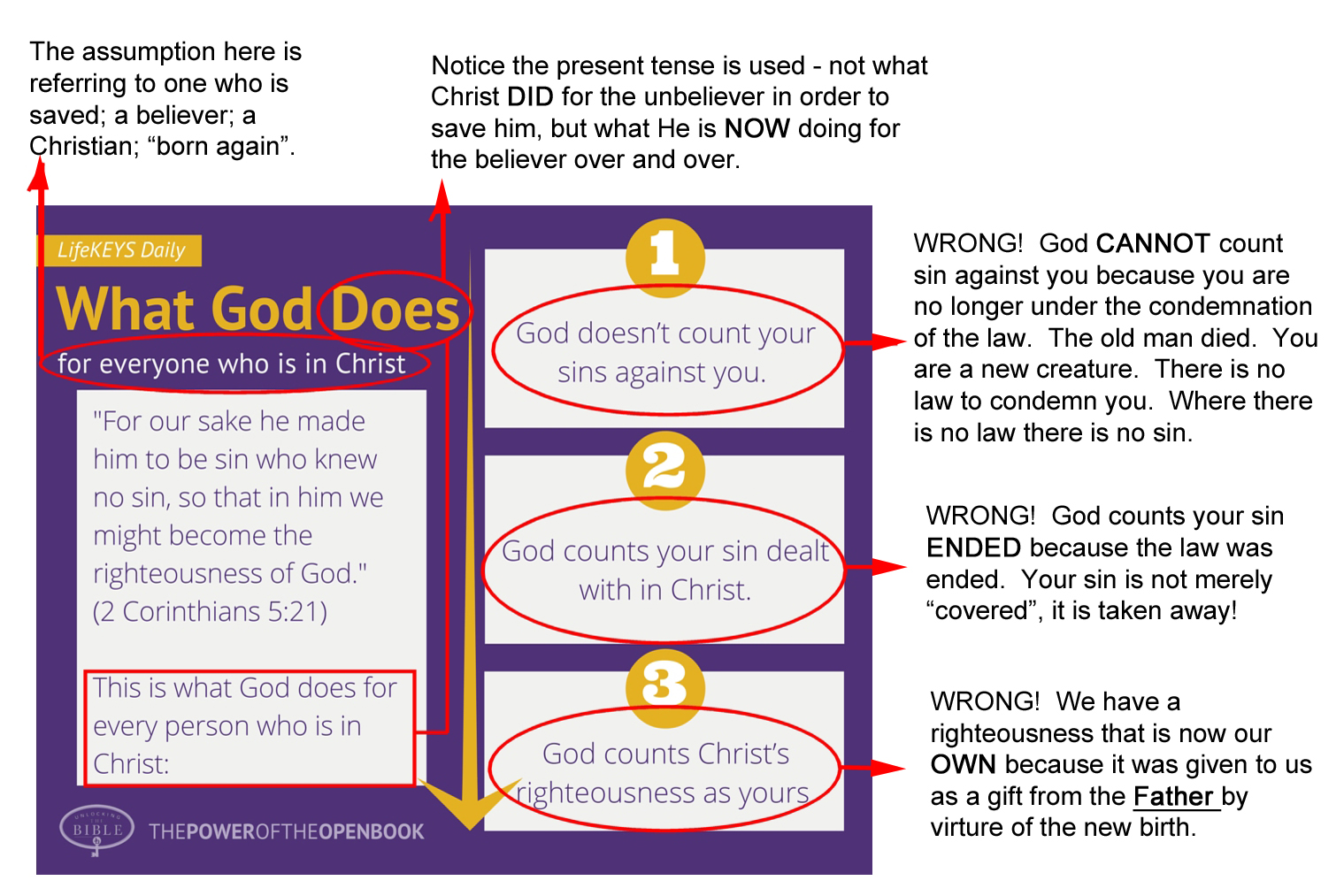
What God Does in Protestant Progressive Justification
There was a meme in my Facebook news feed that caught my eye this morning. I felt compelled to make some corrections to it. If you still don’t believe that Protestantism teaches progressive justification, think again.
Andy
American Clergy Brilliance: “The Gospel of Jesus Christ: An Evangelical Celebration”

“Look, think about this; even an adolescent Sunday school student can see it: if the righteousness of God is revealed apart from the law (Romans 3:21), why would Christ need to keep it for our justification? For crying out loud, what does ‘apart’ mean?”
My theses for this year’s TANC conference highlights the fact that the Reformers taught from a totally different reality than a normative reality that draws logical conclusions from the arrangement of verbs, nouns, prepositions, adjectives, conjunctions, etc. taken at face value. The Reformers created their own metaphysical premise for interpreting reality. The authentic Reformed gospel is predicated on a contra reality. This is one of four reasons that the authentic Reformed gospel experiences a social death periodically throughout church history, and then periodic resurgence movements like the one we are presently in via New Calvinism. There have been five of these resurgence movements sense Calvin’s theocracy in Geneva. They will be documented in volume two of The Truth About New Calvinism. As Christians read their Bibles, they are naturally drawn away from the authentic Reformed gospel because the human tendency is to interpret reality from the normative perspective. They become uncomfortable with the contradictions. However, as each resurgence dies a social death, Protestant traditions of men continue to be a significant part of what emerges from the ashes. A Reformed hybrid emerges that apes the anemic sanctification spawned by Reformed thought. This lays the ground work for the resurgences that follow. Protestantism, historically, oscillates between the weak sanctification of the hybrid and the despotic resurgence movements that temporarily replace the hybrid. Basically, the vicious cycle must be stopped if revival is going to be possible. God sanctifies with truth, not the traditions of men. Part and parcel is a dumbed-down Christianity saturated with the traditions of Reformed men—primarily dead ones. Men of old that are deemed geniuses are often mindless Kool-Aid drinking followers of John Calvin and his ugly stepchildren, the murdering despotic Puritans. Part of the Protestant tradition that carries on is the big “O,” ORTHODOXY. A synonym for “truth” in American churchianity, it is really the repackaging of truth interpreted by the Protestant elite for consumption by the unenlightened masses. The American church follows the tradition of Protestantism when the arrogant, elitist who’s who of evangelicalism come together and publish declarations, i.e., the confessions and creeds of traditional Reformed thought. A recent example of this is the third edition of The Gospel of Jesus Christ: An Evangelical Celebration (1994, 1997, 1999) signed and/or endorsed by, for example, the following: John Ankerberg, Kay Arthur, Tony Evans, Jerry Falwell, Bill Hybels, David Jeremiah, D. James Kennedy, Max Lucado, Woodrow Kroll, Tim & Beverly LaHaye, Erwin Lutzer, Bill McCartney, Luis Palau, Pat Robertson, Ronald Sider, Charles Stanley, John Stott, Joseph Stowell, Chuck Swindoll, Bruce Wilkinson, Ravi Zacharias, Jack Hayford, Steven Strang, John MacArthur Jr., RC Sproul, Charles Colson, Bill Bright, and JI Packer. Only problem is, the document denies the new birth and describes Christians as being under the law as opposed to being under grace. In other words, the authentic gospel of the Reformation. First, the document speaks from the perspective of the authentic Reformed gospel that only recognizes the possibility of a linear gospel, ie., the “golden chain of salvation.” Because sanctification is the links of a chain that stretches from justification to glorification, the links must stay intact by the same gospel that saved us. Hence, grace cannot be inside of the believer because that makes him/her a participant in the completion of justification. Justification is only a finished work if we live among the sanctification links in the same way we were saved—by faith alone. The Reformers only recognized this reality, and judged all other gospels from the same reality. Grace is either infused within the believer, making him/her a participant in finishing justification, or grace remains completely outside of the believer. The alternative that sanctification is completely separate, a parallel gospel, is not considered to be a possible reality. Accordingly, note the following statement in said GEC document:
We deny that we are justified by the righteousness of Christ infused into us or by any righteousness that is thought to inhere within us.
The Reformers believed that ALL grace and righteousness must remain OUTSIDE of the believer or it by default made him/her a participant in the completion of justification. They got around the mass of prepositions throughout Scripture that clearly state that grace is within us by utilizing the emphasis hermeneutic (the redemptive historical hermeneutic). This hermeneutic is a Gnostic concept derived from Plato’s theory of forms. I will delve into this in detail during my second session at this year’s TANC conference. Granted, many of the signers probably didn’t, and still don’t understand what the Reformers believed, and I believe other signers such as RC Sproul deliberately play on that confusion. Secondly, the doctrine propagates the Reformed mainstay of Christ’s perfect obedience to the law being imputed to our sanctification so that “sanctification is not the ‘ground’ of our justification.” See the chain thing going on there? Our enablement in sanctification necessarily makes sanctification the GROUND of our justification because sanctification finishes justification. It’s a “chain.” Here is what the document states:
God’s justification of those who trust in him, according to the Gospel, is a decisive transition, here and now, from a state of condemnation and wrath because of their sins to one of acceptance and favor by virtue of Jesus’ flawless obedience culminating in his voluntary sin-bearing death.
And….
We affirm that Christ’s saving work included both his life and his death on our behalf (Gal. 3:13). We declare that faith in the perfect obedience of Christ by which he fulfilled all the demands of the Law of God on our behalf is essential to the Gospel. We deny that our salvation was achieved merely or exclusively by the death of Christ without reference to his life of perfect righteousness.
Look, think about this; even an adolescent Sunday school student can see it: if the righteousness of God is revealed apart from the law (Romans 3:21), why would Christ need to keep it for our justification? For crying out loud, what does ‘apart’ mean? Worse yet is the idea that this perfect obedience is imputed to our sanctification if we live our Christian lives by faith alone because sanctification is a progressive process that finishes justification. James refuted this idea in no certain terms, which is why the Reformers questioned its rightful place in the New Testament canon. Moreover, this idea keeps Christians “under the law,” which is the biblical designation for the unregenerate. I don’t know much about the theologian William R. Newell, but with that disclaimer, I will say that I agree with his opinion in regard to this issue:
The fatal result of this terrible error is to leave The Law as claimant over those in Christ: for, “Law has dominion over a man as long as he liveth” (7.1). Unless you are able to believe in your very heart that you died with Christ, that your old man was crucified with Him, and that you were buried, and that your history before God in Adam the first came to an utter end at Calvary, you will never get free from the claims of Law upon your conscience (William R. Newell: Verse by Verse Commentary on Romans).
Hence, the law remains a claimant over the believer at any point where he/she stops living their life by faith alone in the same gospel that saved them rather than belief in the new birth followed by the death of the old us that died with Christ and is no longer under the law. We must now fear that our obedience in sanctification is making the law the “ground” of our justification. Likewise, Calvin stated the following: Another principal part of our reconciliation with God was that man, who had lost himself by his disobedience, should by way of remedy oppose to it obedience, satisfy the justice of God, and pay the penalty of sin. Editor’s note: For our redemption, Christ kept the Law for us and died upon the Cross. By this, Christ obtained forgiveness of sins for us (Calvin on the Mediator: Chapel Library press, 2009). This is also known as “vicarious law-keeping.” A definition of vicarious is:
Adjective Experienced in the imagination through the feelings or actions of another person: “vicarious pleasure.” Acting or done for another: “a vicarious atonement”.
Christians need to stop following men in general, and Reformed men in particular. God only sanctifies with truth, and Reformed doctrine does not save or sanctify accordingly. It calls for a salvation by law-keeping and who keeps it is not the issue. The law as a standard for justification is the issue. It also denies the different relationship of the law to believers as opposed to unbelievers: the law provokes the former to righteousness, and provokes the latter to sin. It skews the very biblical definition of the regenerate.
paul

 Paul's Passing Thoughts
leave a comment