The 95 Theses Against New Calvinism pdf file
The 95 Theses Against New Calvinism
__________________________________
Piper, Carson, Keller: The Only Cure For Pornography is Gospel Contemplation
This video clarifies the fact that there is a line in the sand. The church cannot continue to pretend that both philosophies will help Christians—that’s not true. Also, New Calvinists cannot continue to call the biblical prescription “legalism” unfettered and without contention. How Christians live is at stake.
I was struck by a post written by Jay Adams the other day. The idea that being filled with the Spirit is the Spirit being at work in all areas / categories of our life because one area effects another. This of course requires us to learn what the Bible instructs in regard to those areas and applying it to our lives. This is what builds a life that will withstand the storm (Matthew 7: 24-27). And furthermore, how to think, do, and pray in regard to all areas as well.
His example was a guy who has a problem with alcohol who fell off the wagon. He got into a fight with his wife and then, as a result, went to the local watering hole and got drunk with his buddies. We would not tell him to just stop drinking. His relationship with his wife, how he responds to challenges and choices (in this case: lost friends verses saved friends) all played a part in the transgression. All areas of our life contribute to how we think and what we do. This isn’t just a matter of obedience; I think alignment with God’s word in all areas of life is the way of peace and joy. Moreover, Christ promised the Holy Spirit will help us, counsel us, illuminate us, and empower us to accomplish God’s will. We can do all things through Him who strengthens us, but note who is also doing—we must do our part, and it won’t always be easy. To look at this concept as “living by a list,” “a bunch of do’s and don’ts,” “moralism,” “legalism,” or “Phariseeism” is a lie from the pit of hell and will lead to a life of misery.
In the following video, Piper, Carson, and Keller teach that the key to overcoming pornography is contemplation on the gospel. If we come to grips with how horrible our sin is and what Christ had to do about it, and what He did do about it, we will realize how much Christ loves us on the one hand, and learn to loath the sin on the other. Keller also mentions that realizing how much Christ loves us (because of the cross) will lead to us not hating ourselves which he notes as a major contributor to sin. Of course, the Bible states the opposite: a primarily source of sin comes from loving ourselves more than we love others.
Furthermore, the biblical prescription for learning to hate sin is not contemplation on the gospel, but rather investment. We learn to hate something by not investing in it, but instead investing in something else. People unwittingly learn to hate their spouses in this way. Lack of investment verses other things and a dwelling on their negative aspects only which is not truthful thinking to begin with.
Yes, after Piper advocates spiritual contemplation and Keller adds to the error by adding self esteem psycho-babble, Carson mentions accountability, but be not deceived and listen carefully—he is saying that accountability is only a temporary stopgap until gospel contemplation kicks in. In other words, practical measures as instructed by Scripture are not curative, only gospel contemplation is. In the end, they all agree that accountability lingers close to legalism, and the absolute necessity that those holding one accountable are also gospel centered.
The following video clarifies the fact that there is a line in the sand. The church cannot continue to pretend that both philosophies will help Christians—that’s not true. Also, New Calvinists cannot continue to call the biblical prescription “legalism” unfettered and without contention. How Christians live is at stake.
A Response to Aaron O’Kelly, Part Two: Dr. O’Kelly is Only Totally Depraved When He Talks About It
Once again, pardon me for concluding from statements like this that Horton sees no difference between the spiritual condition of the saved /unsaved, and their equal need for the gospel of justification only.
As we continue our work concerning Aaron O’Kelly’s response to my open letter to Peter Lumpkin, it is difficult to know where to go next; the response is rich with post material. However, in this second part, we will focus on the following excerpt as we continue to evaluate New Calvinism with Dr. O’Kelly’s help:
“Dohse does make the claim that the NC denies the significance of the new birth. Such a claim is simply false. Some figures on the chart, such as Goldsworthy, have argued that the message of the gospel cannot be equated with the message of the new birth (and to what degree the new birth should be categorized as a component of the gospel or as an implication of the gospel is a point on which you would find disagreement within the NC), but such a denial does not entail that the new birth is insignificant.
Furthermore, the claim that the official teaching of the NC is that believers remain totally depraved after regeneration is likewise suspect. I myself am not aware of any uniformity among the theologians on the chart with regard to this question, nor have I ever heard any of them discuss it at length. I would imagine that different theologians on the chart would speak of it in different ways. It is certainly no pillar of NC orthodoxy, as Dohse implies. In my own practice, I often speak of myself as totally depraved, but what I mean by that is, considered apart from the grace of Christ, I am totally depraved in and of myself. It is a conceptual category that enables me to speak of myself from a certain perspective, not a theological statement about the inefficacy of regeneration to give me spiritual life. Again, this way of speaking likewise goes at least back to Luther.”
First, A-OK (Dr. Aaron O’Kelly) rightly words my claim: “Dohse does make the claim that the NC denies the significance of the new birth.” Then A-Ok follows with this: “Such a claim is simply false.” Really? I apologize that I got that idea from quotes such as this from New Calvinist Michael Horton:
“But to whom are we introducing people to, Christ or to ourselves? Is the ‘Good News’ no longer Christ’s doing and dying, but our own ‘Spirit-filled’ life?”
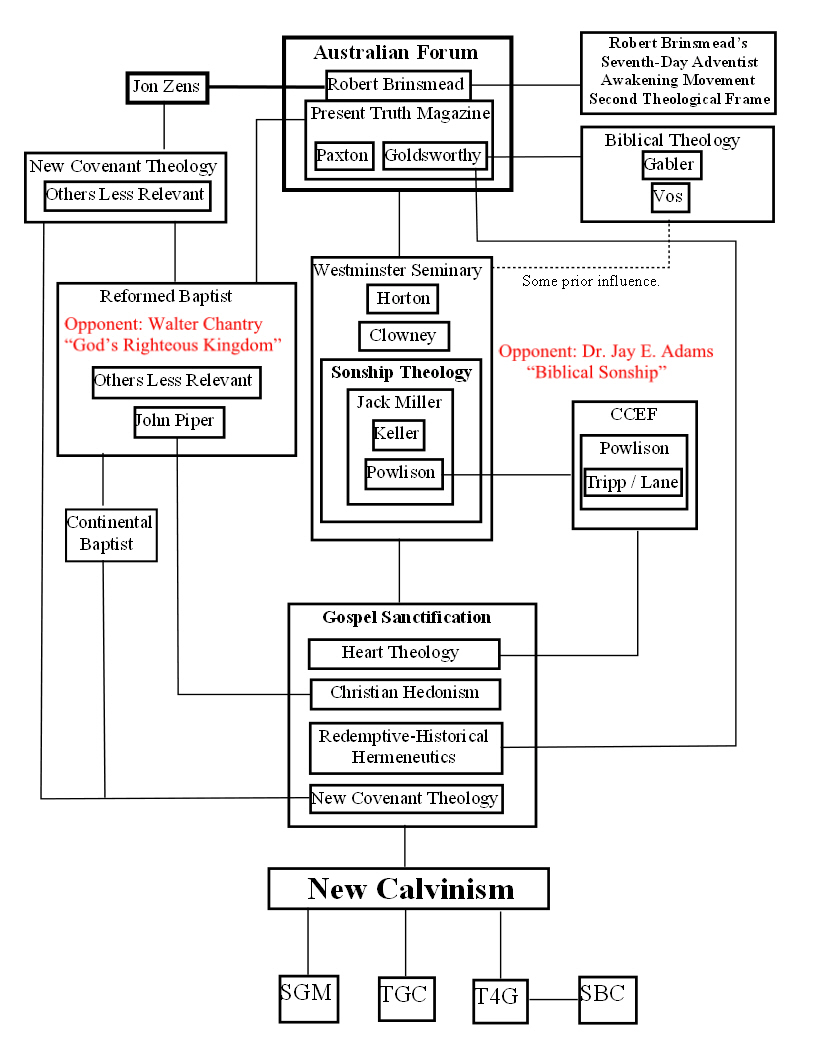
I further apologize that I got that idea because of the following: according to at least one author, much of Horton’s theological thinking and ministry philosophy was formed by the Australian Forum. In a particular article written by the Forum, Goeffrey Paxton states, “It [the new birth] robs Christ of His glory by putting the Spirit’s work in the believer above and therefore against what Christ has done for the believer in His doing and dying.” I found this comparison when one of my readers flippantly commented that he wondered if Horton got one of his favorite jingles, “Christ’s doing and dying” from the Forum. For giggles, I looked into it and was shocked to find the latter quote from the Forum. The quote comes from an article written by the Forum entitled “The False Gospel of the New Birth.” I suppose drawing any conclusions from such a title is presumptuous. Furthermore, Goldsworthy prefaced Paxton’s article with a footnote to make his point clear concerning this statement in Obituary for the Old Testament (G. Goldsworthy, PT vol.41 article2): “And the new-birth oriented ‘Jesus-in-my-heart’ gospel of evangelicals has destroyed the Old Testament just as effectively as has nineteenth-century liberalism.”
Notice, I repeat, notice how all three quotes frame any emphasis on the new birth as another gospel: “Is the ‘Good News’ no longer….but [rather] our….” “….by putting the Spirit’s work in the believer above and therefore against….” “And the new-birth oriented ‘Jesus-in-my-heart’ gospel [emphasis mine]….”
Moreover, Horton said this in Christless Christianity, page 62:
“Where we land on these issues is perhaps the most significant factor in how we approach our own faith and practice and communicate it to the world. If not only the unregenerate but the regenerate are always dependent at every moment on the free grace of God disclosed in the gospel, then nothing can raise those who are spiritually dead or continually give life to Christ’s flock but the Spirit working through the gospel. When this happens (not just once, but every time we encounter the gospel afresh), the Spirit progressively transforms us into Christ’s image. Start with Christ (that is, the gospel) and you get sanctification in the bargain; begin with Christ and move on to something else, and you lose both.”
Once again, pardon me for concluding from statements like this that Horton sees no difference between the spiritual condition of the saved /unsaved, and their equal need for the gospel of justification only. And even though the consequences of “move[ing] on to something else” is the loss of justification (ie., your lost), he doesn’t qualify what “something else” is. In my first part, if you observe my citation of Tullian Tchividjian, his “something else” is “deeper theological waters.” Am I the only one who has a problem with this? Also, spare me the Horton quotes where he appears to emphasize obedience. Horton believes, like many New Calvinist, that biblical imperatives are meant to “drive us to despair of self righteousness” so that we will gain a deeper understanding of our need for justification—in contrast to new creatures who find joy in obedience (though joy does not walk with obedience at every moment) as they are aided by the “Helper” (ESV John 14:15-17).
Throughout his post A-OK employs the New Calvinist protocol to deflect accountability for any particular belief; “One final observation to make before I close is that Dohse appears to be completely unaware of the fact that a very substantive discussion, including a good bit of back-and-forth disagreement, has been going on right in the center of the NC for some time now over the very question of sanctification and how the gospel and our own personal efforts are related to it. Justin Taylor provided a roundup of that discussion here. A quick perusal of that conversation will reveal quite clearly that there is no official New Calvinist position on the question, as Dohse implies. It is an ongoing conversation with significant areas of disagreement within the movement.”
In case, after case, after case, after case, those who confront elders about what is being taught in their churches, and trying to get to the bottom of it, hear this: “Well, all of the elders do not agree on that point.” This is a classic method implemented by cults to avoid coming clean about what they believe until the sheep are “ready to receive it.” And in fact, I will be discussing in one of the next parts how New Calvinism nurtures a cult-like atmosphere in churches since A-OK brought the “cult” angle into the discussion.
However, A-OK does clarify his own position; I think, anyway. After implementing the aforementioned deflection technique cited in another part of his post, He states:
“In my own practice, I often speak of myself as totally depraved, but what I mean by that is, considered apart from the grace of Christ, I am totally depraved in and of myself. It is a conceptual category that enables me to speak of myself from a certain perspective, not a theological statement about the inefficacy of regeneration to give me spiritual life. Again, this way of speaking likewise goes at least back to Luther.”
Here, we can see exactly what New Calvinist really believe about the new birth. First, why would it ever be necessary to speak of a Christian as totally depraved in any context? It goes without saying that if Christ does not indwell us we are not spiritually alive. So why frame anything that way unless you’re talking about BC/AC? And if that is what he is talking about in the above statement, he certainly doesn’t say so. I mean really: “Hey guys, did you know that if Christ didn’t indwell us we would be totally depraved?” Well, duh.
The key to understanding what A-OK is saying is the notation of these two phrases: “I am totally depraved in and of myself (present tense is assumed; ‘I am’)” and “….not a theological statement about the inefficacy of regeneration to give me spiritual life.” This concept was articulated by New Calvinist Paul David Tripp in How People Change. Throughout the book, Tripp refers to the “living Christ” over, and over again as if we didn’t know that Christ is alive. Then on pages 64, and 65 (2006 edition) he plainly states that Christians are spiritually dead, writing, “When you are dead you can’t do anything.” Simply stated, we are still spiritually dead and the living Christ within us obeys for us. This is also strongly implied by how many New Calvinists treat Galatians 2:20. We are not actually new creatures per se, but the only thing within us that is alive is Christ through the Holy Spirit. Before you reject this notion out of hand (though you must admit that it can be seen in Aaron’s careful wording), read Donn Arms’ book review on How People Change here: http://www.nouthetic.org/blog/?p=4793 Or here: http://wp.me/pmd7S-EC .
As Christians, if we are, as Dr. O’Kelly writes, “….totally depraved in and of myself,” how can the Holy Spirit be our “Helper.” What’s a helper? There is no helping the dead, the Holy Spirit would have to do all the work. And trust me, that’s what they really believe. Yet, not only did Christ say, “You must be born again,” the apostle Paul said, “Behold, all things are new.” New for whom? The Holy Spirit certainly doesn’t need anything new. The apostle also said to put off the old man (some translations, “former”) and put on the new creation. Does the Holy Spirit need to put anything new on Himself? I think not.
The implications here are profound. And frankly, I do not give a rat’s behind about disagreements between New Calvinist hacks. At the very least, their position is unclear—that’s on them. Moreover, again, where did Luther ever write: “We must preach the gospel to ourselves everyday”? And if he did, so what? The Bereans didn’t give the apostle Paul a pass on truth; and trust me, Luther was no apostle Paul.
paul

Gospel Sanctification and Sonship’s Gospel-Driven Genealogy, Part 11: Walter Chantry’s Suffering
 One day I hope to meet him. Soon, it would be like those meetings we used to see on Oprah where people who have suffered the same type of traumas meet to share their experiences. In fact, there are clubs all over the country where people meet to do just that. It’s like they have always known each other, and the very first meetings are filled with tears and hugging. Whether it’s the My Poodle Was Slain by a Pitbull in Front of My Eyes Club or some other club of trauma, the reunions seem to be a healing balm of some sort.
Chantry and I could start our own club for those who are traumatized by debating proponents of New Covenant Theology. Chantry tried to destroy the evil child soon after it was delivered and wasn’t yet named ( http://wp.me/pmd7S-Ld ). Apparently, survivors of Chantry’s onslaught split from Reformed Baptist into a meager fellowship called Continental Baptist. New Covenant Theology (NCT) is based on the Australian Forum’s centrality of the objective gospel (COG) which found new life in Sonship Theology and is now a gargantuan movement known as New Calvinism. Chantry’s bantering back and forth with one of two patriarchs of NCT, Jon Zens, is well documented and exhausting. One example can be seen here: http://solochristo.com/theology/nct/zens-chantry.htm .
Method 1: Annoying, and repetitious oversimplified denial.
Chantry, knowing that NCT hacks like to confuse and wear down their opponents with an endless flogging of residual issues, rightly focused on the fact that it all boils down to Antinomianism. The very annoying way in which Zens debates can be seen clearly in present-day COG proponents; for example, “Show me one reference where I have ever written that I am an Antinomian you slanderer!” Chantry’s reply usually followed along these lines: “For substantiation of what I have to say, I could quote almost the entirety of the articles that you [Zens] have printed in ‘Baptist Reformation Review.'” Further, he [Chantry] viewed my [Zens] pleas for documentation as “quibbling about words, a mere strife about terminology that has no point to it.”
Method 2: Rewrite traditional meaning.
COG proponents are very sensitive to the Antinomian charge, so they continually attempt to rewrite the English language and church history to avoid the accusation. Recent articles by Tullian Tchividjian and Elyse Fitzpatrick deny that there is any such thing as Antinomianism. They also try to replace the word “antinomianism” with what they call “neonomianism (“new legalism” as opposed to “anti-law”). Likewise, “obedience” (we obey) is replaced with “new obedience” (Jesus obeyed in our place as part of the atonement, and apparently still obeys for us via the imputed active obedience of Christ). Sanctification is now “progressive sanctification” which is nothing more than the unfolding of our justification via John Piper’s “beholding as a way of becoming.” Of course, he includes “….a way….” so if he’s confronted he can say that he’s talking about contemplative spirituality being just one of many avenues while assuring us that he believes in “obedience.” But of course, he’s really talking about “New Obedience.”
Method 3: Fake contentions against supposedly contrary beliefs.
COG proponents contend against many other belief systems as a way to appear like standguards for orthodox truth. Often, the “contrary” beliefs are very similar to their own. An assistant to DA Carson recently wrote a book on Keswick theology, which has many similarities to COG. Carson also disses Keswick theology on a routine bases, but according to one article:
“Beginning in the 1920s, the Keswick Convention’s view of sanctification began to shift from the view promoted by the leaders of the early convention. William Graham Scroggie (1877–1958) led that transformation to a view of sanctification closer to the Reformed view. Today its speakers include people like D. A. Carson and Sinclair Ferguson, whose views on the Christian life differ significantly from the Keswick Convention’s first generation.” http://ccclh.org/blog/?p=1234
….But apparently, not the second generation of Keswick theology. One of their (COG proponents) favorite targets is postmodernism or the Emergent Church who they share like philosophies with. I go into detail on this subject here: http://wp.me/pmd7S-Lk
Method 4: Quote other leaders who have written against COG-like doctrines.
JC Ryle wrote extensively on doctrines that distorted biblical sanctification, and many of them were very similar to New Calvinism and NCT. In fact, such doctrines that were running about in his day inspired his famous “Scriptural Holiness” which is considered to be one of the best works on Christian living ever written. The introduction outlines seven elements of Quietist type doctrines that fit Gospel Sanctification to a T. Therefore, COG proponents like Kevin Deyoung now quote Ryle extensively. A proponent of NCT has recently sent me emails that contain excerpts from Scriptural Holiness that seem to indicate Ryle supported a synthesis of justification and sanctification, and asked me to post them. Only problem is, I am very familiar with Ryles writings and find the suggestion preposterous. Knowing what I know about Ryle’s theological positions, I assume the quotes pertain to a contention against those who believe that sanctification is a much lesser concern than justification. This doesn’t mean Ryle believed they are exactly the same in essence as the proponent implied.
Mix those four methods with an attitude that is driven by a belief that God is using them to orchestrate a “second reformation” (I’m not joking), and the same kind of confidence the apostle Paul mentioned about the false teachers he contended with, and what you have is a serious Excedrin headache. With that said, one remembers what Jay Adams said about Quietist type doctrines: they will “ruin people’s lives.” He also said Gospel Sanctification is “dangerous and must be stopped.” No doubt—so the fight continues.
paul

 Paul's Passing Thoughts

1 comment