Does Protestantism Require Church Membership for Salvation?
 It most certainly does, but the reason church membership is required by the Protestant faith is far more scandalous than that one symptom. We will start with the core gospel of the Protestant religion, and then see how required membership in the local church is efficacious to its gospel.
How “Christians” that are far removed from the original Protestant tradition function is no defense for its official Reformed gospel. Protestants can’t have it both ways though they try. They excuse what Luther and Calvin taught because not all Protestants function by every jot and tittle. But on the other hand, they deem other religions as false based on their original statement of faith. Obviously, no Protestant will give a Buddhist a pass for one second because, “Not all Buddhists believe the exact same things that Buddha believed.”
By and large, the problem is that most Protestants really don’t know what the Protestant gospel is, and when they are confronted, they choose to defend their investment in it for whatever reason. At least one reason follows: investing in the truth is hard work. Protestantism, like many other religions, propagates the farming-out of their faith to the experts. Of course, that is very ill advised.
First, we will look at a summary of the Protestant gospel, and then establish the summary with specific citations. The core principle is progressive justification. This is the idea that salvation is a process and not a onetime passing from death to life. This fact about Protestantism surprises many Protestants. Many tout “once saved always saved,” but that’s not what the Reformers taught at all. They taught that the justified state was a progression from definitive justification to final justification, and the process in the middle is subjective justification. The process in the middle is really progressive justification, but many Reformed scholars deny that in the face of insurmountable evidence. In fact, the title of chapter 14 in book 3 of the Calvin Institutes is, “The Beginning of Justification. In What Sense Progressive.” In other words, justification is present continuance; it’s not a onetime finished event.
As we will see, the institutional church established by the church at Rome circa 4th century is deemed as God’s institution that oversees the progression of justification for God’s people. Unless you are a member of a local church, your salvation cannot progress from point A to point B. Remember, the Reformation did not really seek to replace the “Mother Church,” but rather sought to reform it. Luther, Calvin, nor their mentor St. Augustine ever officially left the Catholic Church. Luther and Calvin had a dying devotion to Augustine until the end who is an official Doctor of Grace in the Catholic Church until this day.
Foundational to Protestantism is the idea that Christ’s death served two purposes for sin: an unconditional forgiveness of past sin, and a conditional forgiveness for “present sin” and future sin. The condition for receiving forgiveness for “present” and future sin was membership in the local church signified and confirmed by water baptism. They didn’t teach baptismal regeneration directly, but taught that forgiveness of present and future sin can only be received in the church, and only water baptism made someone a true member of the church:
“Wherefore, our initiation into the fellowship of the church is, by the symbol of ablution, to teach us that we have no admission into the family of God, unless by his goodness our impurities are previously washed away” (The Calvin Institutes: 4.1.20).
“Nor by remission of sins does the Lord only once for all elect and admit us into the Church, but by the same means he preserves and defends us in it. For what would it avail us to receive a pardon of which we were afterwards to have no use? That the mercy of the Lord would be vain and delusive if only granted once, all the godly can bear witness; for there is none who is not conscious, during his whole life, of many infirmities which stand in need of divine mercy. And truly it is not without cause that the Lord promises this gift specially to his own household, nor in vain that he orders the same message of reconciliation to be daily delivered to them” (The Calvin Institutes: 4.1.21).
“To impart this blessing to us, the keys have been given to the Church (Mt. 16:19; 18:18). For when Christ gave the command to the apostles, and conferred the power of forgiving sins, he not merely intended that they should loose the sins of those who should be converted from impiety to the faith of Christ; but, moreover, that they should perpetually perform this office among believers” (The Calvin Institutes: 4.1.22).
“Secondly, This benefit is so peculiar to the Church, that we cannot enjoy it unless we continue in the communion of the Church. Thirdly, It is dispensed to us by the ministers and pastors of the Church, either in the preaching of the Gospel or the administration of the Sacraments, and herein is especially manifested the power of the keys, which the Lord has bestowed on the company of the faithful. Accordingly, let each of us consider it to be his duty to seek forgiveness of sins only where the Lord has placed it. Of the public reconciliation which relates to discipline, we shall speak at the proper place” (Ibid).
“…by new sins we continually separate ourselves, as far as we can, from the grace of God… Thus it is, that all the saints have need of the daily forgiveness of sins; for this alone keeps us in the family of God” (John Calvin: Commentaries on the Catholic Epistles; The Calvin Translation Society 1855. Editor: John Owen, p. 165 ¶4).
“. . . forgiveness of sins is not a matter of a passing work or action, but comes from baptism which is of perpetual duration, until we arise from the dead” (Luther’s Works: American ed.; Philadelphia: Muhlenberg Press; St. Louis: Concordia, 1955, vol. 34, p. 163).
“. . . Forgiveness of sins is not a matter of a passing work or action, but of perpetual duration. For the forgiveness of sins begins in baptism and remains with us all the way to death, until we arise from the dead, and leads us into life eternal. So we live continually under the remission of sins. Christ. is truly and constantly the liberator from our sins, is called our Savior, and saves us by taking away our sins. If, however, he saves us always and continually, then we are constantly sinners” (Ibid, p.164).
“For the forgiveness of sins is a continuing divine work, until we die. Sin does not cease. Accordingly, Christ saves us perpetually” (Ibid., p.190).
“Daily we sin, daily we are continually justified, just as a doctor is forced to heal sickness day by day until it is cured” (Ibid., p.191).
Hence, notice that there is no distinction made between sins committed as unbelievers and sins committed as believers. Sin is sin and needs a perpetual forgiveness in order for the “believer” to remain justified. The only difference is unconditional forgiveness (sin committed as an unbeliever) and conditional forgiveness, i.e., you can only receive forgiveness as a member of the local church.
Also note the shocking assertion, usually attributed to Catholic priests, that pastors/elders have the authority to grant forgiveness for present and future sin.
paul
Why the Five Solas are an Anti-Love Abomination: Romans 12:1

Originally published October 4, 2014
The biblical way of living life is pretty straightforward in the Scriptures. The sacrifice of Christ on the cross saved us, and then we move on to the “living sacrifice.” Calvinism propagates a perpetual return to the onetime sacrifice of Christ for all sin and insists that this onetime act must be continually reapplied to our lives by “faith alone” in order to keep ourselves saved. This is what “preaching the gospel to ourselves every day” is all about. It’s a contemporary term, but it is grounded in the doctrinal foundations of the Protestant Reformation.
This is also what is behind the sacred sola fide (faith alone) of the five solas of the Protestant Reformation. But, “faith alone” means literally faith alone in both salvation and sanctification (Christian living). James railed against sanctification by faith alone in no uncertain terms, and thus, his epistle wasn’t exactly Luther’s favorite. In the same way that we assume total depravity of the five points of Calvinism only applies to the unregenerate, ignorant Protestants assume much and think little. When they read or listen to orthodoxy, their minds are programmed to receive only. In Protestant churches everywhere, the five solas are proudly displayed at the front of the church while in reality this clarion cry of Protestantism is a biblical abomination. Hence, from heaven’s viewpoint, this worldwide collective mockery on Sunday morning must be a beholding of unimaginable proportions.
Why is this? Well, because “Christians” “still sin.” And hey, if we still sin, we must need forgiveness every day. And hey, if we still need forgiveness, we can only get it from the original source—the cross. So, the Christian life becomes an endeavor to keep our new sins covered by a continual return to the same gospel that saved us.
This is a result of an egregiously flawed view of the law that has eternal consequences. Christ died on the cross to end the law, and the law NEVER had any connection to justification. Christ died on the cross to reveal the righteousness of God APART from the law. Calvinism makes the law to be justification’s standard, and it NEVER was. Calvinism makes the law something that must be fulfilled in order to maintain and define righteousness (justification). Therefore, Christians remain under law which is the very biblical definition of a lost person. One is either under law, or under grace. Lost, or saved. Calvin and Luther defined “Christians” as under law.
According to their doctrine, Christ ended the law by fulfilling it while he lived on earth and obeying the law perfectly. This is an “ending” defined by an ending to us keeping it, not Christ. This makes the law the definition and standard of God’s righteousness. That’s a huge problem. Christians are then still under law, and must return to the cross so that the law continues to be satisfied by reapplying the death and life of Christ by faith alone (sola fide).
This is nothing new, and is the same Galatian error that Paul stood against. What was his argument? He argued that if a perfect fulfillment of the law defined righteousness (justification), there is life in the law, and the promise was by two seeds, and not just one…that is, Christ. However, Paul made the point that there is only one seed, and therefore NO life in the law…for righteousness. That’s the key, “for righteousness.”
Christ ended the law for righteousness, and our sins are not merely COVERED by a supposed need to return to the cross—our sins are ENDED.
Calvinism’s anti-gospel view of the law is not only a false gospel, but sucks all of the life out of sanctification. Why? It places sanctification under the precarious auspices of the law for justification making justification a process rather than a finished work. Protestants do not know what it means to be under grace. “Under grace” means that Christ fulfills the demands of the law in our stead—that’s a false gospel.
In his letter to the Romans, Paul begins 12:1 with, “I appeal to you therefore….” This appeal was based on everything he had written in the first eleven chapters. The Reformed assert that this is Paul’s call to fulfill the imperatives that follow by returning to the first eleven chapters daily; in essence, a return to the sacrifice of Christ and the cross. Not so, this is an appeal by Paul to move from Christ’s sacrifice to our sacrifice…
…to present your bodies as a living sacrifice, holy and acceptable to God, which is your spiritual worship.
Paul then proceeds with instruction on how to do that. Key to understanding this is knowing that the body, or members, are NOT inherently evil. We sin because the body is “weak,” and mortal, not inherently evil. Notice from the citation above that the body can be used for holy purposes. Also note that we are the presenters to God, and this presentation is “spiritual worship.” Worship is using our minds and bodies to love God and others according to Scripture 24/7:
Romans 13:8 – Owe no one anything, except to love each other, for the one who loves another has fulfilled the law. 9 For the commandments, “You shall not commit adultery, You shall not murder, You shall not steal, You shall not covet,” and any other commandment, are summed up in this word: “You shall love your neighbor as yourself.” 10 Love does no wrong to a neighbor; therefore love is the fulfilling of the law.
Galatians 5:6 – For in Christ Jesus neither circumcision nor uncircumcision counts for anything, but only faith working through love.
Notice in Galatians 5:6 that faith works. This speaks against the anti-gospel lie of sola fide of which all of the five solas stand in the same way that all five points of Calvinism stand or fall on total depravity. Faith is not alone in sanctification in the same way that faith is alone in justification. When that view is proffered, it is telling that such also proffers a gospel that keeps people under law and thus makes justification progressive instead of a finished work. This was James’ very contention against a faith without works in sanctification; in essence, it reveals what you believe about justification.
Moreover, a faith alone that does not work completely circumvents the primary purpose of the living saint: love. In the same way that being under law violates every point of the law when one point is violated (James 2:10), the one under grace fulfills the whole law with one act of love:
for the one who loves another has fulfilled the law. For the commandments, “You shall not commit adultery, You shall not murder, You shall not steal, You shall not covet,” and any other commandment, are summed up in this word: “You shall love your neighbor as yourself.” Love does no wrong to a neighbor; therefore love is the fulfilling of the law.
Is this meant to be literal? Perhaps not, BUT for certain, it demonstrates that the Christian cannot sin against the finished work of justification in anyway because where there is no law, there is no sin (Romans 5:13). Christ’s death on the cross ended the law FOR justification—while we fulfill the law by acts of love and…
Romans 6:12 – Let not sin therefore reign in your mortal body, to make you obey its passions. 13 Do not present your members to sin as instruments for unrighteousness, but present yourselves to God as those who have been brought from death to life, and your members to God as instruments for righteousness. 14 For sin will have no dominion over you, since you are not under law but under grace.
It is now our choice to allow sin to reign in our mortal bodies because the ending of the law strips sin of condemnation. Sin’s ability to condemn through the law has been ended, and therefore, sin has no power over us:
1Corithians 15:56 – The sting of death is sin, and the power of sin is the law. 57 But thanks be to God, who gives us the victory through our Lord Jesus Christ.
We have victory over sin because Christ ended the law and stripped sin of its ability to condemn—Christians do not sin in regard to justification and never needed Christ to fulfill the law of sin and death in our stead; in the present, or the past. He died to end the law. We are now free to fulfill the law of the Spirit of life through love which are actions done by us and described by Paul in Romans chapters 12-16. We can only sin against love, not justification, and Christ never came to fulfill the law of sin and death, but to enable us to fulfill the law of the Spirit of life through faith working in love (See Romans 8:1-17).
There can be no confusion here or questioning of motives, when Christians obey the law, it is for love, not justification: “If you love me, keep my commandments.”
The supposed necessity of Christ to fulfill the law for us while we live the Christian life by “faith alone” is the essence of antinomianism ([anti-law]“anomia”). And consequently, someone else obeying the law for us, or more accurately, loving God and others in our place; i.e., Christ, will , and always does lead to cold heartedness:
Matthew 24:12 – And because lawlessness [anomia] will be increased, the love of many will grow cold.
Psalm 119:70 – their heart is unfeeling like fat, but I delight in your law.
There is no place where you will hear “I love you” more than a Reformed church, yet, it is a lie and indicative of cultic love-bombing. The often-seen five banners of each sola displayed prominently at the front of many churches are banners of heresy over that “church.”
They are banners representing those still under law while falsely proclaiming that they are under grace. These banners mock the cross over raised hands praising to the sounds of contemporary rock music. Deception and damnation never had a happier face.
paul



Pope Francis’ Culture of Death is Looking a Lot Like Protestantism

“Dear Christian parents, will you save your children from this philosophical culture of death?”
The real difference between Catholicism and Protestantism is philosophical, and by no means a biblically based theological argument. If you want to discuss the difference in regard to orthodoxy for the serfs, there is no difference—both are progressive justification. Both propagate a need for the church to get people from salvation point A to salvation point B.
The functions of both camps are really determined by spiritual elitists who think they are above logic and all things material. Catholic philosopher kings tend to think knowledge beyond the material realm is within every being while Protestant philosopher kings believe all true knowledge is outside of the person.
Both appeal to Christ consciousness as the only immutable true form of goodness and truth. When it gets right down to it, you can barely slip a playing card between their definitions of faith.
Catholics seem to believe that the inner light gives everyone some potentiality for being good, while Protestants believe Christians can only see good and experience goodness that remains completely outside of them. They can experience it, but it is not a part of them. Man cannot be partially good enough to participate in his own salvation; it is a total work by God alone from beginning to end. Catholics believe that people can have enough goodness in them to participate in the finishing of their salvation.
In both cases, salvation is a process that needs the church to finish it. Catholics believe people can be made good enough to participate in the finishing while Protestants reject the idea that man can possess any goodness.
The point here is that they share a common belief that salvation is a process overseen by the church, and that affiliation with the church is efficacious to being saved.
Of late, and more and more, they also share a belief in Martin Luther’s doctrine of death. Both interpret all reality from the standpoint of the cross; i.e., “all wisdom is hidden in suffering.” Both see true discipleship as a complete emptying of self. Both see material as evil and only the invisible as good. Catholics believe inner goodness enables us to see ourselves as worthless, while Protestants believe faith enables us to see ourselves as worthless because we are worthless. Catholics believe good people will want to die to self and this material world, while Protestants believe we ought to die because we deserve nothing but death. But either way, it’s a culture of death.
Also, both believe that self-sacrifice shows forth the glory of the cross because all choices to sacrifice self are “living by the cross” or “walking according to the cross.” Self-denial and self-death demonstrate God’s cross-love and this is when the gospel is presented to people with power from on high. We hear this rhetoric in Protestant circles constantly.
So, what in the world inspired this post? Keep in mind that the following video is a Catholic production, and prepare yourself to be dumbfounded.
The same mentality can also be seen in Pope Francis’ collectivist views on economics and financial equality. Francis, who is loco popular with the Millennials, is leading a whole generation of our youth into socialist ideas. On the other side of the fence, the same. Collectivism gauges the total worth of people based on their ability to contribute to “the group” which is Platonic lingo for society at large.
Another aspect of death culture is the rising popularity of environmentalism among Catholic and Protestant youth. If you are a good Catholic, you know that your evil material body exhales carbon dioxide which pollutes the air, but the good trees absorb the carbon. If you are Protestant, you assume trees are better than humans because humans are totally depraved. In this video, it is suggested that we errantly worry more about ISIS killing people than saving trees.
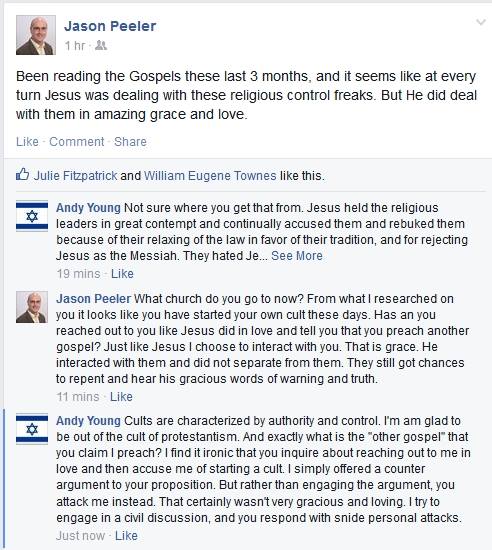
The video was posted on my FaceBook page by a young Christian, and this was my response:
Well, wouldn’t worry about it too much. Apparently, shortly before the return of Christ there is plenty of earth left to destroy because God destroys it. I also find the notion that trees compensate for human pollution via breathing somewhat disturbing. It’s the idea that trees are important because they filter out the product of human living: trees good–humans bad. Fact is, what we exhale is only about 4% carbon. Also note the unqualified moral equivalency between those who kill people (ISIS) and those who cut down trees. lastly, if those who propagate this message really cared about the environment rather than their ulterior political motives, they would point to the science and example of Israel who have turned that desert terrain into a rich agriculture.
Dear Christian parents, will you save your children from this philosophical culture of death? This May, I will be teaching a series on Martin Luther’s Heidelberg Disputation on Blog Talk Radio. We will exegete this foundational document theses by theses. Let me also recommend our 2015 TANC conference where we delve into these issues as well.
paul
All You Need to Debunk Calvinism is the Lord’s Prayer
 In what is commonly referred to as the “Lord’s Prayer,” we are instructed by Christ to ask for forgiveness from the Father. Who the prayer is addressed to has profound soteriological implications.
Calvinism, and really Protestantism in general, promotes the idea that sin is sin; there is no other perspective on sin other than it condemns. Clearly, Christ is telling us to seek forgiveness from the Father, but on the other hand, the apostle Paul wrote that where there is no law, there is no sin (Romans 3:19, 4;15, 5;13, 7:8, 10:4), so as children of the Father, what are we asking for?
The prayer addresses the Father from whom there is no condemnation for His children (Romans 8:1,34). For those who are not His children, sin does condemn. For those who are in God’s family and born of Him, there can be chastisement for family sin (Hebrews 12:5ff). But for those not in God’s family, sin condemns and our Father is potentially a God of wrath to them.
You are either God’s child or a child of wrath (Ephesians 2:3-5). Obviously, repentance from the sin that condemns can only be a one-time event that cancels out the law’s ability to condemn. You cannot be in God’s family while under condemnation.
These two perspectives on sin are efficacious to a true gospel. One is wrath and condemnation, and the other is love through obedience and possible chastisement for disobedience.
Calvinism clearly teaches a single perspective on the law; the single perspective of condemnation (The Calvin Institutes 3.14.9-11). Therefore, supposedly, Christ came to obey the law perfectly so that the law is continually satisfied. Christians are still under the condemnation of the law, but Jesus’ perfect obedience fulfills the law every time we seek forgiveness for “present sin.”
So, do we ask the Father to forgive us for failing Him, or do we ask forgiveness in order to keep our salvation? How we answer that question determines the validity of our gospel.
paul

 Paul's Passing Thoughts
5 comments