Paul's Passing Thoughts

Why So Much Contention in Religion?

Posted in Uncategorized by Paul M. Dohse Sr. on February 25, 2017

ppt-handleI was four different kinds of Baptist for about twenty years and I can tell you there isn’t a more contentious environment anywhere. In addition, a cursory perusal of history will reveal that the vast majority of wars are religious by nature.

In this ministry, which is a think tank and not a Christian organization though religion is part of what we study, we are constantly plagued by petty issues brought up by religionists. What’s going on?

Answer: under law.

In the New Testament, we find a dominant theme: those under condemnation condemn. Love isn’t the order of the day; it’s all about sin sniffing. This flavors all of reality. The worthiness of a person is judged by their lack of faults from the perspective of everyone who has their own mental court of law.

Think about how scary that is; everyone you come in contact with is going to judge you by their own perception of what is good or bad, acceptable or unacceptable. And think about gossip for a moment; it is the combined condemnation of multiple courts of law from different perspectives. Gossip condemns you from multiple angles while rarely missing any fault and even adding some that aren’t true. The endgame of condemnation is condemnation and slander is a handy shortcut for that purpose.

And don’t forget Bible verses. A single verse standing alone can be twisted to say anything about everything.

What is the biblical prescription? The law is to be used for love and not condemnation. When one is born again and no longer under condemnation, the preoccupation is love towards others and not fault finding; or at least it should be.

Another attribute of being under condemnation is the desire to control others and it shouldn’t be a surprise that condemnation is used to accomplish that by people who are under condemnation. It goes something like this: “Because you are unworthy, you need to obey me for your own good.”

Condemnation is also used by those under condemnation to uncondemn themselves and proclaim themselves innocent in their own personal court of law. “My wife is frigid; therefore, I had no choice but to commit adultery.” Examples along this line are inexhaustible.

Most marriage counseling is unsuccessful because it seeks to rectify two condemnation lists from two different courts of law; good luck with that. If the focus is love, sin will be displaced as a natural consequence. In contrast, condemnation is a bottomless pit that can never be sufficiently rectified.

No surprise then: God so loved the world that He gave His only Son who didn’t come into the world to condemn it, but to save it.  

You CANNOT fix anything predicated on condemnation and that includes church as the quintessential example. Where the Bible is used to condemn rather than to instruct in regard to love which does no wrong to its neighbor, only strife and misery remain.  

paul  


John Piper’s Law Problem

Posted in Uncategorized by Paul M. Dohse Sr. on February 25, 2017

Where Fathers Lead

Posted in Uncategorized by Paul M. Dohse Sr. on February 23, 2017

The Christmas Tree and So-Called “Idols of the Heart”
Posted in Uncategorized by Paul M. Dohse Sr. on February 23, 2017

calvin-1Those who know me know I am all about the objective. But I must admit, love is at times mysterious to me. Here is one example: love possesses an unexplained patience with its object. Susan and I are very busy and she is a very social being. She works days; I work nights. So, this morning was not an unusual event.

I was awakened from a coma-like sleep by Susan on a bedside soapbox prior to her leaving for work. In her very welcomed new radio series, “Coffee Commentary with Susan Dohse,” her research has led her to an issue that is new to her: the whole Reformed “Idols of the Heart” doctrine. Her conversation with me in this particular venue began per the usual: at first I am not sure if I am dreaming, then I realize what is going on. Then I ask myself if she realizes that I got home at midnight followed by answering myself in the affirmative. Then the whole love thing kicks in and I begin to focus on the content of her speech followed by actual dialoged.

The Idols of the Heart doctrine is very familiar to me and was the focus of my fulltime research circa 2009. Undoubtedly, Susan will be addressing this in her new weekly series. I am excited about this new endeavor by Susan because it represents the possibility of ongoing teaching unique to present teaching among women taking place in a parched desert. Remember, all of these female puppets are “under the authority” of their Platonist husbands. For all practical purposes its Islam Light. I believe God has charged Susan with being a unique light among women. She is a born teacher, and loves THE truth, not A truth that fulfills misguided needs.

As her words became more and more in-tune as I awoke from my slumber, I understood exactly why she would be so exercised over such a doctrine. As she spoke, the Christmas tree still erected in the TANC conference room was dominate in the background of my mind. I am nowhere near the social being that Susan is, and I am nowhere near a lover of days either. For six years, I have pondered her love for days because God wants us to live with our wives according to understanding, so I always seek to understand her more and more.

On our very large Christmas tree is custom made ornaments that recognize what is going on in the lives of people near and dear to us. The ornaments testify to new careers, new preferences, new relationships, new arrivals into the world, and other elements of life. It testifies to this fact: I have never known a person who loves life and the people in it more than Susan. And I am married to her. And as a result, I am becoming more of a person who recognizes days because these days are when we pause to celebrate life and the people in it. Susan is one who sees little separation between God and His creation.

Any argument about the existence of God defies intuitive knowledge; the real debate is the character of God. Does He love His creation, or does He hate it? Does love for God necessarily demand a hatred for one’s life and all things material because God hates such? In regard to Protestantism, if you know what it really is, the answer is, “yes.”

Hence, we must not “eclipse the Son.” What does that mean? Well, ANYTHING that obscures the sun blocks the glory of the sun shining on us and creates shadows of truth. And in regard to relationships, responses to those relationships tell us whether we love/desire that relationship or any other material thing in the universe more than God. So, if we have an indifference towards the failings of our spouse, this indicates that we love God more than our spouse. Ahmen. Wow, look at him/her; married to a horrible spouse but yet has that silly spiritual grin with glassed-over eyes. Proof positive of a real lover of God and a hater of all things material.

Folks, read the book titled “Uneclipsing the Son” by John MacArthur sycophant Rick Holland; this is the very thesis of the book. This iscalvin-2 mainline evangelical stuff that underpins the massive biblical counseling movement.
So, anything in our life that we “desire” more than God (as indicated by our response to the woes of life) is an “idol of the heart.” Gospel counseling teaches us to “reorient our desires” so that we desire nothing but God. Please note: this doctrine doesn’t call for a reorientation of desires that will result in a desire to DO things according to God’s law, this is merely a desire apart from anything we do. Remember, John Piper’s ministry is simply, “Desiring God” ministries and not “Desiring to do good stuff” ministries. It is “beholding as a way of becoming,” but as I reminded Susan in the dialog process during the morning event, this “becoming” is strictly perception. The goal of all of this a “bigger cross” in our lives. Remember, Soli Deo Gloria! For the Glory of God Alone. And trust me, “alone” means, ALONE.

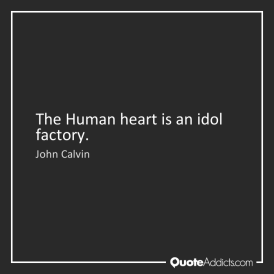
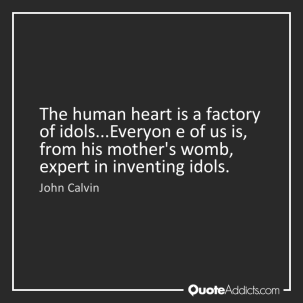
But wait a minute still: because we are totally depraved, “the human heart is an idol factory” (John Calvin). So, all of life is repenting of heart idols that our heart is continually producing. Paul David Tripp calls this a “lifestyle of repentance.” We are right back to the cross chart that this ministry continually shoves in your face. The sum and substance, supposedly, of sanctification is a perpetual return to repenting before the cross of Christ in order to keep ourselves saved. Oh, and by the way, you only have access to this ongoing forgiveness for newly created idols in your heart via church membership.

And remember this: like all other Protestant doctrines, the whole Idols of the Heart thing comes right out of Calvinism. BUT, when you call them out on that we hear this: “Calvin isn’t our authority, the Bible is.” That’s just a lie straight out of the pit of hell. EVERY fundamental of Protestant soteriology is found in the Calvin Institutes without exception.

It will be interesting to see how Susan references all of this with her book review. Be sure to tune in.

paul

Clay Pots Can Know Truth

Posted in Uncategorized by Andy Young, PPT contributing editor on February 21, 2017

Originally published April 11, 2016

Even though my wife and I left the institutional church for good almost 2 years ago, there are still times where I must make the obligatory visit. Going in to visit family is one of those times. I am thankful that the church in which my wife grew up is not steeped in the vileness of Calvinism. Nevertheless, Protestant orthodoxy runs far and wide. Needless to say, as a graduate of the Christian school she attended for 13 years she has nurtured many close relationships with those who were her teachers and peers. So for us the visit is merely a social call and not for purposes of “worship”. Not being a particularly “social” person myself (I am an introvert by nature, and social events suck the life force out of me) I suffer the preaching while reminding myself that it will all be over soon.

Such was the case last weekend as I found myself once again sitting in an adult Sunday School class led by a layman of the church who is without a doubt kind-hearted and well-meaning, but who knows no other way to interpret the Scriptures than what he has been taught all his life. This particular class is right now making its way through the book of 2 Corinthians. The week we were there they were up to chapter 4. Take a look particularly at verses 6 and 7.

“For God, who commanded the light to shine out of darkness, hath shined in our hearts, to give the light of the knowledge of the glory of God in the face of Jesus Christ. But we have this treasure in earthen vessels, that the excellency of the power may be of God, and not of us.” ~ 2 Corinthians 4:6-7

If we are good Protestants, we will look at these verses and see that clearly, this passage is drawing a contrast between our weakness as fragile clay pots and the power of God, right? I can do all things through Christ who strengthens me. And if you have been a reader of PPT for any time, what should be obvious to you are the Protestant talking points and root assumptions: man has no ability, even the saints; there is nothing good in us; we are just worthless clay pots; any good we do is simply Christ doing it through us.

Now don’t get me wrong here, aside from the assumptions of total inability and the idea of the subjectivity of objective good works being performed outside of us, we can acknowledge that God does help us through His spirit. That in and of itself would not necessarily be a wrong application to make, but in the context of this passage it is a novice approach at best. The importance of understanding scripture in the correct historical context cannot be over emphasized. And these were my exact thoughts as I sat there squirming in my pew. There is so much richness to this passage that is being lost simply because people are conditioned to faulty interpretive assumptions.

With what premise then should we begin? First, let us understand that the dominant philosophy of the 1st century was a Platonic gnosticism which was nothing more than yet one more manifestation of the dualism that had dominated all philosophy in man’s attempt to explain the world since perhaps the beginning of time (I suggest you read the transcripts from John Immel’s 2013 TANC Conference sessions if you think that’s an over-generalization).

For the most part, Gnosticism can be summed up like this. Spirit is good and flesh (the physical) is evil. Objective truth can only be found in the spiritual realm. Since man is part of the physical realm, he has no access to objective truth (the “gnosis”). The only way that man can know truth is for a select few to bring it to them. These select few are the Philosopher Kings. They are the pre-ordained ones who have been given the “gnosis” by the “divines”. Therefore, the logical conclusion is that these “mediators” then are the only ones who have the right to rule the masses by virtue of the fact that they are the only ones who can know truth. This is the root system of thought behind ALL tyrannical systems, both political AND religious, for centuries!

Having this as a basis for our study, let us now consider chapter 4 of 2 Corinthians. Verses 1 through 7 present an exercise in rhetoric though a series of contrasting hypothetical assumptions for the purpose of presenting an argument. Let’s look at verses 1 and 2.

“Therefore seeing we have this ministry, as we have received mercy, we faint not; But have renounced the hidden things of dishonesty, not walking in craftiness, nor handling the word of God deceitfully; but by manifestation of the truth commending ourselves to every man’s conscience in the sight of God.” ~ 2 Corinthians 4:1-2

This is our first clue that the apostle Paul is offering a refutation of Gnosticism. Key words include “hidden things” and “manifestation of truth”. Understand who the audience is. Paul’s letters to the assemblies were most often written in response to address some issues that had come to his attention. Remember, one tenet of Gnostic philosophy is that truth is hidden and cannot be known. It would appear as if there were false teachers who had brought this Gnostic teaching into the assemblies there in Corinth and were trying to blend it with Christianity. Notice Paul refers to the “hidden things of dishonesty”, “walking in craftiness”, and “handling the word of God dishonestly”. These are all trademarks of Gnosticism. These false teachers were twisting the word of God to fit their Gnostic orthodoxy, all the while stating that the reason it was true was because these things were “hidden” from the masses and only they were qualified to bring it to them, and they used scripture to support their views.

What is Paul’s contrasting argument?

“…commending ourselves to every man’s conscience in the sight of God…”

He left truth up to their conscience. In other words, he expected his listeners to think. Paul said, I don’t want you people just to believe me because I say so. I don’t want you to believe me because I present myself as an authority. I expect you to use the faculties of reason and come to the conclusion on your own if what I preach is true or not.

 Verse 3 is a critical statement.

“But if our gospel be hid, it is hid to them that are lost:” ~ 2 Corinthians 4:3

This is a profound statement regarding the gospel. God did not reveal himself through His word for the purpose of keeping it hidden, revealing it only to a select few. This is a direct assault on Gnosticism. Gnosticism taught that truth is hidden from the physical realm. But God said, no, I want you to know truth because you are lost and I want to you be reconciled to Me! That is the gospel- Be reconciled to God! That means that man CAN know truth and DOES have access to it. Paul said what we preach is not some hidden truth because that would be counter-productive. It would be antithetical to God’s purpose for the doctrine. That is what distinguishes what we preach from those Gnostic false teachers.

Verse 5 brings us to yet one more distinguishing characteristic of Gnosticism, and that is a narcissistic self-promotion.

“For we preach not ourselves, but Christ Jesus the Lord; and ourselves your servants for Jesus’ sake.” ~ 2 Corinthians 4:5

Remember, only a select few were ordained to have access to the “gnosis”. As a result, these individuals felt that they were superior to the ignorant masses, perceiving themselves as having the right to rule over them. If you want to get to heaven, if you want to have salvation, then you do what I say, or else. Notice how the truth then becomes subordinated to authority. Persuasion is not necessary where power is used. The focus shifts from the message to the one delivering it. But Paul said, I don’t come to you with any desire to promote myself. You don’t get to heaven by doing what I tell you to do. You were saved because you were born again when you believed in Jesus Christ!

And that brings us back to the passage we looked at first.

“For God, who commanded the light to shine out of darkness, hath shined in our hearts, to give the light of the knowledge of the glory of God in the face of Jesus Christ. But we have this treasure in earthen vessels, that the excellency of the power may be of God, and not of us.” ~ 2 Corinthians 4:6-7

This is perhaps the most scathing rebuke of Gnosticism. The fact that believers are referred to as “earthen vessels” is a testament to the metaphysical reality of the New Birth. Now granted, the word “earthen” in the Greek does mean a piece of pottery. But that just makes the argument all that more powerful. A clay pot is made from the “earth”. It is a part of the physical realm. To say that something that is part of the physical realm can know truth is a slap in the face to Gnosticism!

And what is the result of that? Paul uses the word translated “excellency”. In the Greek it is the word υπερβολη (hoo-per-bol-lay) from which we get our English word “hyperbole”. Hyperbole is using extremely outrageous statements to make a point. Paul says that the truth of the gospel sounds outrageous, but it can be known because it is reasonable because physical, frail clay pots have the ability to know it. This serves to demonstrate that its power comes directly from God and not from those who would place themselves as mediators between God and man.

Think about that for a moment. The power of the gospel is in its ability to persuade. It isn’t some self-appointed authority who demands compliance through the use of force. It is God who persuades through the preaching of His word. That means man has the ability to reason and understand it. This can lead a man to be persuaded that God is who He says he is. He can be persuaded to choose to forego his present life and put his faith in God and become a born again new creature who is the righteous offspring of God.   For the apostle Paul to declare that our REAL, righteous new-creaturehood is contained in earthly, physical containers is the antithesis of Gnosticism!

Andy