Think and You Will Find; Stunning Reflections on TANC 2016
Originally published September 9, 2016
From time to time I am privileged to receive an email from author John Immel with a proposed article written by him for publication on PPT. Because it’s John, unpublication is unlikely, so it’s time to give it a quick reading and ramp up the copy and paste.
Unless the article ambushes you; resulting in stunned contemplation.
This journey that has come to be called TANC Ministries began with the following convictions: it will always be predicated on THE truth; it will always continue as long as I am alive; it will always continue if there is hope of helping one person, and if I have anything to do with it there will always be a yearly flag raising called “TANC conferences” to remind folks that this ministry is still here.
My fuel is not following and worldly credentials. My fuel is truth. That’s what the Spirit uses—nothing else (John 17:17).
I refuse to stop learning truth; I refuse to stop thinking; I refuse to quit until I die. I will be seeking truth that changes me and sharing it with others until my last breath. Jesus said to seek truth, and promised it would be found by those who love Him. And He is my only judge. Period. And by the way, He is my brother who will never condemn me with judgement. I use the word, “judge” in a manner of speaking as set against those who think they have been given God’s authority to judge. Reality check: personality appeal and credentials say nothing of a person’s real heart and even less regarding self-proclaimed accreditation by God who has never performed a theophany at any church counsel.
This year’s conference was the most painful to put together, and the most profound, and the most rewarding ever. To those who contributed onsite and those who sent encouragement, you have my promise that Susan and I will never stop trying to do our best. May more and more benefit to others be found yearly and every day in-between.
For some time now, Susan and I have been counseling Protestant spouses who are in really bad marriages and in disagreement with the church’s solutions. Especially since “biblical counseling” has made the marriage worse. Six months ago your marriage needed a tune-up, now both of you are talking to attorneys. But, the other spouse is in agreement with the church. The church’s elders are now the authority in the marriage, and by the way, in accordance with traditional Protestant orthodoxy. Spouse A will only recognize Spouse B as a legitimate spouse if spouse B “repents” and “submits to the authority of Godly men.”
For several months Susan and I have agonized over how to counsel people in this type of situation. These are people who are imprisoned in a cell of misery. In most cases we do not see divorce as the answer even though the replacement of the husband or wife in the home with elders is probably tantamount to divorce when it gets right down to it.
Since Susan and I have been agonizing over this for months, and the interactions of TANC 2016 have given us a clear answer, I would say that this year’s conference was well worth it.
And the first conference as well. That’s when we learned that ALL behavior is driven by logic. And, you can take the boy out of the country, but you can’t take the country out of the boy, and he will continue to do country unless that happens. Removing the spittoons from the house is pointless. And if people cannot think, reason, or change, the boy will always be country and any attempt to take the country out of the boy will be futile. There is no hope for rehillbillytation.
Herein is the answer. Those in this situation need to read John’s following article and know this: there is no hope for peace in the marriage until Spouse A abandons traditional Protestant logic. We would counsel spouse B to legally separate from spouse A until they do. Spouse B, if a child of God, is called to peace, and there is no peace in Calvin’s Geneva.
Now as those of us in the TANC camp like to write, “full stop.” Those of you getting ready to email me and type, “Paul! that’s what I have been saying all along, ‘just leave that church!’” Understand, I love you, I really do, but you just pissed me off. Excuse the French, but I have been sharing the emotional misery of this with many for months. You see, a clock that doesn’t work is right twice a day. Here is the big difference; John not only tells them to leave, but explains WHY they should and HOW they should. Per the usual, regardless of John not beating to the Baptist drum of buffoonery, there is usually something profound to be learned from him. The WHY is important because we must understand where people are in their thinking so we can help them.
Merely espousing the WHAT without the why is why these people are suffering in the first place. If they listen to your WHAT only, they have learned nothing even if they take your advice.
So, this is now our advice and I am not kidding: you hand spouse A the following article by John and you leave; the ball is now in their court. Ok, and here we go… “But Paul, these people don’t respect John Immel.” Sigh. Do you see what is going on? It matters what they think (which is not thinking because they think you shouldn’t think) because in your mind they still have authority. NO-THEY-DO-NOT-HAVE-ANY-AUTHORITY. You have allowed them to use your life to pleasure themselves with their own visions of grandeur. Stop it now. Stop it, like, yesterday. Enough is enough already.
However, you can do this: prepare your own statement, in your own words, to spouse A, through your attorney if necessary. Until you take action, you are merely enabling more fruit from the same ideological tree. That tree must be pulled up by the roots; nothing short of that will suffice. Until the tree is uprooted, NOTHING will change. Stop being an enabler.
Begin article:
These Boots were made for Walkin’
By John Immel: Edited by Paul Dohse, TANC Publishing
TANC 2016 was good. We talked about a lot and, curiously, marriage seemed to be a conference sub theme. It is kinda fun when each speaker’s contribution blends into the other speaker’s content. The speakers do declare their topics early in the year but we don’t give specifics; there is no pre-approval, so everyone at the conference is hearing everything for the first time. So, to encounter an unplanned harmony is always interesting.
Anyway, back to the subject at hand. Making like a tree and leaving. Making like a shepherd and getting the flock out. Make like Tom and Cruise. Make like a fat kid and bounce. Make like a banana and split. Make like a nose and boogie. Making like a baby and heading…
>snicker<
In my 4th and last TANC 2016 session I gave the super-secret method to successfully get out of the Calvinist juggernaut of destruction called Church. I talked about your situation—you know who you are—which goes something like this . . .
You have marital problems . . .
You go to a pastor for help . . .
Pastors say “You are a sinner . . .”
You say “Ok, but how does that help me?”
They say “You are a wretched sinner, you are the problem in the marriage, so you should sacrifice . . .”
You say, “But my husband beats me . . .” OR “My wife is running around . . .”
They say, “We are the pastors. It doesn’t matter what you think. We know everything . . .”
You say, “But . . .”
They say, “See, we knew the problem was you. You are proud. You are arrogant, you are rebellious bla bla bla . . .”
The more you talk to the pastors the worse everything gets until the theological big dogs speak the dreaded words “church discipline,” and your very safe, very Christian world collapses. All your friends dash into the shadows like vampires fleeing the rising sun. You find yourself on a street corner, hat in hand, baffled, mystified and confused. Your other half—the person who promised before God and everyone, to love you and forsake all others—has somehow decided that it is theologically justified to abandon you and move in with other men. Your spouse’s body may still reside at your address, but the intellectual and emotional commitment is to men in a building visited four times a month.
Since this is a family friendly blog I will refrain from detailing the curiously appropriate innuendos for this Reformed Theology ménage a trios, but do I really need to point out that you would NEVER tolerate this kind of relationship in ANY other context? Or maybe you would. I’m just saying . . .
Ehem!
“But John, how do I get out? I’ve tried everything. I keep trying to do the reconciliation process. I keep trying to honor God. I keep trying to do what the Bible says. It says to restore them gently. The Pastors, are wrong, my wife is wrong (my husband is wrong) . . . I just want to help them see that…“
Stop.
Here is the grand delusion that is plaguing your soul. You think you can fix them.
Think a minute. As a Reformed theology aficionado you already know this but you intellectually cheat when it serves your church-going purpose. But I’m going to challenge you to be intellectually consistent for ten seconds. Dig down and find that switch called rational integrity and think of your own doctrine and then ask the question: HOW CAN I FIX WHAT GOD HAS DETERMINED?!
I’m not shouting. I’m just typing in all caps because it’s fun. And maybe those big letters will penetrate your mental stupor.
According to Luther, according to Calvin, according to Reformed theology, according to your own beloved “orthodoxy,” according to your own pastor, there is no human agency in God’s plan. Period.
If there is no human agency in God’s salvific plan then that means YOU are irrelevant. There is no YOU helping them see. They are the way they are because God wants them that way. Period. [“It’s God’s will.” “God will change them when He is ready.” Susan and I hear this constantly]. They “think” what they think because God has given them to think it. They do the evil they do because God has put it in them to do it.
And the moment you start feeling your brain try to apply caveats and hedges to what I just said . . . the moment you are tempted to utter the words “I think . . .,” run to the mirror, look yourself in the face and shout, “Intellectual Fraud!” Because as a Reformed theology aficionado you have no right to the words “I think . . ..”
When you declare fealty to the church elders—because they speak for God—you abandon the right to your own ideas.
So again, the delusion that plagues your soul is that you matter one whit in God’s salvation plan. You are nothing. You are a worm. You are the navel lint in the cosmic belly button. You are wretched, and ugly and full of self. You are a sinner in the hands of an angry God. How dare you exalt yourself to the status of helping God? (That would include James MacDonald too, but he has no intellectual integrity so explaining his metaphysical absurdity is useless.)
Anyway . . .
Every time you crack your Bible and trace your finger across a verse to “help” someone—useless.
Every time you try to protect the “reputation” of the church—ludicrous.
Every time you try to offer a word of “encouragement”—pointless.
Every time you try to “restore” a brother gently—ridiculous.
“John, are you saying that my situation is hopeless?”
Hopeless is as hopeless does . . .
Uh . . . errr . . . or something like that.
Or here is an idea: abandon the doctrine and condemn—with impunity—every evil person who advocates, subsidizes, or supports any part of Calvin’s doctrine. (James MacDonald and every man, woman and child that drops one penny in the offering plate for example.)
If you can do this you are ready for step one of the super-secret plan to get out of the Calvinist juggernaut of destruction.
Step one: Get your brain back. Quit being an intellectual fraud. If you want the right to say “I think . . .” then you are going to have to take off your Huggies and put on your grown-up pants and do the work to lay claim to your own mind.
“So John, what is the second step?”
Well, it is super-secret so I don’t know if you can handle it.
Ready?
You sure?
Leave.
Run Forrest run!
Don’t write a letter. Don’t convene an elder meeting. Don’t beg elders from another church to carry your diaper bag. Don’t fly a carrier pigeon. Don’t tap out Morse code. Don’t send up smoke signals.
In the immortal words of Nancy Sinatra:
You keep saying you’ve got something for me
Something you call love, but confess
You’ve been a-messin’ where you shouldn’ta been a-messin’
And now someone else is gettin’ all your best
These boots are made for walkin’
And that’s just what they’ll do
One of these days these boots are gonna walk all over you
Yeah
Offer no explanation. Give no details. Propose no justification. Just walk out and go learn how to think for yourself. I dare you . . .
“But John, what about my friends?”
Here is a news flash. They are not your friends. They are vampires sucking their life from the sheep in the pews. The moment you walk out the door you are depriving them of the ability to feed on your life like a buffet. Their singular purpose is to be Nosferatu’s soldier operatives—the pastor’s sycophant. You leaving the church is like a stake in the heart, garlic around the neck, or holy water tossed on the face. You leaving will bring out the snarling, raging hatred that really burns inside their double imputed depraved souls.
I’m going to say it again because 90% of you will not believe me until you have beat your head up against this wall a thousand times. They are not your friends. And more importantly neither should they be. You should not want evil people as friends.
“So John, is that what you did. Did you just walk out?”
Yup and here is the proof.*
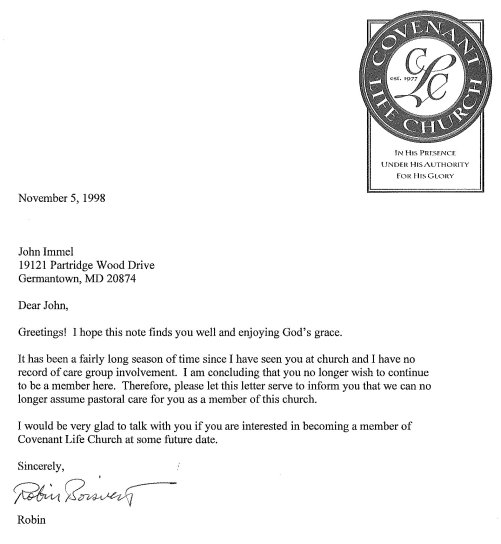
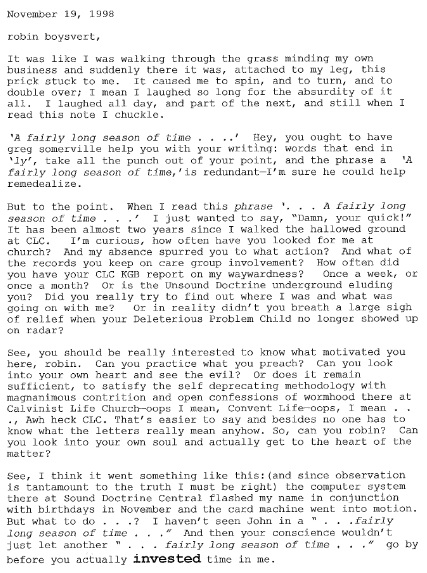
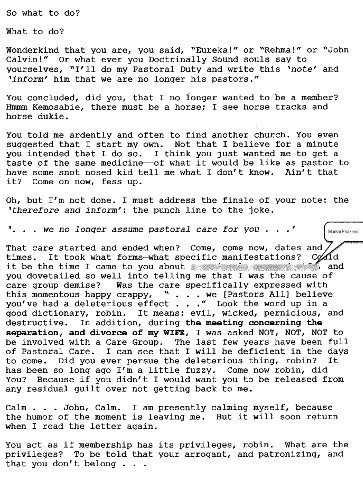
Last weekend I was going through old stuff and found the following correspondence between myself and my favorite spiritual tyrant Robin Boisvert. His name is pronounced bwah vair (I’m pretty sure), and he used to be C.J Mahaney’s Covenant Life Church lead thug homeboy.** Maybe he still is, I don’t know and I don’t care.
(You feel patronized yet robin? >snicker<)
There is a lot to see in the letters below but notice that robin has no clue what has happened with me . . . and that is because I figured out that my boots were made for walkin’.
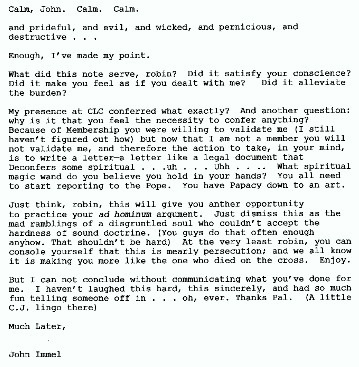
**Greg Somerville was the editor for People of Destiny/Sovereign Grace Magazine. I have no idea what he does now but let’s hope he got a real job instead of being chief propaganda officer for the CJ Mahaney blackmail machine.
End Article.
“Paul, I would come to the yearly conference and support your ministry, but I don’t want my spouse or the church to interpret that as my unwillingness to be reconciled with them.”
Really? How’s that workin’ for ya? You cannot be set free or healed because this shows clearly that these people still wield some degree of authority over you. Your authority is not Christ alone. I don’t necessarily buy into “I think, therefore I am” lock, stock, and barrel, but you can be sure that I reject “I don’t think, therefore I am” with extreme prejudice. You want to be friends with people who reject reason and thinking, AND people who embrace it. Good luck with that, but do not look for our ministry to enable such vacillation in the future. You can thank John for that.
And let me remind you that we are an educational ministry that has no authority. Is that why you are ashamed of us? Because we don’t want to control you? Well, guilty as charged.
Why don’t you add TANC Ministries to your freedom repertoire? Consider adding us to your Unashamed Friends list. After all, regardless of their many reasons for rejecting us which includes accusations against me; ie., a felon in hiding, adulterer, attempted murderer, possible active shooter, etc., etc., I kid you not, their real problem is: I believe that God has called us to think. And by the way, 2017.ttanc.com.Why not register today and enjoy the freedom to seek truth with your own mind?
What do you think?
paul
The Disaster of Sacrifice as the Ultimate Moral Standard – Part 2
The following is part two of a four-part series.
Taken from John Immel’s second session at the 2016 Conference on Gospel Discernment and Spiritual Tyranny
~ Edited by Andy Young
Click here for part one • Click here for part three
(Links to the archived files are found below)
I left us with a cliffhanger – Augustine’s flaw in his doctrine.
I’m not going to tell you what that is in this session!
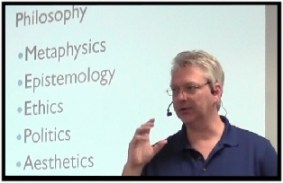
 I know, I’m a mean speaker. But before we can get to Augustine’s flaw, I have to dig into this right here, as represented by the chart at the right. I discussed this at length last year at TANC 2015, and effectively I’ve been already talking about this in some fashion for the last five years. This is the order of hierarchy within philosophy.
Now when I say “philosophy,” I really want you to start thinking in terms of here is how man integrates his mind. The foundation is metaphysics. The next level up is epistemology; how man knows what he knows. Notice how epistemology is the largest area of study in the whole construct, because it deals with how man integrates his world. From that understanding we arrive at action in accord with “good.” This is ethics. And so the question we really need to ask is what is ethics? What is human moral action? Since we’re talking about sacrifice as the highest moral ideal, we need to get into this question – what is sacrifice?
Let me ask you this. When someone demands that you sacrifice for the “greater good”, or the local church, what exactly are they asking you to do? Perhaps some of you may answer:
- Give money
- Give what you have produced
- Give of your time
- Give of your efforts
Here is the real root of what they are asking – sacrifice is the destruction of something. What is being destroyed?
Something of value!
When they ask you to sacrifice to the local church they ask you to give money. That money really represents your personal heartbeats, your personal intellectual efforts, your personal physical efforts. Human production is distilled into money, and that becomes a medium of exchange. So when somebody says they want you to sacrifice, they are asking you to get rid of it on your own behalf, to destroy value.
So the next question is, what are values?
Values are that which one acts to gain or keep.
So let’s break this down. There are two conditions for the concept of values to be possible. First of all, values presupposes a value-er; an entity or being to whom the object is of value. This means that value requires a certain kind of entity; a being capable of generating action toward a goal or an end. This is very important, particularly in light of what I talked about last year regarding determinism. In a determinist world there can be no such concept as value because a determined entity has to self-oriented/goal-oriented action. A determined entity cannot have values.
Second of all, in order for the concept of values to be possible, values presupposes an alternative. This means that different outcomes are possible and that the entity’s actions make the difference. As an entity, whatever outcome I bring upon myself is directly related to my actions. A thing is outside the concept of values if action is irrelevant. If you are guaranteed to have or not to have something regardless of action toward or away from that thing, then it cannot be a value.
 So the next logical question is what entities fulfill these requirements? The answer is, living organisms; the only beings capable of goal-directed action. Living organisms are confronted with a fundamental alternative. A living organism must act in accord with its nature to sustain its life. A living organism is not a passive reactor to its environment. A living organism is driven by a singular goal; the perpetuation of its life. By contrast, inanimate matter does not. It exists regardless of its action; it takes no action. Material matter might change form, buts its existence is perpetual independent of any action.
So value implies alternative, and here is the fundamental alternative in the universe: existence or non-existence; life or death. This alternative can only apply to living beings. The existence of inanimate matter is un-conditional. The existence of living beings is conditional, specifically on their pursuit of values to sustain their life. Life requires a specific course of action because living organisms are constantly confronted with life or death.
Ponder that for a moment because this is crucial to what comes next.
A living entity must take action in accord with its nature to survive, therefore life is a certain kind of motion. Death by contrast is stillness. Death is the state where action stops. To achieve death, just stop moving; stop eating, drinking, anything. You’ll get death just as fast as you possibly can.
 Next question: How do living beings sustain their life? They seek to acquire things that are valuable. Only entities that must act to acquire specific things to sustain their existence can be said to hold values. Water is valuable because it is a component of life. Air is valuable because it is a component of life. Food is valuable because it is a component of life. Living things seek things out because those things sustain life.
Life makes the concept Value possible
The progression goes like this:
Life → Values → GOOD
- That which furthers an organism’s life is the GOOD.
- That which undermines life is the EVIL.
 All living organisms act towards their goals. Most organisms take their actions based on instinct. Man by contrast is a being of volitional conceptual consciousness. Man has no built-in standard of values. He is not guided by instincts. He has no automatic code of survival. Indeed, he has no automatic sense of self-preservation. Babies would die almost immediately if not cared for. How much of parenting is dedicated just to keep kids from killing themselves? Man does not come out of the womb ready to engage the world in which he lives. He needs a very specific set of ideas to make that happen.
Also notice that man does not automatically value life as such. Probably one of the greatest examples of this is Islam. Islam is based on the predicate assumption that men will destroy themselves in the name of Allah. And you can find that same mindset applied to Calvin’s doctrine. How many people in churches are willing to destroy their own lives in service to these higher concepts? They don’t specifically value their lives as such.
It is crucial to understand that learning to love and value life as such, and human life in particular as well as your own life, is an achievement. It is a philosophical achievement that has a very specific set of ideas in place. So man must choose to value life in general, and to be successful he must value his life in particular. So for man to live he must identify the correct values and then choose to follow those values.
And so here is man’s root need for morality. Morality is the proper code of values to sustain human life. Man needs ethics to live. He needs to have way to put what he knows into action to know how to successfully live. This is a crucial development in human history. We have already addressed the fact that historically man has not understood this point. It took Western culture almost 1,700 years to even get within a hint of this concept.
Man requires that he chooses his values to live, which means he chooses between moral action and immoral action. Moral action is that which sustains and facilitates his life. Immoral action is that which is going to kill him. Now those actions have context and much more development behind them, but the point is to understand why man needs a moral code.
Man’s Life/Man’s Character
Life → Values → GOOD → Morality → Ethics → Character
Morality is the standard that facilitates life. Ethics is the moral code. And when a man persists in consistently taking value-driven actions, that is what shapes his character.
 And with this in mind you can begin to understand why Augustine and Calvin’s doctrines are so fundamentally hostile to human existence. You can begin to grasp why I have said at every TANC session that Calvinism is the single-most disastrous body of doctrine ever perpetrated on man. The single abiding standard in Calvin’s doctrine is the death of human existence. Calvin’s repudiation of human value is absolute. This is why sacrifice, continued and on-going sacrifice, is so central to Calvin’s doctrine. Calvin hates man’s existence as such and has created a full philosophical statement to facilitate man’s destruction.
So now we can answer the question that I asked at the beginning; what is sacrifice? Sacrifice is the destruction of values. And this should be a big “Ah Hah!” moment:
- To demand sacrifice is to demand non-existence
- To demand sacrifice is to demand death
Having said all that, I close this segment with these two questions:
How is there any benevolence in sacrifice?
And how have human being been so duped into believing there is virtue in death?
…To be continued
John Immel 2016 Session 2 Archive Video (YouTube) Audio Only (mp3)
The Disaster of Sacrifice as the Ultimate Moral Standard – Part 1
 The following is part one of a four-part series.
Taken from John Immel’s first session at the 2016 Conference on Gospel Discernment and Spiritual Tyranny
~ Edited by Andy Young
Click here for part two • Click here for part three
(Links to the archived files are found below)
We get to talk about philosophy!
The Gospel According to John Immel, chapter 3:1-3
- All people act logically from their assumptions.
- It does not matter how inconsistent the ideas or insane the rationale. They will act until that logic is fulfilled.
- Therefore, when you see masses of people taking the same destructive actions, if you find the assumptions, you will find the cause.
Here is the fundamental premise that I’m trying to bring to light. People act consistently from their body of ideas. They will fulfill that logical conclusion. They cannot escape it because human beings are designed to integrate their concepts from the most basic premises all the way to the highest concepts.
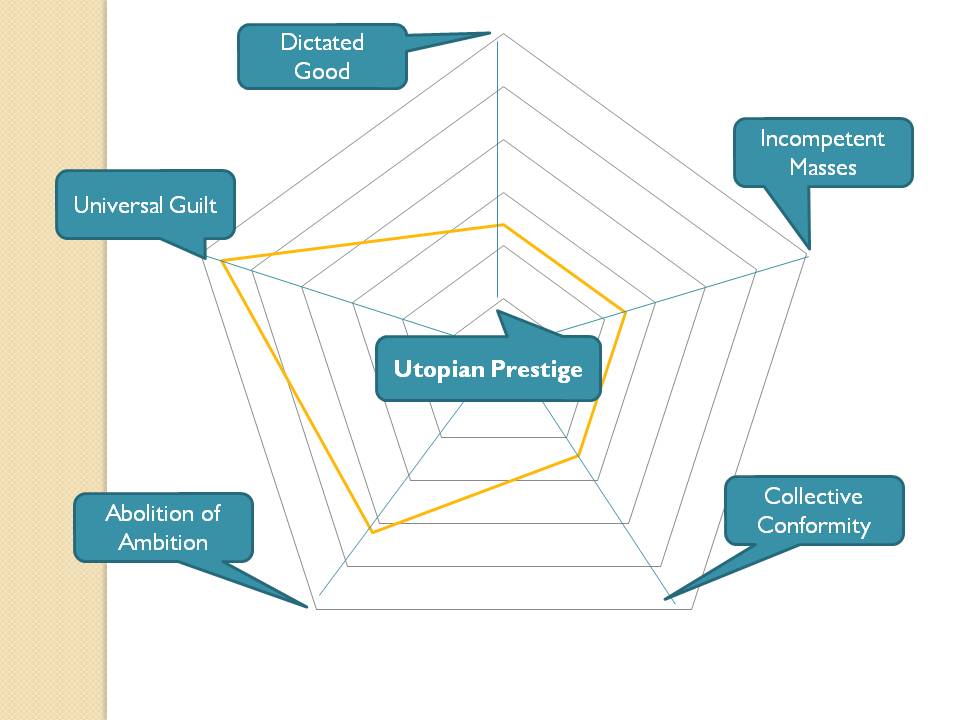 This explanation is best captured in the diagram at the right. My claim to fame within TANC Ministries is to discuss the roots of tyranny. Where does tyranny come from, and why does it exist? This is my contribution to philosophy. I’ve identified five pillars which are the basis for all tyranny. I’ve arranged them into a spider web because I want you to understand that they are all inter-connected. These are not stand-alone events: universal guilt, incompetent masses, collective conformity, abolition of ambition, and dictated good.
In all tyrannies, you will find these fundamental doctrines (and I don’t care if the tyranny is communist, socialist, or Calvinist) behind the arguments that people use to sustain such tyranny.
Man organizes his ideas in a hierarchy. I laid this out consistently in both the 2012 and 2013 TANC conferences – find the assumption and you will find the cause. One of the most challenging things I think people have when they are evaluating the content of ideas is learning to see root principles; learning to see what is at the bottom of what everyone is thinking.
To do that you have to learn to think philosophically. All men organize their ideas into a cohesive whole, and that science is called philosophy. Now they might not be aware of it, it may not be explicit, but all men have an integration of their ideas. In the world of philosophy that process goes by these sub-divisions or disciplines:
Disciplines of Philosophy
– Metaphysics
– Epistemology
– Ethics
– Politics
– Aesthetics (art)
The nature of existence is metaphysics. How man knows what he knows is called epistemology. How we value what we know is ethics. (The bulk of this series will involve the discussion of ethics) How we interact with people is politics. And how man creatively reflects his existence back to himself is called aesthetics or art.
This series of discussions will focus on the central ethical assumption of the Western world, indeed, the whole world:
Gospel According to John Immel 7:17
”Sacrifice as the highest moral ideal is the lynch pin of the coming Protestant Dark Age.”
Ponder that for a minute.
You can see that I crossed out the word “Protestant”, and I did that, not to minimize Calvinist Christianity’s role in the coming Dark Age, but to emphasize that Western culture is heading towards a collapse. The Western world is committing ideological treason to the ideas that brought liberty and light to the whole world. The Western world’s central philosophical betrayal is the  renewed embrace of the primary ethic of sacrifice. Twenty-first century man has decided to abandon the power of individualism a replace it with the primordial ethics of shamens, tribal warlords, and despots.
There is no small irony that in the Western slide into self-destruction, Christianity is paving the way with Augustinian and Calvinist doctrines from ages past that have already proved what they will create. They have already proved that the ideas taken to their logical conclusion will create death, poverty, suffering, and darkness.
It is ironic because Christians like to pretend they are ethical innovators. They love to talk about being separate from the world, and that being “worldly” is the same as being evil, that as Christians they have unique and transforming ideas. Christianity likes to pretend that it originated all the good ideas, and only the bad ideas exist in the world. Christians like to think that self-sacrifice is a wholly unique Christian concept that started when Jesus hung on the cross. They like to think that the world is committed to selfishness and ego, and individuals engaging in self-interest are “worldly.”
But like most myths, when studied beyond the surface it becomes clear that Christianity regularly steals its ideas from other sources. It becomes clear that Christianity repackages worldly ideas and presents them in its own name. For example: taking over Sunday as a day of divine service (it was originally a Greco-Roman holiday dedicated to Zeus); taking over a pagan winter festival and decorating trees and calling it “Christmas”; and probably amongst the most egregious rip-offs in history is the ex-appropriation of Jewish scriptures as the source of Christian authority all the while persecuting and killing the very people to whom the documents were written.
So here is the myth revealed: Christianity did not invent sacrifice for the “greater good”. Indeed, the oldest of all worldly ideas is sacrifice as the highest moral standard. The oldest moral standard known to man, practiced in all cultures and in all continents, is the foundational premise that man must sacrifice himself, must sacrifice his self-interest for the gods, for the tribe, for the people, for the king, for the nation, and the “greater good.”
For the whole of human history, it has been presumed that man is a sacrificial animal. Don’t be deceived that because we don’t see virgins tied to alters and priests holding bloody knives that we in the twenty-first century are more enlightened. We are not. Indeed, the nature of sacrifice today is more pervasive, more destructive, and more vicious. In ages past a sacrifice was done to receive a favor from the gods. It was expected that the destruction of one value would provide something of greater value. Today it is presumed that to receive any benefit from a sacrifice disqualifies the action. Today we sacrifice for the sake of sacrifice alone.
The result is the modern man is offered two existential options:
Sadism – sacrifice enforced as the hands of others
Masochism – self-inflicted sacrifice
Sacrifice is destroying America!
- Sacrifice is destroying a free society at the root
- Sacrifice corrupts government
- Sacrifice destroys achievement
- Sacrifice destroys the meaning of words
- Sacrifice destroys marriages
- Sacrifice gives Calvinist thugs the moral power to perpetrate their tyranny.
But before we trip too far down that path I want to give you a sense of history.
Sumerians – 3500 BCE
 From the land of Ur, kings were gods, and the people were created to serve the gods. Fertility was the most sought-after boon from the gods. To acquire these boons people gave sacrifices. There were sacrifices of animals, and there were sacrifices of grain, and there were sacrifices of people. The belief was that the sacrifice of people made it possible to follow the king into the after-life. It was also a common practice for women to sacrifice themselves to follow their husbands into the after-life.
Hindu Vedas – 1700 BCE to 1100 BCE
The belief is that the Vedas are divinely inspired documents without human authors. Within these scriptures they detail human sacrifice. Some scholars say that human sacrifice was continued in Bengal in the ancient world through the 19th century. The Thuggee cult that was dramatized in the film, Indian Jones and the Temple of Doom was real. They followed Kali, the goddess of destruction, and it is believed they killed somewhere in the neighborhood of 2 million people!
Shang Dynasty – 1523 BCE to 1050 BCE
The Chinese culture was dominated by ancestor worship. When a man died he passed into the “upper regions.” These ancestors had the power to impact the lives of descendants back down on earth. To inspire these ancestors to act on their behalf, people on earth gave sacrifices – animals, food, grain, wine, and other men. It was believed that man’s abasement before the spirits by offering these sacrifices would show the correct humility so that they might be worthy of good fortune. When the kings died, it was common practice to slaughter members of his elite guard and bury them in the tombs to guard the Shang kings in the after-life.
Abraham (Abram) – 1700 BCE
Now consider the geographical region of these first three civilizations: Mesopotamia (Middle East), India, and China. The Bible in the book of Genesis tells about a man named Abram who came from this very same general region, Ur of the Chaldeans.
“Terah took Abram his son and Lot the son of Haran, his grandson, and Sarai his daughter-in-law, his son Abram’s wife, and they went forth together from Ur of the Chaldeans to go into the land of Canaan, but when they came to Haran, they settled there.” ~ Genesis 11:31
“After these things God tested Abraham and said to him, ‘Abraham!’ And he said, ‘Here I am.’ He said, ‘Take your son, your only son Isaac, whom you love, and go to the land of Moriah, and offer him there as a burnt offering on one of the mountains of which I shall tell you.’ So Abraham rose early in the morning, saddled his donkey, and took two of his young men with him, and his son Isaac. And he cut the wood for the burnt offering and arose and went to the place of which God had told him.” ~ Genesis 22:1-3
There are two things I want you to see from these passages. First, notice where Abraham and his whole family is from; Ur, the land of the Sumerians. Second, notice that Abraham never considers the command to sacrifice Isaac to be something unusual. The chances are that he was not the first man to believe that some god somewhere told him to sacrifice his child.
This is very important. Abraham would have been amidst a pantheon of gods. In his culture, everywhere he looked there was a god. And he has this personal God of his own called “Yehowah” (Jehovah) who isn’t know to too many people, if anybody other than Abraham. His household knows Him simply because they have seen Abraham prosper because of Him. So this obscure God says to this man, “Go kill your kid,” – there’s nothing abnormal here to Abraham’s mind.
It is crucial that you understand that at no point in history is sacrifice as a concept unique. Let that sink in for a moment.
Pythagoreans – 570 BCE
I did a full analysis on the Pythagoreans and their impact on Western thought at the 2013 TANC Conference. But a brief review is in order. Their abiding and enduring impact begins with their contributions to music and mathematics. However their greater impact on Western culture is metaphysical. What they offer is profound and unique.

The Pythagoreans celebrate sunrise.
“Man has two parts, a high part and a low part. The low part is the body, the high part the soul. These two are in eternal conflict with each other. The soul is akin to God, to another dimension. Once, it was a god-like creature, inhabiting another, superior, spiritual world. But it sinned. And the result was it fell from grace. And as punishment was included in the body on this earth. The body is therefore the prison, the tomb of the soul. And we are destined, each of us, to go through a series of “reincarnations”. At the end of our earthly span, our soul goes back to the other world, and it gets the appropriate reward or punishment (depending upon its behavior), and then it comes around again, what they call the “wheel of birth.” Sometimes it comes up in another human body, sometimes in an animal body. It lives out its cycle…until…the soul can escape from this body and earth permanently, reunite once and for all with God, and thereby achieve true happiness and salvation…
“How do you [get to it]?…purification…you have to live a good life…an ascetic life…[but] the Pythagoreans at their most ascetic are frenzied hedonists in comparison to the Christians that are yet to come…”
“…to be free of the flesh is man’s highest ethical ideal.”
You can hear the echoes of later Christian doctrine all over this. Here is what the Pythagoreans did. For the first time there was formal concept of man divided against himself – that man was actually two things; spiritual and material. The spiritual was good and the material was functionally evil. They are the developers of human depravity in Western thought.
Most cultures prior to this accepted that the gods were to be revered and their domains were set apart, but it was assumed that man had a right to engage or interact with the gods on some level. The divine was not specifically hostile to man as such, and man by definition could beseech the gods and get boons from them. The Pythagorean premise begins the separation between the material and the spiritual.
Now to my knowledge the Pythagoreans do not participate in human sacrifice in the literal meaning, but they introduce what amounts to a “living death.” For the first time in philosophical history, the presumption is that this stuff (body, matter) that we inhabit is somehow functionally and morally wrong.
Plato to Plotinus to Augustine

Plotinus
I detailed the in a previous conference, but I never get tired of pointing this out. Augustine’s theological pedigree is rooted in Plato’s philosophy via the neo-platonist Plotinus. Plato’s The Republic basically says this: Lesser men are driven by their passions and not fit to rule themselves. Lesser men must subordinate themselves (a.k.a. sacrifice) their base nature to the Philosopher Kings. This is the appropriate order of the world.
Those intellectuals who have the ability to formulate a full philosophical statement, as Plato did, are the ones with the most intellectual power. It is very difficult for people to be philosophical and intellectual innovators. One percent of one percent of one percent of one percent of people in world history will every try to do such a thing. Most people uncritically adopt philosophical statements from whomever they are learning.
Plotinus picks up ideas from the Pythagoreans, the Cynics, and the Stoics who all believed in the soul/body dichotomy, a doctrine which metastasizes as it develops throughout history. While the Pythagoreans would have been considered raving hedonists by comparison, by the time we get to the Cynics, their commitment to the destruction of the body is transcendent. And this is what Plotinus picks up on. By the time we get to Plotinus, he is determined to philosophically eradicate the material world as such, and that specifically means the body.
Plotinus drops all vestiges of the humanist element in Plato’s philosophy. What I mean by that is while Platos’s ideas were wrong, he still held that humanity had virtue. He believed man had value and he still advocated for the betterment of man, but Plato’s was not a religious position even though it had religious elements. But by the time we get to Plotinus, the religious element of spirit-good/matter-evil had reached a peak.
Plotinus probably would have faded into oblivion had it not been for Augustine. Augustine uses Plotinus’ anti-material metaphysic and weaves the Pythagorean’s soul/body dichotomy into Christianity. Augustine said that the nature of man’s sacrifice is individual. This is important. Up until Augustine, men didn’t really consider themselves individuals. They might have identified that they were sole people, but they were always part of something larger. Their nationalities mattered, their participation in the tribe mattered, they conceptualized themselves in the collective mindset. Augustine is the first philosopher to introduce individuality and more importantly, a morbid introspection. Most of you are very keen on doing self-analysis and looking inside and then finding your flaws. This is Augustine’s heritage.
He metastasizes the Pythagorean concept of asceticism and turns it on human life as such. Life qua life is the greatest threat to define existence. The whole of this theology has a singular aim; to make man’s life unlivable and make death the moral ideal.
So now here is the problem. Augustine’s doctrine becomes the de facto standard of Christian orthodoxy for effectively the next thousand years. He stands intellectually unopposed. There is no legitimate intellectual resistance to Augustine’s doctrine until St. Thomas Aquinas. The reason he is so successful at this is because his doctrine is both heresy and treason to oppose. In other words, it is backed by government power.
The logical conclusion of a doctrine that condemns is called asceticism. Asceticism is the soul/body dichotomy – the intentional destruction of the evil material world put into practice. It is no longer a theory. The kind of asceticism the worked its way across Europe was the practice of trying to incrementally destroy the body. Consider the lengths to which they went to destroy the body: staring into the sun until blind so as not to lust after women, sitting on rocks until their legs wasted away, drinking dirty laundry water.
So Christian Europe basically decides that the apostle Paul’s metaphor to beat his body into submission is to be taken literally. Asceticism was the social ideal during the Dark Ages. The problem is, you can’t really practice asceticism because it will kill you, yet the cultural heroes were all ascetics. They are individually self-destructive but they are held up as a moral ideal. They are venerated even though you don’t really do what they do.
 This is the mind set of the European Dark Ages. The Dark Ages are dark in principle because the ideas behind the societal action are dark in principle. If your metaphysics is dark, man can’t know anything because his epistemology, what he knows, his mind, is dark. If his mind is dark, by definition he seeks out darkness. He values darkness. He seeks to destroy. And that means his politics, how he interacts with people, is by definition destructive. Notice the progression. You start with the Augustinian premise of original sin and self-destruction, man is materially and fundamentally evil, it results in a logical conclusion.
Four hundred years after Jesus came preaching life in the covenants of promise, Christianity becomes a cult of death that rules the world with a nihilistic iron fist. But for all of the destruction that Augustine’s ideas created he had one flaw in his theology. He left one avenue of self-interest in his doctrine. That flaw left the world one last glimmer of hope, one last place for man to escape the destruction of human sacrifice. That flaw would remain in human thought for about a thousand years.
…To be continued
John Immel 2016 Session 1 Archive Video (YouTube) Audio Only (mp3)
The Biblical Definition of “Friend” Versus Protestantism
In light of the new birth gospel, referring to the saved as “friends of God” seems to fall way short of what you would call a literal family member. So, as ones here at PPT who strive to think biblically by properly defining Bible words, let’s take a look at what the Bible means by the word, “friend.”
For the most part, “friend” is set against a major gospel theme in the Bible; a call to be reconciled with God because the unsaved are His enemies. A “friend of God” speaks to one who has been reconciled with God. According to the Merriam-Webster dictionary, a friend is defined as, “one that is not hostile | Is he a friend or an enemy?”
“You adulterous people, don’t you know that friendship with the world means enmity against God? Therefore, anyone who chooses to be a friend of the world becomes an enemy of God” (James 4:4 NIV).
Merriam-Webster also notes that this word has multiple levels of relationship that happen to fit with the Bible definition as well: “one attached to another by affection or esteem” and “one that is of the same nation, party, or group” and “one that favors or promotes something” and “a favored companion.”
All biblical ideas.
Actually, in many instances, the biblical idea of “friend” is a deeper relationship than family: “One who has unreliable friends soon comes to ruin, but there is a friend who sticks closer than a brother” (Proverbs 18:24 NIV). In life, you may have friends who are closer to you than family members in every way. Hence, blood is not always thicker than water.
We may also want to ponder, “Greater love has no one than this: to lay down one’s life for one’s friends” (John 15:13 NIV).
The biblical idea of “friend,” in some respects, is a deeper relationship than family because it covers all levels of relationships. However, our family relationship with God through the new birth makes us righteous while our friendship displays our changed nature.
But Houston we have a huuuuge problem. As the present-day Protestant resurgence reveals true orthodoxy more and more, we find that authentic Protestant orthodoxy actually declares so-called believers…”enemies of God.” Truly, the core problem with church is too simple and on display in broad daylight.
The whole Protestant God hates believers and believers hate God and Jesus therefore covers us and saves us from God can be pondered here, and here.
paul
The Problem with Particular Atonement is the How and Not the Who, and Why Protestants Do What They Do
 Presently, I am supposed to be completely out of the loop regarding TANC Ministries because I am preparing to take a state exam for medication certification. However, when perusing what Andy is up to while I am gone, I was made privy to this article by Kevin DeYoung.
I am 60 years old, and in my mind, of all the people I have been made aware of in my life to varying degrees, DeYoung is the epitome of the consummate lackey. While shockingly apt at thinking the thoughts of others, he is more likely to be hit by space junk in the pulpit than having an original thought in his own cranium case. DeYoung makes everyone a mind reader; just read Protestant orthodoxy and you are reading everything that is in his mind.
Anyway, the article is particularly rife with opportunity to further demonstrate why the Protestant Reformation was the biggest hoax ever perpetrated on mankind. One may marvel at the audacity of elementary error being dressed up in such scholarly splendor.
DeYoung begins by writing, “The doctrine of limited atonement–the L in TULIP–teaches that Christ effectively redeems from every people “only those who were chosen from eternity to salvation” (Canons of Dort, II.8). As Ursinus explains in his commentary on the Heidelberg Catechism, Christ’s death was for everyone “as it respects the sufficiency of satisfaction which he made, but not as it respects the application thereof.” In other words, the death of Christ was sufficient to atone for the sins of the whole world, but it was God’s will that it should effectively redeem those and only those who were chosen from eternity and given to Christ by the Father.”
First of all, salvation is neither atonement or redemption. In the absolutely insane month of August coming up, I am actually going to add another project that Andy is going to participate in although he doesn’t know it yet. We are going to put together a video series to challenge a group of pastors who are meeting in August with the following: for crying out loud; you are pastors, please start using biblically correct words when talking about salvation.
However, though not New Covenant salvation according to the Bible, atonement is the basis of the Protestant false gospel; Jesus is a cloak (covering) for unrighteousness that denies the new birth.
And, salvation is not redemption either. Redemption is the saving of the weak/mortal body from eternal death in the resurrection, not the saving of the soul. Making salvation and redemption the same thing enables Protestantism to endorse progressive justification or “final justification.” While constantly feigning belief in present assurance, they constantly refer to “final justification” being future because, you know, that’s when it is final. Why is salvation on the installment plan so important to them? Well, if you are signed, sealed, and delivered, what do you need them for?
DeYoung continues: “The good shepherd lays his life down, not for the goats, but for the sheep (John 10:11). This is why John 6 says Jesus came to save those the Father had given to him, and why Matthew 1:21 says he died for his people, and John 15:13 says for his friends, and Acts 20:28 says for the church, and Ephesians 5:25 says for his bride, and Ephesians 1:4 says for those chosen in Christ Jesus.”
Look, I could post on every sentence in this article, but I only have time to hit the highlights and I really don’t even have time for that. We let the likes of DeYoung assume “those” means “individuals.” Nope, in fitting with the rest of new birth justification and biblical election, more than likely, biblical election refers to groups of people and not individuals; particularly, Jews and Gentiles.
Moreover, another prime example of how Protestant scholars believe that “good grammar makes bad theology” follows here: “This is why John 6 says Jesus came to save those the Father had given to him…and why Matthew 1:21 says he died for his people… and Ephesians 5:25 says for his bride.”
Read Ephesians 5:25. Where in the world therein does it say that the church is the bride of Christ? So, He loves the church like a bride, that doesn’t make the church His bride. When we say, “Let’s be like a tree and leave” to convey a desire to leave a certain place, does that make us a tree?
Like all Protestant ventriloquist puppets of whom DeYoung is chief, he uses presuppositions to deceive; “those” always means “individuals,” and the main point of election is the WHO and not the HOW. It’s all about who God decided to save, and not how He saved them. He saved them by sending His only Son to the cross to end the law. The Bible states that the righteous demands of the law were “nailed to the cross.”
So, who did Christ die for? Everyone born under the law. Who was born under the law? Everyone. End of discussion…and the end of so-called “limited atonement.”
But WHY are Protestants hellbent on this version of election/predestination? Because the church is a sanctuary city from the doctrine itself. It’s the paramount good cop/bad cop approach. You ever heard of John Calvin’s “power of the keys”? Whatever the Protestant elders bind on earth is bound in heaven, and whatever they loose on earth is loosed in heaven, or something like that. Bottom line? If the elders like you, you’re in. This ministry has documented DeYoung and other Protestants saying this in no uncertain terms. And they say it because its formal Protestant orthodoxy.
So, what is the why?
The essence of sin itself, a desire to control others.
paul



6 comments