A Response to Calvary Bible Church, Columbus, Ohio
What follows is my response to a letter I received on September 1, 2017. The original letter can be found here. The subject matter pertains to a Reformation history class being offered this fall by Mr. Saxton. My response is going out in the mail today. I present it here for your consideration.
~ Andy
(related article: “Home Fellowship Distinctives Will Continue to Develop“)

David Saxton “Pastor of Discipleship and Counseling” These guys are big on titles, aren’t they?
David Saxton
Calvary Bible Church
3865 North High Street
Columbus, OH 43214
Mr. Saxton:
Thank you for your timely correspondence dated August 28, 2017, inquiring as to the health and welfare of my family and myself. After all, it has been since June 26, 2011 since last we darkened the doorstep as official “members” of Calvary Bible Church, which to my count is approximately 6 years and 2 months. So glad you finally found the time in your busy schedule. Quite frankly, the letter you sent me last week was possibly the most entertaining thing I had to read that day.
I had also previously received your voicemail message when you called a few days prior to my receipt of your letter. I simply chose not to respond to it. Had you been wise and discerning you would have taken that as a cue and left well enough alone. Instead, you unwisely chose to exercise your over-inflated sense of self-appointed “authority” which you perceive you have over me and composed the afore-mentioned letter.
Since you have chosen to reach out to me in this manner, I believe I am well within my right to offer a rebuttal to the salient points in your letter.
For starters, I never had, nor will I ever have, any desire to attend any “class” taught by you or any pastor/elder/bishop/apostle/shepherd-leader/pope (or whatever self-appointed “authoritative” title you choose for yourselves) of Calvary Bible Church regardless of the subject matter. The class on the Reformation appeared in the news feed of a mutual Facebook friend, and it piqued my own personal curiosity about all things having to do with the Reformation. Thinking that it would provide me with more details on the contents of the class, I entered my email address. I had no intention whatsoever of ever registering.
You stated in your letter the following:
“I am sorry to inform you, but I am unable to register you for the Reformation Institute class at this time. This is because of your unwillingness to follow the spiritual leadership of Calvary Bible Church and to submit to their biblical rebuke of your divisive behavior among the saints. (Hebrews 13:17; and Ephesians 4:1-6)”
Well, take heart, Mr. Saxton. No need to feel sorry, as I already mentioned I had no intention of registering in the first place. However, your expression of regret is disingenuous at best. I highly doubt that you are sorry in the least. More than likely you were giddy with delight at the prospect of invoking your power of exclusion. For what it’s worth, had I even had serious consideration in registering for this class, your response is exactly as I would have predicted it would be.
From your statement above it would seem apparent to any casual reader that the acceptance of one’s registration for said class is predicated on agreement with the leadership of CBC. But I am curious; if you are charging $50 to attend this class, would this not simply be a mutual exchange of value? After all, $50 is $50, regardless if the parties share the same philosophical ideologies or not. I’m sure that if a stranger came into CBC on a given Sunday morning and put $50 in the offering plate you would accept it readily. I’m sure it would go right into the building fund for the new elementary school building at Northside Christian School. I seriously doubt that you would first give this person the third degree about his doctrinal position and then refuse his $50 if he were found in disagreement.
You speak of a “divisive behavior”. Know this, that the division begins and ends with you and the leadership of CBC. Refusing to let someone attend a class on Reformation history because he does not agree with you is the very definition of divisiveness. If you truly believed that your ideas are so correct, that you have the best argument for why you believe what you believe, then those ideas should be able to withstand scrutiny.
Why do you fear having your ideas challenged?
Answer: Because none of your arguments are based on reason.
You stated in your very own course syllabus in section 3 entitled “Reformation Church History Class Format”, letter “c”, that there will be “Open lectures – I encourage your input, comments, and questions,” but this is an outright lie. It would have been better for you to be honest and say that you encourage discussion that only agrees with you. In truth, you fear rational discussion because it represents a direct threat to your self-proclaimed “authority” any time someone disagrees with you. And rather than refute the argument, you resort to attacking your challenger, attempting to marginalize him by using terms such as “proud”, “arrogant”, and “divisive”.
I say “self-proclaimed” authority because that is exactly what it is. Jesus stated in Matthew 28:28 that “all authority in heaven and on earth has been given to me.” This was one of the last things Jesus stated before He ascended into heaven. Nowhere did He outsource that authority to anyone else. We are to follow another’s example only as that person follows Christ, NOT because he has some notion of “authority” over us.
In citing Hebrews 13:17 you have made an egregious interpretive assumption. The word that is translated “obey” is the Greek word πειθω (peitho), and it means to be persuaded through reason. Had the writer of Hebrews meant to say “obey” one would think he would have used the word υπακουω (hupakuo) which speaks of following the instructions of one in authority, such as when the disciples marveled that even the wind and seas obeyed (hupakuo) Jesus.
That you make such an error as this should come as no surprise, for “authority”, particularly the authority in institutional religious establishments, speaks to power and control through coercion and force. For where there is authority, reason is not necessary. When the apostle Paul journeyed from city to city and from synagogue to synagogue he did not preach, “I am right, and you must obey me because I have authority from God.” Time after time the Bible says that Paul reasoned with them out of the scriptures. His scriptural arguments were valid only insofar as they were reasonable, meaning, they flowed from a rational premise to a logical conclusion.
Not everyone took Paul’s arguments at face value. Many took it upon themselves to search out the scriptures for themselves to verify that Paul’s arguments were valid. In fact, such people were called “noble” for doing so. They weren’t labeled “arrogant”, “proud”, or “unsubmissive.”
I am still trying to wrap my head around your citation of Ephesians 4:1-6. Perhaps you could have provided some context. Perhaps it has something to do with your flawed concept of “unity”. Make no mistake; your concept of “unity” is defined as being in agreement with the leadership of CBC. Period. It is disingenuous at best for you to try to suggest anything otherwise. Regardless of what you say or what you preach from the pulpit on any given Sunday, your actions betray you. The letter you sent me last week is evidence enough. If there is one thing I have learned over the past 6 years, it is that all actions are driven by assumptions (a beginning premise or set of premises).
I will say this without apology or equivocation: Protestantism is the biggest fraud ever perpetrated on mankind since the serpent tempted Eve in the Garden of Eden. Protestantism is even a worse fraud than Catholicism because at least Catholics know what they believe and are honest about it. What makes Protestantism truly evil in its deception is the fact that so many Protestants are ignorant about what they believe and what the Reformation was truly about.
Despite all the pontificating about the evils of the selling of indulgences and the perceived over-reaching of the authority of the Pope (there is no end to the irony in that statement), the Reformation was about one thing and one thing only; a desire to return the Roman Catholic Church to the authentic Augustinian orthodoxy from which it had drifted as a result of St. Thomas Aquinas and his rediscovery of Aristotalian philosophy.
There is no other argument. You can sit there and preach to me about submitting to authority, but it only betrays your own duplicity, for if you were indeed truly serious about submitting to authority, you would this very instant crawl on your hands and knees to Pope Francis himself and repent and plead for forgiveness for not submitting to his authority. You cannot have it both ways. The same claim that the Roman Catholic Church uses for authority is the very same one you seek to use. So why do you not submit to Rome? What makes you think that your own personal monopoly on truth is “orthodox”?
Protestantism is a fraud because it plays upon the presumption of the unsuspecting laity by allowing them to assume the normative definition of words while gradually indoctrinating them to a redefinition of terms. Probably the best example of this is the definition of “justification by faith alone.” One is allowed to assume that “faith alone” pertains to one’s justification only, but this is not the case. Reformation Protestantism takes “faith alone” to pertain to sanctification as well.
Luther and Calvin were both clear about this; that one perseveres in salvation by continually returning to the same gospel that saved them in the first place, and this too is accomplished by “faith alone”. This is the assumption behind such catch-phrases as “preach the gospel to yourself every day,” and “the same gospel that saves you sanctifies you.” Incidentally, these were phrases I heard with regularity at CBC once Eric Sipe became pastor.
Such orthodoxy makes Protestantism no different from Catholicism. Both believe in a justification that is progressive. Both believe that salvation must be maintained throughout the life of the believer. The only difference is the means whereby such maintenance is accomplished. Catholics believe salvation is maintained through the sacraments. Protestants believe salvation is maintained by “faith alone.”
Protestantism is a fraud because its orthodoxy results in only one final judgment that determines the truly “elect” from the “non-elect.” In this case, only those who have persevered to the end by “faith alone” will find themselves “covered in Jesus’ righteousness” and thereby spared the wrath of God. This is erroneous on many levels.
First of all, believers will stand before no such judgment. The only judgment for believers will be for rewards at the Bema, NOT to determine salvation. It is only after the second resurrection that unbelievers only will find themselves before the Great White Throne and judged according to their works and subsequently cast into the Lake of Fire.
Secondly, believers are not “covered” in the righteousness of Christ. Salvation is not a “covering” of sin. It is an ending of sin. Believers need no covering because they are truly righteous as a state of being. Their righteousness is a product of the New Birth, not by some vicarious imputation of the righteousness of Jesus to them.
This brings me to the third reason, and it is yet one more evidence of why Protestantism is a fraud; its misunderstanding of the Law. This is Protestantism’s Achilles Heel. Protestantism believes in a righteousness that is the product of perfect law-keeping, or as they like to say, “the righteous demands of the Law.” According to Protestant orthodoxy, since no man can keep the Law perfectly, Jesus must keep it for us, so that his perfect righteousness can be imputed to our account. So long as one is living by “faith alone” and not depending on any of his own works, Jesus’ righteousness is continually applied to them. But there is one HUGE problem with this.
Righteousness is APART FROM the Law!
It does not matter if Jesus has to keep the Law for us, because if that is true, then that is making Law the standard for righteousness in direct contradiction to Romans 3:21 and 3:28 which plainly state that righteousness is apart from the Law. Protestants are keen on saying that justification is a “forensic” or legal declaration of righteousness. How can it be a legal declaration if righteousness is apart from the Law?
This is compounding error with error.
The standard for righteousness is the New Birth! The one who believes in Jesus Christ and accepts God’s free gift of eternal life has passed from death unto life. The old man dies, and in his place is reborn a new creature who is the literal offspring of the Father. Jesus is righteous, not because He kept the Law perfectly, but because He is the Son of God. The one who is born again is righteous because he is God’s child and has God’s righteousness; he is truly righteous as a state of being just as Christ is righteous.
This is why the apostle John wrote in 1 John 3:9,
“Whosoever is born of God doth not commit sin; for his seed remaineth in him: and he cannot sin, because he is born of God.”
The Bible speaks of two kinds of people; those who are “under law” and those who are “under grace.” To be “under law” means to be under the jurisdiction of the law and therefore subject to condemnation. Therefore, to “commit sin” has to do with being under condemnation. But because the believer is born again, he is no longer under condemnation (Romans 8:1), therefore he cannot sin. Since there is no law to condemn him (he is not under law) he cannot sin. Where there is no law there is no sin.
What should be abundantly clear in scripture is that the Law was never intended to be a means of righteousness, yet Protestantism seeks to make that same Law the standard for righteousness. For the one who is under law, the Law can only condemn. But for the born again believer, the Law is a means to show love to God and others. The two greatest commandments are to love God and to love others. Jesus said that if you love Him, then keep His commandments. The Apostle Paul wrote that love is the fulfilling of the Law. All the Law is fulfilled in one statement; “love your neighbor as yourself.”
Born again believers do not sin because they are not under law and cannot be condemned. At worst, for the believer any failure to keep the Law is nothing more than a failure to show love, but it does not condemn!
Yet Protestantism’s misunderstanding of the Law seeks to circumvent love. Protestantism says any good works you do is an attempt to merit righteousness. Protestantism says if you try to keep the Law you are not living by “faith alone.” Protestantism takes away the very means that God made for man to show love to Him and others and makes it nothing more than a subjective experience. The result is a constant introspection where the would-be believer finds himself in a constant state of wondering whether or not he is living enough by “faith alone” at any given moment. Rather than aggressively trying to show love to God and others, his life is characterized by fear!
Is it any wonder then that so many “Christians” (especially teens) lack assurance of salvation?
Is it any wonder then why so many churches are perceived as cold and loveless?
Like I stated before, assumptions drive behavior. The assumption is that any attempt by the believer to obey the Law will result in condemnation. The only thing that condemnation produces is fear, the exact opposite of love.
This is the very thing of which Jesus accused the Pharisees and other religious leaders of His day. The popular belief is that the Pharisees were “legalists”. On the contrary, they too believed that perfect law-keeping was necessary for righteousness, but such a perfect law-keeping was only attained by adherence to some form of orthodoxy or “traditions.”
In this way, Protestantism is no different from Pharisee-ism; it is a righteousness by perfect law-keeping or a law-keeping attained through orthodoxy. It is a misunderstanding of the Law that results in the true purpose of the Law being supplanted. This is the true definition of “anti-nomianism”, or the Greek word ανομια (anomia – no law, lawlessness). Jesus said that because of “anomia”, the love of many would wax cold. Well of course it would. When you tell people they shouldn’t try to keep the Law you take away the only means they have of showing love.
This is the fraud into which you have bought wholesale. As one who claims that he is a preacher of the Word of God, this is the grand lie that you are perpetrating on your unsuspecting pew-sitters. The Bible has much to say about such perpetrators of such evil, for that is exactly what Protestantism is; it is an evil assumption, and its outcome is always the same. It is an ideology that has always produced a culture of death and destruction. Those who peddle it are called ravenous wolves who have no regard for the sheep; those who serve their own belly by deceiving the unlearned with good words and fair speeches; clouds without water carried about by the wind; trees whose fruit withers, without fruit, twice dead, plucked up by the roots; raging waves of the sea, foaming out their own shame; wandering stars, to whom is reserved the blackness of darkness for ever. I dare say that you just might find yourself numbered among those who will have the audacity to cry, “Lord, Lord”, only to hear Jesus say to you, “I never knew you. Depart from me, you who work anomia!”
In your letter you spoke of a desire on your part to seek reconciliation; reconciliation in this case meaning submitting to your authority. Well, that’s not going to happen. You have no authority over me or anyone else for that matter. You have no God-given right to rule. You have no special dispensation of enlightenment that entitles you to such a position. It is not your “gift” to bring light to the great unwashed masses among your congregation. All you have is a laundry list of useless academic credentials; a certificate hanging on a wall in your office; a certificate which you purchased with a great sum but that has no real meaning in the grand scheme of things.
It is unfortunate for you that your whole identity and reason for existence is dependent upon people submitting to you, because should the members and adherents at CBC ever come to the realization that the leadership has no control over their salvation, they will walk away in a heartbeat, and there goes your way of life. You are not even qualified to utter the phrase, “Would you like fries with that?”
You want to be reconciled to me? I quite honestly can’t think of any reason why I would want that. You are part of a system, an institution, a philosophical ideology that perpetrates evil against man and preaches a false gospel. Why would I ever want to be reconciled with that? Perhaps if you were genuinely repentant about your own behavior towards me and sought my forgiveness I might be inclined to give it. But I’m not holding my breath.
Sincerely,
Andrew Young
Born Again Child of God
New Revision of the 47
This is a work in progress. I will continue to add new ones and progressively define each. Will probably be a published work. Add your input to the project in comments.


Home Fellowship Distinctives Will Continue to Develop
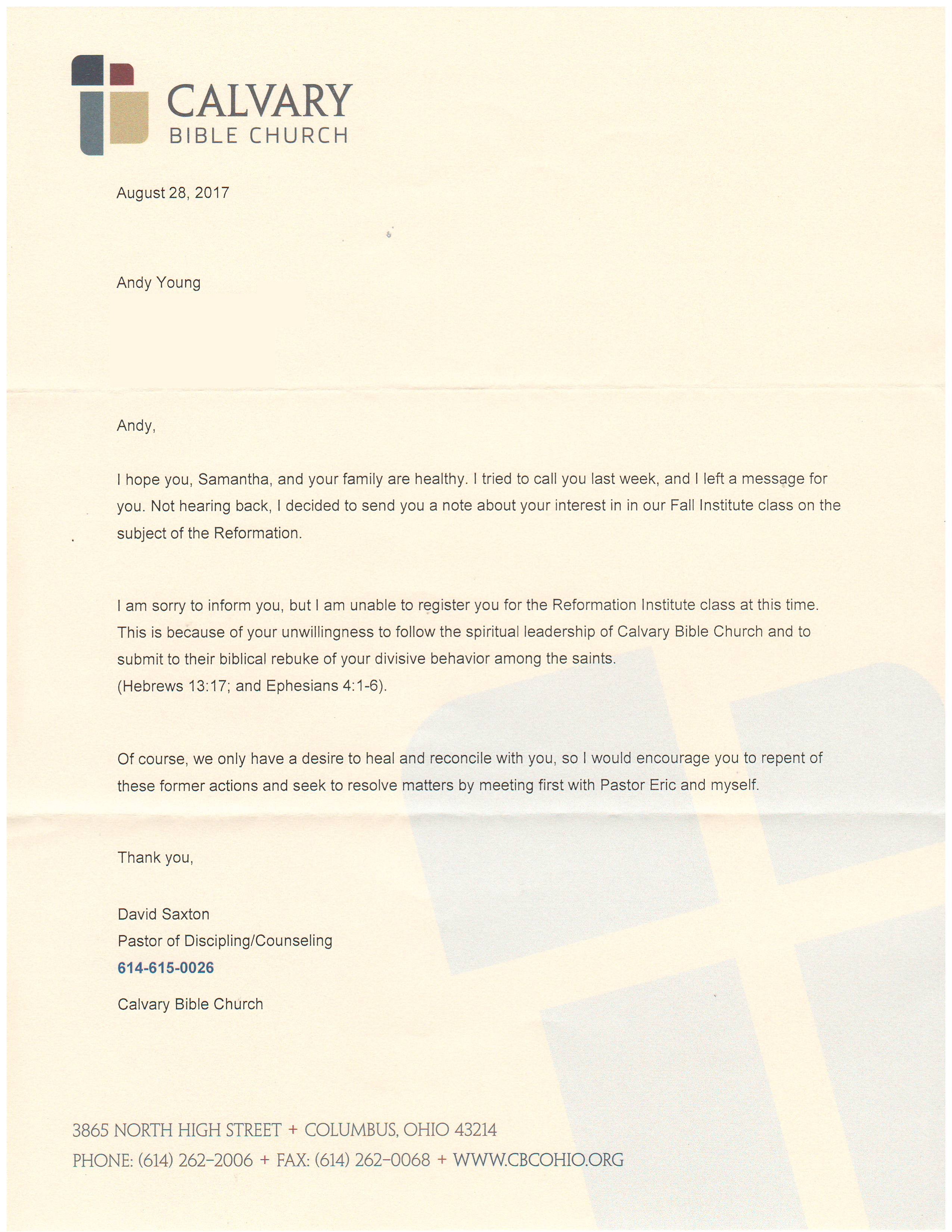 As TANC ministries launches into a focus on alternatives to the church this year, a major one was brought to the forefront this week. Andy Young, our contributing author, gave permission to address the attached letter sent to him recently. Andy himself will have much more to say about this letter in the coming days.
Before I address the letter, let’s review some developing distinctives. First, the fact that we meet in homes is a statement of our gospel. It says we are a literal “household of God,” and not an institution. We are a literal family; that is important.
Meeting in homes with an intentional avoidance of institutional religion proclaims the new birth. Institutions function by law and top-down authority. Home fellowships proclaim justification by new birth and not perfect law-keeping. We deny the supposed double atonement of Christ which is not an atonement to begin with; Christ came to end sin, not merely cover it up. The true gospel is not a cover-up.
Hence, home fellowships function as a cooperative body and not a top down authority. In contrast, those who meet in purpose build sanctuaries deny that individual members of Christ’s body are God’s temple in and of themselves.
Furthermore, the denial of individual bodies as God’s temple also denies the ability of the true saints to use their bodies to offer living sacrifices to God in all matters of life.
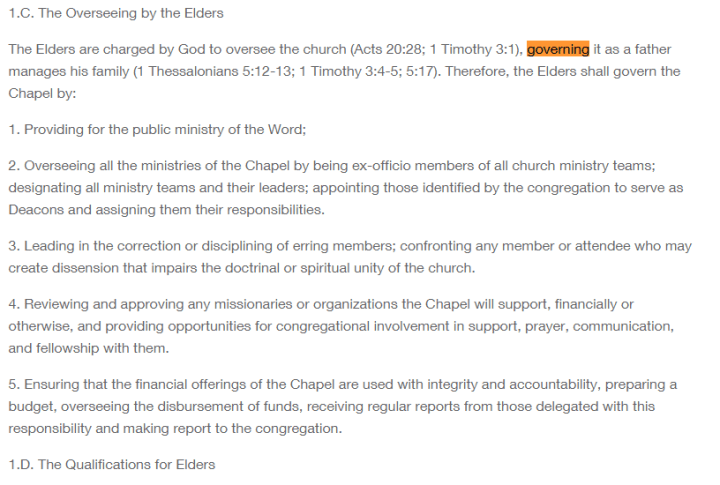
We deny, with extreme prejudice, that men appointed by virtue of buying seminary degrees have authority over our salvation. This is another home fellowship distinctive; the authority of Christ alone as the head of His one body. One authority, and one body.
In the attached letter, it is clear that these men believe they have authority over Andy’s salvation. This is a Protestant distinctive whether Baptist, Methodist, Charismatic, or any other stripe that came out of the Protestant Reformation.
In home fellowships, body members do not wait for permission to use their holy temples to offer living sacrifices to God in all matters of life, and the love we perform is from our own temples and not a substitution.
Keep in mind, by virtue of stated orthodoxy, a love performed by the “saints” themselves would deny the Protestant doctrine of double imputation.
paul
Matt Walsh Jumps on the Joel Osteen Scapegoat Bandwagon
 “…being happy requires courage and risk.”
I said I was going to stop it altogether and I have been good until now; that is, playing the Protestant error Whack-A-Mole game. A key to Protestant survival thus far in history is keeping people busy arguing about “issues that scholars have debated for hundreds of years.”
Therefore, all is well because the religious experts are in the process of ironing out the wrinkles in the Reformation that turned the world right-side-up after being in darkness for thousands of years. Supposedly.
Hence, it is assumed that Protestant “essentials” are unarguable and the church is the undisputed moral compass of society that married reason and logic to religion; “In essentials, unity; in non-essentials, liberty; in all things, charity” (St. Augustine). This is why the bulk of Protestant activity is debate, if anyone would care to pay attention: Protestantism is the epitome of contradiction and doublespeak.
There is only one thing worse than being a Protestant; spending your whole life exposing the low-hanging poisonous fruit in its gargantuan forest. Nevertheless, I will take another bite at the apple after reading an article by Matt Walsh about Joel Osteen. After succumbing to temptation and eating from a forbidden tree one more time, I will tell you what we need to start dong instead.
Since Protestantism is supposedly the beacon of truth and goodness in Western culture, it must invest heavily in warning Churchianity against imposters. And seemingly, Joel Osteen is the chief of all imposters; the consummate “wolf in sheep’s clothing.”
And why is that? Because he preaches the worst false gospel of all, yes, the dreaded, “prosperity gospel.” This is so indicative of Protestantism; a prosperity gospel scorning those who propagate a prosperity gospel. A works salvation scorning works salvation. A Jesus plus something else gospel scorning Jesus plus something else gospels. A…, well, you get the point, and there is no room here to name the hundreds of other examples.
In its endeavor to keep followers busy looking at the church’s enemies lest someone would have time to stumble upon the simple theological math that makes Protestantism a house of cards, they focus on “heretics” that are soft theological targets and affect the church’s bottom financial line which makes Osteen a prime and favorite target. His following constitutes a significant GNP GCP (gross church product). In other words, Osteen is competition that affects the church’s bottom line, and his theology is easily refuted.
Joseph Prince, a close friend of Osteen who would normally fall into the high GCP category and a strong advocate of the prosperity gospel is barely addressed by church stalwarts and the reason is instructive for making the point of this article. Other than his prosperity gospel, Prince is also known as “the prince of grace.” Nobody, but nobody, preaches a more articulate version of the Reformation’s “justification by faith.” The only close second was Tullian Tchividjian who was disposed of for not using nuance enough. Tchividjian was easy to dispose of because his personal moral failures were known among powerful evangelicals. Apparently, Prince is not vulnerable in this regard so they stay clear of him; criticism would bring attention to him which would also reveal that he preaches the exact same gospel as Protestant darlings like John MacArthur Jr. et al. There is irony here that will be addressed later, but unlike Osteen, Prince emphasizes authentic Protestant law/gospel which would make his prosperity message a “non-essential.” By the way, Osteen believes the same gospel as well, but does not articulate it as well as Prince and not nearly as much. So, is accusing Osteen of teaching a “prosperity gospel” a distortion of truth and a false accusation? Absolutely. The issue is really a question of how Christianity is experienced, not how people get saved. But this is but a small whiff of what Protestants do.
Let’s sum up the thesis of this article so far and finish the defining of it: Protestantism, which is truly a prosperity gospel, accuses Osteen of preaching a prosperity gospel which is not true; it is truer to say he preaches an exaggerated prosperity sanctification. Moreover, Osteen is more righteous than his evangelical accusers. Lastly, all parties are guilty of teaching a false gospel. This is an epic example of the pot calling the kettle black on steroids with the kettle being much less worthy of damnation.
Now let’s put feet on the thesis.
We are using Walsh’s article, so let us begin; the subject of his article focuses on criticism that Osteen didn’t open his church building to victims of Hurricane Harvey:
I’m more eager to know why the good pastor hasn’t opened his 10 million dollar, 17,000 square foot mansion to the public. Actually I’d like to know how he justifies ever having bought it in the first place. Well, I know how he justifies it. He and his wife “positioned themselves for a blessing,” as they like to say. Those of us who don’t live in opulent estates just haven’t put ourselves in the right place to receive such rewards.
Um, this assumes that mainline evangelicals do not partake in the same “opulent” lifestyles. Seriously, the press on this is so vast we shouldn’t even have to go there, but we will partake in a short indulgence. James MacDonald, and the Chuck Swindoll 2-million-dollar vacation home controversy to name two among hundreds. Does Walsh wish to ask the same of them? Cognitive dissonance much?
This is the essence of the Prosperity Gospel preached by Osteen and his ilk. It’s insidious and heretical, but crowd pleasing. A Gospel that tells us to embrace suffering and poverty will not pack a 17,000 seat arena. It won’t sell books. It cannot be monetized. It won’t buy you mansions and private planes. It won’t make you famous. People don’t want to hear it. They want to hear something else. They want to hear that fortune and luxury are just around the corner — God wants us to have these things, as Osteen constantly insists — and all we need to do is be a little more positive and probably buy one or two more Joel Osteen books.
This is the Gospel of the World. The Gospel of Osteen. A Gospel specifically tailored to challenge no one, offend no one, and make everyone happy. And it fails miserably on every count.
Huh? Where to begin? A gospel that tells us to embrace suffering doesn’t sell? Is Walsh oblivious to the reality we are swimming in, viz, the massive Neo-Protestant movement of our day? John Piper doesn’t have money? Al Mohler doesn’t have money? They don’t have conferences in Palm Springs? John MacArthur doesn’t have Bible studies on lavish cruises? James MacDonald doesn’t live in a mansion? And they don’t sell a gospel that embraces suffering and the total depravity/inability of mankind?
What is Walsh smoking?
Now let’s talk about the real prosperity gospel of Protestantism and how it compares morally to Osteen’s. Osteen doesn’t sell salvation for a 10% temple tax, he sells “your best life now.” In contrast, Protestantism claims to be God’s authority on earth in regard to the “process of salvation” found only in the institutional church. The “means of grace (salvation)” can only be found in the institutional church, and one of the “means of grace” is none other than the good ole fashioned 10% tithe along with anything extra for good measure. Mainline evangelicals like John MacArthur Jr. routinely teach that there is no salvation apart from putting yourself under the authority of the local church, and tithing less than 10% is robbing God.
Furthermore, they advocate John Calvin’s “power of the keys” which gives the church authority over individual salvation; whatever the church binds on earth will be bound in heaven and whatever the church will loose on earth will be loosed in heaven. If the church likes you—you are in, and the church likes nothing more than a “cheerful giver.”
Joel Osteen sells no such thing. He simply requests donations based on perceived benefits received from his ministry and claims no authority over salvation. He sells a positive message as opposed to the fear of eternal damnation for those who would dare disagree with him which makes him the better of the two.
And there is another major difference between the two. Seemingly all but absent from the health and wealth venue is the Protestant child rape culture that evangelicals refuse to openly confront. Evangelicals who constantly berate Osteen remain silent against organizations like ABWE that partook in a criminal 20-year cover-up of rampant pedophilia amongst its missionaries. John MacArthur Jr., who routinely targets Osteen with his disdain, still endorses CJ Mahaney who covered up child molestation in his church for years and is on tape attempting to blackmail a former ministry associate. It is unclear how Osteen would respond to such scandals in his church because the opportunity has never presented itself, but is this telling if one wants to judge between the two?
The Protestant prosperity gospel is one of negative reward; it’s like a child who demands a reward for doing good and is told the reward is the absence of a spanking. If you obey the Protestant church, your reward is heaven and not hell. It’s the peddling of eternal wellbeing which is many times more valuable than present cash. It is the paramount prosperity gospel. It whispers its vile sins in the ears of goats like Osteen and sends them into the wilderness of social media.
But why does suffering sell? In contrast to Walsh’s cognitive dissonance treatise, why has nihilism, zero sum life, fear, and total depravity always been a dominant ideology of the world and religionists? Because it’s easy and requires less thinking, and doesn’t take courage. You see, being happy requires courage and risk. Like the person who avoids deep relationships for fear of getting hurt, the gospel of suffering and total depravity wishes to stand outside of life and look upon it as one emotionally detached while labeling such indifference “peace that passeth all understanding.” After all, life sucks and ALL people possess “hearts full of darkness.” And don’t you know, you need to get over it because you are no less a sinner saved by grace than the elder who raped your child.
As aforementioned, Osteen is not pushing a gospel to begin with, but more along the lines of a lifestyle that actually requires some effort in embracing life as something positive, albeit errant. And while Osteen receives riches from the freewill of others, evangelicals extract their wealth through tyranny and fear.
What should we do about this? Answer: not what I am doing here. Attempting to fully unravel the depths of Protestant folly is a fool’s errand. Our time needs to be spent reinstating the laity movement known in the first century as the “assembly of Christ.” We need to invest our time in proclaiming a justification by new birth, not a “legal declaration” which is not a righteousness “apart from the law” (obviously) and is a mere declaration—not a state of being. We need Christians to function as a cooperative body in a literal family fellowship, not according to the authority of a manmade institution that usurps the rightful place of Christ as the head of his body.
And this we will do if Christ wills, and He does.
paul
@ Todd Friel
@ToddFriel So brilliant U R misunderstanding what APART means. Justification by law ok if Jesus keeps it 4 us. Better hope Rob B. is right.
— Paul M. Dohse (@PaulMDohse) August 29, 2017

 Paul's Passing Thoughts
13 comments