Over the Threshold
 We will call her “Jane.” While caring for her, I knew little about her other than she was formally a business executive for many years at a large manufacturing company. Her pictureless room revealed little other than various candies she once enjoyed. Memory loss conditions progressively touch every avenue of life; the who, the what, the how, and the why. Eventually, the miraculous involuntary functions of our body that have a mind of their own forget also.
Life responds to those who have lost almost everything; it will tend to take away what is left. This is a woman who knew and loved many, but I never saw them. Yet, we will not judge them, for they assume the person they once knew no longer knows them, and is a person they no longer know as well. The person they once knew and loved is gone. Perhaps. It is at least likely that these are a mystery shrouded by limitations of the physical and living in secrets only known to them and God. More than likely is the fact that such are revered by God, and serving them according to what might be will yield great reward. Here, motives do count with a God of love as in many other areas of life; true love will cover every bet.
Last week, Jane forgot how to swallow, and on her final day a nurse remarked, “she died in peace.” We can start there in documenting her unrecognized treasure. I wonder if everything that lives is teaching us in some way if we will only listen. If only we will pause to ponder. In caring for her I missed this completely, unlike myself, she was always at peace.
In reality, Jane, and many like her, teach vast and deep things that should constantly remind us of things we forget. Those we pity due to memory loss are constantly reminding us of what our pitiful behavior willfully forgets. When we look at them and receive the message, we walk away and forget as one who uses the mirror at the beginning of the day. Perhaps it is ok to forget what we saw in ourselves after we shave, put on makeup, or comb our hair, but forgetting what we see in them is ill advised. We would look better in the mirror if we would practice what they teach. Is this why we neglect their company? Are they our judges?
Jane did not have a life that she lost, Jane had a different life. It was a life that asked many questions about her previous life; a life, like all lives, limited by time. Every time we encounter the Janes of the world we are forced to ask ourselves what we are doing with the present life we have. How are we utilizing our time? What are we thinking about? How are we thinking? Don’t look in the mirror too long, the indictment is unbearable. In fact, we can’t even remember what we were worried about yesterday, yet, the mere personality quirks of others are indelibly burned upon our minds. Many of us have excellent memories about everything that is wrong with the world and suffer memory loss in regard to what is right about the world and others. Memory is often relative to virtue; who are we to judge the Janes of the world? Is our pity towards Jane really arrogance?
Yet, not only do these lives speak to us deeply with a need for lengthy investment because of our chronic forgetfulness, their own lives possess unique elements. The challenge with Jane was getting her to eat. That was a centerpiece of our relationship. She still liked sweets, and adding a little oatmeal to her sugar often worked. She was good at letting the nurses feed her medication in applesauce, so I could fool her if I used a plastic spoon, well, for a couple of bits anyway.
But towards the end of the shift was the highlight of our routine. Hardly anything but skin and bones, I was able to lift her out of her wheelchair and gently lay her in bed which usually resulted in a rare smile. We can only surmise why she smiled as only her and God know, but Susan thinks it invoked a memory of when youthful zeal ruled over life, perhaps being carried over the threshold of a new home or some other event. At any rate, in this case, smiles are always good.
Tradition holds that being carried over a threshold showed a bride’s reluctance to leave a father’s home, or prevented evil spirits from entering the feet of a woman upon entering a new home. If you have listened to any of Susan’s lectures from TANC 2016, you understand these kinds of traditions flowing from church teachings regarding the supposed inherent evil of women. In other cultures, the threshold is a point of greeting before entering someone’s home; all greetings occur at the threshold.
On that day one of three are correct. Jane was carried over the threshold in a joyful leaving of this world to her father’s house, and there was certainly no concern about evil spirits entering her feet. But indeed, there was a greeting at the threshold that our minds can only imagine; another mystery known only by her and a heavenly host.
Her two lives and missions being complete, and uncompensated for her ministry in this world unlike many who call themselves teachers, she was carried over the threshold to eternity, her memory perfectly healed, and now only has one dread…
…that our tainted memories will forget her teachings.
paul
How To Debate A Calvinist: Part 4 – By John Immel
The following is part four of a five-part series.
Taken from John Immel’s fourth session at the 2017 Conference on Gospel Discernment and Spiritual Tyranny
~ Edited by Andy Young
| Click here for part one Click here for part two |
Click here for part three Click here for part five |
In Defense of the Individual
We started out addressing the central fulcrum of almost all Calvinist arguments – an ongoing quest for an undisputed authority so they can ultimately redefine reality however they see fit. Their endless appeal to all things “biblical” is because they believe that is where they borrow their authority so that they can dictate to you whatever it is they think they want you to know.
We then went on to talk about specific arguments that Calvinist use to control you in context to my “web of tyranny” so that you can understand how Abolition of Ambition and Collective Conformity are used together to keep you intellectually subservient and willing to abandon your individuality.
At then end of part three I stated that you had to successfully advocate for your own individuality. This is so crucial because tyranny cannot thrive in a world of self-confident individuals. Tyranny requires your deliberate subordination – your willing sacrifice of self – to whoever is in charge. So the confident individual, the thinking man, will not be willingly subdued, but he will fight back. We have to get comfortable with the fact that we must defend our individuality.
John Locke is a key figure in the course of human events. Locke made a series of arguments that laid a very profound foundation that culminated in the U.S. Constitution, specifically the separation of Church and State. This foundation has given America political autonomy and political freedom. This is essential to understand in the defense of your individualism because Locke’s arguments are the validation of the individual within the context of a civil society.
 I did a full evaluation of John Locke’s philosophy at the 2014 TANC conference. But in this lesson I simply want to focus on some primary points. The first thing I want to discuss is an excerpt from “A Letter Concerning Toleration.” This document was originally published in 1689 which appeared amidst a fear that Catholicism might be taking over England. Locke is responding to the problem of religion and government by proposing religious toleration as the answer. This “letter” is addressed to an anonymous “Honored Sir”, but it was actually Locke’s close friend Philipp van Limborch, who published it without Locke’s knowledge.
“Since you are pleased to inquire what are my thoughts about the mutual toleration of Christians in their different professions of religion, I must need answer you freely that I esteem the toleration to be the chief characteristic mark of the true Church. For whatsoever some people boast of the antiquity of places and names, or the pomp of their outward worship; others, of the reformation of their discipline; all, of the orthodoxy of their faith – for everyone is orthodox to himself – these things, and all others of this nature, are much rather marks of men striving for power and empire over one another than of the Church of Christ.
“In the second place, the care of souls cannot belong to the civil magistrate, because his power consists only in outward force; but true and saving religion consists in the inward persuasion of the mind, without which nothing can be acceptable to God. And such is the nature of the understanding, that it cannot be compelled to the belief of anything by outward force. Confiscation of estate, imprisonment, torments, nothing of that nature can have any such efficacy as to make men change the inward judgment that they have framed of things.
“It may indeed be alleged that the magistrate may make use of arguments, and thereby, draw the heterodox into the way of truth and procure their salvation. I grant it; but this is common to him with other men. In teaching, instructing, and redressing the erroneous by reason, he may certainly do what becomes any good man to do. Magistracy does not oblige him to put off either humanity or Christianity, but it is one thing to persuade and another to command, one thing to press with arguments, another with penalties. This civil power alone has a right to do; to the other, goodwill is authority enough.”
 This is a powerful argument against the algebra of orthodoxy that I discussed in part one of this series. Historically, orthodoxy and the people controlling the definition of orthodoxy has always been about merging political force with doctrine. This is why almost immediately after John Calvin writes his “institutes” he becomes one of the main political figures in Geneva, and in very short order they have a religious theocracy. In every instance Protestant Christianity must push for solidarity between civil government and religious orthodoxy because it must be able to control the definition of reality. You can only do that if you can burn people at the stake.
John Locke correctly identifies that the role of the magistrate cannot be the role of the “soul-saver.” He accepts the premise that human reason is sufficient to the cause of his own consciousness and that man cannot be compelled by force to believe any given orthodoxy. Locke makes a clear distinction between the role of religion and the role of government (force). When these philosophical tides roll across the Atlantic and land in the New World, the closest America ever got to the Dark Ages was the Puritan theocracy in the Massachusetts Bay Colony.
The framers of our Constitution were absolutely sure that such a theocracy should NEVER be allowed the opportunity to grow in ascendancy. The separation of Church and State was designed to limit that fundamental power. They didn’t want the magistrate using force to compel people from heterodoxy into orthodoxy (a.k.a. “political correctness” in religious terms).
“It will be answered, undoubtedly, that it is the orthodox church which has the right of authority over the erroneous or heretical. This is, in great and specious words, to say just nothing at all. Every church is orthodox to itself; to others, erroneous and heretical.”
 This is the fundamental conflict within all of Protestant Christianity. Everybody wants to pretend that their definition of “orthodox” is the correct one, so everybody outside that specific definition is, by definition, in error. So the only question within Protestant Christianity is about who has the authority to compel you to believe their definition. The only way to answer that question is to ask who has the biggest guns? It is always a question of who has the most force.
“So the controversy between these churches about the truth of their doctrines and the purity of their worship is on both sides equal; nor is there any judge, either at Constantinople nor elsewhere upon the earth, by whose sentence it can be determined.”
John Locke’s argument successfully made toleration the fundamental principle of Christian doctrine. He pointed out that those bragging of their spiritual pedigree and doctrinal orthodoxy were really seeking political power and hiding behind the name of Jesus. The only thing that saves man is what happens by persuasion of the mind. Souls cannot be won with government force.
Notice, Locke fully believes that man’s salvation resides in his choice to follow rational arguments.
Notice how these arguments go the heart of our 21st century conflict.
At every turn, Calvinists are returning to the primordial ooze of these historical doctrines; the right to sustain dictatorial power over the course of your intellectual individuality. The point here is they all think that their orthodoxy is the sum of their own mind. You have no obligation to subordinate your mind to theirs.
In Locke’s second treatise on government he goes on to lay the foundation for the nature of government. In chapter two on the State of Nature, Locke says that to understand political power correctly man must first understand his natural state. The natural state is equality. We all, as individuals, reside in our own existence. This is not to be confused with “abilities” or “outcomes” specifically. All men have a right to their own existence by virtue of being individuals. By extension, this means that God would not have appointed some men to subjugate others. This is a root argument against the premise of slavery.
The law that governs the State of Nature is Reason. This is the way man interacts with his own existence and solves the problems of his life. Reason touches that all men are equal and independent. The State of Nature is a state of liberty. The law of Reason says that no man may harm another man’s life, health, liberty, or possessions. There is no subordination of men that authorizes one to destroy the other. Inasmuch as man preserves his life, he must also seek to aid in the preservation of another’s liberty, health, limb, or property.
This is a very different social organization than had ever been conceived before. Up until this time, man was the by-product of the collective. But Locke understood that all of us solve our problems by reason, and because man must be free to solve those problems in order to survive, that means there is a reciprocal responsibility to not cause harm to other individuals as they seek to do the same.
Reason wills peace and the preservation of man, therefore the Law of Nature puts into everyone’s hand the right to punish the transgressor of Reason and to hinder the violation of Reason with violence. This is a crucial distinction. I do not have the right to impose myself upon you and steal what you have, but in the event that I do that you have the moral right to defend against it and to prevent it by violence. Any such man who has violated Reason has thus entered into a State of War. It then becomes the obligation of free men committed to reason and liberty to use violence to repel that action.
Locke’s definition of “property” is an essential evolution of thought. He correctly establishes the roots of “private property.” Property is the product of labor. As you go about using reason to solve the problems of existence you have artifacts of that process. That is your work product; the outcome of your labor. Individuals employ their industry to create the substance of their life. Men in the State of Nature must work to survive.
 There is an unbreakable relationship between your reason, the product of your labor, and your ability to enjoy that labor unharassed. Seizing man’s property is the same as seizing man’s life. Locke correctly identifies that man is indivisible from his work. He correctly integrates human existence by identifying that reason is the root of man’s production. Thus man’s life and man’s property are corollaries of existence. By contrast, historically man has always been a cog in the wheel of the collective, therefore the work that he does is the rightful property of the collective.
Locke goes on to discuss the beginning of political societies. He identifies the correct order in social relationships. Historically it was assumed that the State was the social primary. Men were born into the State, and their lives were disposed of at the will of the State. Locke says otherwise.
“Men, being by nature, all free, equal, and independent, no one can be put out of this estate, and subjected to the political power of another, without consent. A man can only divest himself of his natural liberty, and put on the bonds of civil society, by agreeing with other men to join and unite for their comfortable, safe, and peaceable living one amongst another, in a secure enjoyment of their properties.
“This any number of men may do, because it injures not the freedom of the rest; they are left as they were in the liberty of the State of Nature. When any number of men have so consented to make one community or one government, they are thereby presently incorporated, and make one body politic, wherein the majority have a right to act and conclude the rest.”
Why do men agree to join and unite? According to Locke it is for the comfortable, safe, and peaceable living one among another. Here is his fundamental point. The reason we enter into civil societies is to enjoy the fruits of our labors. You will recognize this concept expressed in the Declaration of Independence: life, liberty, and the pursuit of happiness. Notice the individual comes first.
Here is the progression: Man is first a free, sovereign agent; he labors to create property to satisfy his survival and enjoyment; he seeks social relationships to expand his freedom; he consents to social contracts; government is by consent of the governed.
Here is where I think John Locke did the world a favor. He identified the root of all civilized societies. The root is the individual. The individual’s proper State of Nature is Reason. Private property is a by-product created by rational effort. Government and social contracts are the consequence of individual life, liberty, and happiness. You enter into government contracts to protect yourself from encroachment. Thereby government is subordinated to the individual.
John Locke laid the foundation for a peaceful society by placing theological issues firmly in the realm of personal conscience and delimiting the government purpose. That foundation set the minds of men free, and a light was set forth throughout the earth.
But there was one thing that John Locke did NOT do. He did not tell people how to be effective individuals.
And it is for this reason we will now turn our attention to the last building block of individual defense.
…To be continued.
| Click here for part one Click here for part two |
Click here for part three Click here for part five |
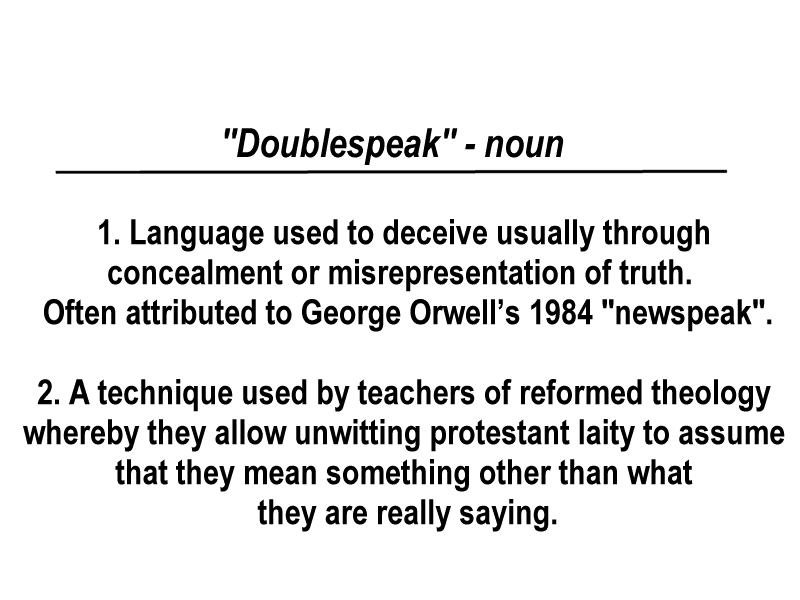
Calvinism’s Senseless Babblings

“Now the end of the commandment is charity out of a pure heart, and of a good conscience, and of faith unfeigned: From which some having swerved have turned aside unto vain jangling; Desiring to be teachers of the law; understanding neither what they say, nor whereof they affirm.”
~ 1 Timothy 1:5-7



1 comment