Why Hillary Will Win and the Future of Capitalism: Part 5 Addendum; Countdown to Election Day
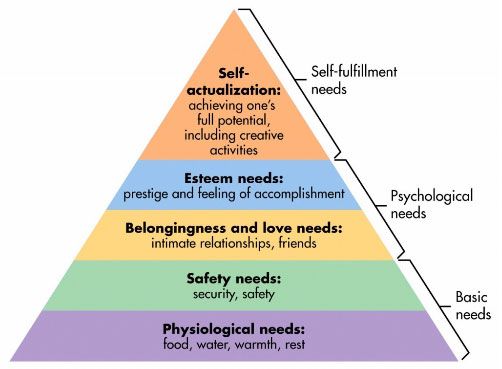
In the previous four parts, we examined why the American people are willing to elect known criminals for President of the United States. It boils down to fear of not having our basic needs met. Maslow’s Hierarchy of Needs is correctly descriptive in regard to these basic human needs.
The next consideration focuses on how these needs are met: is the individual best suited and able to meet these needs (ability of mankind) or is mankind unable and in need of government to fulfill these basic needs? The question concerns the ability/inability of mankind. Historically, cultures have always been dominated by governments predicated on the inability of man until the advent of Americanism.
Why did America and individualism finally come about? Because the doctrine of inability always appeals to a promise of meeting basic needs which result in loss of self-actualization. In other words, the doctrine of inability appeals to the base fears of not receiving food and protection but results in the unfulfillment of individual accomplishment resulting in loss of self-worth and dignity.
Moreover, the economic vessel of the doctrine of inability, socialism, NEVER ultimately delivers on the base needs. It just doesn’t work and never has worked. This, and this alone is the reason that America is the greatest force for good ever known historically; it was founded on the doctrine of individual ability. After thousands of years of incessant war, plague, and starvation, great thinkers began to ponder the reasons for this dreadful norm. They concluded that government’s true purpose was to free the individual to pursue self-actualization with the basic needs being the natural result.
Historically, there has always been a deeply ingrained fear of an unrestrained population. The collective freedom of man was/is thought to define chaos. This deeply ingrained presupposition concerning mankind has always enabled socialism to live another day. Also fueling this presupposition is man’s propensity towards laziness and getting happiness for free rather than earning it. Having one’s basic needs “guaranteed” through obeying a government controlled by the “gifted” has always been the intellectual path of least resistance. It took thousands of years of unspeakable misery to incite the Enlightenment Era which gave birth to the founding fathers of Americanism.
Before we move on to the primary point of this post concerning the present landscape of this election cycle, I would like to park on the two doctrines of ability and inability a little more. Before circa 350 BC, the inability of man was the dominant worldview which encompassed three parts: deity, mediation, and the total inability of the masses. Inability was the doctrine and caste was the application. In all cases, it was necessary for deities of various stripes to appoint mediators (knowers/seers) to rule over the masses for their own good and to save them from themselves. Typically, in that construct, individualists are seen as a threat to the collective wellbeing of the masses because they think they understand reality. So yes, until America came into being, world history was dominated and ruled by the church-state. This is at the core of America’s separation of church and state and the subsequent separation of faith and force.
Circa 400 BC, Plato defined the doctrine of inability via The Republic, and this construct disallowed upward mobility. One’s role in society was predetermined by lineage. All just societies were to be ruled by philosopher kings and their edicts enforced by the warrior class. “Justice,” according to Plato, was defined by one thing only: unity. This led to even more business as usual: wars between philosopher kings (governments) because they disagreed on the best philosophy to bring about utopia. Wars have always been about saving the world.
Aristotle (circa 350 BC) brought a slightly different philosophy to the table; he believed mankind, in general, was able to understand reality, and ability to know realty was not confined to predetermined elitist knowers. Aristotle was the father of the ability of man doctrine. It was still a caste system, but it allowed upward mobility. One’s status as a knower could be earned. Though America is clearly the best thing that has ever happened to the world horizontally, it is still dominated by caste at every level of experience.
When it gets right down to it, the least common denominator of politics and religion is Plato versus Aristotle; the two doctrines of ability and inability. Protestantism, in particular, is little more than a cheap knockoff of Platonism and post-American evangelicalism is a confused hybrid of ability and inability. America was originally settled by European “Christian Platonists,” viz, Puritanism, but the American Revolution produced a Christianity that believed in the ability of mankind. However, as written about much on this blog, evangelicals have all but totally returned to their Platonist roots via the Neo-Protestant/Neo-Calvinist movement.
Initially, post-Revolution America was dominated by an individualism that has laid a foundation that will never be fully destroyed. Americanism finally opened up the Pandora’s Box of freedom, and mankind having tasted it for more than 200 years will never completely turn back. But, American politics will always be a struggle between these two doctrines; the ability or inability of mankind. As stated in the previous parts, a socialist road will never lead to the mother of all church states described in the book of Revelation, but if the book is examined carefully, the best thesis points to a pseudo-capitalism that will set a trap utilized by the Antichrist. Capitalism will lead to a “we are rich and have need of nothing” mentality leading to an unexpected swift destruction when the world is saying “peace and safety.” It might be said as well that the world is experiencing a sort of utopia at that time and snubbing their noses at God accordingly. The ability of man created into man by God becomes a means of worshipping man above God.
Presently, Hillary Clinton embodies a philosophy that believes socialism can lead to socialism. Socialism ALWAYS leads to the total loss of a society’s dignity, but revolution comes when socialism invariably fails to deliver on the basic needs of food and water. Loss of freedom causes misery, but many will live with that if they can get food and water while believing that self-actualization is defined by one’s ability to contribute to the collective good; ie., the mommy-state.
Hillary and company are trying to obtain a socialist utopia by transforming capitalism through redistribution of wealth flavored with class warfare. And in fact, earned status does create envy. Through the dumbing down of the American populous being led by the nose via sound bites that appeal to the baser instincts, 47% of all American households depend on government assistance. The policy is designed to create a fear of homelessness and starvation. We all know people willing to trade their dignity for some kind of security. Right now in America, this duped populous can have their cake and eat it also because there is still plenty of wealth to redistribute. If a prior socialist candidate fails to deliver, there is always hope that the next one in line will do better, but the chorus of the political jingle is always “free stuff” seized from those greedy capitalists. And by the way, note that Hillary’s embracement of the doctrine of inability is frightfully evident.
Hence, Democrats only get reelected when they fail to deliver on the free stuff. The intended recipients stay home and don’t vote—that’s the difference. Example: Jimmy Carter. So, how did Obama get reelected? Despite views to the contrary, he did deliver the free stuff. For example, the horror stories that we hear concerning the Affordable Care Act only affects the middle class, not a large part of the Democratic base made up of the lower middle class. Besides, any shortfall of free stuff is effectively blamed on the Republicans.
Last week, Neil Boortz was a substitute on Herman Cain’s conservative radio program. He reiterated his position that the tightness of this race is media propaganda for purposes of ratings, and I agree with him.
Due to the dumbing down of the American people, a majority will continue to be led down a road paved with promises of guaranteed food and water, but resulting in the same ancient misery flowing from the doctrine of inability. Right now, people can still vote for free stuff while enjoying freedom because there is still plenty of wealth to redistribute from the foundations of American capitalism. Until the balance tilts to a lack of freedom and the delivery of free stuff, the likes of Hillary Clinton are still electable…morals be damned. Morals are not the issue, perceived ability to mother our inability is the issue. In fact, one pro-Hillary celebrity comedian was quoted last week as saying:
To me, it’s really exciting to have the first mother in the White House. It’s not about the first woman, it’s about the first mom. Because a mother just does it. She feeds you and teaches you, protects you. She takes care of sh*t… We need just a tough b*tch mother who nobody likes and who just does sh*t.
As the adage states, good humor is funny because there is some truth in it. The cited statement is the crass version of Mark Twain’s version: “Humor is the good natured side of a truth.”
It may be a close race, but fear of individualism that disregards a safety net and prefers dignity over food and water will prevail. Nevertheless, we must remember there have been former Presidents every bit as socialist as Hillary and America not only survived, but thrived. More than likely, capitalism will make a comeback for the aforementioned reasons.
Of course, I could be wrong. Perhaps the balance is tipped enough that a road of socialism attempting to obtain socialism is a thing of the past. Perhaps Trump will be the beginning of the coming capitalist revival foretold in the Bible. We will find out on Tuesday.
paul



1 comment