Chris Anderson’s “Culture of Grace”
Another gospel-monger making merchandise of unsuspecting laity.
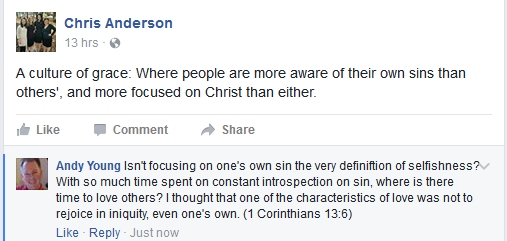
From the Church Works Media website:
“Chris Anderson has pastored since 1997. He’s the senior pastor of Killian Hill Baptist Church in Lilburn, Georgia. He has written dozens of modern hymns for the church published by ChurchWorksMedia, is the editor of the Gospel Meditations devotional series, and has recently published his first full-length book, The God Who Satisfies. He and his wife Lori have four daughters.”
The Philosophy of the Rich Young Ruler
“And, behold, one came and said unto him, ‘Good Master, what good thing shall I do, that I may have eternal life?’ And [Jesus] said unto him, ‘Why callest thou me good? There is none good but one, that is, God…’” ~ Matthew 19:16-17
To say that something is “good” is to refer to its intrinsic value or worth. When God said in proclaiming His creation “good” was that it had value, and not just value to Him, but value in and of itself.
That doesn’t mean that something that is “good” cannot be used for evil intent, and even if it is used for evil, that doesn’t change its intrinsic goodness.
Now contrast this with every philosophy, from Plato to Immanuel Kant, where the chief aim is the destruction of man. Such a philosophy was held by Philo who had a great influence on the Pharisees and Jewish religion, incorporating it into Jewish orthodoxy.
Given this understanding it is easy to see why Jesus would say what He said to the rich young ruler, who would have been a student of this philosophy under the Jewish orthodoxy of that time. Jesus was not making a definitive existential statement about man. He was sardonically pointing out the rational inconsistency of the rich young ruler in calling Jesus “good master” when his own philosophy taught that man is not good.
Nevertheless, unregenerate man is not under condemnation because he has somehow lost his value in being “good.” He is condemned because he is under law. The reality that God made a way for man to be reconciled to Himself is evidence of God recognizing man’s continued “goodness”, his value. That man in the weakness of flesh from time to time may break the law is not somehow indicative of his lack of “goodness”. This is why the Bible states that righteousness is apart from the law. Any attempt to define righteousness by some standard of law-keeping (even if Jesus “keeps the law for us”) is placing man right back under the very same law that can only condemn. The only way for man to escape condemnation is for him to get out from under the law.
This is exactly what the new birth accomplishes. It makes man a truly righteous being who is the literal offspring of God the Father, and one who is no longer condemned by the law because he his a new creature that is not made under the law. The old man who was under the law is dead, and you can’t condemn a dead man. This is the very reason why the apostle John can state unequivocally and without contradiction:
“Whosoever is born of God doth not commit sin; for his seed remaineth in him: and he cannot sin, because he is born of God.” ~ 1 John 3:9
~ Andy

Faith Comes By Hearing
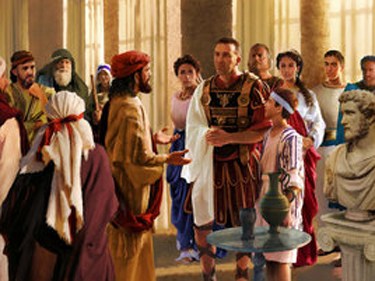 “While Peter yet spake these words, the Holy Ghost fell on all them which heard the word. And [the believing Jews] were astonished, as many as came with Peter, because that on the Gentiles also was poured out the gift of the Holy Ghost…Then answered Peter, Can any man forbid water, that these should not be baptized, which have received the Holy Ghost as well as we?” ~ Acts 10:44-47
You know what’s missing in this passage?
- No one first walked an aisle
- No one first prayed a prayer
- No one first became a member of a “local church”
The people in Cornelius’ home heard the word and believed while Peter was still speaking! They were born again the moment they believed! That is, they were convinced and persuaded that what Peter was saying was true and wanted what was being offered to them.
“So then faith cometh by hearing, and hearing by the word of God.” ~ Romans 10:17
“How then shall they call on him in whom they have not believed? and how shall they believe in him of whom they have not heard? and how shall they hear without a preacher? And how shall they preach, except they be sent? as it is written, ‘How beautiful are the feet of them that preach the gospel of peace, and bring glad tidings of good things!’ ” ~ Romans 10:14-15
Evangelism is not the job of the “local church”. Evangelism is an individual mandate. Every believer is an ambassador of reconciliation!
“And all things are of God, who hath reconciled us to himself by Jesus Christ, and hath given to us the ministry of reconciliation…and hath committed unto us the word of reconciliation. Now then we are ambassadors for Christ, as though God did beseech you by us: we pray you in Christ’s stead, be ye reconciled to God.” ~ 2 Corinthians 5:18-20
~ Andy

 Paul's Passing Thoughts
13 comments