
How to Debate A Calvinist: Part 1 – By John Immel
The following is part one of a five-part series.
Taken from John Immel’s first session at the 2017 Conference on Gospel Discernment and Spiritual Tyranny
~ Edited by Andy Young
| Click here for part two Click here for part three |
Click here for part four Click here for part five |
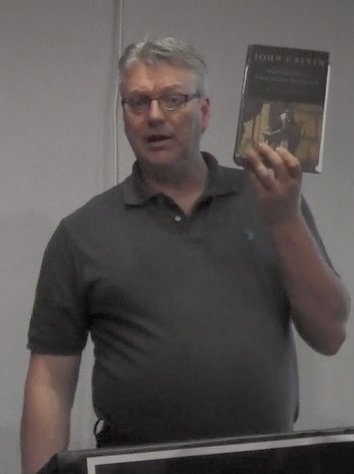
“Have you read Calvin’s Institutes today?”
I must confess, I really struggled this year with what I wanted to talk about. My brain bounced off about a dozen things. I originally thought I was going to dig deeper into the impact of John Locke on American civil government, American religion, the American Revolution. But at the end of the day it didn’t really catch and sustain my attention too much.
Then I thought I might actually discuss death and life and exegete the first four chapters of the book of Genesis. And that didn’t really stick with me very long. And I toyed with a half a dozen other things that just don’t bear mentioning.
Then about two or three months ago I was reading an interaction on Paul’s Passing Thoughts between Paul Dohse and a guy by the name of “GraceWriterRandy”. Now, trust me, this conference is not about GraceWriterRandy, but he is a fantastic anecdote. And so I decided to go ahead and talk about what he did and how that applies generally.
So here is what I noticed. And what so caught my attention was that Randy presumed to set the tone for the entire conversation, and frankly it didn’t matter what part of the conversation. He decided that he was going to dictate the moral and intellectual terms across the board. He reserved the right to make the discussion as narrow or as broad as he wanted.
And then what really bothered me is that everybody accepted the premise. Everybody tended to follow along. So if Randy reframed the conversation, everybody accepted the shift. If Randy argued scripture, everybody started stacking up scriptures. If Randy shifted to moral criticism, everybody started lobbing moral accusations. If Randy challenged a definition, everybody started parsing meanings.
And this is when I realized that I actually had my topic of conversation: Arguments with Calvinists, and trying to unravel the roots of their arguments.
And this is why no one ever gets anywhere in a debate with a Calvinist, because they let the Calvinist shape the direction of the conversation. People rarely ever challenge the Calvinist root assumptions. They let the Calvinist decide that it is their sole right to define all things moral, spiritual, and intellectual. And the foundation of all their arguments is the myth of their [Calvinists’] own authority and their entitlement to dictated force.
So I came up with a brief algebra of historic “Christian” authority:
The Algebra of Authority
Catholic Algebra:
Absolute Truth = Apostolic Authority + Scripture = Error Free Doctrine + Apostolic Succession = Papal Authority = Orthodoxy = Government Force
I want you to notice that the fulcrum of Catholic doctrine is Apostolic Authority PLUS Scripture. Everything else, how they get their doctrinal interpretations, is a direct product of this. Catholics had decided long ago that the reason that “Scripture Alone” got so much traction is because the Catholic church, specifically Papal Authority, decided that it was their job to interpret what it said. But at the end of the day, Orthodoxy is what determines Government Force. In other words, the Pope has the right to compel you to what you think.
Here’s what happened when Protestantism showed up:
Protestant Algebra:
Absolute Truth = Scriptural Authority = Predestined Elders = Error Free Doctrine + Ecclesiastical Force = Orthodoxy
It is very important that you see the relationship here. Predestined Elder inherit the implications of their own Absolute Truth. The function of Predestined Elders in the Protestant world is to compel you to think whatever it is they think they have the right to compel you to think.
This is crucial for you to understand: Authority = Force
Any time somebody says, “I am an authority,” what they are really saying is, “I have the right to force you to do something.” There is nothing elegant about it.
So then how do you debate a Calvinist?
The answer is: You challenge the roots.
This is why I insist, particularly with regard to GraceWriterRandy, no one ever successfully challenges the roots of the assertion.
 I have been talking about my web of tyranny now for the last six years. This is my contribution to the world of philosophy. I have identified what I believe are the five fundamental pillars of tyranny. It doesn’t matter what the ultimate end game is, all tyrannies have these five sub-categories or arguments: Dictated Good, Universal Guilt, Abolition of Ambition, Collective Conformity, and Incompetent Masses. The function of all these sub-categories is designed to create “Utopia,” or an alternate reality.
The reason I have rendered this as a web is because it is not specifically linear. In other words, there is not specifically a logical progression of one to the other. Instead there is a dynamic tension between all five, so all of the arguments act in harmony with all of the others to compel you down the path of this alternate reality; the right to determine some other realm of thinking.
What we have never really discussed is how the arguments fit into the web. On occasion over the last few years I have made reference to when an argument sits, but I want to have an overarching view. I want to start subdividing some of the arguments that you will hear. I’ve tried to pick archetypes of the arguments, and we will try to unravel them in later sessions.
If we are going to successfully debate Calvinist, we have to get good at identifying the foundational assumptions, because:
The Gospel According to John Immel, chapter 3:1-3
- All people act logically from their assumptions.
- It does not matter how inconsistent the ideas or insane the rationale. They will act until that logic is fulfilled.
- Therefore, when you see masses of people taking the same destructive actions, if you find the assumptions, you will find the cause.
Frankly, I don’t think we can have any better object lesson of this truth played out in our civil discourse than the logical assumption of a group of people tearing down historic monuments over wars that were fought long ago over offenses that are entirely manufactured. They are in actuality fulfilling a body of logic that produces some action.
Ideas are what drive human action. There is body of ideas, and a fundamental integration of those ideas, that produces your actions in any given day. This integration is called Philosophy.
Disciplines of Philosophy
– Metaphysics
– Epistemology
– Ethics
– Politics
– Aesthetics (art)
The roots are your metaphysical assumptions; whatever you accept about the nature of existence. Once you actually establish your foundation of metaphysical assumptions, you move to epistemology. That is what you believe your mind can understand. Once you identify what your mind can and cannot know, you move on to ethics. These are the moral judgments that you have about your actions; what is good and what is evil. This is how we define how we interact with other people through politics. Once man is able to establish these first four disciplines, he is able to refresh his existence with artistic expression. His art is a reflection of his most deeply held values.
The Orthodoxy Happy Dance
You might begin to talk to a Calvinist by presenting to him what Luther or Calvin said regarding a certain doctrine, and all is well and good until the Calvinist encounters something he doesn’t like. At this point he might respond by saying, “Well, Calvin might have believed that, but it was really the Synod of Dort that came up with this thing called T.U.L.I.P.” At this point they have made the Synod of Dort their authority over Calvin and Luther.
So then you proceed to point out a fallacy in T.U.L.I.P or the Synod of Dort, and now they might cite the Westminster Confession as being the final authority on the matter, rejecting the Synod of Dort. Notice what they are able to do. At any point in the argument that they don’t happen to like an given intellectual conclusion, no matter where it starts, they get to dance around between any given authority that suits them at any particular moment.
Take a look at the video below. This is an excerpt from a breakout session at the 2016 Cross for the Nations Conference in Indianapolis, IN. In this clip, you will hear John Piper make a reference to being committed to “the whole Calvinistic scheme.” Watch then, as Paul Dohse challenges Piper on the matter of election, Piper proceeds to engage in this orthodoxy happy dance.
Did you catch it? What you just saw Piper do is exactly what Calvinist do with impunity. They want the right to pick any given authority as their intellectual forbearers and then disown those intellectual forbearers whenever it suits their purpose. And this is why I call it the Orthodoxy Happy Dance, because orthodoxy at the end is this amorphous concept to which they get to appeal. They make an appeal to something that has no functional definition. At the end of the day, the real root of what they are advocating is their right to their own authority.
Notice that when pressed on the Calvin Institutes, Piper immediately became a Biblicist. What you will eventually realize, if you care to pay attention, is that Calvinists don’t read the Calvin Institutes ever. They read a few select excerpt here and there and then pretend that it is their intellectual pedigree, which they then believe gives them the license to tell you what to think. You peg them down on what they think and then they just jump to some other source of intellectual pedigree.
This sort of intellectual two-step is a direct violation of Aristotle’s Law of Identity; that A is A. Something cannot be “A” and “not A” at the same time. But with Calvinists, orthodoxy can be anything they want it to be. They have no intellectual integrity. They are not committed to anything specific. This is why every time you start debating Calvinists your conversations go nowhere.
Any time you have such a conversation, what you must do is make them responsible for their intellectual pedigree. If at any point they want to reject any point of Calvinism, they are rejecting the roots of orthodoxy. You will see this comment consistently:
“Calvinists don’t believe everything that John Calvin said…The Bible says blah, blah, blah…”
This is a glittering gem of colossal ignorance. It kills me every time I see it. I guarantee if you read anybody’s blog and you take somebody to task you will get a similar response. Pay attention to this. This is the formulation. They will identify themselves as Calvinists, and then they will pretend that they don’t believe what Calvin said. Suddenly they are independent thinkers and Biblicists. This is a gambit to what they believe they control – Biblical interpretation.
The next time you hear this line of logic, what you must say is, “So, you reject John Calvin’s ideas? Excellent! We agree on something. In your copy of Calvin’s Institutes, show me specifically to what you object.” This must be the only answer you will accept, but here is the thing; they will never do it. They will want to play their gambit of Biblical interpretation because they believe they own it.
Your rebuttal when they go back to the Bible, you say, “So, you are really saying that Calvin’s ideas are not in the Bible, right?” If they have to constantly run back to the Bible, then that means they cannot find those ideas in the Calvin’s Institutes. The moment they concede that point, then the next question you ask is, “So that means that Calvin’s teachings are unbiblical, right? That would make him a heretic, right?” Follow this progression of questioning, and don’t let them leave this point! They must commit to what they are advocating.
You want to make sure they can never escape either an acceptance of Calvin or a rejection of Calvin. They must either accept that there is a synonymous relationship between Calvin and the Bible or there is not one. The moment you drive that wedge they are stuck. They use Calvin to establish their historic pedigree – “I have authority because I believe what all these other historic thinkers think.” Yet at the same time they want to turn around and claim intellectual autonomy whenever they choose. So which is it; historical authority or your own intellectual authority? That is the fulcrum of the debate.
If the truth is defined as “authority,” then there is no such thing as “I think…” The assumption is Authority = No Doctrinal Error; that the only way you can hedge against doctrinal error is to have authority. So the reason they argue “authority” is because they insist that they are the ones who get it all right. But the moment you confront them with something that isn’t right, they want to renounce the very thing that gives them authority. This is what you can never let them get away with.
The real argument here is that they have abandoned the right to the Aristotelian Law of Identity. They are constantly trying to say that “A” can be “B” and “B” can be “A”. They want to have a “both/and” reality.
- Both final authority and error-filled humans.
- Both defender of orthodoxy and an individual thinker denouncing Calvin’s doctrine.
- Both herald of God’s mystic revelation and defender of “objective” truth.
- Both lowly unoriginal mind slave and epitome of rational judgment.
- Both champion of God’s hard truth and pitiful victim of undeserved criticism.
The way to defeat Calvinists is to deny them their authority and hammer away at reality. Reality is their enemy. The reason they engage in the Orthodoxy Happy Dance is because the moment they are confronted with the specifics of history they are toast.
But be forewarned:
- Try to rebuff a Calvinist’s right to define all things and they pretend that no is their equal.
- Try to reject a Calvinist’s monopoly on moral virtue, and they snarl that no man is righteous.
- Try to refuse to let a Calvinist define reality, and they resort to force.
…To be continued
| Click here for part two Click here for part three |
Click here for part four Click here for part five |
God’s Acknowledgment of “Self” and the Full Circle of the Ten Commandments.
Originally Published May 25, 2016
 “And God said unto Moses, I AM THAT I AM: and he said, Thus shalt thou say unto the children of Israel, I AM hath sent me unto you.” ~ Exodus 3:14
When Jehovah (I Am) identified Himself to Moses at the burning bush, He did more than just tell Moses His name. God made a philosophical statement about reality. God acknowledged His own existence, and in so doing He declared His intrinsic rights because of that existence. Furthermore, by acknowledging His own existence, God also recognized man’s existence. I believe this is at the heart of what the Bible means when it says that man was made in God’s image. We have a right to “self” because God has a right to “self”. And for us to acknowledge our own right to “self” demands that we by extension must acknowledge others’ right to “self”, just as God acknowledges ours.
Do not misunderstand what I mean by “right to self”. I do not mean “self-ishness”, which the Bible clearly decries. “Selfishness” means to love oneself MORE than another. On the other hand, the Bible never teaches us to love others more than ourselves. Said another way, the Bible doesn’t teach that we should love ourselves LESS than others. It says we are to love others AS MUCH AS we love ourselves. Herein is the way in which we acknowledge another’s right to “self”, we treat others as WE would want to be treated. We see our own value as an individual and in so doing recognize that others have that same value. That value includes one’s right to existence and the means necessary to sustain that existence. The United States’ Declaration of Independence embodied that idea in this way:
“…We hold these truths to be self-evident: that all men are created equal; that they are endowed by their Creator with certain unalienable rights; that among these are life, liberty, and the pursuit of happiness…”
“That all men are created equal” is to recognize that all men have the same basic right to “self” and to existence, and that equality of individualism is preserved in the rights to seek those things which would secure that existence. No one ever has the right to violate another’s right to “self”, EVEN GOD!
In a conversation with a close friend the other day, I posed the question, “why is stealing wrong?” My friend replied that stealing is wrong because God said so; it’s in the Ten Commandments. Stealing is wrong because God said, “Thou shalt not steal.” I then followed up with the next question, “Why did God say stealing is wrong?” For this my friend had no answer. All he could say was, “I don’t know, I never thought about it before.”
You see for my friend, as it is with most people (particularly Christians), that God “said it” was enough for him. It was nothing more than an appeal to authority. An authority says this or that, so we must do it or not do it. This is the same reasoning that led to the slaughter of 6 million Jews while millions of others gave their tacit approval. People’s behaviors are the product of their assumptions, to paraphrase John Immel. No matter how irrational the behavior may seem, if you find the assumption you will find the reason for the action.
So why DID God say that stealing is wrong? It is a simple question, and once challenged to think, my friend finally did ask it of me. Stealing is wrong because it is a violation of “self”, of the individual. Our possessions are the products of our labors which are an investment of ourselves. Your labor is an exchange of value. You enter into that exchange with an employer who trades you wages for your investment of yourself. Those wages then in turn are exchanged for those things that are necessary to further your existence – food, clothing, shelter, etc. – and if there is any surplus, luxuries – car, mobile phone, flat screen TV, etc. So in reality, everything you produce – labor, wages, food, clothing, car, TV, etc. – is a product of you as an individual. For someone to steal those things from you is to violate “you” (self) because those things represent what the individual produced as a function of “self”. You have a right to them because you produced them because you have a right to “self”.
Contrary to what people/Christians are taught, the Bible is not a theological book. It is a philosophical book. And the Ten Commandments in particular are not simply an authoritative codification of do’s and don’ts. It is a philosophical statement from God to man about the value of the individual. It is a statement about how God values Himself, and it is a statement about how God values man. Conversely it is a statement of how man is to value God and how man is to value man. God’s very first statement to man is an appeal to God’s own sense of “self” and value. God as an individual. “I am God. I exist. I have value.” Therefore, the way we show God that we value Him is to have no other gods before Him! We do not make vain attempts to conceptualize God’s sense of “self” by making an image to represent that. We do not mock God’s name because His name is intrinsically tied to who He is. To violate God’s name is to violate who He is.
Man, too, has value as “self”. Therefore, we honor our parents, we don’t murder, we don’t commit adultery, we don’t steal, we don’t lie, and we don’t covet, not because God said so, but because we acknowledge that this would violate another person’s right to “self”. This is the basis for morality. It can be said then that the definition of morality is anything that does not violate God or man as “self”.
God’s command to not covet seems all-encompassing. The last commandment perfectly reduces everything down to the root motivation for all violations of “self”. And that is self-ISHNESS. A desire to usurp for oneself that which rightfully belongs to another. And as we have said before, that is a desire caused by Sin. The Bible describes Sin as an entity that seeks to control others. It seeks to master and enslave. It seeks to violate another for it’s own benefit, to wield control over another.
The New Testament offers another perspective on covetousness.
“For this ye know, that no whoremonger, nor unclean person, nor covetous man, who is an idolater, hath any inheritance in the kingdom of Christ and of God.” ~ Ephesians 5:5
“Mortify therefore your members which are upon the earth; fornication, uncleanness, inordinate affection, evil concupiscence, and covetousness, which is idolatry:” ~ Colossians 3:5
The apostle Paul had a unique insight among the other apostles in that he was a certified expert on Jewish law. This perspective gave him an ability to draw parallels between Old Testament and New Testament concepts that the others did not. Peter even declared that many of the things which Paul taught were hard to understand (2 Peter 3:16). In these two passages in particular, Paul sees covetousness as being nothing more than idolatry. I’m not exactly sure how he gets there since he doesn’t elaborate on it.
Still, it is an interesting piece to the puzzle. Consider that one of the Ten Commandments speaks to idolatry. When one thinks of graven images, one usually thinks of idolatry. But Paul seems to suggest that idolatry involves more than just “idol worship”. It is a violation of God as “self”. Covetousness is a violation of man as “self”. What Paul has done here is to show the intrinsic relationship between the two. To violate man is to violate God, and to violate God is to violate man. Do not misunderstand, I am in no way suggesting that man IS God. But I do want to point out that there is a mutual recognition between God and man with respect to existence.
So to violate the tenth commandment is to violate the first, and thus we have come full circle. The Ten Commandments then are not statutes in and of themselves. It is not a means for God to show us “filthy rotten sinners” just how “holy He is” and how “sinful we are.” It is a full-orbed treatise on morality and existence. It is not a law for authority’s sake. It is God instructing us on reality. What we see in the Bible is that LOVE is the motivating factor in all of this. To love someone is to ascribe value to them. Perhaps this is the relationship between idolatry and covetousness. To idolize something is to objectify it, to assign value based on its desirableness to oneself instead of an individual’s intrinsic value as another individual.
Whatever the case may be, when we show love to God and others, we have thus fulfilled the whole law because in this way we demonstrate a like view of both man and God, and we see reality the way God sees it.
Andy
God’s Philosophical Statement to Man Transcends the Need for Self-Appointed Mediators
Originally published October 30, 2016
“For this commandment which I command thee this day, it is not hidden from thee, neither is it far off. It is not in heaven, that thou shouldest say, ‘Who shall go up for us to heaven, and bring it unto us, that we may hear it, and do it?’ Neither is it beyond the sea, that thou shouldest say, ‘Who shall go over the sea for us, and bring it unto us, that we may hear it, and do it?’ But the word is very nigh unto thee, in thy mouth, and in thy heart, that thou mayest do it.”
~ Deuteronomy 30:11-14
“It’s Not a List of Do’s and Don’ts”
Originally published October 24, 2016
Protestant orthodoxy wreaks havoc in the lives of believers. It produces confusion, fear, and lack of assurance of salvation. The screen captures below represent the confusion of one such Facebook user, who’s single-perspective on the law produces the very same “loveless” christianity that she bemoans.


Notice in her post, it’s not our love but “Jesus’ love through us”. It’s a list of rules and regulations that no one can follow. She claims she wants to “emulate” the love of Jesus in her life, but that is impossible to do when your orthodoxy takes away the very means of doing so (anomia).
This same person had posted just a few hours earlier that she was “feeling like a screw-up”, and that she prayed to God to show her that He loved her. How sad is that! But this is what protestantism does! Of course she’s going to feel like a screw-up, because she feels like she is constantly under condemnation. When you make perfect law-keeping the standard for righteousness, how else can you expect to feel when you fail to keep the law? Of course you would feel like God doesn’t love you because you’re a screw up.
But then protestantism turns around and teaches us that, don’t worry, we’re all just totally depraved screw-ups. We’re just sinners saved by grace. As if that’s supposed to make everything perfectly acceptable.
Andy

 Paul's Passing Thoughts
2 comments