Why Mark Dever Hates America and Old People
 Originally published July 3, 2013
“But yet, his ministry confronted me for using a logo similar to his T4G logo. Actually, legal action was implied. He will fight for what his logo represents, but anybody who wants an American flag in the sanctuary is a pathetic person stupid enough to think Christians need a flag to worship. And yet, many are miffed by my utter disgust for these people.”
Well, tomorrow is the Fourth of July and the Calvinist bloggers, per the usual, are typing away about the evils of eclipsing the Son by celebrating America. I was sent one such article by a reader of PPT entitled, “Removing Old Glory for God’s Glory.” Apparently, the all-sovereign God dropped the ball when He made America great and created competition for himself. The metaphysical insanity of Calvinism truly staggers the imagination. The article highlighted heretic Mark Dever who rules his Southern Baptist church in D.C. with an iron fist. Dever, who represents the Neo-Calvinist mentality on this, stated the following:
When I was coming to the church in Washington DC, I requested the flag be left out of the sanctuary. Over a year later, an older member of the church asked me where the flag was. I said, “What flag?” She was asking where the American and Christian flags were because Memorial Day was coming up, and we needed a flag. When we gather in the church we’re more fundamentally Christian than American. We have much more in common with the Nigerian who is in Christ than the non-Christian across the street. She was not happy and it was taken to the church leadership. I told the deacons we could leave the flag but it’s a fairly new custom and in this age things are so politicized that the flag looks like a right wing political statement. We want to reach democrats too with the Gospel. After tearful discussion, we decided to keep them out of the sanctuary.
This statement reflects why I have so much disdain for Calvinists. Aside from their hideous false gospel, they are cold-blooded Stoic control freaks. However, my deepest resentment of them, aside from their false gospel of progressive justification, comes from my experience as a fire inspector. My work involved nursing homes, and the abuse that I saw has really left me with a penchant for despising those who disrespect the elderly and their honorable legacies. For one, never talk to an elderly person like you are talking to a young child due to their declining mental capabilities. This is a real pet peeve of mine. If I see you do it, I will not slap you on your silly face, but only because it would be against the law. Focus on what they do understand and address them as a peer. If you could read their minds, what they think of your stupidity and disrespect might be surprising.
These are people with a story. These are people who have paid the dues of life. God has them here for a reason. In our country, anybody in their 70’s or 80’s could be someone who lost half of their family (or all of it) to WWII so that you can have the freedom to eat what you want, read want you want, work where you want, drive what you want, and think what you want. Show some respect. You can quote me on this: one reason I despise Mark Dever is his pattern of disrespecting the elderly. Frankly, this pattern is also indicative of the Neo-Calvinist movement in general. Notice that he is compelled to refer to one of his victims as, “an older member.” Why is that relevant to the issue in his mind?
The American flag means a lot to our contemporary elder population because of what it represents. It represents a people who saved the world from tyranny. It represents a people who refused to give in to their fears in the face of formidable evil beasts never before encountered; an evil that seemed to be otherworldly. They knew for such an evil to prevail would leave an earth unfit for habitation. Courage told them that death or liberty were the only two options. They hold their hand over their heart with streaming tears on their face because that flag waving in the wind represents the termination of killing fields throughout contemporary history. Killing fields that showed no pity for the baby, the child, the fair damsel or the elderly. They paid the price so that Mark Dever has the freedom to look in the mirror and admire his in-vogue unshaven GQ Magazine look; the freedom to stand before thousands of naive youth with hearts muttering, “It’s the voice of a god, and not man.”
And what was his answer to the “older” member?
What flag?
Indeed Mr. Mark Dever.
He then couches his indifference to this parishioner’s perspective by implementing the “tearful” resolution. What is more despicable than the cold indifference of a Calvinist? Perhaps the disingenuous sympathy that insults the intelligence of a child. Dever, while calling himself a pastor, has no ability to possess empathy for those who disagree with him. His social instincts are those of a predatory animal. Notice his further demeaning of the “older” person by suggesting that said person posited the idea that Christians “needed” the flag. Dever makes no distinction between the parishioner’s concern for what the flag represents and a supposed “need.” But yet, his ministry confronted me for using a logo similar to his T4G logo. Actually, legal action was implied. He will fight for what his logo represents, but anybody who wants an American flag in the sanctuary is a pathetic person stupid enough to think Christians need a flag to worship. His minion that contacted me complained about what it costed them to design the logo, but what of the price paid in order for the American flag to stand? And yet, many are miffed by my utter disgust for these people. Much more could be discussed here in regard to Dever’s reality disconnect and incompetence; for example, his suggestion that the American flag is only loved by conservative Republicans.
But where does this mentality come from? It comes from Dever’s Calvinistic philosophy. Augustine, Luther, and Calvin predicated their theology on Platonism. Susan Dohse presented the irrefutable evidence for this at TANC 2013 using the words from Augustine’s own mouth. It’s an ideology that despises life in general. It’s an ideology that seeks to separate itself from life as much as possible and only regard an ambiguous eternity in the Spirit realm. Good works of men are completely irrelevant because they are of this life. The story of the Boy Scout who throws himself in front of a car to save the elderly pedestrian is a gospel of death unless mixed with fear that one would believe that this is a good deed, for only God is good and to believe the deed is good is a mortal sin. To shrink back in terror that the deed is perceived as good is only a venial sin.
This philosophy is the foundation of the Reformation as represented in Luther’s Heidelberg Disputation to the Augustinian Order. Calvin then took Luther’s dualist construct and applied it to a full-orbed worldview via the Calvin Institutes. The construct ONLY sees reality from TWO perspectives: the glory story (any perspective of human existence good or bad) or the cross story. America is the glory story. There are only two realities in the Calvinist worldview. It’s either the glory story or the cross story. And each focus yields a certain result. Dever wanted the flag out because it hinders the cross story. That’s it in a nutshell. His other stated reasons are lies. There is a method to his mystic despotism.
Plato disdained those who insisted on interpreting reality through the five senses. He perceived them as ignorant morons who didn’t know the difference between the true forms and the shadows of the forms. He believed the true forms were accessed through ideas and thinking. Those who are born as philosophers should therefore rule over the unenlightened who insist on being enslaved to the material world. The Reformers merely made Christ and His works the true forms. The glory story is the material; the cross story is Spirit. Likewise, Dever has no patience for stupid old fogies who insist on living in the shadows. No patience for those who take away from the cross story for some other glory. Hence, the title of said post:
Removing Old Glory for God’s Glory.
In the world of the Reformers, there is no room for both. And each focus yields a certain result. Actually, this philosophy has ruled the Western world for centuries in either Platonic secular mode (communism etc.) or integrated religions. The purveyors of each have a common bind: the enlightened must rule the world for this is humanities only hope. In the minds of the Reformed, the only thing worse than a Marxist is one who interprets life by the shadows. Therefore, the Reformer sees the Marxist as a cut above the common man which does not bode well for anything Americana.
The framers of our constitution were the first in history to say “no” to European determinism whether secular or religious. As John Immel pointed out in this year’s conference, their minds were endowed with knowledge concerning the results of “truth” by force or utopia by force. I think the reader who sent me the link added apt thoughts to the reality of that pushback:
The apostle Paul was probably the biggest patriot in the NT. He was very proud of his nationality and grieved for his people, the Jews! You can easily make a case for that.
Oh yeah, it’s easy to see that their same disdain for the freedom represented by the flag is the same disdain for freedom of the laity.
It represents freedom of the individual, which is the last thing a tyrant wants, spiritual or otherwise, free-thinking individuals.
Luther and Calvin disdained free thought. Read Luther’s Heidelberg Disputation for yourself. And that’s Dever’s problem with the flag; what it represents. The T4G logo is not a problem because it represents the control he thinks he should have over those who live in the shadows exemplified by unbiblicaly excommunicating 256 church members for non-attendance. Think about this: couple that with Calvin’s power of the keys which his elders have often written about; the idea that elders have the power to bind and loose salvation on earth. He thought he was condemning 256 people to hell that day.
And that is the difference between Mark Dever and every bloodthirsty tyrant that ever walked the earth, the representation of the flag, but a difference in character as razor thin as a playing card. His associates dream of launching people into the air with catapults and running them over with gospel buses, they even plainly say so in public. The flag represents a restraint that deprives them of their psychotic visions of grandeur.
So tomorrow, on July 4th, eat lots of hotdogs, and say a prayer for freedom. And pray that God would continue to save America from Calvin’s legacy of bloodshed in the name of Christianity.
paul
My Reply to Linda: Yes, I Am a Christian, But Not Sure You Are
 I am presently in the process of eliminating my personal Face Book account. A ministry account will be maintained for the TANC blog, Paul’s Passing Thoughts .com, and overseen by Pearl the PPT moderator. I recommend people befriend that account if they want to stay connected to our ministry.
The reason is simple: I no longer have patience for the evangelical regurgitation of orthodox talking points. Protestants don’t own their own faith that they have seen in the Bible with their own study. What they think they see and understand is what Protestant academics have told them, including the idea that they have authority to tell them what to believe. So, what is wrong with church? Church is wrong with church because it is predicated on a false gospel. That’s right, the Protestant Reformation was a false reformation founded on a false gospel. And this is why Dr. James White and others have refused to debate me publicly; the Protestant gospel as stated in its orthodoxy is the biblical definition of a lost person…under law as opposed to under grace.
Martin Luther and John Calvin et al proffered a gospel that is under law, but that is supposedly OK because Jesus keeps/kept the law for us and that obedience is imputed to our Christian status. This is a perpetual covering of sin, or sometimes referred to as “atonement,” but not an ENDING of sin that requires no further justification. Hence, we must “preach the gospel to ourselves every day” to “keep ourselves in the love of God” (CJ Mahaney) etc. White and others know that this is a simple matter of theological math, and do not intend to address it until enough people catch on. The only case they can make presently is for a historical-redemptive interpretation of Scripture that interprets every verse as a justification verse. Sanctification is defined as progressive justification via Protestant talking points.
So, while in the process of eliminating my personal Face Book account, I noticed a comment to me by a “Linda.” It follows:
“Are you a Christian Paul? And secondly do you believe that the Bible is the inspired Word of God? That would be my two questions for you. Romans says, ‘There is none righteous, no not one.’ That includes you and me. This doesn’t mean that we never do a kind act or good deed. It means that we don’t and can’t do enough of them to be declared ‘RIGHTEOUS’ by God. We could never do enough good deeds and kind acts to get us into heaven. Therefore we need the righteousness of Christ imputed unto us in order to go to heaven. God imputes this kind of righteousness to those who believe and accept HIS son Jesus and his shed blood as atonement for their sins and their UNrighteousness. We are part of God’s family by adoption. Nothing can make us righteous enough to go to heaven. The righteousness that is applied to our never dying soul can only come from Christ. The ‘part and parcel’ of our own being is puny compared with what God demands. In one place in scripture our puny ‘part and parcel’ is described as ‘filthy rags.’ So our own human effort at righteousness is from our flesh. Our flesh is not saved from sin and unrighteousness. Only our soul is. We are not capable of learning and loving enough to be declared righteous enough for heaven. We could learn and love enough to help another person with a kind act or good deed. But that does not fit our soul for heaven. I don’t understand your third question……’Christ imputing sin’ ????”
Her comment was in reply to previous comments made in regard to a post. She was replying to a comment I made regarding her initial comment. Her initial comment follows, and afterward my reply:
“I am a never dying soul whom Christ died and rose for, approved of by God because I have HIS righteousness. Just by learning and loving we are different. Better means ‘improved in some way.’ Not hard questions for me.”
“Linda, where does the Bible say you have the righteousness of Christ? That’s the first question. The second: Are we only approved of God because we ONLY have the righteousness of Christ and none of our own? What about the new birth? If we are literally born of God and now part of His lineage, would that not make us righteous? Do you mean to say that we have a righteousness LIKE Christ’s because we are a member of the same family, or ONLY His righteousness and none that is part and parcel with our own being? Are we truly righteous, or only declared righteous? Third question: was Christ’s role in salvation an imputation of sin AND righteousness, or just sin? On the one hand, you seem to state that we only have the righteousness of Christ, but on the other, you say we learn and love. How exactly do we learn and love if we ourselves are not righteous people? So, I am not trying to be a jerk here, I am simply resolute that Christians should have a clear definition of who they are. Yes, I know exactly what the Reformers believed about our identity, but I would like to see your clarification.”
This is the extreme Protestant cognitive dissonance resulting in the train wreck we call “church” that I no longer have patience for. People who are serious about following Christ need to take their true gospel and leave the institutional church for home fellowship networks. The institutional church is part and parcel with the authority that demands a denial of the obvious. Authority has replaced truth. Nevertheless, I do believe evangelicals will have to eventually address their under law gospel.
I will make this as simple as possible as I am weary of addressing it. Much, much, thanks to Andy Young who is helping to carry the water on this as well. Linda’s response is pretty much the Protestant gospel talking points that we hear often, and pregnant with cognitive dissonance. All in all, her answers to my questions are, “NO.” Please start by noting that. This is where we discuss another disservice the Reformers performed: adding chapters and verses to the Bible. This circumvents the need to read all of Scripture in context. You can form a theological argument by using John Immel’s pet peeve: Scripture stacking. Basically, Linda is using the same verses to argue for the same Protestant talking points that she has received from Protestant academics. As a result, if one examines her statements, the blatant contradictions are stunning.
Where to start? ALL of our works are filthy rags (Isiah 64:6), yet, we can do some stuff that is good? So, “all” doesn’t really mean “all”? Per the usual, Protestants profess a double false gospel because they don’t rightly understand the gospel taught by the father of the Reformation, Martin Luther. In fact, Luther taught that EVERY deed of man is evil, even those that appear good because man’s “good” deeds always have a flawed motive. Calvin taught the same. Hence, if one believes that we can do a good deed, that is “mortal sin” and cannot be forgiven by the church. But, if one believes that every work we do, even works that appear good, are actually evil, all of our sin can be forgiven by revisiting the same gospel that saved us, and that revisitation is only valid under the auspices and oversight of the clergy. This is Luther, this is Calvin, this is the Protestant gospel. I have documented this backwards and forwards as those who follow TANC Ministries know.
Now, for the Protestant part of this that Linda got right, and in fact a mainstay of Protestantism, but still a false gospel. Luther and Calvin orthodoxy already condemns her to hell, but they would agree with her making the law the standard for justification. Biblically, there is NO law in justification. The Bible testifies about justification, but law and justification are mutually exclusive. It doesn’t matter who keeps the law, there is no law in justification. What determines justification is the new birth. The law is strictly for love in the Christian life. Again, the law informs us about justification, and here is the information: law is not the standard for justification, the new birth is. The apostle Paul wrote the epistle of Galatians to make this very point. Again, I predict that folks are going to start catching on to this in the future and the who’s who of evangelicalism are going to have to make a defense; good luck to them as that attempt will be interesting. The Protestant under-law-gospel, also stated by Linda, has Christ fulfilling God’s “demands” in our stead when God’s only demand regarding justification is that we be born again.
In order to make the law the standard for justification, the Reformers resorted to Saint Augustine’s Neo-Platonism, which later became Gnosticism and wreaked havoc on the first century church. We see this in Linda’s talking points about “the flesh.” ALL of our works come from where? Right, the flesh which, like the Reformers, she deems as inherently evil. That’s Gnosticism. The Bible teaches that our bodies, or members, are “weak” not inherently evil. When the Bible speaks of the “desires of the flesh” and the “deeds of the flesh,” that speaks of when our members are used for sinful purposes. Obviously, if Linda would stop long enough to read her own Bible with her own understanding given to her by God, she would see that our body, or “flesh,” can also be used for holy purposes (Romans 12:1 among many other passages). And, what is more obvious than the fact that our bodies are declared to be the temple of God? Actually, a word study reveals that the Holy of Holies is being referred to.
This brings us to Linda’s Protestant confusion in regard to the difference between salvation and redemption. The former is the saving of the soul, the latter is the saving of the mortal body which can be used for evil or good depending on which desires we are obeying. Christians, through the new birth, have the ability to obey the desires of the Spirit stated in the Bible and the ability to say “no” to evil desires that remain part of the body’s weakness and mortality. Because Christ ended the law through the new birth, sin has been stripped of its ability to enslave and condemn. If Christ obeys the law for us, we are still under it and enslaved to sin. The old us that died with Christ violated the whole law with every sin; the new us that was raised with Christ fulfills the whole law with one act of love. Christ didn’t come to obey the law for us—He came to END the law. Christ didn’t come to cover our sin—He came to END our sin.
A book could be written here, but time won’t allow it; nevertheless, let’s address Linda’s confusion, typical among Protestants, in regard to gift and reward. We cannot birth ourselves, but we can obtain the baptism of the Spirit by faith alone in “the promise” (see Galatians chapter 3). Once the gift is received, it is ours to utilize by loving God and others. Exercising the gift is not taking credit for the gift. The Bible states that God would be unjust to forget our good works and service to the saints (Hebrews 6:10). “Unjust”? Yes, because as those literally born of Him (1John chapter 3), and literally a part of His literal family, our reward is due us as siblings working for the Father. As a slave to the former master, we could only earn death wages—now we can earn true reward. Read the Parable of the Talents and see what the outcome is for those who fear and want to give God back only what was given and nothing more. It shows a fundamental misunderstanding of the new birth.
As a policy, I don’t judge the salvation of others. I believe that there are Protestants who are confused enough about Protestantism to be saved. So, yes Linda, I am saved, but I find your assurance that you are saved indicative of your confusion. Protestant orthodoxy CLEARLY states that the motor of sanctification moving justification forward is doubt of salvation because being under condemnation is part and parcel with being under law…the standard for justification according to Protestantism. In Calvin’s words, if “Christians” are not still under condemnation, what further need is there for Christ and His righteousness?
So Linda, I am saved, but I recommend that you start thinking for yourself. All of the Protestant academics you trust will not stand in your stead at the judgment. You will be standing there alone.
And you better have more than a covering with sin underneath it, you better be a literal child of God before Him.
paul
Absolutely Critical to Effective Ministry: Knowing the Two Realities of Protestantism
If we are to accomplish anything in contemporary Christianity, we must begin to live by a basic hard-fast rule: our actions must be guided by the knowledge that there are two realities in contemporary Christianity – grammatical-historical and redemptive-historical.
These are usually discussed as methods of Bible interpretation, but they are really much more than that according to Protestant tradition. These are two different ways of interpreting reality itself.
We will begin by defining the redemptive-historical interpretation of reality along with this caution: one of the most powerful influences that this view of reality has is the dismissal of its basic premise as mere mysticism held by fringe elements of Protestantism. Those who dismiss it out-of-hand then proceed to function by its tenets unawares. The who’s who of Protestantism care little that the masses understand this ideology, just so they function by it.
In fact, Protestant leaders assume most parishioners are unable to grasp its tenets. Therefore, redemptive-historical reality must be explained in a way that will enable congregants to apply it to their lives and function a certain way within church culture. Redemptive-historical reality is primarily the crux of Protestant orthodoxy and its spiritual caste system.
In mythology, we often link the bizarre narratives to the philosophy itself, but that’s a mistake. Roman, Greek, and Babylonian culture was not developed by superstitious idiots. What we fail to understand is the narratives are stories that convey principles to the spiritual underlings so they can apply principles of higher knowledge to their lives. They cannot understand the higher knowledge, but those who can need to tell the underlings how to live in order to obtain the best possible society.
“Orthodoxy” can be likened to mythological narratives that teach those of lesser spiritual understanding how they should live, but they are based on well thought out metaphysical (state of being) systems of knowledge. We shouldn’t be surprised that what seems to be superstition has ruled the greatest empires on earth. This is because the core ideology is always a succinct system of thought that is greatly underestimated. The ancient philosophers were not idiots. Democritus (circa 400 BC) was the originator of atomic theory. The sophist class of philosophers were the first to apply philosophy to sociology in an in-depth way (circa 500 BC). ALL present-day psychologies are founded on the basic theories of that day. For example, the basic ideology that drives the theory of rehabilitation in our modern-day prison systems came from Socrates.
Let’s now define redemptive-historical reality. I will be using a quote from Graeme Goldsworthy who is considered to be the contemporary father of redemptive-historical hermeneutics:
If the story is true, Jesus Christ is the interpretative key to every fact in the universe and, of course, the Bible is one such fact. He is thus the hermeneutic principle that applies first to the Bible as the ground for understanding, and also to the whole of reality (Graeme Goldsworthy: Gospel-centered Hermeneutics; p.48).
This is a pretty straight forward statement and accurately depicts what Protestantism is really founded on; not a theology per se, but a way to interpret reality itself. How in the world does one interpret all of reality through the one person Jesus Christ? You MUST understand: Martin Luther articulated the answer in the foundational treatise of Protestantism, the Heidelberg Disputation.
The Heidelberg Disputation is a concise systematic ideology that explains how all of reality is to be interpreted through redemption, or if you will, the man of redemption, Jesus Christ. Again, the power of this ideology is a dismissal of it out-of-hand by those who proceed to sit under its “theology.” The theology of the metaphysics redefines biblical terms, and uses them to lead the masses into a functioning Christocentric view of reality.
We will not plunge the depths of the Heidelberg Disputation in this writing, but the principles will be outlined and their inevitable functionality among Christians. Before we move forward, let’s examine additional statements that confirm this approach among Christians. This testimony was given in a recent email to me:
An old acquaintance of ours (Presbyterian as they get) has said more times than I can remember something like this: “Every verse in the Bible, from Genesis 1 through Revelation, is talking about Jesus.” Years ago that sounded so intellectual, holy; today it sounds like hogwash. I mean, are we really expected to believe that the passages talking about incestuous rape are talking about Jesus? Come on, really?
Well, as ridiculous as it sounds, the answer is, “yes.” Many function according to the theology that is predicated on this foundational interpretive method for not only the Bible, but reality itself.
Pause: keep in mind that those who function according to this interpretation of reality without understanding its premise will reflect back the resulting interpretation of Scripture. They repeat pulpit talking points without ever investigating the source of them, or the logical conclusions of the talking points. Sometimes, such people are referred to as “useful idiots.” But again we need to be cautious: people who blindly follow others do not do so for the sake of following blindly—they are functioning according to some sort of ideology that leads to the blind following.

Let’s look at some more examples from proponents of New Covenant Theology:
New Covenant Theology insists on the priority of Jesus Christ over all things, including history, revelation, and redemption. New Covenant Theology presumes a Christocentricity to the understanding and meaning of all reality (1st tenet of NCT according to the Earth Stove Society, a NCT think tank).
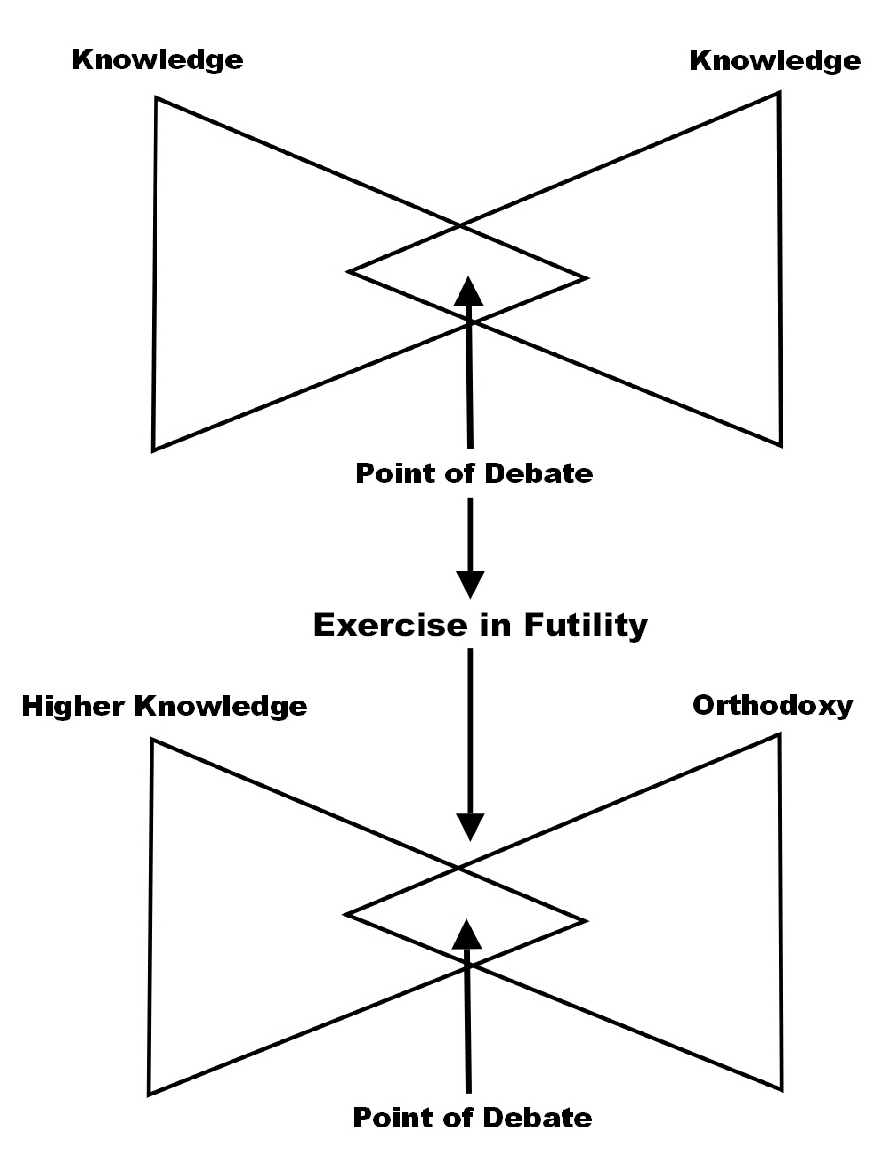
Not much ambiguity in that statement. Pretty clear on its face except for how one would apply it to real life. Again, many might scratch their head in regard to that statement, but proceed to let the theological orthodoxy that flows from it shape their life and thinking. At the point of debate with such people, their orthodoxed talking points will reflect the metaphysical premise. They will absolutely not be swayed in their thinking because they concede that they cannot understand the higher knowledge, and the authority of the higher knowledge is part of the orthodoxy.
Pause: I used to be involved in a ministry that evangelized Jehovah Witnesses. Debating the Bible with them led nowhere because their orthodoxy reinterprets all biblical terms and phraseology. When Christ is referred to, it is assumed that their presuppositions regarding Christ are the same, and they are not. Instead, we challenged their orthodoxy, i.e., the Watchtower publication. Likewise, let me reveal a concluding theme of this study: never debate the Bible with a Protestant; instead, bring their authority into question. Refuse to discuss anything else for it will be futile for reasons yet to be examined.
Let’s look at another statement from the New Covenant Theology camp:
At this time, resist the temptation to utilize subsequent passages to validate the meaning or to move out from the immediate context. Remembering that all exegesis must finally be a Christocentric exegesis.
Look for Christ even if He isn’t there directly. It is better to see Christ in a text even if He isn’t, than to miss Him where He is (The Biblical Theological Study Center: A Christo-Presuppositional Approach to the Entire Scriptures; Max Strange. Online source: http://goo.gl/5sGjP).
The question quickly becomes, “How can you see Jesus in every verse in the Bible?” This is where the Bible becomes a “meta-narrative.” That can mean, “grand narrative,” but in this case it means “metaphysical narrative.” The Bible is a narrative, or story that depicts redemptive reality. You will get confused unless you understand that the theory also posits the inclusion of multi-purpose perspectives into the metaphysical story (a story that depicts true reality). The text grammar doesn’t determine the perspective resulting in a particular objective outcome, but the assumed outcome determines the perspective. So, can “passages talking about incestuous rape” say something about redemption? Of course. In this example, the passage is not talking about Jesus specifically, but denotes why His redemptive works are needed. In some way, according to the prism, the verse always speaks of Jesus and His redemptive works.
This approach to interpreting reality (state of being, or metaphysics), what we call epistemology, plugs into the basic ancient philosophy of total inability. This proffers the idea that man cannot know or comprehend reality. The metaphysic follows: man dwells in a realm apart from true reality that he cannot comprehend. Secondly, somehow, usually via a theory of predeterminism, there are a select few that can ascertain truths from the other realm. Usually, the delineation of the realms is the material versus invisible with mankind residing in the material realm.
The Reformers recognized a reality that man functions in, but deemed it “subjective,” or shadowy. Focusing on this shadowy realm leads to despair. In the aforementioned foundational document of Protestantism, Luther contended that man’s material realm only feeds “the glory story,” or the story of man.
In Luther’s construct, ALL reality is interpreted through two stories: the glory story (the story of man), and the cross story (the story of redemption). Giving any credence to the material world or the belief that man can know the material world empirically only contributes to the story of man and his glory. Yes, man functions in this world, but it does not possess any objective wisdom that can bring true well being. Only an ever-clearer understanding of the cross story can bring well being.
What then is the cross story specifically? It is twofold: it is the holiness of God as set against the sinfulness of man. This is the only objective truth and reality that can bring well being. The goal is a deeper and deeper understanding of how inept we are in every category of life as set against the glory and holiness of God.
Pause for main point: according to this philosophy, the sole purpose of the Bible is to lead us in seeing the cross story with more and more clarity. To the extent that we do that, we will have well being. AND, to the extent that each individual lives according to the cross story, the well being of society as a whole will increase. When Reformed folks talk about “transforming society with the gospel,” this is exactly what they are talking about. To the extent that the populous embraces the doctrine of inability, society will be transformed.
One reason for lauding this epistemology is unified agreement on interpretation. If every verse is about Jesus, there is no division in opinions. Secondly on this point, it gives Christianity a pass on defending inerrancy; e.g., narratives are not meant to be technical systems of theology that require consistency in logic. Thirdly on this point, if some sort of Christocentric conclusion is drawn from the text—it can’t be wrong. If the interpretation of the text somehow demeans man and exalts God, error is impossible.
Before we address the grammatical-historical approach to interpreting reality, let me add some thoughts to the redemptive-historical perspective. This perspective now dominates the institutional church. Just yesterday, I participated in a conversation on a social media site in which the following statement was made about Proverbs chapter 8:
The Old Testament reveals shadows of what Jesus Christ will be in the New Covenant. I can easily say that wisdom personified in Proverbs 8 is Jesus Christ.
If one reads Proverbs 8, the assertion that it is about Christ is beyond presumptuous at best. It is a complete rejection of the plain sense of the grammar; even in lieu of the personification being in the female gender.
Also, these two perspectives on reality are a salvific issue with the Reformed. A denial of total inability equates with the grammatical-historical view of reality which is supposedly an attempt by man to glorify himself by writing his own story. By believing that you can understand reality, you are in essence making yourself God.
The most common question is the issue of biblical imperatives that are clearly directed at mankind. This assumes that man is able to obey because grammatically, the commands are directed at him with a demand for obedience. But again, addressing these commands with the presupposition of total inability that equates with the redemptive-historical prism, the commands are supposedly meant to deliberately frustrate man and “drive him to despair of self-righteousness.”
The Reformed continually concede that the Bible states things in grammatical form, but that is always followed with the proper “gospel context” according to the redemptive-historical interpretation of reality. The classic example is this quotation from Neo-Calvinist Paul David Tripp:
….and the Bible does call us to change the way we think about things. But this approach again omits the person and work of Christ as Savior. Instead, it reduces our relationship to Christ to “think his thoughts” and “act the way Jesus would act.” (How People Change 2006, p.27).
Notice that Tripp concedes that the Bible calls us to do things according to the grammatical context, but goes on to say that is a denial of the gospel (omits the work of Christ as savior). On page 26 of the same book, Tripp calls obedience to the word of God a “behavioral approach” that “separates the commands of Scripture from their Christ-centered gospel context.”
Lastly before we move on, when one is able to wrap their minds around the redemptive-historical approach to interpreting reality, it will be recognized that this approach now saturates the Protestant institutional church.
What is the grammatical-historical approach to interpreting reality? As with the other prism, I am not going to elaborate on the “historical” part except to say that the redemptive-historical hermeneutic makes history part of the prewritten gospel narrative. History is simply the redemptive story playing out as scripted by God.
The political commentator Rush Limbaugh often notes that “words mean things.” This is a good working definition of grammatical-historical interpretation; it draws conclusions from a technical evaluation of the words in a sentence whether spoken or written. The many categories of language that give meaning are considered also, which speaks to the “historical” part of the term. Does the sentence mean the same thing today that it meant then? For instance a sentence written in 1940 might say, “Bob is gay.” History informs us of the meaning in that day: Bob is happy. Today that means Bob is a homosexual. The etymology of words and many other factors weigh-in, but all have this in common: they are empirical tools.
This interpretive method also assumes mankind is able to comprehend the realty he dwells in according to empirical observation and can draw conclusions on his own. Man has ability.
Pause: how did Luther get away with denying that mankind had any kind of ability at all? He chalked-it-up to man’s self-perceived ability that can accomplish things in the material world. These accomplishments are of no worth and only accomplish one thing and one thing only: they serve man’s lust to glorify himself. Luther believed that satisfaction from accomplishment was nothing more than sinful pride. To Luther, the only redeeming thing about the world was that heaven manifested its works on earth according to God’s sovereign will. If man lives life subjectively and professes that his evil “good” works cannot be distinguished from heavenly manifestations “experienced subjectively,” that is venial sin that can be forgiven. In accordance with authentic Reformed tradition, Luther believed the following: the belief that any man, including Christians, can perform a good work is mortal sin.
Therefore, the Reformed often define wisdom/knowledge according to two categories: “worldly knowledge” and “wisdom from above.” Sure, man can obtain worldly knowledge that improves his circumstances, but it is all prideful according to Luther. Wouldn’t this approach propagate a lot of death and misery due to a lack of science? Yes, but that was exactly Luther’s point. Many are perplexed by the embracing of ideologies that result in third world cultures, but those who are perplexed make the point for those in the other camp: what is the perplexity of the detractors? Answer: they are perplexed that other people do not lust after materialism as they do. Hence, third world cultures are often seen as being virtuous by the Reformed.
This is why Luther introduced suffering as a hermeneutic that interprets reality. There is true wisdom in the cross story because according to Luther, “all wisdom is hidden in suffering.” According to Luther, many reject this interpretation of reality and dub it the “foolishness of the cross.” Luther also stated that men call the good evil (suffering), and evil good (anything that prevents suffering). This is why Luther called reason an “ugly whore who should have dung rubbed in her face.”
The grammatical-historical perspective of reality assumes man can interpret his own reality, and the material world is not inherently evil. Believers and unbelievers share common realities that are simply practical and not evil.
Here is the challenge: to bring biblical knowledge to bear on grammatical-historical reality when the prevailing view of Protestantism has been the redemptive prism for hundreds of years.
But there is good news as well: the grammatical prism is what man utilizes intuitively. People assume they can interpret their own reality. Of course, the Reformed see this as the very problem.
Does this mean that grammatical-historical Christians should evangelize the lost world and forgo debate with Protestants? Yes it does, because it is a futile endeavor. You are trying to reach people who define reality itself differently. Protestants are redemptive-historical religionists.

The Magnum Opus of the Reformation: Martin Luther’s Heidelberg Disputation, Part 7: Martin Luther’s Unveiling of the Bondage of the Will
Listen to, or download audio file.
Welcome truth lovers to Blog Talk radio.com/False Reformation, this is your host Paul M. Dohse Sr. Tonight, part 7 of “The Magnum Opus of the Reformation: Martin Luther’s Heidelberg Disputation, Martin Luther’s Unveiling of the Bondage of the Will.”
Greetings from the Potters House and TANC ministries where we are always eager to serve all of your heterodox needs. Our teaching catalog can be found at tancpublishing.com.
If you would like to add to our lesson or ask a question, call (347) 855-8317. Remember to turn your PC volume down to prevent feedback. If you choose to use Skype to listen to the show, my advice is to just dial direct from your Skype account without using any of the Blogtalk links. 347-855-8317.
Per the usual, we will check in with Susan towards the end of the show and listen to her perspective.
Remember, you may remain anonymous. When I say, “This is your host; you are on the air, what’s your comment or question”—just start talking.
If you would like to comment on our subject tonight, you can also email me at paul@ttanc.com. That’s Tom, Tony, Alice, Nancy, cat, paul@ttanc.com. I have my email monitor right here and can add your thoughts to the lesson without need for you to call in. You can post a question as well.
Tonight, we continue in our sentence by sentence evaluation of the HD [Heidelberg Disputation] after addressing some asides in parts five and six. We hear a lot about Martin Luther’s bondage of the will. Tonight, we are looking at the very conception of Luther’s beliefs on the human will. What we are going to find is that Luther’s explanation of human will derived from his position of mortal and venial sin.
Simply stated, if one believes that every act they perform is mortal sin, even their good works, their life is forgivable. Man must not believe he can do a good work. Let’s use theses 11 and 12 to segue into thesis 13 which is the first unveiling of Luther’s bondage of the will.
Thesis 11: Arrogance cannot be avoided or true hope be present unless the judgment of condemnation is feared in every work.
This is clear from Thesis 4. For it is impossible to trust in God unless one has despaired in all creatures and knows that nothing can profit one without God. Since there is no person who has this pure hope, as we said above, and since we still place some confidence in the creature, it is clear that we must, because of impurity in all things, fear the judgment of God. Thus arrogance must be avoided, not only in the work, but in the inclination also, that is, it must displease us still to have confidence in the creature.
Here is something that I haven’t talked about enough in this series: the Reformers were masters of doublespeak. So far, it is obvious that Luther disavowed any value in regard to human life. Yet, in some sentences, he sort of makes it sound like that the issue is life without God. This isn’t the case at all; this is a strict dichotomy between 100% evil and 100% good with nothing in-between.
In contrast, God makes new creatures of mortal men. This flies in the face of Reformed ideology and all of the theology that flows from it. Note that, like all good Gnostics, Luther saw impurity in “all things.” And of course, that includes mankind.
Hence, as stated in this thesis by Luther, man must not have any confidence in self. In other words, God’s creation of man has no inherent ability. The natural ability to do anything is the glory story. Anything that brings glory to man diminishes God. Listen, as one example, the Puritans didn’t dress like they did for no good reason. To wear something with a little color or style would have been the glory story. By the way, do you want to help people? Know this: EVERYTHING people do they do for a reason. Logic drives action. If you want to help people, find the logic behind the action.
So, Reformed ideology splits reality into a strict either/or dichotomy; it’s either the glory story or the cross story. The glory story, or the story of man, can only bring about arrogance.
Let’s pause here to look at the foundational ideology of the Reformation which deals primarily with metaphysics. Like I said, everything people believe and do flows from their logic, so what is the logic that all of this stuff flows from? This is a very simplified version, but it really boils down to this: God does everything that He does because of His self-love. And because God loves Himself, He created evil as a contrast to His holiness. In other words, evil helps to define His holiness by contrast.
This leads to the essence of state of being, or metaphysics, or why things are, or their state of being, according to the metaphysical narrative. What’s a metaphysical narrative? Simply stated: state of being is a story written by God. Everything that is happening in the world today, right down to what people decide to wear, is predetermined by God in His historical prewritten narrative.
All of this benefits God’s self-love. Everything is for His glory. And according to this story, man thinking that he has freedom of choice on any level is evil, and what is he doing? Right, he is writing his own story. If you think that it was your decision to wear what you wore today, you are writing your own glory story. Either you are writing your own life story, or God is writing your life story. You are either god writing your own reality, or God is writing your realty.
Of course you don’t have freedom of the will—that would be writing your own reality—that would be making yourself God. We can also stop here and talk about how the Bible fits into this. The Bible becomes a prototype or model for interpreting reality according to God’s story which is primarily about redemption. The Bible is therefore a tool for interpreting reality according to the cross story, or God’s prewritten metaphysical narrative. And folks, this is everywhere. This way of using the Bible saturates the institutional church.
An example, one of myriads, is the Bible Mesh study material. Listen carefully to what these guys are saying in this promo for the study:
Notice the constant theme of Bible as story, and everything in the Bible being about Christ; ie., redemption. Notice that the Bible is also “your story” and this study enables you to put yourself in the story. You have heard me talk often about the redemptive historical method of interpreting the Bible and this is what it is. They make the Bible a tool for interpreting all of reality according to Martin Luther’s cross story metaphysics. And frankly, 90% of the evangelicals occupying the pulpit in the institutional church take this approach to the Bible.
Thesis 12: In the sight of God sins are then truly venial when they are feared by men to be mortal.
This becomes sufficiently clear from what has been said. For as much as we accuse ourselves, so much God pardons us, according to the verse, »Confess your misdeed so that you will be justified« (cf. Isa. 43:26), and according to another (Ps. 141:4), »Incline not my heart to any evil, to busy myself with wicked deeds«.
So, if you look at two slides on the program slide show, you see two contemporary illustrations published by the Reformed camp that explain where we have come to this point. The two man chart explains the metaphysics,


and the cross chart explains the application as stated in this thesis by Luther: “For as much as we accuse ourselves, so much God pardons us…” His use of Isaiah 43:26 pretty much puts it in a nutshell: confession of sin leads to ongoing justification which can only be found in the institutional church. If we believe man has no will to choose good, and that everything we do is sin, we qualify to be forgiven for purposes of ongoing justification. It’s not complicated.
Thesis 13: Free will, after the fall, exists in name only, and as long as it does what it is able to do, it commits a mortal sin.
The first part is clear, for the will is captive and subject to sin. Not that it is nothing, but that it is not free except to do evil. According to John 8:34,36, »Every one who commits sin is a slave to sin.« »So if the Son makes you free, you will be free indeed.« Hence St. Augustine says in his book ›The Spirit and the Letter‹: »Free will without grace has the power to do nothing but sin«; and in the second book of ›Against Julian‹, »You call the will free, but in fact it is an enslaved will,« and in many other places.
The second part is clear from what has been said above and from the verse in Hos. 13:9, »Israel, you are bringing misfortune upon yourself, for your salvation is alone with me,« and from similar passages.
Again, we will take note of something Luther was accustomed to in his doublespeak. Though he quotes Augustine saying that the will can do nothing but sin without grace, we know that Luther also believed that the will can do nothing but sin WITH grace. This is just another example of his doublespeak. This seems to be very indicative of Reformed teachers; they sow seeds of doubt that they are stating outrageous ideas, but after a space of time the outrageous, tempered by a contradictory statement, will be accepted through repetition. The doublespeak is a red herring until you are fully indoctrinated.
Luther is stating here that the will is “not free except to do evil.”
Thesis 14: Free will, after the fall, has power to do good only in a passive capacity, but it can always do evil in an active capacity.
An illustration will make the meaning of this thesis clear. Just as a dead man can do something toward life only in his original capacity (in vitam solum subiective), so can he do something toward death in an active manner while he lives. Free will, however, is dead, as demonstrated by the dead whom the Lord has raised up, as the holy teachers of the church say. St. Augustine, moreover, proves this same thesis in his various writings against the Pelagians.
Here is where we will employ some help from one of the leading Reformed scholars on Luther’s theology of the cross. This is from Gerhard O. Forde’s “On Being a Theologian of the Cross” which is a commentary on the HD.
Theses 14 and 15 are an attempt to define a little more closely what sort of ability may be ascribed to the will. If, as we have seen in thesis 13, the will is not nothing and is not forced or determined, and if, as we might say, we are not puppets, how then may the power of the will be described?
Pause.
Stop right there. This is the Reformed, “But of course we are not puppets, so how do we explain this?” But the only logical conclusion to Reformed ideology is that we are in fact puppets. In classic Reformed teaching protocol, the brainwashing technique is to deny the logical conclusion while hoping that you will function according to the very logical conclusion and goal that they are seeking.
Listen, according to their very own redemptive-historical hermeneutic, we are nothing but characters in a narrative. No, no, no, we are not puppets, rather, we are mere characters in a metaphysical narrative who are penciled in. And we have a choice, and this is a paraphrase, “…join the plot of the divine drama that includes your story, or attempt to be your own god and write your own glory story.” That’s it. That’s it in a nutshell.
I have been learning a lot from Susan about Jonathan Edwards, and she has so much data already accumulated that I don’t know whether she is going to be able to find this or not, but she was sharing with me about Edwards’ view of the will. Basically, he believed that before a person performs an action, God puts the thought, idea, will, and decision to act in one’s mind beforehand. This kind of goes hand and hand with Edwards’ belief that God is recreating reality at every moment. So, in essence, everything you do is a recreation of reality when it gets right down to it.
So this is how this works: the Reformed will continue to deny that we are puppets while teaching all of the elements of puppeteering. If you teach all of the elements constantly while never speaking of the logical conclusions, people will eventually function according to the logical conclusions which is what they are after. Functionality is the goal—not understanding. Reformation ideology is vehemently opposed to reason and understanding.
Here is another example: the official Reformed doctrine of already not yet. So classic. Sure, sure, you are already saved, of course you are! But not yet. So you think: “Well, sure, our salvation will be fully realized when we are resurrected. That makes total sense.” Well guess what? You just bought into progressive justification. See how this works? Salvation doesn’t have a beginning and an end. It’s a conception. Conception is a onetime final event that completes its work in an instant. You didn’t exist, now you do—end of story.
Let’s continue with Forde’s quotation.
If the claim is that we are to “do what is in us,” then the question quite naturally follows: What then is in us? What sort of capacity do we have?
Pause. Stop right there. Let me shortly answer that question according to 1John chapter 3 before we move on: God’s seed. God’s DNA. We are literally born of God and have His seed IN us. We are new creatures born of God.
To get at the question Luther here uses a distinction current in his day between what our translation has called a “passive capacity” and an “active capacity.” What does that mean? In its passive capacity the will can do good when it is acted upon from without but not on its own, not in an active capacity. A commonly used physical analogy is water. Water has a passive capacity to be heated, but it can’t heat itself. It has no active capacity to do that.
The example Luther uses in his proof is even more to the point because it deals with death and life. On the one hand, corpses could be said to have a passive capacity for life because they can be raised from the dead. But not, of course, on their own power, not in an active capacity, not even in the slightest. Not even by doing their best! The capacity they have is strictly passive. They can be raised, but only by divine power. On the other hand, it is of course true that while a people live they have the active capacity to do something about life and death. They can take life, either their own or some other, but they can’t create or give life. Yet, that only demonstrates that, after the fall, will in its active capacity can only do evil. Since will after the fall is dead and bound to do deadly sin, it can be rescued only from without, as indicated by the fact that it could not bring life out of death but could only be commanded from without by our Lord.
Thus, the fact that even after the fall the will is not nothing means that there is something there. What is it? It is a strictly passive capacity, not an active one. That means that it can be changed but it will not change itself. To be changed, it will have to be accessed “from without.” But it will take radical action. It will take death and resurrection. So we are again pointed toward the cross.
Here, we have plunged the depths of Martin Luther’s bondage of the will. Man is dead, and death is defined as the waters of mortal sin. The waters of mortal sin are not only what man dwells in, he is those waters. He is passively dead. The only active works he can do is dead works. The material realm is man’s glory story of death. He ebb and flows between dwelling in death and experiencing resurrection resulting from him being acted upon from the outside. Being acted upon is completely determined by God’s decision and good pleasure. The long and short of being saved is merely giving testimony to this fact and seeing it for what it is. Saving faith is giving testimony to what you see only, and not anything that you do.
To think you are not dead is mortal sin that cannot be qualified for forgiveness. And again, do see what these guys do? No, no, we are not puppets, right? A question: what do we know about puppets? Well, we know that they are dead. We know that they cannot do anything until they are acted upon, right? This Gerald Forde guy is just like all of the Reformed; he will deny that he is saying that we are mere puppets, and then will describe our Christian existence as puppetry.
This is what annoys me so deeply about people who listen to these yahoos because, “they say some good things.” Why would anybody spend any time investing in this intellectual dishonesty?
So, what is the biblical view of the will? Romans chapter 6. Before one is saved, they are enslaved to sinful desires and free to do good works. Slavery indicates the type of wages that the slave gets—only wages for death. Unsaved people are also indifferent to the law that they will be ultimately judged by. They do not love God’s law. But, they definitely have a free will to follow their God-given conscience and receive rewards for doing so. A person who lives a good common sense life will of course suffer fewer calamities than the foolish. But in the end, this only means less condemnation.
The saved person also has a free will. They are enslaved to righteousness, but unfortunately free to commit sin. However, they do not receive wages of death because they are no longer under the condemnation of the law. They can only receive wages for life. They are no longer indifferent to the law, but love God’s law and its truth. The chart below may help:
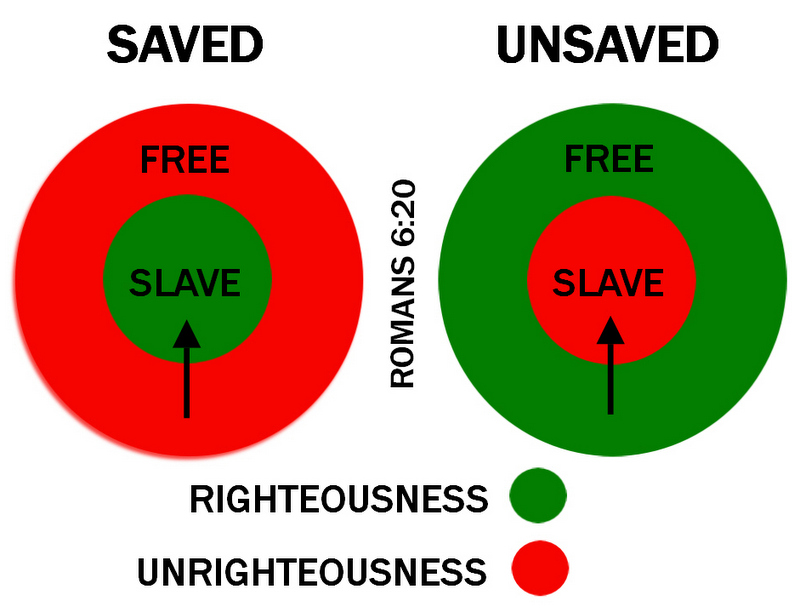
The new birth is a reversal of sin and slavery resulting in a change of direction. No one sins perfectly, and no one loves perfectly. It’s a direction, not perfection. But if you look at the Reformed cross chart again, neither is it a downward direction of sinful perfection resulting in making the cross bigger.
That’s the end of our lesson tonight—let’s go to the phones.

 Paul's Passing Thoughts
2 comments