TANC 2015 – Paul Dohse, Session 3: What is the Gospel?
We don’t hear much about one of the primary biblical terms used for “gospel.” The gospel is also known throughout Scripture as “the promise.” A promise made by God; think about that. But who is the promise to?
Acts 2:36 – Let all the house of Israel therefore know for certain that God has made him both Lord and Christ, this Jesus whom you crucified.”
37 Now when they heard this they were cut to the heart, and said to Peter and the rest of the apostles, “Brothers, what shall we do?” 38 And Peter said to them, “Repent and be baptized every one of you in the name of Jesus Christ for the forgiveness of your sins, and you will receive the gift of the Holy Spirit. 39 For the promise is for you and for your children and for all who are far off, everyone whom the Lord our God calls to himself.” 40 And with many other words he bore witness and continued to exhort them, saying, “Save yourselves from this crooked generation.” 41 So those who received his word were baptized, and there were added that day about three thousand souls.
This is an extraordinary text. Clearly, the gospel is a promise to all men contingent on believing in the promise, and resulting in the “gift” of the Holy Spirt. This is a fundamental principle of Biblicism: when a particular text is absolutely clear, and barring all assumptions, everything else must align logically with the concepts that are clearly stated.
Hence, the Protestant definitions of “election,” “called,” and “chosen” must be completely reevaluated. The gospel is a promise and a gift offered to all men.
…and you will receive the gift of the Holy Spirit. 39 For the promise is for you and for your children and for all who are far off, everyone whom the Lord our God calls to himself.
And who does the Lord call to himself? Everyone.
Turn to me and be saved, all the ends of the earth! For I am God, and there is no other (Isa 45:22).
And I, when I am lifted up from the earth, will draw all people to myself (Jn 12:32).
Say to them, ‘As surely as I live, declares the Sovereign LORD, I take no pleasure in the death of the wicked, but rather that they turn from their ways and live. Turn! Turn from your evil ways! Why will you die, people of Israel?’(Eze 33:11).
Biblicism does not reject mystery, or paradox, but always approaches the latter with extreme skepticism. Biblicists consider paradox guilty until proven innocent. God is not a God of confusion, but be sure of this: the paradox card is more times than not a license for a mystery that only the spiritual elite understand—those who have the rule over you.
If the promise and the gift are verbally offered to all people, but the offer is not legitimate for all, that makes the use of these words completely illogical. Though the issue of election will not be explored in this series, the basic wrongness of Protestants who propagate so-called “sovereign grace” must call their deterministic gospel into question. Those who have the basic gospel completely wrong cannot be trusted with the rest of the story.
However, the fact that salvation is a promise and a gift will be key to exposing the false gospel of Protestantism in simple terms. The Bible defines the gospel with these specific words for good reason – words mean things.
What is the Gospel?
1Corinthians 15:3 – For I delivered to you as of first importance what I also received: that Christ died for our sins in accordance with the Scriptures, 4 that he was buried, that he was raised on the third day in accordance with the Scriptures, 5 and that he appeared to Cephas, then to the twelve. 6 Then he appeared to more than five hundred brothers at one time, most of whom are still alive, though some have fallen asleep.
These are the facts of the gospel, but in Paul’s statement much more is assumed rightly because of other texts that further define what is being stated here in 1Cor 15:3-6. Obviously, no one is saved by a mere believing of the facts concerning the gospel. As James wrote, the devils believe also and do tremble in regard to their future condemnation. The facts do need to be believed, but what saves is the following of Christ in these facts. In other words, it’s not a mere believing of the facts, but also the belief of what the results of believing are, and a desire to want that for yourself.
You believe the promise, and the gift, and you want the gift for yourself. The gift is the baptism of the Spirit, and believing in the transaction that takes place. It’s believing the promise and “receiving” the gift.
Romans 6:1 – What shall we say then? Are we to continue in sin that grace may abound? 2 By no means! How can we who died to sin still live in it? 3 Do you not know that all of us who have been baptized into Christ Jesus were baptized into his death? 4 We were buried therefore with him by baptism into death, in order that, just as Christ was raised from the dead by the glory of the Father, we too might walk in newness of life.
5 For if we have been united with him in a death like his, we shall certainly be united with him in a resurrection like his. 6 We know that our old self[a] was crucified with him in order that the body of sin might be brought to nothing, so that we would no longer be enslaved to sin. 7 For one who has died has been set free from sin. 8 Now if we have died with Christ, we believe that we will also live with him. 9 We know that Christ, being raised from the dead, will never die again; death no longer has dominion over him. 10 For the death he died he died to sin, once for all, but the life he lives he lives to God. 11 So you also must consider yourselves dead to sin and alive to God in Christ Jesus.
12 Let not sin therefore reign in your mortal body, to make you obey its passions. 13 Do not present your members to sin as instruments for unrighteousness, but present yourselves to God as those who have been brought from death to life, and your members to God as instruments for righteousness. 14 For sin will have no dominion over you, since you are not under law but under grace.
It’s amazing that the unsaved understand this in their own way. It’s just a fact that the unsaved understand the gospel intuitively better than the vast majority of Protestants. Most unsaved people know that salvation involves the loss of who they presently are in exchange for a new life that is in the wind so to speak. This is what Christ was telling Nicodemus as recorded in John 3 and why Nicodemus came to Him under cover of darkness—Christ was a threat to the present life he knew. The fact that Christ told him that he must be born again which would result in a new, and completely unpredictable life correlates with the fact that Nicodemus came to Him under cover of darkness. Nicodemus was afraid of losing his present life, and therefore, Christ addressed the issue forthwith.
“Just believe” and “faith alone” minus the new birth is a Protestant hallmark. It boils down to a mere glorified assent to the facts of the gospel. It is not the losing of present life in order to find the new one. It is not repentance, i.e., a turning from the old life and following Christ in literal death and resurrection. Water baptism is a public confession that you understand this. Now many will protest that we are doing something to be saved other than believe; we are “following” Christ. But it is a decision, not some work of following. The Spirit does the baptizing, not us. We are saved by wanting that for our life and accepting the gift that is offered.
But likewise with any gift, once it is given, the receiver owns it. It is now up to us to work out our own salvation with fear and trembling (Phil 2:12,13). Here, “salvation” refers to redemption (the saving of the body, Rom 7:24, 8:23), not the saving of the soul, and work/fear refers to the new Christian person and life, not our onetime new birth. The Christian life is a process; the new birth is a onetime event. Before we were saved, our fear regarded condemnation. Now our fear regards chastisement and sin that leads to unnecessary deaths (consequences for sin). There is no work FOR salvation, but there is a work IN the Christian life, specifically, a work of love (Gal 5:6).
On the flipside, even though there is not a work FOR salvation (justification), there is a work IN being unsaved that has a specific wage paid by a specific master. We met him in the previous session, the sin master. This is how the Bible frames this: there are two masters who pay two different wages: one pays wages for death, and the other pays wages for life. ALL people in the world are earning one or the other in varying degrees. Either group can do bad or good works (Rom 6:20), but one can only be credited for death, and the other can only be credited for life. These are two different wages paid by two different masters.
These two groups, lost and saved, are under two different laws that determine their wages. The lost who belong to the sin master are “under law” and its condemnation, the law of sin and death. Those under this law can only bear fruits of death. In contrast, those purchased by Christ (“you have been bought with a price” 1Cor 6:20, 7:23) can only bear fruits for life. They are identified as “under grace,” or under the law of the Spirit of life (Rom 6:14, 8:20).
Romans 6:15 – What then? Are we to sin because we are not under law but under grace? By no means! 16 Do you not know that if you present yourselves to anyone as obedient slaves, you are slaves of the one whom you obey, either of sin, which leads to death, or of obedience, which leads to righteousness? 17 But thanks be to God, that you who were once slaves of sin have become obedient from the heart to the standard of teaching to which you were committed, 18 and, having been set free from sin, have become slaves of righteousness. 19 I am speaking in human terms, because of your natural limitations. For just as you once presented your members as slaves to impurity and to lawlessness leading to more lawlessness, so now present your members as slaves to righteousness leading to sanctification.
20 For when you were slaves of sin, you were free in regard to righteousness. 21 But what fruit were you getting at that time from the things of which you are now ashamed? For the end of those things is death. 22 But now that you have been set free from sin and have become slaves of God, the fruit you get leads to sanctification and its end, eternal life. 23 For the wages of sin is death, but the free gift of God is eternal life in Christ Jesus our Lord.
This is why Christ came to end the law (Rom 10:4). The law that He ended is the law of sin and death. EVERYONE born into the world is under the law of sin and death and condemnation. This is how we know Christ died for everyone ever born into the world. He also purchased mankind from the sin master; eternal life is the promise, new birth is the gift (if received by faith) resulting in freedom from condemnation and the fruits of death. The believer now “upholds” the law he/she is free to serve: the law of the Spirit of life also known as the “law of Christ” and the “law of liberty.” Salvation is a free gift, but the Christian life is a work that can earn rewards.
Hebrews 6:10 – For God is not unjust so as to overlook your work and the love that you have shown for his name in serving the saints, as you still do.
God would be unjust to forget you labor of love in sanctification because you are earning rewards, and there is no fear in regard to condemnation because that concerns judgement:
1John 4:18 -There is no fear in love, but perfect [mature] love casts out fear. For fear has to do with punishment, and whoever fears has not been perfected in love. [Because they fear condemnation].
This is what is critical about the new birth, or the baptism of the Spirit. The old man that was under the law of sin and death died with Christ, and is now free to “serve another” through being resurrected with Christ:
Romans 7:1 – Or do you not know, brothers—for I am speaking to those who know the law—that the law is binding on a person only as long as he lives? 2 For a married woman is bound by law to her husband while he lives, but if her husband dies she is released from the law of marriage. 3 Accordingly, she will be called an adulteress if she lives with another man while her husband is alive. But if her husband dies, she is free from that law, and if she marries another man she is not an adulteress.
4 Likewise, my brothers, you also have died to the law through the body of Christ, so that you may belong to another, to him who has been raised from the dead, in order that we may bear fruit for God. 5 For while we were living in the flesh, our sinful passions, aroused by the law, were at work in our members to bear fruit for death. 6 But now we are released from the law, having died to that which held us captive, so that we serve in the new way of the Spirit and not in the old way of the written code.
Here is a good place to speak of God’s calling to mankind. This is a good place to talk about how God pushes man to the brink of salvation—to the gates of the kingdom. God, in His calling of man, does everything but make the decision for him.
First, God creates every human being with the works of God’s law written on their hearts, and a conscience that either excuses or accuses them. Those without the word of God will be judged by this internal law, while the religious will be judged by both (Rom 2:12-16). Until a human being develops a conscience, they are not under any law and therefore without sin (Rom 4:15). Man has intuitive knowledge of God’s gospel (Rom 1:18-21).
Secondly, the Holy Spirit uses the law of sin and death to convict the world of sin, righteousness, and the judgment to come (Jn 16:8).
Thirdly, believers use the law of sin and death to convict the world of sin, righteousness, and the judgment to come.
Fourthly, believers testify about God to the world with their lives (Matt 5:14-16).
Fifthly, Christ has purchased all men with His death on the cross. Their sin debt is prepaid. They have already been purchased from the sin master. They themselves choose to remain under the control of their present master, but their contract has been bought out, they are free to choose Christ as their new master.
Sixthly, even the law that condemns unbelievers holds their sin captive. Even the law of sin and death is a “ministry” (2Cor 3:7-11). The first covenant which is passing away (Heb 8:13) held sin captive in the law of sin and death until Christ came (Gal 3:19-27). Christ ended the law for righteousness to those who believe in Him. Our sins are not merely covered—they are ENDED along with the law of sin and death. ALL sin was held captive in the law of sin and death that the old us was under, but upon believing, that man died and is now under the law of the Spirit of life (Rom 8:2). We are now fee to work through love as guided by the Scriptures (Gal 5:6,7). Our obedient love fulfills the law (Gal 5:14, Rom 8:4, Rom 13:8-10, Matt 22:34-40).
Seventh, God increased the law through the first covenant to drive man towards him (Rom 5:20).
Eighth, God made man a living being, but after the fall he made mankind His very family (Gal 3:29, Heb 2:11).
Ninth, in the end, God will vacate heaven and dwell with His family on earth. God Himself comes DOWN to earth to dwell with man (Rev 21:3).
This is some of the good news of God’s love for mankind.
Can Christians Really Be “Self-Righteous”?
 There are many, many Protestant misnomers that are assumed to be truth. In the past I have written about so-called “legalism” and “church discipline.” Neither concepts are found anywhere in the Bible. In this short post, we will mention another one: “self-righteousness,” specifically, the idea that a Christian can be “self-righteous.” If you get my point here, you may reconsider your incredulity regarding the aforementioned misnomers.
Actually, there is a reason that we hear the constant literary and verbal drumbeat regarding the dangers of so-called Christian self-righteousness; the root cause is found in Martin Luther’s alien righteousness soteriology. Many have added the self-righteousness mantra to their vocabulary without thinking the idea through to its logical and historical conclusions.
First of all, the problem is presenting Christian self-righteousness as something to be avoided lest we shipwreck our faith. In other words, answering the biblical call to become who we are will supposedly shipwreck our faith. God made us righteous through the new birth; how would we then make ourselves “self-righteous”? If we have a proper understanding of salvation, why would we attempt to do something that we know is already completed? Because of weak understanding, believers have been led to believe that we are in danger of justifying ourselves. Obviously, this makes good works a spiritual minefield for the Christian. A cursory observation of the institutional church makes this point.
This was Paul’s exact point to the Galatians (3:1-3); why are you trying to complete a work that was finished when you received the Spirit? We are made righteous via the new birth, not the satisfaction of…”the righteous demands of the law.” Understand; when Paul speaks of righteousness by the law in Galatians, he is speaking of manmade traditions that fulfill the law for justification. In other words, the law is the standard for justification—not the receiving of the Spirit.
This is a HUGE problem because if the law is the standard for justification, the believer cannot be free to love, ie., the law cannot be the Christian standard for love AND the standard for justification at the same time. Using the law lawfully for love can show that we are justified/righteous, but the law cannot justify in any way, shape, or form.
Hypothetically, if the law could justify, we would have to keep it perfectly:
Galatians 5:2 – Look: I, Paul, say to you that if you accept circumcision, Christ will be of no advantage to you. 3 I testify again to every man who accepts circumcision that he is obligated to keep the whole law.
What’s going on here? The Galatians were buying into the most common false soteriology of the ages; the idea that the law is the standard for righteousness instead of the new birth. This does not set the Christian free to use the law lawfully, or in other words, as a standard for love:
Galatians 4:21 – Tell me, you who desire to be under the law, do you not listen to the law? 5:1 – For freedom Christ has set us free; stand firm therefore, and do not submit again to a yoke of slavery. 5:6 – For in Christ Jesus neither circumcision nor uncircumcision counts for anything, but only faith working through love. 7 You were running well. Who hindered you from obeying the truth?
So, for those who see the law as the standard for justification, and knowing that we cannot keep the law perfectly, some ritual or tradition is put into place, and if that is practiced, the law is fulfilled. For those falling into this error at Galatia, that meant the observance of days and circumcision. Paul, in essence was saying, “No, no, no—if you are going that route you cannot bypass a perfect keeping of the law; circumcision does NOT fulfill the law.”
No, LOVE is what fulfills the law.
The Galatian problem was a carryover from former error before Christ came to die on the cross to end the law, but later in history Christ was integrated in this way:
Christ fulfills the law for us.
If we do certain things, Christ fulfills the “righteous demands of the law” and a fulfillment of the law is imputed to us. But here is the huge problem with that: law is still the standard for justification, NOT faith working through love. Hence, love is circumvented resulting in dead orthodoxy at best and sinful calamity at worst.
This was the crux of Martin Luther’s alien righteousness. ALL righteousness is outside of the believer, and this is testified to by the fact that Christians cannot obey the law perfectly. If we play by the rules, Christ’s perfect law-keeping will be imputed to us and we can remain saved. Again, the problem is law as justification’s standard.
This keeps the “Christian” under law and COVERED by under grace. In this ancient construct, you have under law and under grace going on at the same time. The “Christian” remains under law, but is “covered” by the righteousness of Christ via under grace.
In contrast, the old us that was under law died with Christ, and we were resurrected with Christ and set free to love according to the law without any fear of condemnation via being under the law. Christ came to end the law of condemnation for those who love him. He loved us first by ending the law on the cross and thereby setting us free to love Him and others according to the law.
The law is NOT the standard for justification—the new birth is, and thus freeing us to love God and others without fear of condemnation.
BUT, this whole idea that Christians can be “self-righteous” confounds under law and under grace. Any righteousness that we have must be, supposedly, our own righteousness that didn’t come from the new birth. This is the true implication of the saying. ALL righteousness remains outside of the believer because he/she cannot keep the law perfectly.
Therefore, the “Christian” is not free to love without fear of condemnation. And again, the church looks like that is indeed the case.
paul
The False Protestant Gospel of “How Much?”
 “At any moment, any lost person can choose to have their sins ended. It is not a question of whether or not they are elected, it is a question of whether or not they are under the law—and they are.”
The Protestant gospel effectively denies the biblical interpretation of the new birth. Because of its Platonist metaphysical presuppositions, it denies the treasure of God’s seed dwelling in weak vessels. Hence, the new birth is redefined and confined to the ability to perceive realm manifestations apart from any ability to do a good work of any kind. As stated by some, “Sanctification is done TO you, not BY you.”
In the biblical good news schema, Christ does ONE act of obedience as His part in God’s reconciliation plan. There is no question of “how much?” because His death was all that was required.
Now enter the heinous “Reformation” gospel of confusion. A cursory observation of Reformation history reveals that the dust-up between Rome and the “Reformers” was over metaphysics first. The very first and foundational doctrinal statement of the Reformation contained 12 theses of philosophical metaphysics. Luther was miffed that Rome was moving away from its Augustinian/Platonist roots and coming under the spell of Thomism. This shift began in the 13th century via St. Thomas Aquinas and eventually incited the Reformation. The assertion that the Reformation was driven by sola scriptura is absurd.
Martin Luther introduced his metaphysical answer to Thomism and foisted his theses that supported it onto Scripture. The centerpiece eventually came to be known as double imputation. To Luther’s credit, he created a timeless soteriology based on metaphysics that continues to turn the world upside down. John Calvin articulated Luther’s foundation in the Institutes of the Christian Religion. Both were dedicated to returning the church to its Augustinian roots.
What is double imputation? Basically, it’s the idea that Christ’s role in the gospel of first importance (as set apart from God’s full counsel which is also good news) was twofold as opposed to ONE single act. This was necessary as a “biblical” doctrine that keeps the material being of man separate from Plato’s trinity: the good, true, and beautiful, ie., the invisible. The true gospel turned dualism philosophy completely on its head by infusing good into weakness and defining the true definitions of God’s creation and the state of being.
The idea that God infused His righteousness into the being of mankind is repugnant to the Reformed mindset. How repugnant? The colonial Puritans executed Quakers for even asserting an errant view of the idea.
Therefore, distorting Christ’s role in God’s elected plan of reconciliation was necessary. Christ’s redefined soteriological role removes all goodness from mankind proper and “Christians” in particular. Christ not only came to die for the sins of particular persons preselected by God, but He also came to live a perfect life in obedience to the law so that His obedience could be imputed to the “elect.”
Now the questions are begged: “How much suffering was necessary to pay the penalty for sins committed by the preselected, and how much obedience was necessary for righteousness to be imputed to the preselected as well. When a false doctrine is predicated on errant presuppositions, not only do these kinds of questions arise, but the attempted answers give rise to more questions.
And displays of nonsense. An example is the weird and embarrassing ad lib “Scream of the Damned” propagated by John Piper and CJ Mahaney at a conference hosted by John MacArthur Jr.’s Grace Community Church.* The sheer weirdness of it all even raised eyebrows within Reformed circles by the likes of Steve Camp. The premise was an adolescent-like attempt to explain how much? in regard to Christ’s death. Imagining the response from my older than dirt and probably dead father in the faith, Pastor Richard Peacock, put me on the floor rolling around while laughing uncontrollably. Only the thought of thousands of attending pastors supported by the hard work and sweat of the laity watching without a blink shocked me into the horror of reality and put an end to my shameless response.
When are people going to stop and say to themselves, “Wait a minute here; what drives this stuff? This kind of stuff just doesn’t happen for any or no reason.”
Likewise, in regard to how much?, how long did Christ have to live and how much of the law did He have to obey for the elect? Theories abound because the question itself flows from the false presuppositions of Platonism foisted on the Scriptures resulting in the doctrine of double imputation.
Christ did ONE thing to secure reconciliation for mankind: He died. How much? Answer: enough for ALL mankind. How? Answer: by ending the law. How is that possible? Answer: because all sin is against the law and imputed to the law, and Christ died to end it. Sin is not covered by Christ’s law–keeping; no, sin is not covered, it is ENDED. At any moment, any lost person can choose to have their sins ended. It is not a question of whether or not they are elected, it is a question of whether or not they are under the law—and they are.
What else did Christ do to secure our reconciliation? Answer: nothing. But wasn’t He resurrected? Answer: yes, but He didn’t do that, that was the Holy Spirit’s role in God’s plan of reconciliation. The fact that Christ would be resurrected was a promise made TO Christ and Abraham BY God. That surprises many Christians who don’t read their own Bibles for themselves, viz, most.
In other words, this is the gospel: Christ DIED to END sin. The Spirit resurrected Christ as the first fruits of those who would also be resurrected to new life and justification which is NOT merely a legal declaration, but a metaphysical fact. It does of course have a legal aspect, but it is adoption court where the Holy Spirt bears witness with us that we are the children of God. Christ was “resurrected” for our justification” by the Holy Spirit. “Forensic Justification” does have a legal aspect, but not only in the halls of criminal court, but just as much in the court of adoption with the Holy Spirit appearing as a witness.
Obedience to the law by Christ does not justify us, the new birth justifies us because we are in fact righteous. The resurrection justifies us, not law-keeping by anyone including Christ.
True resurrection with Christ is “under grace,” but that by no means states that we are no longer under a law. It means that we are no longer under a law that condemns us. This is what strips sin of its power. This is what strips death of its sting. We must remember that the law is the Spirit’s law. He will use it to convict the world of sin and warn of the judgment to come, or he will use it to sanctify God’s children. The law is a savor of death to those who do not believe, and a savor of life as we walk in it as God’s children.
The time has come to stop dwelling in the Protestant metaphysical narrative of death, and to follow Christ in our duty to write a narrative of life.
How much? That will depend on OUR obedience as children of God. The Spirit gave us life and opportunity to use His law to love God and others. “Do’s and don’ts” are not the issue, LOVE is the issue. We do not stay at the foot of the cross while Christ loves for us; we will be rewarded for the narrative of life that we write by using the gifts granted to us when Christ sat down beside the Father and rested from justifying all who will believe in Him.
We zealously write our narrative of life without fear of condemnation because of Christ’s love for us. And our love will never be enough because of the freedom we feel. The freedom purchased by His blood that freed us from the condemnation of the law and the Master empowered by it, and the freedom to love by obeying the law of the Spirit—the perfect law of liberty. When God looks at us, He sees more than Christ, he sees one that Christ is not ashamed to call a brother—He sees one of His children. Christ doesn’t cover us, He presents us.
He is not ashamed of us. His death was enough for our life.
paul
* “Apparently, they got the concept from RC Sproul, who used to be rock solid, but now it would appear that senility has opened his mind to the nonsensical theological acrobatics of our day. Likewise, the same consideration might apply to John MacArthur who spoke at the conference and also sponsored it; he is getting up in years as well. I offer this as a possible excuse for both of them though the vision of my heart longs to see them as the gray-haired stalwarts of the faith that I thought they were. Here is what Sproul said:
‘Once the sin of man was imputed to Him, He became the virtual incarnation of evil. The load He carried was repugnant to the Father. God is too holy to even look at iniquity. God the Father turned His back upon the Son, cursing Him to the pit of hell while on the cross. Here was the Son’s ‘descent into hell.’ Here the fury of God raged against Him. His scream was the scream of the damned. For us’ (Tabletalk magazine, My God, My God, Why Hast Thou Forsaken Me? April 1990, p. 6).
Steve Camp, on his blog, wrote a tame but thoroughly convincing argument against such a notion. But the fact that Camp thought such a significant expenditure of effort was needed is indicative of our day; surely, only ten years ago, such a thesis would have invoked a horrendous outcry among God’s people” (The New Calvinist License To Kill: And Did God Really Condemn Christ To Hell?, Paul’s Passing Thoughts blog, Paul Dohse, Sr., September 2, 2011).
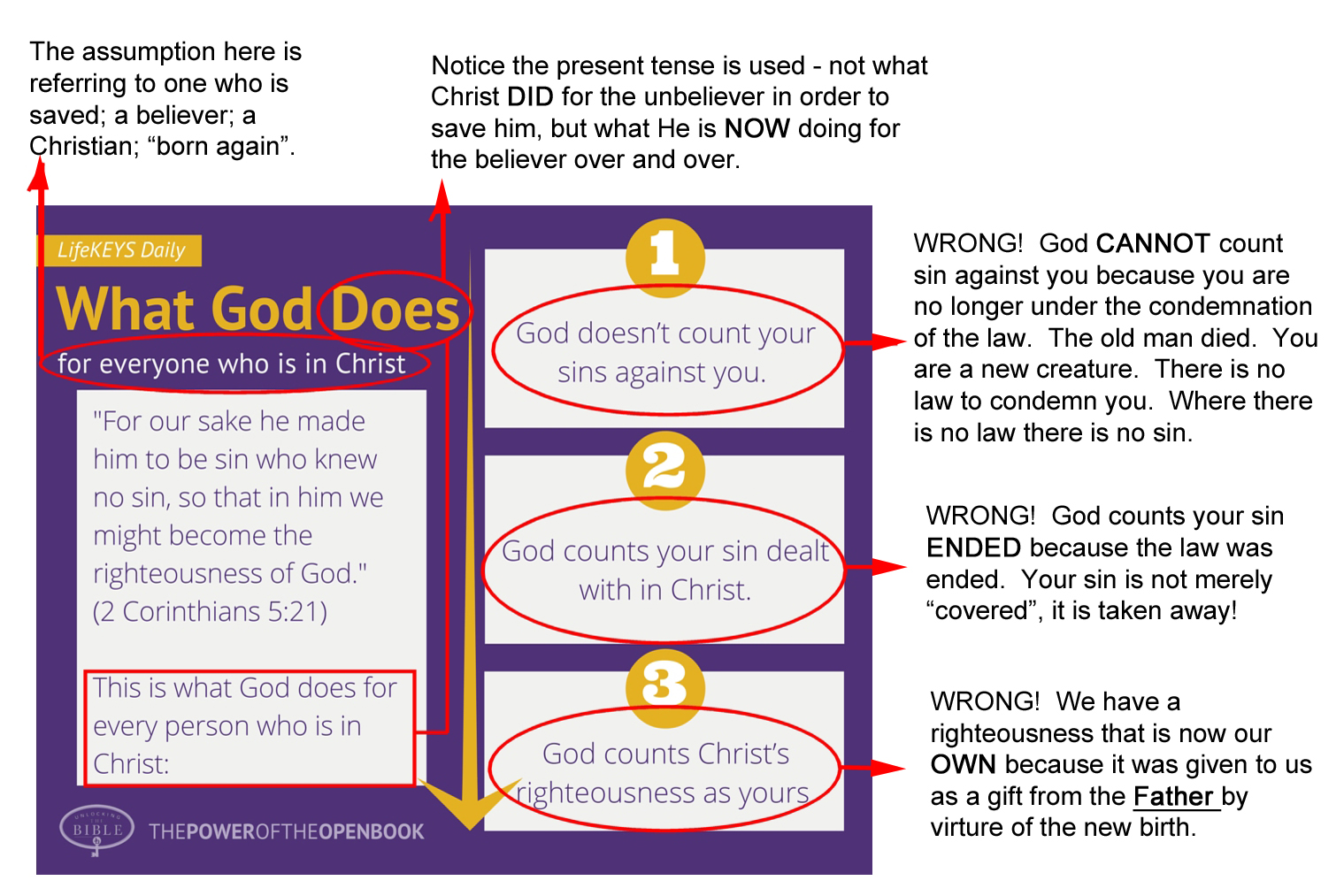
What God Does in Protestant Progressive Justification
There was a meme in my Facebook news feed that caught my eye this morning. I felt compelled to make some corrections to it. If you still don’t believe that Protestantism teaches progressive justification, think again.
Andy
The Source of Phobias
 I have rubbed shoulders recently with folks who have a phobia thing going on. In one particular case, the person presently employed by a relative of mine would not ordinarily be able to hold down a job.
This is another area where Christians show how confused they are. On the one hand, they get all glassy-eyed and proclaim the simplicity of God’s word, how we should read it as “little children.” But you mark my words: on the other hand, they will proclaim my biblical explanation for phobias here, “Too simplistic.”
The source of ALL fear, according to the Bible, is being under law as opposed to being under grace. I find it hard to believe that if the primary source of fear is gone, that the extreme expressions of it are possible.
According to the Bible, being under law, and specifically its condemnation, is the antithesis of LOVE. Throughout the Bible, fear and love are set in contrast to each other—polar opposites.
To those under law, the Bible is condemnation; to those under grace, the Bible is the discipleship of love. One is a law that continually warns of the wrath to come, the other is instruction regarding love.
This is why Paul said that the sting of death is sin, and the power of sin is the law. Ironically, many denominations keep their followers under law. This is why it is more than possible that professing Christians will suffer from these phobias which is also the case with the aforementioned acquaintance. I also find it curious that said person is of a denomination that emphasizes law. Hence, the person’s known faithful Bible reading will only make the fear worse because of a skewed view of law/gospel.
I am also convinced of this: God’s word states that you are under law regardless of who keeps it; under law is under law. The law must be ENDED for condemnation or you are still under its power. You must be put to death so you are no longer under it, and raised to life so that you may serve the law of love freely. Still being under law with the idea that someone keeps it for you is antithetical to the new birth. You must know that you can no longer be condemned. You are not merely protected from condemnation—condemnation no longer exists.
And therefore, fear can only exist if you allow it for it cannot live without condemnation.
paul

 Paul's Passing Thoughts
leave a comment