Why Church is the Perfect Storm of Evil: Carte Blanche Forgiveness, Part 1
 “With all of the hoopla about anger over being wronged turning to ‘bitterness,’ and thus destroying us, where is the same angst about people being destroyed by guilt? Yes friends, that is conspicuously missing. Yet, while there is abundant evidence that guilt destroys, the Bible never states that people are destroyed by anger towards injustice; to the contrary, anger over injustice provokes people to defend righteousness. Why is the focal point righteous indignation in contrast to an emphasis on the real destroyer, GUILT?”
When it gets right down to it, collectivism is a metaphysical pipe dream. The idea that a select few can rule over the masses for the sake of the masses is always a house of cards waiting to fall when too many people get the same idea. God created us as free individuals, and ultimately, majority rules if it wants to; it’s a matter of numbers and the reality that a government is made up of people and you can’t have a government if the government kills everyone. It’s self defeating, so in the final analysis, collectivists must depend on propaganda and misinformation to get cooperation.
So what holds the whole thing together? If man, in reality, self-governs, what prevents total chaos? Here is the answer: man is basically good. Man is also capable. The Bible makes this absolutely clear (Romans 2:14,15). Every person born into the world is created by God with His law written on their hearts. They are also born with a conscience that either accuses them or excuses them. This is why lie detectors work: when the conscience indicts someone, the body reacts physiologically. The conscience is a judge that sees your inner self hidden away from others and punishes you with guilty feelings and fear. Guilt can utterly destroy a person and often does. Many psychologists attribute at least 90% of all mental illness to a guilty conscience. In contrast, people feel good about themselves when they behave honorably. There is no question that much mental illness comes from physiological imbalance, but the question remains as to which comes first: bad choices or the fallout from the choices?
How does Christian carte blanche forgiveness circumvent this whole natural process and create a perfect environment in the church for evil to ply its trade? Answer: carte blanche forgiveness is a symptom of the church’s contra-reality view of man; he is basically evil and unable. This concept of forgiveness flows from false presuppositions concerning mankind. But, as we shall see, the “unable” aspect is just as important to understand as the basically evil element. In the balance is also a proper perspective on justice.
Let’s make an initial point lest we forget. With all of the hoopla about anger over being wronged turning to “bitterness,” and thus destroying us, where is the same angst about people being destroyed by guilt? Yes friends, that is conspicuously missing. Yet, while there is abundant evidence that guilt destroys, the Bible never states that people are destroyed by anger towards injustice; to the contrary, anger over injustice provokes people to defend righteousness. Why is the focal point righteous indignation in contrast to an emphasis on the real destroyer, GUILT?
The starting point to answering these questions, once again, starts with presuppositions concerning mankind. Blank check forgiveness flows from these presuppositions; therefore, proponents will defend the talking points no matter how illogical. Do people often drive you completely nuts with their illogical arguments? It’s because their arguments flow from certain presuppositions. And, that logic also drives their mentality and behavior.
The first proposition is that man is basically evil, and therefore, has no rightful claim to fair treatment. Justice is strictly vertical, or from God’s perspective only because He is the only good. Hence, God is the only one who deserves justice. All sin is against God only as it is ridiculous for thieves who steal from each other to call each other thieves with a clamoring for justice; horizontal justice becomes a ridiculous notion. Of course, no one would verbalize that outright, but this logic manifests itself in indifference towards sin and justice.
But this ideology, which sprang forth from the Protestant Reformation, does not stop with the idea that people are partially evil and partially good. And before we move on, it must also be said that this ideology was hardly unique to the Reformation; the Reformers borrowed it from run of the mill ancient philosophy and put their own biblical spin on it. This is where the ancient philosophy of total inability comes into play. The standard for creating a strict dichotomy between man and ability varies greatly in the ancient philosophies, but our focus here examines how the Reformers used the law of God to create that dichotomy; one infraction renders man totally unable. Man is a pure sinner because he is not perfect. If man is not perfect—all bets are off. There is but one reality: 100% perfection, or 100% evil. And, this is key: salvation is defined by merely knowing this. The idea that any man can do any good is the paramount false gospel according to the Protestant Reformation.
So, you say you want justice because someone wronged you? Well… “He who has no sin throw the first stone.” In this typical twisting of Scripture to support a false premise, the “stone” represents justice. And since we all have sin which proves that we are purely evil and unable to do good, the stone of justice needs to be left on the ground lest we be hypocrites and destroyed by a longing for justice that will lead to the dreaded “bitterness.” Again, concern over the destructive emotion of guilt can hardly be found anywhere. Why? Because that emotion is actually deemed healthy because we are all guilty all of the time. Anger over sin leads to “bitterness.” A recognition of our guilt leads to “humbleness.” In fact, counsel that we hear often from the Protestant elite prescribes a return to the gospel as a medicine for guilt, not repentance towards those whom we have wronged. As far as remedy for the unrepentant that have wronged us, the prescription is the SAME via, “Forgive others the same way you have been forgiven.” The immediate illogical contradiction that comes to mind is the fact that God’s forgiveness is contingent on repentance.
In the next part, we will further examine these illogical presuppositions and how it creates a perfect environment for evil to ply its trade. The unthinkable is the realty: presuppositions concerning mankind either foster or restrain evil. The ideology determines whether or not evil has a healthy environment for breeding. In reality, is the unhealthy environment inside, or outside of church?
paul
Absolutely Critical to Effective Ministry: Knowing the Two Realities of Protestantism

If we are to accomplish anything in contemporary Christianity, we must begin to live by a basic hard-fast rule: our actions must be guided by the knowledge that there are two realities in contemporary Christianity – grammatical-historical and redemptive-historical.
These are usually discussed as methods of Bible interpretation, but they are really much more than that according to Protestant tradition. These are two different ways of interpreting reality itself.
We will begin by defining the redemptive-historical interpretation of reality along with this caution: one of the most powerful influences that this view of reality has is the dismissal of its basic premise as mere mysticism held by fringe elements of Protestantism. Those who dismiss it out-of-hand then proceed to function by its tenets unawares. The who’s who of Protestantism care little that the masses understand this ideology, just so they function by it.
In fact, Protestant leaders assume most parishioners are unable to grasp its tenets. Therefore, redemptive-historical reality must be explained in a way that will enable congregants to apply it to their lives and function a certain way within church culture. Redemptive-historical reality is primarily the crux of Protestant orthodoxy and its spiritual caste system.
In mythology, we often link the bizarre narratives to the philosophy itself, but that’s a mistake. Roman, Greek, and Babylonian culture was not developed by superstitious idiots. What we fail to understand is the narratives are stories that convey principles to the spiritual underlings so they can apply principles of higher knowledge to their lives. They cannot understand the higher knowledge, but those who can need to tell the underlings how to live in order to obtain the best possible society.
“Orthodoxy” can be likened to mythological narratives that teach those of lesser spiritual understanding how they should live, but they are based on well thought out metaphysical (state of being) systems of knowledge. We shouldn’t be surprised that what seems to be superstition has ruled the greatest empires on earth. This is because the core ideology is always a succinct system of thought that is greatly underestimated. The ancient philosophers were not idiots. Democritus (circa 400 BC) was the originator of atomic theory. The sophist class of philosophers were the first to apply philosophy to sociology in an in-depth way (circa 500 BC). ALL present-day psychologies are founded on the basic theories of that day. For example, the basic ideology that drives the theory of rehabilitation in our modern-day prison systems came from Socrates.
Let’s now define redemptive-historical reality. I will be using a quote from Graeme Goldsworthy who is considered to be the contemporary father of redemptive-historical hermeneutics:
If the story is true, Jesus Christ is the interpretative key to every fact in the universe and, of course, the Bible is one such fact. He is thus the hermeneutic principle that applies first to the Bible as the ground for understanding, and also to the whole of reality (Graeme Goldsworthy: Gospel-centered Hermeneutics; p.48).
This is a pretty straight forward statement and accurately depicts what Protestantism is really founded on; not a theology per se, but a way to interpret reality itself. How in the world does one interpret all of reality through the one person Jesus Christ? You MUST understand: Martin Luther articulated the answer in the foundational treatise of Protestantism, the Heidelberg Disputation.
The Heidelberg Disputation is a concise systematic ideology that explains how all of reality is to be interpreted through redemption, or if you will, the man of redemption, Jesus Christ. Again, the power of this ideology is a dismissal of it out-of-hand by those who proceed to sit under its “theology.” The theology of the metaphysics redefines biblical terms, and uses them to lead the masses into a functioning Christocentric view of reality.
We will not plunge the depths of the Heidelberg Disputation in this writing, but the principles will be outlined and their inevitable functionality among Christians. Before we move forward, let’s examine additional statements that confirm this approach among Christians. This testimony was given in a recent email to me:
An old acquaintance of ours (Presbyterian as they get) has said more times than I can remember something like this: “Every verse in the Bible, from Genesis 1 through Revelation, is talking about Jesus.” Years ago that sounded so intellectual, holy; today it sounds like hogwash. I mean, are we really expected to believe that the passages talking about incestuous rape are talking about Jesus? Come on, really?
Well, as ridiculous as it sounds, the answer is, “yes.” Many function according to the theology that is predicated on this foundational interpretive method for not only the Bible, but reality itself.
Pause: keep in mind that those who function according to this interpretation of reality without understanding its premise will reflect back the resulting interpretation of Scripture. They repeat pulpit talking points without ever investigating the source of them, or the logical conclusions of the talking points. Sometimes, such people are referred to as “useful idiots.” But again we need to be cautious: people who blindly follow others do not do so for the sake of following blindly—they are functioning according to some sort of ideology that leads to the blind following.

Let’s look at some more examples from proponents of New Covenant Theology:
New Covenant Theology insists on the priority of Jesus Christ over all things, including history, revelation, and redemption. New Covenant Theology presumes a Christocentricity to the understanding and meaning of all reality (1st tenet of NCT according to the Earth Stove Society, a NCT think tank).
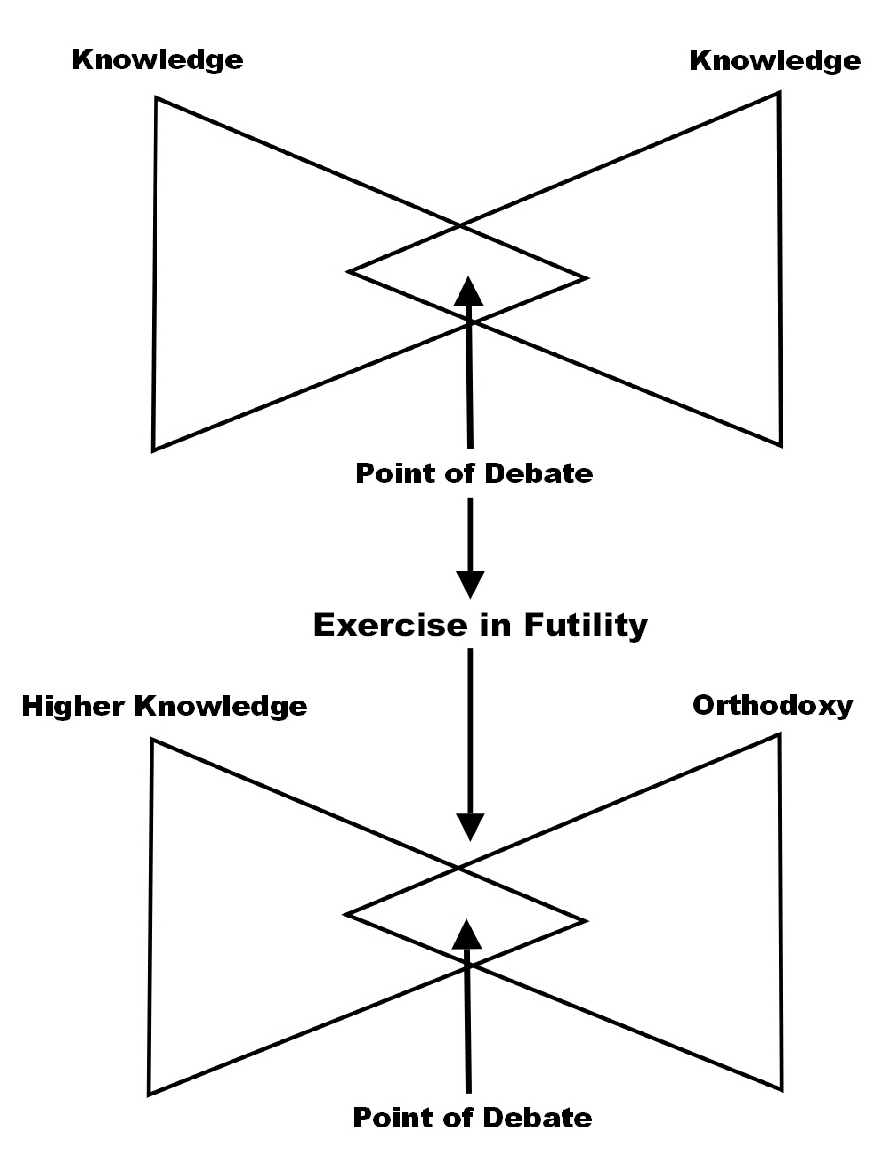
Not much ambiguity in that statement. Pretty clear on its face except for how one would apply it to real life. Again, many might scratch their head in regard to that statement, but proceed to let the theological orthodoxy that flows from it shape their life and thinking. At the point of debate with such people, their orthodoxed talking points will reflect the metaphysical premise. They will absolutely not be swayed in their thinking because they concede that they cannot understand the higher knowledge, and the authority of the higher knowledge is part of the orthodoxy.
Pause: I used to be involved in a ministry that evangelized Jehovah Witnesses. Debating the Bible with them led nowhere because their orthodoxy reinterprets all biblical terms and phraseology. When Christ is referred to, it is assumed that their presuppositions regarding Christ are the same, and they are not. Instead, we challenged their orthodoxy, i.e., the Watchtower publication. Likewise, let me reveal a concluding theme of this study: never debate the Bible with a Protestant; instead, bring their authority into question. Refuse to discuss anything else for it will be futile for reasons yet to be examined.
Let’s look at another statement from the New Covenant Theology camp:
At this time, resist the temptation to utilize subsequent passages to validate the meaning or to move out from the immediate context. Remembering that all exegesis must finally be a Christocentric exegesis.
Look for Christ even if He isn’t there directly. It is better to see Christ in a text even if He isn’t, than to miss Him where He is (The Biblical Theological Study Center: A Christo-Presuppositional Approach to the Entire Scriptures; Max Strange. Online source: http://goo.gl/5sGjP).
The question quickly becomes, “How can you see Jesus in every verse in the Bible?” This is where the Bible becomes a “meta-narrative.” That can mean, “grand narrative,” but in this case it means “metaphysical narrative.” The Bible is a narrative, or story that depicts redemptive reality. You will get confused unless you understand that the theory also posits the inclusion of multi-purpose perspectives into the metaphysical story (a story that depicts true reality). The text grammar doesn’t determine the perspective resulting in a particular objective outcome, but the assumed outcome determines the perspective. So, can “passages talking about incestuous rape” say something about redemption? Of course. In this example, the passage is not talking about Jesus specifically, but denotes why His redemptive works are needed. In some way, according to the prism, the verse always speaks of Jesus and His redemptive works.
This approach to interpreting reality (state of being, or metaphysics), what we call epistemology, plugs into the basic ancient philosophy of total inability. This proffers the idea that man cannot know or comprehend reality. The metaphysic follows: man dwells in a realm apart from true reality that he cannot comprehend. Secondly, somehow, usually via a theory of predeterminism, there are a select few that can ascertain truths from the other realm. Usually, the delineation of the realms is the material versus invisible with mankind residing in the material realm.
The Reformers recognized a reality that man functions in, but deemed it “subjective,” or shadowy. Focusing on this shadowy realm leads to despair. In the aforementioned foundational document of Protestantism, Luther contended that man’s material realm only feeds “the glory story,” or the story of man.
In Luther’s construct, ALL reality is interpreted through two stories: the glory story (the story of man), and the cross story (the story of redemption). Giving any credence to the material world or the belief that man can know the material world empirically only contributes to the story of man and his glory. Yes, man functions in this world, but it does not possess any objective wisdom that can bring true well being. Only an ever-clearer understanding of the cross story can bring well being.
What then is the cross story specifically? It is twofold: it is the holiness of God as set against the sinfulness of man. This is the only objective truth and reality that can bring well being. The goal is a deeper and deeper understanding of how inept we are in every category of life as set against the glory and holiness of God.
Pause for main point: according to this philosophy, the sole purpose of the Bible is to lead us in seeing the cross story with more and more clarity. To the extent that we do that, we will have well being. AND, to the extent that each individual lives according to the cross story, the well being of society as a whole will increase. When Reformed folks talk about “transforming society with the gospel,” this is exactly what they are talking about. To the extent that the populous embraces the doctrine of inability, society will be transformed.
One reason for lauding this epistemology is unified agreement on interpretation. If every verse is about Jesus, there is no division in opinions. Secondly on this point, it gives Christianity a pass on defending inerrancy; e.g., narratives are not meant to be technical systems of theology that require consistency in logic. Thirdly on this point, if some sort of Christocentric conclusion is drawn from the text—it can’t be wrong. If the interpretation of the text somehow demeans man and exalts God, error is impossible.
Before we address the grammatical-historical approach to interpreting reality, let me add some thoughts to the redemptive-historical perspective. This perspective now dominates the institutional church. Just yesterday, I participated in a conversation on a social media site in which the following statement was made about Proverbs chapter 8:
The Old Testament reveals shadows of what Jesus Christ will be in the New Covenant. I can easily say that wisdom personified in Proverbs 8 is Jesus Christ.
If one reads Proverbs 8, the assertion that it is about Christ is beyond presumptuous at best. It is a complete rejection of the plain sense of the grammar; even in lieu of the personification being in the female gender.
Also, these two perspectives on reality are a salvific issue with the Reformed. A denial of total inability equates with the grammatical-historical view of reality which is supposedly an attempt by man to glorify himself by writing his own story. By believing that you can understand reality, you are in essence making yourself God.
The most common question is the issue of biblical imperatives that are clearly directed at mankind. This assumes that man is able to obey because grammatically, the commands are directed at him with a demand for obedience. But again, addressing these commands with the presupposition of total inability that equates with the redemptive-historical prism, the commands are supposedly meant to deliberately frustrate man and “drive him to despair of self-righteousness.”
The Reformed continually concede that the Bible states things in grammatical form, but that is always followed with the proper “gospel context” according to the redemptive-historical interpretation of reality. The classic example is this quotation from Neo-Calvinist Paul David Tripp:
….and the Bible does call us to change the way we think about things. But this approach again omits the person and work of Christ as Savior. Instead, it reduces our relationship to Christ to “think his thoughts” and “act the way Jesus would act.” (How People Change 2006, p.27).
Notice that Tripp concedes that the Bible calls us to do things according to the grammatical context, but goes on to say that is a denial of the gospel (omits the work of Christ as savior). On page 26 of the same book, Tripp calls obedience to the word of God a “behavioral approach” that “separates the commands of Scripture from their Christ-centered gospel context.”
Lastly before we move on, when one is able to wrap their minds around the redemptive-historical approach to interpreting reality, it will be recognized that this approach now saturates the Protestant institutional church.
What is the grammatical-historical approach to interpreting reality? As with the other prism, I am not going to elaborate on the “historical” part except to say that the redemptive-historical hermeneutic makes history part of the prewritten gospel narrative. History is simply the redemptive story playing out as scripted by God.
The political commentator Rush Limbaugh often notes that “words mean things.” This is a good working definition of grammatical-historical interpretation; it draws conclusions from a technical evaluation of the words in a sentence whether spoken or written. The many categories of language that give meaning are considered also, which speaks to the “historical” part of the term. Does the sentence mean the same thing today that it meant then? For instance a sentence written in 1940 might say, “Bob is gay.” History informs us of the meaning in that day: Bob is happy. Today that means Bob is a homosexual. The etymology of words and many other factors weigh-in, but all have this in common: they are empirical tools.
This interpretive method also assumes mankind is able to comprehend the realty he dwells in according to empirical observation and can draw conclusions on his own. Man has ability.
Pause: how did Luther get away with denying that mankind had any kind of ability at all? He chalked-it-up to man’s self-perceived ability that can accomplish things in the material world. These accomplishments are of no worth and only accomplish one thing and one thing only: they serve man’s lust to glorify himself. Luther believed that satisfaction from accomplishment was nothing more than sinful pride. To Luther, the only redeeming thing about the world was that heaven manifested its works on earth according to God’s sovereign will. If man lives life subjectively and professes that his evil “good” works cannot be distinguished from heavenly manifestations “experienced subjectively,” that is venial sin that can be forgiven. In accordance with authentic Reformed tradition, Luther believed the following: the belief that any man, including Christians, can perform a good work is mortal sin.
Therefore, the Reformed often define wisdom/knowledge according to two categories: “worldly knowledge” and “wisdom from above.” Sure, man can obtain worldly knowledge that improves his circumstances, but it is all prideful according to Luther. Wouldn’t this approach propagate a lot of death and misery due to a lack of science? Yes, but that was exactly Luther’s point. Many are perplexed by the embracing of ideologies that result in third world cultures, but those who are perplexed make the point for those in the other camp: what is the perplexity of the detractors? Answer: they are perplexed that other people do not lust after materialism as they do. Hence, third world cultures are often seen as being virtuous by the Reformed.
This is why Luther introduced suffering as a hermeneutic that interprets reality. There is true wisdom in the cross story because according to Luther, “all wisdom is hidden in suffering.” According to Luther, many reject this interpretation of reality and dub it the “foolishness of the cross.” Luther also stated that men call the good evil (suffering), and evil good (anything that prevents suffering). This is why Luther called reason an “ugly whore who should have dung rubbed in her face.”
The grammatical-historical perspective of reality assumes man can interpret his own reality, and the material world is not inherently evil. Believers and unbelievers share common realities that are simply practical and not evil.
Here is the challenge: to bring biblical knowledge to bear on grammatical-historical reality when the prevailing view of Protestantism has been the redemptive prism for hundreds of years.
But there is good news as well: the grammatical prism is what man utilizes intuitively. People assume they can interpret their own reality. Of course, the Reformed see this as the very problem.
Does this mean that grammatical-historical Christians should evangelize the lost world and forgo debate with Protestants? Yes it does, because it is a futile endeavor. You are trying to reach people who define reality itself differently. Protestants are redemptive-historical religionists.

Clarification From Galatians 3: The Trinity is Not a Paradox, Christians Don’t Live by Faith Alone, and the Covenant of Promise Defined
 “Again, it’s the same gospel with Jesus added as perfect law-keeper; it fuses law with gospel. That’s what the Judaizers did, and that’s what Protestant elders do…There is no law in perfection; there is only law in love.”
“All of true Israel will be saved. That’s the promise made to Abraham, and from that promise all the nations find their salvation as well. Any denial of a future redemption of national Israel according to its original identity is a plenary rejection of the gospel.”
“Do you believe a gospel that makes the New Covenant a fulfillment of the Old Covenant rather than an ending of it for those who believe? Have you substituted the fulfillment of the New Covenant via love for a substitutionary fulfillment of the covenant of death? This is what sets the covenant of promise apart from all other gospels. If you are a true Christian, you don’t live by faith alone, you live by love alone, and you are the one doing the loving because you are free from condemnation. Your love is not a substitution; Christ’s death is the only substitution that sets you free to love without fear of condemnation.”
Galatians chapter 3 corrects some significant misnomers that routinely plague those who have to listen to incessant Christian blathering coming from the same who are completely comfortable with contradictions. Faith has become a license for mindlessness, and paradox is now a legitimate hermeneutic.
Since the Bible says God is one person, and also three persons, and the Bible cannot contradict itself, gee whiz, that’s a paradox, and gee whiz, there must be other paradoxes in the Bible as well, and gee whiz, only our “leaders” (dictators) know what a paradox is or isn’t. So, another paradox is the idea that Christians do things by faith alone. We do stuff, but we are not really the ones doing it. “Christians” are very comfortable with this lingo: we didn’t do it, when clearly we did do it, but supposedly, Jesus really did it, lest we get credit for the deed even though Jesus does assign merit for good deeds, but to whom is unclear since we didn’t do it.
And of course, supposedly, people don’t buy into this nonsense because it’s nonsense, but are rather “totally depraved” and will accept the offer of salvation if it is really a promise made to them even though God tells us to tell them that the promise is to them though it may not be. And so it goes; we will pay someone 85,000 dollars a year with a hefty medical package to say things like, “You don’t keep the law by keeping the law.”1 Our job is to say “amen” in between sips of coffee served up from the large vat in the lobby. If the coffee has a little burn in the taste, we wonder, “Is this the day, or just another dry run?”
I am not going to get into the trinity debate, but rather, the point of this post is that the Bible isn’t making a statement about the trinity when it states that God is one. The biblical idea is a statement that makes it clear that there are no other mediators between God and man other than God Himself. Galatians chapter 3 makes this clear. Hence, Protestant popes love to keep the masses distracted with debates about paradoxes lest we figure out that God was drawing a contrast between Himself and them who will travel land, sea, and air to make someone three times the child of hell that they are. And of course, paid for by the Protestant peasantry enslaved to the material world and its knowledge. And of course, from that perspective, spiritual truth can be expected to appear as paradox. In fact, those who demand a logical exegesis of Scripture are deemed as lacking faith, and making Jesus a “precept rather than a person.” By the way, the idea of faith over logic/reason was a major clarion call of the Nazi party during its formative years and expressly Lutheran in origin.2
Galatians chapter 3 is a vivid clarification of the relationship between law and gospel—or better stated biblically, the relationship between law and promise which also excludes every kind of mediator other than God Himself. This is one of the major points of Galatians 3. Paul begins by stating the following in his epistle to the Galatians:
Galatians 3:1 – O foolish Galatians! Who has bewitched you? It was before your eyes that Jesus Christ was publicly portrayed as crucified. 2 Let me ask you only this: Did you receive the Spirit by works of the law or by hearing with faith? 3 Are you so foolish? Having begun by the Spirit, are you now being perfected by the flesh? 4 Did you suffer so many things in vain—if indeed it was in vain? 5 Does he who supplies the Spirit to you and works miracles among you do so by works of the law, or by hearing with faith—6 just as Abraham “believed God, and it was counted to him as righteousness”?
The dictators of the Protestant super-cult focus on the words, “Are you so foolish? Having begun by the Spirit, are you now being perfected by the flesh?” The case is therefore made that we must be perfected the same way we began. This is the Protestant false gospel of progressive justification in a nutshell. It begins with the idea that perfection, viz, justification, is a process. And next, we keep that process going by faith alone. And next, if we live by some sort of faith-alone formula, the same formula that originally saved us, the Holy Spirit will continue to keep us justified. In other words, we have to live by the same gospel that saved us in order to keep ourselves saved which is backdoor works salvation.
What is Paul really saying? His rhetorical question focuses on the erroneous idea that “perfection” (justification) is based on a process. The crux is any kind of process period, but in this case, the process involves the law of Moses. Protestantism uses this text to make the exact case that Paul is arguing against. Except, they add the law to the process in the same way that the Judaizers did albeit in a less direct way. Take note: the very false gospel that Paul is arguing against in Galatians 3 is the same gospel propagated by Protestantism in our day, and the exact same gospel that the Judaizers propagated with Jesus added. In this letter, Paul argues that law cannot be part of the gospel because that would make the law a co-mediator/life-giver with God, and only God can give life. The Judaizers taught that the law does give life, and that “believers” have to continue to draw life and justification from the law.3
But we must now stop and define what Paul meant by “law” in context of keeping it for justification. Judaizer-like false gospels never promote a truthful and perfect keeping of the law in order to remain justified because they know that’s impossible. So, the traditions of men are added as a Cliff Notes keeping of the law that fulfills the “righteous demands of the law.”4 Men are mediators between God and mankind that determine the sub-law that satisfies the holy law, and supposedly, they are appointed by God. Luther and Calvin merely added Jesus to this idea. If we obey the “Christ-centered,” “gospel-centered,” orthodoxy of Protestant elders, Jesus’ perfect obedience to the law of Moses will be imputed to our account, and we will remain “perfect” or justified. Again, it’s the same gospel with Jesus added as perfect law-keeper; it fuses law with gospel. That’s what the Judaizers did, and that’s what Protestant elders do.
Let’s nail this down a little more before we progress further. It entails an understanding of what Paul meant by the receiving of the Spirit. That’s the new birth. That’s the baptism of the Holy Spirit. That changes the believers relationship to the law. Paul’s protest regards the fusion of the law of Moses with perfection which takes place upon the receiving of the Spirit. Paul is protesting a progression or process of perfection by law-keeping. The Judaizers propagated a fulfilling of the law for righteousness via adherence to their traditions5 whereas Protestants demand an adherence to their traditions which supposedly results in Jesus’ perfect law keeping being imputed to the “believer.”
Paul said, in essence, “No, if you want to be justified (perfected) by the law of Moses (the law of sin and death), you have to keep it perfectly. No, circumcision and the observance of days is not a substitution for fulfillment of the law. The law has no part in justification, one is justified (perfected) by the new birth that is received by faith alone. The justified are not justified by the law—law-keeping is what they do, but it is not the law of sin and death for purposes of law-keeping, it is the law of the Spirit of life for purposes of love. There is no law in perfection; there is only law in love.” Hence…
Galatians 4:10 – You observe days and months and seasons and years! 11 I am afraid I may have labored over you in vain…21 Tell me, you who desire to be under the law, do you not listen to the law?…5:2 Look: I, Paul, say to you that if you accept circumcision, Christ will be of no advantage to you. 3 I testify again to every man who accepts circumcision that he is obligated to keep the whole law. 4 You are severed from Christ, you who would be justified by the law; you have fallen away from grace…6 For in Christ Jesus neither circumcision nor uncircumcision counts for anything, but only faith working through love.
In addition, the law being the standard for justification rather than the receiving of the Spirit always leads to a “relaxing of the law” (Matt 5:19). Why? Because some dumbing down of the law as a replacement for true law-keeping for love, or faith working through love, always leads to neglect of the law and true love accordingly. Hence…
Galatians 2:17 – But if, in our endeavor to be justified in Christ, we too were found to be sinners, is Christ then a servant of sin? Certainly not! 18 For if I rebuild what I tore down, I prove myself to be a transgressor. 19 For through the law I died to the law, so that I might live to God…5:7 You were running well. Who hindered you from obeying the truth? 8 This persuasion is not from him who calls you…13 For you were called to freedom, brothers. Only do not use your freedom as an opportunity for the flesh, but through love serve one another. 14 For the whole law is fulfilled in one word: “You shall love your neighbor as yourself.” 15 But if you bite and devour one another, watch out that you are not consumed by one another.
The fulfillment of Moses’ law, the law of sin and death (Romans 8:2), cannot be fulfilled for justification, but said false gospel (Gal 1:6ff.) attempts to do so through mediation in addition to God. This always leads to a dumbing down of the law for purposes of justification. The traditions of men end up being a cloak for unrighteousness under the auspices of being friends of the law. Tradition fulfills the law as a standard for righteousness when the real standard for righteousness is the new birth resulting in the loving of God’s law for purposes of loving God and others, not justification. Justification is a finished work totally apart from the law of sin and death; the only work left is “faith working through love.”
Sure, we don’t do that perfectly, but in regard to justification, so what? The motives of those born of God are love because part and parcel with the new birth is a love for the truth (2Thess 2:10). The law’s ability to condemn was ended by Christ (Rom 10:4) and where there is no law there is NO sin (Rom 4:15). If you now say: “So, the law is the Spirit’s law, and for those who are under law, He uses it to condemn them, but to those who have received Him, He uses it to lead them”; you rightly assess with an additional caveat…Moses’ law of sin and death, while being a ministry of death, still serves the same purpose for New Testament unbelievers as it did for Old Testament believers, that is, it holds sin captive until they believe in Christ, then their sins are ended along with the law that the old them was under, but one who is dead is no longer under the jurisdiction of law that can condemn6 (Romans 7:1-6). Those who receive the Spirit are now free to “serve another” (Rom 6:6). The “new life of the Spirit” enables us to fulfill the law in our acts of love (Rom 8:1-8). The apostle Paul develops these same ideas as we move along in Galatians 3.
Galatians 3:7 – Know then that it is those of faith who are the sons of Abraham. 8 And the Scripture, foreseeing that God would justify the Gentiles by faith, preached the gospel beforehand to Abraham, saying, “In you shall all the nations be blessed.” 9 So then, those who are of faith are blessed along with Abraham, the man of faith.
This is set against what the Judaizers were telling the Galatians. They were telling the Galatians that in order to be a true son of Abraham, you have to follow the recognition of days and circumcision; traditions that supposedly satisfied the law of Moses. Paul wrote this letter to set them straight. Paul wrote the letter to explain how one becomes a true son of Abraham, the man of faith. Note that the baptism of the Spirit is somewhat different from the new birth. As we will see in chapter 3 of this letter, the law of Moses had a particular purpose: to hold all sin captive. As the law increased, so did sin, but all sin is against the law (1Jn 3:4) and imputed to the law; the law of sin and death holds sin captive.
Old Testament believers were born again and ministered to by the Spirit, but their sins were still held captive by the law because the promise of the Spirit had not yet come. The promise of the Spirit would resurrect Christ from the grave who had already ended the law and its condemnation by dying on the cross, and baptize Jew and Gentile into one body.7 The promise of the Spirit was therefore to Abraham and Christ both (Gal 3:16). As King David had prophesied, God would not leave Christ in the grave to see corruption (Acts 2:27, 31, Ps 16:10).
Until then, Old Testament believers dwelt in a place called Hades which was divided into two parts with a gulf separating them (Luke 16:19-31). One side was occupied by those under law and its condemnation, and the other side was occupied by “the captives.” Why were they called “the captives”? Because Jesus had not yet ended the law’s condemnation, and the saints were yet held captive by the law. While Christ was in the grave, he went to Hades and proclaimed victory to the captives, and when the Spirit resurrected Him, according to the promise, He led the captives out of captivity because the law was ended (Eph 4:8, Ps 68:18, 1Pet 3:19). This is the gospel that God preached to Abraham face to face.
Galatians 3:10 – For all who rely on works of the law are under a curse; for it is written, “Cursed be everyone who does not abide by all things written in the Book of the Law, and do them.” 11 Now it is evident that no one is justified before God by the law, for “The righteous shall live by faith.” 12 But the law is not of faith, rather “The one who does them shall live by them.” 13 Christ redeemed us from the curse of the law by becoming a curse for us—for it is written, “Cursed is everyone who is hanged on a tree”— 14 so that in Christ Jesus the blessing of Abraham might come to the Gentiles, so that we might receive the promised Spirit through faith.
Paul is telling the Gentile Galatians, as a Jew of the Jews, that they were part of the gospel from the beginning, and are given access to the commonwealth of elect Israel (Eph 2:12) in the same way that Abraham was saved, by faith alone completely apart from the law. Paul will go on to argue that if the law is justification’s standard, the law is an additional seed, or offspring. In other words, the law is a co-life-giver with God. This is the crux of “one God.” However, don’t misunderstand and think that the law cannot give life to anyone for it can, but not those who are under its condemnation. It is impossible as Paul stated in Romans 8 for anyone under the curse of the law to find life in the law. That’s what Paul is stating here in Gal 3:10-14. Believers “live” (are justified) by faith alone in the free gift of the promise completely apart from the law. Those under grace love God’s law (Ps 119) and it can, in fact, give life to those who are born again (Jn 17:17, 1Pet 2:2).8
Those under the law can only find condemnation in the law. They can only receive the free gift by faith alone in the death and resurrection of Christ.9 When they believe, the Spirit falls on them,10 puts them to death with Christ, and thereby ending the law that all of their sins are against and imputed to, and resurrects them to new life in Christ where they walk according to the Spirit and find life in obedience to the Spirit’s law… “If you love me, keep my commandments.”11 The believer does not question motives in obedience—they know they cannot be justified by the law. They know they are justified by the new birth apart from the law. Paul furthers the point this way:
Galatians 3:15 – To give a human example, brothers: even with a man-made covenant, no one annuls it or adds to it once it has been ratified. 16 Now the promises were made to Abraham and to his offspring. It does not say, “And to offsprings,” referring to many, but referring to one, “And to your offspring,” who is Christ. 17 This is what I mean: the law, which came 430 years afterward, does not annul a covenant previously ratified by God, so as to make the promise void. 18 For if the inheritance comes by the law, it no longer comes by promise; but God gave it to Abraham by a promise.
It simply boils down to this: justification is completely void of law (Rom 3:19, 21, 28). Salvation and new birth come by believing the promise of miraculous new birth:
Romans 9:9 – For this is what the promise said: “About this time next year I will return, and Sarah shall have a son.” 10 And not only so, but also when Rebekah had conceived children by one man, our forefather Isaac,
And…“For what does the Scripture say? ‘Abraham believed God, and it was counted to him as righteousness.’” What did he believe exactly? He believed that God would bring about miraculous new birth demonstrated in Sarah, make his descendants like the sand of the sea, bless the Gentiles through him as well, and that his offspring would live forever in a city built by God (Heb 11:8-12). The miraculous conceptions of Sarah, Rebekah, Elizabeth, and Mary are not mere fodder for mystery, but speak of miraculous new birth and God’s elected means for the promised free gift. It’s by new birth, not law. There is no law in justification; the law is a protector that holds our sin captive until faith comes. Faith only believes in the promise like Abraham—the law did not come until 430 years after God made a covenant with him; the free gift—the promise. The law in NO WAY “ratified” the original covenant which had no law, but was based on the promise to Abraham and the ONE seed, Christ.
Why then the law?
Galatians 3:19 – Why then the law? It was added because of transgressions, until the offspring should come to whom the promise had been made, and it was put in place through angels by an intermediary. 20 Now an intermediary implies more than one, but God is one.
This brings us almost full circle. The law of Moses was put into place by angels on Mount Sinai in the apocalyptic event recorded in the Old Testament. Moses was the mediator, but he was the mediator for a ministry of death:
2Corinthians 3:7 – Now if the ministry of death, carved in letters on stone, came with such glory that the Israelites could not gaze at Moses’ face because of its glory, which was being brought to an end, 8 will not the ministry of the Spirit have even more glory? 9For if there was glory in the ministry of condemnation, the ministry of righteousness must far exceed it in glory. 10Indeed, in this case, what once had glory has come to have no glory at all, because of the glory that surpasses it. 11For if what was being brought to an end came with glory, much more will what is permanent have glory.
Note that Moses’ ministry of death has not completely ended, but is in the process of being abolished (Heb 8:13). Why? Because it still serves a purpose. It will be used to condemn those under it if they do not rid themselves of it. Meanwhile, all sin is imputed to it:
Hebrews 9:15 – Therefore he is the mediator of a new covenant, so that those who are called may receive the promised eternal inheritance, since a death has occurred that redeems them from the transgressions committed under the first covenant. 16 For where a will is involved, the death of the one who made it must be established. 17 For a will takes effect only at death, since it is not in force as long as the one who made it is alive. 18 Therefore not even the first covenant was inaugurated without blood. 19 For when every commandment of the law had been declared by Moses to all the people, he took the blood of calves and goats, with water and scarlet wool and hyssop, and sprinkled both the book itself and all the people, 20 saying, “This is the blood of the covenant that God commanded for you.” 21 And in the same way he sprinkled with the blood both the tent and all the vessels used in worship. 22 Indeed, under the law almost everything is purified with blood, and without the shedding of blood there is no forgiveness of sins.
Note that “a death has occurred that redeems them from the transgressions committed under the first covenant.” That’s because all sin is committed under the first covenant. If the first covenant is completely abolished, there is no sin for anyone. This is why unbelievers are “under law” (Rom 6:14). However, note that Christ has already ended the sin under that covenant for those who believe. The law, both that of the conscience written on every heart (Rom 2:14-16) and the Bible, is a “guardian” (protector) of which all sin is imputed and held captive, and also drives people towards a solution to its condemnation; that solution being the mediator of a better covenant. Again, this brings us full circle to the meaning of God being one, it refers to ONE MEDIATOR: “Now an intermediary implies more than one, but God is one.” Also, it refers to the idea that God is the only life-giver as well:
Galatians 3:21 – Is the law then contrary to the promises of God? Certainly not! For if a law had been given that could give life, then righteousness would indeed be by the law. 22 But the Scripture imprisoned everything under sin, so that the promise by faith in Jesus Christ might be given to those who believe.
23 Now before faith came, we were held captive under the law, imprisoned until the coming faith would be revealed. 24 So then, the law was our guardian until Christ came, in order that we might be justified by faith. 25 But now that faith has come, we are no longer under a guardian, 26 for in Christ Jesus you are all sons of God, through faith. 27 For as many of you as were baptized into Christ have put on Christ. 28 There is neither Jew nor Greek, there is neither slave nor free, there is no male and female, for you are all one in Christ Jesus. 29 And if you are Christ’s, then you are Abraham’s offspring, heirs according to promise.
Even though the law has no part of new birth or justification, viz, perfection, it is not contrary to the promise. Why? Because it takes all sin captive until faith comes, and its condemnation drives one to the mediator of the better covenant, the ONE mediator, Christ. Moses is not a mediator of a covenant that can give life, but yet he is not a mediator of a covenant that is contrary to the promise.
On the flip side, once a person receives the Spirit apart from the law (Gal 3:2), the law can in fact give life:
Ephesians 6:1 – Children, obey your parents in the Lord, for this is right. 2 “Honor your father and mother” (this is the first commandment with a promise), 3 “that it may go well with you and that you may live long in the land.” 4 Fathers, do not provoke your children to anger, but bring them up in the discipline and instruction of the Lord.
Of course, the new birth guarantees eternal life and cancels the law’s ability to condemn, but the believer can “love life and see good days” in the present via love, or obedience to the law (1Pet 3:10). In other words, one must use the law of God “lawfully” (1Tim 1:8). Not in any regard for justification, but for love. The law cannot under any circumstance give life for justification, but as the law of the Spirit of life (Romans 8:2), it enables us to serve God in the new way of the Spirit found in the Bible (Rom 7:6, 25).
Due to the weakness of the flesh, NOT the inherent evil of the flesh which is a Gnostic misnomer,12 the Christian can still be tempted to sin through “sinful desires.” The power of sin is broken because sin is empowered by its ability to condemn13 through the use of the law of sin and death:
1Corinthians 15:56 – The sting of death is sin, and the power of sin is the law. 57 But thanks be to God,who gives us the victory through our Lord Jesus Christ.
Before one is saved and under the condemnation of the law, the law that the unsaved have no love for provokes them to sin with strong desires lending assistance as well. The law, for them, actually makes sin come alive leading to death (Rom 7:7ff.). In the believer, sin is no longer empowered by the condemnation of the law, but sinful desires still exist. However, obeying sinful desires as opposed to the desires of the Spirit defined by Scripture can enslave a Christian to a particular sin (Rom 6:16). Providing provisions to sin can produce overwhelming desires that can control us (Rom 13:14). Wrong thinking or beliefs, in short, false doctrine, also contributes to God’s children leading confused and defeated lives.
What is the New Covenant?
The New Covenant is the second part of the covenant of promise. The Old Covenant was the first part, the New Covenant is the second part of the same covenant of promise.14 The promises (plural) are the other covenants that are the building blocks of the covenant of promise (Eph 2:12). The New Covenant was made to Israel and the father of that nation from which all other nations will be blessed. The Old Covenant proclaimed the New Covenant and held sin captive until Christ came to die. In this way, the Old Covenant was the family will executed upon Christ’s death. Old Testament believers were written into the will/inheritance:
Hebrews 9:15 – Therefore he is the mediator of a new covenant, so that those who are called may receive the promised eternal inheritance, since a death has occurred that redeems them from the transgressions committed under the first covenant.16 For where a will is involved, the death of the one who made it must be established. 17 For a will takes effect only at death, since it is not in force as long as the one who made it is alive. 18 Therefore not even the first covenant was inaugurated without blood. 19 For when every commandment of the law had been declared by Moses to all the people, he took the blood of calves and goats, with water and scarlet wool and hyssop, and sprinkled both the book itself and all the people, 20 saying, “This is the blood of the covenant that God commanded for you.” 21 And in the same way he sprinkled with the blood both the tent and all the vessels used in worship. 22 Indeed, under the law almost everything is purified with blood, and without the shedding of blood there is no forgiveness of sins.
Moses was the mediator of the Old Covenant, and Christ is the mediator of the New, but it is only the New Covenant that gives life. The Old is in no way contrary to the promise (Gal 3:21), but is a ministry of death that serves two purposes: it holds sin captive until faith comes, and will judge those who are under it. The angels are the enforcers of both covenants. They enforced the Old Covenant on Mount Sinai, and will enforce the New Covenant as detailed in the book of Revelation towards completion of the one covenant of promise. The angels are also ministers to the overall covenant of promise throughout time. Hence, their emphasis in regard to the tabernacle etc.
The New Covenant was made to Israel specifically (Jeremiah 31) because they are God’s elect people/nation from which all nations will be blessed. The New Covenant fulfilled the Old Covenant will, and baptized the Gentiles into the commonwealth of Israel. Part of the New Covenant plan was to use the baptism of the Gentiles into the family of God and its commonwealth to make the Jews jealous:
Deuteronomy 32:21 – They have made Me jealous with what is not God; They have provoked Me to anger with their idols. So I will make them jealous with those who are not a people; I will provoke them to anger with a foolish nation,
However, the New Covenant, which promises Israel eternal peace and safety in their own land, will finally be consummated after the fullness of the Gentiles come in:
Romans 11:25 – Lest you be wise in your own sight, I do not want you to be unaware of this mystery, brothers: a partial hardening has come upon Israel, until the fullness of the Gentiles has come in. 26 And in this way all Israel will be saved, as it is written, “The Deliverer will come from Zion, he will banish ungodliness from Jacob”; 27 “and this will be my covenant with them when I take away their sins.”
All of true Israel will be saved. That’s the promise made to Abraham, and from that promise all the nations find their salvation as well. Any denial of a future redemption of national Israel according to its original identity is a plenary rejection of the gospel.
The covenant of promise is a gospel that stands in contrast to all other gospels which make the law of sin and death the standard for righteousness and a co-life-giver with God. There is only one mediator of life. Christ did not come to fulfill the law of sin and death, the Old Covenant, which holds sin captive. He came to end that law for those who believe. Nor did Christ come to be a substitute for that law in the lives of believers for that law is for the unbelieving—not the saved.15 Instead, Christ came to set the captives free from that law in order to serve the righteousness of the law in loving service with no fear of condemnation. There is no fear in love because fear has to do with judgment (1Jn 4:16-19). However, there is a fear of present consequences for obeying sinful desires as we work out our other “salvation” so to speak: the saving of ourselves from potential death that still dwells in the mortal body, and from which we will be saved from in the future, also known as “redemption.”16 Justification and obedience in sanctification ending in redemption should not be confused.
Do you believe a gospel that makes the New Covenant a fulfillment of the Old Covenant rather than an ending of it for those who believe? Have you substituted the fulfillment of the New Covenant via love for a substitutionary fulfillment of the covenant of death? This is what sets the covenant of promise apart from all other gospels.
If you are a true Christian, you don’t live by faith alone, you live by love alone, and you are the one doing the loving because you are free from condemnation. Your love is not a substitution; Christ’s death is the only substitution that sets you free to love without fear of condemnation.
_______________________________________________________________________
1Pastor Jon Young: Dayton Avenue Baptist Church, Xenia, OH.
2https://paulspassingthoughts.com/2014/12/15/something-more-virtuous-than-reason-and-the-road-to-holocaust-2/
3https://paulspassingthoughts.com/2015/01/04/the-potters-house-biblical-covenants-an-overview-and-relevance-to-the-gospel-parts-1-2/ Note citation about perpetually offering the obedience of Christ to God for the satisfying of the law.
4In the Protestant case, rituals that satisfy the law by imputing Christ’s perfect obedience to the law. One of these is church membership which is considered to be one of the “means of grace” found in the institutional church.
5This was an often cited indictment by Jesus against the Pharisees who were rank antinomians for that very reason.
6This is also the real point behind Galatians 2:20 which is a justification verse, not a sanctification verse.
7The book of Acts is the historical account of what Paul is writing about in Galatians 3.
8For the unbeliever the law is death, for the believer it is life.
9Note that Paul emphasizes Christ’s death in the receiving of the Spirit, not Christ’s law-keeping (Gal 3:1ff.).
10As seen all through the book of Acts per the order of salvation: 1. The hearing of the word 2. Faith 3. The baptism of the Spirit.
11Love also fulfills the law. Christ’s ONE act of love makes it possible for us to fulfill the Spirit’s law apart from the law of sin and death. The law is for love—not justification.
12Romans 12:1 along with many other texts makes it clear that the body can be used for holy purposes. In fact, it’s a biblical imperative. It is a weak vessel, but not inherently evil.
13Therefore, be leery of condemnation motifs in any sanctification context.
14The Old and New covenants should not be viewed in a dispensational sense at all, but rather merely two parts of the same covenant. This is a progression of one covenant, not economies.
15Note in 1Tim 1:8-11 and Rom 2:12-16 that the law of Moses is also the gospel. This is because the OT law is a PART of the covenant of promise NOT a dispensation or different plan.
16Phil 2:13, Rom 7:24,25, Lk 21:28. Phil 2:13 is not about justification; it’s about choosing life over death in sanctification with God’s help which is available and leaves us without excuse.
The Nature of God
 I believe incredibly exciting times await God’s people as they break free from the Protestant Orthodoxy Dark Ages. The key will be the realization that God wrote the Bible for the average individual. We have an example of this regarding the nature of God; a subject thought to be too deep for the average disciple.
Our only head is Christ who teaches all, and the idea of being taught assumes the ability to understand. God’s people need to simply let the words in the Bible say what they plainly say, and we are individually responsible for doing so. One must free their minds from the tyranny of orthodoxy and journey into the Bible with their own God-given mind, and they will be responsible to God alone for doing so.
What then does the Bible teach us about God’s nature? The Bible states that God is love:
Beloved, let us love one another, for love is from God, and whoever loves has been born of God and knows God. Anyone who does not love does not know God, because God is love.
So we have come to know and to believe the love that God has for us. God is love, and whoever abides in love abides in God, and God abides in him.
Obtaining God’s Love
Protestant orthodoxy has a peculiar teaching known as the “vital union.” According to Reformed tradition, we maintain this vital union of “Christ in us and us in Christ” by “preaching the gospel to ourselves.” This is done by searching for sin in our lives so that we can return to the cross for forgiveness resulting in increased salvation. The following chart publicized by several Reformed organizations illustrates the process:
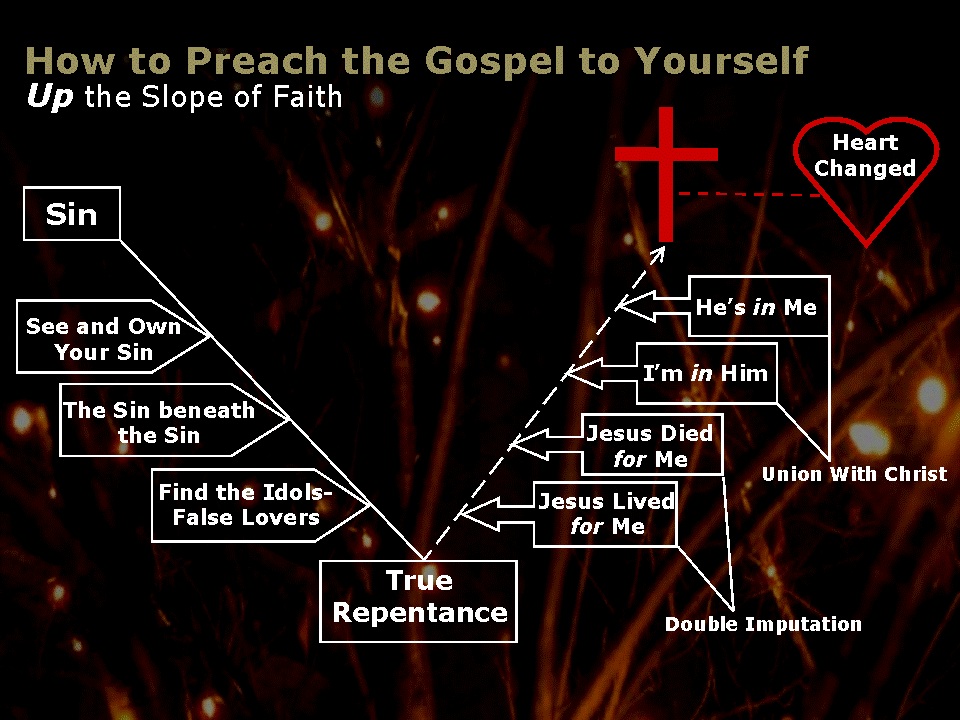
In case you think this is a “biblical” process for best results in growing as a disciple expressed in the illustration by “Heart Changed,” think again as illustrated by another chart published by several Reformed organizations as well:

In this chart, what is growing? Us, or our “salvation”? Many Reformed teachers in our day are fond of telling us how to “keep ourselves in the love of God” by “preaching the gospel to ourselves every day.” In fact, if we change, the following chart from the same camp shows the consequences:

…our salvation gets smaller! In contrast, we obtain God’s love once, and for all time, by believing in His Son, and experience assurance of that love but walking according to our new being.
Little children, let us not love in word or talk but in deed and in truth. By this we shall know that we are of the truth and reassure our heart before him…
But according to Protestant orthodoxy, if we make every effort to love God and others instead making every effort to find more and more sin in our lives, the gospel effect in our lives is diminished.
The Nature of God
How we obtain the love of God as prescribed by Protestant orthodoxy flows from its tenets regarding the nature of God. Primarily, God is defined as sovereign. Rather than sovereignty being an aspect of God’s nature, it is made to be the primary organizing principle—not love. This is an important distinction for those who take part in the exodus from Protestant darkness; will God’s nature be defined by a grammatical and exegetical interpretation of Scripture, or an interpretation based on orthodoxy?
Clearly, the Bible states that God is love. So, how does the Bible define love? Let’s see:
1Corinthians 13:1 – If I speak in the tongues of men and of angels, but have not love, I am a noisy gong or a clanging cymbal. 2 And if I have prophetic powers, and understand all mysteries and all knowledge, and if I have all faith, so as to remove mountains, but have not love, I am nothing. 3 If I give away all I have, and if I deliver up my body to be burned, but have not love, I gain nothing.
4 Love is patient and kind; love does not envy or boast; it is not arrogant 5 or rude. It does not insist on its own way; it is not irritable or resentful; 6 it does not rejoice at wrongdoing, but rejoices with the truth. 7 Love bears all things, believes all things, hopes all things, endures all things.
8 Love never ends. As for prophecies, they will pass away; as for tongues, they will cease; as for knowledge, it will pass away. 9 For we know in part and we prophesy in part, 10 but when the perfect comes, the partial will pass away. 11 When I was a child, I spoke like a child, I thought like a child, I reasoned like a child. When I became a man, I gave up childish ways. 12 For now we see in a mirror dimly, but then face to face. Now I know in part; then I shall know fully, even as I have been fully known.
13 So now faith, hope, and love abide, these three; but the greatest of these is love.
The so-called Reformed gospel of sovereignty calls for the total inability of man to love God even after their definition of conversion. One well known Reformed theologian wrote a book titled One Way Love. This staple Protestant belief is defined in the doctrine of double imputation which calls for the imputation of Christ’s alien righteousness to be imputed to our lives apart from anything we do other than preaching the gospel to ourselves. Much is made of living the Christian life by faith alone in order to maintain our “just standing.”
What it boils down to is God creating evil for His own glory. Whether you consider the teachings of Martin Luther or John Calvin, the founding fathers of Protestantism, this is an irrefutable fact. Luther taught that God created mankind with a passive will; in other words, a will that can only act if acted upon from an outside source. This testifies to God’s nature as defined by sovereignty. Hence, certain people are predetermined to suffer for eternity. In regard to this, John Calvin stated,
[God] arranges all things by his sovereign counsel, in such a way that individuals are born, who are doomed from the womb to certain death, and are to glorify him by their destruction.
~Institutes 3.23.6
I again ask how is it that the fall of Adam involves so many nations with their infant children in eternal death without remedy, unless it so seemed meet to God?…The decree, I admit, is dreadful; and yet it is impossible to deny that God foreknew what the end of man was to be before he made him, and foreknew, because he had so ordained by his decree.
~Institutes 3.23.7
This is contrary to love which is the true nature of God, being “kind,” and “Love does no wrong to a neighbor; therefore love is the fulfilling of the law.” The Reformed even make it a point to say that God did no wrong by creating man in an evil state because the end cause is God’s glory. If God brings good out of something evil, in the final analysis it is good because the end is good. It is also said that God created evil to make good better. However, that still does not dispose of the kindness issue. Love CANNOT be unkind to ANYONE.
Furthermore, it does not seek its own way, and you can insert “its own glory” in that list as well. Moreover, love does not rejoice in evil for any outcome, and always rejoices in truth and not the temporary demise of truth for some kind of better outcome. That notion is absurd.
In the final analysis, one of God’s attributes is sovereignty, but sovereignty is not the organizing principle of his nature because his nature is love.
paul
The Protestant Road to Salvation; Gaining Salvation with More and More Salvation by Using the Bible to be Brought Down to Hell
 The Heidelberg Disputation Series: Theses 15-18.
Listen to audio or download audio file.
Welcome truth lovers to Blog Talk radio.com/False Reformation, this is your host Paul Dohse. Tonight, part 10 of “The Magnum Opus of the Reformation: Martin Luther’s Heidelberg Disputation, Thesis 15 ff. The Protestant Road to Salvation; Gaining Salvation with More Salvation by Using the Bible to be Brought Down to Hell
Greetings from the Potters House and TANC ministries where we are always eager to serve all of your heterodox needs. Our teaching catalog can be found at tancpublishing.com.
If you would like to add to our lesson or ask a question, call (347) 855-8317. Remember to turn your PC volume down to prevent feedback. If you choose to use Skype to listen to the show, my advice is to just dial direct from your Skype account without using any of the Blogtalk links. 347-855-8317.
Per the usual, we will check in with Susan towards the end of the show and listen to her perspective.
Remember, you may remain anonymous. When I say, “This is your host; you are on the air, what’s your comment or question”—just start talking.
If you would like to comment on our subject tonight, you can also email me at paul@ttanc.com. That’s paul@Tom, Tony, Alice, Nancy, cat.com. I have my email monitor right here and can add your thoughts to the lesson without need for you to call in. You can post a question as well.
Tonight, we continue in our sentence by sentence evaluation of the HD (Heidelberg Disputation) starting with thesis 15. Yes, tonight, we really get into the meat of the Protestant gospel, and it ain’t pretty.
Due to the fact that I can’t decide where to stick this with a fork first tonight, let’s begin by reading the 15th thesis:
Thesis 15: Nor could free will remain in a state of innocence, much less do good, in an active capacity, but only in its passive capacity (subiectiva potentia).
The Master of the Sentences (Peter Lombard), quoting Augustine, states, »By these testimonies it is obviously demonstrated that man received a righteous nature and a good will when he was created, and also the help by means of which he could prevail. Otherwise it would appear as though he had not fallen because of his own fault.« He speaks of the active capacity (potentia activa), which is obviously contrary to Augustine’s opinion in his book ›Concerning Reprimand and Grace‹ (De Correptione et Gratia), where the latter puts it in this way: »He received the ability to act, if he so willed, but he did not have the will by means of which he could act.« By »ability to act« he understands the original capacity (potentia subiectiva), and by »will by means of which he could,« the active capacity (potentia activa).
The second part (of the thesis), however, is sufficiently clear from the same reference to the Master.
We discussed the two primary elements of Martin Luther’s bondage of the will in part 7. They are active will and passive will. Man has no active will, his will is passive. It’s like water; it just sits there until it is acted upon by something from the outside. In Luther’s bondage of the will construct, man is dead as a passive being. We normally think of death as a termination of life, but according to Luther, death is a realm where works can be performed, but they are dead works.
As often pontificated by the Reformed, their favorite illustration in regard to this is the resurrection of Lazarus in John 11. Supposedly, this is illustrative of sanctification (the Christian life). From there, the Reformed put metaphysical feet on it in various and sundry philosophical ways, but the major premise is the same.
A caution when studying Reformed ideology/philosophy: separate the major premises from the various applications or you will drive yourself nuts. The major premises such as the total inability of mankind are consistent, but the so-called life applications are not. Let me give an example.
Some of the Reformed believe that man is not active in any regard as far as the will. Everything that happens is because God acted upon man. Others believe man has a free will to do dead works in the material realm, but all manifestations of good works are the result of God acting upon man’s passive will. So, one view sees all human events as a result of God’s active will while others see the distinction in only good or evil acts. Man is passive in regard to good works, but has an active will in regard to all things evil.
Hence, it’s fine to go about your business and live life as it comes just so you believe that everything you do is evil. That qualifies you to be forgiven on Sunday. In the other application, you have no active will at all, but ALL things are preordained by God for His glory. Your goal is only to SEE and EXPERIENCE what God is doing. In the final analysis, these varying applications are not going to cause much of a rift in Reformed circles; the tie that binds is the total inability of man.
But here is another tie that binds: the idea that God created evil for His own glory. Most Protestants think that Protestants believe that Adam and Eve were sinless/holy/pure before the fall and they are just dead wrong in that idea, no pun intended. Authentic Protestant soteriology holds to the idea that Adam and Eve were created with passive wills as clearly stated by Luther in the thesis at hand. Either they had a propensity to do evil and God acted to prevent it until the appointed time, or God actively incited their fall as well.
It can be demonstrated clearly that the creation of evil by God is a Reformed mainstay, but the various philosophical applications make it possible for the Reformed to play all kinds of metaphysical shell games in order to keep people confused and controlled.
As stated before, the Reformation was first and foremost about philosophy and NOT theology. Clearly, the Reformation was about the integration of Dualism with the Bible. One aspect of Dualism insists that nothing can exist without a counterpart to define it. Without darkness, there can be no light, etc. When we get to thesis 28, we will see that Luther’s counterpart to love is evil. Since God is love, the only logical conclusion, other than the fact that Jonathan Edwards and many others have stated it directly, is that God Himself cannot exist without evil because He is the defining counterpart. Some suggest that God existed, but for all practical purposes was nonexistent until He created evil. This is nothing new. This is a resurgence of the exact same Platonist/Neo-Platonist/Gnostic doctrines that plagued the first century church. Take note of what James was pushing back against in that day:
James 1:13 – Let no one say when he is tempted, “I am being tempted by God,” for God cannot be tempted with evil, and he himself tempts no one. 14 But each person is tempted when he is lured and enticed by his own desire. 15 Then desire when it has conceived gives birth to sin, and sin when it is fully grown brings forth death.
16 Do not be deceived, my beloved brothers. 17 Every good gift and every perfect gift is from above, coming down from the Father of lights with whom there is no variation or shadow due to change. 18 Of his own will he brought us forth by the word of truth, that we should be a kind of firstfruits of his creatures.
Of course, the Reformed deny that they teach such things; specifically, that God created evil for His own glory, and dance around the fact with their shell-game communication skills. An example is the following excerpt from an article written by John MacArthur:
Evil originates not from God but from the fallen creature. I agree with John Calvin, who wrote,
. . . the Lord had declared that “everything that he had made . . . was exceedingly good” [Gen. 1:31]. Whence, then comes this wickedness to man, that he should fall away from his God? Lest we should think it comes from creation, God had put His stamp of approval on what had come forth from himself. By his own evil intention, then, man corrupted the pure nature he had received from the Lord; and by his fall drew all his posterity with him into destruction. Accordingly, we should contemplate the evident cause of condemnation in the corrupt nature of humanity-which is closer to us-rather than seek a hidden and utterly incomprehensible cause in God’s predestination. [Institutes, 3:23:8]
~ Is God Responsible for Evil? Grace to You catalogue #A189.
Ok, so it originates from the creature and not God as if that has nothing to do with how God created man. The only alternative is the idea that God created man in His holy image, and with a free will, but don’t hold your breath and wait for them to ever agree to that.
Note Calvin’s language very carefully. It wasn’t one, then another individual deceived by the serpent; it was a propensity inherent in the kind. Also, in the same section of 3.23.8, Calvin attributes the fall to God’s predestination for His glory. It is unclear if Calvin would have agreed with Luther’s bondage of the will via man’s passive will, but Calvin clearly believed that man was created with a level of integrity that could not obtain full fellowship with god even if man had not fallen:
Even If man had remained in his integrity, still his condition was too base for him to attain to God. How much less could he have raised himself so far, after having been plunged by his ruin into death and hell, after staining himself with so many defilements nay, even stinking in his corruption and all overwhelmed with misery?
~The Calvin Institutes 2.12.1. Henry Beveridge translation varies slightly.
Shockingly, the Henry Beveridge translation has it that man’s condition was too base to attain to God “without a Mediator” note capital “M.” Clearly, Calvin is saying that man needed a mediator before the fall.
Thesis 16: The person who believes that he can obtain grace by doing what is in him adds sin to sin so that he becomes doubly guilty.
On the basis of what has been said, the following is clear: While a person is doing what is in him, he sins and seeks himself in everything. But if he should suppose that through sin he would become worthy of or prepared for grace, he would add haughty arrogance to his sin and not believe that sin is sin and evil is evil, which is an exceedingly great sin. As Jer. 2:13 says, »For my people have committed two evils: they have forsaken me, the fountain of living waters, and hewed out cisterns for themselves, broken cisterns, that can hold no water,« that is, through sin they are far from me and yet they presume to do good by their own ability.
Now you ask: What then shall we do? Shall we go our way with indifference because we can do nothing but sin? I would reply: By no means. But, having heard this, fall down and pray for grace and place your hope in Christ in whom is our salvation, life, and resurrection. For this reason we are so instructed-for this reason the law makes us aware of sin so that, having recognized our sin, we may seek and receive grace. Thus God »gives grace to the humble« (1 Pet. 5:5), and »whoever humbles himself will be exalted« (Matt. 23:12). The law humbles, grace exalts. The law effects fear and wrath, grace effects hope and mercy. Through the law comes knowledge of sin (Rom. 3:20), through knowledge of sin, however, comes humility, and through humility grace is acquired. Thus an action which is alien to God’s nature (opus alienum dei) results in a deed belonging to his very nature (opus proprium): he makes a person a sinner so that he may make him righteous.
This thesis is a good summary of the Reformation gospel. Man remains unchanged accept for the ability to see how evil he is and his continued need for the same gospel that saved him. Any notion that there is anything in man that could choose God is double sin and hewing out cisterns for himself that cannot hold water.
Also assumed in the rhetoric is efficacious good works to maintain the law as a standard for justification.
Luther then states what “saved” sinning lost people are to do since they can do nothing but sin. One is to focus on their sin as a way to see a continued need for salvation resulting in more grace…for salvation and continued justification. Instead of being indifferent to sin, embrace it as a means of seeing your need for continued “grace,” herein a more nuanced word than outright “justification” or “salvation.” Again, this nuancing of words incessant with the Reformed began right here in the HD. Following is a contemporary example:
In the following video trailer from the 2011 Resolved Conference, Al Mohler states that the only purpose of the law in the life of a believer is to show us our ongoing need for salvation. Of course, he doesn’t word it that way. He states that believers have an ongoing need for Christ (which no Christian would refute), but note carefully: he is speaking in context of our initial salvation. So, instead of saying plainly that Christians need to be continually saved, or continually justified, he replaces that wording with “Christ.” However, again, the context is clearly salvation. He is saying that we need Christ in the same way that we needed Him for salvation.
Mohler is also saying that the law has the same relationship/purpose to unbelievers as it does believers: to show us our need for Christ. So, obviously, this is in contrast to any ability on the part of the believer to keep it. All the law can do is show NEED. Need for what? Well, what’s the context? Mohler also presents an either/or choice in regard to the law: it either shows us our need for Christ (again, what need specifically?), or we are using it to “rescue ourselves from sin.” Hmmm, what does it mean to “rescue ourselves from sin”? I believe Mohler deliberately uses the word “rescue” instead of “save” in order to add nuance to his point. “Rescue” is less direct, and could refer to a believer trying to overcome sin on his own. This is the same reason he replaces “salvation” with “Christ” in his prior point. It’s deliberate deception. Excluded is any mentioning that the law can be used by the believer to please God and glorify Him in all we do by “observing all that I have commanded.”
~Paul’s Passing Thoughts.com: Why Al Mohler is a Heretic; April 10, 2012
Thesis 17: Nor does speaking in this manner give cause for despair, but for arousing the desire to humble oneself and seek the grace of Christ.
This is clear from what has been said, for, according to the gospel, the kingdom of heaven is given to children and the humble (Mark 10:14,16), and Christ loves them. They cannot be humble who do not recognize that they are damnable whose sin smells to high heaven. Sin is recognized only through the law. It is apparent that not despair, but rather hope, is preached when we are told that we are sinners. Such preaching concerning sin is a preparation for grace, or it is rather the recognition of sin and faith in such preaching. Yearning for grace wells up when recognition of sin has arisen. A sick person seeks the physician when he recognizes the seriousness of his illness. Therefore one does not give cause for despair or death by telling a sick person about the danger of his illness, but, in effect, one urges him to seek a medical cure. To say that we are nothing and constantly sin when we do the best we can does not mean that we cause people to despair (unless we are fools); rather, we make them concerned about the grace of our Lord Jesus Christ.
Ok, so not much commentary needed here—this is pretty plain. As believers we are still sick, and hey, telling someone that they need a doctor continually is not bad news, but good news. All of the Christian life is seeking to be concerned about “grace.” Again, that means salvation. As we have discussed many times before, “grace” is a biblical word that has broad meaning including, for the most part, “help.” Though Luther calls any assertion that this would instill despair in people “foolish,” historical facts beg to differ.
Thesis 18: It is certain that man must utterly despair of his own ability before he is prepared to receive the grace of Christ.
The law wills that man despair of his own ability, for it »leads him into hell« and »makes him a poor man« and shows him that he is a sinner in all his works, as the Apostle does in Rom. 2 and 3:9, where he says, »I have already charged that all men are under the power of sin.« However, he who acts simply in accordance with his ability and believes that he is thereby doing something good does not seem worthless to himself, nor does he despair of his own strength. Indeed, he is so presumptuous that he strives for grace in reliance on his own strength.
Here we have it again. The sole use of the Bible is to show us our worthlessness so as to be brought down to hell in order to prepare ourselves to receive more salvation/justification. As Dr. Michael Horton has said, the sole Purpose of the Bible is to “drive us to despair of self-righteousness.” This is, of course, the mortification part of the Reformed doctrine of mortification and vivification.
With that, let’s go to the phones.

 Paul's Passing Thoughts
leave a comment