The Life of the Believer is Logical, Reasonable, Practical, and Objective
 More than anything, Christ reasoned with people. More than anything, Christ challenged people to think and ponder. One of His favorite introductions to challenging people to think was, “What do you think?” followed by a parable or an example from everyday life.
When Christ began to preach the good news of the kingdom, the Jewish culture was mired in spiritual caste and mysticism. The straightforward commonsense practicality of The Sermon on the Mount, a transcript of Christ’s “good news of the kingdom of God” was utter culture shock. Christ spoke directly to their responsibility in understanding kingdom living and cited NO earthly authority whatsoever. It also demonstrates the kingdom’s mode of operation in regard to present ambassadorship: one head instructing common folks for a common goal.
Christ completely bypassed the spiritual hierarchy of that day as he would in our day if He walked among us as He once did. He wouldn’t contact the Pope, he wouldn’t contact Al Mohler, He wouldn’t contact John Piper; He would take His mandate directly to the common people who are organized and energized by individual gifts—NOT authority.
The institutional church in our day is a mirror image of that day’s spiritual caste; whether the Pope or the Neo-Calvinists, they are no less the contemporary Pharisees and Sadducees of our day. Be sure of this: spiritual authority is ALWAYS accompanied by the idea that God has mediated knowledge through preordained human agencies in addition to Christ. And also be sure of this: spiritual authority will ALWAYS result in illiterate kingdom knowledge and living at best, and cultic tyranny at worst. The supposedly meek pastor is no less a tyrant for disarming you with ignorance that doesn’t even have an ability to ask the right questions.
The apostle Paul could not have been clearer on this as he used the human body to illustrate the function of Christ’s assembly; body parts don’t have authority, they have function. The right hand can tell the bladder to behave itself till the cows come home, but if the bladder is not doing its job, the right hand is wasting its breath (1Corinthians 12). The assembly of believers operate as a body, not an institution. Proper function leads to organized productivity, wellbeing, the advancement of the gospel, and the glory of God.
Christ offered His body once so that we may follow Him in the death and resurrection of the new birth. Once we are born again, our “reasonable (logikos: logical) service” is to offer our bodies as a living sacrifice for the kingdom. Paul’s use of words in Romans 12:1 is stunningly practical. In contrast, cultures have traditionally seized on hokey gimmicks of every sort offered by cultic mediators to bring spiritual manifestations down to earth for our experiential enjoyment or escape from the responsibility of real life. In the first century, as today, the misrepresentation of speaking in tongues is certainly no exception.
1 Corinthians 14:1 – Pursue love, and earnestly desire the spiritual gifts, especially that you may prophesy. 2 For one who speaks in a tongue speaks not to men but to God; for no one understands him, but he utters mysteries in the Spirit. 3 On the other hand, the one who prophesies speaks to people for their upbuilding and encouragement and consolation. 4 The one who speaks in a tongue builds up himself, but the one who prophesies builds up the church. 5 Now I want you all to speak in tongues, but even more to prophesy. The one who prophesies is greater than the one who speaks in tongues, unless someone interprets, so that the church may be built up.
6 Now, brothers, if I come to you speaking in tongues, how will I benefit you unless I bring you some revelation or knowledge or prophecy or teaching? 7 If even lifeless instruments, such as the flute or the harp, do not give distinct notes, how will anyone know what is played? 8 And if the bugle gives an indistinct sound, who will get ready for battle? 9 So with yourselves, if with your tongue you utter speech that is not intelligible, how will anyone know what is said? For you will be speaking into the air. 10 There are doubtless many different languages in the world, and none is without meaning, 11 but if I do not know the meaning of the language, I will be a foreigner to the speaker and the speaker a foreigner to me. 12 So with yourselves, since you are eager for manifestations of the Spirit, strive to excel in building up the church.
13 Therefore, one who speaks in a tongue should pray that he may interpret. 14 For if I pray in a tongue, my spirit prays but my mind is unfruitful. 15 What am I to do? I will pray with my spirit, but I will pray with my mind also; I will sing praise with my spirit, but I will sing with my mind also. 16 Otherwise, if you give thanks with your spirit, how can anyone in the position of an outsider say “Amen” to your thanksgiving when he does not know what you are saying? 17 For you may be giving thanks well enough, but the other person is not being built up. 18 I thank God that I speak in tongues more than all of you. 19 Nevertheless, in church I would rather speak five words with my mind in order to instruct others, than ten thousand words in a tongue.
20 Brothers, do not be children in your thinking. Be infants in evil, but in your thinking be mature. 21 In the Law it is written, “By people of strange tongues and by the lips of foreigners will I speak to this people, and even then they will not listen to me, says the Lord.” 22 Thus tongues are a sign not for believers but for unbelievers, while prophecy is a sign not for unbelievers but for believers. 23 If, therefore, the whole church comes together and all speak in tongues, and outsiders or unbelievers enter, will they not say that you are out of your minds? 24 But if all prophesy, and an unbeliever or outsider enters, he is convicted by all, he is called to account by all, 25 the secrets of his heart are disclosed, and so, falling on his face, he will worship God and declare that God is really among you.
The key to spiritual growth and true manifestations (our walking in truth) of the Spirit is MATURE THINKING and edification by which God’s people mature. Experiential endeavors that are not objective do NOT edify. Period.
Susan and I have a wonderful marriage, but we are not exactly on the same page regarding perceived value in listening to Christian radio. She thinks it has some limited value while I think it is utterly devoid of any edification whatsoever. While riding in the car with her yesterday, we listened to a young girl giving her personal testimony on a “Christian” radio station. Susan often beckons me to “give Christian radio another chance.” The girl spoke of her “personal relationship” with Christ as opposed to merely knowing Him. Trust me, few of these people, if any, can define what it is to have a “personal relationship” with Christ. It’s the mindless spewing of a spiritual bumper sticker that posits subjective piety which supposedly knows beyond knowing. Yes, it’s not about what Jesus says in His word, it’s about the “intimate” relationship with Him. After all, “He’s a person, not a precept.” And so goes the incessant gagathon.
The girl concluded her Gnostic diatribe by sharing how she led her sister to the Lord. Apparently. Yes, she is really happy that her sharing of the gospel lacked substance and knowledge because she had been praying for her sister’s salvation. Hence, she can be confident that it was all of God and not her proficiency in sharing according to knowledge. Susan then asked, “Would you like me to turn the radio off?” I would. This is just another example of why the institutional church is a wasteland of destruction and death. Like gangrene, feeble thinking leads to the silent eating away of flesh and a crippled body with an ongoing need for amputation.
Spiritual growth goes hand in glove with the individual believer being responsible for personal understanding, and by the way, for unity sake must be “convinced in his own mind” (Romans 14). Critical and central to the relevance of home fellowships is EDIFICATION. Teaching and learning must be a primary focus. Home fellowships must be rooted and grounded in objective truth.
paul
Church “Covenants” and How You Should Behave in a Protestant Church
One endeavor on the long list of objectives here at TANC ministries is to get solid legal insight into what has become protocol in evangelical churches. That process began yesterday during a consultation with a local attorney. As documented here at PPT, the Association of Certified Biblical Counselors (ACBC) and its network of churches has become a virtual divorce mill. The pattern that this ministry continues to be made privy to is documented in an open letter to the executive director of ACBC, Heath Lambert.
Simply stated, New Calvinism, which is a return to the original church polity of the Reformation, does not have the force of state to compel church members to follow its orthodoxy. So, it improvises. Instead of simply burning heretics at the stake, or burning a hole through the tongues of those who ask questions in a challenging way, they ruin names and finances.
We must remember, the orthodoxy of the Protestant Reformation was tailored for a church state. America was originally founded by the Pilgrims who didn’t like how the Church of England did church-state, so they came to America and founded “New England.” The name is not happenstance. The American Revolution put an end to the Pilgrims’ theocracy that dominated the colonies. Actually, “Pilgrims” is a soft term for “Puritans.” And please, spare me the emails about the differences between the Pilgrims and the Puritans—the differences are insignificant in the whole scheme of things.
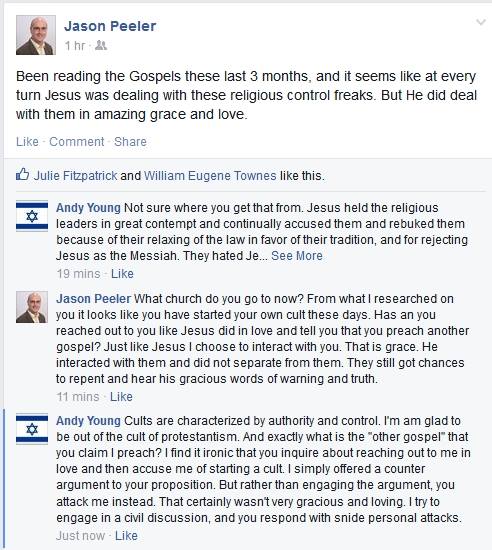
That brings us to the discussion of soft terms. First, the original Protestant Reformation was a simple church state, but in reality, the definition of “cult” comes into play when church states had to improvise in order to control people because of the American Revolution. A cult is defined as follows: it is any religious organization that controls people by means other than a church state. The etymology of the word “cult” does not become significant until post American Revolution.
In other words, without the force of the state to compel people to obey its orthodoxy, it must resort to manipulation and brainwashing to control people. Yes, church states also emphasize brainwashing because murdering people is costly in its implementation, and fewer people amounts to less resources, but brainwashing becomes even more important and refined when the final solution has been outlawed in an open society.
So, let’s state a definitive definition of cult: it is any religious organization that controls people by means other than a church state, and combines faith with authority. Like its church state predecessor, it assumes that the nature of man cannot obtain unity for a given cause without being ruled by those with superior knowledge of realty.
After the American Revolution, churches became a hybrid of orthodoxy and enlightenment thinking. It became an alphabet soup with a broad range of attitude concerning the ability of man to rule self. But, this never resulted in the full-blown focus on individual responsibility mirrored by the 1st century assembly of Christ. The concept of “church” spawned in the 4th century has always permeated the American church psyche, i.e., orthodoxy being a storybook form of truth written by church “Divines” that the saints can understand, and enforced for their own wellbeing.
With that said, soft terms become vital to the American church as we know it today. Church polity is a soft term for church government; church discipline is a soft term for Unam sanctam, or John Calvin’s power of the keys that gives church authority to decide someone’s salvation on behalf of God. It goes without saying that you obey someone that can take away your salvation.
And, “church covenant” is a soft term for “church contract.” Basically, when you sign a church covenant church contract, you are signing away your right to be heard. In most of these contracts, you agree to obey the leadership and to be “teachable.” Hence, from now on, when our ministry hears, “Gee whiz, all I did was ask questions and now my life is being destroyed,” the subject will mostly likely hear, “No, what you did is breach of contract so take your medicine.”
Note: in many churches that deem themselves congregational, the parishioners unwittingly circumvent that reality by agreeing to a revised church covenant prepared and presented by the elders. See how that works?
Moreover, these third party contracts often negate rights found under civil and criminal law. This ministry, more specifically I, stands corrected in my assertion that coercion is being used to control parishioners. In fact, it is not coercion, but according to what the parishioner has agreed to and signed, especially regarding permission to leave church membership. It’s a contract—you signed it, so shut up, nod your head, say amen, and put your money in the plate. It’s all good; if the elders like you—you will more than likely “be able to stand in the judgement.”
What are the redeeming facts here, if any? Education: NEVER sign a church contract. It’s NOT a “covenant” bolstered by your signature—it’s a CONTRACT. This is why TANC does what it does; education, then solution/alternative.
Is there a way to get justice after signing our rights away? Perhaps, because apparently, marriage is also a contract. Rather than burning you at the stake and burying you in the church yard under a stone edict condemning you to hell, which of course is against the law presently, they will begin by ruining your name, and then destroy you financially via divorce.
The process goes something like this: you break your contract and stop being “teachable.” This tells the leadership that you no longer see yourself as a sinner, and you have become “insubordinate.” A dozen or so respected leaders and their wives start telling your wife that you are no longer “humble” and whether she realizes it or not, she is married to an “angry man.” And hark, behavior that your wife formerly assumed not to be abusive, in fact is abusive. Yes, she is married to a man who “doesn’t love her like Christ loved the church.” It’s all downhill from there.
Apparently, legally, this is interference with a marriage contract. Damages would be determined by a jury if the situation ends in divorce. Also, the idea that ACBC could eventually be subject to a class action lawsuit is not all that farfetched.
However, this is just more evidence that the premise and foundations of the institutional church is egregiously flawed and was designed for a church state to begin with. The solution is the cooperation of spiritual gifts, not authority, and fellowship—not membership.
Meanwhile, if you do not like the solution, behave yourself in the Protestant church. Stop going to discernment blogs and whining—you signed the contract, shut up and live by it.
paul
I Repent of Supporting Calvinism
 Yes, I have seen the light, and will now repent of supporting Calvinism. It’s funny how one’s search for the truth is highlighted with lightbulb moments here and there along the way. The most recent drama trending among the discernment blogs is the story reported by Fox News here.
When the couple shared what the church did, and the fact that they were looking for a new church, the lightbulb moment occurred. By “exposing” what the church did, and announcing that they were looking for a new church, they are sending a clear message that the problem is with that particular church, and not the ideology that led to the behavior.
In case anybody hasn’t noticed, there is a whole bunch of misbehaving going on in the Protestant institutional church. By focusing on the behavior, which by the way is both similar and rampant, we facilitate the survival of the ideology that is causing the abuse. It would seem that all of these churches are behaving according to the same playbook; that’s because they are.
Said another way: by separating the behavior from the doctrine, the doctrine that is causing the abuse is getting a pass. Like all discernment blogs, I am guilty of this as well. I have two blogs that detail what happened to me and my family at Clearcreek Chapel. I now see that those blogs are actually promoting Calvinism.
How? The blogs point the finger at Clearcreek Chapel and not the ideology. Really, it was all a misunderstanding; I thought I was a Protestant, and really didn’t know what a Protestant is. By thinking I was a Protestant and hanging out with Protestants, I found out the hard way what a Protestant is.
How we underestimate the power in Jesus’ words: “Beware of the traditions of men.” Ya, no kidding.
It’s the tradition, stupid, not the behavior. Stop supporting Calvinism.
paul




 Paul's Passing Thoughts
leave a comment