Why Christians Can’t See the Total Absurdity of Total Depravity
 “One can clearly see here where Powlison wants to take the plain sense of Scripture and apply the Socratic dialectic; ie, start asking questions about the obvious because truth couldn’t be that easy, and if it is, any Spirit indwelled Christian can do truth at home which is a huge problem for the philosopher kings. Empirical Objectivism puts the power of understanding in the hands of the common people. It is enemy number one for the Platonic New Calvinists.”
1. Background: No New Arrogance Under the Sun
This whole philosopher king idea is really getting traction in my mind and begs for a discussion on Calvin’s total depravity. As I read more and more Socrates and Plato, I keep looking at the cover of the book to make sure it wasn’t really written by some New Calvinist: “Er, did I pick up the wrong book from the stack?” Socrates didn’t like to be questioned with challenging questions. Most of his dialogue was through questions because he believed that was how truth was rediscovered in the mind—through interpretive questions. Socrates didn’t mind inquisitive questions, they were efficacious to the process, but challenging questions in regard to his positions offended him. He had a specific response when he was challenged accordingly: he would sarcastically reverse the roles of teacher and student, and ask questions as the student while making the student the teacher. Sometimes he was very subtle about it to the point that the student was not aware it was going on; apparently, to amuse the gods.
2. Background: No New Interpretation Methods Under The Sun
Before we get to our subject of total depravity, I might mention that this exact same interpretive dialogue schema to determine truth is used by such New Calvinists like Paul David Tripp to discover what our heart idols are. He got the idea from mystic heretic David Powlison who dubs the method, “x-ray questions.” Much of “How People Change” is devoted to this Socratic method. It is also an important part of Neuro Linguistic Programming (used by motivational speaker Tony Robbins) which is a practical modeling application of Neuropsychology (Ed Welch of Powlison’s CCEF holds a Ph.D. in Neuropsychology). Socratism is also the bases of many schools of thought in psychotherapy—especially that of Carl Rogers. As an unbeliever, I was counseled by a Rogerian psychologist and the dialogue was very much like what it would have been with Socrates and one of his students 2500 years ago. This is known as the Socratic dialectic.
3. Background: No New Need For CONTROL Under The Sun
Socrates, and his understudy Plato, taught the governing/aristocratic philosophical class of Athens Greece which was only 10% of the population. Some historians estimate the slave class in that culture as being around 90% of the population. So, the last thing you want is 90% of the population thinking for themselves and coming up with their own ideas. Ideas have a lot of power, and people are inclined to act on them if they think their ideas are really good, or true. Unfortunately, this is the effect that the rulers of Athens were afraid Socrates would have on their society, so they executed him when he refused to go into exile. In case you are curious, executions during that time were boring—they merely brought a cup of Kool-Aid to your jail cell and you drank it.
Later, when Plato founded the first institution of learning in western culture, the Academy in Athens, he made it clear that the philosopher kings were the only ones who had knowledge, and that they should rule over the masses. This was much more acceptable than what Socrates claimed—that the ruling class didn’t know anything because they thought they did. Leveling the playing field to those who simply admit that truth is not definitive, while dissing the ruling class for not knowing anything, was just really a bad idea. There was no middle class to buffer the tipping of the scales.
3A: The Doctrine of Incompetence Necessary for Control
And like the true God, truth was a trinity: beautiful; good; true. However, to claim to know everything about truth would be the same as knowing everything about God. Both Plato and Socrates taught that truth was subjective at best and unknowable in the worst case:
I know not how I may seem to others, but to myself I am but a small child wandering upon the vast shores of knowledge, every now and then finding a small bright pebble to content myself with.
I’m trying to think, don’t confuse me with facts [thinking leads to truth apart from observable criteria].
How can you prove whether at this moment we are sleeping, and all our thoughts are a dream; or whether we are awake, and talking to one another in the waking state?
What truth that the philosopher kings can muster up is societies best shot. Overall, Plato believed that man was inept and should be ruled by philosopher kings who are a little better off because they at least know that truth can’t be known, and if we can ascertain truth at all—it’s not through what can be experienced through the five senses. That leaves the subjective intuition of the mind that is helped in the process (as much as it is one) through the Socratic dialectic. Later, Augustine took these concepts and integrated them with theology. One result of this integration was the idea that man is totally depraved. And that includes saved men as well. Now, by contrast, Plato and Socrates believed man, given a crystal ball, would always choose what’s best, and that his downfall was IGNORANCE (Plato: “Ignorance, the root and stem of every evil.”). Whether a man was good or evil was irrelevant to their school of thought. BUT, the crux of the issue was transferred: the inability/incompetence of man.
3B: Intuitive Subjectivism Verses Empirical Objectivism
Why do the saints of our day buy into such doctrines as total depravity when Scripture plainly teaches otherwise? Because a literal interpretation of Scripture is the same as trying to obtain truth through what can be observed—that’s why. To the Platonist, the idea that objective truth can be obtained at all, much less by evaluating the verbs, nouns, subjects, direct objects, etc. in a sentence, is absurd, and will incite sneers every time. And, this same idea can be found throughout New Calvinist teachings in this present day. In the book, How People Change, Paul David Tripp decries a literal interpretation of biblical imperatives that should rather be seen in their “gospel context.” Even in regard to following the biblical imperative to change our thinking (in the same book), Tripp objects by complaining that Jesus comes to us as a person, not a “cognitive concept” that we apply to our lives as a “formula.” Today’s Reformed philosopher kings have access to the higher knowledge of seeing the gospel and the personhood of Jesus in every verse.
Obviously, this can’t be done empirically if the subject of the verse is not the gospel; unless of course, you are gifted with the correct Reformed metaphysics. Coming to conclusions by Interpreting verbs, nouns etc. are merely Platonist shadows of the real form and not the true reality. New Calvinist Paul Washer has complained that evangelicals propagate a reductionist gospel when the truth is supposedly that the gospel is eternal and unknowable. It’s all the same basic philosophy dressed up in biblical terminology.
Incredibly, this very same contention can be seen in David Powlison’s complaints about Jay Adams in our very day. While lecturing at the church of Reformed heretic John Piper, Powlison stated the following:
I think there’s been a huge growth in the movement in the understanding of the human heart, which is really a way of saying of the vertical dimension. And I had an interesting conversation with Jay Adams, probably 20 years ago when I said, why don’t you deal with the inner man? Where’s the conscience? Where’s the desires? Where’s the fears? Where’s the hopes? Why don’t you talk about those organizing, motivating patterns?
And his answer was actually quite interesting. He said, “when I started biblical counseling, I read every book I could from psychologists, liberals, liberal mainline pastoral theologians. There weren’t any conservatives to speak of who talked about counseling. And they all seemed so speculative about the area of motivation. I didn’t want to speculate, and so I didn’t want to say what I wasn’t sure was so.
One thing I knew, obviously there’s things going on inside people. What’s going on inside and what comes out are clearly connected cause it’s a whole person, so I focused on what I could see.”
In other words, Adams was asserting that since behavior is connected to the heart and motivations anyway, why not focus on what can be objectively observed and apply empirical biblical solutions? The invisible interworking’s of the heart is subjective at best, and risky in regard to being used to help people. Adams wanted to be sure of what he was telling people in regard to solutions for their life problems. But if you believe that objective truth is unknowable anyway, and man’s best hope is the new experimental drug that may or may not help because truth is so far above our knowing (but Plato’s “bright pebble[s]” can be found now and then) then you must find truth beyond observing how the nouns and verbs of Scripture work together empirically to an objective conclusion with solutions following.
So, Powlison answers the Adams’ approach by asserting that the verbs of Scripture have a deeper meaning than what appears objectively. Pretty clever: don’t discount verbs, but add the idea that verbs are also intuitive for the purposes of deeper knowledge:
And that notion that the active verbs with respect to God can do multiple duty for us, they not only call us to faith and love and refuge and hope, but they can turn on their heads and they become questions, what am I hoping in, where am I taking refuge, what am I loving that is not God, that that’s actually a hugely significant component, both of self-knowledge and then of repentance as well.
Emphasis on the positive side of the heart is the whole relationship with God. And I do think that’s a way where, in the first generation, it looks pretty behavioral, and the whole vividness of relationship with God.
One can clearly see here where Powlison wants to take the plain sense of Scripture and apply the Socratic dialectic; ie, start asking questions about the obvious because truth couldn’t be that easy, and if it is, any Spirit indwelled Christian can do truth at home which is a huge problem for the philosopher kings. Empirical Objectivism puts the power of understanding in the hands of the common people. It is enemy number one for the Platonic New Calvinists.
The proof is in the pudding. I have written extensively on the long, long, long list of New Calvinist ideas that blatantly contradict the plain sense of Scripture. How can they get away with this? And why do they do it? Well, first, because what can be plainly observed are shadows of real truth which must be obtained by loftier methods beyond empirical observation. Secondly, the philosopher kings are the supposed experts on that. It harkens back to the famous Jack Hyles quote: “Now shut your Bibles and listen to me.” Rather than to immediately drag this man from the pulpit and toss him into the street, why did the 10,000 plus in attendance that morning obey him without a whimper or batting of the eye?
Because he was a philosopher king—that’s why.
Interpreting “Total Depravity” at Home
But if one does interpret the Bible literally, and if God does speak to us individually through his word, the folly of total depravity is plainly seen. In fact, if Christians do have the freedom to interpret the Bible for themselves, a child can even see the foolishness of this concept. First, we only need to observe 2 Peter 2:7,8;
and if he rescued Lot, a righteous man, who was distressed by the filthy lives of lawless men (for that righteous man, living among them day after day, was tormented in his righteous soul by the lawless deeds he saw and heard)—if this is so, then the Lord knows how to rescue godly men from trials and to hold the unrighteous for the day of judgment, while continuing their punishment.
Peter calls Lot (not exactly the brightest bulb in the Christian bunch ) “righteous.” Not, “totally depraved.” If God wants to put forth the idea that Christians are totally depraved, many passages like this would only cause confusion. “But Paul, that’s talking about positional righteousness, not the actual righteousness of the person.” Oh really? The passage states that it was Lot’s righteous “soul” that was “vexed.” And how do you vex something that is already totally vexed? Nevertheless, we can also add the Apostle Paul’s commentary on the Christian’s righteousness and ability:
I myself am convinced, my brothers, that you yourselves are full of goodness, complete in knowledge and competent to instruct one another (Romans 15:14).
In case there is any question that Paul is not talking about us specifically and not just an attribute that we have in Christ alone, he doubles the personal pronoun for emphasis: “you yourselves.” In a further attempt to show that Christians are totally depraved and no different than unbelievers, Calvinists make the law the standard for justification. A New Calvinist recently challenged my contention that Christians do not sin as a lifestyle, and therefore shouldn’t be referred to as “sinners.” He challenged my contention with their classic rhetorical question that supposedly ends the argument: “Did you sin today?” Hence, if we sinned once, we are guilty of breaking the whole law (James 2:20 [a justification verse not applicable to sanctification]) which supposedly =’s total depravity.
But the law is no longer a standard by which Christians are judged; so therefore, the repentance is even different—it is a washing of the feet rather than a washing of the whole body (see John, chapter 13). Because we have the seed of God within us and this treasure in earthen vessels, we do sin, but not habitually because we are born again and the power of habitual sin is broken. The law is a standard for our kingdom living, but not our just standing—the whole book of 1John is about this and Romans references the same tenets throughout. Because Reformed theology starts with Platonist assumptions about truth and man’s relationship to it—they must rewrite Scripture in totality to make it work which necessarily dismisses a literal interpretation of the grammatical sort.
And I contend that the unregenerate are not even totally depraved. Romans, chapter 2 makes it clear that all people born into the world have the law of God written on their hearts and a conscience that mediates between their actions/thinking and the natural law of God. This, in my mind, thoroughly explains why unsaved people do good things, and pass judgment on what is “natural/good” and “unnatural/evil.” In most cases, extreme behavior (especially unnatural) is attributed to the mind being “ill.” “But Paul, Isaiah said that all of the righteous works of man are as filthy rags to him.” Right, when they are for the purpose of earning favor with God for salvation, or in other cases, hypocritical. I once knew a serial adulterer who volunteered at the community soup kitchen that fed the poor. Does God see that good work as filthy? Of course. But does He look upon the work of a person, who without thinking (because of the law written upon his/her heart), throws themself in front of a car that is about to run over a mother and her baby in the same way? I doubt it. Will that act earn heaven? No. But is the act filthy in God’s eyes? Hardly.
Furthermore, throughout the Scriptures, we learn that there are different degrees of punishment in hell. For the Reformed mind, that’s gotta hurt. That means that the unregenerate, in the negative sense, are given some merit for not being as depraved as they could be. Therefore, the life of an unbeliever does contain merit—not for salvation, but for responding positively to God’s natural law. In fact, at times, the unsaved put Christians to shame in regard to this because as a man thinks in his heart—so is he, and many Christians have been taught that they are totally depraved. This is one of the very reasons that the world is often not endeared to Christianity: it’s a contradiction to the natural law within unbelievers.
Moreover, we see further contradictions in Christ’s account of Lazarus and the rich man in Luke, chapter 16. What did the condemned man have to gain by exhorting Abraham to warn his living brethren about his eternal demise lest they end up the same way? I’m sorry, but how can this not be seen as a selfless exhortation for the benefit of others? Total depravity? How?
But there is a warning in this for the Reformed as well. Abraham told the rich man that if they would not listen to the Scriptures, neither would they listen to one who had been raised from the dead. So, does that mean to merely “listen” to a gospel story? Or, other biblical truth as well? Does the Bible use a myriad of other truths about God to lead others to the gospel, or just the gospel story itself? And who are the approved narrators? Is the true gospel a gospel story about a call to believe and contemplate the gospel only? Is that a true gospel? The Reformed philosopher kings of our day assure us that they know the answers to these questions, and to just trust them as God’s anointed.
No thanks, Christ told me to “consider carefully what you hear.” And sorry, I think “you” means, “me” as in, Paul Dohse. Plato said, “Those who tell the stories rule society.” And in our day, those who make the whole Bible a gospel story are ruling the church. Well, not in my house.
As for me and my house, we will heed our Lord’s advice and consider carefully what we hear. No matter who is telling the story, and we will pay closer attention in alarm to those looking for deeper meaning in simple verbs.
paul
The Sevenfold Thesis of TTANC volume 1
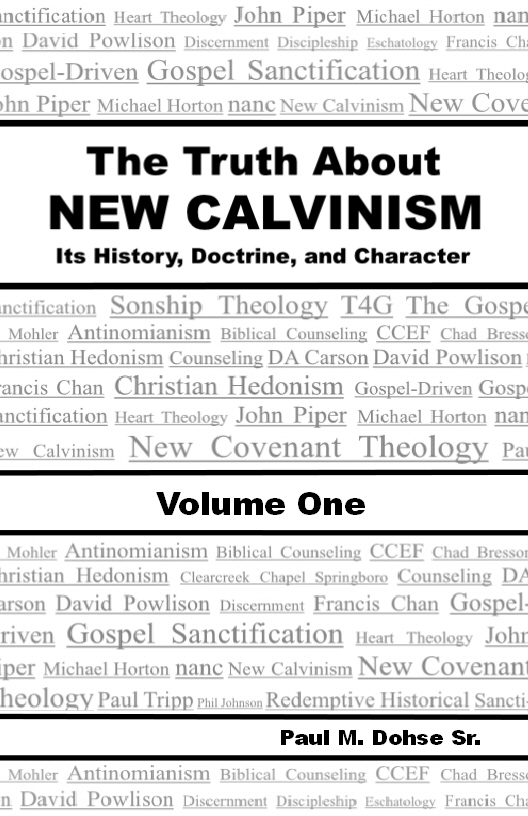 Pages 77 and 78:
The thesis of this book is sevenfold. First, New Calvinism is an expression of antinomian reductionism; specifically, gospel reductionism. It reduces the believers role in God’s spiritual work and plan to the least common denominator—primarily gospel contemplationism.
Second, it reduces the gospel to the saving work of Christ only—eclipsing the Father and Holy Spirit.
Third, because the believer’s role is reduced to a point that is not according to Scripture, he/she is deprived of the abundant life in a way God wants us to experience it for His glory and the arousing of curiosity from those who don’t have the hope of the gospel.
Fourth: it reduces the Scriptures to a historical gospel narrative only—a tool for contemplation. This also “relaxes” the law as a form of antinomianism. While that prism is singular, the system needed to make it work is so complex that it relegates God’s people to a pope-like reliance on those who fancy themselves as masters of meta-narrative interpretation.
Fifth: while reductionist theologies seek to reduce the believer’s role to the least common denominator, supposedly to make much of God and little of man, the elements that attempt to make it seem plausible are often complex and mutating. Therefore, instead of majoring on the application of what is learned from Scripture, believers are constantly clamoring about for some new angle that will give them a “deeper understanding” of the gospel that saved them.
Sixth: Christ and the apostles clearly warned that such doctrines would constantly trouble the church until the return of Christ, and in fact has been the primary nemesis of God’s people throughout redemptive history.
Seventh: All hope in contending against this doctrine is lost if one focuses on all of the theological systems and theories that attempt to make it plausible. This harkens back to lessons learned in contending against first century Gnosticism. For example, as mentioned in chapter five, New Covenant Theology alone has eighty elements. Presently, that is.
Spiritual and Sexual Abuse in the Church: I Can See Clearly Now
In preparation for the second volume of The Truth About New Calvinism and The Reformation Myth, I am reading a hefty amount of material written by Socrates and Plato. Though Socrates was obviously a very annoying person, reading his writings is a real eye-opener in regard to how the first philosophical academy of the western world shapes our present-day thinking from some twenty-five hundred years ago. His very same bases of thought, attitude, and communication techniques that can be seen today are eerily exact—not just similar—exact.
Volume one of TTANC focused on the roots and doctrine of the present-day New Calvinist movement. In preparation for volume two, I dined with church historian John Immel who pointed me to the fact that New Calvinists hold to true Reformation doctrine. Immel then suggested that I research the connections between the Reformers and Augustine, and then Augustine’s connections to Plato. He also provided some clues as to what he believes the connections are. Immel is not one who desires to put ideas in people’s minds; he is more or less a modern-day herald of the need for people to think for themselves.
Mark that. It’s an element that contributes greatly to spiritual and sexual abuse in the church. People – thinking for themselves = abuse. That’s the first part of the equation, we will add to it later. Lest you think that I am alone in seeing hefty significance and a direct relationship between the Soc./Plato Academy and modern-day behavior, consider what others say. In Harper Magazine’s endorsement of “The Wisdom And Ideas Of Plato” by Eugene Freeman and David Appel, they stated the following: “Now anybody can understand and appreciate the basic thoughts that support our modern life.” Though true, not everybody “appreciate[s]” them. Renowned philosopher Karl Popper blamed 20th century totalitarianism on Plato specifically:
Karl Popper blamed Plato for the rise of totalitarianism in the 20th century, seeing Plato’s philosopher kings, with their dreams of ‘social engineering’ and ‘idealism’, as leading directly to Joseph Stalin and Adolf Hitler (via Georg Wilhelm, Friedrich Hegel, and Karl Marx). In addition, Ayatollah Khomeini is said to have been inspired by the Platonic vision of the philosopher king while in Qum in the 1920s when he became interested in Islamic mysticism and Plato’s Republic. As such, it has been speculated that he was inspired by Plato’s philosopher king, and subsequently based elements of his Islamic Republic on it (Wikipedia: online source: http://en.wikipedia.org/wiki/Philosopher_king).
Volume 2 of TTANC will trace New Calvinism from its contemporary birth (the Australian Forum:1970), and back to its Reformed roots. It will also lightly survey the Reformation’s philosophical underpinnings that came from the Soc./Plato Academy. However, The Reformation Myth will address these same things in much deeper detail. Both books will address this from three perspectives: history; doctrine; and character.
Immel’s primary concern is spiritual tyranny, but an understanding of church history is critical to understanding what makes spiritual tyranny tick. In my research for TRM, the subject of abuse has become so entangled in the results that I have decided abuse will dominate the “Character” section of the book. The fact that Plato’s philosopher king concept dominates today’s church is inescapable—with the same results following that have always marked this philosophy’s existence throughout history.
Socrates believed that true knowledge could not be obtained through observation of the material. He also believed that truth was eternal, and immutable, and a higher good than the gods. One could only access truth through the mind, or ideas; ie, the nonmaterial. The mind was the conduit to the realm of truth which in essence was god, and like the real God, cannot be fully known. To Socrates, the first step to wisdom was realizing that definitive truth cannot be known, but yet, man had a duty to orchestrate life by the best truth that could be ascertained from the mind. In other words, truth was already in each person, and true education was a rediscovering of information already known. It is unclear to me at this point whether Socrates believed that truth indwells us all in the fullness of the truth cosmos, or indwells each of us to varying degrees.
The method for discovering the truth that is in us, according to Socratism, is to ask ourselves questions. When Socrates taught, the teaching began with a question concerning life, and through a lengthy dialogue of questions and answers, the best solution was drawn from the mind’s connection to pure truth. This entailed three things: hard, certified work; the recognition that we cannot know anything definitively; the belief that truth cannot be known through observation of solid matter; and the belief that the only measure of moralism was in regard to what best served the masses verses the few. His understudy, Plato, later identified these characteristics as belonging to philosopher kings, and believed such should rule over the masses for the betterment of society’s whole. In regard to the moral fitness (which cannot be definitively ascertained anyway) of the philosopher king, it was irrelevant because his knowledge was essential to the society as a whole and his personal life only affected him—not society. Hence, in societies that function by philosopher kings (knowingly [rare] unwittingly, or by default [most often]), the written law is not much more than a strong suggestion in most cases.
Plato divided the ideal society into three parts: philosopher king, soldier, and producer. It doesn’t take a genius to figure out where this all ends up; the soldiers serve the king, and the producers do not understand the basic fundamentals of truth. All–knowing kings + soldiers = you had better know your place + keep your ideas to yourself because you don’t know that you don’t know.
Now enter St. Augustine. Patron saint of the Catholic Church, father of Reformation philosophy/doctrine, and a follower of Plato. Luther was a member of the Augustinian Order, and Calvin quoted him on every (on average) 2.5 pages of his institutes. Augustine was a dyed in the wool Catholic till the end, and revered as its “Doctor of Grace.” No less credit was given to him among the Reformers. Basic Platonist philosophy drawn from Augustine is really what made the Catholic Church and the Reformation tick, with the same results following. The Reformation was really a spat between Rome and the Reformers about who was going to control the ideas.
For all practical purposes, they were two different camps of philosopher kings at war for control of the producers. The primary crux of the argument, if any, was the idea that the Reformers were moral despot philosopher kings verses the decadence of the popish sort. At any rate, this side of the Reformation, the indifferent attitude towards justice, mercy, and freedom of thought is abundantly evident. By and large in today’s church, we don’t have pastors, we have philosopher kings. They are supposedly so paramount to the wellbeing of the church city-state, that concerns over their outrageous behavior should be overlooked for the Platonist good of the whole. Besides, morals, according to Socrates, are not definitive anyway.
Excellent studies that expound on how Augustine integrated Platonism into theology are not difficult to obtain. To cite just a few examples, Socrates’ “truth” became “gospel “; Plato’s two worlds became Spirit and flesh; and much later, Historicism, which was a product of Platonism, became the hermeneutic for interpretation. But in regard to human carnage, Popper’s complaint has become the same in the church. Whether a philosophy is dressed up in Bible verses or not, the results are the same.
In my mind, nothing else can explain the indifference among church leaders regarding the spiritual and sexual abuse now rampant in the church. And what better example than the ABWE/ Donn Ketchum scandal. The ABWE/GARB brain trust first covered for Ketchum for some twenty years and were part of a massive cover-up. Now the same men who perpetrated the cover-up and were directly responsible for putting additional children in harm’s way are honored continuously in GARB circles. One is being honored via a multi-million dollar athletic center that is being named after him. The infamous Jack Hyles was honored with a Bible college that bears his name. Even the formally laudable John MacArthur Jr. is covering for serial sheep abuser CJ Mahaney.
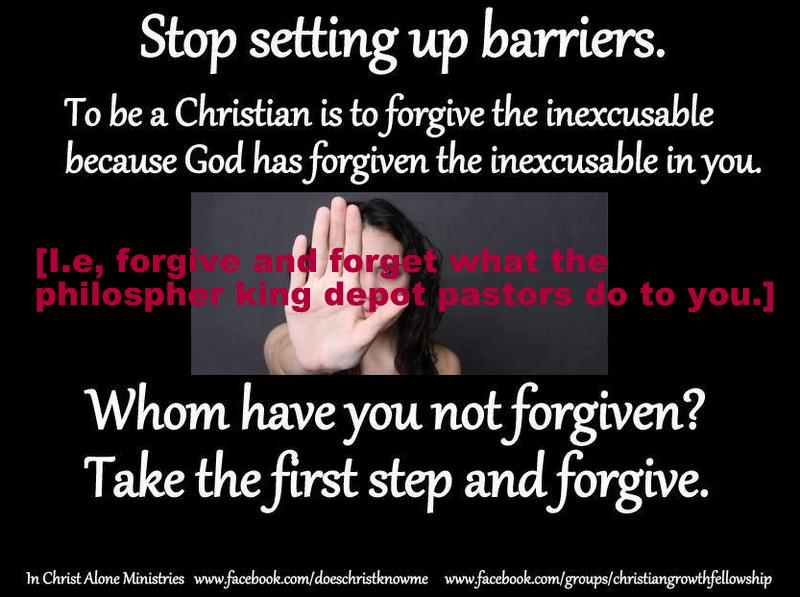
Why? Because they are the philosopher kings. Their higher knowledge leads us through the maze of what’s best for the church as a whole. After all, thousands of souls would be lost without them; so, best that the sexually abused go away quietly for the sake of the bigger picture. And besides, we are all “sinners saved by grace” anyway. In the Platonist vernacular: we are all those who “neither know nor think that [we] know” (Socrates: The Apology).
I’m convinced that the key to getting rid of sexual/spiritual abuse in the church is to totally rethink the organized church that is the breeding ground for the church’s philosopher kings. What is left that is good about the organized church will not stand up against the philosopher kings posing as pastors; so, who needs them?
And let me remind you of who really makes the organized church possible: the producers. I am confident that eventually the producers are going to figure out that they are paying the salaries of those who expect us to offer up our children to the sexual cravings of the philosopher kings.
I have to believe that the whole, “Who are you to judge? Put your money in the plate, buy our books, and keep your mouth shut” routine cannot go on for much longer.
paul
Authentic Calvinism has Always Been Anti-Thinking
 Of course, sanctified Calvinists like Jay Adams have always been pioneers in teaching Christians to think biblically. Adams was also the pioneer in advocating the competence of believers to counsel themselves and others from the Scriptures. Adams’ revolution began in 1970 and included themes that embraced the church’s greatest needs at that time and yet today, such as, “Competent to Counsel,” and “More Than Redemption.”
However, in that same year, Robert Brinsmead and the Australian Forum were systematizing the newly rediscovered Authentic Calvinism that dies a social death every hundred years or so. It dies a social death because it is vehemently opposed to major themes that are critical for the Christian life; namely, among many, competence, and the idea that the Christian life is more than “the gospel.”
Let there be no doubt: these two emerging movements clashed continually, and continue to do so today. The Forum doctrine, Authentic Calvinism, found life at Westminster Seminary in the form of Sonship theology. The father of it was Dr. John “Jack” Miller, and he had two understudies named Tim Keller and David Powlison. Powlison formulated the doctrine into a counseling construct known as “The Dynamics of Biblical Change” which is the foundation for Westminster’s counseling curriculum—otherwise known as CCEF.
Powlison himself, while lecturing at New Calvinist heretic John Piper’s church, stated precisely what the contention is between these two schools of thought:
This might be quite a controversy, but I think it’s worth putting in. Adams had a tendency to make the cross be for conversion. And the Holy Spirit was for sanctification. And actually even came out and attacked my mentor, Jack Miller, my pastor that I’ve been speaking of through the day, for saying that Christians should preach the gospel to themselves. I think Jay was wrong on that. I – it’s one of those places where I read Ephesians. I read Galatians. I read Romans. I read the gospels themselves. I read the Psalms. And the grace of God is just at every turn, and these are written for Christians. I think it’s a place where Jay’s fear of pietism, like his fear of speculation, psychologically actually kept him from tapping into just a rich sense of the vertical dimension. And I think Biblical Counseling as a movement, capital B, capital C, has been on a trajectory where the filling in of some of these neglected parts of the puzzle has led to an approach to counseling that is more mature, more balanced. It’s wiser. It has more continuity with the church historically in its wisest pastoral exemplars.
After the Forum got the ball rolling, Authentic Calvinism, dubbed, “The Centrality of the Objective Gospel Outside of Us,” became Sonship theology, and eventually exploded into the present-day New Calvinist movement. Interestingly enough, in the same lecture, Powlison also articulated further upon another difference in the two schools of thought:
I had an interesting conversation with Jay Adams, probably 20 years ago when I said, why don’t you deal with the inner man? Where’s the conscience? Where’s the desires? Where’s the fears? Where’s the hopes? Why don’t you talk about those organizing, motivating patterns?
And his answer was actually quite interesting. He said, “When I started biblical counseling, I read every book I could from psychologists, liberals, liberal mainline pastoral theologians. There weren’t any conservatives to speak of who talked about counseling. And they all seemed so speculative about the area of motivation. I didn’t want to speculate, and so I didn’t want to say what I wasn’t sure was so.
One thing I knew, obviously there’s things going on inside people. What’s going on inside and what comes out are clearly connected cause it’s a whole person, so I focused on what I could see.”
In other words, Adams insisted on drawing conclusions from what could be observed objectively and is uncomfortable with “helping” people with subjective truth/facts. And Powlison has a problem with that. Why? Because authentic Reformed doctrine contains two ideas that are the mega anti-thesis: the average Christian is not competent, and the Christian life is not more than the gospel. THINKING, and worse yet, objective thinking, is a dangerous stunt that shouldn’t be tried at home by the average parishioner. The parishioner has but two duties: See more Jesus and our own depravity, and follow the spiritually enlightened gospel experts. They are responsible for saving as many totally depraved numbskulls as possible—despite themselves. Their “knowledge” is the latest “breakthroughs” regarding the eternal depths of the “unknowable” gospel because it is the only “objective” source of reality. And reality is deep.
And this is messy business where there is no time to fiddle with totally depraved sheep who think they can know things, and worse yet, figure something out on their own. And of course, the unpardonable sin: critiquing the teachings of the spiritually enlightened with critical thinking. Calvin dealt with such by the sword and burning stake. His New Calvinist children are deprived of such tools, but substitute with character assassination (because what the totally depraved are really guilty of is much worse anyway), bogus church discipline, and the supposed power to bind someone eternally condemned by heavenly authority granted to the spiritually enlightened on earth. Luther himself said of Calvin’s Geneva, “All arguments are settled by sentence of death.”
This brings me to a comment that was posted here on PPT by a reader who uses the handle, “Lydia Seller of Purple.” It was in response to a Calvinist that had the audacity to suggest that Calvinism is an intellectual endeavor meant for the masses. Her superb observations:
Submitted on 2012/07/20 at 3:21 am
“Calvinism appeals to the intellect because the Word of God appeals to the intellect. ”
LOL!!! This is hysterical. Right. Jesus was really impressed with those learned intellectual Pharisees. That sermon on the mount was meant for the intellectual elite of Israel. Kinda embarrassing, Christianity appealed to so many ignorant peasants, too. But you Reformed guys took care of that for us by going along with the state church because they were so much smarter than the ignorant peasants. Yep, they understood the Word better which is why Reformed comes out of the state church tradition. .
“The proper order is intellect, then emotions, then will. Much of so called Christianity appeals to emotions first, then will and never intellect. God made us rational beings for a reason. He wants us to think. When we think properly about God’s truth, our emotions will invariably be affected if we have a heart for God. Such an emotional response will move us to make right choices. Paul put it this way working backwards from the will to the intellect, “You obeyed (the will), from the heart (emotions), that form of doctrine (intellect) unto which you have been handed over.””
But you are totally depraved and unable. That is not rational, Randy. 😮 )
The last paragraph is in quotations, so I assume Lydia uses her last statement to comment on that as being from the same guy, but I have some observations on it either way. The only thing that authentic Calvinists want us to think on is the gospel, and with “redemptive” outcomes only, and “redemptive” applications only. And, the emotions always preceding the will, and controlling it, is right out of John Piper’s Christian Hedonism; ie, gospel intellect (gospel contemplationism), then gospel treasure (delight), resulting in joyful obedience which is really a gospel manifestation or “Christ formation” that doesn’t really come from our actions directly. It is also Michael Horton’s Reformed paradigm of doctrine=gratitude=doxology=obedience. I believe my friend, and church historian John Immel has it right: Christian Hedonism was devised to soften the despair and hopelessness that always follows Authentic Reformed theology (leading to its social death) while maintaining Reformed fatalistic determinism.
Such is an insult on the most loving act of all cosmic history. Christ drew deep from truth to overcome his human emotions in obedience to the cross. He endured for the “joy that was set ahead.” His agony preceded obedience in depths that are incomprehensible. Christian Hedonism mocks the very passion of Christ prior to the cross. Hence, the insistence that the totally depraved sheep ignore common sense in exchange for the “gospel context” is the demand of today’s mystical despot abusers. It is also the major ministry theme of Powlison minion Paul David Tripp; this theme can be seen throughout his Gnostic masterpiece, “How People Change.”
I conclude with another apt observation by Lydia regarding the “Reformation”’s tyranny throughout history:
One has to wonder about the Dutch Reformed tradition that made them think making a fortune in the slave trade was Christian. Same with the Presbyterian trained pro slavery Calvinists who were part of the founding of the SBC. Then you have the Calvinist Boers in South Africa and Apartheid. Of course there were no Calvinist slave owners but history seems to show Calvinists have always thought themselves superior to others.
However, I somewhat disagree with the last sentence about Calvinistic slave owners. “The Reformation Myth” will examine the happy Presbyterian slave advocates of the Confederacy, and how their doctrine was an important part of the Confederate machine. And not to mention the roots of Patriarchy that came from the same era as well.
paul


 Paul's Passing Thoughts
21 comments