How Calvinism Turns Brave Hearts into Cold Hearts
 Originally posted April 29, 2013
I will post a video at the end of this article that elicited the following response from those who posted it on the social network where I watched it:
“Not sure what one could add to or take away from what we have just seen. I am reminded of Matt. 24 when Jesus says that because of lawlessness the hearts of many will grow cold. “Just do it” and laughter throughout the time is just beyond me. Heather was in tears. I wanted to throw up. Beyond disgusting.”
The key to understanding the cold-bloodedness that they observed is in their mention of Matthew 24:12, and the two key words are BECAUSE and LAWLESSNESS. Christ said that “because” of “lawlessness,” love would “grow cold.” The source of this lawlessness is described by Jesus in the previous verse: “many false prophets.”
Now we would do well to examine what Christ meant by the word often translated “lawlessness” and “wickedness” in our English Bibles. These words posit the idea of bad behavior, but that’s not what the actual word that is used by Christ means at all. The word is “anomia.” The “a” is a negative article prefix that means “anti” and “nomia” or nomos, refers to God’s law specifically. The idea of sinful behavior is an entirely different word altogether. Among many used is “hamartia,” or “sin” and these two words are specifically contrasted in 1John 3:4. Sin is defined by any aberration of God’s standard.
In Matthew 24:12, as well as many other passages, an anti-Bible agenda is in view propagated by false prophets.
The world in general becomes cold-hearted by rejecting the law of God written on their hearts and administered by the conscience—either excusing or accusing their actions (ROM 2:15,16). The conscience can eventually be seared if continually violated and ignored (1TIM 4:2). Christians are to keep a clear conscience before God (Acts 24,16 1Peter 3:16, 1TIM 1:5, 3:9, 2TIM 1:3). Keeping a clear conscience before God is obviously behavior focused as judged by the Bible.
One of the monumental misnomers of all time is the idea of “legalism.” This term was formulated by false prophets who really want to steer us away from nomos. Misguided obedience has never been the church’s primary nemesis; it has always been anti-word of God. When the apostle Paul warned those who wanted to be justified by the law, “law,” is in a manner of speaking; Paul was referring to what false teachers purport to be the law, not an actual sincere love for truth and a desire to live by it. This is why James stated that anyone who wanted to be justified by the law had to keep all of it, not a standard of their own choosing (James 2:10). Supposed law-keeping is also often connected to salvation by mere ritual as well. This point cannot be better made than to cite what Paul wrote to the Galatians:
5:2 Look: I, Paul, say to you that if you accept circumcision, Christ will be of no advantage to you. 3 I testify again to every man who accepts circumcision that he is obligated to keep the whole law. 4 You are severed from Christ, you who would be justified by the law; you have fallen away from grace. 5 For through the Spirit, by faith, we ourselves eagerly wait for the hope of righteousness. 6 For in Christ Jesus neither circumcision nor uncircumcision counts for anything, but only faith working through love. 7 You were running well. Who hindered you from obeying the truth? 8 This persuasion is not from him who calls you.
We see here, clearly, that Paul was confronting a belief that being circumcised according to law excused them from a truthful obedience to the law. In other words, justification by law-keeping is ALWAYS a dumbed-down version of the law to make adherence for salvation feasible. Paul contrasts this with true obedience to the law in sanctification:
You were running well. Who hindered you from obeying the truth?
Justification by law-keeping is NEVER an endeavor to obey the truth; it is ALWAYS the replacement of God’s law with the traditions of men—making the law of God “void.” The Pharisees, the supposed poster children for “legalism,” or “living by the law,” were not guilty of trying to obtain salvation by a sincere obedience to the truth, but rather replaced the law of God with their traditions and made that the standard for salvation (which has no law standard to begin with):
Matthew15:1 – Then Pharisees and scribes came to Jesus from Jerusalem and said, 2 “Why do your disciples break the tradition of the elders? For they do not wash their hands when they eat.” 3 He answered them, “And why do you break the commandment of God for the sake of your tradition? 4 For God commanded, ‘Honor your father and your mother,’ and, ‘Whoever reviles father or mother must surely die.’ 5 But you say, ‘If anyone tells his father or his mother, “What you would have gained from me is given to God,” 6 he need not honor his father.’ So for the sake of your tradition you have made void the word of God.
Matthew 23:16 – “Woe to you, blind guides, who say, ‘If anyone swears by the temple, it is nothing, but if anyone swears by the gold of the temple, he is bound by his oath.’ 17 You blind fools! For which is greater, the gold or the temple that has made the gold sacred? 18 And you say, ‘If anyone swears by the altar, it is nothing, but if anyone swears by the gift that is on the altar, he is bound by his oath.’ 19 You blind men! For which is greater, the gift or the altar that makes the gift sacred? 20 So whoever swears by the altar swears by it and by everything on it. 21 And whoever swears by the temple swears by it and by him who dwells in it. 22 And whoever swears by heaven swears by the throne of God and by him who sits upon it. 23 “Woe to you, scribes and Pharisees, hypocrites! For you tithe mint and dill and cumin, and have neglected the weightier matters of the law: justice and mercy and faithfulness. These you ought to have done, without neglecting the others. 24 You blind guides, straining out a gnat and swallowing a camel!
25 “Woe to you, scribes and Pharisees, hypocrites! For you clean the outside of the cup and the plate, but inside they are full of greed and self-indulgence. 26 You blind Pharisee! First clean the inside of the cup and the plate, that the outside also may be clean. 27 “Woe to you, scribes and Pharisees, hypocrites! For you are like whitewashed tombs, which outwardly appear beautiful, but within are full of dead people’s bones and all uncleanness. 28 So you also outwardly appear righteous to others, but within you are full of hypocrisy and lawlessness.
And what were the Pharisees full of “within”? “[L]awlessness” which is the word “anomia.” The English translation is “anti-law” or “antinomianism.” That’s what the Pharisees were full of within—not “legalism” which is a concept not found in the Bible anywhere by idea or word. There is obedience to truth or anti-truth—no in-between.
“Legalism” fosters the idea that Christians can unwittingly try to please God by obeying the truth as a way to earn their justification. The idea was hatched by the Reformers and is a Neo-Calvinist doctrinal mainstay in our day. The favorite illustration is the Pharisees who supposedly were really, really good at keeping the law and obeying the Bible in an attempt to earn their justification. This is a ploy to create confusion in regard to the law’s relationship to justification and sanctification. The Reformers created immense fear among Christians by making the law’s relationship to justification the same as sanctification. In justification, law has no jurisdiction in regard to the Christian. The Christian is transformed from a status where the law is the standard to be justified (and impossible) to a status where the law informs our sanctification totally separate from justification. So, the law is a standard for sanctification, but in regard to the Christian, the law no longer has jurisdiction over his/her salvation. In Calvinism, the law remains a standard for justification IN salvation that must be maintained until the final judgment.
Because man is created to do works, this makes sanctification very tricky with our eternal destiny hanging in the balance. Calvinists therefore assure Christians that if they live their Christian lives by faith alone—they are playing it safe. As one New Calvinist told me: “If I let Jesus do all the work, He can’t fault me for anything when I stand before Him.” Of course, living in a way that imputes the works of Christ to our Christian walk is very complicated, but be assured: New Calvinists will teach us how to “practice obedient faith” so we can arrive at the final judgment covered by “what Jesus has done, not anything we do”….in our Christian walk. This confounding of the law’s relationship to justification and sanctification makes the Christian walk a minefield with constant danger of “making sanctification the ground of our justification.” We must therefore seek out the Reformed for their secret formula for living the Christian life by faith alone. “Sola Fide” is for justification and sanctification both—that’s the dirty little secret. The Reformed couch the language in terms like “obedient faith.” The Reformers saw faith as a neutral conduit that God uses to impute the perpetual works of Christ to the believer. In other words, Christ’s atoning work is not yet finished for salvation: though accomplished in one period of time, it must be continually appropriated to maintain our just standing. The maintenance of our salvation is in view. Hence, we must “preach the gospel to ourselves every day.”
But this brings us from fearful hearts to cold hearts. Reformed theology will heap its share of cold-hearted mentality on humanity “because of anomia.” It’s just more anomia dressed in religious garb. This brings my point back to the video that was posted. It is cold-heartedness on steroids regarding the abortion issue. Therefore, the following should make perfect sense to us:
According to the National Right to Life, the total number of abortions in the US is down-33% from its peak in 1980/81- and the greatest decrease is among adolescent girls and young women. Good News!
But if we look further into these statistics, we find disconcerting news for the Church: The abortion rates among professing Christians are commensurate with the rest of the population!
Approx. 560,000 for Protestants (43%)
Approx. 350,000 per year for Catholics (27%)
13% of abortions (approx. 170,000 per year) are performed on self-described “Born Again” or Evangelical Christians (Alan Guttmacher Institute and Physicians for Reproductive Choice, “An Overview of Abortion in the United States,” 2003 and 2008)
Even more disturbing is the fact that these percentages have NOT dropped, even though the number of abortions have in recent years!
These statistics reveal that actually MORE women who profess Christianity are having abortions.
This is what Reformed theology has always done to society. Despite the traditions of men that claim otherwise, the Reformation did not bring light to darkness, it brought more darkness. Post Reformation brought little more than chaos and turmoil to Europe—more than it had ever seen before. It brought tyranny to America in the form of the Salem witch trials, and its contemporary resurgence has resulted in an unprecedented level of abuses in the American church.
It is the epitome of a primary concern of Christ during His ministry: the replacement of the law by the traditions of men resulting in anomia. While waxing eloquent about the Pharisees, Neo-Calvinism is in fact a return to what plagued the apostolic church. To say that Calvinists vaunt the opinions of a litany of past Reformers as authority is an understatement of the most dramatic sort. Even Charles Spurgeon, “the prince of preachers” did little more than regurgitate Reformed tradition. Recently, one Reformed conference was based on the writings of twenty-five Reformed icons. The popular Resolved conferences hosted by John MacArthur highlighted the traditional teachings and legacies of Reformed men of years gone by.
With all of the harping about the Pharisees by Calvinists—they are the Pharisees, and they propagate the same kind of cold-heartedness with it.
Their heart is unfeeling like fat, but I delight in your law.
~Psalm 119:70
paul
A Doctrinal Evaluation of the Anti-Lordship Salvation Movement: Part 2
Originally published August 14, 2014
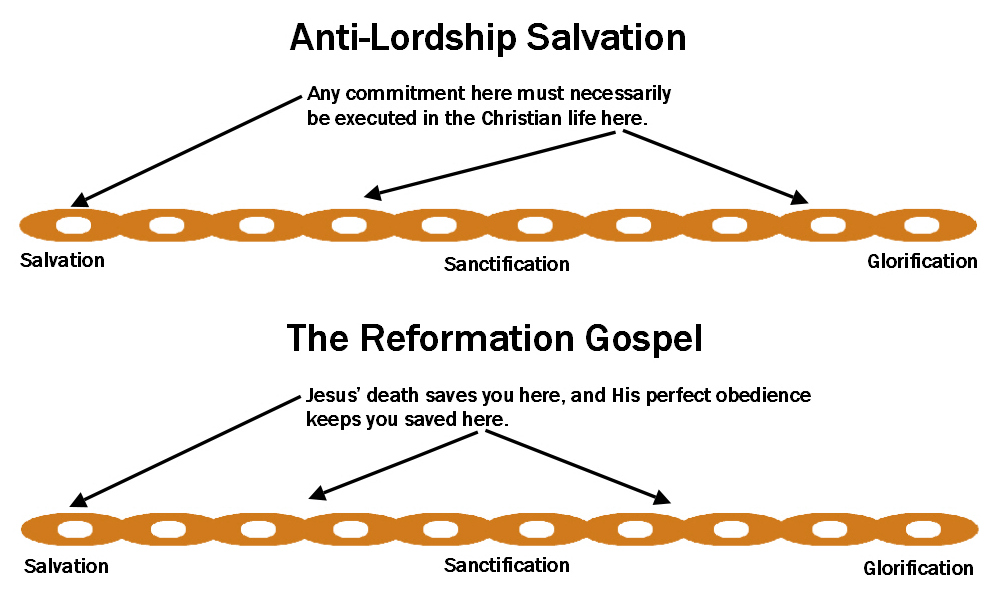
The root of all controversy: the golden chain of salvation.
Before we start part 2, we have a little unfinished business from part 1. The astute observer will ask, “If Jay Adams had the right idea about sanctification while misunderstanding what Calvin really believed, what of his biblical counseling movement that moved from mere generalities to the finer points of Christian living?” Answer: it WAS a revival…probably the only real revival the church has seen since the previous focus on practical application of the Scriptures versus redemptive focus/meditation. And when was that? I have no idea.
You remember my mention of the John “Jack” Miller disciple David Powlison. He started a contra biblical counseling movement against the Jay Adams movement. This is often referred to as first generation biblical counseling versus second generation biblical counseling. The second generation effectively wiped out the first. The crux of that civil war is relevant to this study. One model sees salvation and sanctification as separate. Salvation is completely vertical, but sanctification is mostly horizontal. Jay Adams argued in his aforementioned book against Sonship theology that the source of power in the Christian life is not salvation, but regeneration. In other words, justification is a finished work and a static declaration while the Christian life flows from the “quickening” of the new birth. We don’t return to the cross for power in the Christian life, we learn and obey the Spirit’s instrument for changing us, the law of the Spirit of life. What Adams didn’t realize is that this whole idea of life coming from a perpetual revisitation of our justification is in fact authentic Reformed dogma (see the Calvin Institutes 3.14.9-11).
Every Christian controversy from the Reformation till the present finds its roots in the golden chain. Reformed pastors wax eloquent in regard to who builds the links in the chain between justification and glorification: it’s either us, or the Holy Spirit using “what Jesus has done, not anything we do.”
From the latter 40’s to 1970, the first gospel wave (Billy Graham et al) ruled the Christian scene via EB. Cogous pushed back with a vengeance from 1970 till the present with the second gospel wave. The first wave saw a commitment to obedience as synonymous with keeping yourself saved because of the golden chain idea. To say that they overemphasized the gospel would be a gargantuan understatement. Obviously, they saw a commitment to obedience as transposed upon the Christian life. The second gospel wave demanded a commitment, and recognition of Christ as Lord, but also demanded a life of faith alone to keep the law satisfied with Christ’s perfect obedience. Again, the ALS camp misunderstands the Reformed on this point. Both camps hold to sanctification by faith alone. This is the very idea that James rudely pushed back against in his epistle.
The issue made simple: Romans 8:30.
In Romans 8:30 we read the following:
And those whom he predestined he also called, and those whom he called he also justified, and those whom he justified he also glorified.
Notice that sanctification is missing from this verse even though the context spans the beginning of our salvation to our resurrection. This is the distinction between all golden chain gospels and the real gospel, the kingdom gospel. Jesus came preaching the “gospel of the kingdom.” Hereafter, KG. The golden chain gospel says that sanctification is missing from this verse because justification and sanctification are the same thing. The KG says that sanctification is missing from this verse because justification and sanctification are mutually exclusive. The context is assurance of salvation (see verses 31ff.).
Curiously, the golden chain gospel which includes both ALS and LS/Calvinism, teaches us to remind ourselves of God’s grace alone regardless of anything we do. If our behavior brings doubt, this is evidence of a fundamental misunderstanding of God’s grace and we should therefore remind ourselves of such. ALS says that concern over behavior suggests that you believe behavior finishes justification and not grace alone. With the KG, that consideration is not even on the radar screen because justification and sanctification are completely separate; finishing a finished work is impossible. You can’t have that mentality if you understand it to be an impossible reality. I might also add that simply returning to the same gospel that saved us to cure a troubled conscience instead of changing behavior sears the consequence over time. This is ill advised.
In other words, the KG says it is impossible to unwittingly attempt to please God to gain justification because that work is finished. One is free to aggressively obey God without any fear that they are unwittingly attempting to earn their justification. ALS and LS/Calvinism do not have this convenience because justification is both finished and not finished. The Reformed, already, but not yet construct that relates to predestination cannot be discussed here for lack of room and fear of confusion, but suffice to say for this study that the convenience is not there for either ALS or LS because justification is not finished. You must continue to remind yourself of free grace because you are in a continuum where unwitting works salvation can take place, and the only solution is to disavow good behavior as an evidence of conversion. Obedience must be completely optional. This used to be criticized as “Let go and let God” theology. According to the KG, such a continuum is impossible and not reality.
Consider some dialogue I have had recently with ALS proponents:
Paul, While you ponder my answer, I’d like to ask you, if you’d identify what you believe you must do, before, during and after, in order to be given eternal life. Thank you, In Him, Holly
“Before, during, and after”? to… “be given eternal life.”? The implied answer is: nothing in justification; nothing in sanctification; and nothing in glorification. But again “during” shouldn’t even be deemed possible.
LS in Cogous form already states that perpetual double imputation is needed, so bad behavior is actually a good thing because it “shows forth the gospel.” In contrast, advocates of the KG are concerned with evidence of the new birth, not the overcoming of a propensity to misunderstand the grace of God because all doing in the Christian life is attached to justification somehow. Advocates of the KG understand that nothing they do in the Christian life has anything at all to do with justification. Much assurance comes from that. However, lazy discipleship forfeits assurance because it violates the conscience, and judgment begins in the household of God regarding consequences for bad behavior in this life. The fear generated from that can get confused with fear of eternal judgment.
But don’t miss my main point here: the solution for a lack of assurance in both ALS and LS are the same: preach the gospel to yourself. Remind yourself that works done by us are completely irrelevant to our salvation which also includes sanctification (the Christian life). Both camps woefully devalue the new birth and its expectations. In effect, we have no righteousness and obedience is not really performed by us, but performed by the Holy Spirit if we are “abiding” in Christ. This is a passive sanctification of our works in sanctification in order to categorize them as living by faith alone. ANY work we do is accredited to the justification process, so it must be sanctified by the right process. In the final analysis, Christians must only EXPERIENCE an obedience imputed to us by Christ. Citations by the Reformed abound, and I can cite one from the aforementioned conversation with advocates of ALS:
We can have righteousness of our own, that is self-righteousness. I didn’t notice, did you answer any of the questions? Do you sin? How much? Or not? Are you sinless?
Park on the fact that both camps assert that the Christian has no righteousness. To have any righteousness is a “righteousness of our own.” It’s either ALL us or ALL Christ. Therefore, we can only EXPERIENCE righteousness imputed to us, but it really isn’t us performing it; hence, in relationship to the same conversation:
This passage has nothing to do with becoming saved or providing evidence through our works that we are saved. The passage is about living experientially in a manner that is consistent with our position on [sic] Christ.
Notice that the Christian lives “experientially” according to “our position [i]n Christ.” In other words, Christians only experience their position, they don’t actually perform obedience themselves. In addition, when talking to either camp, one is challenged with the question, “Did you sin today?” And in both cases, when you qualify the question with, “In justification or sanctification?”…without exception they are thrown for a loop. Why? Because they see sin in justification as no different than sin in sanctification—that’s why they ask the question in the first place. If you believe the Christian is personally righteous as well as positionally righteous, you are immediately challenged by both camps with, “Did you sin today?” Why? Because the same assumption is that righteousness and sin are mutually exclusive. For the world, this is true, but not for Christians.
Another fact of the Reformation gospel is “righteousness” is defined as a perfect keeping of the law. To remove the law’s perfect standard, and its demands for perfection from justification is the very definition of antinomianism according to the Reformers. A perfect law keeping must be maintained for each believer if they are to remain justification.
If you remember, this is a direct quote from part one. ALS and LS/Calvinism both define righteousness by perfect law keeping. Again, why the air of profundity in the terse rhetorical question designed to end the argument on the spot by coup de grace? The very essence of the question reveals a profound misunderstanding of law and grace.
Let’s get a little more full circle now with part one. Because the Christian, according to both camps, cannot be righteous if he/she sins even once (“Do you sin? How much? Or not? Are you sinless?”), the good old Reformed mainstay of double imputation is needed for both of these applications of the same golden chain gospel. From part one:
Thirdly, this requires what is known as double imputation. Christ not only died for our sins so that our sins could be imputed to Him, He lived a life of perfect obedience to the law so that His obedience could be imputed to our sanctification.
The windsock of double imputation is the idea that the righteousness of Christ is imputed to our sanctification. He died for our justification, and His perfect obedience to the law was imputed to our sanctification to keep justification rolling forward:
Model A asserts that since we cannot keep the law perfectly, we must invoke the double imputation of Christ by faith alone in order to be saved and stay saved (part 1).
Now let’s look again at the same recent conversation with ALS proponents:
Thanks Mark, I agree. We are qualified as saints, because of Christ’s righteousness imputed to us, but we still sin,..
Therefore, we only “qualify” as saints because we still sin, in order to keep our sainthood the righteousness of Christ must be imputed to us daily. Yes, that would be daily salvation. In the quote immediately prior, “Holly” was responding to this statement:
Hope you don’t mind me adding a thought, I think Paul is saying we were sinners but we are now saints (forgive me if I am wrong), it is true of course that we are saints but I believe it is also still true that we are sinners saved by grace because the Apostle Paul said, “Christ Jesus came into the world to save sinners; of whom I am chief”, present tense.
So, if Christians are still sinners, because we sin, and Christ came to save sinners, it would only make since that our need for salvation is still ongoing. Direct citations that agree with that point by John Calvin and Martin Luther is abundant low hanging fruit, but granted, such statements from the ALS camp are somewhat surprising. To further the point, I might add that “Holly” referred me to a message taught by a notable figure in the ALS movement who interpreted Romans 7:24 as a daily salvation. This is a very common rendering of that verse by the Reformed as well. The verse obviously refers to the redemption of the body and not a daily salvation.
Both are guilty of the same thing: a false double imputation construct must be applied to the Christian life by faith alone and the subjective experience thereof is optional. Like ALS—like Calvinism.
What is wrong with this gospel?
The golden chain gospel misrepresents the Trinity. The Father is removed from His role in salvation because it is His righteousness imputed to the believer before the foundation of the world. According to Romans 8:30, this guarantees glorification. The Holy Spirit is also misrepresented in regard to His role in salvation. His setting us apart before the foundation of the world is confused with His work in regeneration. Christ’s role is redefined beyond His death for our sins as a onetime act that ended sin. This is not a covering—it’s an ending. Even though the Reformed and ALS both concur that Christ died once, His death is perpetually reapplied to sins we commit as Christians when there is no such need. Neither is there a need to impute Christ’s righteousness to us perpetually. At the Bema event, it will not be God the Father looking at us and only seeing Jesus, it will be Jesus Himself judging His righteous followers. He will not be judging His own righteousness. The golden chain gospel is an egregious distortion of the Trinity.
True double imputation is our sins being imputed to Christ, and the Father’s righteousness imputed to us apart from the law. Christ came to end the law. It is because of this, and the new birth, that we are truly righteous in and of ourselves, but of course not apart from God’s power and plan of salvation. We have God’s seed in us, are no longer under any law that can judge us, and are able to please God with our lives. We are new creatures who are sinless according to justification because even if the old us that died with Christ was exhumed and brought into court, there would be no law to condemn us.
This gospel not only distorts the Trinity, rejects the new birth, and distorts double imputation, it misrepresents sonship. The sins we commit as a family member are considered to be sin against justification: “Did you sin today?” Again, if you ask them, “Sin in justification or sanctification?” all you will here is crickets, or the babblings of confused narcissists.
The golden chain gospel also strips the Christian of ability to love Christ and others by keeping Christians under the law of sin and death that Christ came to end. Said gospel makes that law the standard for righteousness. However, there is no law standard in justification, it is APART from any law—it is God’s righteousness imputed to us. Those under grace serve the law of the Spirit of life which is fulfilled by loving Christ and others:
“If you love me, keep my commandments.”
It is impossible to love Christ by keeping the law of sin and death. Besides, that law is ended when we believe. All of our sins committed before faith were against that law and in essence imputed to it. Before we were saved, we were enslaved to that law and it provoked us to sin. Consider two spouses: we were the spouse that was under the law of sin and death until we died with Christ, now we are free to serve another. Sins we now commit are against family relationship, not sins that fall short of the law of sin and death.
Said gospel prevents us from making a commitment to God’s kingdom because the commitment would have to be executed perfectly in kingdom living to maintain our citizenship. Said gospel demands that we only recognize Christ in a one-way relation while ignoring His kingdom, its law, and the king. Yea, we can only accept Him as savior in a one-way relationship. This assumes that a decision to flee the present kingdom of darkness for the kingdom of light cannot be a commitment totally separate from the kingdom citizenship. If we make a commitment, the commitment must be executed perfectly in order to remain a citizen. No, the commitment is totally separate from our citizenship in the same way justification is totally separate from sanctification.
I realize that only repentance was emphasized to the Jews, but they were already saturated with the concept of God’s kingdom. From the beginning, Abraham looked for a city built by God. As we see Gentiles coming into the church, they must be brought up to speed on their new Jewishness. We should read the Bible with this in mind and the way it affected the presentation of the gospel, and the very definition of the word “gospel” itself.
The golden chain gospel rejects the new birth by ignoring the difference in slavery between two different laws: the law of sin and death that will condemn the world, and the law of the kingdom; the law of the Spirit of life. It makes the law of the Spirit of life a fulfilment of the law of sin and death that is in fact ended. In essence we remain enslaved to a law of condemnation as “sinners.” This is a rejection of the new birth.
It also adds another seed to the covenant of promise. If the law of sin and death could impart life, it would be a second seed from which life would come to the world. It doesn’t matter who obeys it, it cannot impart life.
The golden chain gospel distorts the Trinity, distorts double imputation, misrepresents sonship, strips the Christian of ability to love Christ and others, rejects a biblical definition of the new birth, keeps Christians under the law of sin and death, distorts the atonement, perpetually reapplies the death of Christ to salvation, replaces the righteousness of God with a law standard, propagates a one-way relationship with God, makes sin as a kingdom citizen the same as condemning sin, enslaves us as a spouse still under the law of sin and death, calls for us to accept Christ as savior in a one-way relationship while ignoring His Lordship.
Do Christians have two natures? This will be examined in part 3.
paul
Calvinist Catholicism, Denial of Sanctification, Denial of the New Birth, and Distortion of the Trinity Through “Emphasis”
Originally published January 3, 2013
“Those of Reformed theology are not under grace. How do we know that? Because they say Christians are still under the dominion of sin. And plainly, according to the Bible, that equals being under the law and not under grace.”
The mystery of why sanctification is so anemic today is no longer a mystery. Traditionally, this has been the case for a long time in the Western church because the fathers of the Reformation discounted sanctification all together. Sure, they used the term, but it was disingenuous then, and continues to be such with those who use the term today. Weak sanctification leads to very unexciting lives which are no incentive to share the “new life” with others. We share what we are excited about, and being no better than what we were before our “conversion” is neither good news nor worth sharing. It seems the only thing we have to share is, “We are more humble than you because we know that we are empty vessels waiting to be filled and maybe the Lord will fill us and maybe he won’t.” Such a message just doesn’t set the world on fire.
The more I learn, the more I am convinced that there is really no difference between Catholicism and Protestantism: both are “under the law.” One is Jesus plus ritual to complete your justification and the other is Jesus plus making sure you do nothing in your sanctification to complete your justification (because the “just” shall live by faith [ALONE]). And in both cases, being faithful to the authority of the church secures your salvation. Calvin believed that we stay saved through daily repentance for daily salvation, and that forgiveness can only be found in Reformed churches:
Secondly, this passage shows that the gratuitous pardon of sins is given us not only once, but that it is a benefit perpetually residing in the Church, and daily offered to the faithful. For the Apostle here addresses the faithful; as doubtless no man has ever been, nor ever will be, who can otherwise please God, since all are guilty before him; for however strong a desire there may be in us of acting rightly, we always go haltingly to God. Yet what is half done obtains no approval with God. In the meantime, by new sins we continually separate ourselves, as far as we can, from the grace of God. Thus it is, that all the saints have need of the daily forgiveness of sins; for this alone keeps us in the family of God” (Calvin’s Commentaries, Vol. 45: Catholic Epistles).
And, Calvin’s homeboy, Luther, believed that Reformed elders have the authority to forgive sins:
Confession consists of two parts. One is that we confess our sins. The other is that we receive the absolution, that is, forgiveness, from the pastor as from God himself and by no means doubt but firmly believe that our sins are thereby forgiven before God in heaven (Timothy J. Wengert: A Contemporary Translation of Luther’s Small Catechism; Augsburg Fortress PUB 1994, p.49).
And on page 35….
Daily in this Christian church the Holy Spirit abundantly forgives all sins—mine and those of all believers. On the last day the Holy Spirit will raise me and all the dead and will give me and all believers in Christ eternal life.
The granting of eternal life is future, and is based on faithfulness to the established church. Look, I have been a pastor long enough to know that many Baptists associate their salvation with church membership. I have suggested cleaning up the roles in a few churches, and the response is always one that hints of this being synonymous with taking away one’s salvation. Where did they get that idea? Whether Catholic or Protestant, you can get your absolution in a booth or an alter call—there is no difference.
Calvinism, and the Reformed gospel in general, is “under the law.” In the Scriptures, being under the law equals being under the dominion of sin:
Romans 6:14—For sin will have no dominion over you, since you are not under law but under grace.
Romans 2:12—For all who have sinned without the law will also perish without the law, and all who have sinned under the law will be judged by the law.
Romans 2:15—For the law brings wrath, but where there is no law there is no transgression.
Those of Reformed theology are not under grace. How do we know that? Because they say Christians are still under the dominion of sin. And plainly, according to the Bible, that equals being under the law and not under grace. Quotes from the Reformed that establish this are myriad, I will note one:
We are enemies of God. We are God ignoring. We are God defying. We hate God. (CJ Mahaney: Resolved Conference 2008).
Comments by Reformed pastor Matt Chandler speaking of Christians as being “wicked sinners” have apparently been scrubbed from the internet (see here, and here), but nonetheless are indicative of the Reformed position.
This simply equals nothing less than, from the biblical perspective, Christians remaining in an unregenerate state though they call it regeneration. And this, they in fact do:
Bavinck too, wrote in connection with the regenerating work of the Spirit: “The regenerate man is no whit different in substance from what He was before his regeneration” (G. C. Berkouwer: Faith and Sanctification, p. 87).
Unchanging regeneration: such oxymorons are not few in Reformed writings. And though they would deny it, sanctification and the new birth are rejected as a matter logical conclusion. There can be no sanctification or new creaturehood where we are still under the bondage and dominion of sin. This is antithetical to being under grace. The Reformed think tank that launched the present-day New Calvinist movement which is a resurgence of authentic Calvinism, wrote an article in their theological journal entitled, “The False Gospel of the New Birth.” The article can be read here.
The argument that is used is one of emphasis which is Gnostic epistemology: sure, stars are true, but they only shine because of the Sun. Sure, shadows are true, but they wouldn’t exist without the Sun either. Sure, flowers are true, but they wouldn’t be able to grow without the Sun as well. What we want to do is focus on what really gives life: the Sun. To emphasize stars, shadows, or flowers over the thing that actually supplies the life will diminish life to whatever degree that the “good thing” is emphasized over the “best thing.”

Beginning to get the picture? It enables them to acknowledge the truth of sanctification and the new birth while deemphasizing them into oblivion. Out of sight; out of mind. To say that the new birth and our ability in sanctification are deemphasized in today’s church is certainly an understatement.
Said think tank, The Australian Forum, used the same argument to emphasize Christ over the Father and the Holy Spirit as well. Christocentricity is very important to Reformed theology. The core four of this think tank was Geoffrey Paxton, Jon Zens, Graeme Goldsworthy, and Robert Brinsmead. In a book where Paxton documents the Reformed heritage of Seventh-Day Adventism, he stated the following:
Luther and Calvin did not simply stress Christ alone over against the Roman Catholic emphasis on works-righteousness. The Reformers also stressed Christ alone over against all—be they Roman Catholics or Protestants (29) — who would point to the inside of the believer as the place where justifying righteousness dwells. Christ alone means literally Christ alone, and not the believer. And for that matter, it does not even mean any other member of the Trinity! (The Shaking of Adventism: p. 41).
Likewise, the same argument is made in regard to sanctification:
The distinction between the two types of righteousness will make the final emphasis of the Reformation easier to understand. The Reformers contended that the believer is righteous in this life only by faith. In saying this, they were not denying either the necessity or the reality of sanctification in all true believers. Rather, they were asserting that in this life sanctification is never good enough to stand in the judgment. The believer must look only to the righteousness of faith (the righteousness of the God-man) for his acceptance with God.
The inadequacy of sanctificational renewal was an integral part of Reformation teaching. Its corollary was the Reformers’ steadfast gaze at the righteousness of faith—namely, the doing and dying of the God-man, Jesus of Nazareth. Though the believer fights against sin and seeks to be a faithful law-keeper, sin nevertheless remains until his dying day Luther put it forcefully:
Paul, good man that he was, longed to be without sin, but to it he was chained. I too, in common with many others, long to stand outside it, but this cannot be. We belch forth the vapours of sin; we fall into it, rise up again, buffet and torment ourselves night and day; but, since we are confined in this flesh, since we have to bear about with us everywhere this stinking sack, we cannot rid ourselves completely of it, or even knock it senseless. We make vigorous attempts to do so, but the old Adam retains his power until he is deposited in the grave. The Kingdom of God is a foreign country, so foreign that even the saints must pray: ‘Almighty God, I acknowledge my sin unto thee. Reckon not unto me my guiltiness, O Lord.’ There is no sinless Christian. If thou chancest upon such a man, he is no Christian, but an anti-Christ. Sin stands in the midst of the Kingdom of Christ, and wherever the Kingdom is, there is sin; for Christ has set sin in the House of David.
(Ibid pp. 46,47).
Hence, at least Reformed theology is consistent in regard to Christians being under the law and also still under sin’s dominion. We must live by faith alone because we will supposedly stand in a future judgment that will determine righteousness by a perfect keeping of the law. And it’s true, those under the law will stand in such a judgment. But will we? The heart of the Reformation posited the idea that if we live by faith alone in sanctification, Christ will stand in the judgment for us.
But we know well what James thought of sanctification by faith alone.
paul
The “Cross Story” and Sanctified Rape in the Church
Originally published January 21, 2013
“Be sure of it: this is how Calvinists think; this is their worldview.”
“Don’t misunderstand: the problem of ‘victim mentality’ is not even on the radar screen — they have removed the word “victim” from their metaphysical dictionary.”
“Justice necessarily implies victim. Victim necessarily implies worth. All three are conspirators with the glory story.”
Martin Luther had more on his mind than silly Popes when he nailed his 95 Theses to the front door of All Saints’ Church in Wittenberg, Germany. That protest launched the Reformation, but six months later Luther presented the systematic theology of the Reformation to the Augustinian Order in Heidelberg. Luther’s Heidelberg Disputation laid the foundation, and John Calvin later articulated and applied its basic principles to the full spectrum of life in his Institutes of the Christian Religion.
The Cross Story and the Glory Story
Luther’s cross story, or theology of the cross is the crux of the Heidelberg Disputation and introduced in the first sentence of the Calvin Institutes:
Our wisdom, insofar as it ought to be deemed true and solid wisdom, consists almost entirely of two parts: the knowledge of God and of ourselves.
That’s Luther’s theology of the cross: a deeper and deeper knowledge of our putrid humanity as set against God’s holiness. And NOTHING in-between. All of creation, all events, and all reality contribute to deeper knowledge of one of these two, and then both as a deeper knowledge of each gives more understanding to the other; knowledge of both, and the experience of both. Hence, every blessing, including our good works which are done by the Holy Spirit to begin with, lends more understanding of God’s glory. Every evil event, sin, and tragedy lends deeper understanding in regard to our total depravity and worthlessness. But of course your mother is dying of cancer; I am amazed that God would give anyone as many years as He has given her. Who are we to think we deserve even one year of life? And what a wonderful opportunity for her to suffer the way Jesus suffered for us!
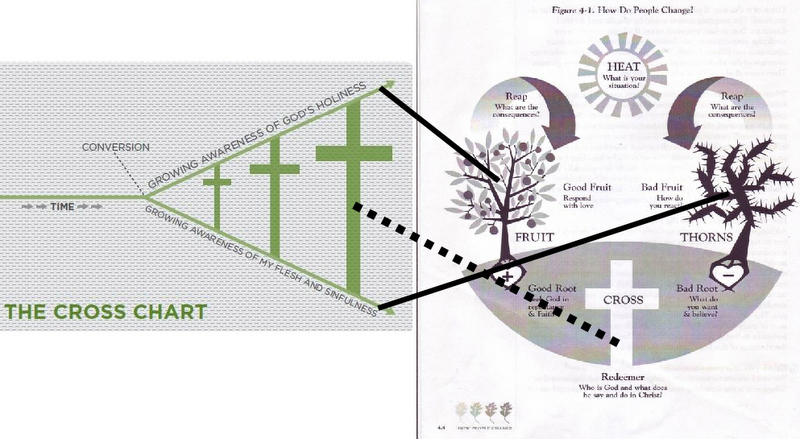
This is the cross story. See the illustration below. This is a contemporary depiction from that camp—this is their assessment:

Anything else at all that gives any credit to humanity—Christian or non-Christian is the “glory story.” That would be our glory specifically, and not Christ’s. To the degree that humanity is considered, the glory of Christ is “ECLIPSED.” This is the theses of a book written by John MacArthur associate Rick Holland: Uneclipsing The Son. Everything is perceived as speaking through one of these two perspectives. ANYTHING coming from what is perceived as the “glory story” is summarily dismissed. Be sure of it: this is how Calvinists think. This is their worldview.
In one of the former Resolved Conferences sponsored by John MacArthur and Holland, in one of his messages, Holland extols a letter written to Puritan Christopher Love by his wife as he awaited execution. Holland forgot to mention to those listening that Love was executed for espionage against the English government while letting the audience assume he was executed for loftier spiritual-like reasons. The following is excerpts from the letter:
O that the Lord would keep thee from having one troubled thought for thy relations. I desire freely to give thee up into thy Father’s hands, and not only look upon it as a crown of glory for thee to die for Christ, but as an honor to me that I should have a husband to leave for Christ…. I dare not speak to thee, nor have a thought within my own heart of my own unspeakable loss, but wholly keep my eye fixed upon thy inexpressible and inconceivable gain. Thou leavest but a sinful, mortal wife to be everlastingly married to the Lord of glory…. Thou dost but leave earth for heaven and changest a prison for a palace. And if natural affections should begin to arise, I hope that the spirit of grace that is within thee will quell them, knowing that all things here below are but dung and dross in comparison of those things that are above. I know thou keepest thine eye fixed on the hope of glory, which makes thy feet trample on the loss of earth.
Justice? That implies that humanity has some sort of value. That implies that life itself has some sort of value. That implies that humanity should be protected through threat of punishment. That’s the glory story. Therefore, Calvin stated the following:
Those who, as in the presence of God, inquire seriously into the true standard of righteousness, will certainly find that all the works of men, if estimated by their own worth, are nothing but vileness and pollution, that what is commonly deemed justice is with God mere iniquity; what is deemed integrity is pollution; what is deemed glory is ignominy (CI 3.12.4).
Death by Biblical Counseling
The church must face up to a sobering reality in our day. The vast majority of biblical counseling that goes on in our day is based on this construct—you will be counseled from the perspective of the cross story, and anything that smacks of the glory story will be snubbed. You are not a victim. There is no such thing as a victim. Christ was the only true victim in all of history. Don’t misunderstand: the problem of “victim mentality” is not even on the radar screen—they have removed the word “victim” from their metaphysical dictionary. “Victim” is part of the glory story; Christ as the only victim is the cross story. I am not a victim. That’s impossible because my sin nailed Christ to the cross. Thank you oh Lord that I was raped. Thank you for this opportunity to suffer for you. Thank you for the strength to forgive the one who raped me in the same way you forgave me. What a wonderful opportunity to show forth your gospel!
Hence, when the leaders of a Reformed church came to inform parents that a young man in that church had molested their toddler, this was the opening statement:
Today, we have before us an opportunity to forgive.
The parents were then counseled to not contact the authorities. Those who do are often brought up on church discipline. Justice necessarily implies victim. Victim necessarily implies worth. All three are conspirators with the glory story. And be not deceived: this is the logic that drives Reformed organizations that are supposed to be mediators in the church; specifically, Peacemaker Ministries and G.R.A.C.E. A major player in the Biblical Counseling Movement is Paul David Tripp. In 2006, he wrote a book that articulates the horizontal application of Luther’s theology of the cross: “How people Change.” Of course, the title is a lie; if he really believed people change, that would be the glory story. Notice also that it is, “How People Change” and not, “How Christians Change.” That’s because this bunch see no difference in the transforming power of the new birth and ordinary Christ-rejecting people.
In the book, Tripp, like all who propagate Luther’s theology of the cross, posits the Bible as a “big picture” narrative of our redemptive life. The Bible is a mere tool for one thing only: leading us more and more into the cross story and away from the glory story. This is accomplished by using the Bible to enter into the cross narrative and thereby seeing our preordained part in the “big picture” narrative of redemptive history. Though Tripp is not forthright about it in the book, this is known as the Redemptive Historical Hermeneutic. By seeing our life through the cross story, we are empowered to live life for God’s glory. This is done by seeing ALL circumstances in life (Heat) as preordained in order to show our sinfulness (Thorns) and God’s goodness (Fruit) for the purposes of having a deeper understanding of both resulting in spiritual wellbeing. In other words, all of life’s circumstances are designed to give us a deeper understanding of the cross story: God’s holiness, and our sinfulness. I have taken his primary visual illustration from the book and drawn lines to the cross story illustration to demonstrate the relationship (click on image to enlarge):
Understanding this lends insight to Tripp citations on the Peacekeepers Ministries website:
Paul Trip wrote a great post over at The Gospel Coalition blog all about the need for pastors to pursue a culture of forgiveness in their ministry. Pastors (and anyone serving Christ) have a choice:
“You can choose for disappointment to become distance, for affection to become dislike, and for a ministry partnership to morph into a search for an escape. You can taste the sad harvest of relational détente that so many church staffs live in, or you can plant better seeds and celebrate a much better harvest. The harvest of forgiveness, rooted in God’s forgiveness of you, is the kind of ministry relationship everyone wants.”
Then he describes three ways forgiveness can shape your ministry. I’ve listed them, but you can read how he explains them in detail.
“1. Forgiveness stimulates appreciation and affection.
2. Forgiveness produces patience.
3. Forgiveness is the fertile soil in which unity in relationships grows.”
He closes with this exhortation:
“So we learn to make war, but no longer with one another. Together we battle the one Enemy who is after us and our ministries. As we do this, we all become thankful that grace has freed us from the war with one another that we used to be so good at making.”
And concerning another author, they also stated:
Last week, Steve Cornell at The Gospel Coalition blog posted some really great insight into the difference between forgiveness and reconciliation. They also offered up some excellent and biblically sound steps in dealing with a situation where an offending party is hesitant to reconcile.
Here he summarizes a key distinction:
“It’s possible to forgive someone without offering immediate reconciliation. It’s possible for forgiveness to occur in the context of one’s relationship with God apart from contact with her offender. But reconciliation is focused on restoring broken relationships. And where trust is deeply broken, restoration is a process—sometimes, a lengthy one”…. His ten guidelines for those hesitant to reconcile are rooted in scripture and, I think, incredibly helpful.
1. Be honest about your motives.
2. Be humble in your attitude.
3. Be prayerful about the one who hurt you.
4. Be willing to admit ways you might have contributed to the problem.
5. Be honest with the offender.
6. Be objective about your hesitancy.
7. Be clear about the guidelines for restoration.
8. Be alert to Satan’s schemes.
9. Be mindful of God’s control.
10. Be realistic about the process.
Notice the overall blurring of distinction between the offended and offender with the subject of forgiveness.
The Cross-centered Anti-justice Pandemic is No longer Exclusively a Reformed Thing
Apart from Calvinism, the redemptive historical cross-centered approach is crossing denominational lines en masse. We at TANC see doctrines that were born of Luther’s theology of the cross in non-Reformed circles constantly; specifically, heart theology (deep repentance), exclusive interpretation of the Scriptures through a redemptive prism, Gospel Sanctification, and John Piper’s Christian hedonism. And we also see the same results. It is not beyond the pale for a pastor who has raped a parishioner to be the one counseling the victim sinner. You know, the “sinner saved by grace.”
God is a God of justice, and throughout the Scriptures He demands that we be people of justice. He demands that we come to the defense of the victim. I close with fitting words from church historian John Immel:
And this is the challenge. This is the challenge that I have as a man who is passionate about thinking: to inspire people to engage in complex ideas that drive tyranny. So here’s my challenge to those who are listening.
Do not be seduced into believing that righteousness is retreat from the world.
Do not be seduced into believing that spirituality is defined by weakness and that timid caution for fear of committing potential error is a reason to be quiet.
Do not be intimidated by vague, hazy threats of failure.
Do not let yourself believe that faith is a license to irrationality. I’m going to say that again to you. This is good. Do not let yourself believe that faith is a license to irrationality.
Do not mistake the simple nature of God’s love for a justification for simple-mindedness.
Do not deceive yourself with the polite notion that you are above the fray, that your right to believe is sufficient to the cause of righteousness. There is no more stunning conceit.
Do not pretend that your unwillingness to argue is the validation of truth.
Know this: Virtue in a vacuum is like the proverbial sound in the forest–irrelevant without a witness. Character is no private deed. To retreat is nothing more than a man closing his eyes and shutting his mouth to injustice.
Virtues are not estimates to be lofted gently against evil.
Virtues are not to be withheld from view in the name of grace.
Virtues are not to be politely swallowed in humble realization that we are all just sinners anyway.
Love is not a moral blank check against the endless tide of indulgent action.
Love is not blind to the cause and effect of reality.
Love is not indifference to plunder and injustice and servitude.
The time is now, you men of private virtue, to emerge from your fortress of solitude and demonstrate that you are worthy of a life that bears your name. The time is now, you men of private virtue, to answer Mick Jagger and all the nihilists that insist we are living on the edge and we cannot help but fall. It is time for you men of private virtue to take up the cause of human existence and think.
~TANC 2012 Conference on Gospel Discernment and Spiritual Tyranny: John Immel; session 1, “Assumptions + Logic = Action.”
paul

 Paul's Passing Thoughts
leave a comment