The Heavenly B-52s Can Save American Christianity From Its Present Dark Age
 Originally posted February 11, 2013
We must remember that the Dark Ages were a European thing. And we must remember that Greco-Roman philosophy was the source and then it was turbocharged with the integration of European style religiosity. European religion has always been grounded in Plato’s disdain for humanity. Hence, one philosopher stated well that faith and force together are the destroyers of the modern world. One of the most notable historians of our time, K.R. Popper, fingered Plato specifically in regard to the logic that has wreaked havoc on Western culture through Communism, Islam, Catholicism, and Reformed theology. Augustine, one of the fathers of the Reformation, called Plato a pre-Christian Christian, and the juggernaut of faith and force was thus born.
And primarily, American religion was imported from Europe via the Puritans who were a European style religious political sect. They wanted to create a theocracy of their own in the new world. That’s the “religious freedom” they sought in America—a political one. Ironically, this importation of a European pandemic is romanticized by the Thanksgiving holiday. Somehow, deep in our evangelical American psyche, we think the Puritans could have led us to the religious utopia that we all lust for. And in fact, deep in our evangelical psyches, we think the war still rages between our Puritan foundations and the evils of Enlightenment philosophy. And if Enlightenment philosophy would surrender, all would be well and the heavenly Jerusalem would finally come down to Earth.
Nothing could be further from the truth. Enlightenment thought, even with its many abhorrent shortcomings, launched America to unprecedented greatness as a nation because of three basic principles that God agrees with: man is free; man is capable; and man is responsible for the sum and substance of his own life before God. Men “small and great” will all stand before God. Plato’s philosopher kings do not stand before God in our stead regardless of the priestly garb that the Reformers have adorned them with.
In the movie Moneyball, based on a true story, the General Manager of the Oakland A’s baseball team set all time league records with a meager budget and has-been players by breaking tradition with the ways big league teams have always been built. The player’s manager of the team was against the plan, and was a constant hindrance to its implementation. But when the Oakland A’s became the talk of the sports world because of the plan, the player’s manager got all of the credit. In the same way, the manager of American Christianity, the one of 95 Theses fame, Martin Luther, is given credit for America’s greatness. God has blessed America because of the Puritan missionary children that he spawned. Their roots are the lifeblood of America. We were “founded on their Christian principles.” This is a significant departure from reality.
Luther despised reason. He believed that reasoning was a dangerous stunt that the unenlightened masses shouldn’t try at home. And because they are not capable, they have to be protected from themselves; hence, neither are they free. To the degree that we are free the world is in a spree. Man must be saved from himself; by force if necessary, and for the good of the world. Martin Luther to the rescue. Stalin to the rescue. Muhammad to the rescue. The Moral Majority to the rescue. And on every Thanksgiving Day, deep, deep in our American psyche, a small still voice cries out: “Oh but for the Puritans! What could we be?” It’s all the same logic. You can dress it up in different doctrines, but it’s all the same. Logic comes in many doctrinal forms—both secular and religious.
The founding fathers of this country were children of the Enlightenment era. Until America popped up on the history radar screen, force and faith was the big league tradition. Our founding fathers proposed something different: government as the protector of man’s right to be free, capable, and responsible. And a government that served at the pleasure of the people to do so. It is a testimony to the power that is displayed when merely three ideas from God are implemented in our realty. Three ideas from God made America the envy of all world history. In the end, the motif that any child can perceive in the book of Revelation will fill the world with blood up to the horse’s bridles: force and faith. To what is said here, the proffers of force and faith, the Reformed of our day, answer in all of their Puritan glory, “I beg your pardon! Jesus Christ should be the envy of the world!” But which Jesus Christ? The Puritan Jesus Christ? And enlightened minds want to know: “Are we free to decide that for ourselves?” And: “Are we capable of even knowing that?” We fear that the answer to both of these questions is, “No.” And that is why giving you power in our lives at any level is a really bad idea.
Hence, To the degree that the Reformed Dark Age feigns, darkness in the American church does rein. And we are in that Dark Age. It came in essence as logic stowed away in the Mayflower’s diseased European rats bringing the same plague with it. I could drag out all of the apocalyptic data and its many faceted manifestations, but a recent televised top of the hour newscast introduction will suffice:
Here we go again, another sex scandal in the Evangelical church.
You notice they said, “Evangelical” and not “Catholic.” Anybody that knows the facts knows that sexual abuse and the subsequent cover-ups are just as prevalent in the Protestant Evangelical Church as it is in the Catholic Church. The scandals are the same, and the silence among clergy is the same, along with the same disregard for victims. Different doctrines—same logic—same results. Logic always has an endgame; there are many different doctrines that can get you there.
But the American Dark Age takes on a different appearance than the open fires of European religious wars and unspeakable terrors for it is tempered with freedom, capability, and responsibility. In the same way that God’s spies found refuge with a harlot, the American church has been saved from itself by Enlightenment thought. The result has been Reformed Light, and the carnage has been greatly limited. The European Reformers believed that children should be seen and not heard; American Reformed Light allows their children to play in a sandbox. Children are happier when they have a sandbox to play in, and they can form all kinds of ideas in what they make in the sand. But when it is time for dinner, it’s also time to put our little buckets and shovels away, run to the dinner bell, and obey mommy and daddy. They protect us from truth that can cause division because we are unable to handle truth, and they make truth a storybook that we can understand. They read it to us at night, and we are much comforted. We can pretend in the backyard, and we feel safe because mommy is watching from the kitchen window.
But the children of Reformed Light do not grow up. For certain, the American church is every bit like grown adults playing in a sandbox. The real Reformers now come forward and scoff at the pathetic sight, and say they are the answer. Yes, not playing with ideas at all must be the answer. Adults in a sandbox is not the problem, the sandbox is the problem. Sandboxes tempt people to play with truth. The Reformers to the rescue—those half breed Semi-Pelagian parents be damned.
Children in adult bodies will always rape, hate, pillage and steal. It is what it is: spiritually, they were born slaves, born incapable, and born irresponsible. Reformed theology is a bus of misfits, but all believe that it is the only bus going to heaven—the bus of faith alone in Puritan sanctification. All kinds are on the bus, but the tie that binds is womb to the tomb total depravity.
Some do not persevere in accepting their total depravity and the total depravity of others. Some do not trust God’s anointed to get the bus of misfits to heaven, so an Inquisition is needed. The European Reformers used the gallows and the burning stake (if the victim was lucky), brainwashing, and orthodoxy. The American Reformers can use brainwashing and orthodoxy, but because of the founding fathers, the American Reformers must replace the gallows and burning stake with character assassination, authority to condemn eternally, and false criminality. And all of the aforementioned paints the portrait of the present-day American Dark Age in the church. There is a little metal plate on the bottom of the spectacular painting hanging in the gallery of human history, and it reads:
Here we go again.
The Bible is written for mass consumption. All Bible books, save a few, were written to assemblies and not leadership. God has also written his word on the hearts of every person ever born into the world (Romans 2:14). We are all responsible before God, free to obey Him or not Obey Him, and obviously, must exercise our minds for understanding. We also live in the information age; so, if man was without excuse in the days of the apostolic church (Romans 2:1) we are certainly without excuse today.
Nations, particularly the USA, have used heavy bombers to drop propaganda leaflets on cities before an invasion or in an attempt to turn the population at large against the enemy leadership. Each bomb usually weighs about 250 lbs. and rains about 60,000 leaflets on a given area. During the Iraq/US war, leaflet bombings resulted in the mass surrender of Iraqi soldiers. In the same way, regardless of what’s going on in the world, God has a message of truth for every person. Invariably, it is man’s responsibility to do what God wants him to do in any given situation.
God has given the truth to all men, and only the truth will set us free. We need to pick up and read the leaflet and surrender to the Chief Shepherd. The Reformation is responsible for this present Dark Age in the American church. It is a doctrine that must be rejected with prejudice, and we must disdain anything that has touched its filthy garments.
A little leaven leavens the whole lump.
paul
Calvinism’s Parasitic Deception: How the Puritans Hijacked the Great Awakening
 Originally published October 30, 2013
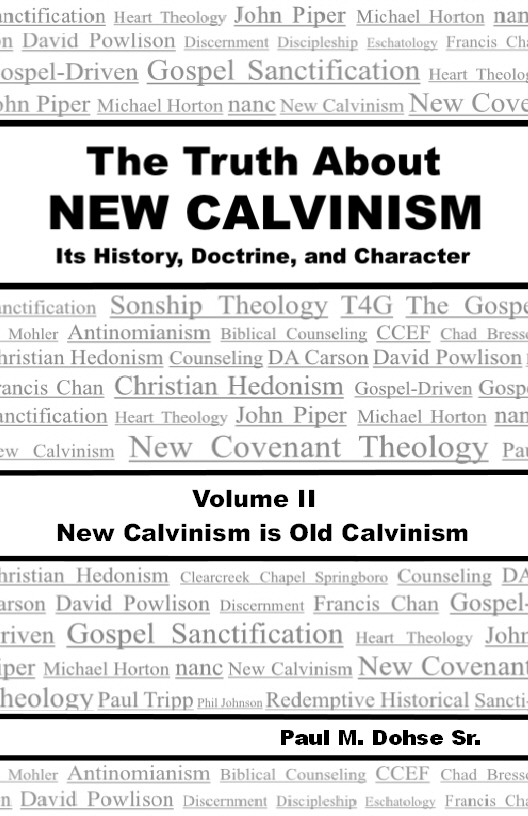
The writing of The Truth About New Calvinism—Volume 2 is in full throttle. From time to time, I would like to share some things that I am stumbling upon as I define my research of the past three years.
Many thanks to those who have helped me define the direction of volumes two and three. Volume 2 is guaranteed to be understandable. This is the unveiling of Calvinism’s fundamental detriment to Christianity and humanity in general. It doesn’t matter whether you understand the doctrine or not; volume 2 will trace and define the logic that formed the doctrine. From there, the assumption that the ideology is dressed up in Bible verses to look, sound, and feel biblical is a correct one. Volume 2 is for the layman, volume 3 will be an in-depth theological evaluation for those who want it. Once the ideology that formed the doctrine is understood in volume 2, volume 3 may be easier to understand.
If it can be confirmed that the Reformers used the Bible to sell an ideology, and it can, and they did, what they came up with is fairly irrelevant. Not only that, volume 2 will examine the fruits of the doctrine which is also telling. In order to sell the ideology, the Reformers proffered a theological treatise from the Bible. Volume 3 will demonstrate why that doesn’t even hold water.
One character trait of New Calvinism is to exploit the overall lack of education concerning its history, ideology, doctrine, and character. New Calvinism, the authentic Reformed article, is looking for a result based on covert assimilation. The result that is sought is CONTROL. This control is sought through justification by faith alone which is a doctrine that is literally justification alone because it eliminates sanctification. Stated in layman’s terms: it emphasizes the work of God while deemphasizing anything the Christian does in salvation or post-salvation. This is done by out of sight, out of mind. If you only teach justification (salvation) to the exclusion of sanctification (the Christian life), the masses will eventually live according to the Reformed version of justification alone. The Reformers were masters at redefining the terms and teaching sanctification in a justification way.
This leads to the Reformed practice of infiltrating religious movements throughout history as a stowaway and then taking over the movement. The prime example is the Great Awakening (1730s – 1790s). The Great Awakening was a pushback against Reformed ideology, not the result of it. The Pilgrims created the need for the Great Awakening. The Pilgrims, a soft idiom for “Calvinistic Puritan political refugees,” brought European tyrannical polity with them. The motif that the Pilgrims came to America for religious freedom is patently false—they came to establish their own vision of a church state. To this point:
Throughout the colonial period, and even in the early years of the independent United States, most colonies or states had established churches—churches legally recognized as the official state church. Different colonies privileged different Christian sects, for example, Congregationalism (the descendent of Puritanism) was the official state church for Massachusetts, Connecticut, and New Hampshire; and Anglicanism was the established faith in most colonies, including Virginia, South Carolina, and Georgia. Along with official recognition came special privileges, like financial support from public taxation. Before the Great Awakening, colonial Americans harbored no expectation that there should be any separation between church and state.[1]
In reality, there are NO religious movements that could be considered legitimate revivals post apostolic church until the Great Awakening which was ignited by the Age of Enlightenment. The Enlightenment was predicated on the ideas of all men being created equal by God, and mankind’s ability to solve problems through reason. This resonated with colonials and slaves alike that were under European tyranny:
Joseph Tracy, the minister, historian, and preacher who gave this religious phenomenon its name in his influential 1842 book The Great Awakening, saw the First Great Awakening as a precursor to the American Revolution. The evangelical movement of the 1740s played a key role in the development of democratic thought, as well as the belief of the free press and the belief that information should be shared and completely unbiased and uncontrolled. [2]
Enlightenment ideas were completely contrary to Reformed thought as exemplified by the Westminster Confession.[3] Most of the Westminster Divines were Puritans. Colonial Puritans believed in slavery according to their extreme European caste mentality, and executed doctrinal detractors. Contra Enlightenment ideas that ignited the Great Awakening can be seen in the present-day New Calvinist movement; for instance, an article written by New Calvinist James MacDonald bearing the title, “Congregational Government is From Satan.”
Nevertheless, Reformed hacks like Jonathan Edwards infiltrated the Great Awakening, and to a large extent hijacked it. The Great Awakening was a revolt against the organized institutional church state, and was a gargantuan human mass of people searching out new ideas. Hence, the thousands who showed up to hear Reformed teachers during that time were not necessarily enthralled by the supposed gatekeepers of the Awakening, but were flocking to hear anyone who had an idea. Edwards et al proceeded to connect the movement to the Reformers of old who were the ones directly responsible for the tyranny that the colonials were experiencing in the first place.
Moreover, the colonial Puritans wasted no time in trying to infiltrate the American Revolution, its founding declarations, and constitution. James Madison fought the infiltration tooth and nail with his Memorial and Remonstrance Against Religious Assessments.
Unfortunately, the colonial Puritans did succeed in identifying Reformation thought with the Great Awakening. The many denominations and groups that were created by the Awakening usually, and unwittingly, identified themselves as Protestants. As a result, the primary Reformed institutions of learning[4] were built with money from the children of the Great Awakening who were really the product of Benjamin Franklin’s contra ideology. Incredibly, and undoubtedly the zenith of historical misrepresentation, those of Reformed thought who hijacked the Great Awakening have been credited with the Abolitionist movement. The Abolitionist movement was nothing more or less than an Enlightenment idea, while the Puritans were the first to bring slaves to the shores of America (ironically, slaves brought many cultic beliefs with them that in part incited the Salem witch trials).[5] The Enlightenment era was directly responsible for the massive conversion of slaves to Christianity shortly after the signing of the Declaration of Independence. The ideas of freedom and reason ignited colonial revivalism, not the contra idealism of the Reformation. Franklin was an abolitionist while he was governor of Pennsylvania, and the epicenter of revivalism among the slave population was Philadelphia.
This form of parasitic deception and covert assimilation is a Reformed hallmark. Those of Reformed idealism, historically, do not build anything. The Pilgrims were utterly inept in fending for themselves in the new world. They latch on to what is alive and feed off of it. Their very institution is a historical Ponzi scheme. A contemporary example is the home church movement in America. Because of the fundamentals that came out of the Great Awakening, the American church remained fundamentally Reformed in its overemphasis on justification because sanctification infers human ability. Therefore, per the usual outcome, a mass exodus from the institutional church began in circa 2000. This resulted in the home church movement. According to the Reformed mode of operation, New Calvinism hijacked that movement as well, primarily for self-preservation. This is the motivation for flock groups and “churches” like Apex. However, they are not purely home churches, and are connected to a central institution in order to maintain control.
A proper understanding of church history is the key. Until then, Reformation thought will continue to suck the life blood out of anything that lives in Western church culture.
Endnotes
1. Shmoop Editorial Team. “Religion in The American Revolution” Shmoop.com. Shmoop University, Inc., 11 Nov. 2008. Web. 30 Oct. 2013.
2. Wikipedia.org: Great Awakening.
3. Paul Dohse: Inseparable: The Reformation’s Principles of Persecution and its Gospel; Paul’s Passing Thoughts .com, August 31, 2013.
4. Columbia University (King’s College, 1754, Anglican), Brown University (Rhode Island College, 1764, Baptist), Rutgers (Queens College, 1766, Dutch Reformed), and Dartmouth College (1769, Congregationalist).
5. 1619: Slavery begins in the colonies, as twenty Africans are brought by a Dutch ship to Jamestown for sale as indentured servants. 1664: Maryland makes lifelong servitude for black slaves legally mandatory. Similar laws are later passed in New York, New Jersey, the Carolinas and Virginia. 1667: The Virginia House of Burgesses passes a law that binds blacks to servitude, even if they convert to Christianity.
Calvinist Catholicism, Denial of Sanctification, Denial of the New Birth, and Distortion of the Trinity Through “Emphasis”
Originally published January 3, 2013
“Those of Reformed theology are not under grace. How do we know that? Because they say Christians are still under the dominion of sin. And plainly, according to the Bible, that equals being under the law and not under grace.”
The mystery of why sanctification is so anemic today is no longer a mystery. Traditionally, this has been the case for a long time in the Western church because the fathers of the Reformation discounted sanctification all together. Sure, they used the term, but it was disingenuous then, and continues to be such with those who use the term today. Weak sanctification leads to very unexciting lives which are no incentive to share the “new life” with others. We share what we are excited about, and being no better than what we were before our “conversion” is neither good news nor worth sharing. It seems the only thing we have to share is, “We are more humble than you because we know that we are empty vessels waiting to be filled and maybe the Lord will fill us and maybe he won’t.” Such a message just doesn’t set the world on fire.
The more I learn, the more I am convinced that there is really no difference between Catholicism and Protestantism: both are “under the law.” One is Jesus plus ritual to complete your justification and the other is Jesus plus making sure you do nothing in your sanctification to complete your justification (because the “just” shall live by faith [ALONE]). And in both cases, being faithful to the authority of the church secures your salvation. Calvin believed that we stay saved through daily repentance for daily salvation, and that forgiveness can only be found in Reformed churches:
Secondly, this passage shows that the gratuitous pardon of sins is given us not only once, but that it is a benefit perpetually residing in the Church, and daily offered to the faithful. For the Apostle here addresses the faithful; as doubtless no man has ever been, nor ever will be, who can otherwise please God, since all are guilty before him; for however strong a desire there may be in us of acting rightly, we always go haltingly to God. Yet what is half done obtains no approval with God. In the meantime, by new sins we continually separate ourselves, as far as we can, from the grace of God. Thus it is, that all the saints have need of the daily forgiveness of sins; for this alone keeps us in the family of God” (Calvin’s Commentaries, Vol. 45: Catholic Epistles).
And, Calvin’s homeboy, Luther, believed that Reformed elders have the authority to forgive sins:
Confession consists of two parts. One is that we confess our sins. The other is that we receive the absolution, that is, forgiveness, from the pastor as from God himself and by no means doubt but firmly believe that our sins are thereby forgiven before God in heaven (Timothy J. Wengert: A Contemporary Translation of Luther’s Small Catechism; Augsburg Fortress PUB 1994, p.49).
And on page 35….
Daily in this Christian church the Holy Spirit abundantly forgives all sins—mine and those of all believers. On the last day the Holy Spirit will raise me and all the dead and will give me and all believers in Christ eternal life.
The granting of eternal life is future, and is based on faithfulness to the established church. Look, I have been a pastor long enough to know that many Baptists associate their salvation with church membership. I have suggested cleaning up the roles in a few churches, and the response is always one that hints of this being synonymous with taking away one’s salvation. Where did they get that idea? Whether Catholic or Protestant, you can get your absolution in a booth or an alter call—there is no difference.
Calvinism, and the Reformed gospel in general, is “under the law.” In the Scriptures, being under the law equals being under the dominion of sin:
Romans 6:14—For sin will have no dominion over you, since you are not under law but under grace.
Romans 2:12—For all who have sinned without the law will also perish without the law, and all who have sinned under the law will be judged by the law.
Romans 2:15—For the law brings wrath, but where there is no law there is no transgression.
Those of Reformed theology are not under grace. How do we know that? Because they say Christians are still under the dominion of sin. And plainly, according to the Bible, that equals being under the law and not under grace. Quotes from the Reformed that establish this are myriad, I will note one:
We are enemies of God. We are God ignoring. We are God defying. We hate God. (CJ Mahaney: Resolved Conference 2008).
Comments by Reformed pastor Matt Chandler speaking of Christians as being “wicked sinners” have apparently been scrubbed from the internet (see here, and here), but nonetheless are indicative of the Reformed position.
This simply equals nothing less than, from the biblical perspective, Christians remaining in an unregenerate state though they call it regeneration. And this, they in fact do:
Bavinck too, wrote in connection with the regenerating work of the Spirit: “The regenerate man is no whit different in substance from what He was before his regeneration” (G. C. Berkouwer: Faith and Sanctification, p. 87).
Unchanging regeneration: such oxymorons are not few in Reformed writings. And though they would deny it, sanctification and the new birth are rejected as a matter logical conclusion. There can be no sanctification or new creaturehood where we are still under the bondage and dominion of sin. This is antithetical to being under grace. The Reformed think tank that launched the present-day New Calvinist movement which is a resurgence of authentic Calvinism, wrote an article in their theological journal entitled, “The False Gospel of the New Birth.” The article can be read here.
The argument that is used is one of emphasis which is Gnostic epistemology: sure, stars are true, but they only shine because of the Sun. Sure, shadows are true, but they wouldn’t exist without the Sun either. Sure, flowers are true, but they wouldn’t be able to grow without the Sun as well. What we want to do is focus on what really gives life: the Sun. To emphasize stars, shadows, or flowers over the thing that actually supplies the life will diminish life to whatever degree that the “good thing” is emphasized over the “best thing.”

Beginning to get the picture? It enables them to acknowledge the truth of sanctification and the new birth while deemphasizing them into oblivion. Out of sight; out of mind. To say that the new birth and our ability in sanctification are deemphasized in today’s church is certainly an understatement.
Said think tank, The Australian Forum, used the same argument to emphasize Christ over the Father and the Holy Spirit as well. Christocentricity is very important to Reformed theology. The core four of this think tank was Geoffrey Paxton, Jon Zens, Graeme Goldsworthy, and Robert Brinsmead. In a book where Paxton documents the Reformed heritage of Seventh-Day Adventism, he stated the following:
Luther and Calvin did not simply stress Christ alone over against the Roman Catholic emphasis on works-righteousness. The Reformers also stressed Christ alone over against all—be they Roman Catholics or Protestants (29) — who would point to the inside of the believer as the place where justifying righteousness dwells. Christ alone means literally Christ alone, and not the believer. And for that matter, it does not even mean any other member of the Trinity! (The Shaking of Adventism: p. 41).
Likewise, the same argument is made in regard to sanctification:
The distinction between the two types of righteousness will make the final emphasis of the Reformation easier to understand. The Reformers contended that the believer is righteous in this life only by faith. In saying this, they were not denying either the necessity or the reality of sanctification in all true believers. Rather, they were asserting that in this life sanctification is never good enough to stand in the judgment. The believer must look only to the righteousness of faith (the righteousness of the God-man) for his acceptance with God.
The inadequacy of sanctificational renewal was an integral part of Reformation teaching. Its corollary was the Reformers’ steadfast gaze at the righteousness of faith—namely, the doing and dying of the God-man, Jesus of Nazareth. Though the believer fights against sin and seeks to be a faithful law-keeper, sin nevertheless remains until his dying day Luther put it forcefully:
Paul, good man that he was, longed to be without sin, but to it he was chained. I too, in common with many others, long to stand outside it, but this cannot be. We belch forth the vapours of sin; we fall into it, rise up again, buffet and torment ourselves night and day; but, since we are confined in this flesh, since we have to bear about with us everywhere this stinking sack, we cannot rid ourselves completely of it, or even knock it senseless. We make vigorous attempts to do so, but the old Adam retains his power until he is deposited in the grave. The Kingdom of God is a foreign country, so foreign that even the saints must pray: ‘Almighty God, I acknowledge my sin unto thee. Reckon not unto me my guiltiness, O Lord.’ There is no sinless Christian. If thou chancest upon such a man, he is no Christian, but an anti-Christ. Sin stands in the midst of the Kingdom of Christ, and wherever the Kingdom is, there is sin; for Christ has set sin in the House of David.
(Ibid pp. 46,47).
Hence, at least Reformed theology is consistent in regard to Christians being under the law and also still under sin’s dominion. We must live by faith alone because we will supposedly stand in a future judgment that will determine righteousness by a perfect keeping of the law. And it’s true, those under the law will stand in such a judgment. But will we? The heart of the Reformation posited the idea that if we live by faith alone in sanctification, Christ will stand in the judgment for us.
But we know well what James thought of sanctification by faith alone.
paul
Are Christians Losing Their Voice in the World Because They are Just Plain Stupid?
Originally published December 30, 2013
I was born again in 1983, but being saved by God does not automatically fix stupid in the here and now. The first stupid thing I did was to join a Baptist church because, by golly, I was saved and I was going to do this Christian thing the right way. Though a selfish sinner ruled by lust, like all of humanity, I had some good God-given qualities; i.e., I took satisfaction in doing a quality job. I brought that quality with me into my Christian life.
To some degree I am not at fault. How was I to know that Baptists are Protestants? How was I to know that Baptists would teach me the ways of Protestant orthodoxy? How was I to know that the fathers of Protestantism despised reason?
Are Protestants stupid? Sure they are. What other breed of homosapien would invest thousands of dollars to learn extensive knowledge about a religion founded by men who believed mankind to be totally depraved and unable to properly understand reality? Stupid? Maybe “sane” is the better question; who endeavors to earn a PhD in total depravity? Moreover, consider the fact that men who earn these nomenclatures of knowledge that plunges the depths of man’s incompetence are themselves men of renown and respected as knowledgeable about knowing nothing.
Yes, supposedly, according to Calvin and Luther, when Paul told the Corinthians that he knew nothing but Christ and Him crucified, he wasn’t talking about knowledge of other gospels, he was talking about the “foolishness of the cross.” Hence, the world rejects the cross because they believe man can know something of value other than the salvific work of Christ. They therefore see the cross as “foolishness.” Calvin and Luther mocked the thinkers of their day and ridiculed those who proposed that the Earth was round and the solar system was in motion. Their serial killing children, the Puritans, attributed the exploits of Benjamin Franklin to demonic powers. Any knowledge other than the cross is not the “cross story,” it is the “glory story.” The glory of man rather than the glory of God.
The fruit doesn’t fall far from the tree. As a pastor, I saw no need whatsoever to learn any “vain philosophy,” and certainly didn’t learn any in high school or seminary. In both cases, Plato is a touchy subject. The Colonial Puritans were ridiculed for being Platonists by their Aristocratic detractors who were children of the same Enlightenment movement that clearly saved Europe from being a third world country shrouded in superstition. The Puritans founded our public school system. They also founded the Ivy League schools from which all of our seminaries came. These were prodigies of Socrates and Plato who defined true wisdom as knowing nothing.
From that gene pool came the Gnostics who defined the “secret knowledge” in the same way. Basically, they were peddlers of happiness in the midst of knowing nothing: “Eat and drink, for tomorrow we die.” And if you messed up the unity and happiness of the communal group led by those with the gnosis, you died a lot sooner.
So, what in the world philosophy inspired this rant? Some time ago, it came to my attention that an atheist website reposted one of my articles in a favorable light. Even after being awakened to the importance of world philosophy and ideas by church historian John Immel, I was horrified. Certainly, I had to then consider that what Calvinists say about me may be true; am I really an “enemy of the cross”? Worse yet, this is a website that has a global rating of 609 with Alexa, that’s #609 worldwide (Google is #1). This multiplied the horror of my evil deed even more. Certainly, if these atheists liked what I wrote, it was pure evil!
Fearfully, I reread the post in order to come to grips with my horrific folly. Soon the fear turned to utter disbelief. The post pointed to the authoritative wisdom of God in the Scriptures. Huh? I reread it again; why would they promote these ideas on their blog? The post, at least in my estimation, assumed metaphysical interpretation via the Bible. So, I stuck around and read some other articles on the website. Clearly, I perceived more of a problem with stupidity than with God. In fact, I couldn’t find any article that had a problem with God in particular; the consistent theme seemed to be that Christians are anti-reason, and my friends, it is no less a fact that Luther called reason a filthy whore that should have dung rubbed in her face to make her ugly.
Now enter what I perceive going on among contemporary Christian youth in our day, especially after our mission to the Cross Conference in Louisville this past weekend. The youth that were attracted to that conference are thinkers. Granted, they are hindered by Churchianity, but the desire is to be thinkers well equipped for battle in the arena of ideas. That is what draws them to this vein of Calvinism from the T4G camp—it is perceived as being an intellectual Christianity. It’s bogus, but nevertheless, T4G does a good job of selling themselves that way, compliments of hard cash from the working class laity. Hence, this particular group of youth are ripe unto harvest if you make your case. My friends, this is good news.
Now consider the Passion variety of youth (Louie Giglio versus Al Mohler et al). They are where the Louisville group will eventually end up if something isn’t done. The Passion group is quintessential Gnosticism. Louisville really hatched a vision for us, but we are researching in order to ascertain whether or not the Passion crowd is too far gone at this point. Furthermore, the youth we encountered in Louisville are more likely to be heard by those beckoning for Christianity to show itself reasonable. By the way, John Piper is the bridge between the two movements. But with both movements, a transition from less teaching to more experience orientation can be clearly seen.
When it gets right down to it, Western religion and culture is predicated on the debate between Plato and Aristotle. How ironic that the contemporary Calvinists of our day maximize the use of the very technology that their mentors despised. Though they hate Aristotle and the children he bore like Ayn Rand, without them, Al Mohler would be just another Hindu priest adding to the pollution of the Ganges River with cremation grounds. In the same way that those priests proclaim that horribly polluted river a place of purifying, Al Mohler and company are living contradictions.
At any rate, ignorance of these matters has not served Christianity or our society well. Christians do error if they think that they do not have to choose the reality that they will function in. Until Christians can define their reality, they will look stupid and act stupid. The Neo-Calvinist leaders of our day do not want our youth to know that they must make that choice, for if they do not understand the reality that they live in and how it functions intellectually…complete control is imminent.
Our ignorance of these matters is evident because we don’t understand why 900 people would voluntarily stand in line before a giant vat full of flavored poison. This is not complicated: those who interpret realty for others dictate perception. Why was I so horrified that atheists posted my article? Why was I so horrified that they listened?
I still have a lot to learn about how the world works.
The Protestant Reformation was NEVER About the Bible
It was brought to my attention yesterday that Mr. Reformation himself, John Piper, hands down the most popular Calvinist of our day and the “elder statesman” of the Neo-Calvinist movement, stated the following in The Legacy of Sovereign Joy: God’s Triumphant Grace in the Lives of Augustine, Luther, and Calvin ( John Piper, Crossway Books, 2000, page 73):
We need to rethink our reformed doctrine of salvation so that every limb and every branch in the tree is coursing with the sap of Augustinian delight.
This is an outright admission that Plato is the foundation for understanding reality and the Bible. Augustine’s integration of Platonist philosophy with the Bible was well documented by Susan Dohse during the 2013 TANC Conference. Once one pursues knowledge in this information age regarding what was really going on during the Reformation, you see that it was nothing more or less than a philosophy war. You can take that literally because armies in fact brought swords and catapults to the theological debates going on during that time.
So, why did Martin Luther make Sola Scriptura a central focus of the Reformation? Due to the rise of the Age of Reason, the Bible being made readily available to the great unwashed masses was inevitable. Ingenuity invented the printing press, and the handwriting was on the wall. The masses were going to get a Bible in every hut, and it was obvious that Augustinian-like slaughter was not killing people fast enough to prevent mass distribution, so the next best thing was to mandate how people interpret the Bible. That’s what the Heidelberg Disputation was all about. Nothing more, nothing less.
Yes indeed, Scripture alone, but with what interpretation? Not the use of reason. To Luther and the Reformers, a serf believing in the ability to reason is like a toddler playing with a loaded gun. Basically, this is a discussion about grammatical interpretation using reason versus redemptive narrative. Those who would use reason to interpret the Bible were known as the “schoolmen,” and Calvin refers to them 69 times in the Calvin Institutes. The references are not complimentary. Like Luther, Calvin saw the use of reason to interpret the Bible as a rogue hermeneutic and antithetical to Platonist principles of philosophy.
This is an issue that has never been brought to the forefront among Christians for consideration even though most pastors preach via meta-narrative, and most Christians assume the use of reason to reach logical conclusions past, “I am a totally depraved person who can know nothing beyond the foolishness of the cross.” This is why Protestants are the most confused individuals on the face of the earth. Protestant pastors interpret reality in a totally different way than those being led.
And so it goes: Sunday after Sunday, the churches are full of parishioners trying to draw logical conclusions for living from a sermon designed to lead parishioners to one conclusion only: the only thing you can understand is that you cannot understand anything save that you deserve hell, and everything other than that is a an undeserved gift. Principles for living life? What life? Life isn’t for living, it is only to be praised as something done to us, not by us. The only thing we should be doing is hell, not life.
Therefore, if you raise a concern, or ask a question, this immediately reveals the fact that you just don’t get it. You are living for your own glory, and not the glory of the cross story. Knowledge and pride are inseparable, and of course, “pride precedeth a fall.”
paul

 Paul's Passing Thoughts
leave a comment