Does the Law Really Lead People to Christ by Revealing Sin Only?
 Originally published October 14, 2013
The insanely celebrated return to our Reformed roots teaches the following about the law:
We are unable to keep the law perfectly. And since a perfect keeping of the law is the standard for righteousness required to live with God forever, our inability to keep the law perfectly leads us to Christ who must keep/fulfill it for us. As Christians, we continue to use the law in this way to “preach the gospel to ourselves.” The more we use the law to show our innate sinfulness, the more we experience “vivification” (a joyful, perpetual rebirth).
The bogus idea that perfect law-keeping is justification’s standard aside, the most popular text that supposedly supports this idea is Galatians 3:24 –
So then, the law was our guardian until Christ came, in order that we might be justified by faith.
To make that verse work, “guardian” (paidagōgos) is often translated as “tutor.” That’s a stretch. The word is better translated “protector”:
Among the Greeks and the Romans the name was applied to trustworthy slaves who were charged with the duty of supervising the life and morals of boys belonging to the better class. The boys were not allowed so much as to step out of the house without them before arriving at the age of manhood (Strong’s Dictionary).
Furthermore, the Reformed gospel teaches that the law is used by the Christian for this same purpose in our Christian walk—to continually lead us closer and closer to Christ by showing forth sin. This blatantly contradicts the context of the passage:
Galatians 3:25 – But now that faith has come, we are no longer [added] under a guardian,
Reformed doctrine clearly teaches that Christians are still under the law’s purpose to show us a deeper and deeper need for Christ and His grace as we see our own sinfulness in a deeper and deeper way. In other words, for Christians, God’s word still has a redemptive purpose. This is the basis for Historic Redemptive hermeneutics. However, even in regard to the lost, the showing forth of sin is only one purpose for the law, but far from being the only one.
Primarily, the law shows forth life. This is by far the primary theme of law throughout the Scriptures. The law shows forth the wisdom of God, and the wellbeing (blessings) of those who follow it. The law is also framed in the context of promise much more than it is judgment.
This gets into the major crux of the Reformed false gospel; the fusion of justification and sanctification concepts. The blessings of law-keeping can be experienced by unbelievers and believers alike, but such cannot obtain eternal life. The point is that the law shows forth life as much as it does death. It shows both. Again, this is a constant theme throughout the Scriptures. Who will deny that unbelievers will have a higher quality of life to the degree that they follow God’s law? No, it can’t gain salvation for them, but the law brings horizontal blessings by virtue of its wisdom.
Point in case:
1Peter 3:1 – Likewise, wives, be subject to your own husbands, so that even if some do not obey the word, they may be won without a word by the conduct of their wives, 2 when they see your respectful and pure conduct.
In this passage, the husband is not won over by the wife demonstrating how sinful we are and our subsequent need for Christ; she is showing forth the blessings of being a believer. These are blessings that he is also experiencing because the home is sanctified by her presence:
1Corinthians 7:14 – For the unbelieving husband is made holy because of his wife, and the unbelieving wife is made holy because of her husband. Otherwise your children would be unclean, but as it is, they are holy. 15 But if the unbelieving partner separates, let it be so. In such cases the brother or sister is not enslaved. God has called you to peace. 16 For how do you know, wife, whether you will save your husband? Or how do you know, husband, whether you will save your wife?
So, there is a sense in which the unbelieving spouse is blessed by the believing one. The law not only shows forth sin, but also shows forth life. The latter is the way the law leads people to Christ just as much as the former.
paul
My Reply to Linda: Yes, I Am a Christian, But Not Sure You Are
 I am presently in the process of eliminating my personal Face Book account. A ministry account will be maintained for the TANC blog, Paul’s Passing Thoughts .com, and overseen by Pearl the PPT moderator. I recommend people befriend that account if they want to stay connected to our ministry.
The reason is simple: I no longer have patience for the evangelical regurgitation of orthodox talking points. Protestants don’t own their own faith that they have seen in the Bible with their own study. What they think they see and understand is what Protestant academics have told them, including the idea that they have authority to tell them what to believe. So, what is wrong with church? Church is wrong with church because it is predicated on a false gospel. That’s right, the Protestant Reformation was a false reformation founded on a false gospel. And this is why Dr. James White and others have refused to debate me publicly; the Protestant gospel as stated in its orthodoxy is the biblical definition of a lost person…under law as opposed to under grace.
Martin Luther and John Calvin et al proffered a gospel that is under law, but that is supposedly OK because Jesus keeps/kept the law for us and that obedience is imputed to our Christian status. This is a perpetual covering of sin, or sometimes referred to as “atonement,” but not an ENDING of sin that requires no further justification. Hence, we must “preach the gospel to ourselves every day” to “keep ourselves in the love of God” (CJ Mahaney) etc. White and others know that this is a simple matter of theological math, and do not intend to address it until enough people catch on. The only case they can make presently is for a historical-redemptive interpretation of Scripture that interprets every verse as a justification verse. Sanctification is defined as progressive justification via Protestant talking points.
So, while in the process of eliminating my personal Face Book account, I noticed a comment to me by a “Linda.” It follows:
“Are you a Christian Paul? And secondly do you believe that the Bible is the inspired Word of God? That would be my two questions for you. Romans says, ‘There is none righteous, no not one.’ That includes you and me. This doesn’t mean that we never do a kind act or good deed. It means that we don’t and can’t do enough of them to be declared ‘RIGHTEOUS’ by God. We could never do enough good deeds and kind acts to get us into heaven. Therefore we need the righteousness of Christ imputed unto us in order to go to heaven. God imputes this kind of righteousness to those who believe and accept HIS son Jesus and his shed blood as atonement for their sins and their UNrighteousness. We are part of God’s family by adoption. Nothing can make us righteous enough to go to heaven. The righteousness that is applied to our never dying soul can only come from Christ. The ‘part and parcel’ of our own being is puny compared with what God demands. In one place in scripture our puny ‘part and parcel’ is described as ‘filthy rags.’ So our own human effort at righteousness is from our flesh. Our flesh is not saved from sin and unrighteousness. Only our soul is. We are not capable of learning and loving enough to be declared righteous enough for heaven. We could learn and love enough to help another person with a kind act or good deed. But that does not fit our soul for heaven. I don’t understand your third question……’Christ imputing sin’ ????”
Her comment was in reply to previous comments made in regard to a post. She was replying to a comment I made regarding her initial comment. Her initial comment follows, and afterward my reply:
“I am a never dying soul whom Christ died and rose for, approved of by God because I have HIS righteousness. Just by learning and loving we are different. Better means ‘improved in some way.’ Not hard questions for me.”
“Linda, where does the Bible say you have the righteousness of Christ? That’s the first question. The second: Are we only approved of God because we ONLY have the righteousness of Christ and none of our own? What about the new birth? If we are literally born of God and now part of His lineage, would that not make us righteous? Do you mean to say that we have a righteousness LIKE Christ’s because we are a member of the same family, or ONLY His righteousness and none that is part and parcel with our own being? Are we truly righteous, or only declared righteous? Third question: was Christ’s role in salvation an imputation of sin AND righteousness, or just sin? On the one hand, you seem to state that we only have the righteousness of Christ, but on the other, you say we learn and love. How exactly do we learn and love if we ourselves are not righteous people? So, I am not trying to be a jerk here, I am simply resolute that Christians should have a clear definition of who they are. Yes, I know exactly what the Reformers believed about our identity, but I would like to see your clarification.”
This is the extreme Protestant cognitive dissonance resulting in the train wreck we call “church” that I no longer have patience for. People who are serious about following Christ need to take their true gospel and leave the institutional church for home fellowship networks. The institutional church is part and parcel with the authority that demands a denial of the obvious. Authority has replaced truth. Nevertheless, I do believe evangelicals will have to eventually address their under law gospel.
I will make this as simple as possible as I am weary of addressing it. Much, much, thanks to Andy Young who is helping to carry the water on this as well. Linda’s response is pretty much the Protestant gospel talking points that we hear often, and pregnant with cognitive dissonance. All in all, her answers to my questions are, “NO.” Please start by noting that. This is where we discuss another disservice the Reformers performed: adding chapters and verses to the Bible. This circumvents the need to read all of Scripture in context. You can form a theological argument by using John Immel’s pet peeve: Scripture stacking. Basically, Linda is using the same verses to argue for the same Protestant talking points that she has received from Protestant academics. As a result, if one examines her statements, the blatant contradictions are stunning.
Where to start? ALL of our works are filthy rags (Isiah 64:6), yet, we can do some stuff that is good? So, “all” doesn’t really mean “all”? Per the usual, Protestants profess a double false gospel because they don’t rightly understand the gospel taught by the father of the Reformation, Martin Luther. In fact, Luther taught that EVERY deed of man is evil, even those that appear good because man’s “good” deeds always have a flawed motive. Calvin taught the same. Hence, if one believes that we can do a good deed, that is “mortal sin” and cannot be forgiven by the church. But, if one believes that every work we do, even works that appear good, are actually evil, all of our sin can be forgiven by revisiting the same gospel that saved us, and that revisitation is only valid under the auspices and oversight of the clergy. This is Luther, this is Calvin, this is the Protestant gospel. I have documented this backwards and forwards as those who follow TANC Ministries know.
Now, for the Protestant part of this that Linda got right, and in fact a mainstay of Protestantism, but still a false gospel. Luther and Calvin orthodoxy already condemns her to hell, but they would agree with her making the law the standard for justification. Biblically, there is NO law in justification. The Bible testifies about justification, but law and justification are mutually exclusive. It doesn’t matter who keeps the law, there is no law in justification. What determines justification is the new birth. The law is strictly for love in the Christian life. Again, the law informs us about justification, and here is the information: law is not the standard for justification, the new birth is. The apostle Paul wrote the epistle of Galatians to make this very point. Again, I predict that folks are going to start catching on to this in the future and the who’s who of evangelicalism are going to have to make a defense; good luck to them as that attempt will be interesting. The Protestant under-law-gospel, also stated by Linda, has Christ fulfilling God’s “demands” in our stead when God’s only demand regarding justification is that we be born again.
In order to make the law the standard for justification, the Reformers resorted to Saint Augustine’s Neo-Platonism, which later became Gnosticism and wreaked havoc on the first century church. We see this in Linda’s talking points about “the flesh.” ALL of our works come from where? Right, the flesh which, like the Reformers, she deems as inherently evil. That’s Gnosticism. The Bible teaches that our bodies, or members, are “weak” not inherently evil. When the Bible speaks of the “desires of the flesh” and the “deeds of the flesh,” that speaks of when our members are used for sinful purposes. Obviously, if Linda would stop long enough to read her own Bible with her own understanding given to her by God, she would see that our body, or “flesh,” can also be used for holy purposes (Romans 12:1 among many other passages). And, what is more obvious than the fact that our bodies are declared to be the temple of God? Actually, a word study reveals that the Holy of Holies is being referred to.
This brings us to Linda’s Protestant confusion in regard to the difference between salvation and redemption. The former is the saving of the soul, the latter is the saving of the mortal body which can be used for evil or good depending on which desires we are obeying. Christians, through the new birth, have the ability to obey the desires of the Spirit stated in the Bible and the ability to say “no” to evil desires that remain part of the body’s weakness and mortality. Because Christ ended the law through the new birth, sin has been stripped of its ability to enslave and condemn. If Christ obeys the law for us, we are still under it and enslaved to sin. The old us that died with Christ violated the whole law with every sin; the new us that was raised with Christ fulfills the whole law with one act of love. Christ didn’t come to obey the law for us—He came to END the law. Christ didn’t come to cover our sin—He came to END our sin.
A book could be written here, but time won’t allow it; nevertheless, let’s address Linda’s confusion, typical among Protestants, in regard to gift and reward. We cannot birth ourselves, but we can obtain the baptism of the Spirit by faith alone in “the promise” (see Galatians chapter 3). Once the gift is received, it is ours to utilize by loving God and others. Exercising the gift is not taking credit for the gift. The Bible states that God would be unjust to forget our good works and service to the saints (Hebrews 6:10). “Unjust”? Yes, because as those literally born of Him (1John chapter 3), and literally a part of His literal family, our reward is due us as siblings working for the Father. As a slave to the former master, we could only earn death wages—now we can earn true reward. Read the Parable of the Talents and see what the outcome is for those who fear and want to give God back only what was given and nothing more. It shows a fundamental misunderstanding of the new birth.
As a policy, I don’t judge the salvation of others. I believe that there are Protestants who are confused enough about Protestantism to be saved. So, yes Linda, I am saved, but I find your assurance that you are saved indicative of your confusion. Protestant orthodoxy CLEARLY states that the motor of sanctification moving justification forward is doubt of salvation because being under condemnation is part and parcel with being under law…the standard for justification according to Protestantism. In Calvin’s words, if “Christians” are not still under condemnation, what further need is there for Christ and His righteousness?
So Linda, I am saved, but I recommend that you start thinking for yourself. All of the Protestant academics you trust will not stand in your stead at the judgment. You will be standing there alone.
And you better have more than a covering with sin underneath it, you better be a literal child of God before Him.
paul
John Piper Proclaims “Christians” Condemned and in Need of Continued Salvation
 One of the major truths that will be emphasized in the present TANC book project is that the Protestant Reformation was NOT based on the Bible. The Protestant kerfuffle with Rome concerned differences in world philosophy—not theology. Sola scriptura is a blatant falsehood. Martin Luther concocted a contending worldview in opposition to an increased influence of Thomism in the Catholic Church. Luther then dressed up his philosophy in Bible verses. Actually, to be more specific, he dressed up Neo-Platonism in biblical garb. This is hardly some deep, dark secret; a cursory observation of church history reveals this, unless you get your church history from a Protestant seminary.
Since the Protestant Reformation was really based on Plato’s Republic, the necessary theological fit was/is progressive justification for those who are preselected and the last to know if they are really selected or not. They get the news at the final judgment. Until then, EVERYBODY is presently under condemnation and in need of continued justification because we have “present sin.” In order to be perpetually rejustified, we must “preach the gospel to ourselves every day,” obey the pastors, and be a faithful church member.
Due to the fact that sola scriptura is a farce, the present-day expression of authentic Protestantism via New Calvinists routinely contradicts the plain sense of Scripture in insane fashion, and nobody blinks an eye. Moreover, cowardly pastors who know better even as confused Protestants allow the New Calvinists to be named and quoted among their sheep.
Let’s talk about one example, the one that prompted this post. On August 22, 2015, John Piper prayed at a Christian anti-abortion rally at a Planned Parenthood location in St. Paul, Minnesota. In that prayer, he stated:
And we acknowledge in the face of your holiness and power that we are sinners. Everyone standing here in this gathering is a sinner in desperate need of salvation that you offer in Jesus Christ. We know that our conscience condemns us, and if our own consciences do, how much more your holy law. So we have not lived up even to our own standards, let alone to your standards. And we confess our sins corporately before you as individuals.
In direct conflict to the Bible’s clear definition of a believer, Piper proclaimed everyone at the gathering as condemned under the law; this is the Bible’s succinct definition of a lost person. In addition, Piper clearly proclaimed in the prayer that Christians are still in need of salvation.
How does he get away with this and stand as one of the most beloved evangelicals of our day? Because he supposedly has authority, and we the believers have no real ability to perceive truth. Clearly, if it comes down to what we understand our Bibles to say versus what John Piper says, he will win the day every time.
So then, for all practical purposes, he speaks for God.
paul
An Introduction to TANC 2015: Why the Protestant Reformation is a Lie

Protestants don’t know anything. That’s not a derogatory remark, it’s merely a staple of Reformed ideology. It’s who we are supposed to be. Protestantism is predicated on the idea of spiritual caste as an accepted norm. The average Protestant parishioner is not supposed to know anything, and again, this is an accepted norm. In fact, many Protestant laymen who didn’t get the memo will concur; knowing something in the institutional church will usually get you in trouble. If you know something, you lack humbleness, and are trying to undermine… The Pastor.
This should not surprise us at all if we understand our authentic roots and the ideology of our spiritual heroes. Though Martin Luther’s 95 Theses is credited with launching the Reformation, its first and defining doctrinal statement came six months later in the form of the Heidelberg Disputation to the Augustinian Order. In the 22nd thesis of that document, Luther declared knowledge to be a vice that does nothing but puff people up, and like with all lust, it can never be satisfied. Luther’s disdain for reason is well documented, referring to it as…
Reason is the Devil’s greatest whore; by nature and manner of being she is a noxious whore; she is a prostitute, the Devil’s appointed whore; whore eaten by scab and leprosy who ought to be trodden under foot and destroyed, she and her wisdom … Throw dung in her face to make her ugly. She is and she ought to be drowned in baptism… She would deserve, the wretch, to be banished to the filthiest place in the house, to the closets.
Reason is the greatest enemy that faith has; it never comes to the aid of spiritual things, but more frequently than not struggles against the divine Word, treating with contempt all that emanates from God.
Reason must be deluded, blinded, and destroyed. Faith must trample underfoot all reason, sense, and understanding, and whatever it sees must be put out of sight and … know nothing but the word of God.
There is on earth among all dangers no more dangerous thing than a richly endowed and adroit reason… Reason must be deluded, blinded, and destroyed.
Reason should be destroyed in all Christians.
Whoever wants to be a Christian should tear the eyes out of his Reason.
To be a Christian, you must “pluck out the eye of reason.”
In our day, this fruit doesn’t fall far from the tree as reflected in this quote by a pastor sent to our ministry by one of his former parishioners:
Paul told the Corinthian church that “‘knowledge’ puffs up but love builds up” (1Cor 8:1). So, if you love knowledge and look into the word of God to gain mere knowledge and you absolutely love doing it to the exclusion or ignoring of everything else, you may be “puffed up” and indeed not “building up.”…. Puffiness rips and tears. Puffiness pushes people away. Puffiness divides. Perhaps even more critical is the fact that puffiness portrays a small gospel and devastatingly distorts God’s glory.
To the puffy I say, “Stop studying your Bible.” Go on a quest for Jesus. He is the Word! Study Him, not it.
Studying Jesus and not any knowledge regarding Jesus is the most popular rendering of 1Corithians 2:2 in our day: we are supposed to make every effort to know NOTHING but Christ and him crucified. After all, according to another popular truism in our day, “He is a person—not a precept.”
Of course, most Protestants would deny all of this out of hand when confronted, but the roots and foundation of Protestant ideology has at least resulted in a lax view of knowledge while leaving the thinking to Protestant academia. Some well-known evangelicals such as Dr. Jay Adams have stated the obvious: Protestants are biblically illiterate, and have no wisdom in regard to Christian living other than God-given commonsense and even that is at an all-time low.
Christians, who strive for wisdom and spiritual maturity in the institutional church, if they don’t give up, will eventually find themselves in turmoil and at a crossroads. Striding towards commonsense spiritual objectives will continually put them at odds with the Protestant herd. I was certainly no exception. As someone who was always considered knowledgeable wherever I attended church as a Baptist, in reality, I knew nothing. The knowledge that I had accumulated in various seminaries and Bible colleges was all but worthless. Though I read and studied my Bible more than most, I understood little of it. Most of what I read made no sense at all. Nevertheless, I deemed myself knowledgeable relative to the environment, yet in my heart, I knew the Christian life made no sense and I was for the most part confused. In reality, I was good at constructing Protestant sentences with orthodox bumper stickers and pithy truisms.
So, I set out on a journey eight years ago to search for clarity after 23 years of confusion and strife. The part of my journey that really made everything come together began in 2011 when I embarked on a personal study of Paul’s letter to the Romans. I was determined to make this the time—the endeavor that would reveal once and for all what I was searching for: why my God seemed to be a God of confusion. I prayed earnestly at the beginning of the study that I would just let Paul’s words say what they plainly said. If something he wrote was definitive, I would use that as a building block of understanding.
Though I stayed true to the plan, not much happened until Romans 4:15. That’s the day my life came to a full stop.
For the law brings wrath, but where there is no law there is no transgression.
What in the world did Paul mean by that? NO law, NO sin: especially in the context; speaking of Christians. I kept it mind and continued to work through the letter. Then I came to Romans 5:13…
for sin indeed was in the world before the law was given, but sin is not counted where there is no law.
There it was again: no law, no sin. I stopped there in my verse by verse study and read through the rest of the letter and found the following:
Romans 7:6 – But now we are released from the law, having died to that which held us captive, so that we serve in the new way of the Spirit and not in the old way of the written code. 7 What then shall we say? That the law is sin? By no means! Yet if it had not been for the law, I would not have known sin. For I would not have known what it is to covet if the law had not said, “You shall not covet.” 8 But sin, seizing an opportunity through the commandment, produced in me all kinds of covetousness. For apart from the law, sin lies dead.
Apart from the law sin lies dead. There it is again. No law, no sin. Then I read the following as well:
Romans 10:4 – For Christ is the end of the law for righteousness to everyone who believes.
Conclusion: Christ died on the cross to end the law, and where there is no law, there is no sin. That’s how Christ took my sins away: He died on the cross to end the law. The true Christian is free from any judgement or condemnation—we are not under the jurisdiction of the law.
I wasn’t the least bit sure where this left the law in regard to the Christian life, but pondering the simple fact that we are no longer condemned was exhilarating and freeing. The old self that was under the law of sin and death died with Christ; you can’t indict a dead person, they are no longer under the law. And even if you exhumed my body and presented it in court, the judge has no law in which to convict me (Rom 7:1-6). There is NOW no condemnation for those in Christ (Rom 8:1).
Again, I was not sure where this left the law in regard to the believer’s life, but I had my building block; part of the pieces fit together which would lead to more pieces fitting and an increased understanding of the bigger picture.
Then I came to Romans 8:2.
For the law of the Spirit of life has set you free in Christ Jesus from the law of sin and death.
Remember, I had committed to simply letting the words say what they say. As a result, I saw something in this verse that I had never seen before; clearly, Paul wrote of two separate laws…the law of the Spirit, which I had always thought of as the Spirit’s realm of influence, and the law of sin and death.
“Wait a minute here,” I thought to myself. “If the law of sin and death refers to the written law that condemns mankind, and the two laws spoken of here are the same Greek word, and they are, why would one refer to a realm while the other one referred to a written law? Could it be that this is two perspectives on the same law?” I knew that a literal take on this verse would demand that, and then John 17:17 came to mind:
Sanctify them in the truth; your word is truth.
Then another verse came to mind:
And when he comes, he will convict the world concerning sin and righteousness and judgment (Jn 16:8).
That’s when I realized that the law has two different applications/perspectives: one for the lost and one for the saved. But verses were not done coming to mind:
Love does no wrong to others, so love fulfills the requirements of God’s law (Rom 13:10).
For in Christ Jesus neither circumcision nor uncircumcision counts for anything, but only faith working through love (Gal 5:6).
So, the Christian is free to aggressively love God and others through obedience without ANY fear of condemnation:
There is no fear in love, but perfect [mature] love casts out fear. For fear has to do with punishment, and whoever fears has not been perfected [matured, or growing] in love (1Jn 4:18).
Therefore, why the Reformation is a lie is not complicated at all. This SIMPLE fact makes Protestant theology a house of cards: it keeps so-called believers under the law of sin and death; its very definition of a Christian is the Bible’s definition of a lost person…under law (Rom 6:14). Protestantism is predicated on a single perspective on the law that Christians remain under; they remain under condemnation. This condemnation is covered by Christ’s righteousness as the “Christian” lives by faith alone. Living by faith alone works (usually some kind of ritual like “preaching the gospel to ourselves everyday”) imputes the obedience of Christ to our Christian lives as a way to keep ourselves justified. The Reformed call this “double imputation.”
Once one gets past all of the theological Protestant-speak, it boils down to extremely simple theological math: a Christian is NOT free to love—Jesus must love for us lest it be works salvation. And it almost goes without saying that there is a love famine in the institutional church for this very reason. The Protestant is not free to love, but must focus on a convoluted life formula that supposedly imputes the righteousness of Christ to our lives and thereby keeps us saved. Yes, this is the dirty little secret: total depravity doesn’t merely apply to the unregenerate, but also to the “saints.”
Yes, yes, many a Protestant doth protest against this accusation because few Protestants know what Protestantism is. Nevertheless, it is a false gospel that denies the new birth and keeps people under law and not under grace—a grace that frees the individual to aggressively love without fear of condemnation and the mire of unhealthy introspection.
We are saved APART from the law of sin and death…period (Rom 3:21), and it does NOT matter who keeps the law, the law of sin and death itself is the issue. Salvation is accomplished by the ENDING of the law of sin and death—not the fulfilling of it. Christ came to fulfill the law of the Spirit of life (and love) through us (Rom 8:4)…NOT the law of sin and death.
That would make the law of sin and death a co-life-giver with Christ. The law cannot give life unto salvation. If Christ fulfilled the law of sin and death with loving obedience to the Father, that law is a co-life-giver. That is Paul’s entire point in Galatians chapter 3. There is only ONE seed. If we are still under the law, the law is an additional seed that can give life…but there is only ONE!
Hence, Protestantism goes the way of most other false religions; some ritual or tradition fulfills the law of sin and death and separates the individual from the freedom to love without condemnation and according to the law of the Spirit of life. Love is replaced by obeying men and faithfulness to their institutions. The law of love is replaced with the traditions of men and their orthodoxy.
Consequently, we are in a Protestant dark age. In the same way that secular America has awakened to the failure of the elitist political class, Christians must awaken to realize the failure of Protestant academia. The assembly of Christ was a laity movement, and only the laity can return God’s people to the truth of the gospel. This is a repeat of history when God’s elect where continually troubled by the 1st century Gnostic elitists. Paul wrote to them…
For consider your calling, brothers: not many of you were wise according to worldly standards, not many were powerful, not many were of noble birth.
Likewise, the beloved James addressed the problem as well:
Listen, my beloved brothers, has not God chosen those who are poor in the world to be rich in faith and heirs of the kingdom, which he has promised to those who love him? But you have dishonored the poor man. Are not the rich the ones who oppress you, and the ones who drag you into court? Are they not the ones who blaspheme the honorable name by which you were called?
This is our mission at TANK, to aid the priesthood of believers in rediscovering the truth of the gospel and kingdom living robbed from us by 500 years of Protestant orthodoxy. The light has been covered by the Protestant basket long enough, and this is a matter of simple theological math: the new birth is the standard of righteousness, NOT the law of sin and death, and it matters not who keeps it—it CANNOT give life.
So, the speakers at this year’s conference are partaking in this journey in the arena of ideas. This is an issue that addresses every area of life and culture. Other than the gospel of first importance stated here, everything is being examined and revisited. It’s not group think, it’s collective truth made up of individuals seeking the one mind of Christ, not the traditions of men.
Let all be convinced according to their own conscience. Protestant elitists will not stand in our stead regardless of their claims, but each person will give an account for the sum and substance of their own lives. Let us do it with trembling and fear; not any fear of condemnation, but a fear of trading the life of Christ for the death of tyranny.
Because only truth sanctifies,
Paul M. Dohse
The Nature of God
 I believe incredibly exciting times await God’s people as they break free from the Protestant Orthodoxy Dark Ages. The key will be the realization that God wrote the Bible for the average individual. We have an example of this regarding the nature of God; a subject thought to be too deep for the average disciple.
Our only head is Christ who teaches all, and the idea of being taught assumes the ability to understand. God’s people need to simply let the words in the Bible say what they plainly say, and we are individually responsible for doing so. One must free their minds from the tyranny of orthodoxy and journey into the Bible with their own God-given mind, and they will be responsible to God alone for doing so.
What then does the Bible teach us about God’s nature? The Bible states that God is love:
Beloved, let us love one another, for love is from God, and whoever loves has been born of God and knows God. Anyone who does not love does not know God, because God is love.
So we have come to know and to believe the love that God has for us. God is love, and whoever abides in love abides in God, and God abides in him.
Obtaining God’s Love
Protestant orthodoxy has a peculiar teaching known as the “vital union.” According to Reformed tradition, we maintain this vital union of “Christ in us and us in Christ” by “preaching the gospel to ourselves.” This is done by searching for sin in our lives so that we can return to the cross for forgiveness resulting in increased salvation. The following chart publicized by several Reformed organizations illustrates the process:
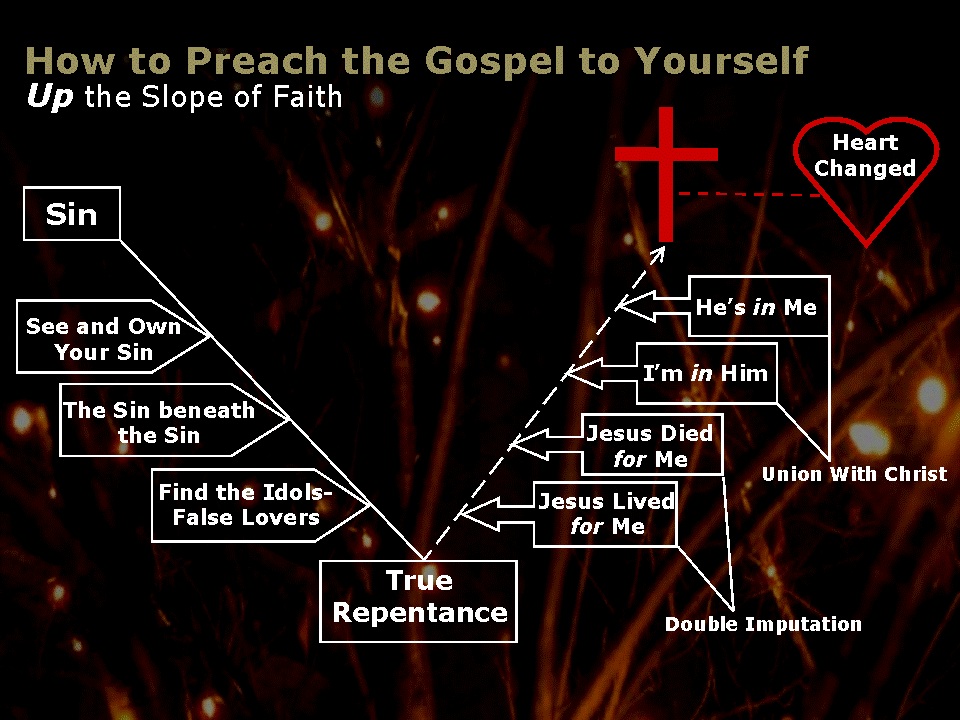
In case you think this is a “biblical” process for best results in growing as a disciple expressed in the illustration by “Heart Changed,” think again as illustrated by another chart published by several Reformed organizations as well:

In this chart, what is growing? Us, or our “salvation”? Many Reformed teachers in our day are fond of telling us how to “keep ourselves in the love of God” by “preaching the gospel to ourselves every day.” In fact, if we change, the following chart from the same camp shows the consequences:

…our salvation gets smaller! In contrast, we obtain God’s love once, and for all time, by believing in His Son, and experience assurance of that love but walking according to our new being.
Little children, let us not love in word or talk but in deed and in truth. By this we shall know that we are of the truth and reassure our heart before him…
But according to Protestant orthodoxy, if we make every effort to love God and others instead making every effort to find more and more sin in our lives, the gospel effect in our lives is diminished.
The Nature of God
How we obtain the love of God as prescribed by Protestant orthodoxy flows from its tenets regarding the nature of God. Primarily, God is defined as sovereign. Rather than sovereignty being an aspect of God’s nature, it is made to be the primary organizing principle—not love. This is an important distinction for those who take part in the exodus from Protestant darkness; will God’s nature be defined by a grammatical and exegetical interpretation of Scripture, or an interpretation based on orthodoxy?
Clearly, the Bible states that God is love. So, how does the Bible define love? Let’s see:
1Corinthians 13:1 – If I speak in the tongues of men and of angels, but have not love, I am a noisy gong or a clanging cymbal. 2 And if I have prophetic powers, and understand all mysteries and all knowledge, and if I have all faith, so as to remove mountains, but have not love, I am nothing. 3 If I give away all I have, and if I deliver up my body to be burned, but have not love, I gain nothing.
4 Love is patient and kind; love does not envy or boast; it is not arrogant 5 or rude. It does not insist on its own way; it is not irritable or resentful; 6 it does not rejoice at wrongdoing, but rejoices with the truth. 7 Love bears all things, believes all things, hopes all things, endures all things.
8 Love never ends. As for prophecies, they will pass away; as for tongues, they will cease; as for knowledge, it will pass away. 9 For we know in part and we prophesy in part, 10 but when the perfect comes, the partial will pass away. 11 When I was a child, I spoke like a child, I thought like a child, I reasoned like a child. When I became a man, I gave up childish ways. 12 For now we see in a mirror dimly, but then face to face. Now I know in part; then I shall know fully, even as I have been fully known.
13 So now faith, hope, and love abide, these three; but the greatest of these is love.
The so-called Reformed gospel of sovereignty calls for the total inability of man to love God even after their definition of conversion. One well known Reformed theologian wrote a book titled One Way Love. This staple Protestant belief is defined in the doctrine of double imputation which calls for the imputation of Christ’s alien righteousness to be imputed to our lives apart from anything we do other than preaching the gospel to ourselves. Much is made of living the Christian life by faith alone in order to maintain our “just standing.”
What it boils down to is God creating evil for His own glory. Whether you consider the teachings of Martin Luther or John Calvin, the founding fathers of Protestantism, this is an irrefutable fact. Luther taught that God created mankind with a passive will; in other words, a will that can only act if acted upon from an outside source. This testifies to God’s nature as defined by sovereignty. Hence, certain people are predetermined to suffer for eternity. In regard to this, John Calvin stated,
[God] arranges all things by his sovereign counsel, in such a way that individuals are born, who are doomed from the womb to certain death, and are to glorify him by their destruction.
~Institutes 3.23.6
I again ask how is it that the fall of Adam involves so many nations with their infant children in eternal death without remedy, unless it so seemed meet to God?…The decree, I admit, is dreadful; and yet it is impossible to deny that God foreknew what the end of man was to be before he made him, and foreknew, because he had so ordained by his decree.
~Institutes 3.23.7
This is contrary to love which is the true nature of God, being “kind,” and “Love does no wrong to a neighbor; therefore love is the fulfilling of the law.” The Reformed even make it a point to say that God did no wrong by creating man in an evil state because the end cause is God’s glory. If God brings good out of something evil, in the final analysis it is good because the end is good. It is also said that God created evil to make good better. However, that still does not dispose of the kindness issue. Love CANNOT be unkind to ANYONE.
Furthermore, it does not seek its own way, and you can insert “its own glory” in that list as well. Moreover, love does not rejoice in evil for any outcome, and always rejoices in truth and not the temporary demise of truth for some kind of better outcome. That notion is absurd.
In the final analysis, one of God’s attributes is sovereignty, but sovereignty is not the organizing principle of his nature because his nature is love.
paul

 Paul's Passing Thoughts
leave a comment