The Brilliant Dr. Ed Welch and Gospel-Driven Failure
 As the resurgence of the Authentic Calvinism pandemic spreads across this country, the absurdity becomes easier to write about every day. In the name of faith, the way Christians are being led into turning off their minds is astounding. But it is a rheostat modus operandi, so those who are being gradually assimilated into this philosophy don’t see it happening. Unfortunately, the lost world and Christian producers are perplexed by all of this.
CCEF is the counseling education wing of Westminster Seminary. Dr. David Powlison, Paul David Tripp, and Dr. Ed Welch, among others, have effectively spread this philosophy throughout the rest of the biblical counseling world. An indifferent attitude toward humanity in general is the result. Different world philosophies will perceive humanity differently. But more and more, Christianity is in league with nihilism which is a kissing cousin to authentic Reformed theology.
It has its roots in Gnosticism which has always been an elitist philosophy among the upper class. Philip J. Lee classifies Gnosticism as an upper socioeconomic phenomenon in his book, Against the Protestant Gnostics. It is no accident that New Calvinism is primarily an upper class phenomenon. Those who have to live in the real world to survive are perplexed by the logic; i.e., those who have to maintain a real job (or three jobs) in a horrible economy to survive. They have to trust Christian academia to deliver up the deeper things of God’s truth that they don’t have time to study, and pay good hard-earned money for it. Perhaps in all of church history, this sacred trust has never been violated in a greater way than in our day. Lee also classifies it as driven by hopelessness with the solution being an escape from realty. At the crux of Reformed theology is the idea that all reality is perceived from understanding how worthless we are as the way to understand God’s holiness. This enables us to abandon the pain and reality of the present world. Happiness is replaced by resurrection experiences that bring joy in understanding our utter worthlessness because we are completely free from the consequences. Hence, as one New Calvinist stated it:
What, then, is the subjective power of this message? Firstly, we find that there is real, objective freedom, the kind that, yes, can be experienced subjectively. We are freed from having to worry about the legitimacy of experiences; our claims of self-improvement are no longer seen as a basis of our witness or faith. In other words, we are freed from ourselves, from the tumultuous ebb and flow of our inner lives and the outward circumstances; anyone in Christ will be saved despite those things. We can observe our own turmoil without identifying with it.
This is really the primarily appeal of Reformed theology: sanctified escapism through worm theology. Dr. Welch recently posted Being a Loser and the Freedom to Fail on CCEF’s blog. It begins this way:
After accepting a CEO position at a non-profit, in which he could make or break the organization’s future, he said, “I believe that one of the great comforts of the gospel is the freedom to fail.” I heard this echoed recently by a friend when he made a somewhat risky vocational decision. Though he struggles with the opinions of others, he was able to say: “the worst I can do is fail.” He smiled as he said it, and I rejoiced in his spiritual maturity, which clearly surpasses my own.
There are so many benefits available in the death and resurrection of Jesus. The freedom to fail is a fine one, given how most of us feel like a failure.
The metaphysical stupidity of this is revealed in the following rhetorical question: Who would like to have a gospel-centered heart surgeon scheduled to perform your quadruple bypass? As you’re being wheeled into the operating room, he looks at you with a smile on his face as says: “I believe that one of the great comforts of the gospel is the freedom to fail.”
This philosophy is wreaking havoc on the church en masse, and then Christians are going to these guys to fix the problem! It’s like going to Dr. Kevorkian for the following presentation problem: “I’m suicidal.” The brilliant Dr. Welch continues:
Then listen to Scripture. You’ll find a number of divine responses. Here are just two.
The brother in humble circumstances ought to take pride in his high position. But the one who is rich should take pride in his low position, because he will pass away like a wild flower. (James 1:9-10)
Consider how you, as a brother in humble circumstances, have been singled out from the beginning of time to belong to God and, as you throw your lot in with Jesus, you have all of Christ’s inheritance. Your stature, indeed, is quite high.
I appreciate those words, and sometimes they are helpful, but I find more comfort— and some humor—in these:
For consider your calling, brothers: not many of you were wise according to worldly standards, not many were powerful, not many were of noble birth. But God chose what is foolish in the world to shame the wise; God chose what is weak in the world to shame the strong; God chose what is low and despised in the world, even things that are not, to bring to nothing things that are, so that no human being might boast in the presence of God. (1 Cor.1:26-29)
In context, the apostle Paul is actually speaking to the problem of false teachers like Ed Welch that intimidate Christians of the lower uneducated socioeconomic class with vain philosophy. Paul’s point is that God uses those of the lower class to refute puffed-up intellectuals with His wisdom. Welch uses these same verses to make the case that we should glory in our ineptness. Not so. The opposite is true.
I am presently in a deep study concerning God’s wilderness Tabernacle. He had specific plans concerning the Tabernacles construction, but also left much of the project to the creativity of the Israelites. He also demanded a skillful performance. All that was instructed was to be performed, “skillfully.” And our sanctification is no different. We are to make the best of the talents we have been given. Christ had no comforting words for those who do not approach our duties in sanctification with all zeal. The Tabernacle wasn’t built by spiritual slackers. Drawing from Welch’s last paragraph, these are NOT the words that I will be speaking to Susan as they are wheeling her in for surgery next month:
(Speaking softly, while stroking her hair softly): now Susan, I have chosen a gospel-centered surgeon for you. He has freedom in Christ, so he is not judged by the world’s standards—he has the freedom to fail. And you know sweety, we all fail every day. He also told me that like most of us, he feels like a failure. So my dear, let’s give this man the freedom to be human—after all, it’s not about what we do, but what Jesus has done. There are more important things in life than boasting about a successful surgery.
Though we may find humor in what is ridiculous, these are the chief surgeons of the biblical counseling movement in our day. And that’s not funny—it’s terrifying.
paul
The “Cross Story” and Sanctified Rape in the Church
“Be sure of it: this is how Calvinists think; this is their worldview.”
“Don’t misunderstand: the problem of ‘victim mentality’ is not even on the radar screen—they have removed the word “victim” from their metaphysical dictionary.”
“Justice necessarily implies victim. Victim necessarily implies worth. All three are conspirators with the glory story.”
Martin Luther had more on his mind than silly Popes when he nailed his 95 Theses to the front door of All Saints’ Church in Wittenberg, Germany. That protest launched the Reformation, but six months later Luther presented the systematic theology of the Reformation to the Augustinian Order in Heidelberg. Luther’s Heidelberg Disputation laid the foundation, and John Calvin later articulated and applied its basic principles to the full spectrum of life in his Institutes of the Christian Religion.
The Cross Story and the Glory Story
Luther’s cross story, or theology of the cross is the crux of the Heidelberg Disputation and introduced in the first sentence of the Calvin Institutes:
Our wisdom, insofar as it ought to be deemed true and solid wisdom, consists almost entirely of two parts: the knowledge of God and of ourselves.
That’s Luther’s theology of the cross: a deeper and deeper knowledge of our putrid humanity as set against God’s holiness. And NOTHING in-between. All of creation, all events, and all reality contribute to deeper knowledge of one of these two, and then both as a deeper knowledge of each gives more understanding to the other; knowledge of both, and the experience of both. Hence, every blessing, including our good works which are done by the Holy Spirit to begin with, lends more understanding of God’s glory. Every evil event, sin, and tragedy lends deeper understanding in regard to our total depravity and worthlessness. But of course your mother is dying of cancer; I am amazed that God would give anyone as many years as He has given her. Who are we to think we deserve even one year of life? And what a wonderful opportunity for her to suffer the way Jesus suffered for us!
This is the cross story. See the illustration below. This is a contemporary depiction from that camp—this is their assessment:

Anything else at all that gives any credit to humanity—Christian or non-Christian is the “glory story.” That would be our glory specifically, and not Christ’s. To the degree that humanity is considered, the glory of Christ is “ECLIPSED.” This is the theses of a book written by John MacArthur associate Rick Holland: Uneclipsing The Son. Everything is perceived as speaking through one of these two perspectives. ANYTHING coming from what is perceived as the “glory story” is summarily dismissed. Be sure of it: this is how Calvinists think. This is their worldview.
In one of the former Resolved Conferences sponsored by John MacArthur and Holland, in one of his messages, Holland extols a letter written to Puritan Christopher Love by his wife as he awaited execution. Holland forgot to mention to those listening that Love was executed for espionage against the English government while letting the audience assume he was executed for loftier spiritual-like reasons. The following is excerpts from the letter:
O that the Lord would keep thee from having one troubled thought for thy relations. I desire freely to give thee up into thy Father’s hands, and not only look upon it as a crown of glory for thee to die for Christ, but as an honor to me that I should have a husband to leave for Christ…. I dare not speak to thee, nor have a thought within my own heart of my own unspeakable loss, but wholly keep my eye fixed upon thy inexpressible and inconceivable gain. Thou leavest but a sinful, mortal wife to be everlastingly married to the Lord of glory…. Thou dost but leave earth for heaven and changest a prison for a palace. And if natural affections should begin to arise, I hope that the spirit of grace that is within thee will quell them, knowing that all things here below are but dung and dross in comparison of those things that are above. I know thou keepest thine eye fixed on the hope of glory, which makes thy feet trample on the loss of earth.
Justice? That implies that humanity has some sort of value. That implies that life itself has some sort of value. That implies that humanity should be protected through threat of punishment. That’s the glory story. Therefore, Calvin stated the following:
Those who, as in the presence of God, inquire seriously into the true standard of righteousness, will certainly find that all the works of men, if estimated by their own worth, are nothing but vileness and pollution, that what is commonly deemed justice is with God mere iniquity; what is deemed integrity is pollution; what is deemed glory is ignominy (CI 3.12.4).
Death by Biblical Counseling
The church must face up to a sobering reality in our day. The vast majority of biblical counseling that goes on in our day is based on this construct—you will be counseled from the perspective of the cross story, and anything that smacks of the glory story will be snubbed. You are not a victim. There is no such thing as a victim. Christ was the only true victim in all of history. Don’t misunderstand: the problem of “victim mentality” is not even on the radar screen—they have removed the word “victim” from their metaphysical dictionary. “Victim” is part of the glory story; Christ as the only victim is the cross story. I am not a victim. That’s impossible because my sin nailed Christ to the cross. Thank you oh Lord that I was raped. Thank you for this opportunity to suffer for you. Thank you for the strength to forgive the one who raped me in the same way you forgave me. What a wonderful opportunity to show forth your gospel!
Hence, when the leaders of a Reformed church came to inform parents that a young man in that church had molested their toddler, this was the opening statement:
Today, we have before us an opportunity to forgive.
The parents were then counseled to not contact the authorities. Those who do are often brought up on church discipline. Justice necessarily implies victim. Victim necessarily implies worth. All three are conspirators with the glory story. And be not deceived: this is the logic that drives Reformed organizations that are supposed to be mediators in the church; specifically, Peacemaker Ministries and G.R.A.C.E. A major player in the Biblical Counseling Movement is Paul David Tripp. In 2006, he wrote a book that articulates the horizontal application of Luther’s theology of the cross: “How people Change.” Of course, the title is a lie; if he really believed people change, that would be the glory story. Notice also that it is, “How People Change” and not, “How Christians Change.” That’s because this bunch see no difference in the transforming power of the new birth and ordinary Christ-rejecting people.
In the book, Tripp, like all who propagate Luther’s theology of the cross, posits the Bible as a “big picture” narrative of our redemptive life. The Bible is a mere tool for one thing only: leading us more and more into the cross story and away from the glory story. This is accomplished by using the Bible to enter into the cross narrative and thereby seeing our preordained part in the “big picture” narrative of redemptive history. Though Tripp is not forthright about it in the book, this is known as the Redemptive Historical Hermeneutic. By seeing our life through the cross story, we are empowered to live life for God’s glory. This is done by seeing ALL circumstances in life (Heat) as preordained in order to show our sinfulness (Thorns) and God’s goodness (Fruit) for the purposes of having a deeper understanding of both resulting in spiritual wellbeing. In other words, all of life’s circumstances are designed to give us a deeper understanding of the cross story: God’s holiness, and our sinfulness. I have taken his primary visual illustration from the book and drawn lines to the cross story illustration to demonstrate the relationship (click on image to enlarge):
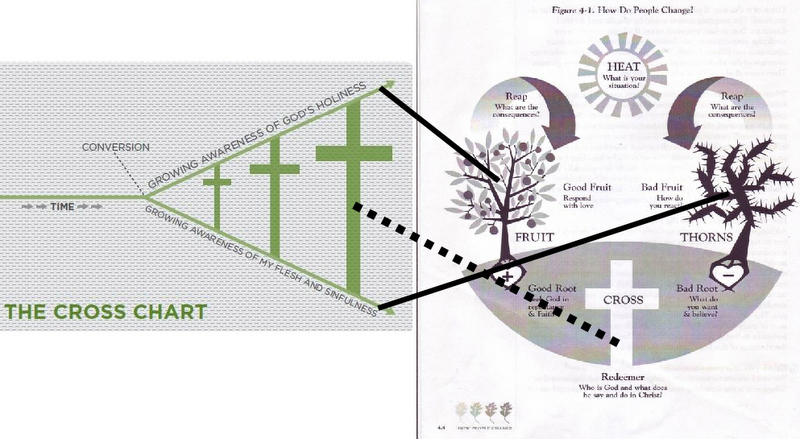
Understanding this lends insight to Tripp citations on the Peacekeepers Ministries website:
Paul Trip wrote a great post over at The Gospel Coalition blog all about the need for pastors to pursue a culture of forgiveness in their ministry. Pastors (and anyone serving Christ) have a choice:
“You can choose for disappointment to become distance, for affection to become dislike, and for a ministry partnership to morph into a search for an escape. You can taste the sad harvest of relational détente that so many church staffs live in, or you can plant better seeds and celebrate a much better harvest. The harvest of forgiveness, rooted in God’s forgiveness of you, is the kind of ministry relationship everyone wants.”
Then he describes three ways forgiveness can shape your ministry. I’ve listed them, but you can read how he explains them in detail.
“1. Forgiveness stimulates appreciation and affection.
2. Forgiveness produces patience.
3. Forgiveness is the fertile soil in which unity in relationships grows.”
He closes with this exhortation:
“So we learn to make war, but no longer with one another. Together we battle the one Enemy who is after us and our ministries. As we do this, we all become thankful that grace has freed us from the war with one another that we used to be so good at making.”
And concerning another author, they also stated:
Last week, Steve Cornell at The Gospel Coalition blog posted some really great insight into the difference between forgiveness and reconciliation. They also offered up some excellent and biblically sound steps in dealing with a situation where an offending party is hesitant to reconcile.
Here he summarizes a key distinction:
“It’s possible to forgive someone without offering immediate reconciliation. It’s possible for forgiveness to occur in the context of one’s relationship with God apart from contact with her offender. But reconciliation is focused on restoring broken relationships. And where trust is deeply broken, restoration is a process—sometimes, a lengthy one”…. His ten guidelines for those hesitant to reconcile are rooted in scripture and, I think, incredibly helpful.
1. Be honest about your motives.
2. Be humble in your attitude.
3. Be prayerful about the one who hurt you.
4. Be willing to admit ways you might have contributed to the problem.
5. Be honest with the offender.
6. Be objective about your hesitancy.
7. Be clear about the guidelines for restoration.
8. Be alert to Satan’s schemes.
9. Be mindful of God’s control.
10. Be realistic about the process.
Notice the overall blurring of distinction between the offended and offender with the subject of forgiveness.
The Cross-centered Anti-justice Pandemic is No longer Exclusively a Reformed Thing
Apart from Calvinism, the redemptive historical cross-centered approach is crossing denominational lines en masse. We at TANC see doctrines that were born of Luther’s theology of the cross in non-Reformed circles constantly; specifically, heart theology (deep repentance), exclusive interpretation of the Scriptures through a redemptive prism, Gospel Sanctification, and John Piper’s Christian hedonism. And we also see the same results. It is not beyond the pale for a pastor who has raped a parishioner to be the one counseling the victim sinner. You know, the “sinner saved by grace.”
God is a God of justice, and throughout the Scriptures He demands that we be people of justice. He demands that we come to the defense of the victim. I close with fitting words from church historian John Immel:
And this is the challenge. This is the challenge that I have as a man who is passionate about thinking: to inspire people to engage in complex ideas that drive tyranny. So here’s my challenge to those who are listening.
Do not be seduced into believing that righteousness is retreat from the world.
Do not be seduced into believing that spirituality is defined by weakness and that timid caution for fear of committing potential error is a reason to be quiet.
Do not be intimidated by vague, hazy threats of failure.
Do not let yourself believe that faith is a license to irrationality. I’m going to say that again to you. This is good. Do not let yourself believe that faith is a license to irrationality.
Do not mistake the simple nature of God’s love for a justification for simple-mindedness.
Do not deceive yourself with the polite notion that you are above the fray, that your right to believe is sufficient to the cause of righteousness. There is no more stunning conceit.
Do not pretend that your unwillingness to argue is the validation of truth.
Know this: Virtue in a vacuum is like the proverbial sound in the forest–irrelevant without a witness. Character is no private deed. To retreat is nothing more than a man closing his eyes and shutting his mouth to injustice.
Virtues are not estimates to be lofted gently against evil.
Virtues are not to be withheld from view in the name of grace.
Virtues are not to be politely swallowed in humble realization that we are all just sinners anyway.
Love is not a moral blank check against the endless tide of indulgent action.
Love is not blind to the cause and effect of reality.
Love is not indifference to plunder and injustice and servitude.
The time is now, you men of private virtue, to emerge from your fortress of solitude and demonstrate that you are worthy of a life that bears your name. The time is now, you men of private virtue, to answer Mick Jagger and all the nihilists that insist we are living on the edge and we cannot help but fall. It is time for you men of private virtue to take up the cause of human existence and think.
~TANC 2012 Conference on Gospel Discernment and Spiritual Tyranny: John Immel; session 1, “Assumptions + Logic = Action.”
paul
Reformed Questions in Response to “False Reformation”
 Paul,
Paul,
Just a few questions:
1. If you accept the idea that “flesh” and “spirit” refer to parts of regenerate believers rather than to spheres in which people live and by which we are controlled, where does sanctification take place, in the flesh or in the spirit? The same question applies in terms of “old man”/ “new man.” Which of those grows in sanctification?
Answer: This question reflects the fact that the Reformed crowd doesn’t openly discuss what they really believe about this issue, and I commend you accordingly. Authentic Reformed doctrine holds to the idea that the active obedience of Christ is manifested in the “Spirit realm” as a result of what we see in the Bible being imputed to us by faith alone in sanctification (see Luther’s Heidelberg Disputation, theses 27). We don’t change. The “Spirit realm” and the “flesh realm” are two forces that put pressure on us, and at any given time, we “yield” to one or the other. This is the position of the elders who are over the NANC training center in Springboro, Ohio according to an email I received from them when they thought I was onboard with their doctrine.
Of course, the take on this varies among those in the Reformed tradition. Another example would be the idea that we are still dead spiritually, and the living Christ within us is the one obeying. What is consistent is the idea that this obedience is experienced in a certain way: joy and a willing spirit (see LHD, theses 27); that’s how we know Jesus is doing it and not us. At any rate, the crux of Reformed theology is that all good works take place outside of the believer; i.e., Luther’s “alien righteousness” for not only justification, but for sanctification as well. Your question is at the very core of debates that took place between heretic Dr. Ed Welch of CCEF and the commendable Dr. Jay Adams.
Jay Adams oversees INS as he was pretty much run out of NANC and CCEF—largely due to the fact that NANC and CCEF are both bastions of evil. I find it utterly intolerable that thousands are sent to these organizations daily with the hope of change when these Reformed organizations in fact don’t believe that God changes them. There are no words for my loathing of such hideous deception while these organizations also take people’s hard-earned money to boot. And some don’t go along with these ideas, but they stand silent and therefore are just as guilty. And my “whole life” is contending against this? Perhaps, but better that than one’s whole life buying acceptance with silence. Moreover, people praise CJ Mahaney and co. for their tireless night and day service to the “gospel” which is really the work of the kingdom of darkness against the kingdom of light. A pity that I would counter that with my own life.
Unfortunately, Adams, who is much more advanced in patience than I am—associates with them, and in my estimation thereby causes confusion regarding the kind of counseling that will change people. Also, the possibility that the only biblical counseling organization left on the face of the earth that is not infected with Trippism and Powlisonism is also a major concern. Nevertheless, Adams and his associate, Donn Arms, are the only ones who have taken a stand against the heretical onslaught taking place in biblical counseling circles which is fraught with mindless followers, lackeys, lovers of filthy lucre, shameless cowards, and lying integrationists. The idea that these people care about any marriage or the well being of any saint is laughable.
But to answer your question completely, I believe the Scriptures are clear that the old self was put to death and no longer has the ability to enslave us to sin. The old self was “under the law” which means that the law provoked him to sin and a final judgment according to the law. As long as we are alive, our mortality has influence over us in regard to the old ways of being under the law, but the enslavement is broken. We are in fact born again, and have a regenerated “law of our mind.” Hence, “the spirit is willing, but the flesh is weak.” The warfare takes place inside of the believer between the law of his mind and the “law of sin.” The apostle makes it absolutely clear: this warfare takes place between my “inner being” and “in my members.” What is clearer? Unless the Bible is a Reformed gospel narrative that isn’t meant to inform our co-laboring with God in sanctification. But it is, because we are no longer “under” it for justification, but are informed by it for sanctification. Because the Reformers believe we are still under it, we must continue to live by the gospel that saved us from the law. We are still under it, but Jesus keeps it for us. How this is applied to the Christian life by the Reformers is outright Gnosticism to the core.
Furthermore, the “law of my mind” part of the believer that “delights in the law” in our “inner being” is what grows. Something in us is in fact growing: a host of passages that include 1Peter 2:1-3 make this certain. Really? Jesus isn’t really talking to us when he states, “Well done faithful servant”?
2. Do you believe sanctification occurs completely apart from faith? Do we have everything we need at the point of regeneration, so that further dependence on the Holy Spirit is no longer necessary? It sounds as if that is what you are saying.
Answer: Your question is framed within the confines of the Reformed either/or hermeneutic. Reality is either interpreted through the “glory story” or the “cross story.” This is the interpretive foundation of Reformed theology as stated in Luther’s HD. Because sanctification includes us, it must be by faith alone like salvation or it includes our glory as well. Therefore, where faith is, it must be by faith alone because faith is of God who will not share His glory with another. Therefore, if our doing is involved with sanctification, it must occur completely apart from faith. It must be the glory story, or the cross story. Reformed proponent Gerhard Forde states this in no uncertain terms.
Biblicists reject that metaphysical presupposition with prejudice. We stand with our beloved brother James, whom Luther rejected for obvious reasons, in saying that faith and works are together in sanctification while faith is alone in justification. Luther and his Reformed minions believe that grace is fused with works apart from our faith when it is faith in the works of Christ alone in sanctification (LHD theses 25).
Also, “Do we have everything we need at the point of regeneration, so that further dependence on the Holy Spirit is no longer necessary?” Again, we see Reformed metaphysics. If any part of our story is in the narrative, it’s semi-Pelagianism and not the cross story. This is a rather simple concept. All of the power that raised Christ from the dead is credited to our account in salvation. The Holy Spirit, our “HELPER” (ESV) “helps” us (that’s what a “helper” does, they “help”) in appropriating the blessings of salvation. He aids us (that’s what a “helper” does, he “aids”). And those blessings are appropriated “IN” (that’s a preposition) the DOING (James 1:25).
3. Do you believe Jesus’ actions are ever to be considered not only as instructional as a pattern for our obedience, but as motivation to imitate him?
Answer: As many have forcefully argued in several articles, especially Presbyterian Pastor Terry Johnson, God uses many different incentives to motivate us other than gratitude and meditating on the salvific works of Christ. This was also Adams’ primary contention against Sonship Theology.
4. Do you see any difference between God’s work in a believer that replaces his need to obey and God’s work in believers motivating them to obey?
Answer: The very question suggests a “need” to “replace (s)” the “need” of a believer to “obey” in sanctification? Of course, a clear distinction is not made regarding….in sanctification or justification? But, NO SUCH NEED EXISTS for sanctification. Our work in sanctification has NO bearing on our justification. The premise of the question is based on faulty Reformed presuppositions.
5. How do you see the Reformed doctrine as teaching that sanctification completes justification?
Answer: They call it a “CHAIN” (The golden chain of salvation-Romans 8:29,30). What’s a “chain”? What happens if you remove the middle links of a “chain” ? It’s not completed—this would seem apparent.
paul

 Paul's Passing Thoughts
3 comments