The Potter’s House: Lesson 71 of Romans Series
The Potter’s House: Romans 15:1-14; Points About Authority and the One Body of Jews and Gentiles
We are finally back to our study in the book of Romans. We have the last two chapters left, and this morning we resume at verse one in chapter 15. The first eleven chapters are a heavy dose of justification, and what we have learned from them has radically transformed our lives. A lot of Bible “learning” unfortunately comes from second hand knowledge rather than God speaking directly to us. After learning many things about justification in the first eleven chapters, we are now learning many things about the roles of Christians in kingdom living. One we should take note of is that there is NO horizontal authority among God’s people. Elders aid believers in exploiting the full potential of their hope—they have no authority.
God’s assembly is not an institution. Institutions are always defined by some kind of authority structure. Authority necessarily needs something to be in charge of, and at least within the walls of the institutional church, it is in charge of truth which leads to orthodoxy. An explanation of truth that is a commentary between God and everyday people is a troubling idea in and of itself. Once you concede that there is horizontal authority in the church, the logical questions that follow are not only troubling, but are answered by the slippery slope of Protestant tyranny. Authority is conceded, but the specific bounds are the elephant in the room because history shows that the church is utterly unable to restrain its own authority. As John Immel often notes, “polity,” or church polity is a soft term for church government. This all implies an authority over truth on behalf of God. There is no orthodoxy—only truth. There is no church government—only gifts, and there is no authority other than Christ.
And as we progress in Romans from chapter 12, we see this reality more and more, beginning with verse 1 here in chapter 15:
We who are strong ought to bear with the failings of the weak and not to please ourselves. 2 Each of us should please our neighbors for their good, to build them up. (NIV)
“Neighbors” is really a word that refers to someone close. It doesn’t exclude the literal neighbors of the hearers, but primarily refers to the fellow believers at Rome. Notice that this verse is an exhortation to the “strong,” and “each of us” in general should focus on building others up. This is a glaring pattern in the New Testament. The call to build up the body is to everyone and those we usually deem as God’s authoritarians are conspicuously missing throughout Scripture. In regard to the all-important elders and pastors, where are they? An inspection of Scripture in regard to this question reveals a stunning reality: elders and pastors have little significance in the New Testament. The emphasis is everyone working together for the building up of the body which as we will see includes a call to ministry usually ascribed to pastors and elders. Where are the elders? And who are all of these people who are supposed to be doing their jobs?
Let’s look at the word, “shepherd,” as in, you know, John MacArthur’s annual “Shepherd’s Conference.” The word (poimēn) appears 17 times in the New Testament and mostly refers to Christ or literal shepherds of herds. As far as I can tell, the word is only used once in regard to a pastor and that is in Ephesians 4:11. Think about that, reference to pastors as a shepherd appears ONCE in the New Testament.
Let’s look at “overseer.” The word (episkopos) appears five times in the New Testament. It refers to pastors once in Acts, once in 1Timothy, Once in Titus, Once in Philippians, and a reference in 1Peter about Christ.
Let’s look at the word “pastor.” It is the same word as “shepherd.” The two are used interchangeably in English translations. Both together represent the aforementioned 17 citations of which one speaks directly to the idea of “pastor.”
Let’s look at the word “bishop.” See, “overseer.” Again, these two words are used interchangeably for the same Greek word in the English translations.
But most telling is where these words are not used. In the magnum opus of justification, Romans, elders are not spoken of in any way, shape, or form. In the magnum opus of correction, the two letters to the Corinthians, again, there is no mention of pastors or their supposed roles even in Christianity gone wild. Of the 27 New Testament letters, at least 19 are corrective and address false doctrine, yet as mentioned before, a direct reference to pastors only occur in about five books. Only three books address leadership specifically with the remainder always addressing the congregation as a whole. Even in regard to the letters addressed to individuals, they were obviously intended to be made very public as well.
But most astounding is the fact that throughout the Scriptures those who are primarily addressed, the general congregation of God’s people, are called on to do ministries that we usually attribute to the “qualified pastorate.” And we will continue to see that throughout this study as well.
Romans 15:3 – For even Christ did not please himself but, as it is written:
“The insults of those who insult you have fallen on me.” (Psalm 69:9)
4 For everything that was written in the past was written to teach us, so that through the endurance taught in the Scriptures and the encouragement they provide we might have hope. (NIV)
The Scriptures were written to “teach us.” This is a direct line of sight from the Bible to believers in general. Nowhere in Scripture is there any merit for an orthodoxy overseen by elitist teachers or elders.
Romans 15:5 – May the God who gives endurance and encouragement give you the same attitude of mind toward each other that Christ Jesus had, 6 so that with one mind and one voice you may glorify the God and Father of our Lord Jesus Christ. (NIV)
Listen, this is it in a nutshell: the goal of one mind in Christ resulting in one voice. You decide from what we have learned in the past two lessons; does Paul say that is a result of blind obedience to authority, or is everyone to be convinced in their own mind? Granted, persuading those who are free to follow their own conscience is hard work. But that is the calling of a true elder. The New Testament does not endorse the dictation of truth in any way, shape, or form.
7 Accept one another, then, just as Christ accepted you, in order to bring praise to God. 8 For I tell you that Christ has become a servant of the Jews on behalf of God’s truth, so that the promises made to the patriarchs might be confirmed 9 and, moreover, that the Gentiles might glorify God for his mercy. As it is written: (NIV)
“Therefore I will praise you among the Gentiles;
I will sing the praises of your name.” (2 Sam. 22:50; Ps. 18:49)
10 Again, it says,
“Rejoice, you Gentiles, with his people.” (Deut. 32:43)
11 And again,
“Praise the Lord, all you Gentiles let all the peoples extol him.” (Psalm 117:1)
12 And again, Isaiah says,
“The Root of Jesse will spring up, one who will arise to rule over the nations; in him the Gentiles will hope.” (Isaiah 11:10)
When Paul writes, “Accept one another, then, just as Christ accepted you, in order to bring praise to God” he is talking about Jew and Gentile, he is writing about the mystery of the gospel. Remember what that is? It is God’s promise that He would bring Jew and Gentile together into one body for His praise and glory. And I do not think that goal has ceased—this is still the mystery of the gospel. This is why anti-Semitism is completely unacceptable among confessing Christians. Listen, any separation gospel or supersessionism is a blatant denial of the gospel. And this is yet another lost aspect of Christianity that must be recultivated; that is, the mystery of the gospel. Jew and Gentile worshipping together in unity is a major source of glorification. This opportunity is probably lost to a great degree because of Jewish customs that are no longer recognized by Christians. We know that Christ’s assemblies recognized Passover for at least 200 years after Christ’s ascension.
As home fellowships learn and grow, I think we will see the power of God’s word come alive to His glory in many-faceted ways. Also, let’s note Paul’s use of the Scriptures to make his case in citing three Old Testament passages. This speaks to the continuity and truth that guides us.
13 May the God of hope fill you with all joy and peace as you trust in him, so that you may overflow with hope by the power of the Holy Spirit. 14 I myself am convinced, my brothers and sisters, that you yourselves are full of goodness, filled with knowledge and competent to instruct one another. 15 Yet I have written you quite boldly on some points to remind you of them again, because of the grace God gave me 16 to be a minister of Christ Jesus to the Gentiles. He gave me the priestly duty of proclaiming the gospel of God, so that the Gentiles might become an offering acceptable to God, sanctified by the Holy Spirit. (NIV)
Once again, on the one hand, we see a sparse emphasis on elders in the New Testament while God’s people in general are told to do the tasks and ministries that are usually attributed to the “expertise” of the elder.
I myself am convinced, my brothers and sisters, that you yourselves are full of goodness, filled with knowledge and competent to instruct one another.
The fact that the institutional church pays pastor’s CEO-like wages for something that God’s people are called on to do leaves one dumbfounded in the face of how powerful the traditions of men are. The Scriptures are clear as to what roles pastor’s play in Christ’s assembly.
Ephesians 4:11 – So Christ himself gave the apostles, the prophets, the evangelists, the pastors and teachers, 12 to equip his people for works of service, so that the body of Christ may be built up 13 until we all reach unity in the faith and in the knowledge of the Son of God and become mature, attaining to the whole measure of the fullness of Christ.
14 Then we will no longer be infants, tossed back and forth by the waves, and blown here and there by every wind of teaching and by the cunning and craftiness of people in their deceitful scheming. 15 Instead, speaking the truth in love, we will grow to become in every respect the mature body of him who is the head, that is, Christ. 16 From him the whole body, joined and held together by every supporting ligament, grows and builds itself up in love, as each part does its work.
First of all, some of these gifts are starter gifts. Prophets were a temporary gift to the church to get things started. But at any rate, these are “gifts” and not offices of authority. Pastors are not mediators or authoritarians. The office of mediator between man and God and the authority thereof is the exclusive office of Christ. Unity in regard to a single truth is not by authority, but as each Christian is “convinced in their own mind” (Rom 14:5). The apostles who were the forerunners of the elders (1Pet 5:1), and continually beseeched the saints to be “one mind in Christ” (Rom 15:6, Phil 2:2, 1Cor 1:10, 1Pet 3:8, 1Cor 2:16).
Key to this unity and cooperation is a proper biblical ministry model. Listen, if the mystery of the gospel is the joining of Jew and Gentile into one body, who’s in charge? That’s an interesting question, no? The answer is that no one in these two groups has authority—it’s a cooperation of gifts under one head which is Christ. What is the biblical ministry model?
Ephesians 4:4 – There is one body and one Spirit—just as you were called to the one hope that belongs to your call— 5 one Lord, one faith, one baptism, 6 one God and Father of all, who is over all and through all and in all.
When Christ arrived on the scene and began preaching the good news of the kingdom of God, it was in the midst of a Jewish religious community heavily predicated on hierarchy and authority. Judaism was an institutional monstrosity fraught with the traditions of the Jewish sages and ruling sects. The issue of Jesus’ lack of formal authority in institutional Judaism is a constant theme throughout the gospels. This is the reason Jesus came performing authenticating miracles—if you were not a recognized religious authority in that day, your ministry was going nowhere. Jesus broke the cycle and ushered in a new ministry model. Today, we don’t have authenticating miracles to validate our message, but we do have the testimony of the Scriptures.
Regardless of the massive religious system of that day, Christ made it clear that the people were “sheep without a shepherd.” They were not led. Jesus was not talking about a lack in the people being ruled over, there was plenty of that, He was talking about the people not being led in the truth.
The new way is a body of believers working together in mutual edification according to the gifts given them by God—a faith working through love. It is unity in one truth according to the way the one master thinks, and that one master is Christ. We are baptized once into one body with one head—one master—one Lord.
Our calling is unity in the one body and its maturity to God’s glory. Over and over and over again the apostles “appeal” to love and unity—NOT authority. It is a cooperation of gifts that are obedient to the one Master. In the rest of chapter 15 and also chapter 16, we see this in action bigtime.
The Heavenly B-52s Can Save American Christianity from Its Present Dark Age
 Originally published February 11, 2013
We must remember that the Dark Ages were a European thing. And we must remember that Greco-Roman philosophy was the source and then it was turbocharged with the integration of European style religiosity. European religion has always been grounded in Plato’s disdain for humanity. Hence, one philosopher stated well that faith and force together are the destroyers of the modern world. One of the most notable historians of our time, K.R. Popper, fingered Plato specifically in regard to the logic that has wreaked havoc on Western culture through Communism, Islam, Catholicism, and Reformed theology. Augustine, one of the fathers of the Reformation, called Plato a pre-Christian Christian, and the juggernaut of faith and force was thus born.
And primarily, American religion was imported from Europe via the Puritans who were a European style religious political sect. They wanted to create a theocracy of their own in the new world. That’s the “religious freedom” they sought in America—a political one. Ironically, this importation of a European pandemic is romanticized by the Thanksgiving holiday. Somehow, deep in our evangelical American psyche, we think the Puritans could have led us to the religious utopia that we all lust for. And in fact, deep in our evangelical psyches, we think the war still rages between our Puritan foundations and the evils of Enlightenment philosophy. And if Enlightenment philosophy would surrender, all would be well and the heavenly Jerusalem would finally come down to Earth.
Nothing could be further from the truth. Enlightenment thought, even with its many abhorrent shortcomings, launched America to unprecedented greatness as a nation because of three basic principles that God agrees with: man is free; man is capable; and man is responsible for the sum and substance of his own life before God. Men “small and great” will all stand before God. Plato’s philosopher kings do not stand before God in our stead regardless of the priestly garb that the Reformers have adorned them with.
In the movie Moneyball, based on a true story, the General Manager of the Oakland A’s baseball team set all time league records with a meager budget and has-been players by breaking tradition with the ways big league teams have always been built. The player’s manager of the team was against the plan, and was a constant hindrance to its implementation. But when the Oakland A’s became the talk of the sports world because of the plan, the player’s manager got all of the credit. In the same way, the manager of American Christianity, the one of 95 Theses fame, Martin Luther, is given credit for America’s greatness. God has blessed America because of the Puritan missionary children that he spawned. Their roots are the lifeblood of America. We were “founded on their Christian principles.” This is a significant departure from reality.
Luther despised reason. He believed that reasoning was a dangerous stunt that the unenlightened masses shouldn’t try at home. And because they are not capable, they have to be protected from themselves; hence, neither are they free. To the degree that we are free the world is in a spree. Man must be saved from himself; by force if necessary, and for the good of the world. Martin Luther to the rescue. Stalin to the rescue. Muhammad to the rescue. The Moral Majority to the rescue. And on every Thanksgiving Day, deep, deep in our American psyche, a small still voice cries out: “Oh but for the Puritans! What could we be?” It’s all the same logic. You can dress it up in different doctrines, but it’s all the same. Logic comes in many doctrinal forms—both secular and religious.
The founding fathers of this country were children of the Enlightenment era. Until America popped up on the history radar screen, force and faith was the big league tradition. Our founding fathers proposed something different: government as the protector of man’s right to be free, capable, and responsible. And a government that served at the pleasure of the people to do so. It is a testimony to the power that is displayed when merely three ideas from God are implemented in our realty. Three ideas from God made America the envy of all world history. In the end, the motif that any child can perceive in the book of Revelation will fill the world with blood up to the horse’s bridles: force and faith. To what is said here, the proffers of force and faith, the Reformed of our day, answer in all of their Puritan glory, “I beg your pardon! Jesus Christ should be the envy of the world!” But which Jesus Christ? The Puritan Jesus Christ? And enlightened minds want to know: “Are we free to decide that for ourselves?” And: “Are we capable of even knowing that?” We fear that the answer to both of these questions is, “No.” And that is why giving you power in our lives at any level is a really bad idea.
Hence, To the degree that the Reformed Dark Age feigns, darkness in the American church does rein. And we are in that Dark Age. It came in essence as logic stowed away in the Mayflower’s diseased European rats bringing the same plague with it. I could drag out all of the apocalyptic data and its many faceted manifestations, but a recent televised top of the hour newscast introduction will suffice:
Here we go again, another sex scandal in the Evangelical church.
You notice they said, “Evangelical” and not “Catholic.” Anybody who knows the facts knows that sexual abuse and the subsequent cover-ups are just as prevalent in the Protestant Evangelical Church as it is in the Catholic Church. The scandals are the same, and the silence among clergy is the same, along with the same disregard for victims. Different doctrines—same logic—same results. Logic always has an endgame; there are many different doctrines that can get you there.
But the American Dark Age takes on a different appearance than the open fires of European religious wars and unspeakable terrors for it is tempered with freedom, capability, and responsibility. In the same way that God’s spies found refuge with a harlot, the American church has been saved from itself by Enlightenment thought. The result has been Reformed Light, and the carnage has been greatly limited. The European Reformers believed that children should be seen and not heard; American Reformed Light allows their children to play in a sandbox. Children are happier when they have a sandbox to play in, and they can form all kinds of ideas in what they make in the sand. But when it is time for dinner, it’s also time to put our little buckets and shovels away, run to the dinner bell, and obey mommy and daddy. They protect us from truth that can cause division because we are unable to handle truth, and they make truth a storybook that we can understand. They read it to us at night, and we are much comforted. We can pretend in the backyard, and we feel safe because mommy is watching from the kitchen window.
But the children of Reformed Light do not grow up. For certain, the American church is every bit like grown adults playing in a sandbox. The real Reformers now come forward and scoff at the pathetic sight, and say they are the answer. Yes, not playing with ideas at all must be the answer. Adults in a sandbox is not the problem, the sandbox is the problem. Sandboxes tempt people to play with truth. The Reformers to the rescue—those half breed Semi-Pelagian parents be damned.
Children in adult bodies will always rape, hate, pillage and steal. It is what it is: spiritually, they were born slaves, born incapable, and born irresponsible. Reformed theology is a bus of misfits, but all believe that it is the only bus going to heaven—the bus of faith alone in Puritan sanctification. All kinds are on the bus, but the tie that binds is womb to the tomb total depravity.
Some do not persevere in accepting their total depravity and the total depravity of others. Some do not trust God’s anointed to get the bus of misfits to heaven, so an Inquisition is needed. The European Reformers used the gallows and the burning stake (if the victim was lucky), brainwashing, and orthodoxy. The American Reformers can use brainwashing and orthodoxy, but because of the founding fathers, the American Reformers must replace the gallows and burning stake with character assassination, authority to condemn eternally, and false criminality. And all of the aforementioned paints the portrait of the present-day American Dark Age in the church. There is a little metal plate on the bottom of the spectacular painting hanging in the gallery of human history, and it reads:
Here we go again.
The Bible is written for mass consumption. All Bible books, save a few, were written to assemblies and not leadership. God has also written his word on the hearts of every person ever born into the world (Romans 2:14). We are all responsible before God, free to obey Him or not Obey Him, and obviously, must exercise our minds for understanding. We also live in the information age; so, if man was without excuse in the days of the apostolic church (Romans 2:1) we are certainly without excuse today.
Nations, particularly the USA, have used heavy bombers to drop propaganda leaflets on cities before an invasion or in an attempt to turn the population at large against the enemy leadership. Each bomb usually weighs about 250 lbs. and rains about 60,000 leaflets on a given area. During the Iraq/US war, leaflet bombings resulted in the mass surrender of Iraqi soldiers. In the same way, regardless of what’s going on in the world, God has a message of truth for every person. Invariably, it is man’s responsibility to do what God wants him to do in any given situation.
God has given the truth to all men, and only the truth will set us free. We need to pick up and read the leaflet and surrender to the Chief Shepherd. The Reformation is responsible for this present Dark Age in the American church. It is a doctrine that must be rejected with prejudice, and we must disdain anything that has touched its filthy garments.
A little leaven leavens the whole lump.
paul
Absolutely Critical to Effective Ministry: Knowing the Two Realities of Protestantism
 If we are to accomplish anything in contemporary Christianity, we must begin to live by a basic hard-fast rule: our actions must be guided by the knowledge that there are two realities in contemporary Christianity; grammatical-historical and redemptive-historical.
These are usually discussed as methods of Bible interpretation, but they are really much more than that according to Protestant tradition. These are two different ways of interpreting reality itself.
We will begin by defining the redemptive-historical interpretation of reality along with this caution: one of the most powerful influences that this view of reality has is the dismissal of its basic premise as mere mysticism held by fringe elements of Protestantism. Those who dismiss it out-of-hand then proceed to function by its tenets unawares. The who’s who of Protestantism care little that the masses understand this ideology, just so they function by it.
In fact, Protestant leaders assume most parishioners are unable to grasp its tenets. Therefore, redemptive-historical reality must be explained in a way that will enable congregants to apply it to their lives and function a certain way within church culture. Redemptive-historical reality is primarily the crux of Protestant orthodoxy and its spiritual caste system.
In mythology, we often link the bizarre narratives to the philosophy itself, but that’s a mistake. Roman, Greek, and Babylonian culture was not developed by superstitious idiots. What we fail to understand is the narratives are stories that convey principles to the spiritual underlings so they can apply principles of higher knowledge to their lives. They cannot understand the higher knowledge, but those who can need to tell the underlings how to live in order to obtain the best possible society.
“Orthodoxy” can be likened to mythological narratives that teach those of lesser spiritual understanding how they should live, but they are based on well thought out metaphysical (state of being) systems of knowledge. We shouldn’t be surprised that what seems to be superstition has ruled the greatest empires on earth. This is because the core ideology is always a succinct system of thought that is greatly underestimated. The ancient philosophers were not idiots. Democritus (circa 400 BC) was the originator of atomic theory. The sophist class of philosophers were the first to apply philosophy to sociology in an in-depth way (circa 500 BC). ALL present-day psychologies are founded on the basic theories of that day. For example, the basic ideology that drives the theory of rehabilitation in our modern-day prison systems came from Socrates.
Let’s now define redemptive-historical reality. I will be using a quote from Graeme Goldsworthy who is considered to be the contemporary father of redemptive-historical hermeneutics:
If the story is true, Jesus Christ is the interpretative key to every fact in the universe and, of course, the Bible is one such fact. He is thus the hermeneutic principle that applies first to the Bible as the ground for understanding, and also to the whole of reality (Graeme Goldsworthy: Gospel-centered Hermeneutics; p.48).
This is a pretty straight forward statement and accurately depicts what Protestantism is really founded on; not a theology per se, but a way to interpret reality itself. How in the world does one interpret all of reality through the one person Jesus Christ? You MUST understand: Martin Luther articulated the answer in the foundational treatise of Protestantism, the Heidelberg Disputation.
The Heidelberg Disputation is a concise systematic ideology that explains how all of reality is to be interpreted through redemption, or if you will, the man of redemption, Jesus Christ. Again, the power of this ideology is a dismissal of it out-of-hand by those who proceed to sit under its “theology.” The theology of the metaphysics redefines biblical terms, and uses them to lead the masses into a functioning Christocentric view of reality.
We will not plunge the depths of the Heidelberg Disputation in this writing, but the principles will be outlined and their inevitable functionality among Christians. Before we move forward, let’s examine additional statements that confirm this approach among Christians. This testimony was given in a recent email to me:
An old acquaintance of ours (Presbyterian as they get) has said more times than I can remember something like this: “Every verse in the Bible, from Genesis 1 through Revelation, is talking about Jesus.” Years ago that sounded so intellectual, holy; today it sounds like hogwash. I mean, are we really expected to believe that the passages talking about incestuous rape are talking about Jesus? Come on, really?
Well, as ridiculous as it sounds, the answer is, “yes.” Many function according to the theology that is predicated on this foundational interpretive method for not only the Bible, but reality itself.
Pause: keep in mind that those who function according to this interpretation of reality without understanding its premise will reflect back the resulting interpretation of Scripture. They repeat pulpit talking points without ever investigating the source of them, or the logical conclusions of the talking points. Sometimes, such people are referred to as “useful idiots.” But again we need to be cautious: people who blindly follow others do not do so for the sake of following blindly—they are functioning according to some sort of ideology that leads to the blind following.

Let’s look at some more examples from proponents of New Covenant Theology:
New Covenant Theology insists on the priority of Jesus Christ over all things, including history, revelation, and redemption. New Covenant Theology presumes a Christocentricity to the understanding and meaning of all reality (1st tenet of NCT according to the Earth Stove Society, a NCT think tank).
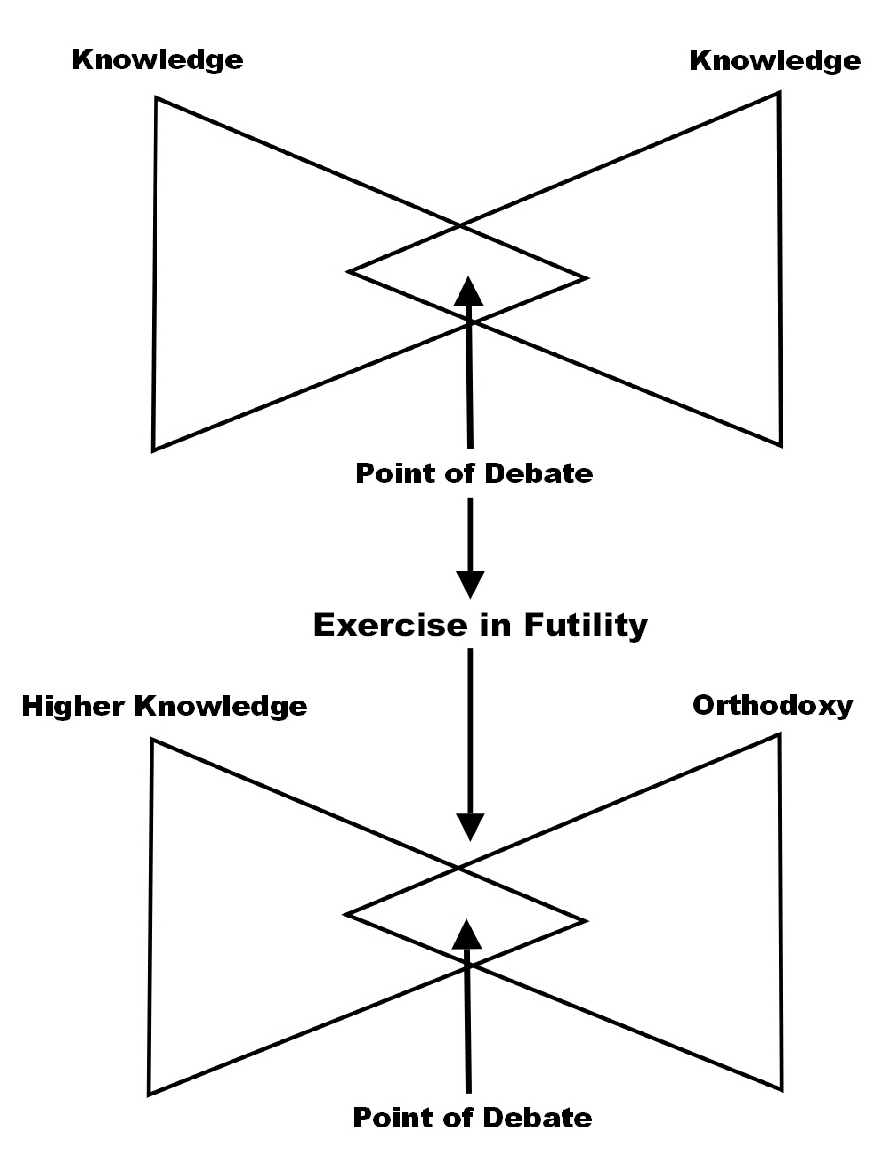
Not much ambiguity in that statement. Pretty clear on its face except for how one would apply it to real life. Again, many might scratch their head in regard to that statement, but proceed to let the theological orthodoxy that flows from it shape their life and thinking. At the point of debate with such people, their orthodoxed talking points will reflect the metaphysical premise. They will absolutely not be swayed in their thinking because they concede that they cannot understand the higher knowledge, and the authority of the higher knowledge is part of the orthodoxy.
Pause: I used to be involved in a ministry that evangelized Jehovah Witnesses. Debating the Bible with them led nowhere because their orthodoxy reinterprets all biblical terms and phraseology. When Christ is referred to, it is assumed that their presuppositions regarding Christ are the same, and they are not. Instead, we challenged their orthodoxy, i.e., the Watchtower publication. Likewise, let me reveal a concluding theme of this study: never debate the Bible with a Protestant; instead, bring their authority into question. Refuse to discuss anything else for it will be futile for reasons yet to be examined.
Let’s look at another statement from the New Covenant Theology camp:
At this time, resist the temptation to utilize subsequent passages to validate the meaning or to move out from the immediate context. Remembering that all exegesis must finally be a Christocentric exegesis.
Look for Christ even if He isn’t there directly. It is better to see Christ in a text even if He isn’t, than to miss Him where He is (The Biblical Theological Study Center: A Christo-Presuppositional Approach to the Entire Scriptures; Max Strange. Online source: http://goo.gl/5sGjP).
The question quickly becomes, “How can you see Jesus in every verse in the Bible?” This is where the Bible becomes a “meta-narrative.” That can mean, “grand narrative,” but in this case it means “metaphysical narrative.” The Bible is a narrative, or story that depicts redemptive reality. You will get confused unless you understand that the theory also posits the inclusion of multi-purpose perspectives into the metaphysical story (a story that depicts true reality). The text grammar doesn’t determine the perspective resulting in a particular objective outcome, but the assumed outcome determines the perspective. So, can “passages talking about incestuous rape” say something about redemption? Of course. In this example, the passage is not talking about Jesus specifically, but denotes why His redemptive works are needed. In some way, according to the prism, the verse always speaks of Jesus and His redemptive works.
This approach to interpreting reality (state of being, or metaphysics), what we call epistemology, plugs into the basic ancient philosophy of total inability. This proffers the idea that man cannot know or comprehend reality. The metaphysic follows: man dwells in a realm apart from true reality that he cannot comprehend. Secondly, somehow, usually via a theory of predeterminism, there are a select few that can ascertain truths from the other realm. Usually, the delineation of the realms is the material versus invisible with mankind residing in the material realm.
The Reformers recognized a reality that man functions in, but deemed it “subjective,” or shadowy. Focusing on this shadowy realm leads to despair. In the aforementioned foundational document of Protestantism, Luther contended that man’s material realm only feeds “the glory story,” or the story of man.
In Luther’s construct, ALL reality is interpreted through two stories: the glory story (the story of man), and the cross story (the story of redemption). Giving any credence to the material world or the belief that man can know the material world empirically only contributes to the story of man and his glory. Yes, man functions in this world, but it does not possess any objective wisdom that can bring true wellbeing. Only an ever-clearer understanding of the cross story can bring wellbeing.
What then is the cross story specifically? It is twofold: it is the holiness of God as set against the sinfulness of man. This is the only objective truth and reality that can bring wellbeing. The goal is a deeper and deeper understanding of how inept we are in every category of life as set against the glory and holiness of God.
Pause for main point: according to this philosophy, the sole purpose of the Bible is to lead us in seeing the cross story with more and more clarity. To the extent that we do that, we will have wellbeing. AND, to the extent that each individual lives according to the cross story, the wellbeing of society as a whole will increase. When Reformed folks talk about “transforming society with the gospel,” this is exactly what they are talking about. To the extent that the populous embraces the doctrine of inability, society will be transformed.
One reason for lauding this epistemology is unified agreement on interpretation. If every verse is about Jesus, there is no division in opinions. Secondly on this point, it gives Christianity a pass on defending inerrancy; e.g., narratives are not meant to be technical systems of theology that require consistency in logic. Thirdly on this point, if some sort of Christocentric conclusion is drawn from the text—it can’t be wrong. If the interpretation of the text somehow demeans man and exalts God, error is impossible.
Before we address the grammatical-historical approach to interpreting reality, let me add some thoughts to the redemptive-historical perspective. This perspective now dominates the institutional church. Just yesterday, I participated in a conversation on a social media site in which the following statement was made about Proverbs chapter 8:
The Old Testament reveals shadows of what Jesus Christ will be in the New Covenant. I can easily say that wisdom personified in Proverbs 8 is Jesus Christ.
If one reads Proverbs 8, the assertion that it is about Christ is beyond presumptuous at best. It is a complete rejection of the plain sense of the grammar; even in lieu of the personification being in the female gender.
Also, these two perspectives on reality are a salvific issue with the Reformed. A denial of total inability equates with the grammatical-historical view of reality which is supposedly an attempt by man to glorify himself by writing his own story. By believing that you can understand reality, you are in essence making yourself God.
The most common question is the issue of biblical imperatives that are clearly directed at mankind. This assumes that man is able to obey because grammatically, the commands are directed at him with a demand for obedience. But again, addressing these commands with the presupposition of total inability that equates with the redemptive-historical prism, the commands are supposedly meant to deliberately frustrate man and “drive him to despair of self-righteousness.”
The Reformed continually concede that the Bible states things in grammatical form, but that is always followed with the proper “gospel context” according to the redemptive-historical interpretation of reality. The classic example is this quotation from Neo-Calvinist Paul David Tripp:
….and the Bible does call us to change the way we think about things. But this approach again omits the person and work of Christ as Savior. Instead, it reduces our relationship to Christ to “think his thoughts” and “act the way Jesus would act.” (How People Change 2006, p.27).
Notice that Tripp concedes that the Bible calls us to do things according to the grammatical context, but goes on to say that is a denial of the gospel (omits the work of Christ as savior). On page 26 of the same book, Tripp calls obedience to the word of God a “behavioral approach” that “separates the commands of Scripture from their Christ-centered gospel context.”
Lastly before we move on, when one is able to wrap their minds around the redemptive-historical approach to interpreting reality, it will be recognized that this approach now saturates the Protestant institutional church.
What is the grammatical-historical approach to interpreting reality? As with the other prism, I am not going to elaborate on the “historical” part except to say that the redemptive-historical hermeneutic makes history part of the prewritten gospel narrative. History is simply the redemptive story playing out as scripted by God.
The political commentator Rush Limbaugh often notes that “words mean things.” This is a good working definition of grammatical-historical interpretation; it draws conclusions from a technical evaluation of the words in a sentence whether spoken or written. The many categories of language that give meaning are considered also, which speaks to the “historical” part of the term. Does the sentence mean the same thing today that it meant then? For instance a sentence written in 1940 might say, “Bob is gay.” History informs us of the meaning in that day: Bob is happy. Today that means Bob is a homosexual. The etymology of words and many other factors weigh-in, but all have this in common: they are empirical tools.
This interpretive method also assumes mankind is able to comprehend the realty he dwells in according to empirical observation and can draw conclusions on his own. Man has ability.
Pause: how did Luther get away with denying that mankind had any kind of ability at all? He chalked-it-up to man’s self-perceived ability that can accomplish things in the material world. These accomplishments are of no worth and only accomplish one thing and one thing only: they serve man’s lust to glorify himself. Luther believed that satisfaction from accomplishment was nothing more than sinful pride. To Luther, the only redeeming thing about the world was that heaven manifested its works on earth according to God’s sovereign will. If man lives life subjectively and professes that his evil “good” works cannot be distinguished from heavenly manifestations “experienced subjectively,” that is venial sin that can be forgiven. In accordance with authentic Reformed tradition, Luther believed the following: the belief that any man, including Christians, can perform a good work is mortal sin.
Therefore, the Reformed often define wisdom/knowledge according to two categories: “worldly knowledge” and “wisdom from above.” Sure, man can obtain worldly knowledge that improves his circumstances, but it is all prideful according to Luther. Wouldn’t this approach propagate a lot of death and misery due to a lack of science? Yes, but that was exactly Luther’s point. Many are perplexed by the embracing of ideologies that result in third world cultures, but those who are perplexed make the point for those in the other camp: what is the perplexity of the detractors? Answer: they are perplexed that other people do not lust after materialism as they do. Hence, third world cultures are often seen as being virtuous by the Reformed.
This is why Luther introduced suffering as a hermeneutic that interprets reality. There is true wisdom in the cross story because according to Luther, “all wisdom is hidden in suffering.” According to Luther, many reject this interpretation of reality and dub it the “foolishness of the cross.” Luther also stated that men call the good evil (suffering), and evil good (anything that prevents suffering). This is why Luther called reason an “ugly whore who should have dung rubbed in her face.”
The grammatical-historical perspective of reality assumes man can interpret his own reality, and the material world is not inherently evil. Believers and unbelievers share common realities that are simply practical and not evil.
Here is the challenge: to bring biblical knowledge to bear on grammatical-historical reality when the prevailing view of Protestantism has been the redemptive prism for hundreds of years.
But there is good news as well: the grammatical prism is what man utilizes intuitively. People assume they can interpret their own reality. Of course, the Reformed see this as the very problem.
Does this mean that grammatical-historical Christians should evangelize the lost world and forgo debate with Protestants? Yes it does, because it is a futile endeavor. You are trying to reach people who define reality itself differently. Protestants are redemptive-historical religionists.

The Elephant in the Room: The Historical-Redemptive Gospel
 Originally published September 3, 2013
There isn’t a bigger elephant in the Sunday school room or the sanctuary than the issue of Bible interpretation. The reason for this follows: the method of interpretation that comes natural to us is assumed.
What is that method? This gets into an area of study called hermeneutics (the theory of interpretation), and the two primary theories thereof are exegesis and eisegesis. These are big theological words that the average Protestant is not supposed to know. This is because the Protestant interpretation of the Scriptures is based on authority.
We will get to exegesis and eisegesis, but the crux of the issue is authority. The Reformers came from Romanism and clearly, their interpretive construct was based on authority; i.e., the average parishioner was not free to interpret the Bible and follow it according to one’s own conscience:
Rightfully and nobly did the Protestant Reformers claim religious liberty for themselves; but they resolutely refused to concede it to others. [1]
The very foundation of Protestant interpretation is based on authority; that is, the leaders dictate meaning. Therefore, traditionally, the need for Protestants in general to understand interpretive principles would be unnecessary, and as a result, Protestantism functions that way till this very day. In the early days of the Reformation, private interpretation was outlawed [2]; in our day, education regarding the tools needed to interpret the Bible are merely excluded.
This fact brings us to an interesting word, “orthodoxy.” Traditionally, this word is associated with “truth” as a synonym. This is not the case at all. Orthodoxy is the authority of truth based on counsels of any given sect. [3] The opinions of these counsels regarding the meaning of “truth” are known as “creeds” and “confessions.” These are “truths” (actually, opinions concerning the meaning of any given subject) repackaged for those who have limited understanding, and usually recited and learned through catechisms [4].
Authority Versus Individual Interpretation
Hence, Protestant interpretation is based on authority and not individual interpretation. The structure of this interpretive process is orthodoxy formed through counsels, distributed by creeds/confessions, and practiced through catechisms. In Europe and early Colonial America, it was a matter of civil law, in our day the process is tempered by the freedom to choose your own orthodoxy, but it is still orthodoxy. Once a typical American parishioner chooses who they want to believe, they will follow that leader as an authority. A like tendency caused the Apostle Paul to confront the believers at Corinth (1COR 3:1-9).
Of course, the authoritative method of interpretation is at the root of every cult. Traditionally, when people seek to find God, they begin by finding an authority that they are comfortable with. This is why many people prefer authoritative interpretation in a free society: it allows them to choose their own general truth while leaving the hard task of thinking to others. The Apostle Paul said this would be particularly problematic in the last days (2TIM 4:3-5).
The visible authority structure within the church is known as “church polity” or church government. [5] Again, the whole construct is based on authority. If authority is the interpretive prism, roles in the church are going to be seen as positions of authority rather than gifts. When Christ ministered here on earth, disciples were free to follow Him or not follow Him under their own free volition (JN 6:66-69). Christ made it clear to the disciples that their roles in the kingdom were not that of authority (Matthew 20:20-28).
The word “office” inserted in the English translations when associated with “bishop” or “deacon” were added in to the translations and do not appear in the Greek manuscripts while in other places these roles are spoken of as gifts (EPH 4:11-16). We have been given authority to proclaim the gospel of the kingdom on earth, but that is a vertical authority and not horizontal. Those who protest the gift idea versus the authority idea often cite the following text:
Hebrews 13:17 – Obey your leaders and submit to them, for they are keeping watch over your souls, as those who will have to give an account. Let them do this with joy and not with groaning, for that would be of no advantage to you.
The word for “obey” in this verse is πείθω (peithō) which means to persuade by argument. The word “submit” is ὑπείκω (hypeikō) which means “to surrender.” Here is the best rendering according to a heavy paraphrase:
Be persuaded by your leaders’ arguments from Scripture and don’t be stubborn in regard to the truth for this is no advantage to your own spiritual wellbeing. Besides, they have to give an account for how they led you, and let that account be a joyful recital to the Lord rather than a sorrowful report.
Why is this important? Because every person is personally culpable before God for following the truth, not men. Paul was an apostle, yet the Bereans verified what he taught according to their own understanding of Scripture (Acts 17:11). Paul told the Corinthians that he should only be followed as he followed Christ (1COR 11:1). Every individual will stand before God to give an account of the sum and substance of their own lives, not who they followed among mortals.
The Exegesis and Eisegesis of Hermeneutics
The theological word for the science of biblical interpretation is hermeneutics. The first consideration of hermeneutics must be exegesis and eisegesis. Exegesis draws conclusions from written text depending on the grammatical meaning and arrangement of words. Eisegesis approaches the text with an interpretive prism. One who uses the exegetical approach will even approach the text to learn how the text itself should be interpreted. Eisegesis assumes one must approach the text with a proper presupposition in order to properly understand it.
Therefore, this takes us right back to the basic question of authority versus the freedom of individual interpretation. Eisegesis will approach the text with a prescribed method of interpretation while exegesis will look for the best way to interpret the text from the text itself. The interpretive prism for eisegesis comes from an authority. The common contention from those of the authority camp is that everybody approaches the Bible with presuppositions, and this is unavoidable; so, it is important to use the right interpretive prism. Since we are supposedly incapable of approaching the Bible objectively, we should bow to their authority in regard to the proper interpretive prism.
Historical-Grammatical Versus Historical Redemptive: The Elephant in the Room
Eisegesis and exegesis really boils down to authority versus individualism, and so does the two major methods of interpretation in the church: historical-grammatical method and the historical-redemptive method. This is where we get into discussion about the elephant in the room. These two devices of interpretation yield completely different results. When we sit under any given teacher, he/she will be using one of these hermeneutics. The two different approaches will sound the same because each uses all of the familiar terms, “gospel,” “justification,” etc., but the terms mean different things in each construct. This is the elephant in the sanctuary and the Sunday school room that no one is talking about.
As suggested by the terms themselves, one interprets the Bible grammatically, and the other interprets the Bible through a Redemptive prism. The latter seems perfectly reasonable: “Isn’t the Bible primarily about Redemption?” The former would judge that assertion by a grammatical evaluation of the text. In other words, conclusions are drawn by the arrangement of words, their meaning, and what those words meant to people in that historical context. This is exegesis.
The redemptive method presupposes that the Bible is a gospel narrative about the works and personhood of Christ. It presupposes that this is the dominate theme of the Bible and everything else in the Bible is secondary and points back to Christ. For example, biblical commands aren’t really meant for us to obey, but rather illustrate the works that Christ has accomplished for us and illustrative of what we are unable to do. This bypasses the normal grammatical interpretation of an imperative expectation, and interprets it as a finished work that God in fact does not want us to do. This is assumed because of the redemptive presupposition. As Neo-Calvinist Paul David Tripp has said, biblical commands must be seen in their “gospel context.” [6]
The Gospel Transformation Study Bible and the Redemptive-Historical Gospel
Dr. Kathleen Nielson, in a promotional video for the Gospel Transformation study Bible, stated that the historical-redemptive theme is not imposed on the text, “it’s actually in there!” This, we by no means deny, but are the works of Christ and His personhood something that every verse in the Bible points to? Nielson, like many from the redemptive-historical camp, use the grammatical approach to determine that something is in the text, and then make that an authoritative interpretive prism.
I have talked face to face with pastors who use this hermeneutic. As one stated to me, “You might have to cover multiple chapters in one sermon in order to see the Christocentric theme God is showing you at the time.” Others are even more direct:
At this time, resist the temptation to utilize subsequent passages to validate the meaning or to move out from the immediate context. Remembering that all exegesis must finally be a Christocentric exegesis.
Look for Christ even if He isn’t there directly. It is better to see Christ in a text even if He isn’t, than to miss Him where He is. [7]
Again, we see that a “Christocentric exegesis,” something that is in the text grammatically, becomes the authoritative eisegesis. And this elephant is a big one, because interpreting the Bible this way is intrinsically tied to the gospel that comes part and parcel with the redemptive method. The historical-redemptive method is a tool for enabling the believer to live by faith alone in their Christian walk. The historical-redemptive method is actually a gospel in and of itself. To interpret the Bible grammatically is to conclude that God actually wants us to exert our own will in response to commands in the Bible. To proponents of the redemptive-historical method, this is works salvation because Christ is not obeying for us in our Christian life. This is what the Reformation motto, “Christ for us” means. The Neo-Calvinist John Piper has stated it this way, “[Christ] 100% for us.” [8] Piper has also said that “necessary sanctification” comes from faith alone in the Christian life (Ibid).
Therefore, according to proponents of the redemptive model, a historical-grammatical interpretation of Scripture necessarily leads to works salvation and making what we do in the Christian life “the ground of our justification” (Ibid). For all practical purposes, Paul David Tripp has stated such:
….and the Bible does call us to change the way we think about things. But this approach again omits the person and work of Christ as Savior. Instead, it reduces our relationship to Christ to “think his thoughts” and “act the way Jesus would act.” [9]
Here, Tripp concedes that the Bible can be interpreted grammatically, “and the Bible does call us to change the way we think about things.” Grammatically, one assumes the commandments are to us and that we are called to do them. Again, Tripp clearly recognizes this fact. But what does he say the results are?
But this approach again omits the person and work of Christ as Savior.
What happens if we “omit” Christ as “Savior”? Clearly, Tripp is stating that if we interpret the Bible literally and obey it, we are circumventing Christ’s salvific work. Much more than mere semantics are at stake here. The elephant in the room is absolutely huge! This is about the gospel.
The historical-redemptive method of interpretation is all the rage in contemporary Christianity. Projects and programs that promote this method of interpretation and target all age groups abound. Almost all Christian publishers are on board with the historical-redemptive hermeneutic. The latest project that has been unveiled towards this endeavor is Crossway Publishers’ The Gospel Transformation Bible. It will be available 10/19/13.
The subtitle is, “Christ in all of Scripture, Grace for all of Life.” This is typical of those who promote this method of interpretation and its gospel. Christians will assume that the title only pertains to justification by faith alone, but it doesn’t. “Transformation” or change has to do with the Christian life, and in the subtitle, “Grace” replaces “gospel” to veil the real crux of this doctrine. Basically, it teaches that Christians are transformed by continually revisiting the same gospel that saved them. Not only that, we keep ourselves saved by doing such. This is what is behind the Neo-Calvinist mantra, “We must preach the gospel to ourselves every day.” John Piper has said that the question is not only how one gets saved, but how one must use the same gospel that saved him/her to keep themselves saved. [10] Piper has also said that we must “see” the same gospel that saved us over and over again as a requirement to enter heaven. [11]
Note: This is what’s so critical about the Reformed historical-redemptive interpretative model according to many Calvinists, it enables us to fulfill what is “required of us” to enter heaven (Ibid). In essence, once saved, how we read our Bible determines whether we keep our salvation or not. So therefore, those who promote The Gospel Transformation Bible actually see it as a resource for maintaining one’s salvation.
The “Gospel-Driven” Life
The question that is invariably raised is, “How do proponents of the historical-redemptive model explain obedience and the Christian life?” Primarily, they say Christians must “experience” obedience, but must not be the ones who perform it in the Christian life. By revisiting the gospel afresh, the works of Christ are “manifested” in our lives. When this happens, the obedience is experienced by a willing, joyful spirit. As we use the historical-redemptive model to see how sinful we are (a deeper realization of our sin, the realization that originally saved us), and thereby gaining a greater appreciation for what Jesus did for us, we experience “vivification.” This is some sort of joyful rebirth. Proponents of this hermeneutic, primarily those of Reformed theology, refer to this as “mortification and vivification.” A “daily dying and rising,” a “living out of our baptism.” [12] [13]
The Origin of the Historical-Redemptive Hermeneutic
Where did this hermeneutic originate? Even though Martin Luther’s 95 Theses launched the Reformation, the framework of the Reformation’s doctrine and gospel was articulated by Martin Luther six months later. Essentially, Luther’s Heidelberg Disputation to the Augustinian Order in 1518 is the heart and soul of the Reformation. Calvin’s Institutes of the Christian Religion is a greatly expanded treatise of Luther’s framework. However, every fundamental element of Reformation doctrine can be found in Luther’s Disputation, and this by no means excludes the historical-redemptive hermeneutic. [14]
The primary theme of Luther’s Disputation is known as The Theology of the Cross. It was comprised of the glory story and the cross story. Luther believed that salvation must be maintained by an incessant emptying of self. One’s focus must be OUTWARD only. Any semblance of an inward look was the “glory story.” The outward focus on Christ and His works, and nothing about us whatsoever is the “cross story.” A beginning focus on the cross saves us, and a continued focus on the cross story keeps us saved the same way we were originally saved: by faith alone. Sola Fide also pertains to the Christian walk/life. The historical-redemptive model came from Luther’s Theology of the Cross.
Luther believed the outward focus and utter eradication of self leads to a subjective power displayed by the Holy Spirit that we experience. However, we are not to be concerned with it because there is no way for us to distinguish between our own efforts and those of the Spirit. [15] Mortification and vivification can be ascertained in Theses’ 16 and 17 of the Disputation.
Never have Christians been so oblivious to such a critical issue. What we believe about the gospel and how we convey it to the world is at stake. Every Sunday in America, historical-grammatical parents deliver their children to historical-redemptive teachers while clueless in regard to the ramifications. This reality actually creates mixed families and marriages via two different gospels. One spouse buys into sanctification by faith alone while the other one doesn’t. Eventually, you have a mixed marriage.
The issue with these two hermeneutics is not a matter of semantics and preference—these are two different gospels. This issue is the elephant in the sanctuary and the Sunday school room.
ENDNOTES
1. Nabu Public Domain Reprints: The Principles of the Westminster Standards Persecuting; William Marshall, D.D., Coupar – Angus. Edinburgh, William Oliphant & Co. 1873, p. 13.
2. Ibid., pp. 19-22, 28.
3. Bruce Overton: MacMillan’s Modern Dictionary; The Macmillan Co. New York 1943.
4. Ibid.
5. Ibid. designated as synonymous with “politic” : the science of government.
6. Paul David Tripp: How People Change; Punch press 2006, p. 26.
7. The Biblical Theological Study Center: A Christo-Presuppositional Approach to the Entire Scriptures; Max Strange. Online source: http://goo.gl/5sGjP).
8. John Piper: Desiring God .org blog: Video, If you had 2 minutes with the Pope, what would you say?
9. Paul David Tripp: How People Change; Punch press 2006, p. 27.
10. John Piper: Desiring God .org blog; How Does The Gospel Save Believers? Part 2. August 23, 1998 Bethlehem Baptist Church.
11. Ibid, Part 3.
12. Michael Horton: The Christian Faith: A Systematic Theology for Pilgrims On the Way; Zondervan 2011, p. 661.
13. Paul Washer: The Gospel Call and True Conversion; Part 1, Chapter 1, heading – The Essential Characteristics Of Genuine Repentance, subheading – Continuing and Deepening Work of Repentance.
14. In its fundamental elements. It was not referred to as the historical-redemptive hermeneutic for many years afterward.
15. Heidelberg Disputation: Theses 24.
Why Home Fellowships Can Help Abused Women and the Institutional Church Cannot

In our vision for a return to the way Judeo-Christian assemblies were done for about the first 300 years, let’s look at why home fellowships can help abused women and the institutional church cannot.
I would like to use this article as a catalyst for argumentation. The article was posted (author is not clearly stated) by Anna Wood who co-authored a book with Jeff Crippen, a Reformed pastor. The book can be found here.
The post is titled, What domestic abuse victims need from the church. My contention is that abused women cannot get what they need from “the church” as demonstrated over and over and over again. In fact, clearly, as also demonstrated over and over and over again as well, the institutional church adds to the abuse and becomes a co-abuser.
Why is this? The article offers a perspective from which to answer. This issue also speaks to the differences between home fellowships and the institutional church, hereafter “the church.” In an institution, it is easy to sign on the dotted line, give at the office, and pretend. Pastors can bark from Calvin’s Geneva pulpit all they want to; all folks have to say is, “Hey, I am a member in good standing, and as often heard, humble and incompetent—it’s not my gift and I am not qualified.” Likewise, in said article, the author’s call to “get involved” is going nowhere in the church in case anyone hasn’t noticed.
To the contrary, home fellowships are comprised of people who are sick of playing church, are weary of being mere spectators, and are not looking to walk into an arena with hungry lions, but know it could lead to that. They are also confident in the Spirit-filled laity and recognize where 500 years of academic popeism has brought us. In addition, they have a literal view of reality versus the functional dualism that drives orthodoxy. What am I saying? I am saying that home fellowships have a radically different worldview than orthodoxy and this will lead to aggressive participation in all kinds of needs.
Let me further this point by using the article at hand:
Statistics say that one out of four women in the United States experience domestic abuse of some form in their lifetime. Men can also be victims of domestic abuse. When those who have suffered are members of the Lord’s church, the faithful among them have an obligation to help them. And, if we know of someone in the community who is being abused, I also believe we have an obligation to help if we can. When, for whatever reason, we shy away from this obligation, either through ignorance or willful refusal to get involved, we lay waste to the Gospel we claim to believe. Christians are called to defend the oppressed yet when it comes to domestic violence, so few do.
What abuse victims need from their fellow Christians is pretty simple and straightforward. We need you to be Jesus to us. Do what He would do, say what He would say, were He the One ministering to us. Isn’t that what we all need from each other, anyway? Christians are called to stand in the place of Christ here on the earth and be His representative and do the works He would do. To fail in this is to fail in serving Christ.
Whoa, what a minute here! This is entirely unrealistic because of the message constantly drilled into the heads of Protestants. We are “all just sinners saved by grace.” We are, according to one prominent evangelical, “enemies of God.” According to yet another, “we hate God.” On the one hand, it is constantly drilled into the heads of those in the church that “when you are dead, you can do nothing,” but on the other hand we really think that parishioners shouldn’t think twice about getting involved in a domestic abuse situation?
First of all, getting involved in domestic violence is not “pretty simple.” Actually, it can get you killed by someone who doesn’t much appreciate your intervention. Moreover, getting the facts and evaluating the situation biblically is far from simple. Now couple that with the constant total depravity of the saints mantra heard in the church and it is little wonder that few will get involved in domestic abuse needs. The completely upside down worldview of the church makes laity involvement in domestic abuse nothing more than a pipe dream.
And, “Christians are called to defend the oppressed yet when it comes to domestic violence, so few do.” This complaint is not only a mere symptom, but is not even a symptom of the real problem. Congregants not only fail to defend the oppressed, they either turn a blind eye or defend the defender of the abusers—the church. Ever heard of SGM? Ever heard of ABWE? Ever heard of the SBC? In case you haven’t noticed, they are not only still in business, but business is booming! Why? Because regardless of what happens in the church, it is the only ticket to heaven. “What? so billions of people should go to hell because some bad things happen in the church that is made up of sinners? Well, get a grip—where there are people, there is sin!” That is in quotations because this is exactly what we hear in response to a “cry for justice.”
So far, if you are keeping notes, we have two reasons the church cannot help abused women: 1. The total depravity of the saints resulting in a few “experts” attempting to minister to a massive throng 2. Salvation is found in the institution, and therefore the institution will be defended at all cost. Better that a few suffer by themselves rather than all of humanity being sent to hell.
Before we move on to the next points, a little more clarification: why does the church defend abusers? It starts with its worldview. Without going into a lot of detail, we must first recognize that Calvin and Luther are the church’s heroes, and then recognize what their “theology of the cross” was all about. This is a philosophy that interprets all reality via the suffering of the cross. As Luther stated, “all wisdom is hidden in suffering.” Luther, as well as Calvin, split reality into two epistemologies: the cross story and the glory story. Only preordained leaders can lead the great unwashed masses in the cross story—only the preordained can save humanity from the story of man, or the glory story. As Al Mohler once said, “pastors are preordained to save God’s people from ignorance.”
 However, theologians of the cross and the spiritual peasantry have something in common: we are all just sinners saved by grace. So, everything going on in the material realm is fairly insignificant—it’s just the same old sin and dance anyway. But by the same token, theologians of the cross are preordained of God and invaluable. And besides, many are icons of the institution that keep the money rolling in. Sure, you can reject this theory and opt for another one, but in the process you will drive yourself nuts trying to figure out why ABWE defended and protected Donn Ketcham until the bitter end.
Need another example among myriads? What about Jack Hyles? The guy was a mafia don dressed in Bible verses and is still a spiritual hero among many Baptists. David Hyles, Jack’s son, was also a well-respected pastor in the church who had affairs with at least 19 women and is a suspect in an unsolved murder. Yet, to the best of my knowledge to date, David Hyles is still invited to speak at Baptist conferences/churches and receives robust ovations. Jack Hyles remained in the pulpit until his death in 2001 and was succeeded by his son in law Jack Schaap who is presently in prison for statutory rape. Jack Hyles is notorious for his quip, “If you didn’t see it, it didn’t happen” and is still revered among many Baptists as the best preacher since the apostle Paul.
The article continues with its list of things abuse victims need from “the church.” But the thesis of this article is that the church is not only unable to supply these things, but becomes a co-abuser. In contrast, the original Christian model for fellowship is well able to help and more likely to do just that.
First on the list is “The Pure Gospel.”
The church long ago got away from the pure gospel. We water it down, mix it up and serve it with a side of fun. No wonder it doesn’t save. It can’t save. It’s poison. We need preachers dedicated to the truth of God’s Word who are willing to stand up and preach that truth without changing it one iota. We need Christians who long after righteousness. When we have that–the pure Gospel preached and lived–we’ll see more Christians helping abuse victims and we’ll see less abusers masquerading as Christians.
Uh, ok, not sure how to add to this. It’s a stunning admission while calling on the same church to do something about the problem it has created. We don’t need “preachers” to do anything. Preachers have been preaching long and hard for thousands of years and the results are evident. We need God’s people to stand up and get back to the first works of home fellowship. The laity waiting on the experts is long traveled and worthless. More of what is beginning to happen needs to happen more and more. Ordinary Spirit-filled Christians are meeting together around the word and fellowship, and seeking God’s face in this whole matter about how church is traditionally practiced. And the fact that the church is grounded in a false gospel is something I addressed in another article posted today and Friday.
Without addressing every single point in the article other than those mentioned already, let me move on to this one:
Someone to care for their needs
Do you know what keeps a lot of abused women and children with their abusers? The lack of money to leave. If a woman is trying to get herself and her children to safety, don’t spend time telling her why she’s wrong, what you think about her decision or trying to talk her out of it. She knows what it’s like to live in abuse and you don’t. Even if she stays, chances are great that she and her children need something or maybe a lot of things. Financial abuse often accompanies other types of abuse. Instead of lecturing, get busy serving and help them.
According to the first-century model, a home fellowship network would be several small groups meeting in several homes in the same geographical area. And because of freedom from massive infrastructure cost and “tithing” versus New Testament giving based on NEED only funds and resources to help the abused would be ample. In fact, I could share an example from our very own home fellowship. We have a young lady living with us, and other people connected to our fellowship contribute financially to her needs. She is fully supported independently from anybody who might be a problem in her life. And when people live with you, trust me, you know the facts and you do a lot of listening. She will be completely self-reliant this month after living with us for about two years.
In regard to a different kind of abuse, a home fellowship network that I know of in Africa operates in the following way: the network assimilates street orphans from Nairobi into their fellowships. There is a leader from the network, equipped with the latest information about funds and availability that goes into Nairobi searching for orphans, and upon finding some, brings them back to the fellowship network where they will have a home, food, protection, and education. Let’s say that our home fellowships are connected with theirs; many of these children could be brought stateside and assimilated into fellowship here as well.
In addition to being freed from the bondage of infrastructure expense, the authority of the church’s clergy is suffocating. Clergy, more times than not, are control freaks obsessed with keeping the herd calm. They are spiritual cowboys constantly concerned with the herd being spooked. This speaks to the rest of the concerns in the post being considered here. More times than not, the laity are kept in the dark concerning the needs of those abused. There is a wall of confidentiality between the church’s “trained” counselors and the parishioners who fund the whole mess. When red flags are raised in regard to how certain situations are handled, we are told that “we should trust the elders who are closest to the situation and know all of the details.” This continually proves to be a recipe for disaster, and elders are granted NO such authority via the Scriptures.
Small groups in private homes offer intimate support and confidentiality from the other home fellowships. It is a perfect balance of intimate care and financial support if needed. All of the different gifts and experiences of Christ’s body are brought to bear on the situation.
Also, we must remember that the home fellowship movement is comprised of people from all walks of life: policemen, mental health professionals, etc., etc. These people or their areas of expertise are not separated from any situation by the professional clergy for inappropriate reasons.
paul

 Paul's Passing Thoughts
leave a comment