An Introduction to TANC 2015: Why the Protestant Reformation is a Lie

Protestants don’t know anything. That’s not a derogatory remark, it’s merely a staple of Reformed ideology. It’s who we are supposed to be. Protestantism is predicated on the idea of spiritual caste as an accepted norm. The average Protestant parishioner is not supposed to know anything, and again, this is an accepted norm. In fact, many Protestant laymen who didn’t get the memo will concur; knowing something in the institutional church will usually get you in trouble. If you know something, you lack humbleness, and are trying to undermine… The Pastor.
This should not surprise us at all if we understand our authentic roots and the ideology of our spiritual heroes. Though Martin Luther’s 95 Theses is credited with launching the Reformation, its first and defining doctrinal statement came six months later in the form of the Heidelberg Disputation to the Augustinian Order. In the 22nd thesis of that document, Luther declared knowledge to be a vice that does nothing but puff people up, and like with all lust, it can never be satisfied. Luther’s disdain for reason is well documented, referring to it as…
Reason is the Devil’s greatest whore; by nature and manner of being she is a noxious whore; she is a prostitute, the Devil’s appointed whore; whore eaten by scab and leprosy who ought to be trodden under foot and destroyed, she and her wisdom … Throw dung in her face to make her ugly. She is and she ought to be drowned in baptism… She would deserve, the wretch, to be banished to the filthiest place in the house, to the closets.
Reason is the greatest enemy that faith has; it never comes to the aid of spiritual things, but more frequently than not struggles against the divine Word, treating with contempt all that emanates from God.
Reason must be deluded, blinded, and destroyed. Faith must trample underfoot all reason, sense, and understanding, and whatever it sees must be put out of sight and … know nothing but the word of God.
There is on earth among all dangers no more dangerous thing than a richly endowed and adroit reason… Reason must be deluded, blinded, and destroyed.
Reason should be destroyed in all Christians.
Whoever wants to be a Christian should tear the eyes out of his Reason.
To be a Christian, you must “pluck out the eye of reason.”
In our day, this fruit doesn’t fall far from the tree as reflected in this quote by a pastor sent to our ministry by one of his former parishioners:
Paul told the Corinthian church that “‘knowledge’ puffs up but love builds up” (1Cor 8:1). So, if you love knowledge and look into the word of God to gain mere knowledge and you absolutely love doing it to the exclusion or ignoring of everything else, you may be “puffed up” and indeed not “building up.”…. Puffiness rips and tears. Puffiness pushes people away. Puffiness divides. Perhaps even more critical is the fact that puffiness portrays a small gospel and devastatingly distorts God’s glory.
To the puffy I say, “Stop studying your Bible.” Go on a quest for Jesus. He is the Word! Study Him, not it.
Studying Jesus and not any knowledge regarding Jesus is the most popular rendering of 1Corithians 2:2 in our day: we are supposed to make every effort to know NOTHING but Christ and him crucified. After all, according to another popular truism in our day, “He is a person—not a precept.”
Of course, most Protestants would deny all of this out of hand when confronted, but the roots and foundation of Protestant ideology has at least resulted in a lax view of knowledge while leaving the thinking to Protestant academia. Some well-known evangelicals such as Dr. Jay Adams have stated the obvious: Protestants are biblically illiterate, and have no wisdom in regard to Christian living other than God-given commonsense and even that is at an all-time low.
Christians, who strive for wisdom and spiritual maturity in the institutional church, if they don’t give up, will eventually find themselves in turmoil and at a crossroads. Striding towards commonsense spiritual objectives will continually put them at odds with the Protestant herd. I was certainly no exception. As someone who was always considered knowledgeable wherever I attended church as a Baptist, in reality, I knew nothing. The knowledge that I had accumulated in various seminaries and Bible colleges was all but worthless. Though I read and studied my Bible more than most, I understood little of it. Most of what I read made no sense at all. Nevertheless, I deemed myself knowledgeable relative to the environment, yet in my heart, I knew the Christian life made no sense and I was for the most part confused. In reality, I was good at constructing Protestant sentences with orthodox bumper stickers and pithy truisms.
So, I set out on a journey eight years ago to search for clarity after 23 years of confusion and strife. The part of my journey that really made everything come together began in 2011 when I embarked on a personal study of Paul’s letter to the Romans. I was determined to make this the time—the endeavor that would reveal once and for all what I was searching for: why my God seemed to be a God of confusion. I prayed earnestly at the beginning of the study that I would just let Paul’s words say what they plainly said. If something he wrote was definitive, I would use that as a building block of understanding.
Though I stayed true to the plan, not much happened until Romans 4:15. That’s the day my life came to a full stop.
For the law brings wrath, but where there is no law there is no transgression.
What in the world did Paul mean by that? NO law, NO sin: especially in the context; speaking of Christians. I kept it mind and continued to work through the letter. Then I came to Romans 5:13…
for sin indeed was in the world before the law was given, but sin is not counted where there is no law.
There it was again: no law, no sin. I stopped there in my verse by verse study and read through the rest of the letter and found the following:
Romans 7:6 – But now we are released from the law, having died to that which held us captive, so that we serve in the new way of the Spirit and not in the old way of the written code. 7 What then shall we say? That the law is sin? By no means! Yet if it had not been for the law, I would not have known sin. For I would not have known what it is to covet if the law had not said, “You shall not covet.” 8 But sin, seizing an opportunity through the commandment, produced in me all kinds of covetousness. For apart from the law, sin lies dead.
Apart from the law sin lies dead. There it is again. No law, no sin. Then I read the following as well:
Romans 10:4 – For Christ is the end of the law for righteousness to everyone who believes.
Conclusion: Christ died on the cross to end the law, and where there is no law, there is no sin. That’s how Christ took my sins away: He died on the cross to end the law. The true Christian is free from any judgement or condemnation—we are not under the jurisdiction of the law.
I wasn’t the least bit sure where this left the law in regard to the Christian life, but pondering the simple fact that we are no longer condemned was exhilarating and freeing. The old self that was under the law of sin and death died with Christ; you can’t indict a dead person, they are no longer under the law. And even if you exhumed my body and presented it in court, the judge has no law in which to convict me (Rom 7:1-6). There is NOW no condemnation for those in Christ (Rom 8:1).
Again, I was not sure where this left the law in regard to the believer’s life, but I had my building block; part of the pieces fit together which would lead to more pieces fitting and an increased understanding of the bigger picture.
Then I came to Romans 8:2.
For the law of the Spirit of life has set you free in Christ Jesus from the law of sin and death.
Remember, I had committed to simply letting the words say what they say. As a result, I saw something in this verse that I had never seen before; clearly, Paul wrote of two separate laws…the law of the Spirit, which I had always thought of as the Spirit’s realm of influence, and the law of sin and death.
“Wait a minute here,” I thought to myself. “If the law of sin and death refers to the written law that condemns mankind, and the two laws spoken of here are the same Greek word, and they are, why would one refer to a realm while the other one referred to a written law? Could it be that this is two perspectives on the same law?” I knew that a literal take on this verse would demand that, and then John 17:17 came to mind:
Sanctify them in the truth; your word is truth.
Then another verse came to mind:
And when he comes, he will convict the world concerning sin and righteousness and judgment (Jn 16:8).
That’s when I realized that the law has two different applications/perspectives: one for the lost and one for the saved. But verses were not done coming to mind:
Love does no wrong to others, so love fulfills the requirements of God’s law (Rom 13:10).
For in Christ Jesus neither circumcision nor uncircumcision counts for anything, but only faith working through love (Gal 5:6).
So, the Christian is free to aggressively love God and others through obedience without ANY fear of condemnation:
There is no fear in love, but perfect [mature] love casts out fear. For fear has to do with punishment, and whoever fears has not been perfected [matured, or growing] in love (1Jn 4:18).
Therefore, why the Reformation is a lie is not complicated at all. This SIMPLE fact makes Protestant theology a house of cards: it keeps so-called believers under the law of sin and death; its very definition of a Christian is the Bible’s definition of a lost person…under law (Rom 6:14). Protestantism is predicated on a single perspective on the law that Christians remain under; they remain under condemnation. This condemnation is covered by Christ’s righteousness as the “Christian” lives by faith alone. Living by faith alone works (usually some kind of ritual like “preaching the gospel to ourselves everyday”) imputes the obedience of Christ to our Christian lives as a way to keep ourselves justified. The Reformed call this “double imputation.”
Once one gets past all of the theological Protestant-speak, it boils down to extremely simple theological math: a Christian is NOT free to love—Jesus must love for us lest it be works salvation. And it almost goes without saying that there is a love famine in the institutional church for this very reason. The Protestant is not free to love, but must focus on a convoluted life formula that supposedly imputes the righteousness of Christ to our lives and thereby keeps us saved. Yes, this is the dirty little secret: total depravity doesn’t merely apply to the unregenerate, but also to the “saints.”
Yes, yes, many a Protestant doth protest against this accusation because few Protestants know what Protestantism is. Nevertheless, it is a false gospel that denies the new birth and keeps people under law and not under grace—a grace that frees the individual to aggressively love without fear of condemnation and the mire of unhealthy introspection.
We are saved APART from the law of sin and death…period (Rom 3:21), and it does NOT matter who keeps the law, the law of sin and death itself is the issue. Salvation is accomplished by the ENDING of the law of sin and death—not the fulfilling of it. Christ came to fulfill the law of the Spirit of life (and love) through us (Rom 8:4)…NOT the law of sin and death.
That would make the law of sin and death a co-life-giver with Christ. The law cannot give life unto salvation. If Christ fulfilled the law of sin and death with loving obedience to the Father, that law is a co-life-giver. That is Paul’s entire point in Galatians chapter 3. There is only ONE seed. If we are still under the law, the law is an additional seed that can give life…but there is only ONE!
Hence, Protestantism goes the way of most other false religions; some ritual or tradition fulfills the law of sin and death and separates the individual from the freedom to love without condemnation and according to the law of the Spirit of life. Love is replaced by obeying men and faithfulness to their institutions. The law of love is replaced with the traditions of men and their orthodoxy.
Consequently, we are in a Protestant dark age. In the same way that secular America has awakened to the failure of the elitist political class, Christians must awaken to realize the failure of Protestant academia. The assembly of Christ was a laity movement, and only the laity can return God’s people to the truth of the gospel. This is a repeat of history when God’s elect where continually troubled by the 1st century Gnostic elitists. Paul wrote to them…
For consider your calling, brothers: not many of you were wise according to worldly standards, not many were powerful, not many were of noble birth.
Likewise, the beloved James addressed the problem as well:
Listen, my beloved brothers, has not God chosen those who are poor in the world to be rich in faith and heirs of the kingdom, which he has promised to those who love him? But you have dishonored the poor man. Are not the rich the ones who oppress you, and the ones who drag you into court? Are they not the ones who blaspheme the honorable name by which you were called?
This is our mission at TANK, to aid the priesthood of believers in rediscovering the truth of the gospel and kingdom living robbed from us by 500 years of Protestant orthodoxy. The light has been covered by the Protestant basket long enough, and this is a matter of simple theological math: the new birth is the standard of righteousness, NOT the law of sin and death, and it matters not who keeps it—it CANNOT give life.
So, the speakers at this year’s conference are partaking in this journey in the arena of ideas. This is an issue that addresses every area of life and culture. Other than the gospel of first importance stated here, everything is being examined and revisited. It’s not group think, it’s collective truth made up of individuals seeking the one mind of Christ, not the traditions of men.
Let all be convinced according to their own conscience. Protestant elitists will not stand in our stead regardless of their claims, but each person will give an account for the sum and substance of their own lives. Let us do it with trembling and fear; not any fear of condemnation, but a fear of trading the life of Christ for the death of tyranny.
Because only truth sanctifies,
Paul M. Dohse
The Heidelberg Disputation Series Part 9: The Truth About Galatians 2:20
 Listen to audio or download audio file.
Welcome truth lovers to Blog Talk radio .com/False Reformation, this is your host Paul M. Dohse Sr. Tonight, part 9 of “The Magnum Opus of the Reformation: Martin Luther’s Heidelberg Disputation, The Truth About Galatians 2:20.”
Greetings from the Potters House and TANC ministries where we are always eager to serve all of your heterodox needs. Our teaching catalog can be found at tancpublishing.com.
If you would like to add to our lesson or ask a question, call (347) 855-8317. Remember to turn your PC volume down to prevent feedback. If you choose to use Skype to listen to the show, my advice is to just dial direct from your Skype account without using any of the Blogtalk links. 347-855-8317.
Per the usual, we will check in with Susan towards the end of the show and listen to her perspective.
Remember, you may remain anonymous. When I say, “This is your host; you are on the air, what’s your comment or question”—just start talking.
If you would like to comment on our subject tonight, you can also email me at paul@ttanc.com. That’s Tom, Tony, Alice, Nancy, cat, paul@ttanc.com. I have my email monitor right here and can add your thoughts to the lesson without need for you to call in. You can post a question as well.
Galatians 2:20 is the go-to verse for all stripes of progressive justification. For those who seek to live an aggressive sanctification and life of fearless love, its constant twisting by proponents of progressive justification is an ongoing nuisance of biblical proportions. This episode attempts to end the argument once and for all.
What is the constant mantra that we here today in regard to Galatians 2:20? “See, it is not I who lives, I am still spiritually dead, and the life I appear to live is really Christ living through me.”
First, what is our specific beef with this notion? Ok, so folks have a passive view of sanctification (Christian living); so what? The so what follows: a passive approach to sanctification assumes that justification is an unfinished process, and therefore, any actions by “saved” people must not circumvent the justification (salvation) process. That’s default works salvation because we are involved in keeping the salvation process going, albeit doing nothing with intentionality.
This is the crux of the Protestant gospel; justification by faith. We are justified by faith alone in the same gospel that saved us because not doing anything but believing is supposedly a faith alone work. But not doing anything with intentionality is doing something—that’s the problem. And as we will see, the biblical definition of faith is contrary to the Reformed definition of faith.
Let me walk you through our process tonight. We will begin by looking at the proper interpretive method that must be used in rightly dividing Galatians 2:20. Then we will look at the proper context, followed by the right definitions of the words used in the verse resulting in correct interpretive conclusions.
Let’s look at the proper interpretive method for rightly dividing Galatians 2:20. We call this hermeneutics. Whenever we read our Bibles, we must ask ourselves if the context is justification or sanctification. What is the difference?
Justification, unlike the Reformed definition, is a state of being brought about by the new birth. It is not merely a legal declaration that changes our status. The Bible uses the words “justification” and “righteousness” interchangeably.
Know the difference between the Biblicist remedy to prevent legal fiction, and the Reformed remedy to prevent legal fiction. The Reformed remedy states that the declaration is not legal fiction because the righteousness of Christ is imputed to the “believer” and substitutes the believer’s righteousness with the righteousness of Christ. This is Martin Luther’s alien righteousness and the Reformed doctrine of Christ for us. Even though the saint remains a sinner, Martin Luther’s Simul iustus et peccator, or simultaneously saint and sinner, covers the believer with the righteousness of Christ. In Reformed thought, the standard of this righteousness is the law.
The Biblicist remedy doesn’t cover sin, it ends it. The standard for righteousness in being justified is the new birth, not the law. We are not only declared righteous, we are righteous because we are born again into the literal family of God. In essence, the Trinity became a family. That’s huge. For eternity the Trinity was only one between the three of them, but their remedy for sin was to make mankind one with them as a family. In the plan of salvation, in the election of the salvific plan, God became a Father, and the Messiah became a Son. This nomenclature denotes the plan of salvation specifically; God not only redeems man, He makes Him His literal family through the agency of the Holy Spirit.
Hence, righteousness is not a declaration made true by a double substitution, it is true because the new birth makes us righteous; it is a state of being, not a mere forensic declaration. The new birth is a onetime event that results in the Spirit living within us forever. Our hearts are truly redeemed, but we are still weak and therefore susceptible to breaking the law. Yet, we are righteous because God’s seed dwells within us, and the law’s ability to judge us has been cancelled. More on that later.
Therefore, Scripture verses must be interpreted by the context of justification or sanctification. Does the verse pertain to the new birth which is a onetime finished event, or the Christian life which is ongoing? What is the difference between the two?
Simply stated, one is a gift, and the other is a reward. Does the context speak of the gift, or what we do to earn our rewards? Does the context speak of the finished work of salvation, or our endeavor to live in fearless and aggressive love followed by its rewards and blessings?
Let’s define the difference by defining the lost versus the saved; the unrighteous versus the righteous. The two have a different master, a different reward, and a different law. The master correlates to the wages received according to their slavery.
We are all born under sin which is defined in the Bible as a master. In this sense, we are/were enslaved to sin. As slaves under the Sin master, though they can do good works, the only wage that can be received is death and condemnation. The law, or the Bible, condemns those who are “under law.”
In contrast, Christ purchased all men with His blood by paying the penalty for sin. He has effectively purchased all slaves from the other slave master. You were “bought with a price.” If you believe this, you are now a slave to the new Master through the new birth. You can only receive wages for life, and there is no condemnation. As Christians, our goal is not to stop doing sinful things; our goal is to gain things pertaining to life. Christians focus on sin way too much—our focus should be love. Peter said that “above all” focus on love because love covers a multitude of sins. The Bible is now our guide for loving God and others, and does not condemn us.
Moreover, salvation is not a mere assent to the facts of the death, burial, and resurrection of Christ, it is a decision to follow Christ in death and resurrection through the baptism of the Holy Spirit that results in the new birth and the permanent receiving of the Holy Spirit. The old you literally dies and you are resurrected a new person.
Amazingly, lost people know this intuitively; the most common reason that the unregenerate don’t want to become saved is because they know it means giving up their present life, and being resurrected to the uncertainty of being a totally new person sold out to the kingdom. I believe that to be the focus of Christ’s exchange with Nicodemus in John 3.
And this is also the focal point of Galatians 2:20. Proponents of progressive justification use this verse to refute Biblicism which proffers a radical dichotomy between justification and sanctification. But in truth, Paul is attacking the Galatian error of progressive justification which substitutes the believer’s love in sanctification for a ritual that keeps justification moving forward. It’s the exact same error propagated by the Reformation.
The context is Paul’s rebuttal regarding how the Galatians were attempting to be justified. Justification is clearly the context. The fact that Paul is addressing the subject of justification in the body of text where Galatians 2:20 resides, is clearly evident (three times alone in Galatians 2:16, Galatians 2:17, 2:21, 3:8, 3:11, 3:24, 5:4). The Galatians were being led away into error via a justification which has law as its standard. It’s the same old song and dance with progressive justification; some sort of ritual or tradition fulfills the whole law which is not the standard of justification to begin with.
Since people cannot keep the law perfectly, the law is dumbed down into some sort of ritual or ceremony. Paul therefore warns them that if they want to be justified by the law, they are responsible for all of the law, not just the recognition of a few rituals:
Galatians 5:2 – Look: I, Paul, say to you that if you accept circumcision, Christ will be of no advantage to you. 3 I testify again to every man who accepts circumcision that he is obligated to keep the whole law. 4 You are severed from Christ, you who would be justified by the law; you have fallen away from grace.
Obviously, they believed that circumcision satisfied what many call today the “righteous demands of the law,” or a satisfaction “under the eyes of the law.” It is clear that a salvation by circumcision (ordinance) is in the mix here: 2:3, 2:12, 5:2, 5:3, 5:6, and 5:11. Perhaps circumcision saved you, and then the ongoing observance of other rituals maintained ones “just standing” (Gal 4:10, 11). At any rate, this results in the “relaxing of the law” for purposes of love in sanctification. Or in other words, antinomianism:
Galatians 2:15 – We ourselves are Jews by birth and not Gentile sinners; 16 yet we know that a person is not justified[b] by works of the law but through faith in Jesus Christ, so we also have believed in Christ Jesus, in order to be justified by faith in Christ and not by works of the law, because by works of the law no one will be justified.
17 But if, in our endeavor to be justified in Christ, we too were found to be sinners, is Christ then a servant of sin? Certainly not! 18 For if I rebuild what I tore down, I prove myself to be a transgressor.
Galatians 5:7 – You were running well. Who hindered you from obeying the truth? 8 This persuasion is not from him who calls you. 9 A little leaven leavens the whole lump.
Galatians 5:13 – For you were called to freedom, brothers. Only do not use your freedom as an opportunity for the flesh, but through love serve one another. 14 For the whole law is fulfilled in one word: “You shall love your neighbor as yourself.”
Of particular interest to further the point is Paul’s assertion as to what actually fulfills the law; LOVE, not ritual or tradition, especially since we are not justified by the law to begin with.
Now, as we move into the focal point of Galatians 2:20, it is important to define the words used in the verse.
I am crucified with Christ: nevertheless I live; yet not I, but Christ liveth in me: and the life which I now live in the flesh I live by the faith of the Son of God, who loved me, and gave himself for me (KJV [nevertheless I live excluded by ESV]).
Look, this verse is nothing more or less than run of the mill Pauline soteriology. It speaks of the Spirit’s baptism and the new birth. It is arguing against progressive justification by reiterating the new birth. “I am crucified with Christ” speaks of the old us that was crucified with Christ:
Romans 6:1 – What shall we say then? Are we to continue in sin that grace may abound? 2 By no means! How can we who died to sin still live in it? 3 Do you not know that all of us who have been baptized into Christ Jesus were baptized into his death? 4 We were buried therefore with him by baptism into death, in order that, just as Christ was raised from the dead by the glory of the Father, we too might walk in newness of life.
5 For if we have been united with him in a death like his, we shall certainly be united with him in a resurrection like his. 6 We know that our old self[a] was crucified with him in order that the body of sin might be brought to nothing, so that we would no longer be enslaved to sin. 7 For one who has died has been set free[b] from sin. 8 Now if we have died with Christ, we believe that we will also live with him. 9 We know that Christ, being raised from the dead, will never die again; death no longer has dominion over him. 10 For the death he died he died to sin, once for all, but the life he lives he lives to God. 11 So you also must consider yourselves dead to sin and alive to God in Christ Jesus.
12 Let not sin therefore reign in your mortal body, to make you obey its passions. 13 Do not present your members to sin as instruments for unrighteousness, but present yourselves to God as those who have been brought from death to life, and your members to God as instruments for righteousness. 14 For sin will have no dominion over you, since you are not under law but under grace.
In light of Romans 6 and 7, here is what I think this verse is saying:
The old I was crucified with Christ, but nevertheless the new I lives, not the old I, but the new I that is indwelt by Christ. The new I lives by faith in Christ who loved me and died for me.
In light of other Scripture, this is the only conceivable interpretation. And we must also consider the biblical definition of “by faith.” Galatians 5:6 makes the definition absolutely certain:
For in Christ Jesus neither circumcision nor uncircumcision counts for anything, but only faith working through love.
Also note what James said about faith:
James 2:14 – What good is it, my brothers, if someone says he has faith but does not have works? Can that faith save him? 15 If a brother or sister is poorly clothed and lacking in daily food, 16 and one of you says to them, “Go in peace, be warmed and filled,” without giving them the things needed for the body, what good is that? 17 So also faith by itself, if it does not have works, is dead.
18 But someone will say, “You have faith and I have works.” Show me your faith apart from your works, and I will show you my faith by my works. 19 You believe that God is one; you do well. Even the demons believe—and shudder! 20 Do you want to be shown, you foolish person, that faith apart from works is useless? 21 Was not Abraham our father justified by works when he offered up his son Isaac on the altar? 22 You see that faith was active along with his works, and faith was completed by his works; 23 and the Scripture was fulfilled that says, “Abraham believed God, and it was counted to him as righteousness”—and he was called a friend of God. 24 You see that a person is justified by works and not by faith alone. 25 And in the same way was not also Rahab the prostitute justified by works when she received the messengers and sent them out by another way? 26 For as the body apart from the spirit is dead, so also faith apart from works is dead.
This is the EXACT same faith that is advocated by progressive justification soteriology in general, and Reformation soteriology in particular; a faith without works that invokes some kind of substitution for our works in sanctification. And they love to use Galatians 2:20 to promote it. Last week, we looked at this in-depth through the ministry of one of the more mainline evangelical churches; John MacArthur’s Grace to You ministries. We deconstructed a sermon on Galatians 2:20 by one of the ministry’s most prominent leaders, Phil Johnson, [also see Part 2 here].
In his Reformed run of the mill evaluation of the verse, he advocated the idea that it is a paradox; Paul was speaking of one man that is both dead and alive. Because of Christ, we are dead to the law because Christ fulfilled the law for us. We are alive when Christ’s fulfillment of the law is imputed to us in sanctification. Justification does not change the person in any way, shape, or form, but because of Christ, we are dead to the law for justification and alive to the law in sanctification because Christ fulfills the law in our place. There is no real exchange of masters because justification does not change us; the other Master, Christ, is a servant for us while we remain a slave sold under sin.
As John Piper once stated it, Christ is a school teacher that does our homework for us, and takes the test for us as well. He is also, for all practical purposes, a Master who purchased us with His blood, and then does our work for us. Again, it’s a matter of several single perspectives that unites what God separates. And in fact, the Reformed state constantly that Christians are still enslaved to sin.
This also unites gift and reward making salivation the reward for living by their definition of faith alone. This makes faith alone a work for purposes of earning our salvation. It is doing nothing with intentionality because love in sanctification is deemed works salvation. The servant is not free to love. The servant is not free to serve the other Master because he/she is still under the law that cannot be kept perfectly. But, it is love that fulfills the law, not law-keeping.
Note the following text:
Hebrews 6:9 – Though we speak in this way, yet in your case, beloved, we feel sure of better things—things that belong to salvation. 10 For God is not unjust so as to overlook your work and the love that you have shown for his name in serving the saints, as you still do. 11 And we desire each one of you to show the same earnestness to have the full assurance of hope until the end, 12 so that you may not be sluggish, but imitators of those who through faith and patience inherit the promises.
Note that God would be “unjust” in not rewarding their love and servitude. Why? Because sanctification is about the earning of reward while justification is a gift. Scripture must be interpreted according to the context of justification or sanctification accordingly.
Faith works in love. Faith works—this is not mere contemplationism or faith in Christocentric facts, it’s a working faith that we will be rewarded for. Let’s now define how faith works by, or through love. It’s the freedom to obey the law of the Spirit of life as opposed to the law of sin and death that the new man was under (Romans 6:14 and 8:2). This is what fulfills the law, not a dumbed down tradition. This is why Christ said that our righteousness must surpass that of the Pharisees; it must be a righteousness that works through love and fulfills the law accordingly. Not that the law is a standard for justification to begin with, but this is set against the idea that it is. The new birth frees the saint to aggressively love through obedience without any fear of condemnation.
Because the Pharisees sought to fulfill the law with their traditions, they relaxed the law and ignored its weightier tenets of mercy and love. As a result, they were rank antinomians on the inside and the outside (Matthew 23:28, Luke 11:39), and just another example of those who hold to progressive justification.
Moreover in closing, if justification does not change us through the baptism of the Spirit and Galatians 2:20 pertains to mere death and life experiences imputed to us by Christ as proponents of progressive justification assert, that leaves us with the raw reality of what the institutional church will look like. As ones still under the law of sin and death, the reading and teaching of God’s law will actually provoke people to sin:
Romans 7:7 – What then shall we say? That the law is sin? By no means! Yet if it had not been for the law, I would not have known sin. For I would not have known what it is to covet if the law had not said, “You shall not covet.” 8 But sin, seizing an opportunity through the commandment, produced in me all kinds of covetousness. For apart from the law, sin lies dead. 9 I was once alive apart from the law, but when the commandment came, sin came alive and I died. 10 The very commandment that promised life proved to be death to me. 11 For sin, seizing an opportunity through the commandment, deceived me and through it killed me. 12 So the law is holy, and the commandment is holy and righteous and good.
13 Did that which is good, then, bring death to me? By no means! It was sin, producing death in me through what is good, in order that sin might be shown to be sin, and through the commandment might become sinful beyond measure.
Sin is empowered by its ability to condemn through the law (1Cor 15:56). Sin is empowered and alive via condemnation. The person who is not reborn is under the law and its condemnation. Sin is still empowered by its ability to condemn through the law. This is why Christ came to end the law (Romans 10:4). Regardless of what kind of front the institutional church is able to erect, progressive justification keeps people under the law, under the Sin master, and the law itself will only provoke and promote sin.
In fact, in regard to youth groups, they will turn your children into antinomian rebels. This is irrefutable and a foregone conclusion regarding any doctrine that keeps people under the law. The law will only provoke them to sin because of its ability to condemn those who are still under it. In contrast consider the following:
Romans 7:1 – Or do you not know, brothers—for I am speaking to those who know the law—that the law is binding on a person only as long as he lives? 2 For a married woman is bound by law to her husband while he lives, but if her husband dies she is released from the law of marriage. 3 Accordingly, she will be called an adulteress if she lives with another man while her husband is alive. But if her husband dies, she is free from that law, and if she marries another man she is not an adulteress.
4 Likewise, my brothers, you also have died to the law through the body of Christ, so that you may belong to another, to him who has been raised from the dead, in order that we may bear fruit for God. 5 For while we were living in the flesh, our sinful passions, aroused by the law, were at work in our members to bear fruit for death. 6 But now we are released from the law, having died to that which held us captive, so that we serve in the new way of the Spirit and not in the old way of the written code.
See what is really going on in Galatians 2:20? Take the “yet not I, but Christ liveth in me” and interpret it with, “you also have died to the law through the body of Christ.” Because the verse is strictly about how we are truly justified, it must be interpreted with the law in mind. And you can see that context in the venue of Galatians 2:20 with a capital C. Consider another interpretive paraphrase:
I am crucified with Christ and no longer under the law that enslaved me to sin, nevertheless I live according to the new way of the Spirit; yet not the I that was under the law, but the I with Christ living in me because I died to the law through His body: and the life which I now live in the flesh I live by faith working through love according to the Spirit’s law of life.
This is a fair paraphrase unless you want to totally disregard Romans 6, 7, and 8, or worse yet, contradict those chapters. So why in the world is Galatians 2:20 worded this way? First, remember, it is ONE verse, and unlike any other verse about justification. Is this some sort of thumbnail statement that represents the corpus of Paul’s teachings on justification? I think that is very likely. Paul bemoans throughout his letter to the Galatians that he had invested all kinds of time in teaching them about law and gospel. It is very likely that this is a bumper sticker statement that represents the corpus of that teaching. If this verse says what purveyors of progressive justification say that it says, the rest of Pauline soteriology is clearly and completely upside down.
But be certain of this: this teaching of Galatians 2:20 is exactly why the institutional church looks like it does today. It is a return to Pharisee-like antinomianism traditions. It was in fact the Judaizers that were troubling the saints at Galatia.
With that, let’s go to the phones.
Helping People with Obsessive-Compulsive Disorder (OCD)
 Obsessive-compulsive behavior (OCD) “is an anxiety disorder characterized by uncontrollable, unwanted thoughts and repetitive, ritualized behaviors you feel compelled to perform.” The common symptom most of us are familiar with is excessive handwashing. However, the experts also associate OCD with hoarding.
That’s interesting. According to the experts, many hoarders smitten with OCD fear that something bad will happen to them if they throw away certain items. I can relate as I will not throw a Bible away. I relate the trash with things that are of no value. When I first became acclimated to the use of computers I was emailing a close friend. I wouldn’t delete his emails because the lingo for the email service I was using was “trash.” I soon learned how to use email folders to store all of his emails. Likewise, I will not throw away cards people send me, especially family. So, I would disagree with the experts that hoarding is completely fear driven. I think other issues are at play in regard to hoarding while not excluding fear altogether from that equation.
Things like excessive handwashing are easier to address because clearly that is fear driven. The Bible is pretty clear on the dynamics of fear. First of all, we know that the works of the law are written on the hearts of all people born into the world. That means valuing life is intuitive. We are wired to love life. And of course, that is one of the many reasons that I have devoted what’s left of my life to exposing the dangers of Protestantism; the doctrine is predicated on the total depravity of man and mankind’s inherent worthlessness. So, what’s up with the anti-abortion movement? Well, with any religion, fewer numbers in the pool of resources is not beneficial, but that is a subject for another time and probably better addressed by Sean over at Oligarchy White Paper.
So, healthy and wise fear defends life; that’s first. Let’s now discuss what gets healthy fear out of whack according to the Bible. This will also explain why Protestantism will be no stranger by any means to OCD. Fear has to do with judgement or CONDEMNATION.
Fear has to do with judgement, or eternal condemnation, and judgement follows death. This is why people fear death: because they know intuitively that judgement follows death. Invariably, death means giving an account to God. The Bible states that the sting of death is the law because the law condemns.
1Corinthians 15:56 – The sting of death is sin, and the power of sin is the law. 57 But thanks be to God, who gives us the victory through our Lord Jesus Christ.
Sin is empowered by condemnation. If you take away sin’s ability to condemn, it has no purpose to exist. Sin is described in the Bible as a “master” that seeks to enslave. It does so through fear of judgement. Therefore, sin is empowered by the law. No law, no condemnation, and death has no sting (fear of the judgement that comes afterward). The crux of unhealthy fear is ignorance in regard to law.
This is an “imputation” that is not discussed nearly enough in Christian circles. ALL sin is against the law. This is the way God set things up. This is reality. As the law was added over the years, sin increased. Nevertheless, this is why Christ died on the cross, to END the law. Christ didn’t go to the cross to die for sins per se, but all sin against the law. When Christ died on the cross, He cancelled the law and all sin against it. He also cancelled any judgement or condemnation; the judge has no law from which to convict.
Keep in mind, there has always been the law of God written on the hearts of every individual that is administered by the conscience, and either accusing or excusing us, but God added the written code for the purpose of imputing sin. All sin is against the law (1John 3:4). The written code was added for the express purpose of holding sin captive (Galatians 3:22).
Let’s take a look at a particular Old Testament passage.
Zechariah 3:1 – Then he showed me Joshua the high priest standing before the angel of the Lord, and Satan standing at his right hand to accuse him. 2 And the Lord said to Satan, “The Lord rebuke you, O Satan! The Lord who has chosen Jerusalem rebuke you! Is not this a brand plucked from the fire?” 3 Now Joshua was standing before the angel, clothed with filthy garments. 4 And the angel said to those who were standing before him, “Remove the filthy garments from him.” And to him he said, “Behold, I have taken your iniquity away from you, and I will clothe you with pure vestments.” 5 And I said, “Let them put a clean turban on his head.” So they put a clean turban on his head and clothed him with garments. And the angel of the Lord was standing by.
6 And the angel of the Lord solemnly assured Joshua, 7 “Thus says the Lord of hosts: If you will walk in my ways and keep my charge, then you shall rule my house and have charge of my courts, and I will give you the right of access among those who are standing here. 8 Hear now, O Joshua the high priest, you and your friends who sit before you, for they are men who are a sign: behold, I will bring my servant the Branch. 9 For behold, on the stone that I have set before Joshua, on a single stone with seven eyes, I will engrave its inscription, declares the Lord of hosts, and I will remove the iniquity of this land in a single day. 10 In that day, declares the Lord of hosts, every one of you will invite his neighbor to come under his vine and under his fig tree.”
The new garments are NOT Christ. The new garments represent the righteousness of the Old Testament saint as a result of believing in the coming branch that would take away the sins of the world, not just cover them. If anything, other than representing righteousness, the new clothing would represent the law before it would represent Christ. The Old Testament saint, along with his/her sins, was held captive by the law of condemnation until Christ died on the cross to end the law and “set the captives free.”
But don’t get lost in all of the theology. Here is the simple point: those who are under grace are able to keep fear in perspective. There are only two people groups in the world: under law, and under grace (Romans 6:14). The Bible is very specific about the difference: those under law face judgment according to the law and certain condemnation. This empowers sin and puts the sting in death leading to all kinds of unhealthy fear in various and sundry forms.
Where confusion comes, in follows the idea that there is no law in grace. The law (the Bible) is the Holy Spirit’s law; He will use it to convict the world of sin and the judgement to come, or He will use it to sanctify believers. This comes about by believers learning about the Bible and using its wisdom for the sole purpose of loving God and others while knowing that the law’s ability to condemn has been cancelled. For the believer, death is still an affront to their love of life, but death doesn’t threaten to condemn them for eternity. Those under threat of judgement may be given to debilitating fear. “The unbelieving flee when no one pursues.”
Let’s pause to examine a particular verse:
1John 4:18 – There is no fear in love, but perfect love casts out fear. For fear has to do with punishment, and whoever fears has not been perfected in love.
Unfortunately, the English doesn’t do well in accurately reflecting the Greek word “mature” in this verse. Mature love casts out fear. Those who are overtaken with fear are not maturing in love. This verse is better thought of in this way:
There is no law in love, but those who are growing in grace experience a casting away of the law’s condemnation because law has to do with judgement. Those who have a hopeless fear of death are not learning the law and applying it to their lives in order to love God and others. This is what casts out fear.
This is why OCD will be just as prevalent among Protestants as it will be among the under law crowd. Protestantism has a singular perspective on the law: it can only condemn. This results in confusion about law among many professing Christians. Because there is only one perspective on the law, i.e., it must be kept perfectly in order to fulfill righteousness, complex soteriologies emerge that seek to fulfill the law via substitutions of all sorts. Think, “various and sundry denominations.”
For the most part, these false constructs replace the pursuit of love via the law with rituals that fulfill the law completely in our stead. In the case of the Galatians, they replaced “faith WORKING through love” with circumcision and the observance of days and dietary laws. They believed this fulfilled the whole law in their place. Whether folks want to face up to it or not, Martin Luther and John Calvin did the exact same thing with the following construct:
If you obey these certain rituals, the perfect obedience of Christ to the law will be imputed to your life, and this will keep you justified positionally.
But that’s still under law. It matters not who keeps the law—under law is still under law.
The fearful person must know that the law cannot condemn them. They must know that there is NOW…NO condemnation for those who believe in Christ (Romans 8:1). Death is indeed unfortunate and sad, but to the one under grace it does not destroy the present life as well through unhealthy fear.
The motives for obedience by the one under grace should not be questioned because obedience for justification is a metaphysical impossibility. The only reason left for one under grace to obey the law is love. But if you will notice…
…the fearful are crippled in their ability to love others, no?
For example, those who have an unreasonable fear of crowds will fail to support loved ones at special events, etc. When you are spending all of your time washing your hands along with all sorts of other preventative rituals, it is obviously more difficult to serve others. And unfortunately, these fears become habit patterns. The body will be trained over time to react to certain situations and fears in habitual ways.
We are created in the image of God and have many of God’s characteristics…but it is never said that God fears as far as I can tell from the Scriptures. After Adam and Eve disobeyed God, fear indeed was the very first symptom causing Adam and Eve to hide from God. Death brings us face to face with God.
But those under grace have no need to fear judgement or condemnation from God. The Bible states that this particular fear of condemnation is the source of fear run amuck, and it cripples our ability to love. Christ died on the cross so that we can follow Him in death—this is the Spirit’s baptism. One who is dead is not under the law (Romans 7:1ff). Even if your body is exhumed and taken into court, the judge has no law to judge you with for Christ ended it. You only went to one court hearing after you were resurrected to new life: adoption court where the Holy Spirit stood with you and testified that you have been adopted by God the Father. He knows, He resurrected you with the same power that He resurrected Christ with.
The unbelieving must be born again, and the Protestant must come to a proper understanding of the law. The fearful must follow Christ in the baptism of the Holy Spirit through trust in what both have accomplished for us. In both cases, unhealthy fear is robbed of its power. Death is unpleasant, but not a terror. Slowly but surely, fearful believers who keep reminding themselves that they are not under condemnation will replace fear with love more and more.
Christ came that we may have life, and have it more abundantly. It is our duty to call on believers to seize and lay upon the many precious promises secured by Christ on the cross through horrendous suffering. Seize upon the purpose of his death, that is, to give life. Christ died for life, not more death…unless you speak of the former self.
Romans 8:14 – For all who are led by the Spirit of God are sons of God. 15 For you did not receive the spirit of slavery to fall back into fear, but you have received the Spirit of adoption as sons, by whom we cry, “Abba! Father!”
As Christians love more and more, their consciences do not condemn them. The law written on the heart is still operative. If Christians are weak in love, an accusatory conscience can tempt them to believe they are still under condemnation of the law. When Christians violate their conscience whether biblically informed or not, they should seek fatherly forgiveness, but not forgiveness to prevent condemnation. By the way, part of the cure for fearful Christians is to address God as Father in prayer, not just God, especially a god of condemnation. Christ did not come to condemn the world, but to save it. Also, the Bible is clear: Christians should fear present consequences for sin, but NEVER eternal condemnation.
I know that a popular consensus claims that ALL phobias are a medical problem. Nevertheless, the spiritual aspect should always be addressed. In most cases, the need for medication will eventually vanquish, and with the doctor being in agreement. I must point out that I am aware of situations where medical doctors insisted that medication for such things are an ongoing need for life, and such did not end up being the case at all. In most cases, it is a spiritual problem.
And by the way: counseling that teaches the fearful to devalue life is an ill-advised solution. The fear of death may be gone because life deserves death anyway, but that will hardly lead to a life of love. Obviously.
paul
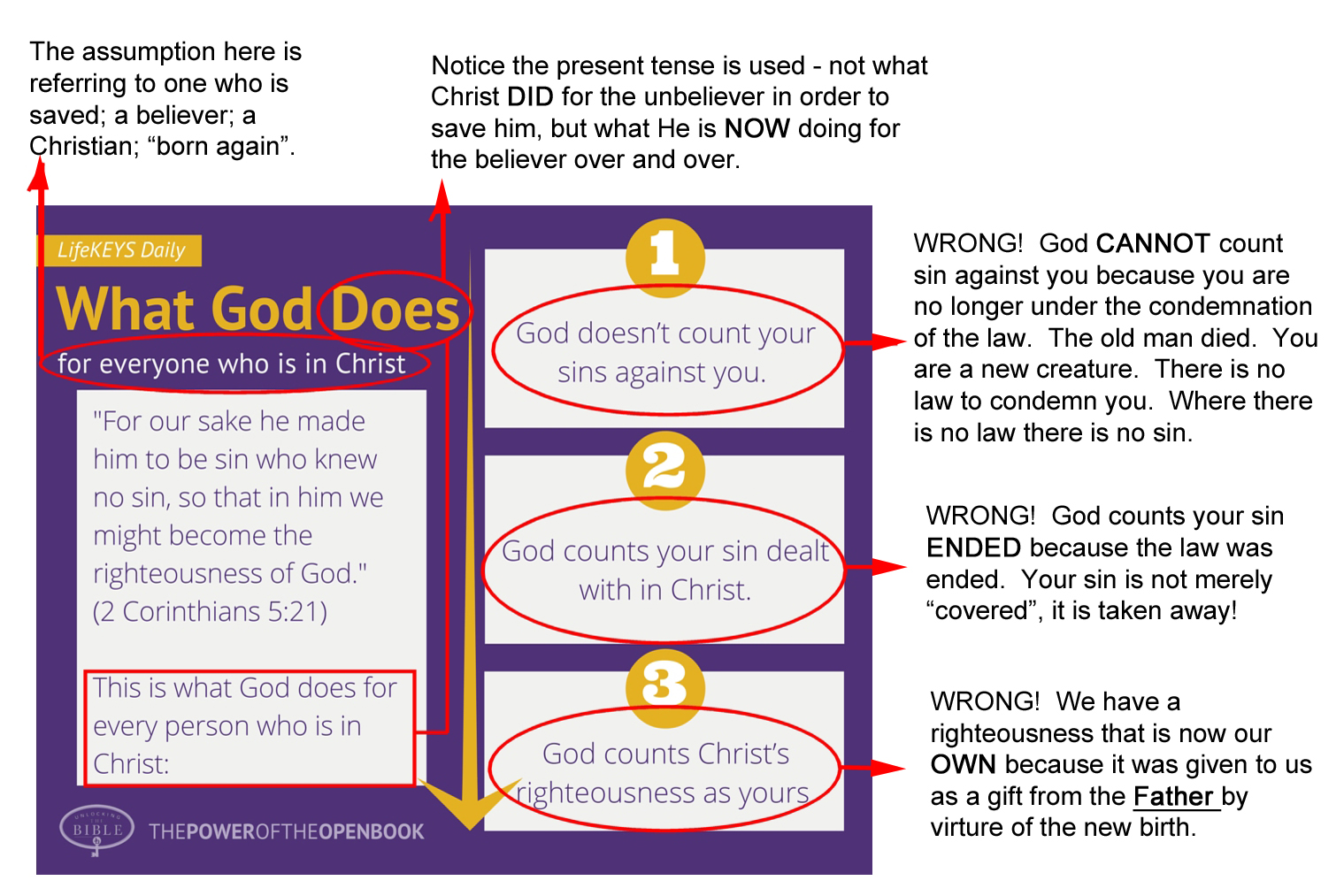
What God Does in Protestant Progressive Justification
There was a meme in my Facebook news feed that caught my eye this morning. I felt compelled to make some corrections to it. If you still don’t believe that Protestantism teaches progressive justification, think again.
Andy
The Source of Phobias
 I have rubbed shoulders recently with folks who have a phobia thing going on. In one particular case, the person presently employed by a relative of mine would not ordinarily be able to hold down a job.
This is another area where Christians show how confused they are. On the one hand, they get all glassy-eyed and proclaim the simplicity of God’s word, how we should read it as “little children.” But you mark my words: on the other hand, they will proclaim my biblical explanation for phobias here, “Too simplistic.”
The source of ALL fear, according to the Bible, is being under law as opposed to being under grace. I find it hard to believe that if the primary source of fear is gone, that the extreme expressions of it are possible.
According to the Bible, being under law, and specifically its condemnation, is the antithesis of LOVE. Throughout the Bible, fear and love are set in contrast to each other—polar opposites.
To those under law, the Bible is condemnation; to those under grace, the Bible is the discipleship of love. One is a law that continually warns of the wrath to come, the other is instruction regarding love.
This is why Paul said that the sting of death is sin, and the power of sin is the law. Ironically, many denominations keep their followers under law. This is why it is more than possible that professing Christians will suffer from these phobias which is also the case with the aforementioned acquaintance. I also find it curious that said person is of a denomination that emphasizes law. Hence, the person’s known faithful Bible reading will only make the fear worse because of a skewed view of law/gospel.
I am also convinced of this: God’s word states that you are under law regardless of who keeps it; under law is under law. The law must be ENDED for condemnation or you are still under its power. You must be put to death so you are no longer under it, and raised to life so that you may serve the law of love freely. Still being under law with the idea that someone keeps it for you is antithetical to the new birth. You must know that you can no longer be condemned. You are not merely protected from condemnation—condemnation no longer exists.
And therefore, fear can only exist if you allow it for it cannot live without condemnation.
paul

 Paul's Passing Thoughts
leave a comment