


The TANC Library of Heterodoxy
Future contributions to heterodoxy:


Re: Lecrae; Dear Spiritual Peasantry, Please Help Me Understand
 I would like the spiritual peasantry to help me understand why they keep doing it: tithing hard earned money, and not forgetting “offerings” to boot, forfeiting time with family because the “doors of the church are opened,” ignoring nature’s way of telling you something is wrong (conscience) because “the elders are close to the situation and know all of the intimate details” that somehow trump the obvious, listen to a different variation of the same gospel message every week, etc., when the orthodoxy only applies to you and not leaders.
Why are you obedient to leaders who apply the rules to you only, or continue to endorse those who practice this brazen double standard? What am I referring to? Well, poke the Googleberg Press anywhere for examples, but what is the latest drama that has provoked this post? I’m glad you asked.
Below, there are two short vids of John MacArthur bemoaning the increased unwillingness of the spiritual peasantry to “put themselves under the authority of ‘godly men.’” I chose these two because what MacArthur states in these vids echoes what we hear daily from the who’s who of evangelicalism.
Now enter the latest institutional church drama: the father of holy hip hop, Lecrae, also the toast of the New Calvinist elite, appears to be totally off the orthodox reservation. “Old” Calvinist Joel Taylor posted on this latest drama here. Also see this, and this.
So far, his numerous elitist New Calvinist mentors are silent. Taylor might be a little miffed since he left the movement because Paul Washer wanted his blog to be vetted and overseen by his elders. Like they are overseeing Lecrae? Hardly. Side note: the Westminster Confession calls for media oversight by the clergy, so Washer’s elders were only doing, bless their hearts, what Calvinists do.
Why does the evangelical peasantry continue to put up with this double standard? Really, I now confess, it’s a rhetorical question; they put up with it because they have been sold on the idea that the institutional church is the only way to heaven. Supposedly, we have no direct access to the Chief Shepherd, Jesus Christ who is the head of the church. Pastors speak for Christ on earth—it’s called the “power of the keys.” It’s a formal Reformation doctrine.
But there is an alternative. Read the New Testament. Christians met in homes, and nowhere is it stated that there is anything insufficient about that or the idea that home fellowships were a transitional stopgap. In addition, though not the ideal, it is clear that some apostolic era home fellowships DID NOT have elders. Eldership DOES NOT legitimize a home fellowship. Furthermore, EVERY believer is accountable to Christ individually (the priesthood of believers 1Pet 2:9), and what some evangelical brainiac told you to believe will not be an excuse. You, and you alone have the responsibility to not be deceived by yourself or others.
Just stop and think about what you are paying good money for and submitting to. And by the way, seminaries don’t legitimize fellowships either—there weren’t any seminaries in the first century and eleven of the twelve apostles were not formally educated. What has Christian academia done for us? Go to any Christian book store and peruse the mass confusion displayed in all of its aesthetic majesty. Ask five pastors to define the words, “law” and “gospel” you will get five different answers for each. That’s what academia has done for us: zilch.
Lecrae will not be called out until he breaks one of the unpardonable sins of the New Calvinist inner circle. Then (barf alert), he will be used as an example to demonstrate the high standards of New Calvinist aristocracy. We only know what two of these codes are: don’t deny the existence of hell (that takes away the ability to control people through fear, see “Rob Bell”), and don’t lack nuance in your teaching lest the peasants figure out the crux of what Calvin really believed (see, “Tullian Tchividjian”).
We may never know the real reason Mark Driscoll was kicked to the curb with pious indignation, but trust me, it had nothing to do with the same rampant abuse that goes on in New Calvinist churches daily not excluding criminal activity. It is fairly well documented that James MacDonald partakes in the same serial abuse that marked Driscoll’s ministry, but whatever Driscoll did, MacDonald hasn’t done it yet, and neither has Lecrae.
How long will the peasantry put up with this blatant double standard? Lack of theological education is not an excuse for being a fool, and being taxed for it to boot.
paul
Let’s Pretend: Cedarville University Cares About the Gospel
 Originally published June 10, 2013
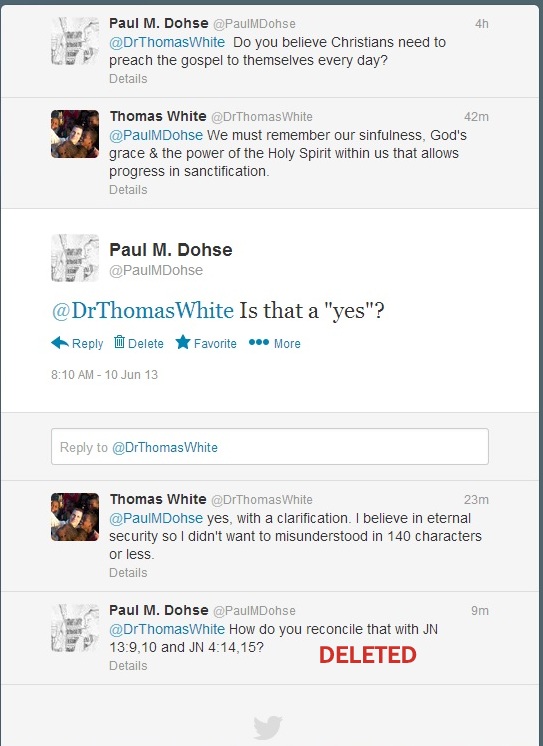
“Did you know Christians still need to be saved? Well, bless your heart, it may be too late for you, but quickly enroll your children at Cedarville where they can be saved by Dr. White’s gospel.”
Nobody wants to discuss the gospel that has been running the show in the American church for several years. Launched by a Reformed think tank in 1970, it seized control of evangelicalism in the mid-1990s. Propagators continually put forth the idea that they are the new sheriffs in town and they need time to straighten things out, but the fact is that their gospel has been running the show for almost twenty years now. Are we better off? Hardly.
We aren’t talking about mere semantics here. We are talking about the heart of the gospel. We are talking about the law’s relationship to grace. We are talking about the very definition of justification. New Calvinism keeps the believer under law, but supposedly that’s ok because Jesus keeps it for us. No, under law is under law no matter who keeps it. God will not honor a false gospel. The New Calvinists aren’t fixing anything—they are creating the mess with their backdoor antinomianism.
The new President of Cedarville College is just what the trustees were looking for: handsome; educated; an adventurist; sports enthusiast; the appearance of pure orthodoxy; the Mayberry RFD family—all the things that bring in admissions from suburbia Christianity. Hope has returned to Cedarville; the alumni can once again look at themselves in the mirror. Yes, he’s good, even being a student of New Calvinism for six years now, it took me forty minutes to positively identify him as a New Calvinist heretic. I consider him one of the best at masking his false gospel.
Dr. Thomas White and his wife were both educated at Southeastern Baptist Theological Seminary, a bastion of Christian mysticism and New Calvinism. But a statement on his blog says it all:
When the Gospel drives everything we do, we see all of us need grace every day. We all have deceitfully wicked hearts and preaching a moralistic set of rules will never save but will only add a burden that mankind cannot bear. We should teach about theological realities such as adoption, redemption, forgiveness, and grace. We should become protectors of widows and orphans and fathers to the fatherless.
We need to proclaim loudly the biblical message that children are a blessing from the Lord, that life begins at the moment of conception, that we must fear God more than any opinion of man, and that the Gospel brings grace if one repents and believes. No matter any judge’s verdict, we must defend life now, not wait until the morning after.
For the most part this reads well, but the devil is in the details. The greatest errors are always closest to the truth. Does the gospel drive EVERYTHING we do? Does the same gospel that saved us continue to completely drive our Christian life? You know, the “gospel-driven life.” The “gospel-centered life.” Do Christians continue to need grace every day? What does he mean by “grace”? The common grace we expect from God every day, or the same grace that saved us? Do Christians need daily salvific grace? Is that what he means? Sure it is, for he goes on to write,
We all have deceitfully wicked hearts….
Is that true? Do born-again Christians have “wicked hearts”? Yes, according to New Calvinists. That’s why we need the gospel every day.
Like with all New Calvinists, we receive the same ambiguous rhetoric from White that masks his false gospel:
….preaching a moralistic set of rules will never save but will only add a burden that mankind cannot bear.
“Mankind” is thrown in to knock you off the scent. This kind of New Calvinist deception is protocol. The “preaching” refers back to “we” and “us” in the previous sentence including “all.” That would be us, as in CHRISTIANS, the fact that New Calvinists see us as no different than the unregenerate (and therefore still under the law) notwithstanding.
Furthermore, try not to close your eyes because a shocking scene is coming:
1. Rules in the Bible are called “moralistic.”
2. And, preaching rules will never “save” Christians.
Did you know Christians still need to be saved? Well, bless your heart, it may be too late for you, but quickly enroll your children at Cedarville where they can be saved by Dr. White’s gospel.
Somehow, they will become moral and serving as well. Dr. White will teach them two different things that supposedly yield godly results:
A. They are still totally depraved.
B. They should value life and help the poor.
Really? Dr. White also states that we should….”teach about theological realities such as adoption, redemption, forgiveness, and grace.” “Obedience” and “sanctification” and “discipleship” are conspicuously missing. And there is a reason for that.
Like all New Calvinists, Dr. White will propagate a gospel contemplationism that supposedly results in the imputation of Christ’s obedience to the believer in sanctification. That’s because we are still under the law and Christ’s obedience must be imputed to our sanctification so that we can live our Christian life in the same way we were saved: by faith alone. Synergistic sanctification is believed to be works salvation. It’s antinomian let go and let God theology.
Again, these guys have been running the show for twenty years and the results speak for themselves. One result is the GARB response to the ABWE scandal. It’s sad but true: Christians continue to pay good money in the name of a gospel that will not sanctify, or save.
paul


The Calvinist’s Greatest Fear: The Spiritual Peasantry Will Understand Law and Grace
Originally published January 2, 2013
“The two are completely separate; the law is left behind in the former and loved in the latter.”
Susan and I perceive constantly that most Christians don’t understand the difference between justification and sanctification. Said another way, they don’t understand the difference between law and grace. This is by design. Instead of outlawing the Bible like the Popes, the Reformers merely posited the Bible as a catechism that aped their orthodoxy derived from counsels and creeds. I won’t mention names, but prominent evangelical leaders have shared with me personally that they know the general populous of American Christians are theologically illiterate. And again, this is by design. And, most Christians in our day openly admit it, and in some cases are proud of it. The remainder admits they believe that the pastorate is an intermediary between them and what God wants us to understand.
There are a number of problems with this, but primarily, God thinks it’s a bad idea. The Bible is clearly written to Christians in general. And His word cannot be properly understood unless it is read in the context of justification/sanctification. Whatever your opinion of the American church, it is a product of parishioner illiteracy in regard to doctrine; that is certain and indisputable.
Though it takes a lot of study to see some things in simple form, the simple fact of Calvinism (and we are all Calvinists if we are Protestant) is that it makes “under” a verb and not what it is: a preposition. They could get away with this in medieval times because most people didn’t know the difference. In our day, we know the difference, but assume the pastorate has a set of metaphysical eyes given to them by God before the foundation of the world that we don’t have—so our eyes don’t even blink when their interpretations contradict the plain sense of Scripture.
As we have seen in our previous observations from the book of Romans, Christians are UNDER grace and were previously UNDER law. All people born into the world are born into it UNDER the law, and will be judged by it at the end of their lives if they don’t escape it. Christ was the only man ever born under the law that could live by it without sin and was therefore the only man ever born who could die for our sins. We escape the condemnation of the law by believing in what He did to make a way of escape for us. Calling on Christ to save us acknowledges that we all fall short of God’s glory and are therefore in danger of eternal separation from Him.
We are “under” grace, NOT “under” law:
Romans 6:14—For sin will have no dominion over you, since you are not under law but under grace.
The word for “under” here is hupo which is a primary preposition. Calvinism teaches that we are still under the law. This is the main reason that it is a false gospel. Now, they would vehemently deny this in the following way with red faces and veins popping out of their necks:
NONSENSE! We emphatically state constantly that no man is justified by the law unless he can keep it perfectly and we all know that no man can keep the law perfectly. We constantly cite James 2:10 which states that if we break the law at one point—we are guilty of breaking the whole law. HOW DARE YOU SLANDER US IN THIS WAY!!!
This argues the point by making “under” a verb (something we do or don’t do) rather than a position. Therefore, they are not arguing jurisdiction, they are arguing practice in regard to how we are justified. Position is the issue, not what we do; i.e., keeping the law or not keeping the law, or doing this/that in this way or the other way etc. Calvinists believe our position stays the same; therefore, what we do becomes critical. In fact, what we don’t do keeps us saved; e.g., “You don’t keep the law by keeping the law.”
There are four versions of “Christians” still being “under” the law, or under its jurisdiction. First, antinomianism which teaches that we are still under the law, but God cancelled our obligation to keep it because it promotes grace. Secondly, that we are still under the law, but the Holy Spirit helps us keep it so that we will pass the final judgment. Thirdly, that we are still under the law, but if we perform certain rituals within the church, by authority of the church, our sins are continually forgiven (perpetual pardon in the face of the law). Fourthly, we are still under the law, but Jesus keeps it for us while we continually contemplate His saving works in the Scriptures. This is the Reformed view. And of course—it’s no less a false gospel than the former three.
This is verified by their interpretation of Galatians 2:20—this exposes their heresy:
I have been crucified with Christ. It is no longer I who live, but Christ who lives in me. And the life I now live in the flesh I live by faith in the Son of God, who loved me and gave himself for me.
We supposedly remain spiritually dead, which as they know is clearly synonymous with being under the law in Scripture. So, Galatians 2:20 is interpreted as being applicable to our Christian life. We don’t live in our Christian life, we are still spiritually dead, but the living Christ within us keeps the law for us so that the “ground of our justification will be Christ in the final judgment.” Calvinists believe that we are not under the law in regard to the idea that we don’t keep it in our Christian life to be justified, Christ keeps it for us. Hence, “under” is a verb issue rather than a position issue. What we do becomes critical, not where we are positionally. Therefore, Calvinism makes our Christian life (sanctification) by faith alone as a way to maintain our just standing for the final judgment. Only problem is, we are still fulfilling a requirement of the law in cooperation with Christ—this is the problem of salvation being a verb issue rather than a preposition issue. If the law no longer has jurisdiction over us FOR JUSTIFICATION, who keeps it or doesn’t keep it is irrelevant FOR JUSTIFICATION.
Then what is Paul talking about in Galatians 2:20? He is talking about justification; not sanctification, this should be evident. Consider the context:
Galatians 2:16—yet we know that a person is not justified by works of the law but through faith in Jesus Christ, so we also have believed in Christ Jesus, in order to be justified by faith in Christ and not by works of the law, because by works of the law no one will be justified.
Galatians 2:17—But if, in our endeavor to be justified in Christ, we too were found to be sinners, is Christ then a servant of sin? Certainly not!
Galatians 3:11—Now it is evident that no one is justified before God by the law, for “The righteous shall live by faith.”
Consider verse 21 which immediately follows 2:20:
I do not nullify the grace of God, for if righteousness were through the law, then Christ died for no purpose.
Why do Calvinists apply Galatians 2:20 to sanctification? Because what we do is the issue, not our position, so Christ must obey the law for us. To the contrary, we are justified because the old self that lived in the flesh died with Christ. And when it did, we also died to the law. So, in regard to justification, we can only be justified if the life we lived in the flesh is dead and no longer under the law. Being alive in the flesh equals: being under the law. Now, obviously, our mortal bodies are still alive in one sense in that we are walking around, but in reality the old self is dead and the power of sin and the law are broken. In that sense, we are dead, and justified via the fact that Christ was resurrected for our justification (Romans 4:25). Notice that Paul states that he is dead in regard to his life “in the flesh.” This doesn’t mean that we are also spiritually dead in sanctification. The context of Galatians 2:20 is justification. Hopefully, Romans 6:5-14 will clarify this for you:
5 For if we have been united with him in a death like his, we shall certainly be united with him in a resurrection like his. 6 We know that our old self was crucified with him in order that the body of sin might be brought to nothing, so that we would no longer be enslaved to sin. 7 For one who has died has been set free from sin. 8 Now if we have died with Christ, we believe that we will also live with him. 9 We know that Christ, being raised from the dead, will never die again; death no longer has dominion over him. 10 For the death he died he died to sin, once for all, but the life he lives he lives to God. 11 So you also must consider yourselves dead to sin and alive to God in Christ Jesus.
12 Let not sin therefore reign in your mortal body, to make you obey its passions. 13 Do not present your members to sin as instruments for unrighteousness, but present yourselves to God as those who have been brought from death to life, and your members to God as instruments for righteousness. 14 For sin will have no dominion over you, since you are not under law but under grace.
As we have noted before in our Romans study, being under the law comes part and parcel with being lost and under the power of sin which is provoked by the law. The flesh under the law is like throwing gasoline on a fire (Romans 7:8-11). But notice in Romans 6:5-14 that there is both death and life. This passage in Romans also adds “death” to being under the law and the bondage of sin. Galatians 2:20 only speaks of our death to the law and sin (“Apart from the law, sin lies dead”), not the life we have in sanctification. Romans 5-14 speaks to both because the context includes both sanctification and justification:
13 Do not present your members to sin as instruments for unrighteousness, but present yourselves to God as those who have been brought from death to life, and your members to God as instruments for righteousness. 14 For sin will have no dominion over you, since you are not under law but under grace.
We have been brought from death to life. The life we live in the flesh has had the power and dominion of sin under the law broken because we died with Christ. We are dead and Christ lives for our justification:
Romans 4:23—But the words “it was counted to him” were not written for his sake alone, 24 but for ours also. It will be counted to us who believe in him who raised from the dead Jesus our Lord, 25 who was delivered up for our trespasses and raised for our justification.
In regard to justification and this life we live in the flesh, we are dead, and more importantly, also dead to the law as well, and only Christ is alive, but that doesn’t pertain to sanctification as well. In sanctification, we are alive, and UNDER GRACE. In justification, the old self is dead and no longer under the law. Calvinists believe we remain under the law in sanctification, and being under the law is synonymous with still being spiritually dead. Therefore, we remain dead in sanctification and under the judgment of the law, so the law must be fulfilled for us.
Being under grace is synonymous with being born again, new creatures, informed by the law, not under it (see Galatians 2:19), and lovers of the truth. Obedience to the law is now our means of loving the Lord and showing the world that we love Him. The law is the full counsel of God in regard to family harmony and kingdom living. It informs us on how to be separate from the world. In a word: sanctification. The law in regard to judging our justification has NO jurisdiction over us. We are no longer under it.
The very fact that Calvinists propagate a total depravity of the saints in which bondage to sin is not broken clearly illustrates that the law is still a standard for our justification; we are still under its jurisdiction for our just standing. A cursory perusal of Reformed writings can produce a motherload of citations to establish this fact, but one from Reformed icon G. C. Berkouwer should suffice:
Bavinck too, wrote in connection with the regenerating work of the Spirit: “The regenerate man is no whit different in substance from what He was before his regeneration” (Faith and Sanctification p. 87).
Clearly, this can only mean one thing: the one that is “no whit different” must also remain under the law. His position hasn’t changed, so lest one attempt to be justified by the law, what is done in sanctification becomes paramount in eternal issues as opposed to it being a Divine family matter. The Reformed camp uses the book of Galatians to argue for this when the book actually addresses their specific error. They use the book of Galatians, as mentioned, particularly 2:20, to argue a supposed Pauline position that the Galatians were doing things in their sanctification that was affecting the status of their just standing. Again, the Reformed crowd makes what we do in sanctification the issue, not our position which biblically proposes that nothing done in sanctification can affect justification. The Reformed use of Galatians to argue this propagates a fusion of justification and sanctification which makes the law the standard for justification from salvation to glorification.
However, the book of Galatians is the antithesis of such as it shows a clear dichotomy between justification/sanctification and the application of the law in each. In justification: NO application. In sanctification: obedience. In regard to no law in justification, but the law informing our sanctification, consider Galatians 2:19:
For through the law I died to the law, so that I might live to God.
We have also noted in our Romans study:
But now the righteousness of God has been manifested apart from the law, although the Law and the Prophets bear witness to it—
We are justified apart from the law, but we would not know anything about these issues if not informed by the “Law and the prophets.” Furthermore, after belaboring the point about their being no law in justification, in both Romans and Galatians Paul makes his point by asking “What saith the Scriptures?” (Romans 4:3 and Galatians 4:30). And the absolute classic point on this is Galatians 4:21:
Tell me, you who desire to be under the law, do you not listen to the law?
There is no law in justification, but the law informs our obedience in Sanctification. Scriptural examples are myriad, but consider Galatians 5:2-7:
2 Look: I, Paul, say to you that if you accept circumcision, Christ will be of no advantage to you. 3 I testify again to every man who accepts circumcision that he is obligated to keep the whole law. 4 You are severed from Christ, you who would be justified by the law; you have fallen away from grace. 5 For through the Spirit, by faith, we ourselves eagerly wait for the hope of righteousness. 6 For in Christ Jesus neither circumcision nor uncircumcision counts for anything, but only faith working through love.
7 You were running well. Who hindered you from obeying the truth?
Verses 2 through 6 are about justification by faith alone apart from the law. Verse 7 concerns sanctification—running and obeying which we are free to do aggressively without fear of it affecting our justification. The two are completely separate; the law is left behind in the former and loved in the latter. I once heard a Reformed pastor fuming from the pulpit over a statement that he heard at a conference: “He said that the law leads us to Christ, and then Christ leads us back to Moses. THAT’S BLASPHEME!!!”
No it isn’t. When the law was increased through Moses, it had a dual purpose: to increase sin in order to show those under the law their need for salvation, and as can be ascertained by many other texts, for the saved to better glorify God:
Romans 5:20—The law was brought in so that the trespass might increase. But where sin increased, grace increased all the more,
Galatians 3:19—Why then the law? It was because of transgressions….
paul

 Paul's Passing Thoughts
leave a comment