Absolutely Critical to Effective Ministry: Knowing the Two Realities of Protestantism
 If we are to accomplish anything in contemporary Christianity, we must begin to live by a basic hard-fast rule: our actions must be guided by the knowledge that there are two realities in contemporary Christianity; grammatical-historical and redemptive-historical.
These are usually discussed as methods of Bible interpretation, but they are really much more than that according to Protestant tradition. These are two different ways of interpreting reality itself.
We will begin by defining the redemptive-historical interpretation of reality along with this caution: one of the most powerful influences that this view of reality has is the dismissal of its basic premise as mere mysticism held by fringe elements of Protestantism. Those who dismiss it out-of-hand then proceed to function by its tenets unawares. The who’s who of Protestantism care little that the masses understand this ideology, just so they function by it.
In fact, Protestant leaders assume most parishioners are unable to grasp its tenets. Therefore, redemptive-historical reality must be explained in a way that will enable congregants to apply it to their lives and function a certain way within church culture. Redemptive-historical reality is primarily the crux of Protestant orthodoxy and its spiritual caste system.
In mythology, we often link the bizarre narratives to the philosophy itself, but that’s a mistake. Roman, Greek, and Babylonian culture was not developed by superstitious idiots. What we fail to understand is the narratives are stories that convey principles to the spiritual underlings so they can apply principles of higher knowledge to their lives. They cannot understand the higher knowledge, but those who can need to tell the underlings how to live in order to obtain the best possible society.
“Orthodoxy” can be likened to mythological narratives that teach those of lesser spiritual understanding how they should live, but they are based on well thought out metaphysical (state of being) systems of knowledge. We shouldn’t be surprised that what seems to be superstition has ruled the greatest empires on earth. This is because the core ideology is always a succinct system of thought that is greatly underestimated. The ancient philosophers were not idiots. Democritus (circa 400 BC) was the originator of atomic theory. The sophist class of philosophers were the first to apply philosophy to sociology in an in-depth way (circa 500 BC). ALL present-day psychologies are founded on the basic theories of that day. For example, the basic ideology that drives the theory of rehabilitation in our modern-day prison systems came from Socrates.
Let’s now define redemptive-historical reality. I will be using a quote from Graeme Goldsworthy who is considered to be the contemporary father of redemptive-historical hermeneutics:
If the story is true, Jesus Christ is the interpretative key to every fact in the universe and, of course, the Bible is one such fact. He is thus the hermeneutic principle that applies first to the Bible as the ground for understanding, and also to the whole of reality (Graeme Goldsworthy: Gospel-centered Hermeneutics; p.48).
This is a pretty straight forward statement and accurately depicts what Protestantism is really founded on; not a theology per se, but a way to interpret reality itself. How in the world does one interpret all of reality through the one person Jesus Christ? You MUST understand: Martin Luther articulated the answer in the foundational treatise of Protestantism, the Heidelberg Disputation.
The Heidelberg Disputation is a concise systematic ideology that explains how all of reality is to be interpreted through redemption, or if you will, the man of redemption, Jesus Christ. Again, the power of this ideology is a dismissal of it out-of-hand by those who proceed to sit under its “theology.” The theology of the metaphysics redefines biblical terms, and uses them to lead the masses into a functioning Christocentric view of reality.
We will not plunge the depths of the Heidelberg Disputation in this writing, but the principles will be outlined and their inevitable functionality among Christians. Before we move forward, let’s examine additional statements that confirm this approach among Christians. This testimony was given in a recent email to me:
An old acquaintance of ours (Presbyterian as they get) has said more times than I can remember something like this: “Every verse in the Bible, from Genesis 1 through Revelation, is talking about Jesus.” Years ago that sounded so intellectual, holy; today it sounds like hogwash. I mean, are we really expected to believe that the passages talking about incestuous rape are talking about Jesus? Come on, really?
Well, as ridiculous as it sounds, the answer is, “yes.” Many function according to the theology that is predicated on this foundational interpretive method for not only the Bible, but reality itself.
Pause: keep in mind that those who function according to this interpretation of reality without understanding its premise will reflect back the resulting interpretation of Scripture. They repeat pulpit talking points without ever investigating the source of them, or the logical conclusions of the talking points. Sometimes, such people are referred to as “useful idiots.” But again we need to be cautious: people who blindly follow others do not do so for the sake of following blindly—they are functioning according to some sort of ideology that leads to the blind following.

Let’s look at some more examples from proponents of New Covenant Theology:
New Covenant Theology insists on the priority of Jesus Christ over all things, including history, revelation, and redemption. New Covenant Theology presumes a Christocentricity to the understanding and meaning of all reality (1st tenet of NCT according to the Earth Stove Society, a NCT think tank).
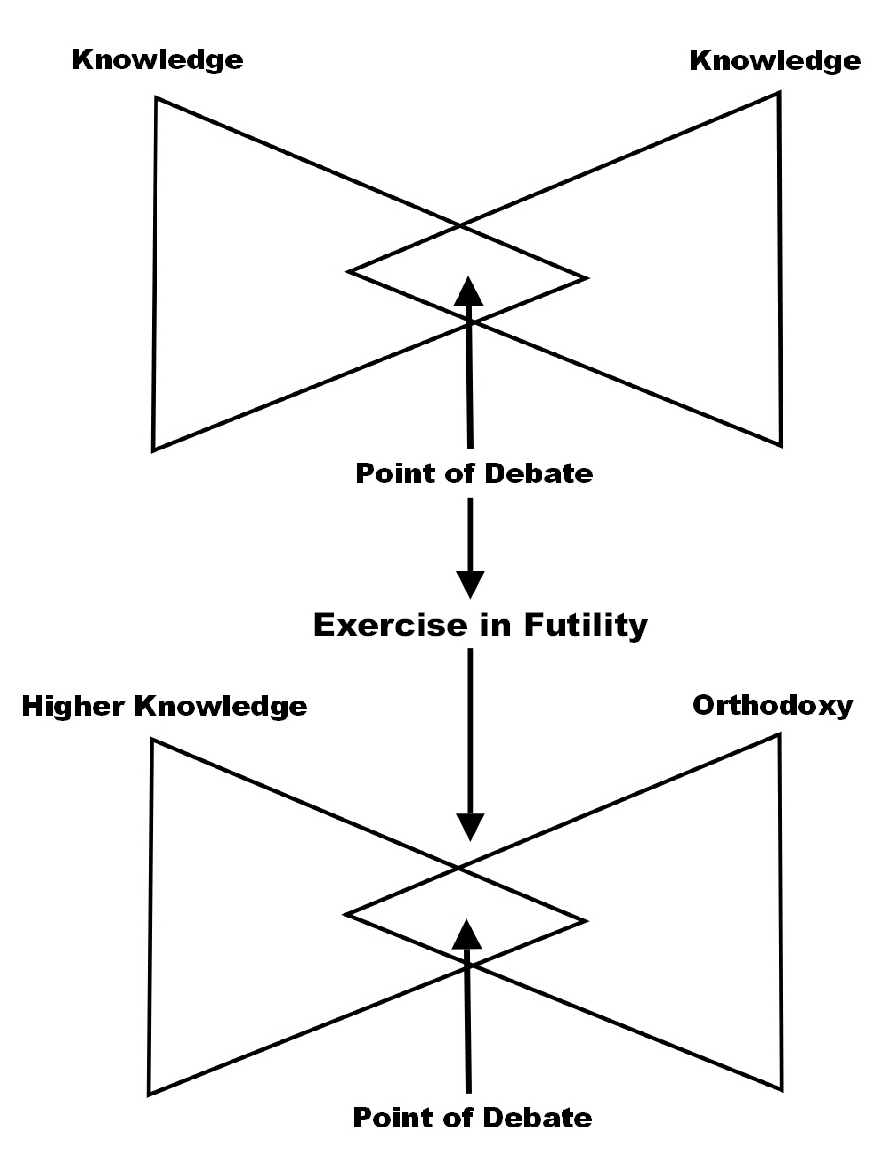
Not much ambiguity in that statement. Pretty clear on its face except for how one would apply it to real life. Again, many might scratch their head in regard to that statement, but proceed to let the theological orthodoxy that flows from it shape their life and thinking. At the point of debate with such people, their orthodoxed talking points will reflect the metaphysical premise. They will absolutely not be swayed in their thinking because they concede that they cannot understand the higher knowledge, and the authority of the higher knowledge is part of the orthodoxy.
Pause: I used to be involved in a ministry that evangelized Jehovah Witnesses. Debating the Bible with them led nowhere because their orthodoxy reinterprets all biblical terms and phraseology. When Christ is referred to, it is assumed that their presuppositions regarding Christ are the same, and they are not. Instead, we challenged their orthodoxy, i.e., the Watchtower publication. Likewise, let me reveal a concluding theme of this study: never debate the Bible with a Protestant; instead, bring their authority into question. Refuse to discuss anything else for it will be futile for reasons yet to be examined.
Let’s look at another statement from the New Covenant Theology camp:
At this time, resist the temptation to utilize subsequent passages to validate the meaning or to move out from the immediate context. Remembering that all exegesis must finally be a Christocentric exegesis.
Look for Christ even if He isn’t there directly. It is better to see Christ in a text even if He isn’t, than to miss Him where He is (The Biblical Theological Study Center: A Christo-Presuppositional Approach to the Entire Scriptures; Max Strange. Online source: http://goo.gl/5sGjP).
The question quickly becomes, “How can you see Jesus in every verse in the Bible?” This is where the Bible becomes a “meta-narrative.” That can mean, “grand narrative,” but in this case it means “metaphysical narrative.” The Bible is a narrative, or story that depicts redemptive reality. You will get confused unless you understand that the theory also posits the inclusion of multi-purpose perspectives into the metaphysical story (a story that depicts true reality). The text grammar doesn’t determine the perspective resulting in a particular objective outcome, but the assumed outcome determines the perspective. So, can “passages talking about incestuous rape” say something about redemption? Of course. In this example, the passage is not talking about Jesus specifically, but denotes why His redemptive works are needed. In some way, according to the prism, the verse always speaks of Jesus and His redemptive works.
This approach to interpreting reality (state of being, or metaphysics), what we call epistemology, plugs into the basic ancient philosophy of total inability. This proffers the idea that man cannot know or comprehend reality. The metaphysic follows: man dwells in a realm apart from true reality that he cannot comprehend. Secondly, somehow, usually via a theory of predeterminism, there are a select few that can ascertain truths from the other realm. Usually, the delineation of the realms is the material versus invisible with mankind residing in the material realm.
The Reformers recognized a reality that man functions in, but deemed it “subjective,” or shadowy. Focusing on this shadowy realm leads to despair. In the aforementioned foundational document of Protestantism, Luther contended that man’s material realm only feeds “the glory story,” or the story of man.
In Luther’s construct, ALL reality is interpreted through two stories: the glory story (the story of man), and the cross story (the story of redemption). Giving any credence to the material world or the belief that man can know the material world empirically only contributes to the story of man and his glory. Yes, man functions in this world, but it does not possess any objective wisdom that can bring true wellbeing. Only an ever-clearer understanding of the cross story can bring wellbeing.
What then is the cross story specifically? It is twofold: it is the holiness of God as set against the sinfulness of man. This is the only objective truth and reality that can bring wellbeing. The goal is a deeper and deeper understanding of how inept we are in every category of life as set against the glory and holiness of God.
Pause for main point: according to this philosophy, the sole purpose of the Bible is to lead us in seeing the cross story with more and more clarity. To the extent that we do that, we will have wellbeing. AND, to the extent that each individual lives according to the cross story, the wellbeing of society as a whole will increase. When Reformed folks talk about “transforming society with the gospel,” this is exactly what they are talking about. To the extent that the populous embraces the doctrine of inability, society will be transformed.
One reason for lauding this epistemology is unified agreement on interpretation. If every verse is about Jesus, there is no division in opinions. Secondly on this point, it gives Christianity a pass on defending inerrancy; e.g., narratives are not meant to be technical systems of theology that require consistency in logic. Thirdly on this point, if some sort of Christocentric conclusion is drawn from the text—it can’t be wrong. If the interpretation of the text somehow demeans man and exalts God, error is impossible.
Before we address the grammatical-historical approach to interpreting reality, let me add some thoughts to the redemptive-historical perspective. This perspective now dominates the institutional church. Just yesterday, I participated in a conversation on a social media site in which the following statement was made about Proverbs chapter 8:
The Old Testament reveals shadows of what Jesus Christ will be in the New Covenant. I can easily say that wisdom personified in Proverbs 8 is Jesus Christ.
If one reads Proverbs 8, the assertion that it is about Christ is beyond presumptuous at best. It is a complete rejection of the plain sense of the grammar; even in lieu of the personification being in the female gender.
Also, these two perspectives on reality are a salvific issue with the Reformed. A denial of total inability equates with the grammatical-historical view of reality which is supposedly an attempt by man to glorify himself by writing his own story. By believing that you can understand reality, you are in essence making yourself God.
The most common question is the issue of biblical imperatives that are clearly directed at mankind. This assumes that man is able to obey because grammatically, the commands are directed at him with a demand for obedience. But again, addressing these commands with the presupposition of total inability that equates with the redemptive-historical prism, the commands are supposedly meant to deliberately frustrate man and “drive him to despair of self-righteousness.”
The Reformed continually concede that the Bible states things in grammatical form, but that is always followed with the proper “gospel context” according to the redemptive-historical interpretation of reality. The classic example is this quotation from Neo-Calvinist Paul David Tripp:
….and the Bible does call us to change the way we think about things. But this approach again omits the person and work of Christ as Savior. Instead, it reduces our relationship to Christ to “think his thoughts” and “act the way Jesus would act.” (How People Change 2006, p.27).
Notice that Tripp concedes that the Bible calls us to do things according to the grammatical context, but goes on to say that is a denial of the gospel (omits the work of Christ as savior). On page 26 of the same book, Tripp calls obedience to the word of God a “behavioral approach” that “separates the commands of Scripture from their Christ-centered gospel context.”
Lastly before we move on, when one is able to wrap their minds around the redemptive-historical approach to interpreting reality, it will be recognized that this approach now saturates the Protestant institutional church.
What is the grammatical-historical approach to interpreting reality? As with the other prism, I am not going to elaborate on the “historical” part except to say that the redemptive-historical hermeneutic makes history part of the prewritten gospel narrative. History is simply the redemptive story playing out as scripted by God.
The political commentator Rush Limbaugh often notes that “words mean things.” This is a good working definition of grammatical-historical interpretation; it draws conclusions from a technical evaluation of the words in a sentence whether spoken or written. The many categories of language that give meaning are considered also, which speaks to the “historical” part of the term. Does the sentence mean the same thing today that it meant then? For instance a sentence written in 1940 might say, “Bob is gay.” History informs us of the meaning in that day: Bob is happy. Today that means Bob is a homosexual. The etymology of words and many other factors weigh-in, but all have this in common: they are empirical tools.
This interpretive method also assumes mankind is able to comprehend the realty he dwells in according to empirical observation and can draw conclusions on his own. Man has ability.
Pause: how did Luther get away with denying that mankind had any kind of ability at all? He chalked-it-up to man’s self-perceived ability that can accomplish things in the material world. These accomplishments are of no worth and only accomplish one thing and one thing only: they serve man’s lust to glorify himself. Luther believed that satisfaction from accomplishment was nothing more than sinful pride. To Luther, the only redeeming thing about the world was that heaven manifested its works on earth according to God’s sovereign will. If man lives life subjectively and professes that his evil “good” works cannot be distinguished from heavenly manifestations “experienced subjectively,” that is venial sin that can be forgiven. In accordance with authentic Reformed tradition, Luther believed the following: the belief that any man, including Christians, can perform a good work is mortal sin.
Therefore, the Reformed often define wisdom/knowledge according to two categories: “worldly knowledge” and “wisdom from above.” Sure, man can obtain worldly knowledge that improves his circumstances, but it is all prideful according to Luther. Wouldn’t this approach propagate a lot of death and misery due to a lack of science? Yes, but that was exactly Luther’s point. Many are perplexed by the embracing of ideologies that result in third world cultures, but those who are perplexed make the point for those in the other camp: what is the perplexity of the detractors? Answer: they are perplexed that other people do not lust after materialism as they do. Hence, third world cultures are often seen as being virtuous by the Reformed.
This is why Luther introduced suffering as a hermeneutic that interprets reality. There is true wisdom in the cross story because according to Luther, “all wisdom is hidden in suffering.” According to Luther, many reject this interpretation of reality and dub it the “foolishness of the cross.” Luther also stated that men call the good evil (suffering), and evil good (anything that prevents suffering). This is why Luther called reason an “ugly whore who should have dung rubbed in her face.”
The grammatical-historical perspective of reality assumes man can interpret his own reality, and the material world is not inherently evil. Believers and unbelievers share common realities that are simply practical and not evil.
Here is the challenge: to bring biblical knowledge to bear on grammatical-historical reality when the prevailing view of Protestantism has been the redemptive prism for hundreds of years.
But there is good news as well: the grammatical prism is what man utilizes intuitively. People assume they can interpret their own reality. Of course, the Reformed see this as the very problem.
Does this mean that grammatical-historical Christians should evangelize the lost world and forgo debate with Protestants? Yes it does, because it is a futile endeavor. You are trying to reach people who define reality itself differently. Protestants are redemptive-historical religionists.

An Answer to Run of the Mill Calvinist Oligarchy
Romans 9 explains it all but please don’t whitewash it. The “it does not depend on man’s effort….” The “it” IS salvation. Jesus said you did not choose me but… etc. New Testament is heavy on “Calvinism” at least the salvation part of Calvinism.
Esau was not loved by God, period. Conditional love is all there is. Personally I don’t believe unconditional love makes since. God does not love those he throws in hell and he does not allow those he loves to throw themselves in hell, yea I guess I’m kinda Calvinistic. Every time I hear a preacher say God loves everyone there is a little voice from the back of the church where I’m sitting “except Esau.”
I do get weary of the constant rejection of Calvinism. The question is predetermination with or without free choice towards salvation. God allowing a free choice of rejection and not stopping it would still be predetermined if he knows the outcome and allows it. Plain and simple logic.
Chuck Hulsey
Chuck,
What is plain and simple logic, as far as we can understand it, and for certain the most logical paradox if you want to call it one, is the answer to the question “Why would God allow evil in the world?” Answer: freewill is an important pillar of metaphysics. And let’s be clear, predeterminism is not unique. Predeterminism has been the dominate philosophy driving the vast majority of all civilizations since the beginning of time. In the secular realm it is “fate,” “destiny,” etc., in religious realms fate and destiny are personified.
Freewill and predeterminism are the two trees of philosophy, and the fruit of each are historically apparent; predeterminism has brought nothing but slaughter and misery upon the earth. It is the driving force behind slavery, poverty, starvation in third world civilizations, communism, Islam, and geographical oligarchy in general.
Its kissing cousin is authority. Predeterminism began in the garden when the serpent suggested to Eve that she couldn’t really understand God without his superior metaphysical insight. He was the supposed authority on God. In contrast, the linchpin of human wellbeing is the following: God speaks to man directly without human mediators. God seeks reconciliation with all people individually. The only authority is what God says to individuals, not what other men say he is saying.
But in regard to those who want to claim they speak for God, and in most cases rule in God’s stead, what is their proof? God has rarely come to earth and ordained certain individuals. This is where predeterminism comes in. As church historian John Immel well notes, every religious leader who has ever claimed authority over God’s people has done so in accordance with “preordination.” They are “called” of God. Every pastor, pope, and snake oil salesman who has ever lived has his/her own story of how God revealed their “calling.” Verily, God had his hand on them before the foundation of the world.
Others use education, intimidating massive institutions built on the backs of serfs, and the sword to affirm what God has supposedly preordained.
Somewhere in time immediately after man was kicked out of the garden, spiritual caste was devised, and it was predicated on select individuals ruling over the great unwashed masses in God’s stead. These are preordained individuals who ask their own rhetorical question to the masses, “has God really said…?” It is grounded in the grand presupposition of man’s total inability.
This system was articulated by Plato in the 4th century BC via The Republic, but there has scarcely been anything other than his philosopher king/soldier/producer caste system from the beginning. Calvinism is just one more worn-out bloody song and dance of determinism in world history.
That’s what is “logical” my friend if you wish to go there. Pick the tree you like by its fruits.
Moreover, if you want to further explore what is logical, predeterminism requires the redefinition of many, many, many words that have commonly understood, if not intuitive, definitions. I could name many, but the primary one is “hope.” By determinism’s very definition, hope cannot be objective. And if it is not objective, how can it be hope? No one can know for certain whether they have hope or not. The only hope for mankind is that some have hope, but no one will know for certain who has hope until the end. Hence, Protestants can claim until the cows come home that they value life, but their fundamental logic states otherwise, and frankly, their historical fruits bear that out.
 Now, in regard to your orthodox regurgitation of Scripture interpretation flowing from the belief that you are unable to ascertain truth for yourself, your appeal isn’t really to Scripture; it is to what Protestant philosopher kings say that Scripture means. Your problem with me is that I think I can know truth. Per the theme of this year’s “Liberation” conference featuring the who’s who of Neo-Calvinism, going to the Bible for “information” is “evil” and “nasty theology.” Neo-Calvinists are now plainly stating what Calvin stated from the beginning: you must continue to receive ongoing grace to remain saved, and that grace can only be found under the grace-giving Christocentric preaching of Reformed elders. Mainline Calvinists are now saying this publically in no uncertain terms. How can one even take Protestantism seriously, and Calvinism in particular?
Calvinism is a laughable naked emperor. It has survived all of these years by distracting the masses with election Scripture-stacking contests when its fundamental soteriology is clearly grounded in progressive justification. Predeterminism is the root of the poisonous tree of progressive justification bearing the rotten fruit of antinomian behavior.
After all, if justification is finished, what do we need the philosopher kings for? We don’t, and nothing strikes more fear in them than the possibility of people investigating the cause of all the smoke they want to discuss to keep people from their dirty little secret…
…they replace Christ as the one mediator between God and men with their Christocentric progressive justification false gospel.
Unstoppable: The American Spirit and its Role in Bible Prophecy
 If you want to evaluate world philosophy by its least common denominator, you could focus on its definition of God, or presuppositions concerning mankind. If you focus on the latter, it’s a statement in regard to God’s will for creation. There are a handful of least common denominators that could be used under different categories.
For purposes of this post, we will choose the category of politics. This is not a subject that belongs to the nomenclature of “politics” as we commonly think of it; politics is the method that we use to communicate what we believe about our ethic formed by our metaphysics and epistemology.
At any rate, in regard to the contemporary world stage, the following question is a major factor in determining ethics and politics: is man capable of self-governing? If the masses are in control, will chaos ensue? And why does chaos matter? What is the primary purpose of being?
America was the first country in world history to form a government based on answering the question of self-governing in this way: Yes, mankind is not only capable of self-governing, but man is best served by this construct.
Let’s be clear: NO politician has ever done anything stupid or said anything stupid; what they do is based solely on how they answer the question of self-governing… “Do those idiots think we are stupid!?” Well, not exactly, politicians are driven by their presuppositions in regard to mankind.
The results of the American experiment speak for themselves, but the process, from the beginning, has been a debate, and at times a war, between two differing philosophies concerning the ability of man to self-govern. From the cradle of civilization, this has been a deeply spiritual question as well: can the masses know reality? I believe that we must go to the Bible to observe where all of this started. It started with the serpent selling Eve on the idea that she couldn’t really understand what God was saying without his help. She only had half of the metaphysics: the knowledge of good. He had the whole package: the knowledge of good AND evil. Hence, she could be more like God if she would only allow him to guide her. The rest is history. This is the epistemological caste system that has dominated world history until the advent of the American idea.
Wherever you stand with God, the fact remains that He created an orderly cosmos which includes Earth. And it is irrefutable that life works better when it is ordered according to the apparent construct. But, can man see and understand God’s order of things? The framers of the American Constitution, for the first time in world history, said, “Yes.” This question drives everything in American politics. What every American politician does is defined by how they answer this question.
And, the naysayers of self-governing acknowledge that the American idea has yielded positive results, but you see, they love humanity so much that they are unwilling to settle for mere good results. Yes, their love for humanity will not rest until perfect utopia is established, and that is only possible if man understands that he cannot govern himself. If only mankind would give oligarchy a chance!
So, don’t be surprised when the naysayers use a good thing to bring about the best thing. Some are confused when they see those who have benefited from capitalism (free markets representing the will of the people) using those resources to fight against capitalism. This does not befuddle me. In their minds, they are using a good thing to bring about the best thing. You see, self-governing will only bring about temporary change, but their goal for the humanity that they love sooooo much is “real and lasting change.” Yes, if humanity would only understand that tyranny will eventually end all tyranny, and will usher in the utopia that we all desire where truth is defined by one thing and one thing only: unity. To them, unity equals truth. That is at least one aspect of their metaphysics: war and conflict can be ended; poverty can be ended; perfect harmony can be obtained. But in order for this to happen, man must understand his limitations.
And so it goes, we see capitalism under siege in this country. But has the American experiment survived too long? Has it gained too much awareness to ever be defeated? Yes, I think it has. Points in case:
Gun control: some arrogant little American punk designed a machine the size of a desk copier that will print guns. It can also print bullets. I’m not kidding you. He also does this as a non-profit venture.
Mandated minimum wage for fast-food restaurants…which will eventually put fast-food chains under the control of the federal government: some wacko American designed a food machine that will manufacture the perfect burger. This promises to be a windfall for the fast-food chains under the categories of food waste and food theft alone. It will also deplete federal tax income. This power play is an atomic backfire.
Government controlled health care: Walmart will soon be selling health care directly to the public and there isn’t a damn thing that the government can do about it. Any attempt to stand in the way will have appearances of evil that even a child can ascertain.
State secession: if one understands government politics and continues to learn more about it, the genius of the American founders will never cease to amaze. The threat of states seceding from the nation, particularly Texas, would be the endgame to many political debates. A weak stomach for war fueled by the anti-capitalist liberals themselves only fuels the idea more.
Overall colonial America bad attitude: strangely, the idea that life isn’t worth living without freedom that came from colonial America is yet very strong in our culture. Ironically, weak immigration laws proffered by liberals will only add to this reality because people who come here from other countries know why they came: freedom. The fact that they risk their lives to come here only makes them kinsmen with the spirit of colonial America that much more. Republicans should focus on educating these immigrants in regard to this kindred spirit.
So, what does this all have to do with America and Bible prophecy? Where does America fit in? Is America in Bible prophecy? Yes, I think it is, indirectly.
Before America, tyrannical governments ruled with an iron fist, or iron feet that trampled anything in their way. Whenever a particular government emerged as the leader in the only political game ever played until America; viz, conquest, the leader ruled unabated until someone else emerged as the new king of the world hill. This is depicted by symbolism in Daniel 2:31-45. The image, which coincides with the four beasts in Daniel chapter 7, depicts four major world kingdoms in human history. It is interesting that the final form of the final kingdom is iron mixed with clay. I believe that speaks to the idea that America will continue to have enough strength and influence to prevent world dominance by any one government.
As an alternative to conquest, America was the first nation to replace conquest with wealth creation, or capitalism. Because of this, America for the most part, is not interested in occupation. The American ideal is setting people free to create their own individual wealth. It is a government for the people and by the people because it is founded on the belief that mankind is capable of self-governing. Oligarchy is the anti-politics of self-governing. The final form of the final world power will be a weak oligarchy accordingly. America is NOT defined within specific biblical symbolism because it is a historical anomaly. I suggest it is the reason behind the scene of iron feet mixed with clay.
Another reason America is not specifically mentioned regards another historical anomaly: most tyrannical world empires were ruled by an alliance between its religion and state. A cursory review of the book of Revelation reveals that the final form of the final empire will be a church state on steroids, perhaps fueled by the reunification of Catholicism and Protestantism. Both are firmly grounded in the idea that man is unable to self-govern.
For this reason, no political party defined by free markets should assume that the evangelical vote is in their camp. Indeed, people in the community where Susan and I live continue to be surprised that Cedarville University, a conservative Christian institution, has many professors and leaders that endorse President Obama. That doesn’t surprise me at all.
“But Paul, are you saying that evangelicals don’t believe people are able to self-govern?”
Of course they believe that people are able to self-govern! As long as those people are good Christians.
paul

 Paul's Passing Thoughts
leave a comment