Identity
 “Be sure of this: any disagreement by any churchman in regard to any point of Calvinism constitutes a misunderstanding of what church is. Any aversion to Calvin by any churchman can be likened to a Communist rejecting the big three of Moa, Stalin, and Marx. To the degree that one rejects Calvin, one also rejects church orthodoxy found in Augustine and Luther. It constitutes an embarrassing confusion of one’s identity. If you are faithful to church, you are faithful to John Calvin whether wittingly or unwittingly. Protest if you will, but your protest is misinformed.”
Is America a Christian Nation? Dissecting the Worldview
 Originally aired January 31, 2015
Tonight we are discussing the question, “Is America a Christian nation?” Is America a Christian nation? The fact that the question is trending really should alarm us. The fact that the very question is trending is an open display of the average Christian’s errant view of history and really reality itself. Because of Protestant tradition, most Christians have a completely bogus worldview. Nevertheless, we will answer the question biblically tonight. We will present a truly biblical worldview. We’re not going to spend a lot of time on that. I’m going to present what I think is the biblical worldview at the end of the presentation reading from Romans Chapter [UNINTELLIGIBLE 0:03:35]. Really another way you could ask it is, “How should true Christians process reality itself?”
Well, where to start? First, let’s start with defining what a Christian is. Christian is one of those generic words that we kind of throw around, right? We are going to stop here and ask why that is. Why do we just kind of – are able to throw around these words like Christian, Gospel and so on and so forth? And we need to look at that because it speaks hugely to the point at hand here. How can we have this conversation without a definitive understanding of what the word Christian means? This question is discussed on radio and other venues, that is, the question of “Are we a Christian nation?” America, that is. The question is discussed on radio and other venues comfortably while crossing every line between everything and the kitchen sink that calls itself Christian, and nobody blinks. How can this happen? Well, here’s how. Because all stripes under the nomenclature of Christian define the word this way. You ready? Not secular. That’s the definition of Christianity, not secular.
So during the day when Christian soccer moms are running the home base and listening to this discussion on the radio via the Janet Mefferd Show or whatever, it can be Catholic, Jehovah Witness, Mormon, Unitarian or whatever. To all of them, the word Christian in this context means the same thing: not secular. Yes. While this subject is being discussed, all theological differences can be put away because all of these parties have one thing in common. They believe in God in one way or the other. For the time being, they are united against the greater evil, the secular, the big S, those who don’t believe in God. And as we know, the godless have been out to destroy the godly since the beginning of time, us against them. Yes, as we think, the primary nemesis of the Church has been all of those secular people who don’t believe in God. And on the other hand, you could also say their definition of secular are those who don’t believe in God. Usually, more times than not, it’s just equated with atheism. Secular equals atheism.
This so not human history. Do this. Find one account in human history where a secular government persecuted religion. Well, your answer is probably going to be, “Well, Marxism.” But even if that’s true, even if you could use Marxism as an example, Marxism is a parenthetical historical anomaly really. But let’s look at the notion. Marxism was/is an equal opportunity persecutor when it gets right down to it, that is merely intolerant of different views on how to achieve its utopia. I think it’s fair to say for the most part Marxism doesn’t care what you believe. It primarily believes whether or not you give them any trouble or stand in their way. Those who die under its tyranny usually do so as a result of its policies, not a targeted persecution. Its targeted persecution is usually against dissenters. Even if you find fault with my assessment, remember Marxism is primarily a 19th and 20th century phenomenon. And, by the way, secular governments in general are really a post-American Revolution phenomenon. Before that, church states were the norm, and by church, which is a very handy word with a 5th-century etymology, we mean organized religion. Organized church states were always the norm by and large before the American Revolution, and again, really, the whole secular government thing is kind of a post American Revolution phenomenon.
Okay. So here at TANC, which sponsors this radio show, we are big on defining words because words mean things. “Church” is defined as a religious institution with an authority structure. By and large, all international violence in human history is predicated by religious intolerance. This is a violence that will not even tolerate those who keep their mouths shut and look the other way. This is a violence that goes door to door demanding that you agree with them. This is an intolerance that one day announces that your race has been proclaimed anathema. Have a nice day. Please note the first step kind of sounds like this: Don’t you want a government ruled by godly principles? Of course, you do. Christian good, secular bad. Those who believe in God, good. Those who don’t believe in God, bad. Second step, once they get into power using that ploy, hark! Not all who claim God really believe in God. Then the secular boogeyman that never existed in the first place is now the pseudo-Christian. Let the slaughter begin. That’s history, period. This is the way it always happens.
So this is what we really are asking when we ask if America was founded on Christian principles. Was America founded on belief in God? Was belief in God principal in which the nation was supposed to function? After all, don’t we have money with “In God we trust” printed on it? We have defined what is really behind the trending conversation. I’m going to pause and give a short answer to the question, really longer than I thought it would be, and then develop the first notion. Really, I’m going to first develop more the second notion, that is, what’s behind the trend? I’m going to address the second notion first, actually. What is the true historic answer to the question? Then I’m going to conclude with what a true biblical worldview should be. (more…)
The Heavenly B-52s Can Save American Christianity From Its Present Dark Age
 Originally published February 11, 2013
We must remember that the Dark Ages were a European thing. And we must remember that Greco-Roman philosophy was the source and then it was turbo charged with the integration of European style religiosity. European religion has always been grounded in Plato’s disdain for humanity. Hence, one philosopher stated well that faith and force together are the destroyers of the modern world. One of the most notable historians of our time, K.R. Popper, fingered Plato specifically in regard to the logic that has wreaked havoc on Western culture through Communism, Islam, Catholicism, and Reformed theology. Augustine, one of the fathers of the Reformation, called Plato a pre-Christian Christian, and the juggernaut of faith and force was thus born.
And primarily, American religion was imported from Europe via the Puritans who were a European style religious political sect. They wanted to create a theocracy of their own in the new world. That’s the “religious freedom” they sought in America—a political one. Ironically, this importation of a European pandemic is romanticized by the Thanksgiving holiday. Somehow, deep in our evangelical American psyche, we think the Puritans could have led us to the religious utopia that we all lust for. And in-fact, deep in our evangelical psyches, we think the war still rages between our Puritan foundations and the evils of Enlightenment philosophy. And if Enlightenment philosophy would surrender, all would be well and the heavenly Jerusalem would finally come down to Earth.
Nothing could be further from the truth. Enlightenment thought, even with its many abhorrent shortcomings, launched America to unprecedented greatness as a nation because of three basic principles that God agrees with: man is free; man is capable; and man is responsible for the sum and substance of his own life before God. Men “small and great” will all stand before God. Plato’s philosopher kings do not stand before God in our stead regardless of the priestly garb that the Reformers have adorned them with.
In the movie, Moneyball, based on a true story, the General Manager of the Oakland A’s baseball team set all time league records with a meager budget and has-been players by breaking tradition with the ways big league teams have always been built. The player’s manager of the team was against the plan, and was a constant hindrance to its implementation. But when the Oakland A’s became the talk of the sports world because of the plan, the player’s manager got all of the credit. In the same way, the manager of American Christianity, the one of 95 Theses fame, Martin Luther, is given credit for America’s greatness. God has blessed America because of the Puritan missionary children that he spawned. Their roots are the lifeblood of America. We were “founded on their Christian principles.” This is a significant departure from reality.
Luther despised reason. He believed that reasoning was a dangerous stunt that the unenlightened masses shouldn’t try at home. And because they are not capable, they have to be protected from themselves; hence, neither are they free. To the degree that we are free the world is in a spree. Man must be saved from himself; by force if necessary, and for the good of the world. Martin Luther to the rescue. Stalin to the rescue. Muhammad to the rescue. The Moral Majority to the rescue. And on every Thanksgiving Day, deep, deep in our American psyche, a small still voice cries out: “Oh but for the Puritans! What could we be?” It’s all the same logic. You can dress it up in different doctrines, but it’s all the same. Logic comes in many doctrinal forms—both secular and religious.
The founding fathers of this country were children of the Enlightenment era. Until America popped up on the history radar screen, force and faith was the big league tradition. Our founding fathers proposed something different: government as the protector of man’s right to be free, capable, and responsible. And a government that served at the pleasure of the people to do so. It is a testimony to the power that is displayed when merely three ideas from God are implemented in our realty. Three ideas from God made America the envy of all world history. In the end, the motif that any child can perceive in the book of Revelation will fill the world with blood up to the horse’s bridles: force and faith. To what is said here, the proffers of force and faith, the Reformed of our day, answer in all of their Puritan glory, “I beg your pardon! Jesus Christ should be the envy of the world!” But which Jesus Christ? The Puritan Jesus Christ? And enlightened minds want to know: “Are we free to decide that for ourselves?” And: “Are we capable of even knowing that?” We fear that the answer to both of these questions is, “No.” And that is why giving you power in our lives at any level is a really bad idea.
Hence, To the degree that the Reformed Dark Age feigns, darkness in the American church does rein. And we are in that Dark Age. It came in essence as logic stowed away in the Mayflower’s diseased European rats bringing the same plague with it. I could drag out all of the apocalyptic data and its many faceted manifestations, but a recent televised top of the hour newscast introduction will suffice:
Here we go again, another sex scandal in the Evangelical church.
You notice they said, “Evangelical” and not “Catholic.” Anybody that knows the facts knows that sexual abuse and the subsequent cover-ups are just as prevalent in the Protestant Evangelical Church as it is in the Catholic Church. The scandals are the same, and the silence among clergy is the same, along with the same disregard for victims. Different doctrines—same logic—same results. Logic always has an endgame; there are many different doctrines that can get you there.
But the American Dark Age takes on a different appearance than the open fires of European religious wars and unspeakable terrors for it is tempered with freedom, capability, and responsibility. In the same way that God’s spies found refuge with a harlot, the American church has been saved from itself by Enlightenment thought. The result has been Reformed Light, and the carnage has been greatly limited. The European Reformers believed that children should be seen and not heard; American Reformed Light allows their children to play in a sandbox. Children are happier when they have a sandbox to play in, and they can form all kinds of ideas in what they make in the sand. But when it is time for dinner, it’s also time to put our little buckets and shovels away, run to the dinner bell, and obey mommy and daddy. They protect us from truth that can cause division because we are unable to handle truth, and they make truth a storybook that we can understand. They read it to us at night, and we are much comforted. We can pretend in the backyard, and we feel safe because mommy is watching from the kitchen window.
But the children of Reformed Light do not grow up. For certain, the American church is every bit like grown adults playing in a sandbox. The real Reformers now come forward and scoff at the pathetic sight, and say they are the answer. Yes, not playing with ideas at all must be the answer. Adults in a sandbox is not the problem, the sandbox is the problem. Sandboxes tempt people to play with truth. The Reformers to the rescue—those half breed Semi-Pelagian parents be damned.
Children in adult bodies will always rape, hate, pillage and steal. It is what it is: spiritually, they were born slaves, born incapable, and born irresponsible. Reformed theology is a bus of misfits, but all believe that it is the only bus going to heaven—the bus of faith alone in Puritan sanctification. All kinds are on the bus, but the tie that binds is womb to the tomb total depravity.
Some do not persevere in accepting their total depravity and the total depravity of others. Some do not trust God’s anointed to get the bus of misfits to heaven, so an Inquisition is needed. The European Reformers used the gallows and the burning stake (if the victim was lucky), brainwashing, and orthodoxy. The American Reformers can use brainwashing and orthodoxy, but because of the founding fathers, the American Reformers must replace the gallows and burning stake with character assassination, authority to condemn eternally, and false criminality. And all of the aforementioned paints the portrait of the present-day American Dark Age in the church. There is a little metal plate on the bottom of the spectacular painting hanging in the gallery of human history, and it reads:
Here we go again.
The Bible is written for mass consumption. All Bible books, save a few, were written to assemblies and not leadership. God has also written his word on the hearts of every person ever born into the world (Romans 2:14). We are all responsible before God, free to obey Him or not obey Him, and obviously, must exercise our minds for understanding. We also live in the information age; so, if man was without excuse in the days of the apostolic church (Romans 2:1) we are certainly without excuse today.
Nations, particularly the USA, have used heavy bombers to drop propaganda leaflets on cities before an invasion or in an attempt to turn the population at large against the enemy leadership. Each bomb usually weighs about 250 lbs. and rains about 60,000 leaflets on a given area. During the Iraq/US war, leaflet bombings resulted in the mass surrender of Iraqi soldiers. In the same way, regardless of what’s going on in the world, God has a message of truth for every person. Invariably, it is man’s responsibility to do what God wants him to do in any given situation.
God has given the truth to all men, and only the truth will set us free. We need to pick up and read the leaflet and surrender to the Chief Shepherd. The Reformation is responsible for this present Dark Age in the American church. It is a doctrine that must be rejected with prejudice, and we must disdain anything that has touched its filthy garments.
A little leaven leavens the whole lump.
paul
Achieving Total Conquest Over Depression, Part 1: Paul and Susan Christian Living Series on Blogtalk Radio Program 3
Introduction for all parts:
Everyone wants to be happy. Happiness is the essence of a quality life. Closely akin to happiness is peace; a relaxed and tranquil state of mind. Clinical depression prevents both and thrusts one into the pits of darkness and despair. Trouble in life can put people into a day by day survival mode, clinical depression puts people into an hour by hour survival mode.
This type of depression is an oppression of the soul that often torments people with out of control thoughts coming from a racing mind. The person may experience psychopathic thoughts that are totally out of character for the individual. Interests and enjoyments vanquish—the depressed person loses all self confidence and believes they are losing their mind.
Depression’s greatest ploy is how it is experienced; it seems to be a foe that attacks from outside of us and oppresses whomever it chooses. In fact, the medical model of depression does nothing to lessen that fear. Can depression come upon us in the same way that we catch a cold? What are its causes, and what is the cure? Is there a cure? Is there hope for those stricken with major depression?
Susan and Paul will speak from their own experiences with clinical depression, and how it has stricken others. The topic of depression has been a focus of Paul’s studies for 35 years, and he has experienced it as an unbeliever and believer. But, ideas that come from experience alone are not adequate; facts must explain why life is experienced in the way that it is.
Don’t give depression another year; join Paul and Susan live and contribute to the discussion.
Achieving Total Conquest Over Depression: Part 1; Audio Podcast Link
Greetings truth lovers from the Potter’s House in Xenia, Ohio. This is Paul and Susan Dohse broadcasting live from blogtalkradio.com/falsereformation. Tonight, part 3 of our Christian Living series: “Achieving Total Conquest Over Depression.” [This is part 1 in regard to the subject of depression.]
If you want to join in the discussion, call 937-855-8317—you may remain anonymous—when you hear me say, “This is Paul and Susan, what is your comment or question” just start talking. You can also add to the program by emailing a comment or question to paul@ttanc.com that’s paul@ tyrant, tulip, Alice, Nancy, cat .com. We keep an eye on the email during the program. You can also find our published materials at tancpublishing.com.
So, of course, we are a pretty small-time ragtag operation here at blogtalk, so let me give you instructions on how to listen to the program over your phone if you don’t want to be patched in live to discuss this issue on the air. Call in, wait till you hear the show live; then hangup and call back. That’s our signal that you only want to listen to the show over your phone. If you want to be patched in to discuss the topic with Susan and me live, just call in and wait for us to patch you in. If your PC or MAC is near by, turn down the speakers to prevent feedback.
Let me begin tonight with this: even though depression has been a significant interest of mine for 35 years, it goes without saying that there is a lot about depression and related struggles that I do not know. Tonight is about what I do know, and how you can use it to help others who are in a state of depression.
First, here is what I know about depression’s most formidable weapon in its arsenal: the idea that depression is [always] a chronic medical problem is a lie. Depression is curable…always. I know this from personal study, personal experience, and my experience with helping others with depression. No, just because I am using the nomenclature, “clinical depression,” doesn’t mean I buy into the medical model. With that being said, I know from personal experience that depression can be caused by physiological conditions. Some medications can cause depression, and it is said that thyroid problems can cause depression as well. As far as the latter—don’t know, but in regard to the former—I do know from experience with other people.
Here is the first thing you do when you get depression: you go to the doctor. Doctors are an efficacious ally in the fight against depression, but many get some important things wrong; specifically, the idea that depression is a chronic medical problem—that’s just wrong.
Ok, so, let’s take my own case with depression for example. My doctor at the time was an awesome doctor, but he and I had some disagreement on this whole “chemical imbalance” thing. Undoubtedly part of God’s plan, I joined a church at the time pastored by a disciple of Dr. Jay Adams. And we have much to say tonight in regard to the infamous Dr.J., but suffice to say for now that I had bought into his idea that depression is not hopeless—there is something you can do about it.
Now, no doubt, people with severe depression probably have a chemical imbalance. And no doubt, medication makes the patient feel better. But here is the question: “Which comes first; the cause or the symptoms?” There is no doubt that causes of depression can lead to symptoms that all but totally disable the depressed person. Listen to me, lack of sleep alone will totally put you down. So here is what I decided early on: Adams’ counseling model was the ticket, but I needed the drugs to help me through the physiological symptoms caused by the depression.
At first, I took the doses prescribed by the doctor, and no doubt, the stuff works. But as I improved, I began cutting the doses back without telling the doctor. Of course, he believed that the medication was making me better, but I believed my change of thinking and lifestyle was making me better and the drugs were just taking care of the debilitating symptoms. He would often say, “Wow, this is great, we are finding just the right balance in the dosage” while in reality I was cutting in half whatever he told me to take. See the problem here? And, was that whole experience kinda fun? Yes it was.
But here is the problem: any sane person is going to naturally assume that because the medication is making them feel better, that the “cure” confirms the diagnosis and this is just not true. Listen, here is something else that we know…long term use of psychotropic drugs will mess your body up bad. Drugs are not the cure.
So, the most formidable weapon of depression is this whole idea that it has a medical cause. You get depression like you catch a cold or something. This leads to the medication whack-a-mole game and the real cause is never addressed. This leads to depression’s second greatest weapon: hopelessness. Um, I suppose people can live without hope, but it ain’t pretty. Who wants to hear a doctor say, “There is nothing we can do”? Second to that, “All we can do is help you cope.” However, whenever you can do something, well, obviously, that gives hope. Here is something about hope and please don’t miss this: the Bible makes hope synonymous with TRUTH. If a “truth” has no hope, it’s probably not true. This whole thing with DOING is big in regard to our discussion about Jay Adams which we will get to shortly.
Thirdly, another big weapon of depression follows: the gravity of it is only understood by those who have suffered from it. Those who have never experienced depression seem to assume that it is an overreaction to the blues or merely being bummed out. To the contrary, depression is a debilitating oppression. Imagine not having any interest in anything, or finding no enjoyment in anything that you formally enjoyed. In fact, things that you formally enjoyed like music may disturb and agitate you. The mind races with uncontrolled and disturbing thoughts. Though most of these thoughts are not accompanied by a desire or motive to carry them out, they are yet very disturbing and will involve hurting one’s self or others. Women will often put their children in the care of others because the presence of the children incite thoughts of hurting them. Of course, because one thinks they are losing their mind because of all of this, sleep deprivation follows which only further inflames the situation.
This is what I mean by the term, “clinical depression.”
A fourth weapon of depression is isolation. The depressed person believes that no one but them can understand what they are going through, and therefore, no one can help them. This will often lead the depressed person to suffer alone and not seek help.
The fifth weapon of depression is the downward spiral. Thoughts and actions create certain feelings, BUT feelings also produce thoughts. The depressed person’s worst enemy is thinking provided by feelings, and worse yet, when those thoughts are believed to be true. The depressed person will sometimes say, “I feel like I am losing my mind.” Note: their feelings are telling them something, leading to fear that such might happen. This think, feel, think, feel, think, feel, downward spiral is a very dangerous thing. [Thoughts (fears) produced by feelings accompanied by depression are lies].
Yet a sixth weapon of depression is the idea that depression comes from the outside and inflicts whomever it will. Depression is seen as an ominous force that comes from without and cannot be defeated or controlled. Many depressed people wonder if depression is demon oppression, and in fact I believe this to be the case in many instances. Worse yet however is the belief that Christians can be demon possessed, which definitely adds another recipe for disaster to the situation.
But the beginning of complete victory over depression starts with these facts: You are NOT losing your mind, your depression has a cause or causes, and when you find those causes, there are solutions that overcome the causes. In other words, HOPE. Without hopelessness, depression is dead in the water. Hopelessness is the food that feeds the depression beast. Depression has no greater ally than the medical model. This is not to say that depression doesn’t become a medical problem, this is saying the following idea is proven to be a lie: depression is caused by a chronic medical problem that requires medication throughout the remainder of the person’s life. This robs the depressed of hope as they are continually returning to doctors to get their medication adjusted.
Let’s pause here to make a point based on the obvious. Those who have lost a loved one or suffered some other sort of tragedy may become depressed. The cause is obviously grief. The cure is wisdom in regard to grief. The Bible has a lot to say about the proper way to grieve. We are not to grieve as those who have no hope [1Thess 4:13]. Also, we are created to be social beings; people can become depressed because they are lonely. Now look, I am not that much of a social being, so I don’t relate that much to people who are struggling with loneliness, but let me tell you something…I have seen loneliness utterly destroy people. It can be a very strong emotion. This is where I will point to one of many advantages of home fellowships versus the institutional church. Being around lots of people doesn’t cure loneliness, but can rather merely remind you of how lonely you are. Being around lots of people engaging in superficial conversation doesn’t cure loneliness, real friendships are the cure, not people gathered together to pay their salvation dues by participating in institutional sacraments.
Let’s look at another cause and effect depression issue. The Bible teaches that our heart will be where we invest. This is kind of in the area of preventative medicine regarding what we call a “balanced life.” You have an over-investment in a particular area of your life, and then you lose whatever that is. With women, it’s usually children; with men, it’s usually their careers. When the loss happens, it leaves a huuuuuge empty void in the person’s being. Empty nest syndrome can cause very severe depression in women.
These are easily defined types of depression. Tonight, we are dealing with oppressive types of depression which I described earlier—this type of depression seems to come out of nowhere.
What am I saying in all of this? Debilitating depression (not the depression all of us are bound to experience from time to time) is BOTH preventable and curable. And in both cases, practicality and wise living is the key.
So, we have three areas yet to visit tonight in regard to this issue of depression that is of the oppressive type: history, cause, and cure. As Christians, contemporary church history is very relevant to the subject of mental wellbeing among Christians and depression in particular.
When I became a Christian in 1983, one of the things I assumed was that Christians would be experts in good living. I thought, “I am saved, now it is time to get on with this living godly thing.” Boy, was I ever in for a surprise. Secondly, I assumed that no life problem was too big for God, and that the Bible had the answers for all of them. Again, I was in for a really big surprise. From the outset, I was perplexed about all of the discussion surrounding the same gospel that saved us.
Here is what I didn’t understand: Protestantism, hereafter, “church,” was/is predicated on the idea that salvation is a process that is maintained by faithfulness to church and its sacraments. Catholics are pretty upfront about this; Protestants and their “means of grace” are less so. You get saved by faith alone, but then faithfulness to the “means of grace” (grace refers to salvation) keeps the salvation process moving forward.
Both Catholics and Protestants (authentic Protestantism) believe that salvation is an ongoing process, aka progressive justification. Catholics believe in a literal new birth which qualifies one to do good works as one of the sacraments that progress salvation forward. Protestants cry foul on that and deem it works salvation. How then does Protestantism get around the works salvation charge? Well, since mere belief in the gospel that saved you is not a work, you keep yourself saved by returning to the same gospel that saved you over and over again. The likes of Dr. Micheal Horton call this, “revisiting the gospel afresh.”
So, how exactly do you return to the gospel? Well, how were you originally saved? Right, you repented and were forgiven of sin. Think about this: if you keep yourself saved by returning to the gospel, you must still need the gospel and salvation, right? Paul David Tripp calls this a “lifestyle of repentance.” Right, because of “present sin”, Christians still need ongoing forgiveness. Beginning salvation took care of all of our past sin while “preaching the gospel to ourselves every day” takes care of the “present sin.” IF we live our “Christian” lives by faith alone well enough, we will be able to stand in the final judgment covered by the righteousness of Christ and not a “righteousness of our own.” But take note: there is only ONE place where you can receive forgiveness for present sin and keep your salvation moving forward; that’s right, your good ol’ local institutional Protestant church. Look, this is documented Protestant orthodoxy. This is irrefutable.
But over the course of years from the Protestant Reformation, primarily from people reading the Bible grammatically within the Protestant camp, that gospel began to get integrated with other ideas like OSAS (once saved always saved) and ideas of obedience to the law, but not to the point where it had any real significance. As far as Protestants go, this led to living by biblical generalities. Yet, churchians functioned according to original Protestant tenets, but verbally professed things like OSAS and obedience to the law. As always, real life problems were farmed out to secular “experts” because the church’s business is keeping people saved, not solving life problems. I heard a pastor recently commend himself for not counseling in order to not be distracted from what really matters: the gospel.
In 1970, a Presbyterian pastor, Dr. Jay Adams, decided to pushback against the church’s inability to help people with the word of God. Dr. Adams was like most Protestants of that day; they really didn’t understand what the Reformation was really about. Adams is what we call a grammatical Calvinist; he interprets reality literally, and interprets the Bible grammatically. Much of Adams’ theology is predicated on the plain sense of Scripture, but that’s NOT Calvin and Luther, nor is it Augustine who Calvin and Luther followed. The big three of Protestant soteriology, Augustine, Luther, and Calvin, held to a redemptive view of reality (cross metaphysics) and a redemptive interpretation of Scripture.
These are also two different gospels. A grammatical Calvinist believes that salvation is a finished work and the Christian life, or sanctification, is completely separate from justification. The grammatical interpretation of Scripture and reality begins to formulate a hybrid theology with the redemptive fundamentals of Reformed doctrine. But this is not what the Reformers believed. Adams did not understand why the church was so passive in regard to helping people change, but nevertheless, he sought to apply his studies to changing that mode of operation.
In 1970, his book, Competent to Counsel, launched the biblical counseling movement. Let me also say this: Adams wanted this to be a laity movement. Adams was not the founder of CCEF or NANC. He was not in favor of certifying counselors. This is one of the many things he is to be commended for. His movement resulted in a real revival. I believe this movement, primarily in the 90s when it really picked up steam, was one of the few true revivals, if not the only true one post-Reformation. And don’t bring up the Great Awakening as an argument though that is a great example of many, many pseudo Reformed revivals claimed by that camp. The Great Awakening was a product of the American Revolution and its ideas concerning freedom. Then you have Edwards/Whitefield et al riding in on their mangy horses and taking credit for it. They shared the exact same Puritan soteriology that incited the American Revolution. At any rate, the biblical counseling movement was a true revival in that people’s lives were being changed dramatically. I was there and witnessed it with my own eyes, and was an avid supporter of the movement.
Also in 1970, a Seventh Day Adventist theologian named Robert Brinsmead launched a movement that revealed the real and original tenets of the Protestant Reformation. This movement led to several other movements resulting in a massive resurgence of Reformation soteriology known as the New Calvinism movement. Born out of the New Calvinism movement was an alternative to Adams’ counseling construct known as “second generation biblical counseling.” At first, both movements got along ok with Psychology being the primary whipping boy for both movements, but eventually their conflicting gospels would collide. While Jay Adams is the primary personification of first generation biblical counseling, Dr. David Powlison is such for second generation biblical counseling. While speaking at pastor John Piper’s church (the “elder statesmen of the New Calvinism”), Powlison admitted openly that the difference between the two counseling movements is a contrary gospel.
Now, let me make this as simple as I can. In change and problem solving, if you can do something, there is hope—if you can’t do something, there isn’t hope. If the doctor comes to you and says, “There is nothing we can DO,” that is NOT hopeful. If the doctor says, “There is something we can do,” there is hope. This would seem fairly evident. Listen to what Jay Adams told me himself face to face: when he was traveling about speaking at churches regarding his counseling movement, his talks were treated as if they were a “strange new gospel” because he was saying that we could DO something about our problems. A title of a book Adams wrote during that time is “More Than Redemption.” Say what?!! That title and the idea of it is completely antithetical to the Protestant Reformation which contended that justification is the whole enchilada from beginning to end. The point of all of this? In considering where to go for help in the evangelical church, what gospel is the counseling based on? Can one be helped by a false gospel? I think not.
In addressing the causes and biblical cures of oppressive types of depression we cannot discuss everything tonight, but we can discuss the most important things. In the case of my depression, I was never able to pinpoint a specific cause…until recently. I guess the cause is now so obvious that it escaped recognition as the obvious sometimes does—you are looking for something deeper rather than what is right in front of you.
Like most unbelievers, I believe I had an intuitive understanding of the new birth. I think most unbelievers know salvation means being saved from your present life. And that’s exactly the reason that unbelievers resist; even in the face of imminent disaster there is something about their life that they don’t want to give up. Perhaps they think they are free and the Lord’s commands are “burdensome.” At any rate, in my childlike state of mind as a new believer, I was shocked to realize that I was still sinning. You see, I assumed a radical transformation would take place. Sure, my life greatly improved, but I didn’t want to sin at all! I read book after book and agonized over the Scriptures in order to find out what was going on. And of course, no one in the institutional church could correctly explain it to me. The lame explanations that I received didn’t ring true to me [especially the “two natures” fighting against each other motif].
Bottom line: how could I be absolutely sure that anything I did for God in my life wasn’t an effort to justify myself? This threw cold water on any attempts to love God and kept me in constant doubt and turmoil.
Consequently, I doubted my salvation. Not only that, there were sins in my life that I just couldn’t overcome. Here is what I believe led to my depression: fear of condemnation, AND being under law. That’s where it began, and then some of the other factors we have discussed tonight all joined in resulting in a colossal downward spiral. If you doubt your salvation, your hope is greatly diminished. A basic fear of condemnation and judgment, I have come to believe, prefaces the massive list of phobias that exist in our society. The Bible states that fear and death go hand in hand, and the terror of death is defined by the fear of judgment that follows [Hebrews 2:15].
Moreover, a single perspective on law leading to a mentality verbalized to me just the other day, “sin is sin,” leads to slavery to sin because you are still under law and provoked by it leading to even more fear of condemnation [Romans 7:1-11]. I believe my former depression was the result of my defective understanding of law and gospel and justification specifically.
The Bible states that mature love casts out fear, but this does not speak of acts of love per se [acts of love however do bring peace and joy], but a state of being. Working out our love to the point of maturity is the antithesis of being under law and its condemnation—condemnation is impossible, and all that is left is the wages of life as opposed to the wages of death. We are under grace where love fulfills the whole law. If we still need the gospel, that means we still need salvation from the law’s condemnation. In fact, Calvin and Luther both stated that fear of condemnation is the catalyst for sanctification—they plainly said it! Hence, more depression should be expected in the church than anywhere else! [See the booklet, “It’s Not About Election” @ tancpublishing.com].
Fear is a really really big deal, and is more times than not a perquisite to depression. Please note the following from the Anxiety and Depression Association of America:
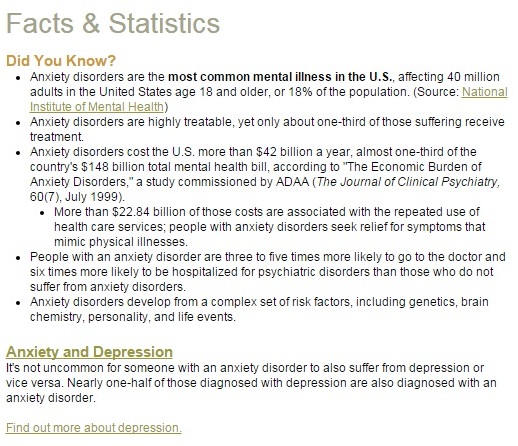


 [Note that fear/anxiety is associated with almost every mental illness that there is.]
I have come to believe that helping people with the deepest needs of life begins with a biblically accurate view of justification and its relationship to sanctification. This is where it begins, let’s go to the phones.
My Reply to Linda: Yes, I Am a Christian, But Not Sure You Are
I am presently in the process of eliminating my personal Face Book account. A ministry account will be maintained for the TANC blog, Paul’s Passing Thoughts .com, and overseen by Pearl the PPT moderator. I recommend people befriend that account if they want to stay connected to our ministry.
The reason is simple: I no longer have patience for the evangelical regurgitation of orthodox talking points. Protestants don’t own their own faith that they have seen in the Bible with their own study. What they think they see and understand is what Protestant academics have told them, including the idea that they have authority to tell them what to believe. So, what is wrong with church? Church is wrong with church because it is predicated on a false gospel. That’s right, the Protestant Reformation was a false reformation founded on a false gospel. And this is why Dr. James White and others have refused to debate me publicly; the Protestant gospel as stated in its orthodoxy is the biblical definition of a lost person…under law as opposed to under grace.
Martin Luther and John Calvin et al proffered a gospel that is under law, but that is supposedly OK because Jesus keeps/kept the law for us and that obedience is imputed to our Christian status. This is a perpetual covering of sin, or sometimes referred to as “atonement,” but not an ENDING of sin that requires no further justification. Hence, we must “preach the gospel to ourselves every day” to “keep ourselves in the love of God” (CJ Mahaney) etc. White and others know that this is a simple matter of theological math, and do not intend to address it until enough people catch on. The only case they can make presently is for a historical-redemptive interpretation of Scripture that interprets every verse as a justification verse. Sanctification is defined as progressive justification via Protestant talking points.
So, while in the process of eliminating my personal Face Book account, I noticed a comment to me by a “Linda.” It follows:
“Are you a Christian Paul? And secondly do you believe that the Bible is the inspired Word of God? That would be my two questions for you. Romans says, ‘There is none righteous, no not one.’ That includes you and me. This doesn’t mean that we never do a kind act or good deed. It means that we don’t and can’t do enough of them to be declared ‘RIGHTEOUS’ by God. We could never do enough good deeds and kind acts to get us into heaven. Therefore we need the righteousness of Christ imputed unto us in order to go to heaven. God imputes this kind of righteousness to those who believe and accept HIS son Jesus and his shed blood as atonement for their sins and their UNrighteousness. We are part of God’s family by adoption. Nothing can make us righteous enough to go to heaven. The righteousness that is applied to our never dying soul can only come from Christ. The ‘part and parcel’ of our own being is puny compared with what God demands. In one place in scripture our puny ‘part and parcel’ is described as ‘filthy rags.’ So our own human effort at righteousness is from our flesh. Our flesh is not saved from sin and unrighteousness. Only our soul is. We are not capable of learning and loving enough to be declared righteous enough for heaven. We could learn and love enough to help another person with a kind act or good deed. But that does not fit our soul for heaven. I don’t understand your third question……’Christ imputing sin’ ????”
Her comment was in reply to previous comments made in regard to a post. She was replying to a comment I made regarding her initial comment. Her initial comment follows, and afterward my reply:
“I am a never dying soul whom Christ died and rose for, approved of by God because I have HIS righteousness. Just by learning and loving we are different. Better means ‘improved in some way.’ Not hard questions for me.”
“Linda, where does the Bible say you have the righteousness of Christ? That’s the first question. The second: Are we only approved of God because we ONLY have the righteousness of Christ and none of our own? What about the new birth? If we are literally born of God and now part of His lineage, would that not make us righteous? Do you mean to say that we have a righteousness LIKE Christ’s because we are a member of the same family, or ONLY His righteousness and none that is part and parcel with our own being? Are we truly righteous, or only declared righteous? Third question: was Christ’s role in salvation an imputation of sin AND righteousness, or just sin? On the one hand, you seem to state that we only have the righteousness of Christ, but on the other, you say we learn and love. How exactly do we learn and love if we ourselves are not righteous people? So, I am not trying to be a jerk here, I am simply resolute that Christians should have a clear definition of who they are. Yes, I know exactly what the Reformers believed about our identity, but I would like to see your clarification.”
This is the extreme Protestant cognitive dissonance resulting in the train wreck we call “church” that I no longer have patience for. People who are serious about following Christ need to take their true gospel and leave the institutional church for home fellowship networks. The institutional church is part and parcel with the authority that demands a denial of the obvious. Authority has replaced truth. Nevertheless, I do believe evangelicals will have to eventually address their under law gospel.
I will make this as simple as possible as I am weary of addressing it. Much, much, thanks to Andy Young who is helping to carry the water on this as well. Linda’s response is pretty much the Protestant gospel talking points that we hear often, and pregnant with cognitive dissonance. All in all, her answers to my questions are, “NO.” Please start by noting that. This is where we discuss another disservice the Reformers performed: adding chapters and verses to the Bible. This circumvents the need to read all of Scripture in context. You can form a theological argument by using John Immel’s pet peeve: Scripture stacking. Basically, Linda is using the same verses to argue for the same Protestant talking points that she has received from Protestant academics. As a result, if one examines her statements, the blatant contradictions are stunning.
Where to start? ALL of our works are filthy rags (Isiah 64:6), yet, we can do some stuff that is good? So, “all” doesn’t really mean “all”? Per the usual, Protestants profess a double false gospel because they don’t rightly understand the gospel taught by the father of the Reformation, Martin Luther. In fact, Luther taught that EVERY deed of man is evil, even those that appear good because man’s “good” deeds always have a flawed motive. Calvin taught the same. Hence, if one believes that we can do a good deed, that is “mortal sin” and cannot be forgiven by the church. But, if one believes that every work we do, even works that appear good, are actually evil, all of our sin can be forgiven by revisiting the same gospel that saved us, and that revisitation is only valid under the auspices and oversight of the clergy. This is Luther, this is Calvin, this is the Protestant gospel. I have documented this backwards and forwards as those who follow TANC Ministries know.
Now, for the Protestant part of this that Linda got right, and in fact a mainstay of Protestantism, but still a false gospel. Luther and Calvin orthodoxy already condemns her to hell, but they would agree with her making the law the standard for justification. Biblically, there is NO law in justification. The Bible testifies about justification, but law and justification are mutually exclusive. It doesn’t matter who keeps the law, there is no law in justification. What determines justification is the new birth. The law is strictly for love in the Christian life. Again, the law informs us about justification, and here is the information: law is not the standard for justification, the new birth is. The apostle Paul wrote the epistle of Galatians to make this very point. Again, I predict that folks are going to start catching on to this in the future and the who’s who of evangelicalism are going to have to make a defense; good luck to them as that attempt will be interesting. The Protestant under-law-gospel, also stated by Linda, has Christ fulfilling God’s “demands” in our stead when God’s only demand regarding justification is that we be born again.
In order to make the law the standard for justification, the Reformers resorted to Saint Augustine’s Neo-Platonism, which later became Gnosticism and wreaked havoc on the first century church. We see this in Linda’s talking points about “the flesh.” ALL of our works come from where? Right, the flesh which, like the Reformers, she deems as inherently evil. That’s Gnosticism. The Bible teaches that our bodies, or members, are “weak” not inherently evil. When the Bible speaks of the “desires of the flesh” and the “deeds of the flesh,” that speaks of when our members are used for sinful purposes. Obviously, if Linda would stop long enough to read her own Bible with her own understanding given to her by God, she would see that our body, or “flesh,” can also be used for holy purposes (Romans 12:1 among many other passages). And, what is more obvious than the fact that our bodies are declared to be the temple of God? Actually, a word study reveals that the Holy of Holies is being referred to.
This brings us to Linda’s Protestant confusion in regard to the difference between salvation and redemption. The former is the saving of the soul, the latter is the saving of the mortal body which can be used for evil or good depending on which desires we are obeying. Christians, through the new birth, have the ability to obey the desires of the Spirit stated in the Bible and the ability to say “no” to evil desires that remain part of the body’s weakness and mortality. Because Christ ended the law through the new birth, sin has been stripped of its ability to enslave and condemn. If Christ obeys the law for us, we are still under it and enslaved to sin. The old us that died with Christ violated the whole law with every sin; the new us that was raised with Christ fulfills the whole law with one act of love. Christ didn’t come to obey the law for us—He came to END the law. Christ didn’t come to cover our sin—He came to END our sin.
A book could be written here, but time won’t allow it; nevertheless, let’s address Linda’s confusion, typical among Protestants, in regard to gift and reward. We cannot birth ourselves, but we can obtain the baptism of the Spirit by faith alone in “the promise” (see Galatians chapter 3). Once the gift is received, it is ours to utilize by loving God and others. Exercising the gift is not taking credit for the gift. The Bible states that God would be unjust to forget our good works and service to the saints (Hebrews 6:10). “Unjust”? Yes, because as those literally born of Him (1John chapter 3), and literally a part of His literal family, our reward is due us as siblings working for the Father. As a slave to the former master, we could only earn death wages—now we can earn true reward. Read the Parable of the Talents and see what the outcome is for those who fear and want to give God back only what was given and nothing more. It shows a fundamental misunderstanding of the new birth.
As a policy, I don’t judge the salvation of others. I believe that there are Protestants who are confused enough about Protestantism to be saved. So, yes Linda, I am saved, but I find your assurance that you are saved indicative of your confusion. Protestant orthodoxy CLEARLY states that the motor of sanctification moving justification forward is doubt of salvation because being under condemnation is part and parcel with being under law…the standard for justification according to Protestantism. In Calvin’s words, if “Christians” are not still under condemnation, what further need is there for Christ and His righteousness?
So Linda, I am saved, but I recommend that you start thinking for yourself. All of the Protestant academics you trust will not stand in your stead at the judgment. You will be standing there alone.
And you better have more than a covering with sin underneath it, you better be a literal child of God before Him.
paul

 Paul's Passing Thoughts
leave a comment