Re: Lecrae; Dear Spiritual Peasantry, Please Help Me Understand
 I would like the spiritual peasantry to help me understand why they keep doing it: tithing hard earned money, and not forgetting “offerings” to boot, forfeiting time with family because the “doors of the church are opened,” ignoring nature’s way of telling you something is wrong (conscience) because “the elders are close to the situation and know all of the intimate details” that somehow trump the obvious, listen to a different variation of the same gospel message every week, etc., when the orthodoxy only applies to you and not leaders.
Why are you obedient to leaders who apply the rules to you only, or continue to endorse those who practice this brazen double standard? What am I referring to? Well, poke the Googleberg Press anywhere for examples, but what is the latest drama that has provoked this post? I’m glad you asked.
Below, there are two short vids of John MacArthur bemoaning the increased unwillingness of the spiritual peasantry to “put themselves under the authority of ‘godly men.’” I chose these two because what MacArthur states in these vids echoes what we hear daily from the who’s who of evangelicalism.
Now enter the latest institutional church drama: the father of holy hip hop, Lecrae, also the toast of the New Calvinist elite, appears to be totally off the orthodox reservation. “Old” Calvinist Joel Taylor posted on this latest drama here. Also see this, and this.
So far, his numerous elitist New Calvinist mentors are silent. Taylor might be a little miffed since he left the movement because Paul Washer wanted his blog to be vetted and overseen by his elders. Like they are overseeing Lecrae? Hardly. Side note: the Westminster Confession calls for media oversight by the clergy, so Washer’s elders were only doing, bless their hearts, what Calvinists do.
Why does the evangelical peasantry continue to put up with this double standard? Really, I now confess, it’s a rhetorical question; they put up with it because they have been sold on the idea that the institutional church is the only way to heaven. Supposedly, we have no direct access to the Chief Shepherd, Jesus Christ who is the head of the church. Pastors speak for Christ on earth—it’s called the “power of the keys.” It’s a formal Reformation doctrine.
But there is an alternative. Read the New Testament. Christians met in homes, and nowhere is it stated that there is anything insufficient about that or the idea that home fellowships were a transitional stopgap. In addition, though not the ideal, it is clear that some apostolic era home fellowships DID NOT have elders. Eldership DOES NOT legitimize a home fellowship. Furthermore, EVERY believer is accountable to Christ individually (the priesthood of believers 1Pet 2:9), and what some evangelical brainiac told you to believe will not be an excuse. You, and you alone have the responsibility to not be deceived by yourself or others.
Just stop and think about what you are paying good money for and submitting to. And by the way, seminaries don’t legitimize fellowships either—there weren’t any seminaries in the first century and eleven of the twelve apostles were not formally educated. What has Christian academia done for us? Go to any Christian book store and peruse the mass confusion displayed in all of its aesthetic majesty. Ask five pastors to define the words, “law” and “gospel” you will get five different answers for each. That’s what academia has done for us: zilch.
Lecrae will not be called out until he breaks one of the unpardonable sins of the New Calvinist inner circle. Then (barf alert), he will be used as an example to demonstrate the high standards of New Calvinist aristocracy. We only know what two of these codes are: don’t deny the existence of hell (that takes away the ability to control people through fear, see “Rob Bell”), and don’t lack nuance in your teaching lest the peasants figure out the crux of what Calvin really believed (see, “Tullian Tchividjian”).
We may never know the real reason Mark Driscoll was kicked to the curb with pious indignation, but trust me, it had nothing to do with the same rampant abuse that goes on in New Calvinist churches daily not excluding criminal activity. It is fairly well documented that James MacDonald partakes in the same serial abuse that marked Driscoll’s ministry, but whatever Driscoll did, MacDonald hasn’t done it yet, and neither has Lecrae.
How long will the peasantry put up with this blatant double standard? Lack of theological education is not an excuse for being a fool, and being taxed for it to boot.
paul
Let’s Pretend: Cedarville University Cares About the Gospel
 Originally published June 10, 2013
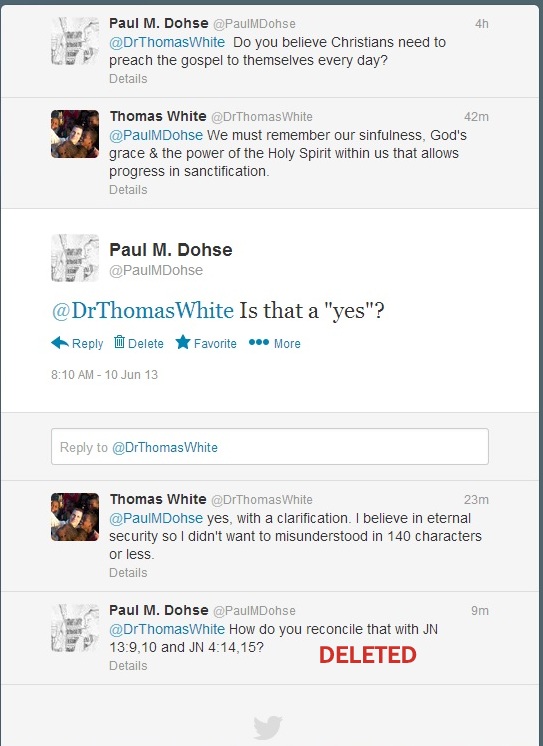
“Did you know Christians still need to be saved? Well, bless your heart, it may be too late for you, but quickly enroll your children at Cedarville where they can be saved by Dr. White’s gospel.”
Nobody wants to discuss the gospel that has been running the show in the American church for several years. Launched by a Reformed think tank in 1970, it seized control of evangelicalism in the mid-1990s. Propagators continually put forth the idea that they are the new sheriffs in town and they need time to straighten things out, but the fact is that their gospel has been running the show for almost twenty years now. Are we better off? Hardly.
We aren’t talking about mere semantics here. We are talking about the heart of the gospel. We are talking about the law’s relationship to grace. We are talking about the very definition of justification. New Calvinism keeps the believer under law, but supposedly that’s ok because Jesus keeps it for us. No, under law is under law no matter who keeps it. God will not honor a false gospel. The New Calvinists aren’t fixing anything—they are creating the mess with their backdoor antinomianism.
The new President of Cedarville College is just what the trustees were looking for: handsome; educated; an adventurist; sports enthusiast; the appearance of pure orthodoxy; the Mayberry RFD family—all the things that bring in admissions from suburbia Christianity. Hope has returned to Cedarville; the alumni can once again look at themselves in the mirror. Yes, he’s good, even being a student of New Calvinism for six years now, it took me forty minutes to positively identify him as a New Calvinist heretic. I consider him one of the best at masking his false gospel.
Dr. Thomas White and his wife were both educated at Southeastern Baptist Theological Seminary, a bastion of Christian mysticism and New Calvinism. But a statement on his blog says it all:
When the Gospel drives everything we do, we see all of us need grace every day. We all have deceitfully wicked hearts and preaching a moralistic set of rules will never save but will only add a burden that mankind cannot bear. We should teach about theological realities such as adoption, redemption, forgiveness, and grace. We should become protectors of widows and orphans and fathers to the fatherless.
We need to proclaim loudly the biblical message that children are a blessing from the Lord, that life begins at the moment of conception, that we must fear God more than any opinion of man, and that the Gospel brings grace if one repents and believes. No matter any judge’s verdict, we must defend life now, not wait until the morning after.
For the most part this reads well, but the devil is in the details. The greatest errors are always closest to the truth. Does the gospel drive EVERYTHING we do? Does the same gospel that saved us continue to completely drive our Christian life? You know, the “gospel-driven life.” The “gospel-centered life.” Do Christians continue to need grace every day? What does he mean by “grace”? The common grace we expect from God every day, or the same grace that saved us? Do Christians need daily salvific grace? Is that what he means? Sure it is, for he goes on to write,
We all have deceitfully wicked hearts….
Is that true? Do born-again Christians have “wicked hearts”? Yes, according to New Calvinists. That’s why we need the gospel every day.
Like with all New Calvinists, we receive the same ambiguous rhetoric from White that masks his false gospel:
….preaching a moralistic set of rules will never save but will only add a burden that mankind cannot bear.
“Mankind” is thrown in to knock you off the scent. This kind of New Calvinist deception is protocol. The “preaching” refers back to “we” and “us” in the previous sentence including “all.” That would be us, as in CHRISTIANS, the fact that New Calvinists see us as no different than the unregenerate (and therefore still under the law) notwithstanding.
Furthermore, try not to close your eyes because a shocking scene is coming:
1. Rules in the Bible are called “moralistic.”
2. And, preaching rules will never “save” Christians.
Did you know Christians still need to be saved? Well, bless your heart, it may be too late for you, but quickly enroll your children at Cedarville where they can be saved by Dr. White’s gospel.
Somehow, they will become moral and serving as well. Dr. White will teach them two different things that supposedly yield godly results:
A. They are still totally depraved.
B. They should value life and help the poor.
Really? Dr. White also states that we should….”teach about theological realities such as adoption, redemption, forgiveness, and grace.” “Obedience” and “sanctification” and “discipleship” are conspicuously missing. And there is a reason for that.
Like all New Calvinists, Dr. White will propagate a gospel contemplationism that supposedly results in the imputation of Christ’s obedience to the believer in sanctification. That’s because we are still under the law and Christ’s obedience must be imputed to our sanctification so that we can live our Christian life in the same way we were saved: by faith alone. Synergistic sanctification is believed to be works salvation. It’s antinomian let go and let God theology.
Again, these guys have been running the show for twenty years and the results speak for themselves. One result is the GARB response to the ABWE scandal. It’s sad but true: Christians continue to pay good money in the name of a gospel that will not sanctify, or save.
paul


The Truth About Predeterminism: A Historical and Biblical Evaluation
 Good evening and welcome to False Reformation blogtalk radio. I am your host, Paul M. Dohse Sr.
If you would like to join the discussion tonight and add to what we are learning, call 347-855-8317 and remember to mute the speakers on your laptop or PC. And by the way, the question or comment does not have to pertain to the subject at hand—it can be off-point.
I am very excited to share what my research has yielded since I began this ministry in 2006, working at it part time until April of 2010, and thereafter full time until now. Resources can also be found at tancpublishing.com.
Tonight we will be discussing the subject of predeterminism, otherwise known as God’s election or predestination. Now, I realize that election and predestination primarily speak to God preselecting who will be saved and not saved, while predeterminism deals with the wider spectrum of human events.
Let me set the table for tonight’s discussion. Starting out in Reformed beliefs can be simple enough. God preselected those who will be saved, and left the rest to their own devices. And, there seems to be Bible verses that state this plainly.
You might even believe that election and freewill are both 100% true. You might believe that this is a paradox. I heard Rick Warren tell John Piper that this is his position, since the Bible states both, both are equally true. You could also argue that paradoxes like this exist in science. Let me give you an example from Dr. Bo Grissom as stated in last year’s conference:
Consider, for example, the physics of light where two seemingly contradictory theories are used side-by-side to explain its different properties.
The wave theory is used to understand the oscillation aspects of light (e.g., Polaroid sunglasses), while at the same time the particle theory is employed to explain other applications (e.g., photoelectric solar panels). Although these two theories are totally incompatible, each provides useful information in certain technical applications.
To date, scientists simply use the appropriate theory as needed for a particular design problem. There is no worry about whether light actually exists as a wave, or as a particle, just because it is not yet fully understood. This same approach may be taken in the spiritual realm and is probably the best stance to take in dealing with the apparent contradiction between individual free will and God’s total sovereignty.
When we extend this God’s predeterminism from salvation to every aspect of life, we are not just talking about election and predestination, or whether one is a 1 or 2 or 3 or 4 or 5 point Calvinist, we are now talking about determinism or predeterminism. Hence, the word used in our title tonight. And this is where we must go because Protestantism was founded on hard determinism not soft determinism.
The Protestant tradition is based on Redemptive Historical hermeneutics. What’s that? It is the belief that every facet of human life is predetermined. It is the belief that reality and the state of being is a prewritten story or grand narrative written by God. This is known as metanarrative, or metaphysical narrative, or a grand metaphysical narrative. In regard to authentic Protestantism, all of history is a predetermined gospel, or redemptive narrative also known as the “divine drama.”
This is also the basis of mythology which is NOT superstition. Mythology is merely the most ancient and basic foundations of religion. It is the idea that a force, nature, cosmos, or personal God has prewritten history. The story, as it unfolds, is the state of being. The author of being is always an invisible force who manifests his/her being in the material realm.
Mythology in its various forms also has mediators between the invisible and material. These are elitist guides who have special insight into the invisible realm that cannot be understood by the general populous. Therefore, in order to guide the masses, priests, philosophers, or whatever you want to call them, explain truth to the masses in a way that they can understand it, namely, via a story.
For the most part, people in cultures don’t take the mythological stories literally, they understand that the guides are merely repackaging what they are unable to understand in a way that they can apply it to their lives. Ancient cultures were not stupid people driven by superstition; they understood the mythological narratives to be creeds and catechisms to live by that come from purer truths that only the guides can understand.
Superstition then, is an unreasonable understanding and application of the mythological narrative. That’s what superstition is. It may also include many personal quirks applied to the superstition as well.
So, from the cradle of society comes mythology, and its orthodoxy is metanarrative. This of course requires a spiritual and social caste system or a empirical pecking order. This is why Hinduism is the most ancient of religions—because mythology is the most ancient of religions.
In this ancient construct, everything is predetermined in the story written by the force or personal God, and life is ONLY experienced. It’s like standing in the rain. You feel the rain, you experience the rain, but you have no control over the rain—the rain is a story that you only experience—your part in the narrative is only experienced.
In Hinduism, which is the best example, the spiritual strata is Bhramin, Kshatryia, Vaishya, Sudra, and Untouchables. But listen very careful to what Karma is in Hinduism. THIS IS KEY. I am citing Swami Bhaskarananda: Chapters IX to XI from the book “The Essentials of Hinduism,” Heading; “Predestination”:
Karma is the infant stage of Hinduism where saints believe they are responsible for their own actions, but as growth moves forward, the mature saint…
He becomes convinced that God has been doing everything by using his body, mind, energy and the senses. He feels that he is only an instrument in the hands of God, and whatever God has been doing to him is for his ultimate spiritual good. At this high level of spirituality the doctrine of predestination becomes the only valid doctrine to him. To him the doctrine of karma ceases to be a valid doctrine.
Therefore, these two doctrines, even though apparently contradictory to each other, are valid for people at different stages of spiritual growth.
Hang on to all of this as we are going to plug it back in later. This will all come together for you as we progress.
At this juncture, I am going to inject another key term: the total inability of man. Can we state anything other than the obvious fact that Hinduism representing the foundation of ancient religion is one soul with the total inability of man? Absolutely not.
When I first became a Christian, I was, I guess what you would call Arminian. I only borrow the term to make a point because Christianity is not either Calvinism or Arminianism, that’s perhaps the biggest red herring of all time.
I was later persuaded into believing what is often referred to as sovereign grace. Or, election. I was never crazy about it though I believed it to be true. To me, there were certain Bible verses that made individual election unavoidable.
Fast forward to the TANC Research era. When my research found that Protestantism was founded on the false gospel of progressive justification, I pretty much deemed the election issue as a diversion from the real issue of the gospel, and pronounced the election issue irrelevant.
I then adopted the aforementioned paradox view and stuck it in my back pocket. I am not going to take the time tonight to discuss why I decided to revisit the issue, but I did. And here was my approach:
I found the issue of law and gospel to be very definitive in the Bible, what I call “theological math,” and assumed that a deeper and deeper objective understanding of law and gospel would lead to more understanding of the more subjective and mysterious biblical issues. What we know are building blocks to what we don’t know. If not, conclusions are merely leaps in logic.
Deuteronomy 29:29 makes it very clear that there are things we are responsible for knowing and doing, but to some degree we are not going to understand everything. BUT, we also need to milk the objective cow for all we can get out of it. You stick with what you know positively and see where it leads you.
And here is where I have been led: I believe freewill is a metaphysical pillar. I believe it is one of the major tenets of being. I also believe that it better answers the more difficult questions such as, “Why did God allow sin into the world?” That is, if He did in fact allow it—we must remember that is a presupposition. God is not limited in any way by perceived attributes. Example: God is omniscient, but does that mean God in unable to not know something because of His omniscience? What if God doesn’t want to know something? Is He UNABLE to not know?
I have come to believe God did not elect individuals, but rather elected the means of salvation which includes people groups and Christ Himself. I believe God is sovereign and intervenes in the freewill affairs of men to guarantee predetermined outcomes which DOES NOT include every detail of life and history.
The Bible says that God created hell for the Devil and not man; therefore, men go to hell because they choose to go there against God’s desired will. Though the fall caused man to be ashamed and hide from God—God seeks him out and reasons with him.
This brings us to some very important reasons to consider the truthfulness of predeterminism. First, the primary pundit of predeterminism is the Protestant tradition. As we discussed prior, Protestantism is the false gospel of progressive justification. Therefore, predeterminism is fruit from the poisonous tree.
Secondly, and most importantly, the Reformed tradition has made the sovereignty of God the gospel itself. Don’t miss this; note this term: “sovereign grace.” We must understand that sovereign grace is a specified gospel. It is a soteriology or doctrine of salvation—please don’t miss this. Individual election is not a separate issue from the death, burial, and resurrection of Christ according to the Reformed camp.
A key concept of sovereign grace is the total inability of man. In 2008, Calvinist John MacArthur stated the following at a conference:
The doctrine of human unwillingness and inability is perhaps the most attacked doctrine wittingly or unwittingly. The idea that sinners are completely helpless to redeem themselves or to make any contribution to that redemption from sin and divine judgment is the most attacked because in the big picture, it is the most despised doctrine.
Consequently, it is the most distinctively Christian doctrine, contrary to all non-Christian views of men. All religions in the world are some form of a works righteousness system. And at the foundation of all those religions other than the true faith in the true gospel is the idea that people can be good and good enough to contribute to their salvation, to somehow merit favor with deity and a happy after life.
Because this is the universal foundational doctrine of all false systems of religion, it is therefore the most – because, I should say, the opposite of it is the foundation of all these religions, it is therefore the most attacked Christian doctrine. It is distinctively Christian because it affirms the absolute inability of man to do anything to contribute to his salvation.
That’s a crock. What MacArthur said is the well-traveled narrative and historical motif, but the exact opposite is true. The carte blanche religiosity most prevalent in all of human history is determinism. This has always been true in the secular realm as well. In the secular realm it is known as freewill skepticism. Somebody sent me a great video on this a couple of days ago and I found it most fascinating.
But look, mankind has been so saturated with a propensity towards determinism that its philosophical truisms pepper our speech. Quote, “Don’t tempt fate.” “It’s our destiny.” In sports: this team or that team is a “team of destiny.” “Oh well, I guess it just wasn’t meant to be.” One of the biggest hits ever was Doris Day’s Que Sera, Sera (Whatever Will Be Will Be). In 1964 you couldn’t go anywhere without hearing that song.
So, like the video I was sent the other day, MacArthur who I think represents the general mentality well is proffering the idea that freewill skepticism is counter intuitive—historically, the exact opposite is true. Calvinism is an extremely old shoe. It’s just a chip off the old block of ancient mythology—it follows that tradition.
So, freewill skeptic philosophers as well as Calvinists talk often about free will’s relationship to “American individualism.” And this is the next step to our discussion: determinism goes hand in hand with collectivism, and freewill goes hand in hand with individualism. Let me explain how this works.
If whatever rules the universe in the invisible realm has representatives or mediators in the material realm, that means the majority of humanity cannot know reality. The other alternative is what got Socrates executed. He taught that truth was intuitive to everybody and leveled the playing field which was a really bad idea because only 10% of the population made up the ruling class.
Therefore, his understudy Plato had to get out of Dodge and become a foreign exchange student for a while, but he studied in India and came back to Athens with a much better idea: the philosopher kings are able to obtain the gnosis and teach it to the masses, the warriors inforce the dictates of the philosopher kings, and the sole purpose of the masses is the collective good.
This was never more or less than Plato’s version of the Hindu caste system. The value of an individual is based on their ability to contribute to the common good as judged by the philosopher kings and enforced by the warriors if necessary.
Where did the crux of this system begin? In the garden with the serpent and Eve. The serpent, in essence said, “Eve, you aren’t able to correctly ascertain what God really said, you need me, a spiritually superior being, to properly interpret what God really said.” That’s where all of this starts. It worked well in the garden, why in the world would the construct ever change, right? This also makes mediators the obvious shoe-in for social engineering or societal wellbeing.
Now we have to figure out who the mediators are, right? How do we figure that out? Who is to say? That’s where predeterminism comes in as well. The mediators are always preordained by God before the foundation of the earth. This goes hand in hand with the social class strata.
Social classes determine who the rulers are, the warrior class, and the artisans. It becomes a matter of lineage or pedigree. And as you know, this has never changed in many, many cultures. In many cases upward mobility is forbidden.
Traditionally, collectivism, again, the idea that the worth of an individual is determined by ability to contribute to the common good, is the doctrine that is always associated with determinism and its spiritual caste. The preordained mediators keep the masses in tune with good karma. Immature citizens think they can actually control their fate, while the wiser artisans and producers know that whatever force they worship is completely sovereign. Hey, if the force didn’t want that philosopher king in power, he or she wouldn’t be in power. And of course, some cultures take it a step further and deem the rulers as the actual material manifestations of a god or several gods. Examples of this would be Japanese emperor worship during WWII and the Pope (the “Holy Father” of the Catholic Church).
I am going to pause here and mention how these ancient traditions show up in the contemporary Protestant church. The president of Southern Seminary, Al Mohler, stated at a conference in Florida that pastors are God’s appointed preordained ministers to save His people from ignorance. That’s what he said. In the Puritan tradition, upward mobility was considered a violation of the fifth commandment because it didn’t honor the social class you were born into. Folks, this is all the same stuff! A book written by Calvinist Paul David Tripp, How People Change, is a 200 + page treatise on how to become part of God’s metaphysical divine drama. You are not in control of anything, you just need to be able to see the world through eyes of faith; i.e., all of life is the unfolding of a preordained redemptive narrative (see endnote at end of transcript).
In addition, Calvin’s three-fold election construct that we discussed last week is identical to the election doctrine of Gnosticism, a later version of Neo-Platonism. The hylic coincide with Calvin’s non-elect, the psychic are the partially initiated, or temporarily illumined, and the pneumatic are the fully initiated or Calvin’s lot that persevere till the end. This is all the same stuff.
Now, we are getting ready to close the first segment so anyone wanting to call in can start ramping up while I finish the first segment with individualism which is mostly identified with freewill. Individualists commonly believe that they do not need a mediator to understand God or reality. Secondly, individualists would reject predeterminism out of hand. Thirdly, they would reject social caste out of hand and deem it as tyranny. Fourthly, they believe happiness is found in accomplishment and would reject anything that hinders upward mobility. Fifthly, they would reject total inability.
However, individualism is what is counter intuitive. Individualism is a unique American experiment which finally happened after man suffered unspeakable misery for 10,000 years at the hands of collectivism. EVERYONE agrees that there has never been a country like America in the history of the world. Well, why not? Why did it take so long? Because individualism is not our natural bent—collectivism is. No? After all of the mass graves and misery amassed by collectivism, why are politicians worldwide still hell-bent on implementing it?
Ever heard of the tower of babel? We wouldn’t even have the individualism that we have now unless God confused the languages. Man was continually commanded by God to spread out, fill the whole earth and subdue it. What did they do? They all gathered in a Hindu huddle at the tower of babel.
That’s the first segment. Conclusion: Calvinism is far from being unique. It’s just the same old warn-out collectivism that has been wreaking havoc on mankind since the garden. Determinism is nothing unique, the total inability of man is not unique—IT’S ALL THE WORLD HAS EVER KNOWN UNTILL AMERICA CAME ALONG. Status quo religious books like the Quran are saturated with the idea of predeterminism from the front cover to the back cover. I could go on and on with example after example.
Segment 2
What about the gospel of sovereign grace? This is a gospel that is defined by predeterminism. Apart from predeterminism, all gospels are deemed false—it must have the determinism element. Freewill is tantamount to a false gospel because it leaves room for man to have a role in the salvation “process” that supposedly starts with beginning justification which is experienced subjectively and ends with final justification. It’s a process of salvation instead of the finished work of salvation being applied to the specific point in time when a person believes the gospel. The life of the born again believer now becomes part of the salvation “process.”
Supposedly, saving faith can ONLY ASK to be part of the salvation process via John Calvin’s Sabbath rest where we must rest from our works because the same gospel that saved us also sanctifies us. We must rest from our works in the Christian life because it is now part of the process. Accordingly, no saint can know positively if they are the called class of elect, or the class that perseveres. Again, this is akin to the Gnostic election classes of hylic, psychic, and pneumatic. The called, like the psychic, are temporarily or partially illumined and have no way of knowing whether or not they will persevere until the end. Assurance is clearly ambiguous.
This is authentic Protestantism’s definition of saving faith. Ability to choose in any part of the salvation process is tantamount to the ability of man and therefore akin to works salvation. Not unlike spiritual maturity in Hinduism, as the good Protestant grows spiritually, he/she realizes more and more that they have no real role in the salvation process, but only experience God’s prewritten metaphysical narrative. Spiritual growth is defined by a progression from soft determinism to hard determinism.
In the Protestant “gospel of sovereign grace,” soft determinism is the minimal requirement because having freewill is tantamount to the ability to choose which is considered works salvation. Individuals then grow into their final salvation by evolving into hard determinism. This is by no means unique, but very prevalent among the world’s religions including movements like radical environmentalism.
Do Calvinists believe in total inability? Well, many environmentalists believe the very existence of man is detrimental to the earth!
Hard determinism is comfortable with the idea that there is no assurance of salvation which of course is a direct contradiction to the book of 1John. As far as the Reformed stating this in no uncertain terms, chapter 5 of It’s Not About Election is chock-full of citations from Calvin, Luther, and contemporary Calvinists like John Piper.
However, there is a get out of fate free card, right? What is it? The Reformed power of the keys. Simply stated, if you are a member of a Reformed church and you obey the elders and they like you, if you “humbly” put yourself under their authority with issues of error being beside the point—YOUR’RE IN because whatever they bind on earth is bound in heaven and whatever they loose on earth is loosed in heaven. Do you want to go to heaven? Well then, keep your mouth shut and put your money in the plate.
Now, back to this sovereign grace gospel and the next point about it—it makes God’s sovereignty paramount to the gospel and not God’s love. If man has a choice, or freewill which speaks to ability, this would violate God’s attribute of sovereignty. It would deny God is sovereign in all matters of life and being. In other words, God’s sovereignty and freewill are mutually exclusive. Beside the point that this again limits God because of an attribute assigned to Him, the stated biblical cause of God saving the world because of love is changed to God saving the world because of His sovereignty.
This also posits the idea that sin came into the world because of God’s sovereign will and not His permissive will. The unavoidable conclusion also posits the idea that sin coming into the world was God’s desired will. In contrast, God may have chosen not to know anything about what would come out of freewill as a creative principle. The Bible never states that God knew sin was going to come into the world and decided to permit it for some reason. The Bible states that sin was “found” in Satan at some point (Ezekiel 28:15).
Built-in inherent weaknesses or propensities are not part of God’s creation. Rather, God’s attribute of freewill assumes good results because all that God creates is good. Obviously, Lucifer and Adam were created with freewill, but nevertheless, freewill is not the problem. Reformed soteriology makes freewill synonymous with sin, and makes any kind of ability sin as well.
Many in the Reformed camp deny that they believe God’s sovereignty and freewill are mutually exclusive, but total inability assumes freewill is both impossible and sinful, so they cannot have it both ways. In their minds, man is only free to sin because freewill itself is sinful.
In reality, and according to the Bible, God is capable of being sovereign, but often chooses not to be. Again, he is not limited by any of His own attributes. God flexes His sovereignty in electing outcomes (sovereign will) and keeping promises through intervention, but at times chooses not to be sovereign. There are numerous examples of this throughout the Bible.
The Bible also documents cause and effect throughout. The Bible documents God’s intervention to prevent outcomes caused by the actions of men. The Bible also documents God’s active will, passive will, and permissive will. Cause and effect is also described in context of promises and incentive; if a person does this, God promises He will do that.
Hence, the gospel of God’s sovereign grace logically turns the Bible completely upside down if you interpret it grammatically, and that’s the point. Authentic Protestant tradition does not interpret the Bible literally, but according to a metaphysical redemptive story. Reality is a prewritten metaphysical narrative. This is nothing new—it’s the same old song and dance that’s been going on since the tower of Babel.
Really, what it does, if you really think about it—it makes the literal full counsel of God secondary, and the good news of Protestant authority primary. That’s one reason why incessant theological debate in evangelical circles is acceptable—it’s all theater—if you obey your elders and put your money in the plate you’re going to heaven anyway!
Why, for years, have you stood befuddled in regard to what evangelical elders can get away with saying and doing in the church? Because it’s really about the good news of Protestant authority and nothing more or less.
We are going to close tonight in the book of Genesis. I think we see what effect sin had on man; it made man ashamed and caused him to hide from God. Then we see God seeking man out and confronting Him. Shame does not equal total inability.
And this also affects evangelism. It is our role to seek others out on behalf of God. Why has evangelism always been so anemic among Protestants? This is why: Protestants have been taught that man is not only ashamed, but totally depraved with no ability to choose God once he/she is persuaded by the preaching of the word. The incentive to evangelize is not to see people saved, but to glorify God in both death and life. It is a mere proclamation that glorifies God either way, not an attempt to persuade. God is glorified when people are saved because he chose them, and God is also glorified when people reject the gospel because their greater damnation also glorifies God.
In the same aforementioned conference, John MacArthur referred to this idea of glorifying God in evangelism as a “savor of life to life and death to death.” Either way, it is a “savor” unto the Lord. This idea is not only a disincentive; it’s not biblically true and will therefore not find the Holy Spirt cooperative. MacArthur also stated in the same message that “total depravity or unwilling and unable [is]…a gospel theme.” Again, we see God’s sovereignty and man’s inability as foundational to the gospel, not God’s love.
In fact, many Calvinists argue that any gospel presentation that contains a reference to choice is a false gospel. The gospel is to be presented and the results left to God for His glory. If a person asks, “what shall we do?” they are to be told that they can only ask and hope for the best, but God will be glorified either way.
Also, in the same message, MacArthur stated:
The Spirit and the Son are in agreement that this work is a work of divine, sovereign power. And then, of course, we commented earlier, reading John 6:44, “No one can come to me unless the Father who sent me draws him.” John 8:36, “If the Son shall make you free, you shall be free indeed.” It’s the work of the Son. It’s the work of the Spirit. It’s the work of the Father who draws. In none of these texts, by the way, did Jesus defend the sinner’s ability. In none of these texts did Jesus defend free will. Yes, the sinner has will, and his will is activated by the Spirit in the work of salvation, but his will is not free.
Problems with this view follow: Jesus also said that He would be lifted up in order to draw ALL men to Himself (Jn 12:32). The Spirit also convicts men of sin and the judgment to come (Jn 16:8)—the Spirit works with us in evangelism.
God sovereignly elects the means of salvation and the final outcome of world history, but he does not elect individuals. When saints are called elect, it refers to their identification with a group or purposes elected by God, not the individual per se.
God elected salvation for all men, and the plan of salvation clearly includes an invitation to all of mankind. God sends His Spirit to convict and warn all men while God’s people proclaim His gospel from the word. The goal of evangelism is to “persuade” men to believe the word of God. Faith comes to men through this joint effort between the Spirit and God’s people. The new birth, or regeneration, then comes by faith (Rom 10:17, Gal 3:5).
In contrast, proponents of the gospel of sovereign grace must implement tenets like limited atonement and total depravity to make their case. Many of these tenets are blatant contradictions to the plain sense of Scripture.
And, in regard to Hindus claiming that all religions really agree with them unawares, they just may have a point.
Endnotes
Examples abound. A placard published on Facebook read, “All of your days have been written in God’s book. When you go through disappointment, don’t stop on that page. Stay the course. Keep believing. You may be tired, discouraged and frustrated, but don’t give up on your future.”
Even the late conservative evangelical Adrian Rogers once stated in a sermon:
“When you are surrendered to the will of God, focused on the Word of God, then the Holy Spirit begins to pray in you and through you. He energizes, motivates, and guides your prayer. One of the greatest lessons I’ve learned about prayer is this: the prayer that gets to Heaven is the prayer that starts in Heaven. Prayer is the Holy Spirit finding a desire in the heart of the Father, putting that desire in our heart, then sending it back to Heaven in the power of the cross. The prayer that gets to Heaven is the prayer that starts in Heaven. Our part is just to close the circuit” (online source: http://www.oneplace.com/ministries/love-worth-finding/read/articles/prayer-and-the-will-of-god-11630.html).
You can add to that a sermon by Dr. Devon Berry entitled, How to Listen to a Sermon in which he posits the idea that there is no such thing as edifying personal Bible study. The only thing that counts for receiving progressive grace is sitting under the preaching of elders because they get the word from God in the same kind of cycle described by Rogers. Berry is the chairman of the elders at Clear Creek Chapel in Springboro, Ohio which is a training center for the Christian Counseling and Educational Foundation which controls at least 90% of the biblical counseling going on in the evangelical church.


Justification is NOT a Declaration of Righteousness; The Christian is Made Personally Righteous
It begs the question: has the institutional church ever taught us anything at all that is true? Here we go again; have we all not heard all of our Christian lives that justification is “a legal pardon/declaration in which the Christian is declared righteous”? It is usually explained like this:
“When we believe in Jesus, it is just like we never sinned.”
Excuse me, but if you are presently a Christian, it is NOT “just like you never sinned,” you in fact have never sinned, nor will you ever sin in the future.
Huh?
We are talking about JUSTIFICATION, right? Two things happen when we are justified, or… “saved.” The law is ended/cancelled for us when we believe because Christ nailed the law and all of its condemnation to the cross. And, where there is no law, there is no sin. We are not talking about sin as God’s children that grieves the Holy Spirit who seals us until the day of redemption, we are talking about sin that would condemn us eternally.
This is where the logical jump from the ending of the law to justification is defined as a mere legal pardon. The Bible gives tacit recognition to that, kind of, but the primary definition of justification in the Bible is being made personally righteous through the new birth. God’s children are justified because they are made personally righteous. We are not just declared righteous, we are righteous. The nomenclature “duck” does not make a duck a duck, his duckness makes him a duck. Likewise, Christians are justified because they are in fact righteous.
Christians do not bear sin that is covered by God’s righteousness (often erroneously dubbed, “the righteousness of Christ”), our sin is ENDED, and God’s righteousness is infused into us via the new birth—we are literally born of God. Granted, sin still dwells in our mortal bodies, but it cannot condemn us because Christ ended the law on the cross. God now deals with us as children, because we really ARE his children and have his seed (DNA) within us. We may be chastised by God from time to time, but NOT condemned.
Christianity is not a mere mental ascent to the facts of the gospel; it is a literal following of Christ in death and resurrection. You are not “asking Jesus into your heart,” you are accepting God’s invitation to die with Christ and be resurrected with Him. The old you that was under the law literally dies, and you are born again as a literal child of God. Regardless of the fact that you are in a mortal body, you are God’s child and have His seed (σπέρμα sperma; seed of offspring) within you. The issue of the flesh’s weakness is resolved at redemption, but has nothing to do with your present righteousness.
This is why the Christian walk is so important; it testifies to the new birth. Be sure of this: truisms like, “We are all just sinners saved by grace” reveal a fundamental lack of understanding in regard to the gospel. Justification is not a covering, it is an ending of sin/condemnation and the walk of the new creature. I will close with this passage to make my final point:
1John 3:1 – See what kind of love the Father has given to us, that we should be called children of God; and so we are. The reason why the world does not know us is that it did not know him. 2 Beloved, we are God’s children now, and what we will be has not yet appeared; but we know that when he appears we shall be like him, because we shall see him as he is. 3 And everyone who thus hopes in him purifies himself as he is pure.
4 Everyone who makes a practice of sinning also practices lawlessness; sin is lawlessness. 5 You know that he appeared in order to take away sins, and in him there is no sin. 6 No one who abides in him keeps on sinning; no one who keeps on sinning has either seen him or known him. 7 Little children, let no one deceive you. Whoever practices righteousness is righteous, as he is righteous. 8 Whoever makes a practice of sinning is of the devil, for the devil has been sinning from the beginning. The reason the Son of God appeared was to destroy the works of the devil. 9 No one born of God makes a practice of sinning, for God’s seed abides in him, and he cannot keep on sinning because he has been born of God. 10 By this it is evident who are the children of God, and who are the children of the devil: whoever does not practice righteousness is not of God, nor is the one who does not love his brother.

 Paul's Passing Thoughts
3 comments