Why the Whole Predestination Debate is Stupid and Shameful
This is a reposting of this morning’s post under a different title to make another point. At this point, whether predestination regarding salvation is true or false is not the point; predestination is argued from a Protestant point of view and Protestantism is a false gospel to begin with. In other words, salvific predestination is fruits from the poisonous tree. Yet, there are Protestant ministries that I assume are financially viable predicated on the whole election issue, which is shameful. It also highlights a primary characteristic of Protestantism: they strain at a gnat and swallow a camel. Protestants love to debate theology and are addicted to controversies.
When you consider the overt elementary errors of Protestant soteriology, one wonders how there are churches every mile apart on the highways that have $500,000-plus annual budgets. The answer is fairly simple: churches are selling salvation, and what will a person do to save their soul? Answer: anything and everything, including believing whatever is necessary. Once they believe they are part of an institution that will get them into heaven, critical thinking is turned off. And, authority is deemed as a higher power that can be claimed as a free ticket into heaven.
Consider the absurdity. Christ did not appear at any church council to coronate any church as an authority. And, you can buy said authority by obtaining a seminary degree and toeing the institutional line. The Bereans even held Paul to account according to their own personal interpretation of the scriptures. People believe certain men have authority because they say they have authority. What’s up with that?
I would be inclined to judge against salvific predestination because of the source: if Protestantism doesn’t have the gospel right, why would they be right about predestination? It stands to reason that predestination is needed to help make the pieces of their false gospel fit together logically. Protestantism holds to the idea that a person is unable to do any good work. Believing in Christ would be a good work, and therefore, works salvation according to Protestantism. Predestination sort of solves that problem.
Furthermore, if you are born into the family of God and a forever child of God, and nothing can separate you from his love, and have the indwelling Spirit, which teaches you, what do you need church for other than fellowship and encouragement unto good works? This is why Protestantism redefines the new birth: it takes away church authority…plain and simple. Fellowship alone doesn’t pay the bills; it takes raw authority. In addition, one and done salvation (once saved always saved) is bad for reoccurring monthly revenue.
paul
This morning’s post:
Mr. Dohse,
For your consideration:
Romans 6:7 says, were it translated consistently from the Greek, “For he that is dead is JUSTIFIED from sin.” The ASV is one of the few translations that renders the Greek word there the same way–“justified”–as it is rendered everywhere else (about 39 times) in the New Testament. The KJV went off script here, and many others followed its lead.
In the argument of Romans 6, the one who has died with Christ, who has died as the old self he was, is justified from sin according to Romans 6:7.
If one has died with Christ, one is justified from sin.
Galatians 3:21 says that no law was given that could impart life, and that is why righteousness could not come through the law. Put aside for the moment any arguments concerning why the law could not give life–focus on the implication that if there is no new life, there is no righteousness or justification. Because the law had no capacity for imparting new life, the law could not justify or cause a man to be righteous.
If there is no new life, there is no justification.
Putting those verses together, the moment of justification is when God regenerates and transforms a man from being an old self into a new self, at the moment the old self dies and is transformed into or raised again as a new creation, a new spiritual man, this transformation being a gift from God and accomplished by His creative power.
A man is justified in the moment he is born again.
This regeneration is promised to everyone who turns away from any contrary belief to believe instead the Gospel as stated in 1 Corinthians 15:3-4.
Does that sound about right?
Exactly right. This is what makes justification by faith wrong x 14. First, the born again believer is justified because he/she is righteous as a state of being because of the new birth recreation. We are not merely “declared” righteous, we are righteous. When God looks at us, he sees us, his children. There is no need to see Jesus instead of us, we are his literal children.
Hence, the second point: salvation is NOT a covering of sin, which is atonement, but it is an ending of sin. Shockingly, MacArthur et al routinely call salvation “atonement.” According to JBF, grace is a covering for remaining under law.
Which brings us to the third point. You can’t be both, you are either under law or under grace. CLEARLY, JBF teaches that the believer remains under the condemnation of the law. Phil Johnson is fond of saying that “Christians remain under the righteous demands of the law.”
Fourthly regarding one of your points: there is no law that can give life. If the law can give life, it is a fourth member of the Trinity. The law has no role in the new birth recreation. Paul flogs the proverbial dead horse on this in Galatians. Why then the law? Well, according to Galatians, all sin is imputed to the law. Then, when a person is born again, the law is vanquished along with all sin under the old covenant. The believer was protected from condemnation by way of imputation to the law…”until faith came.” Viz, Christ, who did NOT come to fulfill the law through the perfect keeping of it, but rather came to fulfill “The Promise,” which is a primary name for the gospel that is ignored in most church circles and replaced with JBF.
Which brings us to a 5th point: Christ was righteous by virtue of who he is, NOT through perfect law-keeping. Shockingly, JBF teaches that Christ earned his righteousness through perfect law-keeping so he could then impute that earned righteousness to us. This is the Protestant doctrine of double imputation, which is overt blasphemy. Why would Christ fulfill a law that cannot give life? No, the new birth gives life, not the law.
Which leads us to point six: JBF has a single perspective on the law denying the Spirit’s two uses of the law (to convict the world of sin and the judgment to come; and sanctification) per Romans 8:2. Protestantism, therefore, teaches that Romans 8:2 refers to two realms, not law. By redefining nomos as a realm, they make a case for the law of the Spirit being a covering for the law of condemnation.
Which brings us to point seven: JBF conflates Fatherly chastisement with condemnation/wrath, and conflates the definition of sin in sanctification (better stated as a failure to love) with sin under the law. This makes a ritualistic perpetual atonement necessary.
Which brings us to point eight: we contend that salvation cannot be a process in which the believer is still living. This demands a role for the believer in a salvation process. Protestant scholars state this openly making a distinction between salvation and justification. Supposedly, salvation is a process while justification is the onetime act. This is a deliberate word shell game meant to confuse the issue. Supposedly, God only declares us righteous as a mere “legal declaration” (how can a legal declaration be righteousness apart from the law, being a legal declaration?) one time. But hark, then we must “participate in Christ” by perpetually returning to the same gospel that saved us for re-justification, which is supposedly the onetime act. Clearly, regarding this, Protestantism teaches that our original Spirit baptism is reapplied to the salvation process, keeping us justified, when we partake in a “lifestyle of repentance” (participation in Christ). Actually, Calvin and Luther taught that the power of baptism was in the water baptism. This is the Protestant doctrine of mortification and vivification and closely related to the doctrine of the vital union as well. This blog has posted hundreds of citations on this point from Calvin, Luther, and Michael Horton and will not belabor the point here. Protestantism teaches a beginning justification, what they call progressive sanctification, but is really progressive justification, and then a final justification. Calling the progression of justification “progressive sanctification” is deliberate deception. Calvin referred to justification and sanctification as a “twofold grace.” What does that mean? Well, both have to do with salvation. But, “Wait a minute!” you say, “I thought justification was the onetime act!” Right…you get it. Protestantism is a morass of confusion. Furthermore, to make progressive justification feasible, JBF splits works into two categories: faith alone works (the “ordinary means of grace” done at church), and works that are works. I kid you not. People listen to this stuff and don’t even blink.
This brings us to point nine: though Protestants claim a doctrine of assurance, obviously, they are lying. According to original Protestant soteriology, perseverance is a gift of God that is not given to all those who are “illumined” (Calvin). Hence, no one who is a professing Protestant can know whether or not they are predetermined to have the gift of perseverance until “final justification.” But, absurdly, there is also the doctrine of the “power of the keys,” which teaches that whatever the church elders bind on earth will be bound in heaven. In other words, if the church elders like you, you’re in. We have citations from the likes of Kevin Deyoung saying this in no uncertain terms, and of course Calvin states it in many of his writings. In contrast, assurance is grounded in the fact that there is no law to judge us. A dead man cannot be indicted. Even if the court dug up our dead body and presented it to the judge, the judge has no law to condemn us with. We contend that someone who is born again cannot be unborn, which leads us to the next point.
Point 10: We deny with prejudice that “believers” remain unregenerate and still need to be saved by revisiting the same gospel that originally “saved” us, as stated by many Protestant theologians including Calvin, Luther, and John Piper et al. This coincides systemically with points 1-9.
Point 11: We deny the idea that a “believer” is sanctified through a greater and greater appreciation for our salvation as amplified by realizing more and more how far we are from our Father, rather than the true goal of sanctification to be more and more like our Father. Hence, we deny that salvation is strictly “confessional” and wholly agree with the truism, “Preach the gospel always, and if necessary, use words.” Indeed, we believe that a “tree is known by its fruit.” We are to let our light shine through deeds, not words only.
Point 12: We affirm salvation through justification by new birth per 1John 3, and not through perfect law-keeping by anyone, including Christ.
Point 13: We reject “semper reformanda” or “always reforming.” This is a blank check for making up soteriology as you go. You don’t have to be right about anything. This is identical to the JW doctrine of “increasing light.”
Point 14: We deny that the family of God is an authoritative institution, or a living body with more than one head. We deny additional mediators other than Christ, and affirm the priesthood of believers.
In view of all of this, what should we do? We should wholly reject Protestantism and its JBF soteriology and come out from among them. All the drama regarding church is attributed to one thing: a false gospel. When I was a young aspiring pastor going to seminary, the vision was to “return to the power of the first century church.” Well, first of all, it wasn’t church. Church as we know it today doesn’t come along until the 4th century, with its infant beginnings in the 3rd century. And by the way, “church” is NOT a biblical word. Walk away, and begin informal weekly fellowships with those who are like-minded. A model for such fellowships could be the last supper in John and other related passages. Between Acts and other NT passages, there is a clear model for such gatherings. Like in the NT, these are informal gatherings. What determines a fellowship? Well, fellowship. People who show up are fellowshipping with the body. The gathering should function as a cooperative body with each organ practicing gifts, no authority needed.
I hear a lot about the home fellowship movement being sparsely scattered all over the U.S. I think we are seeing the beginning of change regarding that. Little by little, people are starting to get it. It’s wrong to merely leave church, you must replace it with the real item. Merely meet informally as many times a week as you want to. Share a meal, and the word of God in some type of format. Give time for gifts to be manifested as time goes on. As you grow, split into additional fellowships. Its not complicated.
Church is a lie: come out from among them and be separate.
paul
Come Out From Among Them and Be Separate
Mr. Dohse,
For your consideration:
Romans 6:7 says, were it translated consistently from the Greek, “For he that is dead is JUSTIFIED from sin.” The ASV is one of the few translations that renders the Greek word there the same way–“justified”–as it is rendered everywhere else (about 39 times) in the New Testament. The KJV went off script here, and many others followed its lead.
In the argument of Romans 6, the one who has died with Christ, who has died as the old self he was, is justified from sin according to Romans 6:7.
If one has died with Christ, one is justified from sin.
Galatians 3:21 says that no law was given that could impart life, and that is why righteousness could not come through the law. Put aside for the moment any arguments concerning why the law could not give life–focus on the implication that if there is no new life, there is no righteousness or justification. Because the law had no capacity for imparting new life, the law could not justify or cause a man to be righteous.
If there is no new life, there is no justification.
Putting those verses together, the moment of justification is when God regenerates and transforms a man from being an old self into a new self, at the moment the old self dies and is transformed into or raised again as a new creation, a new spiritual man, this transformation being a gift from God and accomplished by His creative power.
A man is justified in the moment he is born again.
This regeneration is promised to everyone who turns away from any contrary belief to believe instead the Gospel as stated in 1 Corinthians 15:3-4.
Does that sound about right?
Exactly right. This is what makes justification by faith wrong x 14. First, the born again believer is justified because he/she is righteous as a state of being because of the new birth recreation. We are not merely “declared” righteous, we are righteous. When God looks at us, he sees us, his children. There is no need to see Jesus instead of us, we are his literal children.
Hence, the second point: salvation is NOT a covering of sin, which is atonement, but it is an ending of sin. Shockingly, MacArthur et al routinely call salvation “atonement.” According to JBF, grace is a covering for remaining under law.
Which brings us to the third point. You can’t be both, you are either under law or under grace. CLEARLY, JBF teaches that the believer remains under the condemnation of the law. Phil Johnson is fond of saying that “Christians remain under the righteous demands of the law.”
Fourthly regarding one of your points: there is no law that can give life. If the law can give life, it is a fourth member of the Trinity. The law has no role in the new birth recreation. Paul flogs the proverbial dead horse on this in Galatians. Why then the law? Well, according to Galatians, all sin is imputed to the law. Then, when a person is born again, the law is vanquished along with all sin under the old covenant. The believer was protected from condemnation by way of imputation to the law…”until faith came.” Viz, Christ, who did NOT come to fulfill the law through the perfect keeping of it, but rather came to fulfill “The Promise,” which is a primary name for the gospel that is ignored in most church circles and replaced with JBF.
Which brings us to a 5th point: Christ was righteous by virtue of who he is, NOT through perfect law-keeping. Shockingly, JBF teaches that Christ earned his righteousness through perfect law-keeping so he could then impute that earned righteousness to us. This is the Protestant doctrine of double imputation, which is overt blasphemy. Why would Christ fulfill a law that cannot give life? No, the new birth gives life, not the law.
Which leads us to point six: JBF has a single perspective on the law denying the Spirit’s two uses of the law (to convict the world of sin and the judgment to come; and sanctification) per Romans 8:2. Protestantism, therefore, teaches that Romans 8:2 refers to two realms, not law. By redefining nomos as a realm, they make a case for the law of the Spirit being a covering for the law of condemnation.
Which brings us to point seven: JBF conflates Fatherly chastisement with condemnation/wrath, and conflates the definition of sin in sanctification (better stated as a failure to love) with sin under the law. This makes a ritualistic perpetual atonement necessary.
Which brings us to point eight: we contend that salvation cannot be a process in which the believer is still living. This demands a role for the believer in a salvation process. Protestant scholars state this openly making a distinction between salvation and justification. Supposedly, salvation is a process while justification is the onetime act. This is a deliberate word shell game meant to confuse the issue. Supposedly, God only declares us righteous as a mere “legal declaration” (how can a legal declaration be righteousness apart from the law, being a legal declaration?) one time. But hark, then we must “participate in Christ” by perpetually returning to the same gospel that saved us for re-justification, which is supposedly the onetime act. Clearly, regarding this, Protestantism teaches that our original Spirit baptism is reapplied to the salvation process, keeping us justified, when we partake in a “lifestyle of repentance” (participation in Christ). Actually, Calvin and Luther taught that the power of baptism was in the water baptism. This is the Protestant doctrine of mortification and vivification and closely related to the doctrine of the vital union as well. This blog has posted hundreds of citations on this point from Calvin, Luther, and Michael Horton and will not belabor the point here. Protestantism teaches a beginning justification, what they call progressive sanctification, but is really progressive justification, and then a final justification. Calling the progression of justification “progressive sanctification” is deliberate deception. Calvin referred to justification and sanctification as a “twofold grace.” What does that mean? Well, both have to do with salvation. But, “Wait a minute!” you say, “I thought justification was the onetime act!” Right…you get it. Protestantism is a morass of confusion. Furthermore, to make progressive justification feasible, JBF splits works into two categories: faith alone works (the “ordinary means of grace” done at church), and works that are works. I kid you not. People listen to this stuff and don’t even blink.
This brings us to point nine: though Protestants claim a doctrine of assurance, obviously, they are lying. According to original Protestant soteriology, perseverance is a gift of God that is not given to all those who are “illumined” (Calvin). Hence, no one who is a professing Protestant can know whether or not they are predetermined to have the gift of perseverance until “final justification.” But, absurdly, there is also the doctrine of the “power of the keys,” which teaches that whatever the church elders bind on earth will be bound in heaven. In other words, if the church elders like you, you’re in. We have citations from the likes of Kevin Deyoung saying this in no uncertain terms, and of course Calvin states it in many of his writings. In contrast, assurance is grounded in the fact that there is no law to judge us. A dead man cannot be indicted. Even if the court dug up our dead body and presented it to the judge, the judge has no law to condemn us with. We contend that someone who is born again cannot be unborn, which leads us to the next point.
Point 10: We deny with prejudice that “believers” remain unregenerate and still need to be saved by revisiting the same gospel that originally “saved” us, as stated by many Protestant theologians including Calvin, Luther, and John Piper et al. This coincides systemically with points 1-9.
Point 11: We deny the idea that a “believer” is sanctified through a greater and greater appreciation for our salvation as amplified by realizing more and more how far we are from our Father, rather than the true goal of sanctification to be more and more like our Father. Hence, we deny that salvation is strictly “confessional” and wholly agree with the truism, “Preach the gospel always, and if necessary, use words.” Indeed, we believe that a “tree is known by its fruit.” We are to let our light shine through deeds, not words only.
Point 12: We affirm salvation through justification by new birth per 1John 3, and not through perfect law-keeping by anyone, including Christ.
Point 13: We reject “semper reformanda” or “always reforming.” This is a blank check for making up soteriology as you go. You don’t have to be right about anything. This is identical to the JW doctrine of “increasing light.”
Point 14: We deny that the family of God is an authoritative institution, or a living body with more than one head. We deny additional mediators other than Christ, and affirm the priesthood of believers.
In view of all of this, what should we do? We should wholly reject Protestantism and its JBF soteriology and come out from among them. All the drama regarding church is attributed to one thing: a false gospel. When I was a young aspiring pastor going to seminary, the vision was to “return to the power of the first century church.” Well, first of all, it wasn’t church. Church as we know it today doesn’t come along until the 4th century, with its infant beginnings in the 3rd century. And by the way, “church” is NOT a biblical word. Walk away, and begin informal weekly fellowships with those who are like-minded. A model for such fellowships could be the last supper in John and other related passages. Between Acts and other NT passages, there is a clear model for such gatherings. Like in the NT, these are informal gatherings. What determines a fellowship? Well, fellowship. People who show up are fellowshipping with the body. The gathering should function as a cooperative body with each organ practicing gifts, no authority needed.
I hear a lot about the home fellowship movement being sparsely scattered all over the U.S. I think we are seeing the beginning of change regarding that. Little by little, people are starting to get it. It’s wrong to merely leave church, you must replace it with the real item. Merely meet informally as many times a week as you want to. Share a meal, and the word of God in some type of format. Give time for gifts to be manifested as time goes on. As you grow, split into additional fellowships. Its not complicated.
Church is a lie: come out from among them and be separate.
paul
What Is The Answer To Life’s Most Important Question
Recently a friend of TANC Ministries emailed me and asked me the following question.
“Would like to ask you a favor. Could you summarize the gospel/new birth in a paragraph or two? …In other words, suppose someone walks up to you and asks, ‘How do I get saved? Is there any hope for me?’ Suppose this person is a stripper, prostitute. What would be the most appropriate response?”
This is a great question! Here at Paul’s Passing Thoughts and TANC Ministries we talk much about doctrine and justification and the errors of authentic Protestantism. Our focus has been primarily to those who find themselves stuck in the institutional church and those who are seeking honest solutions to the problems they perceive and have witnessed in the institutional church. In other words, our ministry focus has been geared primarily towards believers. We don’t often discuss strategies for giving the true Biblical Gospel to the unsaved.
But that is neither here nor there. So in response to our friends inquiry I sat down and put together a few thoughts about just how we should present the Gospel, not just to strippers and prostitutes, but to anyone who is under law and in desperate need of salvation for eternal condemnation. My reply follows:
This is really hard to do in a paragraph or two. I have a comprehensive essay on the Gospel that I wrote about a year ago. It is rather long and technical, but it might give you a place to start. Here’s the link:
A Comprehensive Essay on the True Gospel
I don’t know that I would necessarily present the Gospel to an unsaved person this way, but there are several points in that article that for a person who desires to be saved are necessary for them to understand.
- They have to understand the state of unregenerate man (that he is under law and therefore under condemnation. Incidentally, this is the reason for the guilt they may be experiencing, as well as the conviction of the Holy Spirit, which is provoking them to seek salvation.)
- They have to understand who God is.
- They have to understand that God will judge all those who are under law.
- They have to understand that God made a way for man to get out from under law and escape condemnation (judgment)
- They have to understand that Jesus is the Son of God who died on the cross to end the law and end condemnation.
- They have to understand that a person who believes in Jesus (that He is God’s Son and died to end the law) is born again (“born from above”, “born of the Spirit”, “Born of the Father”).
- They have to understand that one who is born again is righteous as a state of being because he is now the literal offspring of God the Father.
- They have to understand that one who is born again is righteous because the law has been ended for him and he is no longer under condemnation. There is no judgment for him
- They have to understand (and this is most important) that a person who is God’s child no longer lives a lifestyle like he used to. A person who is God’s child has a love for the law and a desire to live accordingly.
I add that last point in because if we’re dealing with, as you say, a stripper or a prostitute, then implicit in the Gospel is the reality that such a person can no longer continue doing the things they were doing. This is not because it is necessary to maintain salvation but because such behavior would not be congruent with one who is no longer a slave to sin but a slave to righteousness.
This brings up another issue, because now you may be dealing with someone with whom such a profession is their only means of living. The reality of how they are going to provide for themselves if they stop being a prostitute or stripper looms over their heads. This is where I think the truth of the book of James hits home. This is where we as believers need to step in and exercise our faith. I think we need to think ahead as to how we can step in and provide a temporary solution for people such as this so that they can end this lifestyle and provide for their means until they can get back on their feet again; so there can be no excuse for them not to accept God’s gift of eternal life; so they can become a child of God and live a Godly life with no worries. This is, as James says, “pure religion and undefiled before God.”
~ Andy
If You Go to Church You Are Guilty As Hell
 One of my perspectives has changed again. It’s amazing how dialogue and writing turns on new light bulbs. Truly, for a born again Christian blogger Facebook supplies more material than one could ever write about. It’s the gift that just keeps giving.
Consider a few examples to begin my first point before I get to the Facebook exchange. CJ Mahaney is back and bigger than ever. Jim Bakker, yes, Jim Bakker is back and bigger than ever. GARB and Cedarville University are bigger than ever despite the ABWE missionary Kids scandal which by the way included not only child rape but kidnapping, and a 20-year coverup of such. The President of Cedarville University even stated publically that Christians still need salvation. John Piper states such continually. And, it’s business as usual; in fact, business is booming. After all, if salvation is a onetime personal affair, what would you need them for?
The reason is simple and something I saw in the institutional church for years before I left it: salvation can only be found in church membership and submission to its orthodoxy. This is also stated unequivocally in its founding doctrinal statements whether Protestant or Catholic.
Until today, I blamed those rascally church leaders for all of this and was forgiving of the poor misinformed, misled innocent sheep. No, the fact is, if you go to church, you are guilty as hell. You are supporting a lie, and there is no justice for the church’s victims because like the devils that gave birth to the church, churchians do not share God’s love for justice.
Full stop. No evil has ever been put down in the church by the church. Evil has always been stopped in the church by someone going outside of the church and seeking help from the secular authorities. Why? Because the infidels have more love for justice than the church. Not complicated. And what is “justice”? Justice defends life value. An “eye for an eye” is not about revenge, it’s about defending life. See it for yourself in the founding doctrinal statements of the church: life is evil and must be continually crucified. Church isn’t about a one-time death that brings forth a never ending Spring and fountain of life, it is about dwelling in death. That’s stated church orthodoxy. And moreover, dwelling in death is the stated gateway to joy. It’s a formal church doctrine known as Mortification and Vivification. It’s a stated orthodoxy of death. It’s about death…that’s church…period.
Hence, victims are relegated to the basement closets because what does one expect in a temple of death but death itself? What we have today is parishioners leaving one Protestant temple for lesser death in another Protestant temple where the same logic has not yet fully played itself out. Therefore, at least for the time being, one is in a “more loving church” where sinful elders sin less, but hark, we must remember that there is no perfect church and we are all just sinners saved by grace. Amen, but nevertheless, you support the system and you are guilty as hell—you are no less a “Good German” of Nazism fame.
Don’t blame it on Calvinism; don’t blame it on “Reformed theology.” Church is Reformed theology; church is Calvinism. Calvinism isn’t the problem; church is the problem. Predestination is not the core issue; the exact same soteriology is the issue. A different application of the same evil does not make the evil unevil.
So before I copy and paste the Facebook dialogue that led to this post, what’s the answer? That’s not complicated either. God’s people must start functioning like the family they are rather than an institution that dispenses ongoing salvation in return for a temple tax. The whole system must be rejected for the sake of God’s love. In other words, for the first time in your life, read the book of Acts with your own mind and simply let the words say what they say, not what some man with six bogus titles after his name says they say. Words mean things.
But if you do nothing else, stop supporting church. Stop being guilty as hell.
Begin dialogue.
Paul, my freedom in Christ is a soul issue. Man has tried insisting on speaking for Him since the beginning. You make good valid points, but no one has the power to steal what He gives. And no rulers, church or state, will ever be on the truly right side where He is!
Not sure what you are saying. Are you saying that no one is perfect so all bets are off?
Not sure what you are saying! I am His child Paul. I have a peace and joy that cannot be stolen. It is a simple statement.
24/7 uninterrupted peace and joy. Wow, that’s pretty impressive.
Paul, I honestly do not know where you are coming from. But I learned as a teenager that an awful lot of life is going to be out of my control. The foundation He gives is not. I sense a deep sarcasm in you and for that I am sad. I have no doubt you have been scalded by something. Me too. But one thing I do know— this kind of conversation is not productive. You are looking for discord and you are not going to get it from me. I simply know that at the end of any day, no matter how bad, God. Loves. me., and one day I am going home. And yes, I find great joy in that.
I will not comment on “where I am coming from” in this stream because my initial comments are gone. But I will comment on what I think bothers me about you overall. You are a typical parishioner who parrots institutional church talking points flavored with supposed humble godliness. Point in case: “no one has the power to steal what He gives.” Oh really? The church hasn’t stolen the innocence of many young children over the years? And yes, this is the exact rhetoric we hear from churchians when someone wants to hold the church accountable.
No, you don’t yell at them and attack them verbally which you have decried in your post, you feed them pious sounding institutional church talking points and tell them to “move on with life” and,…here it is,…don’t miss it…”no church is perfect” so in essence, yes, all bets are off. You represent mainline evangelicalism that has not held itself accountable for a litany of contemporary atrocities. When it is all said and done after ABWE, SGM, to name a meager few, it is business as usual. Yes, look around, totally business as usual.
And why is this? Well, the hypocrisy is endless. While claiming trust in JESUS ALONE the real trust is in the institutional church and that is exactly why the church always survives its scandals; the congregants are its supporters and enablers. They hide behind “bad churches and good churches,” “high controlling churches versus churches that aren’t like that,” and “no mere church can take away what Jesus has given,” and the ever-handy “cult” nomenclature while deep in their hearts they know it is the system that is the problem.
Hence, while giving tacit agreement to my original comment you sensed a slight offense against the institution that you trust for your salvation and lobbed the usual pious sounding talking points at me which by the way is sugar-coated condescension. But before I get to that, let me highlight the usual speaking for God and defining Him according to man’s tradition which always makes God the creator of evil. Since nobody can take away what Jesus has given, any parishioner who feels like the church has taken away something originally given by God; you know, like a marriage or virginity, only have themselves to blame for being unspiritual.
This is victim blaming and makes God appear as an advocate for evil to the unregenerate. Again, victim blaming in order to protect the church is a result of where the real trust for salvation is placed—the institutional church. And hark, it just so happens that church orthodoxy states that exactly in its founding doctrinal statements.
Now, while you decry those who personally attack people who expose selective evil, you are somehow pious because you didn’t call me names, but rather made statements about me that result in logical conclusions demanding numerous unflattering labels. This is typical and reveals the true arrogance of those sold out to the institutional church. Note that you were more knowledgeable about life than me by the time you were a teenager. Well, aren’t you special? Note that my pathetic mindset is so pathetic that it can’t even warrant anger but only pity. My mindset, therefore, makes you “sad.” Such a loving soul you are. And lastly, I have nothing to bring to the table in any discussion about life because my only motive is to “look(ing) for discord.”
And what about my “sarcasm”? Let me help you with that. It’s a survival mechanism for dealing with putrid hyper-hypocrisy that blames my Father for evil and in reality lifts up misfits like John Piper above God. And by the way, try reading your Bible for yourself and you will find that sarcasm was a communication tool used by Jesus and Paul often. There is something else I can mention as well though this could be a book; joy results in knowing that God loves you no matter how “bad” you are. Yep, that’s the Cross Chart.
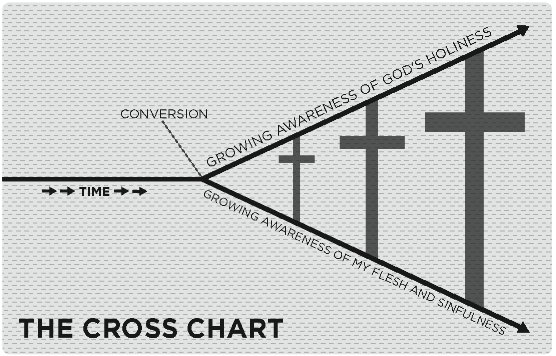
That’s the good old-fashioned orthodoxy that you trust and will protect and enable at any cost because it’s what you truly trust for your salvation. In essence, the antithesis of love because it rejoices in evil. The depth of your badness results in joy because of God’s grace. In reality, that’s just a really bad idea.
Now, let me share the joy of having my own blog. You will certainly delete this dialogue as perhaps you did the other because it slighted the institutional church that you trust for your salvation, but this nevertheless will make a great post for the blog today.
Wow, just wow……for the life of me I can’t understand how in the world my friend deserves the attack you have just made on her. The reason she and I both friended you was because we saw your posts on Calvinism. She and I have both been hurt by the “reformed” and from different churches. We were really interested in your take on it. I had no idea the anger you hold toward those who don’t agree with you. For some reason, it seems you want to just argue. I see an unfollow in sight. I’m so sorry you feel the need to attack with your pride of intellect. Just so sad.
You just furthered my point entirely. Calvinism is church. Reformed is church. You can’t separate the two. Actually, I could make a good living defending the “church” against “Calvinism” and actually passed on an opportunity to do so. Calvinism isn’t the problem, church is the problem. Christ’s body is a family and not an authoritative institution. When I first published “The Truth About New Calvinism” I was quickly becoming the darling of the anti-Reformed crowd until I realized that the anti-Reformed crowd is Reformed. And, my willingness to proclaim the truth with a few encouragers results in the following label: “angry.” Yes, I am an “angry man.” LOL! I wear that as a badge of honor.
And by the way, does this make me the same kind of angry guy that she praises in her initial post? Uh, I lost my wife too because of a church but no other church would come to my defense. Sooooo, please help me be the good kind of angry that you think so much of.
..and no other church came to my defense nor the guy she praises; why? Because where would people get their salvation if the institution was held accountable? That’s why. You can’t have it both ways.
End relevant dialogue.
So there you have it folks; it is alright to be angry against “bad” churches, but not the system itself though predicated on false justification with a perpetual death application that supposedly brings joy. You may think I was somewhat harsh with these ladies, but this is not an issue that will come to light by tiptoeing around; anything but directness in regard to this subject will be taken and heard the way one prefers to hear it. Unfortunately, in regard to this particular subject rooted deep in tradition, you know that you have made your point if people are offended. And…
…it also reveals what they really hold dear in the face of truth, an institution.
paul
Moving On As a Contemporary Child of God; All Those Who Do So Have Their Own Blessed Broken Road
 “The Protestant teachers proudly proclaim themselves as bad people and even laugh about it, but yet the simplicity of cause and effect somehow escapes us.”
“In all cases, orthodoxy is the knowledge handed down to the spiritual peasants to inform them on how to be progressively saved by the institution.”
“…in the final judgment followers will stand alone before God.”
Recently, the host and domain address for eldersresolution.org came up for renewal. With everything I have going on with TANC Ministries the due date slipped between the cracks and the site is temporarily down although there are other extensions of the site online (clearcreekchapel.com).
Looking through the information that the site documents was a defining moment and one of deep reflection. I decided to renew the domain address and move it to another site that I will develop sometime in the near future. Perhaps this very post will be the centerpiece.
Before I move on to the primary ideas of this post, let me say that eldersresolution.org, which can now be found in pdf format at http://clearcreekchapeleldersresolution.weebly.com/ was the work of my son-in-law, Pastor David Ingram, and pioneered the concept of using websites to hold the institutional church accountable in a public way. He came up with the idea as a way to take a stand in my situation (circa 2008), and to my knowledge there were no such sites on the internet at that time. It would seem that the Bangladesh missionary kids (https://bangladeshmksspeak.wordpress.com/) were also innovators in regard to the concept early on. In 2009, the concept went viral in response to the heavy-handed leadership mode of the New Calvinist movement which had finally come of age after 39 years of covert growth; what many called the “Quite Revolution” (http://founders.org/library/quiet/).
Reviewing the information made me cringe as it revisited what a weak and confused person I was at the time. With that said, it was also a major turning point in my life that I find impossible to regret. How many times did I dismiss the numerous and serious problems I saw in the church with, “What else is there?” For 27 years I struggled to find relevance in the church.
The turning point was the New Calvinist movement, and specifically the New Calvinists that covertly obtained control of Clearcreek Chapel (Springboro, Ohio). I had been a member there for 20-years-plus and a former elder. As these leaders began transforming Clearcreek from Reformation Light to Reformation Lager, I wondered if I had finally stumbled upon the answers to why Protestant sanctification is so anemic, illogical, and irrelevant.
Like the Protestant leaders I had rubbed shoulders with in the past, they couldn’t answer the hard questions, but this time I really pressed the issue because they were just adding more confusion to the confusion I had found a way to live with. That was troubling to me. Then, when they started responding to my persistence with passive forms of aggression, and later not so passive, I figured I was on to something.
Funny, one question I kept asking publically in Sunday school seemed to be the lightning rod: “How do we know when we are trying to please God ‘in our own efforts’ and what exactly does that mean to begin with? How should we do effort?” It was very obvious to the congregation that they didn’t want to answer the question, but I kept pushing the issue and that’s when all of the trouble started. It would seem that in my search for Protestant relevance, I had finally found the right question. If Christians are to rightly partake in a right effort versus a wrong effort, how is that determined?*
And of course, now I know why they didn’t want to answer the question. Protestantism teaches that sanctification is a “Sabbath rest” in which we “rest in what Jesus has done—not anything we do.” This is what Protestant Light formally criticized as let go and let God theology. But of course in the scheme of things, the folly of this construct is fully realized: not doing things is a metaphysical impossibility; so, what we are talking about is two different types of works. That would be, not working work and working work. Or if you may, faith alone works and work work.
This boils down to Protestant orthodoxy classifying works according to the traditions of men. They determine what faith alone works are as opposed to works that are “self-justifying.” It boils down to the following: obedience to their definitions determine your salvation. Non-self-justifying works pertain to Protestant ritual that keeps you saved. And of course, the sacrament of tithing keeps the money pouring in for infrastructure that bolsters the aurora of authority. What will people pay for their eternal salvation? Observe the splendor of Protestant temples and institutions that pollute the landscape everywhere.
Eldersresolution.org is merely a documenting of the symptoms. The domain will always be there, but I am not really sure why it is a good idea. It was originally constructed to warn others about the Clearcreek Chapel elders who had supposedly distorted Protestant orthodoxy and done really bad things to other people. What I know now is that Protestantism itself is the bad thing. Bad things happen in church because church is bad. In fact, one of the premier leaders of the present-day Protestant church, Dr. John Piper, brags about being bad (https://youtu.be/6-GxkAJ1OBU). The Protestant teachers proudly proclaim themselves as bad people and even laugh about it, but yet the simplicity of cause and effect somehow escapes us.**
Other mediators other than Christ necessarily demand institutional salvation based on what is supposedly God’s authority by proxy. This is why the body of Christ is a literal family and NOT an institution in any way, shape, or form. It is a literal family that one is literally born into by the baptism of the Spirit otherwise known as being “born again.” It is the literal “household of God” and the family of God the Father—not an institution any more than any family is an institution. Christ’s mandate to His assemblies is to be carried out through a family format—the literal family of God. Any vestige of institutionalism will cripple the cause of Christ to the degree that it exists within the assemblies of Christ expressed where families dwell: in homes, not institutional purpose buildings.
ALL institutional churches and religions have these things in common: mediators other than Christ or mediators in addition to Christ. There is a claim of authority other than Christ or a shared authority with Christ, and finally, there is always a gnosis caste system; the haves and have-nots in regard to the ability to know truth owned by the institution. In all cases, orthodoxy is the knowledge handed down to the spiritual peasants to inform them on how to be progressively saved by the institution.
False religion is always a broken road, but unfortunately, the pain of that road will rarely lead people to other places. But when it does, the pain of that road becomes an irrelevant and distant concern. It is a pain that is finished and its purpose completed. It is swallowed up by the experience of where the road has taken you. The story of your broken road will rarely warn others of danger or save anyone; people will forgive or look the other way in many, many things in order to gain eternal life. In the minds of the “good Germans” during WWII Germany was not perfect, but what else was there? In their minds; nothing.
In the mind of a good Protestant or Catholic what else is there? Nothing. It may be a nasty bus, but it’s the only bus going to heaven because the authority of men says so. But in the final judgment followers will stand alone before God.
And so it is. The broken road has led me to a place that makes its potholes and highway robbers a distant and irrelevant memory. Their work is finished. When experience teaches you a new way, and you begin to live in that new way, that’s healing.
Staying on the broken road and revisiting its experiences will never heal. Never. When pain is a finished work…you are healed. It is little different than Christ’s obedience to the cross which He despised and bore for the joy that was set ahead.
It is finished.
paul
*Chad Bresson, an elder at Clearcreek Chapel once prayed before the congregation: “Lord, we know that we have tried to please you in our own efforts this week, please forgive us.”
**The father of the Reformation, Martin Luther, stated in a letter to Philip Melanchthon: “If you are a preacher of mercy, do not preach an imaginary but the true mercy. If the mercy is true, you must therefore bear the true, not an imaginary sin. God does not save those who are only imaginary sinners. Be a sinner, and let your sins be strong, but let your trust in Christ be stronger, and rejoice in Christ who is the victor over sin, death, and the world. We will commit sins while we are here, for this life is not a place where justice resides.”

 Paul's Passing Thoughts
2 comments