
If You Go to Church You Are Guilty As Hell
 One of my perspectives has changed again. It’s amazing how dialogue and writing turns on new light bulbs. Truly, for a born again Christian blogger Facebook supplies more material than one could ever write about. It’s the gift that just keeps giving.
Consider a few examples to begin my first point before I get to the Facebook exchange. CJ Mahaney is back and bigger than ever. Jim Bakker, yes, Jim Bakker is back and bigger than ever. GARB and Cedarville University are bigger than ever despite the ABWE missionary Kids scandal which by the way included not only child rape but kidnapping, and a 20-year coverup of such. The President of Cedarville University even stated publically that Christians still need salvation. John Piper states such continually. And, it’s business as usual; in fact, business is booming. After all, if salvation is a onetime personal affair, what would you need them for?
The reason is simple and something I saw in the institutional church for years before I left it: salvation can only be found in church membership and submission to its orthodoxy. This is also stated unequivocally in its founding doctrinal statements whether Protestant or Catholic.
Until today, I blamed those rascally church leaders for all of this and was forgiving of the poor misinformed, misled innocent sheep. No, the fact is, if you go to church, you are guilty as hell. You are supporting a lie, and there is no justice for the church’s victims because like the devils that gave birth to the church, churchians do not share God’s love for justice.
Full stop. No evil has ever been put down in the church by the church. Evil has always been stopped in the church by someone going outside of the church and seeking help from the secular authorities. Why? Because the infidels have more love for justice than the church. Not complicated. And what is “justice”? Justice defends life value. An “eye for an eye” is not about revenge, it’s about defending life. See it for yourself in the founding doctrinal statements of the church: life is evil and must be continually crucified. Church isn’t about a one-time death that brings forth a never ending Spring and fountain of life, it is about dwelling in death. That’s stated church orthodoxy. And moreover, dwelling in death is the stated gateway to joy. It’s a formal church doctrine known as Mortification and Vivification. It’s a stated orthodoxy of death. It’s about death…that’s church…period.
Hence, victims are relegated to the basement closets because what does one expect in a temple of death but death itself? What we have today is parishioners leaving one Protestant temple for lesser death in another Protestant temple where the same logic has not yet fully played itself out. Therefore, at least for the time being, one is in a “more loving church” where sinful elders sin less, but hark, we must remember that there is no perfect church and we are all just sinners saved by grace. Amen, but nevertheless, you support the system and you are guilty as hell—you are no less a “Good German” of Nazism fame.
Don’t blame it on Calvinism; don’t blame it on “Reformed theology.” Church is Reformed theology; church is Calvinism. Calvinism isn’t the problem; church is the problem. Predestination is not the core issue; the exact same soteriology is the issue. A different application of the same evil does not make the evil unevil.
So before I copy and paste the Facebook dialogue that led to this post, what’s the answer? That’s not complicated either. God’s people must start functioning like the family they are rather than an institution that dispenses ongoing salvation in return for a temple tax. The whole system must be rejected for the sake of God’s love. In other words, for the first time in your life, read the book of Acts with your own mind and simply let the words say what they say, not what some man with six bogus titles after his name says they say. Words mean things.
But if you do nothing else, stop supporting church. Stop being guilty as hell.
Begin dialogue.
Paul, my freedom in Christ is a soul issue. Man has tried insisting on speaking for Him since the beginning. You make good valid points, but no one has the power to steal what He gives. And no rulers, church or state, will ever be on the truly right side where He is!
Not sure what you are saying. Are you saying that no one is perfect so all bets are off?
Not sure what you are saying! I am His child Paul. I have a peace and joy that cannot be stolen. It is a simple statement.
24/7 uninterrupted peace and joy. Wow, that’s pretty impressive.
Paul, I honestly do not know where you are coming from. But I learned as a teenager that an awful lot of life is going to be out of my control. The foundation He gives is not. I sense a deep sarcasm in you and for that I am sad. I have no doubt you have been scalded by something. Me too. But one thing I do know— this kind of conversation is not productive. You are looking for discord and you are not going to get it from me. I simply know that at the end of any day, no matter how bad, God. Loves. me., and one day I am going home. And yes, I find great joy in that.
I will not comment on “where I am coming from” in this stream because my initial comments are gone. But I will comment on what I think bothers me about you overall. You are a typical parishioner who parrots institutional church talking points flavored with supposed humble godliness. Point in case: “no one has the power to steal what He gives.” Oh really? The church hasn’t stolen the innocence of many young children over the years? And yes, this is the exact rhetoric we hear from churchians when someone wants to hold the church accountable.
No, you don’t yell at them and attack them verbally which you have decried in your post, you feed them pious sounding institutional church talking points and tell them to “move on with life” and,…here it is,…don’t miss it…”no church is perfect” so in essence, yes, all bets are off. You represent mainline evangelicalism that has not held itself accountable for a litany of contemporary atrocities. When it is all said and done after ABWE, SGM, to name a meager few, it is business as usual. Yes, look around, totally business as usual.
And why is this? Well, the hypocrisy is endless. While claiming trust in JESUS ALONE the real trust is in the institutional church and that is exactly why the church always survives its scandals; the congregants are its supporters and enablers. They hide behind “bad churches and good churches,” “high controlling churches versus churches that aren’t like that,” and “no mere church can take away what Jesus has given,” and the ever-handy “cult” nomenclature while deep in their hearts they know it is the system that is the problem.
Hence, while giving tacit agreement to my original comment you sensed a slight offense against the institution that you trust for your salvation and lobbed the usual pious sounding talking points at me which by the way is sugar-coated condescension. But before I get to that, let me highlight the usual speaking for God and defining Him according to man’s tradition which always makes God the creator of evil. Since nobody can take away what Jesus has given, any parishioner who feels like the church has taken away something originally given by God; you know, like a marriage or virginity, only have themselves to blame for being unspiritual.
This is victim blaming and makes God appear as an advocate for evil to the unregenerate. Again, victim blaming in order to protect the church is a result of where the real trust for salvation is placed—the institutional church. And hark, it just so happens that church orthodoxy states that exactly in its founding doctrinal statements.
Now, while you decry those who personally attack people who expose selective evil, you are somehow pious because you didn’t call me names, but rather made statements about me that result in logical conclusions demanding numerous unflattering labels. This is typical and reveals the true arrogance of those sold out to the institutional church. Note that you were more knowledgeable about life than me by the time you were a teenager. Well, aren’t you special? Note that my pathetic mindset is so pathetic that it can’t even warrant anger but only pity. My mindset, therefore, makes you “sad.” Such a loving soul you are. And lastly, I have nothing to bring to the table in any discussion about life because my only motive is to “look(ing) for discord.”
And what about my “sarcasm”? Let me help you with that. It’s a survival mechanism for dealing with putrid hyper-hypocrisy that blames my Father for evil and in reality lifts up misfits like John Piper above God. And by the way, try reading your Bible for yourself and you will find that sarcasm was a communication tool used by Jesus and Paul often. There is something else I can mention as well though this could be a book; joy results in knowing that God loves you no matter how “bad” you are. Yep, that’s the Cross Chart.
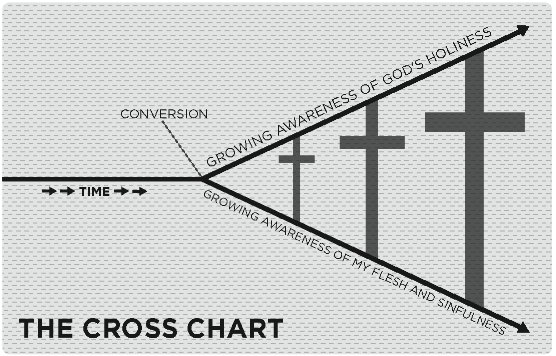
That’s the good old-fashioned orthodoxy that you trust and will protect and enable at any cost because it’s what you truly trust for your salvation. In essence, the antithesis of love because it rejoices in evil. The depth of your badness results in joy because of God’s grace. In reality, that’s just a really bad idea.
Now, let me share the joy of having my own blog. You will certainly delete this dialogue as perhaps you did the other because it slighted the institutional church that you trust for your salvation, but this nevertheless will make a great post for the blog today.
Wow, just wow……for the life of me I can’t understand how in the world my friend deserves the attack you have just made on her. The reason she and I both friended you was because we saw your posts on Calvinism. She and I have both been hurt by the “reformed” and from different churches. We were really interested in your take on it. I had no idea the anger you hold toward those who don’t agree with you. For some reason, it seems you want to just argue. I see an unfollow in sight. I’m so sorry you feel the need to attack with your pride of intellect. Just so sad.
You just furthered my point entirely. Calvinism is church. Reformed is church. You can’t separate the two. Actually, I could make a good living defending the “church” against “Calvinism” and actually passed on an opportunity to do so. Calvinism isn’t the problem, church is the problem. Christ’s body is a family and not an authoritative institution. When I first published “The Truth About New Calvinism” I was quickly becoming the darling of the anti-Reformed crowd until I realized that the anti-Reformed crowd is Reformed. And, my willingness to proclaim the truth with a few encouragers results in the following label: “angry.” Yes, I am an “angry man.” LOL! I wear that as a badge of honor.
And by the way, does this make me the same kind of angry guy that she praises in her initial post? Uh, I lost my wife too because of a church but no other church would come to my defense. Sooooo, please help me be the good kind of angry that you think so much of.
..and no other church came to my defense nor the guy she praises; why? Because where would people get their salvation if the institution was held accountable? That’s why. You can’t have it both ways.
End relevant dialogue.
So there you have it folks; it is alright to be angry against “bad” churches, but not the system itself though predicated on false justification with a perpetual death application that supposedly brings joy. You may think I was somewhat harsh with these ladies, but this is not an issue that will come to light by tiptoeing around; anything but directness in regard to this subject will be taken and heard the way one prefers to hear it. Unfortunately, in regard to this particular subject rooted deep in tradition, you know that you have made your point if people are offended. And…
…it also reveals what they really hold dear in the face of truth, an institution.
paul
The Secular World Understands Reality Better Than Protestants
 In the eight-plus years that TANC Ministries has been researching the vile doctrine of Calvinism and the evil that is authentic Protestant orthodoxy, one fact emerges over and over again – Protestants are the most confused group of individuals that there ever was. I was reminded of that fact once again when an article appeared in my Facebook newsfeed this morning entitled, “Survey Finds Most American Christians Are Actually Heretics”. The article was published in the “Religion” section of a secular news site called “The Federalist”
Here’s the deal. Protestantism is founded in the Gnostic concept that man is totally unable to comprehend true knowledge, and as a result, man must be ruled by the select few who have the “gnosis”, the “knowledge” that man “knows nothing”. This root assumption has been the basis for every form of tyranny and spiritual abuse since the beginning of time. Protestantism is no exception, no matter how you dress it up in Bible verses.
So when I read an article that concludes that the majority of those who call themselves “Christians” have relatively little actual Bible knowledge, it comes as no surprise to me, not only because of what I know with regard to authentic Protestantism and its metaphysical assumptions, but I can recall hearing similar results of “studies” throughout my life. Funny how a system of orthodoxy that depends on a Biblically illiterate laity to maintain its control and authority publishes the results of a survey that bemoans that very thing – Biblical illiteracy.
This article is only the most recent to come to this conclusion in the past 40 years, if not the past 500 or more. Since the time of the reformation and before, “Christians” have always been woefully illiterate in their understanding of exactly what God has revealed to man in His philosophical statement on reality, also known as “The Bible”. But in today’s information age they have no excuse. Knowledge and wisdom are there for those who have the courage to seek it out!
Let’s look at some of the more interesting statements found in this article in question, beginning with one of the opening paragraphs:
“A survey of 3,000 people conducted by LifeWay Research and commissioned by Ligonier Ministries found that although Americans still overwhelmingly identify as “Christian,” startling percentages of the nation embrace ancient errors condemned by all major Christian traditions. These are not minor points of doctrine, but core ideas that define Christianity itself.”
According to their own website, “LifeWay Christian Resources is one of the world’s largest providers of Christian resources, including services, Bibles, Bible studies, research, events, church music and supplies, and digital services.” The number of books written by the “who’s who” of mostly reformed academia is voluminous, and it grows bigger every month. Just talk to any one of your “Christian” friends and they will be sure to talk about the latest book or “devotional” written by their favorite author/elder/pastor/spiritual guru (read “Philosopher Kings”). And reformed “Christian” blogs such as “Ligonier” abound. Yet despite all of these resources and the countless amounts of money spent in the “Christian” publications industry, this article concludes, “startling percentages of the nation embrace ancient errors condemned by all major Christian traditions.” Surely this can’t be because people aren’t reading enough John Piper!
Exactly what are these “ancient errors” supposedly condemned by “Christian traditions?” Again from the article:
“Two-thirds admitted that everyone sins a little bit, but still insisted that most people are good by nature, which directly contradicts scripture (See ‘All have sinned and fallen short of the glory of God,’ and ‘The heart is deceitful above all things, and desperately wicked: who can know it?’).”
What is probably worse than the false doctrine of “total depravity” is the outright lie that “total depravity” is unique to “orthodox Christianity”. In fact the exact opposite is true. I need only refer you to the 2015 TANC Conference and speaker, John Immel, who gave us an outstanding survey of deterministic thought throughout history. In those 2015 sessions we learned that in every philosophical system of thought, the one major theme that was consistent over and over again was the concept of the depravity of man and some deterministic force compelling his actions. (View clip here) So to suggest that the idea of “total depravity” is a concept unique to Christianity is beyond disingenuous.
But what I find remarkable is that despite the “Christian tradition” emphasis on total depravity, man (secular, unregenerate man for the most part, but some professing “Christians” as well) still has a propensity to regard man himself as existentially good. I believe that this is the natural and correct assessment of man because it is consistent not only with what man knows to be true in and of himself but also because of what his own senses tell him in simply observing reality around him. Despite the evil that is in the world, it is man who chooses whether or not he can do good things or bad things. This is not a contradiction of scripture, this is a contradiction of a false “orthodox” interpretation of scripture.
Man is not condemned because he is “totally depraved” and cannot “do good”. Man is condemned because he is under law. The remedy is not to have One who “does good for us” so that His obedience can be vicariously imputed to our account. No, the remedy is for the law to be ended so that it can no longer condemn. This is what the New Birth accomplishes. For the one who is born again, the old man has died. In his place is a new creature who is the literal offspring of the Father, and the law has no jurisdiction over him. He cannot be judged by it, and therefore, he cannot be condemned by it. He is truly free to use the law as a means to show love to God and to others. He can love without fear of condemnation.
Furthermore, the Bible never teaches that man has a “sin nature”. The statement in Ephesians, “for all have sinned” is indeed a statement of fact. Yes, all have sinned, but that is not indicative of man’s nature. Man is not metaphysically evil. It simply means that the unregenerate man is under law and has transgressed that law and is therefore subject to condemnation. In contrast, the Bible teaches that man (flesh) is “weak”, but that man is able to choose how to use his flesh; to do evil or to do good. Because the unregenerate man is a slave to the Sin-master, he will have a propensity to obey the master who pays his wages. But he still is able to choose to do good. Since the Sin-master only pays wages of death, choosing to do good only results in less death, but death just the same.
This is why “Christians” are so confused. They understand that man, even “Christians”, do wrong things. Orthodoxy labels this as “sin” because all of “Christianity” has a single-perspective on sin, that is, ALL sin is condemning. This is the source of what they perceive as a contradiction. They intuitively know man is good but are taught that even the good they do is evil. And so when they “sin”, the natural response because of what they have been taught is fear of condemnation.
Here is another point from the article:
“They also saw a huge increase in evangelicals (28 percent, up from 9 percent) who indicated that the Third Person of the Trinity is not equal with God the Father or Jesus, a direct contradiction of orthodox Christianity.”
Protestantism teaches the believer to have an ever-deeper understanding of his own depravity (sin) while having an ever-growing awareness of God’s holiness. As he does this, the cross (and what Jesus does for us) gets bigger and bigger. The emphasis is always on, not just what Jesus did, but what He is still doing for the “Christian” every day, living and obeying the law in our stead so that we can have “the imputed righteousness of Christ”.

Such orthodoxy not only keeps the “Christian” under law, but it emphasizes the role of Christ at the expense of the Father and the Holy Spirit. The Father is regarded as a vengeful monster who is to be feared, and Christ is the only one who stands in the way to deflect the Fathers wrath. The Holy Spirit is simply the agent whom God sends to the “elect” for the purpose of regenerating them to a “saving faith”. He is rarely if ever presented as the Comforter who empowers the born again believer to live a sanctified life through obedience. With the Protestant emphasis on the “Cross-Centered” gospel, or the “Christ-Centered” gospel, is there why wonder why Christians hold a diminished view of the roles of the other members of the Trinity?
The writer of the article goes on to address the issue that “Christians” don’t seem to be very well-read when it comes to the Bible, yet they would cite the Bible as being an important part of their lives, going so far as to refer to it as the primary source of authority for living. He cites the following as an example:
“Former Newsday religion reporter Kenneth Briggs recently told Religion News Service that the faith he finds in ‘mega-type churches’ is a ‘Bible-less,’ ‘alternative version of Christianity.’ Scripture, he says, has become ‘a museum exhibit, hallowed as a treasure but enigmatic and untouched.’”
Such is true not only of “mega-churches” with thousands of members, but it also holds true for the smaller community churches with membership rolls in the hundreds or less. This is not a statement on the church size or the “style of worship”. It is a testament to the fact that the Bible itself has become irrelevant when it comes to faith and Godliness. While “mega-churches” might be more inclined to a “pop-psychology” approach to teaching and preaching, in 99% of modern churches, the very truths of scripture have been replaced with orthodoxy presented by mere men who have become the self-appointed mediators between God and man. These are the “divines” who have been ordained by God to reinterpret reality for the great, unwashed masses. When the laity have become followers of men, they have no need to open their Bibles, let alone consider what the Bible itself has to say about things.
Ironic, too, that an organization such as LifeWay, who’s industry includes the publication of “Christian” literature, is incredulous that Christians spend so little time reading their Bibles. I dare say that if more and more “Christians” actually spent more time in the study of God’s word for themselves, rather than relying on someone to interpret it for them, it would be the “Christian” book stores that would eventually become irrelevant.
Christians are uninformed about Christianity for the same reason that people in secular society are uninformed about politics. In both cases the answer is because people have outsourced their brains to someone else. They are much too involved in the comforts of their own existence to care about the larger matters. They leave that for the “experts”. It is much easier to let someone else tell you how you should think about something than to do all that heavy lifting on your own. And the so-called “experts”, whether secular (politicians, pundits, “talking heads”, media) or religious (pastors, elders, academics, scholars, “popes”), take advantage of that reality for their own ends; control over the uninformed masses.
The author proposes a few possible solutions in all of this. While the survey specifically polled those who profess to be Christians, he believes that the study of the Bible is beneficial for unbelievers as well.
“For those who don’t profess Christianity, gaining a basic understanding of the creeds and Scriptures of the religion that built our civilization isn’t a bad idea, either. As Indian Christian philosopher Vishal Mangalwadi writes, the Bible created the modern world by making the West a reading and thinking civilization, and by grounding this reading and thinking in the idea that truth is knowable.”
Well, that’s not a completely honest assessment. The notion that “truth is knowable” runs counter to Protestantism and its Gnostic roots, where the only “truth” that is knowable is that you cannot “know” anything. Truth is to be for those in self-appointed authority who have been gifted to bring this “knowledge of knowing nothing” to the rest of us. Yet Protestantism lays claim to this kind of “knowledge” as being the foundational philosophy of western civilization. The reality is that it was this same kind of thinking that kept man in the Dark Ages, and it is what is responsible for our own spiritual dark age in which we presently find ourselves.
The rebirth of thought that ushered in the Age of Enlightenment of the 16th and 17th centuries happened in spite of religion, not because of it. The Bible did not create a world of reading and thinking. It was reading and thinking that enabled man to regard Biblical truth with the right interpretive assumptions. Men rejected the notion of “total depravity” and rediscovered the principles of individualism and man’s ability. These are the very premises that gave rise to “Americanism” and which made our nation the greatest the world has ever seen. Contrary to Protestant orthodoxy, the Bible speaks very highly of man’s ability. Even God Himself values the individual and his ability to reason (after all, we are all made in God’s image), so much so that He made it possible for the condemnation of the law to be ended so that man could be reconciled to Himself as members of His own family!
If Protestants are Biblically illiterate, it is because Protestantism made them that way. I dare say that the majority of “Christians” are more “secular” in their philosophy (without even knowing it) than they care to admit. The results of the survey in this article would seem to support that. That’s not necessarily a bad thing. If nothing else, it offers a valid explanation for the current mass exodus from the modern institutional church. People can just no longer tolerate the rational inconsistencies they observe between reality and Protestant orthodoxy. And perhaps as a matter of consequence, many of them might actually end up taking that Bible off the shelf, blow the dust off the cover, and start reading it for themselves.
Andy
Redemptive-Historical Hermeneutic – A Classic Example
Originally published March 4, 2015
I came across an “interesting” blog article the other day. It appeared in my Facebook newsfeed because someone on my friend list commented on it when one of his friends shared it. Of course, since I am not friends with the one who originally shared it, I was unable to add my comment, thus the inspiration for this article today.
The title of the blog article in questions is, “If we sin, do we lose our salvation?” That mere fact that such a question is still posed in Christianity is indicative of just how biblically illiterate most Christians are. The fact that authors such as this one still address this question in the manner that he does is even more disturbing.
Before even addressing the issue of whether one can lose one’s salvation, the author begins his article by citing Jesus’ example of the two house builders found in Luke chapter 6. Let’s take a look at this passage ourselves before we move on.
47Whosoever cometh to me, and heareth my sayings, and doeth them, I will shew you to whom he is like: 48He is like a man which built an house, and digged deep, and laid the foundation on a rock: and when the flood arose, the stream beat vehemently upon that house, and could not shake it: for it was founded upon a rock. 49But he that heareth, and doeth not, is like a man that without a foundation built an house upon the earth; against which the stream did beat vehemently, and immediately it fell; and the ruin of that house was great.
Luke 6:47-49
Clearly, Jesus is using a metaphor, but to properly understand the metaphor we must ask ourselves, what is the context of this passage? It should be apparent that the context is a contrast between two kinds of individuals. One kind is an individual who hears AND does. The second kind is an individual who hears only. The parallel passage in Matthew 7 goes even further in marking this contrast.
24Therefore whosoever heareth these sayings of mine, and doeth them, I will liken him unto a wise man, which built his house upon a rock: 25And the rain descended, and the floods came, and the winds blew, and beat upon that house; and it fell not: for it was founded upon a rock. 26And every one that heareth these sayings of mine, and doeth them not, shall be likened unto a foolish man, which built his house upon the sand: 27And the rain descended, and the floods came, and the winds blew, and beat upon that house; and it fell: and great was the fall of it.
Matthew 7:24-27
The individual who hears AND does is considered wise. The one who hears only is considered foolish. Herein is the point of this whole passage: the emphasis on hearing AND doing, which is considered to be wise. But please notice what the blog author chooses as his focus:
“Building a house is very similar to one’s experience as either a Christian believer or an unsaved nonbeliever. That is why Jesus drew a comparison between the two (Luke 6:47-49). If you start out with a good foundation that is level and built on solid ground, you can confidently add on walls and flooring and a roof and every other component that makes up a house, and be certain that, because the foundation is sound, the house will be sound. But if you lay a poor foundation that is uneven and shaky, the rest of the house will follow and all the components that are built on that poor foundation will be compromised. To have a soundly constructed house, you must have a good foundation; to have a rock-solid Christian faith, you must build it on foundational truth.”
This is one of the most intellectually incompetent and dishonest uses of the two builders that I have ever seen! This example from scripture has nothing to do with “foundations”. It has everything to do with wisdom and sanctification. The author completely ignores the part about wisdom in both hearing and doing and instead engages in what I call “spiritualizing the analogy”, making it about justification instead. He has interpreted this passage in the so-called “proper gospel context”. This is what happens when you interpret scripture using a redemptive-historical hermeneutic. Spiritualizing the analogy makes a false application of a metaphor that was never intended. It is a logical fallacy. Let’s examine what I mean by this.
If I am given the logical premises that A=B and B=C, I can logically conclude that A=C. This is the logic of the example of the two house builders.
A = B Hearing and doing = a wise man
B = C A wise man = building on a rock (a good foundation)
therefore
A = C Hearing and doing = building on a rock (will make one strong; i.e. aggressive sanctification)
The same holds true for the foolish man.
A = B Hearing only = a foolish man
B = C A foolish man = building on sand (a poor foundation)
therefore
A = C Hearing only = building on sand (will make one weak; i.e. little or no sanctification)
A metaphor makes no sense in and of itself. It has no relevance outside of the initial truth that it represents. If Jesus had only said, “Make sure you build on a rock foundation and not a foundation of sand,” that would have made no sense whatsoever. But Jesus clearly stated that hearing and doing is wise, and He further emphasized that point by using the analogy of building on a rock. Notice also that a correct logical progression in thought results in the proper application of the conclusions. One can reasonably conclude that this not a salvation passage but rather a sanctification passage for believers.
That is the proper meaning and intention of this passage. Contrast that with what the author did in the article. He took the metaphor all by itself and made it say whatever he wanted it to say in order to make his case. And what is his case?
“If you believe that Jesus Christ died on the Cross to pay for your sins, and turn to God in repentance of your sins, then you will be saved… This does not mean that after this occurs, you will never sin again, or even that you will not commit the same sin repeatedly. It means that your heart has been changed toward sin so that you can now see it for what it is… Fortunately, for Paul and for you and for me, that question has a definitively glorious answer: ‘Thanks be to God, who delivers me through Jesus Christ our Lord!’”
Plain and simple, this is progressive justification. Notice it is an ongoing deliverance, not a onetime deliverance. So, then the question remains, what do we have to do to keep the deliverance going? Well, we repent, and that saves us, BUT we still sin. So what? Well, the “so what” is that we need perpetual saving by Jesus. This is what Paul David Tripp and Tim Keller and John Piper call a “daily rescue.” This is Luther’s theology of the cross, a perpetual mortification and vivification.
This is the very reason why the emphasis on the hearing AND doing is ignored. For us “to do” would be works, at least in this construct, if this were a passage on justification and not sanctification. We must live by “faith alone” and not build on the wrong “foundation.” We can only “experience” what it is to have the right foundation, because for us to try and work and build is building on the wrong foundation which is the reformed definition of the “unsaved”. But justification is a finished work. There is nothing we can do to add to it. Because it is finished, we can aggressively “do” the things we “hear” taught to us in the Word. Time and time again, the scriptures equate for us doing good with life and doing evil with death. Good = life = wise. Evil = death = foolish. When it comes right down to it, this really isn’t that hard to figure out.
Andy

 Paul's Passing Thoughts
1 comment