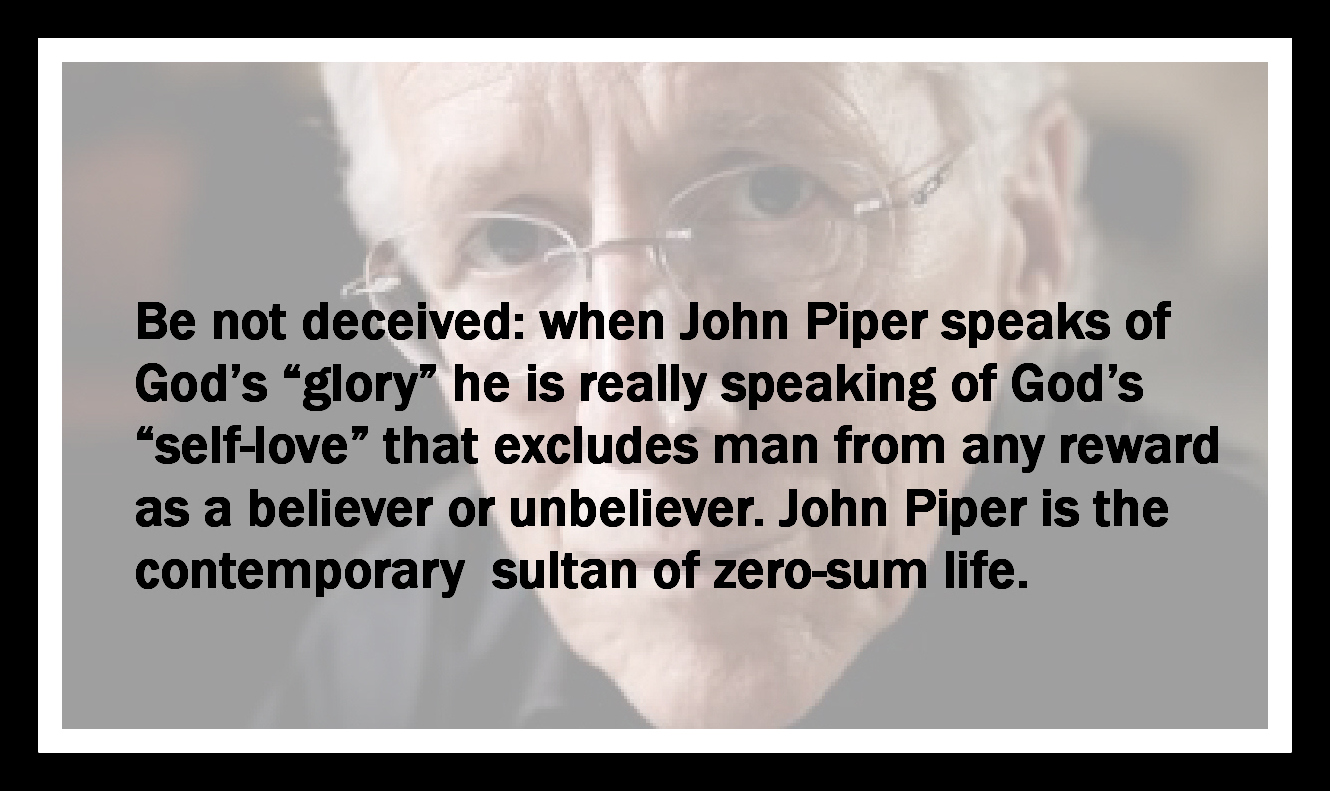
The False Protestant Gospel of “How Much?”
 “At any moment, any lost person can choose to have their sins ended. It is not a question of whether or not they are elected, it is a question of whether or not they are under the law—and they are.”
The Protestant gospel effectively denies the biblical interpretation of the new birth. Because of its Platonist metaphysical presuppositions, it denies the treasure of God’s seed dwelling in weak vessels. Hence, the new birth is redefined and confined to the ability to perceive realm manifestations apart from any ability to do a good work of any kind. As stated by some, “Sanctification is done TO you, not BY you.”
In the biblical good news schema, Christ does ONE act of obedience as His part in God’s reconciliation plan. There is no question of “how much?” because His death was all that was required.
Now enter the heinous “Reformation” gospel of confusion. A cursory observation of Reformation history reveals that the dust-up between Rome and the “Reformers” was over metaphysics first. The very first and foundational doctrinal statement of the Reformation contained 12 theses of philosophical metaphysics. Luther was miffed that Rome was moving away from its Augustinian/Platonist roots and coming under the spell of Thomism. This shift began in the 13th century via St. Thomas Aquinas and eventually incited the Reformation. The assertion that the Reformation was driven by sola scriptura is absurd.
Martin Luther introduced his metaphysical answer to Thomism and foisted his theses that supported it onto Scripture. The centerpiece eventually came to be known as double imputation. To Luther’s credit, he created a timeless soteriology based on metaphysics that continues to turn the world upside down. John Calvin articulated Luther’s foundation in the Institutes of the Christian Religion. Both were dedicated to returning the church to its Augustinian roots.
What is double imputation? Basically, it’s the idea that Christ’s role in the gospel of first importance (as set apart from God’s full counsel which is also good news) was twofold as opposed to ONE single act. This was necessary as a “biblical” doctrine that keeps the material being of man separate from Plato’s trinity: the good, true, and beautiful, ie., the invisible. The true gospel turned dualism philosophy completely on its head by infusing good into weakness and defining the true definitions of God’s creation and the state of being.
The idea that God infused His righteousness into the being of mankind is repugnant to the Reformed mindset. How repugnant? The colonial Puritans executed Quakers for even asserting an errant view of the idea.
Therefore, distorting Christ’s role in God’s elected plan of reconciliation was necessary. Christ’s redefined soteriological role removes all goodness from mankind proper and “Christians” in particular. Christ not only came to die for the sins of particular persons preselected by God, but He also came to live a perfect life in obedience to the law so that His obedience could be imputed to the “elect.”
Now the questions are begged: “How much suffering was necessary to pay the penalty for sins committed by the preselected, and how much obedience was necessary for righteousness to be imputed to the preselected as well. When a false doctrine is predicated on errant presuppositions, not only do these kinds of questions arise, but the attempted answers give rise to more questions.
And displays of nonsense. An example is the weird and embarrassing ad lib “Scream of the Damned” propagated by John Piper and CJ Mahaney at a conference hosted by John MacArthur Jr.’s Grace Community Church.* The sheer weirdness of it all even raised eyebrows within Reformed circles by the likes of Steve Camp. The premise was an adolescent-like attempt to explain how much? in regard to Christ’s death. Imagining the response from my older than dirt and probably dead father in the faith, Pastor Richard Peacock, put me on the floor rolling around while laughing uncontrollably. Only the thought of thousands of attending pastors supported by the hard work and sweat of the laity watching without a blink shocked me into the horror of reality and put an end to my shameless response.
When are people going to stop and say to themselves, “Wait a minute here; what drives this stuff? This kind of stuff just doesn’t happen for any or no reason.”
Likewise, in regard to how much?, how long did Christ have to live and how much of the law did He have to obey for the elect? Theories abound because the question itself flows from the false presuppositions of Platonism foisted on the Scriptures resulting in the doctrine of double imputation.
Christ did ONE thing to secure reconciliation for mankind: He died. How much? Answer: enough for ALL mankind. How? Answer: by ending the law. How is that possible? Answer: because all sin is against the law and imputed to the law, and Christ died to end it. Sin is not covered by Christ’s law–keeping; no, sin is not covered, it is ENDED. At any moment, any lost person can choose to have their sins ended. It is not a question of whether or not they are elected, it is a question of whether or not they are under the law—and they are.
What else did Christ do to secure our reconciliation? Answer: nothing. But wasn’t He resurrected? Answer: yes, but He didn’t do that, that was the Holy Spirit’s role in God’s plan of reconciliation. The fact that Christ would be resurrected was a promise made TO Christ and Abraham BY God. That surprises many Christians who don’t read their own Bibles for themselves, viz, most.
In other words, this is the gospel: Christ DIED to END sin. The Spirit resurrected Christ as the first fruits of those who would also be resurrected to new life and justification which is NOT merely a legal declaration, but a metaphysical fact. It does of course have a legal aspect, but it is adoption court where the Holy Spirt bears witness with us that we are the children of God. Christ was “resurrected” for our justification” by the Holy Spirit. “Forensic Justification” does have a legal aspect, but not only in the halls of criminal court, but just as much in the court of adoption with the Holy Spirit appearing as a witness.
Obedience to the law by Christ does not justify us, the new birth justifies us because we are in fact righteous. The resurrection justifies us, not law-keeping by anyone including Christ.
True resurrection with Christ is “under grace,” but that by no means states that we are no longer under a law. It means that we are no longer under a law that condemns us. This is what strips sin of its power. This is what strips death of its sting. We must remember that the law is the Spirit’s law. He will use it to convict the world of sin and warn of the judgment to come, or he will use it to sanctify God’s children. The law is a savor of death to those who do not believe, and a savor of life as we walk in it as God’s children.
The time has come to stop dwelling in the Protestant metaphysical narrative of death, and to follow Christ in our duty to write a narrative of life.
How much? That will depend on OUR obedience as children of God. The Spirit gave us life and opportunity to use His law to love God and others. “Do’s and don’ts” are not the issue, LOVE is the issue. We do not stay at the foot of the cross while Christ loves for us; we will be rewarded for the narrative of life that we write by using the gifts granted to us when Christ sat down beside the Father and rested from justifying all who will believe in Him.
We zealously write our narrative of life without fear of condemnation because of Christ’s love for us. And our love will never be enough because of the freedom we feel. The freedom purchased by His blood that freed us from the condemnation of the law and the Master empowered by it, and the freedom to love by obeying the law of the Spirit—the perfect law of liberty. When God looks at us, He sees more than Christ, he sees one that Christ is not ashamed to call a brother—He sees one of His children. Christ doesn’t cover us, He presents us.
He is not ashamed of us. His death was enough for our life.
paul
* “Apparently, they got the concept from RC Sproul, who used to be rock solid, but now it would appear that senility has opened his mind to the nonsensical theological acrobatics of our day. Likewise, the same consideration might apply to John MacArthur who spoke at the conference and also sponsored it; he is getting up in years as well. I offer this as a possible excuse for both of them though the vision of my heart longs to see them as the gray-haired stalwarts of the faith that I thought they were. Here is what Sproul said:
‘Once the sin of man was imputed to Him, He became the virtual incarnation of evil. The load He carried was repugnant to the Father. God is too holy to even look at iniquity. God the Father turned His back upon the Son, cursing Him to the pit of hell while on the cross. Here was the Son’s ‘descent into hell.’ Here the fury of God raged against Him. His scream was the scream of the damned. For us’ (Tabletalk magazine, My God, My God, Why Hast Thou Forsaken Me? April 1990, p. 6).
Steve Camp, on his blog, wrote a tame but thoroughly convincing argument against such a notion. But the fact that Camp thought such a significant expenditure of effort was needed is indicative of our day; surely, only ten years ago, such a thesis would have invoked a horrendous outcry among God’s people” (The New Calvinist License To Kill: And Did God Really Condemn Christ To Hell?, Paul’s Passing Thoughts blog, Paul Dohse, Sr., September 2, 2011).
The Magnum Opus of the Reformation: Martin Luther’s Heidelberg Disputation; Part 2
 Listen to the lesson or download audio file.
Welcome truth lovers to Blog Talk radio .com/False Reformation, this is your host Paul M. Dohse Sr. Tonight, part 2 of “The Magnum Opus of the Reformation: Martin Luther’s Heidelberg Disputation.”
Greetings from the Potters House and TANC ministries where we are always eager to serve all of your heterodox needs. Our teaching catalogue can be found at tancpublishing.com.
If you would like to add to our lesson or ask a question, call (347) 855-8317. Remember to turn your PC volume down to prevent feedback.
Per the usual, we will check in with Susan towards the end of the show and listen to her perspective.
Remember, you may remain anonymous. When I say, “This is your host; you are on the air, what’s your comment or question—just start talking.
If you would like to comment on our subject tonight, you can also email me at paul@ttanc.com. That’s Tom, Tony, Alice, Nancy, cat, paul@ttanc.com. I have my email monitor right here and can add your thoughts to the lesson without need for you to call in. You can post a question as well.
Last week we did pretty well; we began with an introduction and completed the first two theses. Tonight, we begin with thesis 3.
Thesis 3: Although the works of man always seem attractive and good, they are nevertheless likely to be mortal sins.
Human works appear attractive outwardly, but within they are filthy, as Christ says concerning the Pharisees in Matt. 23:27. For they appear to the doer and others good and beautiful, yet God does not judge according to appearances but searches »the minds and hearts« (Ps. 7:9). For without grace and faith it is impossible to have a pure heart. Acts 15:9: »He cleansed their hearts by faith.«
The thesis is proven in the following way: If the works of righteous men are sins, as Thesis 7 of this disputation states, this is much more the case concerning the works of those who are not righteous. But the just speak in behalf of their works in the following way: »Do not enter into judgment with thy servant, Lord, for no man living is righteous before thee« (Ps. 143:2). The Apostle speaks likewise in Gal. 3:10, »All who rely on the works of the law are under the curse.« But the works of men are the works of the law, and the curse will not be placed upon venial sins. Therefore they are mortal sins. In the third place, Rom. 2:21 states, »You who teach others not to steal, do you steal?« St. Augustine interprets this to mean that men are thieves according to their guilty consciences even if they publicly judge or reprimand other thieves.
In this third thesis, Luther declares ALL works of men evil. That includes the works of believers as well. Again, we come to a paramount tenet of the Reformation; total depravity does not only pertain to mankind in general, but also the saints. Even though the works of men appear “good and beautiful” (eerily similar to Plato’s trinity of the good, true, and beautiful), they are evil:
If the works of righteous men are sins, as Thesis 7 of this disputation states, this is much more the case concerning the works of those who are not righteous.
By the way, this is synonymous with the Calvin Institutes 3.14.9-11. Luther hints in this thesis in regard to why all the works of men can be deemed wicked: they are under the law, and no man can keep the law perfectly:
But the works of men are the works of the law…
This is another way of saying that Christians remain under the law just like unbelievers, and since no person can keep the law perfectly, all bets are off. The Calvin Institutes 3.14.10 is an in-depth articulation of this idea. This is amazing because it’s right here where Reformed soteriology falls completely apart and turns the whole Bible upside down. Right here, you are looking at it. It’s the idea that Christians cannot perform a good work because they are still under the law and the law demands perfect obedience.
Also, amazingly, all of the major tenets of the Reformation gospel are in this one thesis. Let’s begin with Luther’s heart theology that actually laid the foundation for the contemporary biblical counseling movement; at least what came out of Westminster’s CCEF. An illustration can be seen below.
Luther cites Matthew 23:27 and Psalms 7:9 to make the point that the outward works of men are meaningless and God looks upon the heart. In this theology, the “heart” is the seat of faith. Even though the believer can do no good work; the believer’s heart (or faith) can be pure. What Luther proffers as we move along is a purity totally disconnected from works, and purity (faith) that is strictly an ability to perceive, and depending on the Reformed camp, experience the works of God completely separate from anything man does. If we pay close attention, we see these ideas in this third thesis.
For without grace and faith it is impossible to have a pure heart.
We must continue to remember that what Luther is saying about the heart is completely disconnected from man’s ability to do a good work. Why? Because everything man does is under the law and no man can keep the law perfectly. Again…
But the works of men are the works of the law…
Everything man does whether lost or saved is under the law, and since no man can keep the law perfectly; all of his works are condemned. The next part is very important:
Acts 15:9: »He cleansed their hearts by faith.«
The heart is cleansed by faith alone, and as we will see further along in our study, Luther believed that these cleansings needed to be repeated for ongoing present sin. But a little bit of thinking will reveal it here as well. If we are still under the law, we continue to sin against the law which necessarily demands a repurification. Especially since this sin is “mortal sin.” However,
But the works of men are the works of the law, and the curse will not be placed upon venial sins. Therefore they are mortal sins.
It boils down to this: if one thinks they performed a good work or are able to perform a good work, that’s mortal (subject to death) sin. But a faith that separates itself from works is venial (forgivable) sin which must be continually sought to receive ongoing cleansing. Luther elaborates on this more in the latter theses, but note how he uses Psalm 143:2 in this regard:
»Do not enter into judgment with thy servant, Lord, for no man living is righteous before thee«
To not completely depend on faith alone, and thinking that you can do a good work is being under the curse of the law:
Gal. 3:10, »All who rely on the works of the law are under the curse.« But the works of men are the works of the law, and the curse will not be placed upon venial sins.
So there is no middle ground; one either depends totally on faith or on works. The belief that one can do a good work is tantamount to being cursed.
This third thesis is the very heart of the Reformation: no man can do a good work, and to believe that is pure faith apart from any good works. Again, faith and good works are separated. Now you know why Luther didn’t like the book of James. The premise for this is the supposed fact that believers remain under law which is a glaring contradiction to Scripture. The “heart” is the seat of pure faith apart from any works; faith and works are mutually exclusive throughout the life of the “believer.”
Thesis 4: Although the works of God are always unattractive and appear evil, they are nevertheless really eternal merits.
That the works of God are unattractive is clear from what is said in Isa. 53:2, »He had no form of comeliness«, and in 1 Sam. 2:6, »The Lord kills and brings to life; he brings down to Sheol and raises up.« This is understood to mean that the Lord humbles and frightens us by means of the law and the sight of our sins so that we seem in the eyes of men, as in our own, as nothing, foolish, and wicked, for we are in truth that. Insofar as we acknowledge and confess this, there is »no form or beauty« in us, but our life is hidden in God (i.e. in the bare confidence in his mercy), finding in ourselves nothing but sin, foolishness, death, and hell, according to that verse of the Apostle in 2 Cor. 6:9-10, »As sorrowful, yet always rejoicing; as dying, and behold we live.« And that it is which Isa. 28:21 calls the »alien work« of God »that he may do his work« (that is, he humbles us thoroughly, making us despair, so that he may exalt us in his mercy, giving us hope), just as Hab. 3:2 states, »In wrath remember mercy.« Such a man therefore is displeased with all his works; he sees no beauty, but only his depravity. Indeed, he also does those things which appear foolish and disgusting to others.
This depravity, however, comes into being in us either when God punishes us or when we accuse ourselves, as 1 Cor. 11:31 says, »If we judged ourselves truly, we should not be judged by the Lord«. Deut. 32:36 also states, »The Lord will vindicate his people and have compassion on his servants.« In this way, consequently, the unattractive works which God does in us, that is, those which are humble and devout, are really eternal, for humility and fear of God are our entire merit.
Here we have the Reformed mainstay doctrine of mortification and vivification. This is a major Reformed soteriological doctrine along with double imputation and the vital union. But in regard to M&V, here it is folks—right here. This is probably where this doctrine is first introduced.
But first, let’s look at the Reformation’s single perspective on the law also in this thesis. Luther makes it clear that the supposed sole purpose of the law is to bring man down into despair because of his total depravity:
This is understood to mean that the Lord humbles and frightens us by means of the law and the sight of our sins so that we seem in the eyes of men, as in our own, as nothing, foolish, and wicked, for we are in truth that. Insofar as we acknowledge and confess this, there is »no form or beauty« in us, but our life is hidden in God (i.e. in the bare confidence in his mercy), finding in ourselves nothing but sin, foolishness, death, and hell, according to that verse of the Apostle in 2 Cor. 6:9-10, »As sorrowful, yet always rejoicing; as dying, and behold we live.« And that it is which Isa. 28:21 calls the »alien work« of God »that he may do his work« (that is, he humbles us thoroughly, making us despair, so that he may exalt us in his mercy, giving us hope), just as Hab. 3:2 states, »In wrath remember mercy.« Such a man therefore is displeased with all his works; he sees no beauty, but only his depravity. Indeed, he also does those things which appear foolish and disgusting to others.
Once we use the law, and God uses circumstances to bring us into despair, that is the mortification part, God brings about vivification, or exaltation. As you can see, Luther uses 2Corithians 6:9,10 to make the case for that. This suffering is actually the good works of God as opposed to the evil works that look good to man; ie., good works done by men whether saved or unsaved. Later in this disputation Luther will define that as the story of man, or the glory story, viz, good and beautiful works done by man, versus the cross story, viz, the works of God that look unattractive. As we will see further along, this is Luther’s very definition of the new birth. The Christian life is a perpetual death (mortification) and resurrection (vivification) cycle that continually repeats itself experientially from despair to joy.
This is also the basis of John Piper’s Christian Hedonism doctrine. Joy must be part of the salvation experience because it is the upside of the perpetual new birth experience that keeps salvation moving forward by faith alone. If you only experience despair, that’s a half gospel. Many are confused by John Piper’s Christian Hedonism doctrine until they understand M&V, then it all makes perfect sense why joy must be part of the salvation experience. Contemporary Reformers state it this way:
Progressive sanctification has two parts: mortification and vivification, ‘both of which happen to us by participation in Christ,’ as Calvin notes….Subjectively experiencing this definitive reality signified and sealed to us in our baptism requires a daily dying and rising. That is what the Reformers meant by sanctification as a living out of our baptism….and this conversion yields lifelong mortification and vivification ‘again and again.’ Yet it is critical to remind ourselves that in this daily human act of turning, we are always turning not only from sin but toward Christ rather than toward our own experience or piety (Michael Horton: The Christian Faith; mortification and vivification, pp. 661-663 [Calvin Inst. 3.3.2-9]).
At conversion, a person begins to see God and himself as never before. This greater revelation of God’s holiness and righteousness leads to a greater revelation of self, which, in return, results in a repentance or brokenness over sin. Nevertheless, the believer is not left in despair, or he is also afforded a greater revelation of the grace of God in the face of Christ, which leads to joy unspeakable. This cycle simply repeats itself throughout the Christian life. As the years pass, the Christian sees more of God and more of self, resulting in a greater and deeper brokenness. Yet, all the while, the Christian’s joy grows in equal measure because he is privy to greater and greater revelations of the love, grace, and mercy of God in the person and work of Christ. Not only this, but a greater interchange occurs in that the Christian learns to rest less and less in his own performance and more and more in the perfect work of Christ. Thus, his joy is not only increased, but it also becomes more consistent and stable. He has left off putting confidence in the flesh, which is idolatry, and is resting in the virtue and merits of Christ, which is true Christian piety (Paul Washer: The Gospel Call and True Conversion; Part 1, Chapter 1, heading – The Essential Characteristics Of Genuine Repentance, subheading – Continuing and Deepening Work of Repentance).
Now, the next thesis is fairly interesting. In the fifth thesis, Luther distinguishes between crimes and mortal sins.
Thesis 5; The works of men are thus not mortal sins (we speak of works which are apparently good), as though they were crimes.
For crimes are such acts which can also be condemned before men, such as adultery, theft, homicide, slander, etc. Mortal sins, on the other hand, are those which seem good yet are essentially fruits of a bad root and a bad tree. Augustine states this in the fourth book of ›Against Julian‹ (Contra Julianum).
This is pretty straight forward. Criminal acts are NOT classified as mortal sins. Criminal acts are works that are condemned among men while mortal sins are the good works of man that are really “fruit of a bad tree.” Those of orthodoxy must deny that man does any good work at all that is not condemned by God. The belief that any man can do any kind of meritorious work falls under sin that will not be forgiven. This means that Reformed persons in the know would seek daily forgiveness for every, and all acts performed by them. It pretty much boils down to this quotation cited by a theological journal:
The flesh, or sinful nature of the believer is no different from that of the unbeliever. “The regenerate man is no whit different in substance from what He was before his regeneration.” — Bavinck [Reformed philosopher Herman Bavink] (Present Truth: Sanctification-Its Mainspring Volume 16 Article 13).
At this point it is fairly easy to draw a watershed conclusion in all of this: the lynchpin idea of the Reformation was that salvation can only be obtained and maintained with a righteousness not our own, but also the exclusion of righteous acts performed by us. At this point, there is only one way forward: a mystical manifestation of works performed by deity; Martin Luther’s Alien Righteousness. This necessarily demanded and still demands a discussion of a philosophical ideology to make manifestation and realm birthing feasible. The Heidelberg Disputation not only does that, but articulates the theoretical life application and how these manifestations are experiences in reality. Luther was very concise in that regard while anticipating future objections.
Thesis 6: The works of God (we speak of those which he does through man) are thus not merits, as though they were sinless.
In Eccles. 7:20, we read, »Surely there is not a righteous man on earth who does good and never sins.« In this connection, however, some people say that the righteous man indeed sins, but not when he does good. They may be refuted in the following manner: If that is what this verse wants to say, why waste so many words? Or does the Holy Spirit like to indulge in loquacious and foolish babble? For this meaning would then be adequately expressed by the following: »There is not a righteous man on earth who does not sin.« Why does he add »who does good,« as if another person were righteous who did evil? For no one except a righteous man does good. Where, however, he speaks of sins outside the realm of good works he speaks thus (Prov. 24:16), »The righteous man falls seven times a day.« Here he does not say: A righteous man falls seven times a day when he does good. This is a comparison: If someone cuts with a rusty and rough hatchet, even though the worker is a good craftsman, the hatchet leaves bad, jagged, and ugly gashes. So it is when God works through us.
Luther’s rusty and rough hatchet is an interesting metaphysical illustration. Notice carefully who the “’good’ craftsman” is. That can’t be us, right? Right, we are the rusty and rough hatchet. A hatchet, like all other tools, is a completely passive instrument. It has no life of its own. It only does what the craftsman does with it. Like one Reformed teacher said to me, “The Christian life is done to us not by us.”
Also, the hatchet doesn’t get any credit for the work, but only the good craftsman using the axe. This is Luther’s cardinal point of the thesis. This is a strict metaphysical dichotomy of good and evil with man defining evil and God defining good (The Calvin Institutes 1.1.1.). All manifestations of good on earth must come from above, and no good can be in man or come out of man.
Of course, this makes God the creator of rusty and rough hatchets; ie., sin and evil, but remember, as Luther stated, the good work of the craftsman only appears to be evil to us, right?
Although there is no room in this series to unravel every Scripture text that Luther twisted for his own purposes, I will speak to his use of Ecclesiastes 7:20 to make his point. All that verse is really saying is that man needs wisdom because he is not sinless and is prone to erroneous ways and death without wisdom. It’s not saying that no man does any good work. The idea in the text as noted by translations like NASB follows: no man does only good exclusively.
A thought before we go to the phones for you who are aware of our ministry’s dustup this week with the Wartburg Watch. Some folks from over there came over to PPT claiming that we have no orthodoxed credentials; therefore, apparently, our views are not relevant. Well, two things: if this is not orthodoxy, what is? And secondly, how can people claim to be advocates for the abused when they hold to this doctrine? They are either blowhards that don’t even understand what they are talking about, or they do understand. Which is it? Let’s go to the phones.
Advocate for the Spiritually Abused? Then Wade Burleson Should Denounce Election in Sanctification
 Originally published March 11, 2013
“This is because Western culture has never adequately exposed Reformed theology for what it really is. As long as Protestantism clings to the Reformation myth, it will never completely break free from its bondage to anemic sanctification.”
“If Burleson wants to be an advocate for the spiritually abused he should denounce his Reformed gospel of spiritual tyranny. While he may help some people heal from abuse, he will go back to his pulpit and produce twice as many abusers.”
Last night at our evening Bible study we discussed election. Not election for justification (salvation), but election in sanctification (our Christian life). This is the Reformed idea that God sovereignly elects all of our good works in our Christian life in the same way that he elects some to be saved and passes over others. This leaves them to the choice that is inevitable if God doesn’t intervene: man will never choose God on his own. In the same way concerning sanctification, man is still totally depraved, and unless God intervenes will only do works that are filthy rags before God. In salvation, God only changes man’s position, not his nature. Therefore, in sanctification, God imputes His own good works to our life via intervention and leaves us to our own total depravity in the rest. Choice in justification; works in sanctification; God completely sovereign in both.
Though the application of this is somewhat complex, it boils down to the Reformation’s definition of double imputation: Christ’s righteousness was imputed to us positionally by His death, and the perfect obedience He demonstrated in His life is imputed to our sanctification as a way to keep our justification intact until glorification. Hence, to not believe in sanctified sovereignly elected works in our Christian life is paramount to works salvation. “The same gospel that saved us also sanctifies us.” Sanctification must be a continual revisiting of salvation by faith alone in order to maintain our justification. This is the very heart of Calvinism. Yes, we do something in sanctification: we continually revisit our need for the gospel, and as we do that, the works of Christ are imputed to us by faith alone in sanctification. This is the theses of the Reformation’s magnum opus, Luther’s Heidelberg Disputation to the Augustinian Order, and articulated by John Calvin in the Institutes of the Christian Religion. This opposes Biblicism which sees double imputation as our sins imputed to Christ and God’s righteousness imputed to us and sanctification being an entirely different consideration.
We discussed how this authentic doctrine of the Reformation has wreaked havoc on the church. When God is seen as completely sovereign in sanctification, ideological conclusions are then drawn from what actually happens in real life. Rape is God’s will, and the perpetrator is seen as one who is acting out expected behavior where God has not intervened. “But for the grace of God, there go I.” We have all said it. No? All of grace in salvation—all of grace in sanctification. The only difference between you and a rapist is grace; therefore, who are you to judge? Even if you are the victim. Luther and Calvin thought righteous indignation a joke, and Calvin called justice, “mere iniquity.” Luther’s theology of the cross deemed suffering as the most valuable asset of the Reformation’s inner-nihilist theology:
He, however, who has emptied himself (cf. Phil. 2:7) through suffering no longer does works but knows that God works and does all things in him. For this reason, whether God does works or not, it is all the same to him. He neither boasts if he does good works, nor is he disturbed if God does not do good works through him. He knows that it is sufficient if he suffers and is brought low by the cross in order to be annihilated all the more. It is this that Christ says in John 3:7, »You must be born anew.« To be born anew, one must consequently first die and then be raised up with the Son of Man. To die, I say, means to feel death at hand (Heidelberg Disputation: Theses 24).
Note that this constant seeking after suffering and self-deprivation leads to being “raised up” in the Christian life. This constant seeking after death leads to joyful rebirths when Christ’s obedience is imputed to us. This is the basis of John Piper’s Christian Hedonism which also implements Theses 28 of the Disputation. As you can see, it’s what they call the new birth. The new birth is something that continually reoccurs in salvation when Christ’s obedience is imputed to us.
The indifference towards suffering that this theology breeds cannot be overstated. It is such that Calvin’s beseechment of the Geneva counsel to have a detractor beheaded rather than burned with green wood is a supposed act of compassion that is Reformed folklore. And be absolutely positive of this: the roots of authentic Calvinism are %99.99 responsible for the spiritual tyranny in the contemporary church—especially among New Calvinists.
This is why I have a problem with Pastor Wade Burleson being postured as a spiritual abuse advocate. I realize that he is a well-known pastor and therefore a valuable advocate for a cause, but promoting him as a defender of the spiritually abused separates logic from consequences. It encourages a hypothetical idea that because all Nazis didn’t execute Jews, Nazism doesn’t necessarily lead to the persecution of Jews. Right, not in all cases, but for every person Burleson helps his doctrine will produce twice the indifference and abuse in other people. Many members of the present-day Nazi party are seemingly quality people who could be utilized in good causes, but the possibility is remote because Western culture has been properly educated in regard to Nazi ideology. Such is not the case with Reformed theology. While a Nazi might make a good carpenter you would likely not hire one as an advocate for the Anti-Defamation League. There are Nazis who would do a fine job in that role but the ideology would do more harm than good in the long run.
We also discussed how authentic Calvinism dies a social death from time to time because of the tyranny that it produces and then experiences resurgence paved by the weak sanctification left in its wake. This is because Western culture has never adequately exposed Reformed theology for what it really is. As long as Protestantism clings to the Reformation myth, it will never completely break free from its bondage to anemic sanctification.

Burleson strongly endorses one of the core four individuals who helped found the present-day New Calvinist movement, Jon Zens:
One of my favorite theologians is Jon Zens. Jon edits the quarterly periodical called Searching Together, formerly known as the Baptist Reformation Review. Jon is thoroughly biblical, imminently concerned with the Scriptures …. The best $10.00 you will ever spend is the yearly subscription to Searching Together (http://www.wadeburleson.org/2010/09/searching-together-edited-by-jon-zens.html).
Zens, who has also been known as an advocate for the spiritually abused, was a key contributor to the Reformed think tank that launched present-day New Calvinism (The Australian Forum) of which some Burleson promoters refer to as the “Calvinistas.” It’s not meant as a compliment. But yet, Burleson’s theology is one and the same with them:
Those who have read Grace and Truth to You for any amount of time know that this author is persuaded the Bible teaches that the eternal rewards of Christians are those rewards–and only those rewards–which are earned by Christ. It is Christ’s obedience to the will and law of the Father that obtains for God’s adopted children our inheritance. It is Christ’s perfect obedience which brings to sinners the Father’s enduring favor and guarantees for us our position as co-heirs with Christ (http://www.wadeburleson.org/2011/11/therefore-knowing-terror-of-lord-we.html).
Those who have faith in Christ will never appear at any future judgment of God, or be rewarded for their good behavior. Our sins were judged at the cross, and the behavior for which we are rewarded is Christ’s behavior (Ibid).
Obviously, other than the previous points made, Burleson’s statement proclaiming Zens as “thoroughly biblical” and his outright rejection of 1COR 3:10-15 and 2COR 5:9-10 are troubling to say the least. Burleson also holds strongly to the exact same method of interpretation that makes elected works in sanctification possible among the “Calvinistas.” That would be the Bible as gospel meta narrative approach. It uses the Bible as a tool for gospel contemplationism which results in the works of Christ being imputed to our sanctification when we “make our story His story.” Luther got the concept from Pope Gregory the Great who believed that meditating on Christ’s works in the Scriptures endears us to Him romantically and thus inspires joyful obedience. It’s all the same rotten mysticism propagated today by John Piper and Francis Chan. It’s a mystical (actually Gnostic) approach to the Bible that makes elected works in sanctification possible.
As a cute way of propagating this nonsense, Burleson has named his para-church ministry “Istoria Ministries Blog.” His blog subheading noted that istoria is a Greek word that combines the idea of history and story:
Istoria is a Greek word that can be translated as both story and history. Istoria Ministries, led by Wade and Rachelle Burleson, helps people experience the life transforming power of Jesus Christ so that their story may become part of His story.
This ministry called him out on the fact that the word istoria does not appear anywhere in the Scriptures which led him to change the subheading a couple of days later. He then changed the subheading to a citation (GAL 1:18) that is the only place in the Bible where the word appears. Only thing is, even then, it’s not “istoria,” it’s “historeo”:
g2477. ιστορεω historeo; from a derivative of 1492; to be knowing (learned), i. e. (by implication) to visit for information (interview):— see.
This citation has nothing to do with his original point of naming his ministry as such. It’s simply the only reference he could find that proves that the word is in the Bible. Kinda, as I said, even then the word is not “istoria.” Istoria is a more contemporary Greek word that in fact can be used as “history” or “story.” But the earliest use of the word seems to be circa 1300, and is most prevalent in referring to the “story paintings” of medieval times. It’s just a lame, almost adolescent attempt to argue for this approach to the Bible.
If Burleson wants to be an advocate for the spiritually abused he should denounce his Reformed gospel of spiritual tyranny. While he may help some people heal from abuse, he will go back to his pulpit and produce twice as many abusers.
paul
Deb and Dee of Wartburg Watch .com: Gossip, Not Gospel; Hobby, Not Hope
 There is a huge problem with the Christian blogosphere; it is very comfortable with hopelessness. In fact, hopelessness has become a hobby. The real world simply can’t function without solutions, but the Christian e-world seems to be exempt from that reality.
I started this blog when most blogs that address trends in Neo-Calvinism started, circa 2009. The goal was to find answers and an eventual solution to the New Calvinist movement that continues to turn the church upside down. Perhaps my solution-oriented bent comes from my entrepreneurial background; without solutions—you don’t make payroll. I never had to face any of my employees and say, “I can’t pay you this week” because the possibility was too terrifying. Trust me, it was all about solutions for many years.
The problem is simple: the recent and ongoing tsunami of spiritual abuse is due to a false gospel which shouldn’t surprise us. That was my first goal; to find the “why.” Then I found the solution.
What is more obvious than the fact that the institutional church which some call, “the evangelical industrial complex of celebrity pastors” makes the ongoing abuse possible? What is more obvious than the fact that institutions cannot function without money? Take ABWE of the missionary kids infamy. GARB churches could have brought ABWE to its knees inside of a week; yet, even in light of unspeakable atrocities against children, not one congregation pulled support. Hence, the situation dragged on and on for roughly twenty years with little or no justice brought to bear. Why? Where are the missionary kids today? Does anybody even remember them? Oh, I forgot, their situation isn’t trending right now; that would be the latest drama everyone is feeding on: Jordan Root and Matt Chandler’s Village Church.
The discernment blogosphere could stop spiritual abuse dead in its tracks. We are talking about huge numbers and people who have immense influence. Why would you continue to give any credence whatsoever to an institution that makes abuse possible? Churches are either directly involved in abuse, or turn a blind eye to it. Pastors who dwell in the institutional church could indeed put a stop to it as well. For example, a handful of IFB pastors could have stopped the Jack Hyles cartel from wreaking havoc on innocent lives, but they didn’t. Why?
Obviously, it’s a preservation issue of some sort at the expense of innocents who are attending church and trying to do what’s right. Instead, they fall prey to tyranny and pedophiles. There is a reason why the Protestant church now bears the same fruit of the Catholic Church while both continue to thrive. How can this be?
Let’s pause for clarification of points:
- The Protestant/Catholic/evangelical industrial complex of celebrity pastors is predicated on a false gospel, specifically, the false gospel of progressive justification. Protestants and Catholics merely disagree on man’s role in the progression. False gospels bear bad fruit—this should be evident.
- Catholic/Protestant hierarchies both claim God’s authority on earth to oversee the progression of salvation. The Catholics are more upfront about the idea, Protestants less so; nevertheless, this ministry has a cache of quotations from leading evangelicals that make the same claim. And they get that directly from Calvin and Luther.
- Participants of the evangelical industrial complex of celebrity pastors knowingly profess progressive justification, or unwittingly function by it.
- Progressive justification calls for an institution vested with God’s authority to oversee salvation. We hear all of the time that formal church membership is synonymous with being in the “body of Christ.”
- Progressive justification, theologically, allows for any and every kind of sin under the auspices of authority. We simply must not question God’s anointed who “stand in the gap” and “stand in our stead” before God. Our role is “humble submission” before God. If those who stand in the stead have wronged us—they will answer to God, not us. Our role is to “forgive the way we have been forgiven.”
Break point: most discernment blogs are pundits of this system. Their only hope is in the system itself. This is why they refuse to associate ideology with behavior. Regardless of what’s going on in the “church,” the goal is to somehow fix the church. Since 2009, they continue to whine, cry, and beg the institutional church to behave itself. They gather together, moaning and licking each other’s wounds, crying out to the institutional church as god rather than the Prince of Peace. Really, it’s pathetic.
The paramount example of this sad scene is Deb and Dee’s Wartburg Watch .com. In their attempt to save the institutional church, they have become a celebrity subculture that mediates between the hierarchy and Churchianity’s sheeple herd. They are also a model for most of the other discernment blogs.
Listen, when the focus of salvation is a system, people will cling to that system at all cost. It is NEVER the ideological foundations of the system; it is ALWAYS a few bad apples that are to blame. If you suggest that it is the system itself that is the problem, you better go to that conversation in full riot gear.
And yesterday was a good example. It’s an amazing scene. In the same way that celebrity pastors get a pass from their followers, Deb and Dee not only get a pass for their illogical ways and steroidal hypocrisy, but also, as I found out yesterday, a vibrant defense from their faithful followers. Dee, and probably Deb as well, stood by while I apparently got what was coming to me. And cursory observations of their comment streams reveal that they are selective in regard to who receives this verbal abuse.
There is no room here by any means to document the full brunt of their ideological disconnects and hypocrisy, but I will touch on the basics. Let me start with explaining their intolerance of me regardless of the following: the price I paid for asking New Calvinists too many questions rates near the top of the abuse scale, so why did Deb and Dee stand by while I received my verbal beating which included blatant false accusations and baseless name calling? Because like black conservatives who are not black because they are conservatives, I am not a fellow victim because I offer an articulation of the problem and a solution.
Besides the fact that Deb and Dee are not victims of the institutional church, an articulation of the abuse problem and a solution threatens their hobby; ie., gossip mongering. For years, they have held an endless recycling of trending drama in the institutional church with spotlighted victims coming and going. They have their own Top 40 hits of the trending victims that eventually drop down to number 200 or lower. The discussion held on their blog is the musical hit of the week until people get tired of it and wait at the doors of their Wartburg castle with bated breath for whatever is trending next.
But here is the bottom line: Karen Hinkley will not find justice any more than the missionary kids, and that’s NOT ok with me. Karen Hinkley is at the top of the chart right now, and the missionary kids are not even on the chart. Deb and Dee are comfortable with that because trending victims come and go feeding their hobby and celebrity status as hopeless gossip peddlers. Their gargantuan pooling of opinions has not solved anything and has actually enabled the institutional church to continue in tyranny and abuse. They are facilitators—not advocates. They only have talk and have no solutions. In other words, they offer no hope.
Let’s put feet on this a little more. Deb and Dee see no real power in the truth or a connection between ideology and behavior. The latter has been my primary problem with them for several months. In a venture to keep people connected with the institutional church in some way, shape, or form, they offer an e-church hosted by none other than Wade Burleson who is a consummate Neo-Calvinist.
Let that sink in a little. While supposedly taking up the cause of those abused by the New Calvinists, they endorse a New Calvinist, and make it a point to expose others to his teachings.
Really? Do I really have to expound on this further? Look, I could cite the lame excuse they present for doing this on their blog, but I can’t really muster up a mental incentive to do so. This comfort with metaphysical contradictions is post-modernesque in the extreme.
Now, regardless of the fact that I rarely, actually, VERY rarely visit other blogs, and the subsequent accusation by Dee’s minions yesterday that I am a “low grade troll,” I was beckoned to Wartburg yesterday in regard to a statement that she made which leads me to the next point. Since the obvious must be discussed in our day, it stands to reason that the obvious must also have need of being articulated. This speaks to the other problem I have with Wartburg: they do not see truth as efficacious to healing.
Let me be clear and make a statement that I fully intend to stand by: Deb and Dee believe a false gospel. How do I know this? Dee said so. The statement that was brought to my attention follows:
Remember, we are all positionally holy but we are all functional sinners.
This is clearly a false gospel that denies the new birth. In fact, it is a return to the same authentic Protestant gospel that New Calvinism is predicated on. Deb and Dee cannot help people victimized by New Calvinism because they are functioning New Calvinists and that’s exactly why they are hooked up with Wade Burleson which should be more than obvious, but anyway, it is what it is.
Sigh. Ok, let’s start with the fact that the biblical definition of a “sinner” is someone who is unregenerate. Really? Do I have to explain this? Do I have to point out that Dee called “believers” functioning unregenerates? Are evangelicals that far gone? This is the exact same gospel that John Piper et al hold to. He states it plainly all of the time: Christians still need ongoing salvation that can only be found in the institutional church. Furthermore, that also comes directly from Calvin and Luther both in no uncertain terms. Deb and Dee, as well as many of their minions, are well aware of this ministry’s numerous citations that establish this as fact, but…
…they simply don’t care about the truth nor do they see it as relevant, except for the fact that it threatens their hobby and celebrity status. Clearly, their problem with John Piper is primarily his tweets, not his gospel, and they have as much said so in the past. Why? Because they believe the same false gospel.
Christians, if they are really Christians, are not merely “positionally” righteous, they are in fact righteous beings because they have been literally born again of God. In the gospel according to Deb and Dee, there is no understanding of sin in regard to justification and sin under grace. UNDER LAW (the biblical definition of a lost person) and UNDER GRACE (the biblical definition of a saved person) are not separate—“Christians” remain under law and under grace is merely a covering supplied by a perpetual imputation of Christ’s righteousness. This is the New Calvinist false gospel that Deb and Dee buy into while claiming to be champions for those abused by the “Calvinistas.” It’s otherworldly ironic.
So in the final analysis, the Wartburg Watch offers no one hope—victims are only fodder for their hobby, regardless of their motives, and they offer no true good news, but rather replace the gospel with gossip.
paul

 Paul's Passing Thoughts
6 comments