Calvinism and the Cultural Spoon Feeding of Control and Tyranny
 Originally posted January 22, 2015
I inadvertently stumbled upon the fact that Mark Dever’s 9Marks blog has pulled down their post on John Calvin’s power of the keys. The article* was an accurate rendition of the Reformed doctrine, but apparently not nuanced enough. One of the classic marks of cultism is truth on the installment plan or a bite at a time. You don’t actually show the pie in all its glory, you feed the pie to folks in truism-size bites until they become the pie without realizing it. It matters little to Calvinists if you understand how you are controlled, just so you are controlled.
Said another way, you never see the bottle of Christocentric potion, you only open wide and let Mark Dever et al spoon-feed it to you. So, as a service to inquiring minds that want to know, I dug up an article that I wrote about the overly overt Calvinist article. Enjoy.

Leeman’s article supplies the Cliff Notes to his book and explains something that I have seen among New Calvinist groups for a long time: they believe elders have the authority to determine/declare the salvation of a person. Whether they are right or wrong is irrelevant, God will honor it. I have seen firsthand how this teaching enables New Calvinist leaders to control parishioners. You see, I only write articles like “New Calvinism and Hotel California” to keep my sanity, but there is more truth to it than I like to admit. Unless you want to lose your salvation, you’re not leaving a New Calvinist church unless they say you can. And contending against their doctrine, well, that’s not for the faint of heart.
Leeman states the following in the article:
If the sinner still does not repent, round 4 ensues, which involves removing the individual from the covenant community—treating him like an outsider. Sometimes this is called “church discipline” or “excommunication.”
Jesus then invokes the keys of the kingdom again: whatever the church binds on earth will be bound in heaven, and whatever the church looses on earth will be loosed in heaven. And Jesus is not addressing the apostles or the universal church here. He’s envisioning a local church. The local church, it appears, has been given the apostolic keys of the kingdom. As a result…
The local church has heaven’s authority for declaring who on earth is a kingdom citizen and therefore represents heaven.
And….
Jesus has authorized the local church to stand in front of a confessor, to consider the confessor’s confession, to consider his or her life, and to announce an official judgment on heaven’s behalf. Is that the right confession? Is this a true confessor? It’s just like Jesus did with Peter.
And, when do new Calvinists have the authority to do this? According to Leeman:
Matthew 18, which is filled with even more earth and heaven talk than Matthew 16, presents a crystal clear picture of this authority in the context of church discipline. But the ability to remove someone from membership presupposes an overarching authority to assess a person’s gospel words and deeds and to render a judgment. This authority begins the moment a person shows up in the church building doors claiming, like Peter did, that Jesus is the Christ.
In case you missed it: “This authority begins the moment a person shows up in the church building doors claiming, like Peter did, that Jesus is the Christ.” Told ya. In a New Calvinist church, they think they have authority over you whether you’re a member or not.
And what if they are wrong about their declaration? According to Leeman:
Will the local church exercise the keys perfectly? No. It will make mistakes just like every other authority established by Jesus makes mistakes. As such, the local church will be an imperfect representation of Christ’s end-time gathering. But the fact that it makes mistakes, just like presidents and parents do, does not mean it’s without an authoritative mandate.
Oh well, stuff happens, right?
Leeman ends the piece, like all New Calvinists do with a back door of escape in case somebody who matters calls them out on such outrageous teachings:
Does all this mean that what a local church does on earth actually changes a person’s status in heaven? No, the church’s job is like an ambassador’s or an embassy’s. Remember what I said about visiting the U.S. Embassy in Brussels when my passport expired. The embassy didn’t make me a citizen, it formally affirmed it in a way I could not myself. So with a local church.
This statement completely contradicts everything he said prior. If Christ binds it in heaven, WHY WOULD IT NOT CHANGE THE STATUS OF THE BELIEVER? Is it bound or not?
Of course, the message he wants parishioners to get is the authority part and the supposed fact that an elder declaration concerning a person’s salvation carries some hefty weight. But his contradiction makes my point. In Matthew 18, there is no such authority even being discussed, that’s why Leeman necessarily contradicts himself. By the time you get to the fourth step, several people are involved in what’s usually a messy situation. Several different scenarios could be in the mix here. Why did Jesus go from telling it to the whole church to discussing two or three people? I believe that Jesus is saying that heaven will honor the ones in the situation that are conducting themselves truthfully—even if it is only two people. I don’t think Jesus is assuming that church discipline always goes well.
Regardless of how weak you think that argument is, clearly, the salvific status of the person is not in view here. Only fellowship status is in view; they are to be treated “like” an unbeliever, NOT DECALRED AN UNBELIEVER. How do we know this? Because in the situation at Corinth regarding the guy that committed a sexual sin of the baser sort, Paul assumes that he is a believer, even in the midst of his excommunication:
1 Corinthians 5:5
Hand this man over to Satan for the destruction of the flesh, so that his spirit may be saved on the day of the Lord.
If one examines the Scriptures carefully, there is really no such thing as “church discipline” to begin with. There is self-discipline and the Lord’s discipline. We change a believer’s fellowship status so that the Lord will discipline them, but the church does not do the discipline. This point is much more than mere semantics and keeps so-called “church discipline” in proper perspective. There is much woe in the church because many elders think they do the discipline and not the Lord.
paul
*As it turns out, we found it uploaded to pdf format. Thanks to whomever did that! ~~Pearl
Identity
 “Be sure of this: any disagreement by any churchman in regard to any point of Calvinism constitutes a misunderstanding of what church is. Any aversion to Calvin by any churchman can be likened to a Communist rejecting the big three of Moa, Stalin, and Marx. To the degree that one rejects Calvin, one also rejects church orthodoxy found in Augustine and Luther. It constitutes an embarrassing confusion of one’s identity. If you are faithful to church, you are faithful to John Calvin whether wittingly or unwittingly. Protest if you will, but your protest is misinformed.”
Achieving Total Conquest Over Depression, Part 1: Paul and Susan Christian Living Series on Blogtalk Radio Program 3
 Introduction for all parts:
Everyone wants to be happy. Happiness is the essence of a quality life. Closely akin to happiness is peace; a relaxed and tranquil state of mind. Clinical depression prevents both and thrusts one into the pits of darkness and despair. Trouble in life can put people into a day by day survival mode, clinical depression puts people into an hour by hour survival mode.
This type of depression is an oppression of the soul that often torments people with out of control thoughts coming from a racing mind. The person may experience psychopathic thoughts that are totally out of character for the individual. Interests and enjoyments vanquish—the depressed person loses all self confidence and believes they are losing their mind.
Depression’s greatest ploy is how it is experienced; it seems to be a foe that attacks from outside of us and oppresses whomever it chooses. In fact, the medical model of depression does nothing to lessen that fear. Can depression come upon us in the same way that we catch a cold? What are its causes, and what is the cure? Is there a cure? Is there hope for those stricken with major depression?
Susan and Paul will speak from their own experiences with clinical depression, and how it has stricken others. The topic of depression has been a focus of Paul’s studies for 35 years, and he has experienced it as an unbeliever and believer. But, ideas that come from experience alone are not adequate; facts must explain why life is experienced in the way that it is.
Don’t give depression another year; join Paul and Susan live and contribute to the discussion.
Achieving Total Conquest Over Depression: Part 1; Audio Podcast Link
Greetings truth lovers from the Potter’s House in Xenia, Ohio. This is Paul and Susan Dohse broadcasting live from blogtalkradio.com/falsereformation. Tonight, part 3 of our Christian Living series: “Achieving Total Conquest Over Depression.” [This is part 1 in regard to the subject of depression.]
If you want to join in the discussion, call 937-855-8317—you may remain anonymous—when you hear me say, “This is Paul and Susan, what is your comment or question” just start talking. You can also add to the program by emailing a comment or question to paul@ttanc.com that’s paul@ tyrant, tulip, Alice, Nancy, cat .com. We keep an eye on the email during the program. You can also find our published materials at tancpublishing.com.
So, of course, we are a pretty small-time ragtag operation here at blogtalk, so let me give you instructions on how to listen to the program over your phone if you don’t want to be patched in live to discuss this issue on the air. Call in, wait till you hear the show live; then hangup and call back. That’s our signal that you only want to listen to the show over your phone. If you want to be patched in to discuss the topic with Susan and me live, just call in and wait for us to patch you in. If your PC or MAC is near by, turn down the speakers to prevent feedback.
Let me begin tonight with this: even though depression has been a significant interest of mine for 35 years, it goes without saying that there is a lot about depression and related struggles that I do not know. Tonight is about what I do know, and how you can use it to help others who are in a state of depression.
First, here is what I know about depression’s most formidable weapon in its arsenal: the idea that depression is [always] a chronic medical problem is a lie. Depression is curable…always. I know this from personal study, personal experience, and my experience with helping others with depression. No, just because I am using the nomenclature, “clinical depression,” doesn’t mean I buy into the medical model. With that being said, I know from personal experience that depression can be caused by physiological conditions. Some medications can cause depression, and it is said that thyroid problems can cause depression as well. As far as the latter—don’t know, but in regard to the former—I do know from experience with other people.
Here is the first thing you do when you get depression: you go to the doctor. Doctors are an efficacious ally in the fight against depression, but many get some important things wrong; specifically, the idea that depression is a chronic medical problem—that’s just wrong.
Ok, so, let’s take my own case with depression for example. My doctor at the time was an awesome doctor, but he and I had some disagreement on this whole “chemical imbalance” thing. Undoubtedly part of God’s plan, I joined a church at the time pastored by a disciple of Dr. Jay Adams. And we have much to say tonight in regard to the infamous Dr.J., but suffice to say for now that I had bought into his idea that depression is not hopeless—there is something you can do about it.
Now, no doubt, people with severe depression probably have a chemical imbalance. And no doubt, medication makes the patient feel better. But here is the question: “Which comes first; the cause or the symptoms?” There is no doubt that causes of depression can lead to symptoms that all but totally disable the depressed person. Listen to me, lack of sleep alone will totally put you down. So here is what I decided early on: Adams’ counseling model was the ticket, but I needed the drugs to help me through the physiological symptoms caused by the depression.
At first, I took the doses prescribed by the doctor, and no doubt, the stuff works. But as I improved, I began cutting the doses back without telling the doctor. Of course, he believed that the medication was making me better, but I believed my change of thinking and lifestyle was making me better and the drugs were just taking care of the debilitating symptoms. He would often say, “Wow, this is great, we are finding just the right balance in the dosage” while in reality I was cutting in half whatever he told me to take. See the problem here? And, was that whole experience kinda fun? Yes it was.
But here is the problem: any sane person is going to naturally assume that because the medication is making them feel better, that the “cure” confirms the diagnosis and this is just not true. Listen, here is something else that we know…long term use of psychotropic drugs will mess your body up bad. Drugs are not the cure.
So, the most formidable weapon of depression is this whole idea that it has a medical cause. You get depression like you catch a cold or something. This leads to the medication whack-a-mole game and the real cause is never addressed. This leads to depression’s second greatest weapon: hopelessness. Um, I suppose people can live without hope, but it ain’t pretty. Who wants to hear a doctor say, “There is nothing we can do”? Second to that, “All we can do is help you cope.” However, whenever you can do something, well, obviously, that gives hope. Here is something about hope and please don’t miss this: the Bible makes hope synonymous with TRUTH. If a “truth” has no hope, it’s probably not true. This whole thing with DOING is big in regard to our discussion about Jay Adams which we will get to shortly.
Thirdly, another big weapon of depression follows: the gravity of it is only understood by those who have suffered from it. Those who have never experienced depression seem to assume that it is an overreaction to the blues or merely being bummed out. To the contrary, depression is a debilitating oppression. Imagine not having any interest in anything, or finding no enjoyment in anything that you formally enjoyed. In fact, things that you formally enjoyed like music may disturb and agitate you. The mind races with uncontrolled and disturbing thoughts. Though most of these thoughts are not accompanied by a desire or motive to carry them out, they are yet very disturbing and will involve hurting one’s self or others. Women will often put their children in the care of others because the presence of the children incite thoughts of hurting them. Of course, because one thinks they are losing their mind because of all of this, sleep deprivation follows which only further inflames the situation.
This is what I mean by the term, “clinical depression.”
A fourth weapon of depression is isolation. The depressed person believes that no one but them can understand what they are going through, and therefore, no one can help them. This will often lead the depressed person to suffer alone and not seek help.
The fifth weapon of depression is the downward spiral. Thoughts and actions create certain feelings, BUT feelings also produce thoughts. The depressed person’s worst enemy is thinking provided by feelings, and worse yet, when those thoughts are believed to be true. The depressed person will sometimes say, “I feel like I am losing my mind.” Note: their feelings are telling them something, leading to fear that such might happen. This think, feel, think, feel, think, feel, downward spiral is a very dangerous thing. [Thoughts (fears) produced by feelings accompanied by depression are lies].
Yet a sixth weapon of depression is the idea that depression comes from the outside and inflicts whomever it will. Depression is seen as an ominous force that comes from without and cannot be defeated or controlled. Many depressed people wonder if depression is demon oppression, and in fact I believe this to be the case in many instances. Worse yet however is the belief that Christians can be demon possessed, which definitely adds another recipe for disaster to the situation.
But the beginning of complete victory over depression starts with these facts: You are NOT losing your mind, your depression has a cause or causes, and when you find those causes, there are solutions that overcome the causes. In other words, HOPE. Without hopelessness, depression is dead in the water. Hopelessness is the food that feeds the depression beast. Depression has no greater ally than the medical model. This is not to say that depression doesn’t become a medical problem, this is saying the following idea is proven to be a lie: depression is caused by a chronic medical problem that requires medication throughout the remainder of the person’s life. This robs the depressed of hope as they are continually returning to doctors to get their medication adjusted.
Let’s pause here to make a point based on the obvious. Those who have lost a loved one or suffered some other sort of tragedy may become depressed. The cause is obviously grief. The cure is wisdom in regard to grief. The Bible has a lot to say about the proper way to grieve. We are not to grieve as those who have no hope [1Thess 4:13]. Also, we are created to be social beings; people can become depressed because they are lonely. Now look, I am not that much of a social being, so I don’t relate that much to people who are struggling with loneliness, but let me tell you something…I have seen loneliness utterly destroy people. It can be a very strong emotion. This is where I will point to one of many advantages of home fellowships versus the institutional church. Being around lots of people doesn’t cure loneliness, but can rather merely remind you of how lonely you are. Being around lots of people engaging in superficial conversation doesn’t cure loneliness, real friendships are the cure, not people gathered together to pay their salvation dues by participating in institutional sacraments.
Let’s look at another cause and effect depression issue. The Bible teaches that our heart will be where we invest. This is kind of in the area of preventative medicine regarding what we call a “balanced life.” You have an over-investment in a particular area of your life, and then you lose whatever that is. With women, it’s usually children; with men, it’s usually their careers. When the loss happens, it leaves a huuuuuge empty void in the person’s being. Empty nest syndrome can cause very severe depression in women.
These are easily defined types of depression. Tonight, we are dealing with oppressive types of depression which I described earlier—this type of depression seems to come out of nowhere.
What am I saying in all of this? Debilitating depression (not the depression all of us are bound to experience from time to time) is BOTH preventable and curable. And in both cases, practicality and wise living is the key.
So, we have three areas yet to visit tonight in regard to this issue of depression that is of the oppressive type: history, cause, and cure. As Christians, contemporary church history is very relevant to the subject of mental wellbeing among Christians and depression in particular.
When I became a Christian in 1983, one of the things I assumed was that Christians would be experts in good living. I thought, “I am saved, now it is time to get on with this living godly thing.” Boy, was I ever in for a surprise. Secondly, I assumed that no life problem was too big for God, and that the Bible had the answers for all of them. Again, I was in for a really big surprise. From the outset, I was perplexed about all of the discussion surrounding the same gospel that saved us.
Here is what I didn’t understand: Protestantism, hereafter, “church,” was/is predicated on the idea that salvation is a process that is maintained by faithfulness to church and its sacraments. Catholics are pretty upfront about this; Protestants and their “means of grace” are less so. You get saved by faith alone, but then faithfulness to the “means of grace” (grace refers to salvation) keeps the salvation process moving forward.
Both Catholics and Protestants (authentic Protestantism) believe that salvation is an ongoing process, aka progressive justification. Catholics believe in a literal new birth which qualifies one to do good works as one of the sacraments that progress salvation forward. Protestants cry foul on that and deem it works salvation. How then does Protestantism get around the works salvation charge? Well, since mere belief in the gospel that saved you is not a work, you keep yourself saved by returning to the same gospel that saved you over and over again. The likes of Dr. Micheal Horton call this, “revisiting the gospel afresh.”
So, how exactly do you return to the gospel? Well, how were you originally saved? Right, you repented and were forgiven of sin. Think about this: if you keep yourself saved by returning to the gospel, you must still need the gospel and salvation, right? Paul David Tripp calls this a “lifestyle of repentance.” Right, because of “present sin”, Christians still need ongoing forgiveness. Beginning salvation took care of all of our past sin while “preaching the gospel to ourselves every day” takes care of the “present sin.” IF we live our “Christian” lives by faith alone well enough, we will be able to stand in the final judgment covered by the righteousness of Christ and not a “righteousness of our own.” But take note: there is only ONE place where you can receive forgiveness for present sin and keep your salvation moving forward; that’s right, your good ol’ local institutional Protestant church. Look, this is documented Protestant orthodoxy. This is irrefutable.
But over the course of years from the Protestant Reformation, primarily from people reading the Bible grammatically within the Protestant camp, that gospel began to get integrated with other ideas like OSAS (once saved always saved) and ideas of obedience to the law, but not to the point where it had any real significance. As far as Protestants go, this led to living by biblical generalities. Yet, churchians functioned according to original Protestant tenets, but verbally professed things like OSAS and obedience to the law. As always, real life problems were farmed out to secular “experts” because the church’s business is keeping people saved, not solving life problems. I heard a pastor recently commend himself for not counseling in order to not be distracted from what really matters: the gospel.
In 1970, a Presbyterian pastor, Dr. Jay Adams, decided to pushback against the church’s inability to help people with the word of God. Dr. Adams was like most Protestants of that day; they really didn’t understand what the Reformation was really about. Adams is what we call a grammatical Calvinist; he interprets reality literally, and interprets the Bible grammatically. Much of Adams’ theology is predicated on the plain sense of Scripture, but that’s NOT Calvin and Luther, nor is it Augustine who Calvin and Luther followed. The big three of Protestant soteriology, Augustine, Luther, and Calvin, held to a redemptive view of reality (cross metaphysics) and a redemptive interpretation of Scripture.
These are also two different gospels. A grammatical Calvinist believes that salvation is a finished work and the Christian life, or sanctification, is completely separate from justification. The grammatical interpretation of Scripture and reality begins to formulate a hybrid theology with the redemptive fundamentals of Reformed doctrine. But this is not what the Reformers believed. Adams did not understand why the church was so passive in regard to helping people change, but nevertheless, he sought to apply his studies to changing that mode of operation.
In 1970, his book, Competent to Counsel, launched the biblical counseling movement. Let me also say this: Adams wanted this to be a laity movement. Adams was not the founder of CCEF or NANC. He was not in favor of certifying counselors. This is one of the many things he is to be commended for. His movement resulted in a real revival. I believe this movement, primarily in the 90s when it really picked up steam, was one of the few true revivals, if not the only true one post-Reformation. And don’t bring up the Great Awakening as an argument though that is a great example of many, many pseudo Reformed revivals claimed by that camp. The Great Awakening was a product of the American Revolution and its ideas concerning freedom. Then you have Edwards/Whitefield et al riding in on their mangy horses and taking credit for it. They shared the exact same Puritan soteriology that incited the American Revolution. At any rate, the biblical counseling movement was a true revival in that people’s lives were being changed dramatically. I was there and witnessed it with my own eyes, and was an avid supporter of the movement.
Also in 1970, a Seventh Day Adventist theologian named Robert Brinsmead launched a movement that revealed the real and original tenets of the Protestant Reformation. This movement led to several other movements resulting in a massive resurgence of Reformation soteriology known as the New Calvinism movement. Born out of the New Calvinism movement was an alternative to Adams’ counseling construct known as “second generation biblical counseling.” At first, both movements got along ok with Psychology being the primary whipping boy for both movements, but eventually their conflicting gospels would collide. While Jay Adams is the primary personification of first generation biblical counseling, Dr. David Powlison is such for second generation biblical counseling. While speaking at pastor John Piper’s church (the “elder statesmen of the New Calvinism”), Powlison admitted openly that the difference between the two counseling movements is a contrary gospel.
Now, let me make this as simple as I can. In change and problem solving, if you can do something, there is hope—if you can’t do something, there isn’t hope. If the doctor comes to you and says, “There is nothing we can DO,” that is NOT hopeful. If the doctor says, “There is something we can do,” there is hope. This would seem fairly evident. Listen to what Jay Adams told me himself face to face: when he was traveling about speaking at churches regarding his counseling movement, his talks were treated as if they were a “strange new gospel” because he was saying that we could DO something about our problems. A title of a book Adams wrote during that time is “More Than Redemption.” Say what?!! That title and the idea of it is completely antithetical to the Protestant Reformation which contended that justification is the whole enchilada from beginning to end. The point of all of this? In considering where to go for help in the evangelical church, what gospel is the counseling based on? Can one be helped by a false gospel? I think not.
In addressing the causes and biblical cures of oppressive types of depression we cannot discuss everything tonight, but we can discuss the most important things. In the case of my depression, I was never able to pinpoint a specific cause…until recently. I guess the cause is now so obvious that it escaped recognition as the obvious sometimes does—you are looking for something deeper rather than what is right in front of you.
Like most unbelievers, I believe I had an intuitive understanding of the new birth. I think most unbelievers know salvation means being saved from your present life. And that’s exactly the reason that unbelievers resist; even in the face of imminent disaster there is something about their life that they don’t want to give up. Perhaps they think they are free and the Lord’s commands are “burdensome.” At any rate, in my childlike state of mind as a new believer, I was shocked to realize that I was still sinning. You see, I assumed a radical transformation would take place. Sure, my life greatly improved, but I didn’t want to sin at all! I read book after book and agonized over the Scriptures in order to find out what was going on. And of course, no one in the institutional church could correctly explain it to me. The lame explanations that I received didn’t ring true to me [especially the “two natures” fighting against each other motif].
Bottom line: how could I be absolutely sure that anything I did for God in my life wasn’t an effort to justify myself? This threw cold water on any attempts to love God and kept me in constant doubt and turmoil.
Consequently, I doubted my salvation. Not only that, there were sins in my life that I just couldn’t overcome. Here is what I believe led to my depression: fear of condemnation, AND being under law. That’s where it began, and then some of the other factors we have discussed tonight all joined in resulting in a colossal downward spiral. If you doubt your salvation, your hope is greatly diminished. A basic fear of condemnation and judgment, I have come to believe, prefaces the massive list of phobias that exist in our society. The Bible states that fear and death go hand in hand, and the terror of death is defined by the fear of judgment that follows [Hebrews 2:15].
Moreover, a single perspective on law leading to a mentality verbalized to me just the other day, “sin is sin,” leads to slavery to sin because you are still under law and provoked by it leading to even more fear of condemnation [Romans 7:1-11]. I believe my former depression was the result of my defective understanding of law and gospel and justification specifically.
The Bible states that mature love casts out fear, but this does not speak of acts of love per se [acts of love however do bring peace and joy], but a state of being. Working out our love to the point of maturity is the antithesis of being under law and its condemnation—condemnation is impossible, and all that is left is the wages of life as opposed to the wages of death. We are under grace where love fulfills the whole law. If we still need the gospel, that means we still need salvation from the law’s condemnation. In fact, Calvin and Luther both stated that fear of condemnation is the catalyst for sanctification—they plainly said it! Hence, more depression should be expected in the church than anywhere else! [See the booklet, “It’s Not About Election” @ tancpublishing.com].
Fear is a really really big deal, and is more times than not a perquisite to depression. Please note the following from the Anxiety and Depression Association of America:
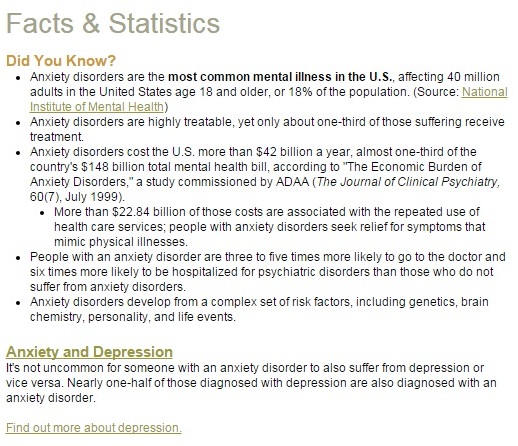


 [Note that fear/anxiety is associated with almost every mental illness that there is.]
I have come to believe that helping people with the deepest needs of life begins with a biblically accurate view of justification and its relationship to sanctification. This is where it begins, let’s go to the phones.
Escaping Church and its Culture of Death
 Originally published August 19, 2015
“This isn’t a technique for boosting our spiritual growth; this is a means of re-salvation because we are still technically lost and under law. ‘Under grace’ merely qualifies us for perpetual re-salvation. That’s Protestantism…period!”
Week in, and week out, and days in-between, professing Christians meet at a local institutional church to further indoctrinate their families in the Protestant culture of death. It doesn’t seem like death as families cheerfully socialize together and lift up their hands as the hipster praise bands make a joyful noise to the Lord. In addition, charismatic orators speak of things that are clearly in the Bible.
But let’s talk about good old fashioned theological math found in the Bible. The Bible addresses the only two people groups that exist in the world: the lost and the saved. As professing Christians, we want to be biblically defined as saved people, no? Can a case be made in this post that present-day evangelicals define themselves according to what the Bible defines as “lost”? Yes. All in all I am sure you will agree; any religion that defines itself as unregenerate is a really bad idea.
Here is how the Bible defines the two people groups:
Romans 6:14 – For sin will have no dominion over you, since you are not under law but under grace.
Every person living in the world is under law or under grace, lost or saved. Protestants define themselves as under law with under grace as a covering. Romans 6:14 is defined this way:
We are under grace because the righteousness of Christ continually saves us from being under law.
So, with Protestantism, it’s both. Under grace means we are still under law but progressively saved by grace. Under law is who we are, while we “experience” grace. Under law is what we do, under grace is what we experience. Supposedly, when Paul stated that we are “not” under law, what he really meant to say is under law is the absence of grace. The lost are only under law, but the saved are under both.
Hence, we are still under the “righteous demands of the law,” but if we are under grace, Jesus keeps the law for us. This is achieved by focusing on our sinfulness against the law, and returning to the same gospel that originally saved us out of gratitude. Objections to this idea are met with accusations of indifference to Christ’s sacrifice. Therefore, the “Christian” must live a “lifestyle of repentance” and constantly seek a “greater revelation of self” which is inherently sinful. The goal is to plunge the depths of our supposed total depravity. And if you are paying attention, our sin and the original gospel that saved us are the constant drumbeats we hear in the institutional church week in and week out.
Consequently, our goal is to see more and more of our reality of being under law resulting in an increased joy regarding our original salvation. Mainline evangelical Paul Washer states it this way:
At conversion, a person begins to see God and himself as never before. This greater revelation of God’s holiness and righteousness leads to a greater revelation of self, which, in return, results in a repentance or brokenness over sin. Nevertheless, the believer is not left in despair, for he is also afforded a greater revelation of the grace of God in the face of Christ, which leads to joy unspeakable. This cycle simply repeats itself throughout the Christian life. As the years pass, the Christian sees more of God and more of self, resulting in a greater and deeper brokenness. Yet, all the while, the Christian’s joy grows in equal measure because he is privy to greater and greater revelations of the love, grace, and mercy of God in the person and work of Christ. Not only this, but a greater interchange occurs in that the Christian learns to rest less and less in his own performance and more and more in the perfect work of Christ. Thus, his joy is not only increased, but it also becomes more consistent and stable. He has left off putting confidence in the flesh, which is idolatry, and is resting in the virtue and merits of Christ, which is true Christian piety (Paul Washer: The Gospel Call and True Conversion; Part 1, Chapter 1, heading – The Essential Characteristics Of Genuine Repentance, subheading – Continuing and Deepening Work of Repentance).
This not only turns the Bible completely upside down, but leaves the Christian in a lifestyle of death while rejoicing in it. This is a true celebration of death, and church is the culture thereof. Romans 6 is clear about what it means to remain under law:
3 Do you not know that all of us who have been baptized into Christ Jesus were baptized into his death? 4 We were buried therefore with him by baptism into death, in order that, just as Christ was raised from the dead by the glory of the Father, we too might walk in newness of life.
5 For if we have been united with him in a death like his, we shall certainly be united with him in a resurrection like his. 6 We know that our old self was crucified with him in order that the body of sin might be brought to nothing, so that we would no longer be enslaved to sin. 7 For one who has died has been set free from sin. 8 Now if we have died with Christ, we believe that we will also live with him. 9 We know that Christ, being raised from the dead, will never die again; death no longer has dominion over him. 10 For the death he died he died to sin, once for all, but the life he lives he lives to God. 11 So you also must consider yourselves dead to sin and alive to God in Christ Jesus.
Obviously, if we believe our formal sinful self has been “brought to nothing,” Paul Washer’s sanctification construct is impossible, and his statement speaks to the authentic soteriology of the Protestant Reformation. How do you achieve a greater revelation of your sinful self when your former sinful self has been “brought to nothing”?
You don’t, which leaves the “believer” yet under law and in need of salvation. The “believer” needs to continually return to the same gospel that saved him/her in order to remain saved. Instead of the new birth being a onetime event that brings the former sinner to “nothing,” the new birth is defined as a joy experience resulting from revisiting the gospel afresh for forgiveness of sin that still condemns us.
This cycle simply repeats itself throughout the Christian life. As the years pass, the Christian sees more of God and more of self, resulting in a greater and deeper brokenness. Yet, all the while, the Christian’s joy grows in equal measure because he is privy to greater and greater revelations of the love, grace, and mercy of God in the person and work of Christ (Ibid).
We are asking the question, How does the gospel save believers?, not, How does the gospel get people to be believers?… Believers need to be saved. The gospel is the instrument of God’s power to save us. And we need to know how the gospel saves us believers so that we make proper use of it (John Piper: Part 2 of a series titled, “How Does the Gospel Save Believers”).
Progressive sanctification has two parts: mortification and vivification, ‘both of which happen to us by participation in Christ,’ as Calvin notes….Subjectively experiencing this definitive reality signified and sealed to us in our baptism requires a daily dying and rising. That is what the Reformers meant by sanctification as a living out of our baptism….and this conversion yields lifelong mortification and vivification ‘again and again.’ Yet it is critical to remind ourselves that in this daily human act of turning, we are always turning not only from sin but toward Christ rather than toward our own experience or piety (Michael Horton: The Christian Faith; mortification and vivification, pp. 661-663 [Calvin Inst. 3.3.2-9]).
…by new sins we continually separate ourselves, as far as we can, from the grace of God… Thus it is, that all the saints have need of the daily forgiveness of sins; for this alone keeps us in the family of God (John Calvin: Commentaries on the Catholic Epistles; The Calvin Translation Society 1855. Editor: John Owen, p. 165 ¶4).
Moreover, the message of free reconciliation with God is not promulgated for one or two days, but is declared to be perpetual in the Church (2 Cor. 5:18, 19). Hence believers have not even to the end of life any other righteousness than that which is there described. Christ ever remains a Mediator to reconcile the Father to us, and there is a perpetual efficacy in his death—viz. ablution, satisfaction, expiation; in short, perfect obedience, by which all our iniquities are covered (The Calvin Institutes: 3.14.11).
Where we land on these issues is perhaps the most significant factor in how we approach our own faith and practice and communicate it to the world. If not only the unregenerate but the regenerate are always dependent at every moment on the free grace of God disclosed in the gospel, then nothing can raise those who are spiritually dead or continually give life to Christ’s flock but the Spirit working through the gospel. When this happens (not just once, but every time we encounter the gospel afresh), the Spirit progressively transforms us into Christ’s image. Start with Christ (that is, the gospel) and you get sanctification in the bargain; begin with Christ and move on to something else, and you lose both (Michael Horton: Christless Christianity; p. 62).
Nor by remission of sins does the Lord only once for all elect and admit us into the Church, but by the same means he preserves and defends us in it. For what would it avail us to receive a pardon of which we were afterwards to have no use? That the mercy of the Lord would be vain and delusive if only granted once, all the godly can bear witness; for there is none who is not conscious, during his whole life, of many infirmities which stand in need of divine mercy. And truly it is not without cause that the Lord promises this gift specially to his own household, nor in vain that he orders the same message of reconciliation to be daily delivered to them (The Calvin Institutes: 4.1.21).
Therefore, “under grace” is defined as a mere qualification to return to the same gospel that saved us; in other words, “We must preach the gospel to ourselves every day” in order to keep ourselves saved. How prevalent is this idea in the contemporary church? Consider this laundry list from Peter Lumpkins .com:
“As Pastors we must first preach the gospel to ourselves before we proclaim to the world the necessity of a Savior” (Scott Thomas, President of Acts 29 Network).
“Yet even when we understand that our acceptance with God is based on Christ’s work, we still naturally tend to drift back into a performance mindset. Consequently, we must continually return to the gospel. To use an expression of the late Jack Miller, we must ‘preach the gospel to ourselves every day’ (Jerry Bridges, Reformed author).
“We must preach the Gospel to ourselves and one another every day” (Ashland Avenue Baptist Church Distinctives, Lexington, KY).
“The Gospel must be central to our lives and central to our message. Strive to keep the Gospel in the center of your worship ministry. Jerry Bridges tell us that we must preach the Gospel to ourselves everyday. It has been said that we never move on from the Cross, only to a more profound understanding of the Cross” (Dr. Greg Brewton, Associate Dean for Music and Worship Leadership at The Southern Baptist Theological Seminary).
“We must preach the Gospel to ourselves” (Francis Chan, Passion 2011).
“Yesterday was a powerful moment in the Word of God as we studied Romans 8:1-4. I challenged those present to learn to preach the gospel to ourselves daily. Why? If we do not preach the gospel to ourselves daily, we will return to sin, bondage, guilt, the Law, and legalism…You see, this is why we must preach the gospel to ourselves daily” (Ronnie Floyd, former Chairman of the Great Commission Resurgence Task Force).
“I’ve been re-reading Jerry Bridges’ excellent book The Discipline of Grace…Bridges reminded me of just how important it is to ‘preach the gospel to ourselves everyday’ if we are going to be transformed into the likeness of Christ” (Tullian Tchividjian, Senior Pastor, Coral Ridge Presbyterian Church).
“…I once assumed…that the gospel was simply what non-Christians must believe in order to be saved… But I’ve come to realize that once God rescues sinners, his plan isn’t to steer them beyond the gospel, but to move them more deeply into it. The gospel, in other words, isn’t just the power of God to save you, it’s the power of God to grow you once you’re saved… . This idea that the gospel is just as much for Christians as it is for non-Christians may seem like a new idea to many but, in fact, it is really a very old idea” (Tullian Tchividjian, Senior Pastor, Coral Ridge Presbyterian Church).
“We must preach the gospel to ourselves everyday… . As we preach the gospel to ourselves, we should be both encouraged and overwhelmed with gratitude, and both should give us a desire to deal with the sin in our lives” (Casey Lewis, student, Southwestern Baptist Theological Seminary).
“A Prayer for Preaching the Gospel to Ourselves… . …Most gracious Lord Jesus, even as Paul was eager to preach the gospel to believers in Rome, so I’m eager to preach it to my own heart today…” (Scotty Smith, Guest blogger at Justin Taylor’s The Gospel Coalition site and Pastor, Christ Community Church, Franklin, TN).
“We must constantly be preaching the gospel to ourselves, filling our hearts with your beauty and bounty, Lord Jesus… . Dear heavenly Father, it’s not about “mind over matter,” or the power of positive thinking, or the pragmatic good of cognitive therapy. It’s all about preaching the gospel to ourselves every opportunity we get…” Scotty Smith, Pastor, Christ Community Church, Franklin, TN (here and here, respectively)
“We must constantly be preaching the gospel to ourselves, filling our hearts with your beauty and bounty, Lord Jesus… . Dear heavenly Father, it’s not about “mind over matter,” or the power of positive thinking, or the pragmatic good of cognitive therapy. It’s all about preaching the gospel to ourselves every opportunity we get…” Scotty Smith, Pastor, Christ Community Church, Franklin, TN (here and here, respectively)
“How can we not shift from the hope of the Gospel? By preaching the Gospel to ourselves daily… . ‘Preaching the Gospel to yourself’ is a phrase I first ran across in ‘The Discipline of Grace’ by Jerry Bridges, and have observed for years in the life of my good friend, C.J. Mahaney. C.J. has written persuasively, biblically, and practically on this topic in his new book, ‘Living the Cross Centered Life’… . Don’t take a day off from preaching the Gospel to yourself” (Bob Kaulfin, Director of Worship Development for Sovereign Grace Ministries and worship leader at Covenant Life Church led by Josh Harris).
“Far too many Christians are passive in their fight for joy…. What can I do? ‘Well, God does not mean for us to be passive. He means for us to fight the fight of faith the fight for joy. And the central strategy is to preach the gospel to yourself’…” (John Piper, When I Don’t Desire God, p.81, as quoted by Bob Kauflin).
“I am thoroughly engrossed with Joe Thorn’s personal mediations on preaching the gospel to oneself” (Tom J. Nettles, Professor of Historical Theology, Southern Baptist Theological Seminary, promoting Joe Thorn’s book, Note to Self: the Discipline of Preaching to Oneself).
“In the few months prior to Verge God was really working on me. I’ve been doing a lot of repenting of the idols in my heart. I’ve been preaching the gospel to myself” (Steve McCoy, SBC Pastor).
“This may sound really selfish, but faithfully preaching the gospel to myself is actually what enables me to share it faithfully to others” (Timmy Brister, SBC Associate Pastor).
“I chose not to include the response to the gospel…but just tried to focus on what the gospel actually is. I edit it regularly as I try to grasp and preach the gospel to myself” (Ed Stetzer, LifeWay).
This isn’t a technique for boosting our spiritual growth; this is a means of re-salvation because we are still technically lost and under law. “Under grace” merely qualifies us for perpetual re-salvation. That’s Protestantism…period!
And the culture that will result is defined in the Bible:
Romans 6:15 – What then? Are we to sin because we are not under law but under grace? By no means! 16 Do you not know that if you present yourselves to anyone as obedient slaves,[c] you are slaves of the one whom you obey, either of sin, which leads to death, or of obedience, which leads to righteousness? 17 But thanks be to God, that you who were once slaves of sin have become obedient from the heart to the standard of teaching to which you were committed, 18 and, having been set free from sin, have become slaves of righteousness. 19 I am speaking in human terms, because of your natural limitations. For just as you once presented your members as slaves to impurity and to lawlessness leading to more lawlessness, so now present your members as slaves to righteousness leading to sanctification.
20 For when you were slaves of sin, you were free in regard to righteousness. 21 But what fruit were you getting at that time from the things of which you are now ashamed? For the end of those things is death. 22 But now that you have been set free from sin and have become slaves of God, the fruit you get leads to sanctification and its end, eternal life. 23 For the wages of sin is death, but the free gift of God is eternal life in Christ Jesus our Lord.
Christ said, “You must be born again.” This is clearly a doctrine that redefines the new birth by defining the “believer” as unchanged and yet under law. Along with that is an unavoidable conclusion that this also includes a fruits unto death existence that is part and parcel with being under law.
This will, and does make sin and condemnation the focus and theme of church while the Bible emphasizes ADDING virtue to our faith in contrast to a continual re-visitation of our supposed depravity.
1Peter 4:8 – Above all, keep loving one another earnestly, since love covers a multitude of sins.
2Peter 1:3 – His divine power has granted to us all things that pertain to life and godliness, through the knowledge of him who called us to his own glory and excellence, 4 by which he has granted to us his precious and very great promises, so that through them you may become partakers of the divine nature, having escaped from the corruption that is in the world because of sinful desire. 5 For this very reason, make every effort to supplement your faith with virtue, and virtue with knowledge, 6 and knowledge with self-control, and self-control with steadfastness, and steadfastness with godliness, 7 and godliness with brotherly affection, and brotherly affection with love. 8 For if these qualities are yours and are increasing, they keep you from being ineffective or unfruitful in the knowledge of our Lord Jesus Christ. 9 For whoever lacks these qualities is so nearsighted that he is blind, having forgotten that he was cleansed from his former sins.
Romans 15:14 – I myself am satisfied about you, my brothers, that you yourselves are full of goodness, filled with all knowledge and able to instruct one another.
Hebrews 10:24 – And let us consider how to stir up one another to love and good works.
In the past, Protestants were confused enough about their own soteriological traditions that the fruits unto death were minimal, but during this Neo-Reformed resurgence that we are witnessing presently, such is not the case; the institutional church is a blatant culture of death. And those who would expose their children to it are woefully undiscerning. Ask yourself this simple question: do I leave church better equipped to see something that the Bible states isn’t there or better equipped to love God and others? Am I better at seeing my own depravity, or have I learned new ways to love which covers a multitude of sins anyway?
The remedy for this malady is a return to where the gathering of believers belongs: in home fellowships where believers are equipped to love God and others as a lifestyle, NOT a “lifestyle of repentance.” The institutional church was first called “church” when it was founded in the 4th century, and it was founded on the same idea that believers remain under law. Therefore, an authoritative institution was created that supplied official re-salvation for those under law. The institutional church goes hand in glove with the idea that it supplies a place for re-salvation, i.e., those qualified to receive it by being “under grace.”
To impart this blessing to us, the keys have been given to the Church (Mt. 16:19; 18:18). For when Christ gave the command to the apostles, and conferred the power of forgiving sins, he not merely intended that they should loose the sins of those who should be converted from impiety to the faith of Christ; but, moreover, that they should perpetually perform this office among believers” (The Calvin Institutes: 4.1.22).
Secondly, This benefit is so peculiar to the Church, that we cannot enjoy it unless we continue in the communion of the Church. Thirdly, It is dispensed to us by the ministers and pastors of the Church, either in the preaching of the Gospel or the administration of the Sacraments, and herein is especially manifested the power of the keys, which the Lord has bestowed on the company of the faithful. Accordingly, let each of us consider it to be his duty to seek forgiveness of sins only where the Lord has placed it. Of the public reconciliation which relates to discipline, we shall speak at the proper place (Ibid).
Come out from among them and be separate.
My Reply to Linda: Yes, I Am a Christian, But Not Sure You Are
 I am presently in the process of eliminating my personal Face Book account. A ministry account will be maintained for the TANC blog, Paul’s Passing Thoughts .com, and overseen by Pearl the PPT moderator. I recommend people befriend that account if they want to stay connected to our ministry.
The reason is simple: I no longer have patience for the evangelical regurgitation of orthodox talking points. Protestants don’t own their own faith that they have seen in the Bible with their own study. What they think they see and understand is what Protestant academics have told them, including the idea that they have authority to tell them what to believe. So, what is wrong with church? Church is wrong with church because it is predicated on a false gospel. That’s right, the Protestant Reformation was a false reformation founded on a false gospel. And this is why Dr. James White and others have refused to debate me publicly; the Protestant gospel as stated in its orthodoxy is the biblical definition of a lost person…under law as opposed to under grace.
Martin Luther and John Calvin et al proffered a gospel that is under law, but that is supposedly OK because Jesus keeps/kept the law for us and that obedience is imputed to our Christian status. This is a perpetual covering of sin, or sometimes referred to as “atonement,” but not an ENDING of sin that requires no further justification. Hence, we must “preach the gospel to ourselves every day” to “keep ourselves in the love of God” (CJ Mahaney) etc. White and others know that this is a simple matter of theological math, and do not intend to address it until enough people catch on. The only case they can make presently is for a historical-redemptive interpretation of Scripture that interprets every verse as a justification verse. Sanctification is defined as progressive justification via Protestant talking points.
So, while in the process of eliminating my personal Face Book account, I noticed a comment to me by a “Linda.” It follows:
“Are you a Christian Paul? And secondly do you believe that the Bible is the inspired Word of God? That would be my two questions for you. Romans says, ‘There is none righteous, no not one.’ That includes you and me. This doesn’t mean that we never do a kind act or good deed. It means that we don’t and can’t do enough of them to be declared ‘RIGHTEOUS’ by God. We could never do enough good deeds and kind acts to get us into heaven. Therefore we need the righteousness of Christ imputed unto us in order to go to heaven. God imputes this kind of righteousness to those who believe and accept HIS son Jesus and his shed blood as atonement for their sins and their UNrighteousness. We are part of God’s family by adoption. Nothing can make us righteous enough to go to heaven. The righteousness that is applied to our never dying soul can only come from Christ. The ‘part and parcel’ of our own being is puny compared with what God demands. In one place in scripture our puny ‘part and parcel’ is described as ‘filthy rags.’ So our own human effort at righteousness is from our flesh. Our flesh is not saved from sin and unrighteousness. Only our soul is. We are not capable of learning and loving enough to be declared righteous enough for heaven. We could learn and love enough to help another person with a kind act or good deed. But that does not fit our soul for heaven. I don’t understand your third question……’Christ imputing sin’ ????”
Her comment was in reply to previous comments made in regard to a post. She was replying to a comment I made regarding her initial comment. Her initial comment follows, and afterward my reply:
“I am a never dying soul whom Christ died and rose for, approved of by God because I have HIS righteousness. Just by learning and loving we are different. Better means ‘improved in some way.’ Not hard questions for me.”
“Linda, where does the Bible say you have the righteousness of Christ? That’s the first question. The second: Are we only approved of God because we ONLY have the righteousness of Christ and none of our own? What about the new birth? If we are literally born of God and now part of His lineage, would that not make us righteous? Do you mean to say that we have a righteousness LIKE Christ’s because we are a member of the same family, or ONLY His righteousness and none that is part and parcel with our own being? Are we truly righteous, or only declared righteous? Third question: was Christ’s role in salvation an imputation of sin AND righteousness, or just sin? On the one hand, you seem to state that we only have the righteousness of Christ, but on the other, you say we learn and love. How exactly do we learn and love if we ourselves are not righteous people? So, I am not trying to be a jerk here, I am simply resolute that Christians should have a clear definition of who they are. Yes, I know exactly what the Reformers believed about our identity, but I would like to see your clarification.”
This is the extreme Protestant cognitive dissonance resulting in the train wreck we call “church” that I no longer have patience for. People who are serious about following Christ need to take their true gospel and leave the institutional church for home fellowship networks. The institutional church is part and parcel with the authority that demands a denial of the obvious. Authority has replaced truth. Nevertheless, I do believe evangelicals will have to eventually address their under law gospel.
I will make this as simple as possible as I am weary of addressing it. Much, much, thanks to Andy Young who is helping to carry the water on this as well. Linda’s response is pretty much the Protestant gospel talking points that we hear often, and pregnant with cognitive dissonance. All in all, her answers to my questions are, “NO.” Please start by noting that. This is where we discuss another disservice the Reformers performed: adding chapters and verses to the Bible. This circumvents the need to read all of Scripture in context. You can form a theological argument by using John Immel’s pet peeve: Scripture stacking. Basically, Linda is using the same verses to argue for the same Protestant talking points that she has received from Protestant academics. As a result, if one examines her statements, the blatant contradictions are stunning.
Where to start? ALL of our works are filthy rags (Isiah 64:6), yet, we can do some stuff that is good? So, “all” doesn’t really mean “all”? Per the usual, Protestants profess a double false gospel because they don’t rightly understand the gospel taught by the father of the Reformation, Martin Luther. In fact, Luther taught that EVERY deed of man is evil, even those that appear good because man’s “good” deeds always have a flawed motive. Calvin taught the same. Hence, if one believes that we can do a good deed, that is “mortal sin” and cannot be forgiven by the church. But, if one believes that every work we do, even works that appear good, are actually evil, all of our sin can be forgiven by revisiting the same gospel that saved us, and that revisitation is only valid under the auspices and oversight of the clergy. This is Luther, this is Calvin, this is the Protestant gospel. I have documented this backwards and forwards as those who follow TANC Ministries know.
Now, for the Protestant part of this that Linda got right, and in fact a mainstay of Protestantism, but still a false gospel. Luther and Calvin orthodoxy already condemns her to hell, but they would agree with her making the law the standard for justification. Biblically, there is NO law in justification. The Bible testifies about justification, but law and justification are mutually exclusive. It doesn’t matter who keeps the law, there is no law in justification. What determines justification is the new birth. The law is strictly for love in the Christian life. Again, the law informs us about justification, and here is the information: law is not the standard for justification, the new birth is. The apostle Paul wrote the epistle of Galatians to make this very point. Again, I predict that folks are going to start catching on to this in the future and the who’s who of evangelicalism are going to have to make a defense; good luck to them as that attempt will be interesting. The Protestant under-law-gospel, also stated by Linda, has Christ fulfilling God’s “demands” in our stead when God’s only demand regarding justification is that we be born again.
In order to make the law the standard for justification, the Reformers resorted to Saint Augustine’s Neo-Platonism, which later became Gnosticism and wreaked havoc on the first century church. We see this in Linda’s talking points about “the flesh.” ALL of our works come from where? Right, the flesh which, like the Reformers, she deems as inherently evil. That’s Gnosticism. The Bible teaches that our bodies, or members, are “weak” not inherently evil. When the Bible speaks of the “desires of the flesh” and the “deeds of the flesh,” that speaks of when our members are used for sinful purposes. Obviously, if Linda would stop long enough to read her own Bible with her own understanding given to her by God, she would see that our body, or “flesh,” can also be used for holy purposes (Romans 12:1 among many other passages). And, what is more obvious than the fact that our bodies are declared to be the temple of God? Actually, a word study reveals that the Holy of Holies is being referred to.
This brings us to Linda’s Protestant confusion in regard to the difference between salvation and redemption. The former is the saving of the soul, the latter is the saving of the mortal body which can be used for evil or good depending on which desires we are obeying. Christians, through the new birth, have the ability to obey the desires of the Spirit stated in the Bible and the ability to say “no” to evil desires that remain part of the body’s weakness and mortality. Because Christ ended the law through the new birth, sin has been stripped of its ability to enslave and condemn. If Christ obeys the law for us, we are still under it and enslaved to sin. The old us that died with Christ violated the whole law with every sin; the new us that was raised with Christ fulfills the whole law with one act of love. Christ didn’t come to obey the law for us—He came to END the law. Christ didn’t come to cover our sin—He came to END our sin.
A book could be written here, but time won’t allow it; nevertheless, let’s address Linda’s confusion, typical among Protestants, in regard to gift and reward. We cannot birth ourselves, but we can obtain the baptism of the Spirit by faith alone in “the promise” (see Galatians chapter 3). Once the gift is received, it is ours to utilize by loving God and others. Exercising the gift is not taking credit for the gift. The Bible states that God would be unjust to forget our good works and service to the saints (Hebrews 6:10). “Unjust”? Yes, because as those literally born of Him (1John chapter 3), and literally a part of His literal family, our reward is due us as siblings working for the Father. As a slave to the former master, we could only earn death wages—now we can earn true reward. Read the Parable of the Talents and see what the outcome is for those who fear and want to give God back only what was given and nothing more. It shows a fundamental misunderstanding of the new birth.
As a policy, I don’t judge the salvation of others. I believe that there are Protestants who are confused enough about Protestantism to be saved. So, yes Linda, I am saved, but I find your assurance that you are saved indicative of your confusion. Protestant orthodoxy CLEARLY states that the motor of sanctification moving justification forward is doubt of salvation because being under condemnation is part and parcel with being under law…the standard for justification according to Protestantism. In Calvin’s words, if “Christians” are not still under condemnation, what further need is there for Christ and His righteousness?
So Linda, I am saved, but I recommend that you start thinking for yourself. All of the Protestant academics you trust will not stand in your stead at the judgment. You will be standing there alone.
And you better have more than a covering with sin underneath it, you better be a literal child of God before Him.
paul

 Paul's Passing Thoughts
1 comment