John Pavlovitz Sees the Problem with Mud and is Trying to Save It.
 I hate Facebook, but can’t live without it. One reason why is an article that was reposted by someone on my Facebook friends list. The article, written by a John Pavlovitz, was posted on his blog John Pavlovitz .com.
As gleaned from the article, JP sees the problems concerning “church” with stunning clarity, and is on a journey to save it from those who have “hijacked” it.
Like so many in our day, JP doesn’t understand that the church which he properly describes as “in the mud” is not in the mud because it has been hijacked—it is the mud.
Like so many in our day, he doesn’t want to “[throw]ing the baby Jesus out with the muddy bath water.” But Jesus doesn’t dwell in any muddy water. If you throw out the muddy bath water of the church, fear not, Jesus is not in there.
Much can be drawn out of JP’s article, but without a doubt the primary reason that the JPs of the world will not succeed in changing the muddy church follows: they think Christianity is a combination of Jesus and mud, the mud being us, and the only problem with church at this time is it’s too muddy. The muddy Christians are being too muddy, but Jesus still loves the muddy church. Therefore, we must save the Church of Mud by making it less muddy.
This is why Luther and Calvin never really left the Catholic Church; they shared the same essential metaphysics, epistemology, and politics (they also killed people who disagreed with them). They only disagreed on the ethics. The Reformation was not a revolution, it was a reformation. The Catholic Church had become too muddy.
This is what the JP’s of the world and all discernment bloggers to boot don’t understand: we don’t need another Reformation—we need a revolution. The problem with the muddy church is: it is made of muddy people and Jesus is not muddy, and those who follow Christ are like Him in the world. We are “washed,” not muddy.
And JP would say: “But we still have mud.” Therefore, a revolution instead of a mere reformation would be “throwing the baby Jesus out with the muddy bath water.” Here is what JP, like many others do not understand: the Church of Mud is muddy for a reason. While sharing the same ideology as the Church of Mud, their primary concern is that things become too muddy. They love the mud as much as anyone and seek to save the mud. However, there must be limits to the mud. The ideology that creates the mud cannot be allowed to create too much muddiness.
Hence, when JP and many others point out that there is too much mud, the others in the Church of Mud should not accuse him and others of, “being angry malcontents; serial complainers who have no real desire to make things better, who simply delight in publicly dragging Christianity through the mud.”
You see, the church being muddy is one thing, but dragging it through its muddiness is something else entirely. Why? Well, according to the formal doctrine of the church, it is the only place where mudders get saved, so you can’t do anything to hurt the Church of Mud. Now you are messing with the gospel of muddiness.
JP apparently means well, but his confusion can be seen in the article, i.e., “The problem is, organized Christianity is no longer truly in the hands of all the people. Like so many riches in this world, it too is being hoarded and held by a small minority who tend to speak for themselves; who are prone to leveraging power and position and platform to control those who they deem to be inferior or dangerous or deviating from the norm.”
This is the contradiction of the post: what was just cited and the whole not throwing Jesus out with the muddy water thing. He sees the problem, but clearly doesn’t understand that the ideology of church orthodoxy (the norm) will not, and cannot permit something that is “truly in the hands of all the people.” We call that a “revolution.” It’s a complete rebuild, not a renovation.
He is biblically correct on this, but fails to understand the difference between a true biblical model of “church” and Protestant orthodoxy. He is correct: God’s family is a holy nation of priests. What does that imply? It implies that there is no spiritual caste in the family of God.
The Bible states that we are a body, and with all bodies, the individual parts play very important roles and determine what the body is able to achieve. The body parts don’t wait around for permission from men to practice their function; they are guided by the one head, Christ. The body parts work together according to truth for the unity of one mind and one voice that strives to learn the mind of Christ more and more. The body parts are organized according to gifts.
But it doesn’t stop there. We are not just any run of the mill priests. The type of priest that the Bible is speaking of is the priest who entered the Holy of Holies once a year to offer an atonement for the sins of Israel. But now the veil has been torn asunder and all have free access to the Holy of Holies. We are able to enter in because we are washed—not muddy. Muddy people have never been allowed to enter the Holy of Holies and never will be.
JP recommends a revolution that will put Christianity back in the “hands of all the people,” and then prescribes a mere reformation; that won’t work. We are not muddy priests of a muddy church in charge of making sure we don’t become too muddy.
Is this perfectionism? Yes and no depending on how you define perfectionism in regard to the new birth. The church spawned by the Reformation defined perfectionism as a denial that Christians sin. It basically redefined sin in stark contrast to the biblical definition. The Bible makes a distinction between sin that condemns and sin by those who are God’s literal offspring. The Reformers made no such distinction in brazen defiance of holy writ.
As a result of this single perspective on sin, they made the law THE standard and measure of righteousness, and not the new birth. Instead of the new birth putting those under the law of condemnation to death with Christ and freeing them to obey the law for the sole purpose of love after their resurrection to new life, the Reformers kept believers in the mud and not washed by the baptism of the Spirit.
In other words, Jesus came to cover the mud, not wash it away. According to Calvin and Luther both, “saved” people must become official members of the Church of Mud through the initiation of water baptism to keep their mud covered by perpetual rewashings every time that we return to the “same gospel that saved us.” This is why we must, “preach the gospel to ourselves every day” and “live by the gospel” according to everything in our lives being “gospel driven.”
Consequently, according to Luther, and Calvin, the believer should care less how much mud gets flung around as it is really none of our business. We are not in control of the mud, only getting it covered by behaving at church. If we are in control of the mud depth, well, we have a “righteousness of our own.” And trust me, the mud doesn’t fling far from the pigsty.
Hate to tell you JP, but the church folk that fear you are right; according to Protestantism, you really should keep your mouth shut. The muddiness is what it is; if you think there is too much mud you are self-righteous. Sound familiar?
If you go to “The Table” tab/page on JP’s blog, it is fraught with Church of Mud orthodoxy mixed in with anti-total depravity emergent-like ideology. Like so many in our day, JP needs to totally forget everything he has learned and do the job he is called to: High Priest. That is his job, not the collecting of other people’s thoughts for perhaps a well-meaning search for answers.
On the same page, you will notice that we “reflect” rather than actually do things, and our lives are a “story” like the redemptive-historical metaphysics of the Church of Mud. And then there is this:
We realize that no one has all the answers, and that faith and doubt live side by side. No one has the market cornered on Truth and we’re OK with that.
What about the one mind of Christ that we are called to be unified by? If no one can really know anything “except Christ and Him crucified,” or stated another way, Luther and Calvin’s “objective gospel experienced subjectively,” what unity does JP propose will take place? This confirms that he is out of touch with the biblical concept of body.
The page also states that everyone and their views are welcome, but I am not sure they want to hear what I have to say because I think little of a physician who wants to save cancer patients by first saving the cancer, or those trying to save the Church of Mud from too much mud.
We need a revolution, not a reformation. The problem with the Church of Mud is the mud.
paul

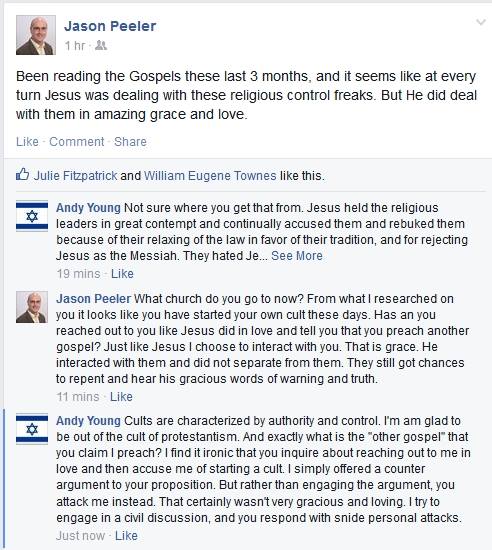


Camp on This: The Problem with Church
Steve Camp is a Reformed leader and contemporary Christian music icon. In fact, while still blinded by the ways of Protestantism, I was a huge fan of Camp and have probably purchased every CD he ever recorded. He recently posted a comment on his Facebook page that is an almost perfect thumbnail of Protestant heresy and churchianity in general.

Let’s unravel this invitation to go to hell in a handbasket one idea at a time:
As I read FB and Twitter each day, it saddens me to read Christians posting for help with basic needs in their lives. When you see this, it’s proof positive that they are not part of a local church.
Oh really? Home fellowships are in a much better position to help people because of expendable income not going to the Protestant temple tax. As a former Reformed elder, I can tell you what percentage of tithe goes to infrastructure and it ain’t pretty. Not only that, there are always strings attached to any help you get from a Protestant institutional church. One such church offered to pay for my education in fire safety engineering. I said no because I knew it was a control move. In fact, because of what was going on at the time, their motives were so obvious I was embarrassed for them. Home fellowships accomplish EVERYTHING we are called to do at a fraction of the cost.
May I encourage you today to get plugged into a gospel-centered church.
Being interpreted: a church that continually “shows forth” the same gospel that saved us. That’s Protestantism: a return to the same gospel to maintain forgiveness for “present sin.” Calvin taught that sin in the Christian life “removes us…from grace” (“grace,” ie., justification) and reforgiveness of such sin can only be found in formal Protestant church membership.
Be taught God’s Word; worship the Lord Jesus; celebrate the Lord’s supper; fellowship with other believers; pray; serve; give; help meet the needs and bear the burdens of another; develop and use your Spirit given gifts; grow in grace; share your faith; glorify God.
In this list are the Protestant, and don’t miss this, “means of grace.” Stripping this term of its nuance, it is better stated “means of justification.” Notice towards the end of the list we read, “grow[ing] in grace” which is more truthfully rendered “growing in justification.”
Sitting under the teaching of seminary certified philosopher kings, taking the Lord’s Table, being faithful to the church, tithing, etc., “imparts grace” (justification) and are the “means of grace” (justification).
Also notice that instead of worshiping God in spirit and in truth wherever we are because our bodies are the temple of the Holy Spirit and not some “local church,” “worship” only takes place when we meet corporately in the local expression of the “holy mother Church” as Calvin enjoyed calling it.
paul
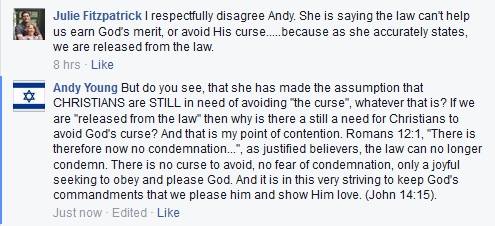
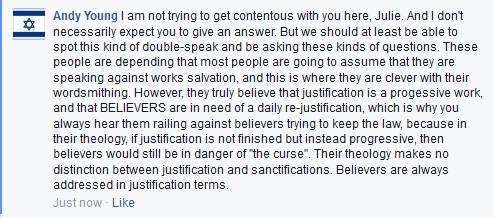
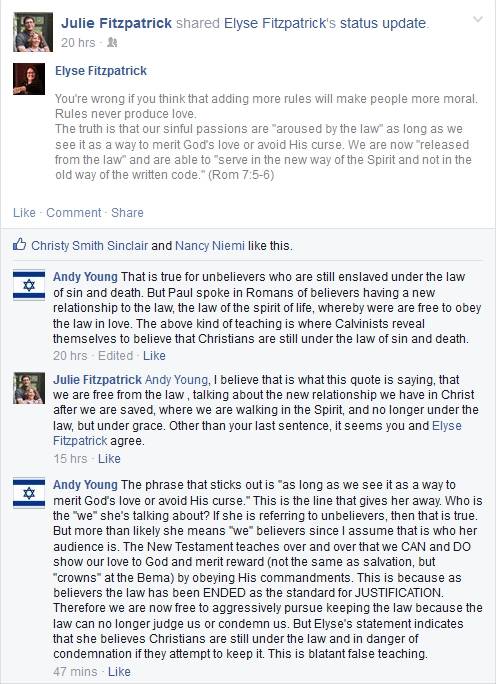

 Paul's Passing Thoughts
leave a comment