A Reformed Myth: Calvinists Believe in Election
 “And this is far from being a John Piper exclusive, this is the Reformed tradition.”
It would seem that something good could be said about Calvinism’s doctrine of election; at least if you are one of the lucky chosen, you are guaranteed eternal life, right? Wrong.
So-called “election” only takes care of original sin, you must now continue to live by faith alone in your Christian life so that the perfect obedience of Christ continues to be imputed to your account. The specific terms for this are “Christ 100% for us” and “already not yet.” Since Calvinists see justification and sanctification as the same thing, “100%” means Christ must perform all works in both justification and sanctification.
John Piper preached a series entitled, “How Does the Gospel Save Believers?” Did you know believers still need to be saved? In the series he explains how we are already saved but not yet:
We are asking the question, How does the gospel save believers?, not: How does the gospel get people to be believers? When spoken in the power of the Holy Spirit, the gospel does have power to open people’s eyes and change their hearts and draw them to faith, and save them. That’s what is happening on Tuesday nights and Wednesday nights this summer. People are being drawn to Christ through the power and beauty of the gospel. But I am stressing what Paul says here in verses 16 and 17, namely, that “the gospel is the power of God for salvation to everyone who believes.” Believers need to be saved. The gospel is the instrument of God’s power to save us. And we need to know how the gospel saves us believers so that we make proper use of it.
So, did you know that believers need to make “proper use” of the gospel in order to be “saved” as believers? And this is far from being a John Piper exclusive, this is the Reformed tradition. Piper’s next statement defies the imagination in regard to how mind numb people must be at Bethlehem Temple:
I say it with Paul: I, John Piper, am eager to preach the gospel to you who believe – exactly to you who believe – because this gospel which is laid out in the book of Romans, is the power of God to save you. You believers need to hear the gospel in order to be saved. And Paul labors mercifully for 16 chapters to tell us the gospel and how it works to save believers.
Well, this should be a crude awakening in regard to what Calvinists mean when they say, “We must preach the gospel to ourselves every day.” They mean this as a matter of eternal life and death for the believer.
And so it goes: election isn’t the issue, the gospel of progressive justification is the issue, and besides that, Calvinists don’t even believe in election to begin with.
paul
Election, and the Arena Unlittered by Flesh and Blood
 “Does the doctrine of election logically exclude the value of the non-elect?”
When it gets right down to it, ignorance built the people ovens at Auschwitz. Not the builders, they were by no means ignorant, but the ignorance of people in general supplied the mortar. The bloodthirsty are rarely ignorant of knowledge that matters, that’s how they control the ignorant masses. We would expect God to be the master of understatement for the purpose of making a point; hence, “My people die for lack of knowledge.” The Nazis knew exactly what they were doing, and the world finally responded because of the results. And so it goes; the eventual reactionary blitzkrieg by good men is bittersweet for Lady Wisdom. Many must die to make the point, and no consolation can be found in quick death, for the tyrant’s disdain for the victims will not tolerate such mercy.
Christians have always led the pack of ignorance that focuses on the what rather than the why. Our faith is a “license for irrationality” (John Immel: TANC 2012, session 1). Yes, knowledge is puffed up. Knowledge seeks to explain the God so high above us. We embrace the philosophy of our fathers whom we know not: “The truly wise man knows that he knows nothing” (Socrates). Ignorance is child-like faith. We believe that we can remain as harmless doves without the wisdom of serpents. We claim Jesus Christ while parroting Socrates in our ignorance. We worship at the altar of mindlessness while attributing all that we don’t understand to “God’s will.” Prayer is our exhibition of faith that proclaims our helplessness. Stupidity, prayer, and “God’s will” are our functional trinity. Knowledge that feeds our bank account and personal worth is within our domain—knowledge for life and death belongs to the gods. Therefore, our elderly fustigate the young for using bad grammar while wallowing in doctrinal ignorance.
So, week after week, we settle for the same old song and dance at church; literally, seven verses about Jesus repeated eleven times with drums, guitars, and violins. And what will we learn this week? What else? Something about Jesus. When He spoke of wisdom, He was merely speaking of Himself. This is how Churchianity is done; this is our doctrine: to teach ANYTHING ELSE but Jesus is to hinder the sanctification of the saints (John MacArthur Jr.). No, no, we don’t need to know the history and substance of philosophy; that would prevent us from quoting ancient philosophers and attributing their wisdom to Jesus (piously pronounced, “geeee-jussss”).
So this is the lightbulb moment: in the name of Jesus, we watch tyranny grow in our backyard. As it sprouts upward, we attribute its growth to God’s will and we pray about it. The American church has watched the TULIP named Neo-Calvinism grow for 43 years now, and we still attribute it to God’s will and we still pray about it.
I imagine sister Martha is pretty upset about being asked to leave after being a member here for seventy years. Certainly, she must have done more than just ask a few questions. Oh well, God’s will. I asked one of the elders about the situation and he replied, “Jesus.” And who can argue with that answer? We must remember to pray for her.
Dear, could you please pass the fish?
Two articles written by Kevin O’Brian reveal the jolt of reality that can result from a little bit of thinking. I don’t know anything about Kevin O’Brian, but I can tell you that you need to read these two articles: [1] and [2]. Does the doctrine of election logically exclude the value of the non-elect? And what does Nihilism have to do with today’s Churchianity? Is John Immel right? Can the rejection of certain ideologies prevent the tyranny that always follows? Can the arena of ideas prevent the festive arena of humans being devoured by wild beasts?
That question is answered by another must read article [3] by the 12 Tribes organization. I don’t know anything about them either, but I can tell you that you need to read this article also. These three articles together make a strong statement; a wakeup call to the importance of thinking in the arena unlittered with flesh and blood—the arena of knowledge, wisdom, and thinking.
Logic that always leads to tyranny and death must not be allowed to grow. It must be slain in the arena of ideas. And most of all, it must be kept from entering the house of God in the Trojan horse embodied by the minds of men.
paul
[1] http://www.thwordinc.blogspot.com/2013/01/just-kill-it.html
[2] http://thwordinc.blogspot.com/2013/06/calvinism-and-abortion.html
American Christians Are All Calvinists
“Calvin didn’t believe in election. The assumed absurdity of the statement testifies to the traditions of men that saturate the American church.”
There is no new thing under the sun. When Christ came and began His ministry with the proclamation of the kingdom gospel, Israel was steeped in the traditions of men. And Christ didn’t call it “legalism,” He called it antinomianism. Whether Arminian or Calvinist, both came from that same stock. They claim to be different, but both celebrate their parents as heroes of the faith: the Pilgrims. The unregenerate even get in on the act during the holiday season of Thanks Giving and Christmas.
But the Pilgrims were Puritans. And the Puritans were rabid Calvinists. They brought with them the first Bible to ever see American soil: the Geneva Bible which included Calvin’s play by play commentary. They came to start a theocracy modeled after Calvin’s Geneva, and succeeded. And what followed was the same heartless brutality they brought with them from Europe. The Pilgrims were merciless tyrants and were put out of business because they hung too many Quakers for disagreeing with them. Like Calvin and Luther, they were endowed with superstition and mysticism clothed in European orthodoxy.
The reverence of Puritans as spiritual giants and pioneers is grounded on pure myth. They were communistic, and lacked the rugged individualism that founded this nation. Regardless of the vast, unmolested resources they found when they arrived here, Indians had to teach them how to survive. The Puritans were not innovators, and invented little to overcome the environment they found themselves in. Their presuppositions concerning man and mystical approach to life did not serve them well. These same presuppositions run deep and wide in the American church.
But what about Calvinism versus Arminianism and the election issue? There is no disagreement there either. Calvin didn’t believe in election. The assumed absurdity of the statement testifies to the traditions of men that saturate the American church. Calvin believed that we are sanctified the same way we were saved, by faith and repentance alone. He also believed that this saving duo of faith and repentance were necessarily perpetual, and could only be received in the formal church institution. Luther believed this as well. You keep your salvation by being faithful to the local church, or “new covenant.” One must remain “faithful to the covenant” by seeking perpetual reconciliation in the church. So-called election is being elected to be in the covenant, but then you have to keep yourself in the covenant. You run the “race of faith” by “faith alone” in order to stay justified in sanctification.
God then sorts out who was able to do that at a single, last judgment. Hence, Augustine, a forefather of the Reformation, believed that eternal life wasn’t determined until the final judgment. I document these assertions in “False Reformation” and the mini-booklet “New Calvinism for Dummies” (tancpublishing.com). However, this may be helpful as well: https://paulspassingthoughts.com/2012/10/31/mutable-justification-not-shocking-just-reformed/
The fact that Reformed theology rejects election can also be seen in Supersessionism. This is the belief that though the nation of Israel was elected, they lost their election because they didn’t stay faithful to the covenant. So, once elected doesn’t necessarily mean always elected. Though Revelation makes it clear that God will dwell with man ON EARTH for eternity, the American emphasis is eternity in heaven. Why? Because God tabernacling with man on earth =’s Israel. That’s why. The very purpose of election cannot be denied as stated by Paul in Romans 9—anything at all that we do is separated from justification. Therefore, Calvinists deny the purpose of election.
Arminians are no different because they come from the same stock. They also deny election, and seek comfort in church membership. I can’t even tell you how many Southern Baptists that I have visited who trust in their church membership for salvation. To suggest they be removed from the church roles because they have not attended in several years is tantamount to removing them from the book of life. This is a common mentality in Baptist churches and I have witnessed it first hand on many occasions. Also throw in the obvious overemphasis on salvation in Arminian Baptist churches because like their Calvinist counterparts, the same gospel that saved you also sanctifies you.
Because of the traditions of men, we are all Calvinists. And we are so steeped in tradition that we don’t even know it. There is no new thing under the sun.
paul
Fundamentals of American Christianity, Calvinism, Covenants, and Election: The Potter’s House: 4/7/2013
Chart illustration for discussion at 00:45:31
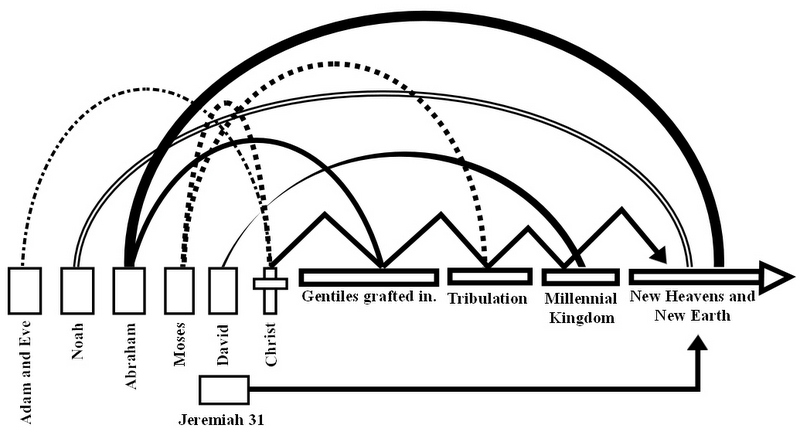
If you are much like me as an average American Christian, you are pretty foggy on God’s overall plan for mankind involving Old Testament and New Testament tenets. Perhaps due to laziness, we accept broad generalizations concerning the differences between the testaments. For example, “Old Testament saints were saved by keeping the law—we are saved by grace,” “God gave the law to show us we can’t keep it—to drive us to resting in Christ alone,” etc.
There is no doubt that it takes diligent study to understand redemptive covenants, election, and sanctification paradigms. The complexities of these issues have not been taught in the American church. Why? Our American Christian heritage comes from the Puritans who arrived on our Eastern shores from Europe. They were Calvinistic, and part and parcel with European Calvinism comes theocracy and orthodoxy. Like ducks searching for bodies of water, European Calvinism will eventually head in this direction. There are no exceptions, and it is only a matter of time. If Calvinism is ultimately deprived of theocracy and orthodoxy, particularity the Puritan breed, it will die. Lesser forms of pure Calvinism can survive well on orthodoxy alone, but the more pure forms like Puritanism will die without theocracy. Hence, Puritanism today is merely folklore propagandized with spiritual sound bites.
What is orthodoxy? It’s the antithesis of Acts 17:11. It assumes a spiritual caste system where some are preordained to understand things that the average saint cannot understand. The average Christian searching the Scriptures to determine if a pastor is teaching truth was, and still is an unacceptable construct in European Calvinism. It is thought to prideful, unsubmissive, and a rejection of God-appointed authority. Orthodoxy is what the spiritually enlightened prepare for the unenlightened in creeds, confessions, and counsels. One advertisement I saw for a seminary announced that it was “confessional.” What does that mean? It means that it teaches and holds to historic confessions of faith. These confessions have authority, and were written by the, for example, “Westminster Divines.” Problem is, this passes a traditional interpretation from generation to generation on an assumptive basis; i.e., to rethink orthodoxy would be arrogantly reinventing the spiritual wheel. This is our heritage, and why we don’t know much. Creeds, confessions, and counsels do not deliver in-depth analysis on the aforementioned issues; primarily, they tell us how to think.
Therefore, the Potter’s House is a journey, and there is no looking back. We have learned astounding things from the book of Romans that Susan and I have never been taught in our combined eighty years of being Christians. But most importantly, what we have learned are building blocks that are keys to understanding more of God’s counsel. I think it is time in our study to look at some of these fundamental building blocks. Some speak directly to the chapter we are in. But first, let’s review some former ones:
1. The “gospel” is the good news of God’s full counsel for life and godliness. The death, burial, and resurrection of Christ is the gospel of “first importance” or “first order of importance.” “Word,” Scripture,” Gospel,” “holy writ,” etc., are all used interchangeably throughout the Bible.
2. Paul categorizes all people into two categories: under law, and under grace. Those under the law are enslaved to sin, provoked to sin by the law, and will be judged by the law. Those under grace are enslaved to righteousness, provoked to do good by the law, and will not be judged by the law.
3. The importance of angels in administering God’s covenants.
4. Salvation is Trinitarian, not Christocentric.
5. A major key to understanding the book of Revelation is Exodus 19-24.
6. The Bible interprets itself and identifies its own methods of interpretation.
7. The law is completely separate from justification, but informs our sanctification.
8. The difference between justification, definitive sanctification, progressive sanctification, and final sanctification.
9. The difference between salvation and justification.
10. Why Christians are truly righteous in the here and now.
11. Why Christians still struggle with sin.
12. The difference between our redeemed hearts and our mortality.
13. Motivation to share the gospel and better ways to do it.
14. Divine Anthropology: what makes mankind tick?
Other things are becoming clearer in our study concerning election and covenants which brings us closer to the issues at hand in chapter nine. I will save election for last because once that is discussed it will be all anybody is thinking about. I would like to use Ephesians 2:11-16 for our first point:
11 Therefore remember that at one time you Gentiles in the flesh, called “the uncircumcision” by what is called the circumcision, which is made in the flesh by hands— 12 remember that you were at that time separated from Christ, alienated from the commonwealth of Israel and strangers to the covenants of promise, having no hope and without God in the world. 13 But now in Christ Jesus you who once were far off have been brought near by the blood of Christ. 14 For he himself is our peace, who has made us both one and has broken down in his flesh the dividing wall of hostility 15 by abolishing the law of commandments expressed in ordinances, that he might create in himself one new man in place of the two, so making peace, 16 and might reconcile us both to God in one body through the cross, thereby killing the hostility.
This passage makes separation from the covenants of promise synonymous with being alienated from God. There is also more than one covenant of promise.
“Covenants” is in the plural. So, we don’t want to think of Old Testament Covenants as being replaced by the New, but rather we want to think of all of these covenants as building on each other. Also, the covenants will have future elements, abolished elements, and elements that are being phased out with time. Paul states what part of the Mount Sinai Book of the Covenant was “abolished,” the ordinances regarding sin offerings since Christ fulfilled the propitiation for sin (vv. 14, 15).
To be separated from Christ is also likened to being separated from the “commonwealth” of Israel (v. 12). This speaks to Israel as a nation. As we discussed last week, this doesn’t mean that all of national Israel will be saved. They were an elect nation with elect people, but not all in the nation are elected individually. Allegorically, some are descendants of Hagar and others are from Sarah. This symbolizes slavery to sin versus heirs of the promise. Paul wanted to make sure the Gentiles at Rome understood that rebellion within Israel didn’t mean that God had revoked His promises to Israel as a nation.
As yet, none of the covenants have been abolished. Again, some elements are yet future, some are fading away, and some elements have been abolished. Even the New Covenant has such elements. Jeremiah 31 states that the law of God will be written on everyone’s heart and there will be no need to teach anybody about the Lord. Obviously, that is future. We read the following in 1Corintians 13:8-10;
8 Love never ends. As for prophecies, they will pass away; as for tongues, they will cease; as for knowledge, it will pass away. 9 For we know in part and we prophesy in part, 10 but when the perfect comes, the partial will pass away.
Prophesies, tongues, and knowledge are all under the New Covenant (past, present), and when the perfect comes knowledge will pass away. Nobody will have need to be taught as Jeremiah predicted. That’s future. The “perfect” is what Peter said we are ultimately looking for: the new heavens and new earth:
1Peter 3:13 – But according to his promise we are waiting for new heavens and a new earth in which righteousness dwells.
The “promise” is another name for the Abrahamic covenant which, as we looked at last week, included the Gentiles from the beginning.
Another truth about the Old Covenant is that it was a will. It was like the inheritance that your parents leave you in their will. The inheritance is eternal life, and Christ, the testator, had to die for the will to be executed:
Hebrews 9:15 – Therefore he is the mediator of a new covenant, so that those who are called may receive the promised eternal inheritance, since a death has occurred that redeems them from the transgressions committed under the first covenant. 16 For where a will is involved, the death of the one who made it must be established. 17 For a will takes effect only at death, since it is not in force as long as the one who made it is alive. 18 Therefore not even the first covenant was inaugurated without blood.
And like any will, the inheritance is promised. In this sense, sin was bound up or imputed to the covenant until Christ came:
Galatians 3:15 – To give a human example, brothers: even with a man-made covenant, no one annuls it or adds to it once it has been ratified.
Galatians 3:21 – Is the law then contrary to the promises of God? Certainly not! For if a law had been given that could give life, then righteousness would indeed be by the law. 22 But the Scripture imprisoned everything under sin, so that the promise by faith in Jesus Christ might be given to those who believe. 23 Now before faith came, we were held captive under the law, imprisoned until the coming faith would be revealed. 24 So then, the law was our guardian until Christ came, in order that we might be justified by faith. 25 But now that faith has come, we are no longer under a guardian, 26 for in Christ Jesus you are all sons of God, through faith.
These are building blocks; neither do I have a full understanding about how all of this works together, but apparently sins were imputed to the covenat/will until Christ died. To be saved in the Old Testament was to acknowledge that you were an heir of salvation through Christ. So, Old Testament saints would have definitely been looking for the coming of Christ. Soon after Christ died, the Gentiles received the good news that they were part of the inheritance as well.
Furthermore, outside of the covenant there is a principle of reaping and sowing as well as a principle of reaping and sowing in the covenant as well. This is abundantly clear as Paul cites the Old Covenant in regard to blessings in this life:
Ephesians 6:1 – Children, obey your parents in the Lord, for this is right. 2 “Honor your father and mother” (this is the first commandment with a promise), 3 “that it may go well with you and that you may live long in the land.” 4 Fathers, do not provoke your children to anger, but bring them up in the discipline and instruction of the Lord.
Hence, promises of spiritual wellbeing through obedience are an undeniable part of the Old Covenant and most definitely still in effect presently. There is a lot going on in these covenants and confusion in our day is not lacking. Nevertheless, the Scripture explains all of this in further detail, but it takes diligent study to show ourselves approved. The following chart may be helpful in encouraging you to study these things for yourself.
Lastly, the relationship between covenants and election. I get my share of grief over my present understanding of election. I take a paradoxical position. Election is 100% true and is crucial for keeping justification and sanctification separate as well as eternal security. Paul, as we saw last week, states the purpose of election is no uncertain terms: to exclude works from justification. On the other hand, I believe free will is also 100% true. I believe this because it is what I see in the Scriptures. It comes with special privilege as well: I get accused of being both a Calvinist and Arminian. But Calvinists don’t believe in election, that’s a myth. For example, though Israel was clearly elected by God (DEUT 7:6-8), most of them hold to Supersessionism. That’s the belief that God replaced Israel with the church because they violated their covenant with God. This is a denial of election. The promise is not contingent on anything we do. It’s not conditional. Blessings and cursing/reaping and sowing is conditional, but not election. This same Reformed take on Israel applies to the individual as well: we are elected to participate in the race, but must be faithful to the church in order to not be disqualified from the race of faith. Calvinists don’t believe in election. As if their doctrine wasn’t goofy enough already—you can add that: the supposed sultans of election don’t even hold to it.
Besides, this paradox can be seen in real life. We implore people with all passion to be reconciled to God, especially Arminians. Yet, Arminians always credit God with saving the person. Few Arminians will ever be heard crediting themselves or the redeemed person for his/her salvation. Nor have I ever heard an Arminian pray to God that anyone would save themselves.
In additon, to satisfy my John Locke Christian friends, its science. Susan and I have a friend who is in the process of writing a book on God’s sovereignty and man’s free will. I will share a small portion of his manuscript to make my point:
Of course, it must be admitted that finite mankind has a limited capacity for understanding the workings of our Infinite Creator. Consequently, one practical way to resolve this challenge to our faith is to face up to the reality of our finite ability to understand God’s workings. In this approach, it is necessary to accept by faith those things that seem beyond any rational understanding. For many, this may be a satisfactory solution to the dilemma. In fact, a similar approach is sometimes followed in the field of science. Consider, for example, the physics of light where two seemingly contradictory theories are used side-by-side to explain its different properties. The wave theory is used to understand the oscillation aspects of light (e.g., Polaroid sunglasses), while at the same time the particle theory is employed to explain other applications (e.g., photoelectric solar panels). Although these two theories are totally incompatible, each provides useful information in certain technical applications. To date, scientists simply use the appropriate theory as needed for a particular design problem. There is no worry about whether light actually exists as a wave, or as a particle, just because it is not yet fully understood. This same approach may be taken in the spiritual realm and is probably the best stance to take in dealing with the apparent contradiction between individual free will and God’s total sovereignty.
As an avid reader of the Bible since my conversion in 1983, I began to take this position in 1986 and have not abandoned it yet. The apostles and others evangelized like it depended on them, but yet made strong statements regarding the sovereignty of God in salvation.
paul
For a free DVD of this message mailed to you at no charge, click here.
The Potter’s House is a member of the Home Fellowship Network: homefellowship.net

Calvinism’s Repenting Your Way Into Heaven and the Folly of the Election/Freewill Debate
My Grandmother was of a vein of Freewill Baptists that believed in Jesus plus perpetual salvific repentance for salvation. They based this on 1John 1:9; “If” you are faithful in confessing known sin, you are forgiven and washed from unknown sin as well. According to this brand of gospel, when one believes on Christ, all their past sins are forgiven, but ongoing sin must be confessed to maintain salvation. Basically, it’s Jesus plus praying your way into heaven. Fortunately, I believe my Grandmother eventually rejected that approach to salvation.
Works salvation can be very subtle. It is anything that requires something of us in sanctification to maintain justification. That’s key: the crux of the issue is the fusion of justification and sanctification. When the two are fused, even doing nothing in sanctification to maintain our justification is works salvation because we are doing something in sanctification for justification even if doing something is doing nothing. Unless the two are completely separate, justification depends on something we do or don’t do in sanctification. Hence, even doing nothing is a work. It’s abstaining from works to maintain our salvation.
That’s what makes this Freewill Baptist doctrine a false gospel—something is required by us in sanctification to maintain justification because the two are still connected. Now, Freewill Baptist, as the very name implies, are Arminians, not Calvinistic. They differ on election, but not salvation. And trust me, the salvation gig is what matters, not the election gig.
I can now hear the cat cries from Calvinists because they are being compared to Freewill Baptists. But they are no different in regard to the gospel because the relationship of sanctification to justification is what matters and NOT election. Nobody is going to hell for their views on election/freewill, but taking part in the maintaining of God’s call is a different matter altogether. And Calvinists believe nothing different on that wise than the Freewill Baptists.
The Freewill Baptist, the aforementioned strain, believes that the same repentance that saved you also sanctifies you all the way to heaven. It’s a perpetual salvific repentance. It’s a perpetual “washing.” Thing is, Christ made it clear that this washing only takes place one time (John ch. 13). Calvinists believe that the same gospel that saved you also sanctifies you; e.g., “We must preach the gospel to ourselves every day.” But specifically, they also believe that daily forgiveness must be sought in order to maintain our salvation. Here is what Calvin wrote:
Secondly, this passage shows that the gratuitous pardon of sins is given us not only once, but that it is a benefit perpetually residing in the Church, and daily offered to the faithful. For the Apostle here addresses the faithful; as doubtless no man has ever been, nor ever will be, who can otherwise please God, since all are guilty before him; for however strong a desire there may be in us of acting rightly, we always go haltingly to God. Yet what is half done obtains no approval with God. In the meantime, by new sins we continually separate ourselves, as far as we can, from the grace of God. Thus it is, that all the saints have need of the daily forgiveness of sins; for this alone keeps us in the family of God (Calvin’s Commentaries, Vol. 45: Catholic Epistles).
And….
Moreover, the message of free reconciliation with God is not promulgated for one or two days, but is declared to be perpetual in the Church (2 Cor. 5:18, 19). Hence believers have not even to the end of life any other righteousness than that which is there described. Christ ever remains a Mediator to reconcile the Father to us, and there is a perpetual efficacy in his death (CI 3.14.11).
In regard to the gospel, there is no difference between Freewill Baptists and Calvinists, and that’s why the freewill/election debate makes no difference as well.
paul

 Paul's Passing Thoughts
5 comments