Absolutely Critical to Effective Ministry: Knowing the Two Realities of Protestantism

If we are to accomplish anything in contemporary Christianity, we must begin to live by a basic hard-fast rule: our actions must be guided by the knowledge that there are two realities in contemporary Christianity – grammatical-historical and redemptive-historical.
These are usually discussed as methods of Bible interpretation, but they are really much more than that according to Protestant tradition. These are two different ways of interpreting reality itself.
We will begin by defining the redemptive-historical interpretation of reality along with this caution: one of the most powerful influences that this view of reality has is the dismissal of its basic premise as mere mysticism held by fringe elements of Protestantism. Those who dismiss it out-of-hand then proceed to function by its tenets unawares. The who’s who of Protestantism care little that the masses understand this ideology, just so they function by it.
In fact, Protestant leaders assume most parishioners are unable to grasp its tenets. Therefore, redemptive-historical reality must be explained in a way that will enable congregants to apply it to their lives and function a certain way within church culture. Redemptive-historical reality is primarily the crux of Protestant orthodoxy and its spiritual caste system.
In mythology, we often link the bizarre narratives to the philosophy itself, but that’s a mistake. Roman, Greek, and Babylonian culture was not developed by superstitious idiots. What we fail to understand is the narratives are stories that convey principles to the spiritual underlings so they can apply principles of higher knowledge to their lives. They cannot understand the higher knowledge, but those who can need to tell the underlings how to live in order to obtain the best possible society.
“Orthodoxy” can be likened to mythological narratives that teach those of lesser spiritual understanding how they should live, but they are based on well thought out metaphysical (state of being) systems of knowledge. We shouldn’t be surprised that what seems to be superstition has ruled the greatest empires on earth. This is because the core ideology is always a succinct system of thought that is greatly underestimated. The ancient philosophers were not idiots. Democritus (circa 400 BC) was the originator of atomic theory. The sophist class of philosophers were the first to apply philosophy to sociology in an in-depth way (circa 500 BC). ALL present-day psychologies are founded on the basic theories of that day. For example, the basic ideology that drives the theory of rehabilitation in our modern-day prison systems came from Socrates.
Let’s now define redemptive-historical reality. I will be using a quote from Graeme Goldsworthy who is considered to be the contemporary father of redemptive-historical hermeneutics:
If the story is true, Jesus Christ is the interpretative key to every fact in the universe and, of course, the Bible is one such fact. He is thus the hermeneutic principle that applies first to the Bible as the ground for understanding, and also to the whole of reality (Graeme Goldsworthy: Gospel-centered Hermeneutics; p.48).
This is a pretty straight forward statement and accurately depicts what Protestantism is really founded on; not a theology per se, but a way to interpret reality itself. How in the world does one interpret all of reality through the one person Jesus Christ? You MUST understand: Martin Luther articulated the answer in the foundational treatise of Protestantism, the Heidelberg Disputation.
The Heidelberg Disputation is a concise systematic ideology that explains how all of reality is to be interpreted through redemption, or if you will, the man of redemption, Jesus Christ. Again, the power of this ideology is a dismissal of it out-of-hand by those who proceed to sit under its “theology.” The theology of the metaphysics redefines biblical terms, and uses them to lead the masses into a functioning Christocentric view of reality.
We will not plunge the depths of the Heidelberg Disputation in this writing, but the principles will be outlined and their inevitable functionality among Christians. Before we move forward, let’s examine additional statements that confirm this approach among Christians. This testimony was given in a recent email to me:
An old acquaintance of ours (Presbyterian as they get) has said more times than I can remember something like this: “Every verse in the Bible, from Genesis 1 through Revelation, is talking about Jesus.” Years ago that sounded so intellectual, holy; today it sounds like hogwash. I mean, are we really expected to believe that the passages talking about incestuous rape are talking about Jesus? Come on, really?
Well, as ridiculous as it sounds, the answer is, “yes.” Many function according to the theology that is predicated on this foundational interpretive method for not only the Bible, but reality itself.
Pause: keep in mind that those who function according to this interpretation of reality without understanding its premise will reflect back the resulting interpretation of Scripture. They repeat pulpit talking points without ever investigating the source of them, or the logical conclusions of the talking points. Sometimes, such people are referred to as “useful idiots.” But again we need to be cautious: people who blindly follow others do not do so for the sake of following blindly—they are functioning according to some sort of ideology that leads to the blind following.

Let’s look at some more examples from proponents of New Covenant Theology:
New Covenant Theology insists on the priority of Jesus Christ over all things, including history, revelation, and redemption. New Covenant Theology presumes a Christocentricity to the understanding and meaning of all reality (1st tenet of NCT according to the Earth Stove Society, a NCT think tank).
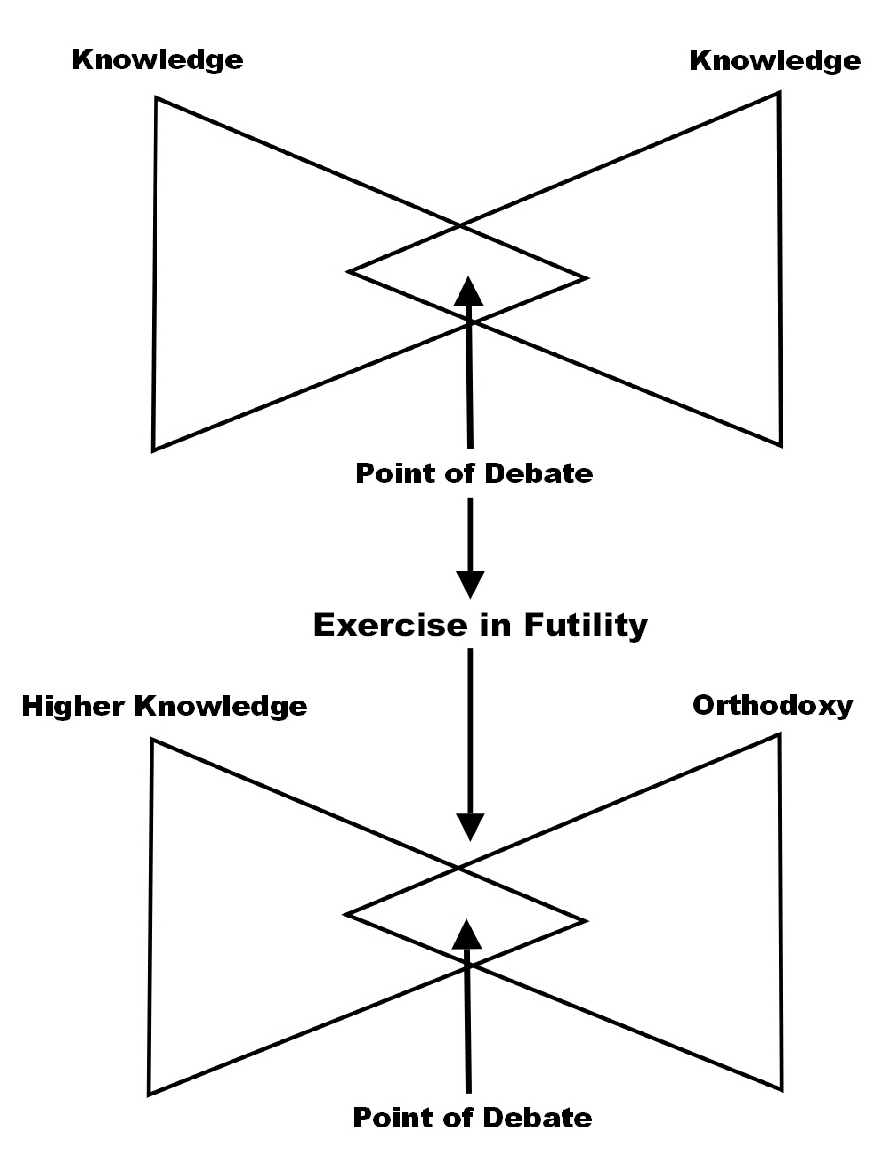
Not much ambiguity in that statement. Pretty clear on its face except for how one would apply it to real life. Again, many might scratch their head in regard to that statement, but proceed to let the theological orthodoxy that flows from it shape their life and thinking. At the point of debate with such people, their orthodoxed talking points will reflect the metaphysical premise. They will absolutely not be swayed in their thinking because they concede that they cannot understand the higher knowledge, and the authority of the higher knowledge is part of the orthodoxy.
Pause: I used to be involved in a ministry that evangelized Jehovah Witnesses. Debating the Bible with them led nowhere because their orthodoxy reinterprets all biblical terms and phraseology. When Christ is referred to, it is assumed that their presuppositions regarding Christ are the same, and they are not. Instead, we challenged their orthodoxy, i.e., the Watchtower publication. Likewise, let me reveal a concluding theme of this study: never debate the Bible with a Protestant; instead, bring their authority into question. Refuse to discuss anything else for it will be futile for reasons yet to be examined.
Let’s look at another statement from the New Covenant Theology camp:
At this time, resist the temptation to utilize subsequent passages to validate the meaning or to move out from the immediate context. Remembering that all exegesis must finally be a Christocentric exegesis.
Look for Christ even if He isn’t there directly. It is better to see Christ in a text even if He isn’t, than to miss Him where He is (The Biblical Theological Study Center: A Christo-Presuppositional Approach to the Entire Scriptures; Max Strange. Online source: http://goo.gl/5sGjP).
The question quickly becomes, “How can you see Jesus in every verse in the Bible?” This is where the Bible becomes a “meta-narrative.” That can mean, “grand narrative,” but in this case it means “metaphysical narrative.” The Bible is a narrative, or story that depicts redemptive reality. You will get confused unless you understand that the theory also posits the inclusion of multi-purpose perspectives into the metaphysical story (a story that depicts true reality). The text grammar doesn’t determine the perspective resulting in a particular objective outcome, but the assumed outcome determines the perspective. So, can “passages talking about incestuous rape” say something about redemption? Of course. In this example, the passage is not talking about Jesus specifically, but denotes why His redemptive works are needed. In some way, according to the prism, the verse always speaks of Jesus and His redemptive works.
This approach to interpreting reality (state of being, or metaphysics), what we call epistemology, plugs into the basic ancient philosophy of total inability. This proffers the idea that man cannot know or comprehend reality. The metaphysic follows: man dwells in a realm apart from true reality that he cannot comprehend. Secondly, somehow, usually via a theory of predeterminism, there are a select few that can ascertain truths from the other realm. Usually, the delineation of the realms is the material versus invisible with mankind residing in the material realm.
The Reformers recognized a reality that man functions in, but deemed it “subjective,” or shadowy. Focusing on this shadowy realm leads to despair. In the aforementioned foundational document of Protestantism, Luther contended that man’s material realm only feeds “the glory story,” or the story of man.
In Luther’s construct, ALL reality is interpreted through two stories: the glory story (the story of man), and the cross story (the story of redemption). Giving any credence to the material world or the belief that man can know the material world empirically only contributes to the story of man and his glory. Yes, man functions in this world, but it does not possess any objective wisdom that can bring true well being. Only an ever-clearer understanding of the cross story can bring well being.
What then is the cross story specifically? It is twofold: it is the holiness of God as set against the sinfulness of man. This is the only objective truth and reality that can bring well being. The goal is a deeper and deeper understanding of how inept we are in every category of life as set against the glory and holiness of God.
Pause for main point: according to this philosophy, the sole purpose of the Bible is to lead us in seeing the cross story with more and more clarity. To the extent that we do that, we will have well being. AND, to the extent that each individual lives according to the cross story, the well being of society as a whole will increase. When Reformed folks talk about “transforming society with the gospel,” this is exactly what they are talking about. To the extent that the populous embraces the doctrine of inability, society will be transformed.
One reason for lauding this epistemology is unified agreement on interpretation. If every verse is about Jesus, there is no division in opinions. Secondly on this point, it gives Christianity a pass on defending inerrancy; e.g., narratives are not meant to be technical systems of theology that require consistency in logic. Thirdly on this point, if some sort of Christocentric conclusion is drawn from the text—it can’t be wrong. If the interpretation of the text somehow demeans man and exalts God, error is impossible.
Before we address the grammatical-historical approach to interpreting reality, let me add some thoughts to the redemptive-historical perspective. This perspective now dominates the institutional church. Just yesterday, I participated in a conversation on a social media site in which the following statement was made about Proverbs chapter 8:
The Old Testament reveals shadows of what Jesus Christ will be in the New Covenant. I can easily say that wisdom personified in Proverbs 8 is Jesus Christ.
If one reads Proverbs 8, the assertion that it is about Christ is beyond presumptuous at best. It is a complete rejection of the plain sense of the grammar; even in lieu of the personification being in the female gender.
Also, these two perspectives on reality are a salvific issue with the Reformed. A denial of total inability equates with the grammatical-historical view of reality which is supposedly an attempt by man to glorify himself by writing his own story. By believing that you can understand reality, you are in essence making yourself God.
The most common question is the issue of biblical imperatives that are clearly directed at mankind. This assumes that man is able to obey because grammatically, the commands are directed at him with a demand for obedience. But again, addressing these commands with the presupposition of total inability that equates with the redemptive-historical prism, the commands are supposedly meant to deliberately frustrate man and “drive him to despair of self-righteousness.”
The Reformed continually concede that the Bible states things in grammatical form, but that is always followed with the proper “gospel context” according to the redemptive-historical interpretation of reality. The classic example is this quotation from Neo-Calvinist Paul David Tripp:
….and the Bible does call us to change the way we think about things. But this approach again omits the person and work of Christ as Savior. Instead, it reduces our relationship to Christ to “think his thoughts” and “act the way Jesus would act.” (How People Change 2006, p.27).
Notice that Tripp concedes that the Bible calls us to do things according to the grammatical context, but goes on to say that is a denial of the gospel (omits the work of Christ as savior). On page 26 of the same book, Tripp calls obedience to the word of God a “behavioral approach” that “separates the commands of Scripture from their Christ-centered gospel context.”
Lastly before we move on, when one is able to wrap their minds around the redemptive-historical approach to interpreting reality, it will be recognized that this approach now saturates the Protestant institutional church.
What is the grammatical-historical approach to interpreting reality? As with the other prism, I am not going to elaborate on the “historical” part except to say that the redemptive-historical hermeneutic makes history part of the prewritten gospel narrative. History is simply the redemptive story playing out as scripted by God.
The political commentator Rush Limbaugh often notes that “words mean things.” This is a good working definition of grammatical-historical interpretation; it draws conclusions from a technical evaluation of the words in a sentence whether spoken or written. The many categories of language that give meaning are considered also, which speaks to the “historical” part of the term. Does the sentence mean the same thing today that it meant then? For instance a sentence written in 1940 might say, “Bob is gay.” History informs us of the meaning in that day: Bob is happy. Today that means Bob is a homosexual. The etymology of words and many other factors weigh-in, but all have this in common: they are empirical tools.
This interpretive method also assumes mankind is able to comprehend the realty he dwells in according to empirical observation and can draw conclusions on his own. Man has ability.
Pause: how did Luther get away with denying that mankind had any kind of ability at all? He chalked-it-up to man’s self-perceived ability that can accomplish things in the material world. These accomplishments are of no worth and only accomplish one thing and one thing only: they serve man’s lust to glorify himself. Luther believed that satisfaction from accomplishment was nothing more than sinful pride. To Luther, the only redeeming thing about the world was that heaven manifested its works on earth according to God’s sovereign will. If man lives life subjectively and professes that his evil “good” works cannot be distinguished from heavenly manifestations “experienced subjectively,” that is venial sin that can be forgiven. In accordance with authentic Reformed tradition, Luther believed the following: the belief that any man, including Christians, can perform a good work is mortal sin.
Therefore, the Reformed often define wisdom/knowledge according to two categories: “worldly knowledge” and “wisdom from above.” Sure, man can obtain worldly knowledge that improves his circumstances, but it is all prideful according to Luther. Wouldn’t this approach propagate a lot of death and misery due to a lack of science? Yes, but that was exactly Luther’s point. Many are perplexed by the embracing of ideologies that result in third world cultures, but those who are perplexed make the point for those in the other camp: what is the perplexity of the detractors? Answer: they are perplexed that other people do not lust after materialism as they do. Hence, third world cultures are often seen as being virtuous by the Reformed.
This is why Luther introduced suffering as a hermeneutic that interprets reality. There is true wisdom in the cross story because according to Luther, “all wisdom is hidden in suffering.” According to Luther, many reject this interpretation of reality and dub it the “foolishness of the cross.” Luther also stated that men call the good evil (suffering), and evil good (anything that prevents suffering). This is why Luther called reason an “ugly whore who should have dung rubbed in her face.”
The grammatical-historical perspective of reality assumes man can interpret his own reality, and the material world is not inherently evil. Believers and unbelievers share common realities that are simply practical and not evil.
Here is the challenge: to bring biblical knowledge to bear on grammatical-historical reality when the prevailing view of Protestantism has been the redemptive prism for hundreds of years.
But there is good news as well: the grammatical prism is what man utilizes intuitively. People assume they can interpret their own reality. Of course, the Reformed see this as the very problem.
Does this mean that grammatical-historical Christians should evangelize the lost world and forgo debate with Protestants? Yes it does, because it is a futile endeavor. You are trying to reach people who define reality itself differently. Protestants are redemptive-historical religionists.

Acts Lesson 66

Tuesday Night Bible Study – LIVE on Blogtalk Radio!
Lesson 66 – November 24, 2015 (click here to listen)
Join us each Tuesday night at 7:00 PM as the host, Andy Young, leads a verse by verse exegetical study of the Book of Acts.
Paul and company have escaped safely to the island of Melita where Paul demonstrates the power of the name of Jesus that is able to save a man from his sin as well as heal the sick.
Tonight’s Text – Acts 28:1-15
The Interpretation of Reality and the Calvinist Swamis

Swami Albert Mohler at 2011 FBC Conference: pastors are “God-appointed agents to save God’s people from ignorance.”
The fact of the matter follows when you boil it down to the least common denominator: the Protestant Reformation was a quarrel about how one should interpret reality. In other words, sola scriptura is pure propaganda. Especially in our present day, preaching for the most part uses Scripture to promote a certain view of reality. The specific studies on this are the historical-redemptive hermeneutic and what is known as Biblical Theology. These terms are egregiously misleading. Instead of the Bible being used to develop a theology with a historical-grammatical view of reality assumed, the Bible is used as a mere tool for aiding one in interpreting reality as a story, or metaphysical narrative written by a god or plethora of gods.
The concept finds its roots in good old fashioned mythology. One should not think of mythology as rank superstition; to the contrary, mythological narratives are stories written by “gifted” spiritual leaders who understand spiritual truth that the populous at large are not able to understand. The gifted leaders package these truths in bedtime stories that the totally depraved masses can understand for purposes of life application. In Protestant context, we know it as orthodoxy and “subordinate truth.” One example would be the Westminster Confession which was penned by the “Westminster Divines.”1 Ponder that one for awhile if you think words mean things.
The foundation and historical progression is not hard to follow.2 It began in the garden when the serpent attempted to present himself as a mediator between people and God. The case presented to Eve follows: there are things about God that you can’t understand, but because I am a superior being, I can guide you in them to make you more like God. At issue from the very beginning was additional mediators between mankind and God. The serpent suggested that the direct relationship between God and mankind was lacking. This is the lie that forms the foundation of all false religions. Instead of mankind at large having initial and ongoing direct access to God at all times, false teachers make the case that they are the gateway to God or some kind of utopia.
Almost immediately after the garden, the religion of spiritual caste was off and running. More than likely, Hinduism was the first formal religion of spiritual hierarchy. True salvation is a body with one head—Christ. Because we are literally born of God into His literal family, we love God and are new creatures who think like Him, and have the same mind of His Son, Christ. Unity comes from having the same mind in Christ, and coming to agreement on such.3 If there is only one mind, and there is disagreement, obviously everybody must agree that someone is right and someone is wrong. However, Scripture instructs us to leave room for the members to be convinced in their own minds and according to the development of a biblical conscience.4 Of course, this would exclude the gospel of first order that cannot be compromised.5
In spiritual caste, an elite class understands reality while the masses are unable. This is usually divided between the material and the invisible as two different realities. Fundamentally, the material is evil and the invisible is good. One may suspect that the incarnation of Christ was a direct pushback to that idea. And of course, if the elite know what’s best for the great unwashed, for the best possible well-being of humanity in general, they must rule over those enslaved to interpreting reality through their five senses. This is where authority comes in; supposedly, for the sake of mankind. So, let’s review the primary tenets of most religions:
- Two realities divided by truth versus illusion.
- Mediators between truth and illusion.
- The mediators should have authority for the sake of humanity.
Usually, the invisible realm is represented by virtue or some sort of deity. Mediators are the elitists in the caste system. They can be visiting deities, or those specially gifted in the material realm. And because they are part of the material realm, they are subject to it, but not to the degree that the ungifted are so…do what they say, not what they do. It’s primarily a gift of perception; because they can see things that the common man cannot see. They create understandable teachings that will best serve man in the material realm.
In most of these caste religions, predeterminism is the centerpiece. This is because in the vast majority of these caste religions, reality is a story orchestrated by the truth realm, or invisible realm. And all stories have an author. If reality is a story, the story must have an author. And if reality has an author, of course everything is predetermined by the author—this is unavoidable. So if redemption is a story as academics of the Reformed tradition constantly state as if in a manner of speaking, of course every detail of reality is predetermined because reality is a story, and all stories have an author. In addition, it may be noted that determinism and fatalism are the historical norm in general, and Protestantism is just another player in the same old song and dance.
The progression of caste started in the garden, found its first formality in Hinduism, was passed on to Plato when he studied in India, became Gnosticism, and later dictated the basic principles of the Protestant Reformation. Augustine’s City of God is a remodeled version of Plato’s Republic and Martin Luther, as well as John Calvin, were rabid followers of Augustine. Luther was a friar in the Augustinian Order, and Calvin quotes Augustine more than 400 times in the Calvin Institutes of the Christian Religion. In some translations of the Institutes, that’s an average of every 2.5 pages.
In the final analysis therefore, the Reformers, especially Martin Luther, made the gospel a metaphysical story that interprets all of reality. When you go to see a movie at your local theater, you are a character in the movie watching a movie. The movie you are in was prewritten by God like all movies are prewritten by an author. Therefore, in some sense, saving faith is seeing yourself in God’s plot which is totally out of your control and would exclude all freewill. If you have any freewill at all, you are trying to write your own reality; you are writing your own story; you are trying to be your own god. In fact, this is the very primary theses of the founding doctrinal statement of the Protestant Reformation: Martin Luther’s Heidelberg Disputation to the Augustinian Order. In that founding document presented to the Order six months after the 95 Theses, Luther presented reality in two parts: the cross story and the story of man. According to Luther a theologian is either a theologian of the cross, or a theologian of glory (the glory of man rather than God).
Presently in the Protestant evangelical church, the idea of Christianity being a story dominates church media. Consider the following citation by the contemporary father of historical-redemptive hermeneutics and Biblical Theology:
If the story is true, Jesus Christ is the interpretative key to every fact in the universe and, of course, the Bible is one such fact. He is thus the hermeneutic principle that applies first to the Bible as the ground for understanding, and also to the whole of reality.6
Similar quotations among evangelicals in our day are myriad. The Bible is merely a prototype of redemptive reality that describes generalities, or prisms of redemptive reality in which we see our own lives. Our own lives are part of the story, and we are to interpret our lives through the redemptive reality described in the Bible. The Bible describes the redemptive reality of the past (other lives as interpretive prisms/examples) and the future (how the story will end), and we are experiencing the present redemptive reality IF we have “entered into the plot”7 or entered the “Divine drama.”8 This is little less than the Hindu Lila.
The basic recurring theme in Hindu mythology is the creation of the world by the self-sacrifice of God—”sacrifice” in the original sense of “making sacred”—whereby God becomes the world which, in the end, becomes again God. This creative activity of the Divine is called lila, the play of God, and the world is seen as the stage of the divine play. Like most of Hindu mythology, the myth of lila has a strong magical flavour. Brahman is the great magician who transforms himself into the world and then performs this feat with his “magic creative power”, which is the original meaning of maya in the Rig Veda. The word maya—one of the most important terms in Indian philosophy—has changed its meaning over the centuries. From the might, or power, of the divine actor and magician, it came to signify the psychological state of anybody under the spell of the magic play. As long as we confuse the myriad forms of the divine lila with reality, without perceiving the unity of Brahman underlying all these forms, we are under the spell of maya. (…) In the Hindu view of nature, then, all forms are relative, fluid and ever-changing maya, conjured up by the great magician of the divine play. The world of maya changes continuously, because the divine lila is a rhythmic, dynamic play. The dynamic force of the play is karma, an important concept of Indian thought. Karma means “action”. It is the active principle of the play, the total universe in action, where everything is dynamically connected with everything else. In the words of the Gita Karma is the force of creation, wherefrom all things have their life.9
And of course, if reality is a story with an author, hard determinism is the order of the day; stories do not write themselves, nor do the characters in the story have freewill to write the story. Consequently, the notion that Calvinists derive their theology from the Bible rather than metaphysics is a misnomer, and in many cases outright deceptive. The Reformed tradition is really the same worn out deterministic mythology that has always dominated world philosophy and wreaked havoc on historical experience from the very beginning. And invariably, converts to Protestantism in the Reformed tradition will mutate from freewill, to soft determinism, and finally hard determinism. Or from “Pelagianism,” to “Semi-Pelagianism,” to “orthodoxy.”
Karma is the infant stage of Hinduism where saints believe they are responsible for their own actions, but as growth moves forward, the mature saint…
“[…] becomes convinced that God has been doing everything by using his body, mind, energy and the senses. He feels that he is only an instrument in the hands of God, and whatever God has been doing to him is for his ultimate spiritual good. At this high level of spirituality the doctrine of predestination becomes the only valid doctrine to him. To him the doctrine of karma ceases to be a valid doctrine.
Therefore, these two doctrines, even though apparently contradictory to each other, are valid for people at different stages of spiritual growth.”10
In regard to practical application, the parallels become even more vivid. The trichotomy of soul and society in Hinduism and Platonism are identical, and the same principles are mirrored in Gnosticism and Calvinism as well. The soul of each person is threefold, and predetermined by God or some other force/deity. In each person, there is the spiritual, intellectual, and instinctive. However, each person will be dominated by one of these characteristics, and society benefits to the degree that each person lives according to the predetermined dominant aspect of their souls. This is the basis for caste systems, and usually coincides with lineage. In other words, you are expected to stay within the social strata determined by birth for the good of society at large. This is jumping ahead a little, but this idea had deep roots in Puritan beliefs who were theological descendants of Calvin. To not remain in the social strata you were born into was thought to be a violation of the 5th commandment according to the Puritans—it was dishonoring your parents.11
The theory also coincides with the two realities of material and invisible, the material being evil and the invisible being truth. The spiritual are the mediators who are able to see beyond the material while the intellectuals are wise enough to know that the mediators should be trusted. They have a special love for the truth, so they love the mediators as well. Those who have souls dominated by instinct are enslaved to the material world and their five senses. To insert another connection somewhat prematurely, the Puritan Jonathan Edwards believed that salvation required a sixth sense in order to see the kingdom of God. In other words, the five senses that evaluate the material world were all but useless for salvation.12 This sixth sense, according to Edwards, is experienced by “delightful conviction” and “inward, sweet delight in God and divine things.” Well known pastor and Puritan wannabe John Piper borrowed these ideas from Edwards to form his Christian Hedonism movement.
In regard to Plato and the aforementioned metaphysical trichotomy, this is the philosopher king, warrior, and producer classes. This coincides with the Hindu Bhramin, Kshatryia/Vaishya, and Sudra/Untouchables. And, John Calvin had his own construct communicated via his election doctrine with more of a Gnostic flavor. Unbeknownst to most people who actually call themselves “Calvinists,” John Calvin propagated three classes of elect: the elect of the elect (those who persevere, the “P” in TULIP), the temporary elect (the called who do not persevere), and the non-elect. This coincides with Gnosticism as follows:
Calvinism derived its 3 classes ultimately from the 3 classes in Valentinian Gnosticism (see Ireneaus’ five books Against Heresies):
1. Pneumatics (spirituals) – The elect of the elect.
2. Psuchics (soulys) – The average elect.
3. Hylics (carnals) – The non-elect.
Meaning, the Hylics have no chance. As for the Psuchics, they are (as you put it) “entered into the race” but not given “the gift of perseverance.” And the Pneumatics, of course, are elect to the uttermost, meaning nothing they do can damn them.
In Gnosticism, this is natural selection, or election by nature according to Clement of Alexandria in Stromata: 2. 3. More specific definitions follow:
In the gnostic view, hylics, also called Somatics (from Gk σώμα (sōma) “body”), were the lowest order of the three types of human. The other two were the psychics and the pneumatics (from Gk πνεύμα (pneuma) “spirit, breath”). So humanity comprised matter-bound beings, matter-dwelling spirits and the matter-free or immaterial, souls.
Somatics were deemed completely bound to matter. Matter, the material world, was seen as “evil” in the gnostic world view. The material world was created by a demiurge, in some instances a blind, mad God, in others an army of rebellious angels as a trap for the spiritual Ennoia. The duty of (spiritual) man was to escape the material world by the aid of the hidden knowledge (gnosis). *
The pneumatics (“spiritual”, from Greek πνεῦμα, “spirit”) were, in Gnosticism, the highest order of humans, the other two orders being psychics and hylics. A pneumatic saw itself as escaping the doom of the material world via the transcendent knowledge of Sophia’s Divine Spark within the soul.†
They conceive, then, of three kinds of men, spiritual, material, and animal . . . The material goes, as a matter of course, into corruption. The animal, if it make choice of the better part, finds repose in the intermediate place; but if the worse, it too shall pass into destruction. But they assert that the spiritual principles which have been sown by Achamoth, being disciplined and nourished here from that time until now in righteous souls (because when given forth by her they were yet but weak), at last attaining to perfection, shall be given as brides to the angels of the Saviour, while their animal souls of necessity rest for ever with the Demiurge in the intermediate place. And again subdividing the animal souls themselves, they say that some are by nature good, and others by nature evil. The good are those who become capable of receiving the [spiritual] seed [and becoming pneumatic]; the evil by nature are those who are never able to receive that seed [and become hylic].—Irenaeus, Adv. Haer. I. 7, 513
Calvin held to these same three types of categories except the determinism is by God rather than nature. For Calvin, it is the non-elect, the elect, and those of the elect that are gifted with perseverance:
In fine, we are sufficiently taught by experience itself, that calling and faith are of little value without perseverance, which, however, is not the gift of all (CI 3.24.6)
The expression of our Savior, “Many are called, but few are chosen,” (Mt. 22:14), is also very improperly interpreted (see Book 3, chap. 2, sec. 11, 12). There will be no ambiguity in it, if we attend to what our former remarks ought to have made clear—viz. that there are two species of calling: for there is an universal call, by which God, through the external preaching of the word, invites all men alike, even those for whom he designs the call to be a savor of death, and the ground of a severer condemnation. Besides this there is a special call which, for the most part, God bestows on believers only, when by the internal illumination of the Spirit he causes the word preached to take deep root in their hearts. Sometimes, however, he communicates it also to those whom he enlightens only for a time, and whom afterwards, in just punishment for their ingratitude, he abandons and smites with greater blindness (CI 3.24.8).14
Calvinism is nothing new; it’s the same worn out ancient mythological song and dance foisted on the Bible. Many preaching in Protestant temples in our day think that it all comes from the Bible because Protestant academics told them such. We call that “orthodoxy.” It is mythology’s noble lie of metaphysical bedtime stories for serfs. Sunday church is hosted by two kinds of pastors: those who think orthodoxy actually came from the Bible and therefore think they are teaching the Bible, and those who know what’s really going on. The former is sad enough, but those who sit under the latter are paying good money to be perceived as useful idiots.
_______________________________________________________________________
1 https://en.wikipedia.org/wiki/Westminster_Assembly
2 Historical progression will be documented in detail: TTANC volume 3
3 Phil 2:2, 2:5-8, 1Cor 1:10, 2:15
4 Romans 14
5 1Cor 15:1-4
6 Graeme Goldsworthy: Gospel-Centered Hermeneutics; p.48
7 Paul David Tripp: How People Change
9 https://en.wikipedia.org/wiki/Lila_(Hinduism) Frijof Capra, The Tao of Physics (1975)
10 Swami Bhaskarananda: Chapters 9-11 The Essentials of Hinduism; Predestination
11 https://paulspassingthoughts.com/2012/10/04/reformed-caste-system-the-puritans-saw-violation-of-caste-as-equal-to-violation-of-the-5th-commandment/
12 https://paulspassingthoughts.com/2015-tanc-conference-on-gospel-discernment-and-spiritual-tyranny/susan-dohse-sessions-1-3-jonathan-edwards-the-man-the-myth-the-message/
13 https://paulspassingthoughts.com/2014/01/30/predestination-and-the-gnostic-connection/
14 https://paulspassingthoughts.com/2014/01/30/predestination-and-the-gnostic-connection/
TANC 2015, John Immel, Session 1: Examining the Historical Perspectives and Evolution of Determinism






The Problem With Protestant Election
 Listen to the program or download audio file.
Welcome truth lovers to Blog Talk radio .com/False Reformation, this is your host Paul Dohse. Tonight, another Paul Dohse parenthesis in our Heidelberg Disputation series, “The Problem With Protestant Election.”
Greetings from the Potters House and TANC ministries where we are always eager to serve all of your heterodox needs. Our teaching catalog can be found at tancpublishing.com.
If you would like to add to our lesson or ask a question, call (347) 855-8317. Remember to turn your PC volume down to prevent feedback over your cellphone. If you choose to use Skype to listen to the show, my advice is to just dial direct from your Skype account without using any of the Blogtalk links. It’s the same number, 347-855-8317.
Per the usual, we will check in with Susan towards the end of the show and listen to her perspective.
Remember, you may remain anonymous. When I say, “This is your host; you are on the air, what’s your comment or question”—just start talking.
If you would like to comment on our subject tonight, you can also email me at paul@ttanc.com. That’s Paul @ Tom, Tony, Alice, Nancy, cat .com. I have my email monitor right here and can add your thoughts to the lesson without need for you to call in. You can post a question as well.
Before we get started tonight, I must implement our new policy here at False Reformation. I think as recovering Protestants, we must embrace our fears and failures. One example is the sin minefield. Whenever disciples endeavor to embark on some new project, deep introspection ensues. Could the project cause us to sin? Pray tell, what are our true motives? And overall, we deem it our duty to recognize the major weaknesses of the other disciples, and for me, that is, “going off on rabbit trails all the time.”
Therefore, as a recovering Protestant, I have decided to embrace this failure as one no longer under condemnation. Yes, whenever I go down a rabbit trail, I want to make it a memorial of remembrance that I am not condemned for going down that rabbit trail. Hence, from now on, just prior to going down a rabbit trail in this show, the rabbit trail will be introduced with the following song:
So basically, when you hear an excerpt of that song on the program, you know that it is a rabbit trail coming. The upbeat introduction is also a remembrance that I need not seek forgiveness for the rabbit trail least I be condemned. Ahmen.
What is the major problem with the Protestant view of election? It is tenfold. First, as thoroughly documented by TANC ministries, the Protestant Reformation is dead wrong on salvation. The second point exacerbates the problem: all positions on election come from Protestantism, and all positions are framed by Protestant scholars. In other words, Protestant academia controls the context in which the issue is debated. Think about the insanity of this: all arguments about election start with a Protestant context; the so-called 5 points of Calvinism. In the same way that a “Band-Aid” viz, a brand defines what something is, Protestants of the authentic Reformed tradition have completely co-opted the context and framework of the argument which virtually guarantees the outcome that they want; either capitulation, or confusion which only bolsters their worldview that mankind cannot comprehend reality.
Thirdly, while there are many verses in the Bible that seem to indicate an individual preselection for salvation and damnation, there are also many that indicate that mankind is able to choose or reject salvation. There is obviously a contradiction which is written off as paradox, BUT, with one side of the paradox being the engine of existence. What am I saying here? They claim paradox, but only one side of the paradox is applicable—the sovereign side.
Fourthly, Protestantism deliberately uses a process of assimilation based on allowing the saints to assume things about orthodoxy at its progressive points. As the saints are gradually assimilated into full blown Platonism dressed in biblical garb, they are allowed to assume that “faith alone” does not include sanctification, and that “total depravity” does not include the saints, and that God does not preselect people for eternal damnation. This is a 500 year-old system of assimilation that is evil genius. And they know exactly what they are doing. How do they condone it? Well, we must not teach things that the great unwashed masses are not yet “ready for.” Nevertheless, in the same way that pot leads to harder drugs, hardcore Protestant Platonists invariably move from a grudging soft determinism to soft determinism, ie., so-called 3 or 4 point Calvinism, but eventually become advocates of hard determinism.
Fifthly, we are allowing a religion that continually produces bad fruit to dictate the confines of the debate and define the interpretive terms and words. Protestant orthodoxy has effectively defined all of the biblical terms in which our reality is interpreted, and be sure of it, those who effectively define the definition of words control reality. We have allowed a religion that continually produces rotten fruit to co-opt the grammar. That’s a really, really bad idea.
Sixth, a casual reading of Scripture is tortured because of the overall biblical dialogue found by independent reading. If God preselects some for salvation and others for damnation for his glory and self-love, why do we have Christ weeping over Jerusalem, why do we have God saying, “come let us reason together saith the Lord,” why do we have the apostle Paul expending all kinds of energy to “persuade” people in regard to the gospel? If individual determinism is true, the Bible makes NO sense whatsoever. Let’s look at a specific example of this:
Luke 16:19 – “There was a rich man who was clothed in purple and fine linen and who feasted sumptuously every day. 20 And at his gate was laid a poor man named Lazarus, covered with sores, 21 who desired to be fed with what fell from the rich man’s table. Moreover, even the dogs came and licked his sores. 22 The poor man died and was carried by the angels to Abraham’s side. The rich man also died and was buried,23 and in Hades, being in torment, he lifted up his eyes and saw Abraham far off and Lazarus at his side. 24 And he called out, ‘Father Abraham, have mercy on me, and send Lazarus to dip the end of his finger in water and cool my tongue, for I am in anguish in this flame.’ 25 But Abraham said, ‘Child, remember that you in your lifetime received your good things, and Lazarus in like manner bad things; but now he is comforted here, and you are in anguish. 26 And besides all this, between us and you a great chasm has been fixed, in order that those who would pass from here to you may not be able, and none may cross from there to us.’ 27 And he said, ‘Then I beg you, father, to send him to my father’s house— 28 for I have five brothers—so that he may warn them, lest they also come into this place of torment.’ 29 But Abraham said, ‘They have Moses and the Prophets; let them hear them.’ 30 And he said, ‘No,father Abraham, but if someone goes to them from the dead, they will repent.’ 31 He said to him, ‘If they do not hear Moses and the Prophets, neither will they be convinced if someone should rise from the dead.’”
Ok, so, the guy asks Abraham to send Lazarus over to give him relief from his suffering, and Abraham’s answer includes nothing about preselection; why not? If the guy is over there suffering for God’s glory, what’s all of this other discussion about? And why do they discuss the best means of persuasion? If the point is preselection, how people might be best persuaded is certainly a mute point, no? What is problematic is the Bible’s constant passing on making the preselection angle the main point when such opportunities appear over and over again throughout the Bible. Let’s look at another example. Matthew 26:24.
The Son of Man goes as it is written of him, but woe to that man by whom the Son of Man is betrayed! It would have been better for that man if he had not been born.”
Well, doesn’t God always want what’s best? Consider this verse in context of what love is via 1Corinthians chapter 13. Love ALWAYS seeks what’s best for others. Bottom line: if preselection is true, the Bible is nothing more than a convoluted quagmire of confusion. But God is NOT a God of confusion.
Here is another thought. The Reformed love to talk about the potter and the clay deal in Romans 9. The potter has a right to make some vessels for wrath and others for salvation and He is glorified by both. But then there is this also…
2Timothy 2:20 – Now in a great house there are not only vessels of gold and silver but also of wood and clay, some for honorable use, some for dishonorable. 21 Therefore, if anyone cleanses himself from what is dishonorable, he will be a vessel for honorable use, set apart as holy, useful to the master of the house, ready for every good work. 22 So flee youthful passions and pursue righteousness, faith, love, and peace, along with those who call on the Lord from a pure heart. 23 Have nothing to do with foolish, ignorant controversies; you know that they breed quarrels.
Here, what kind of vessel you are is determined by “cleansing” yourself. We will not be discussing Romans 9 tonight, but it will be covered in a series of articles I am presently writing.
Seventh, Biblicism rejects plenary paradox as an interpretive method because of interpretive presuppositions demanded by Scripture itself: God is NOT a God of confusion. Though paradox is a biblical reality, it is rare, and always suspect. It is guilty until proven innocent.
Eighth, individual HOPE is an acid test for truth. If something lacks individual assurance or hope, it is extremely suspect. And regardless of Protestant squealing of denial in epic volume, the engine of its progressive salvation is predicated on the so-called Christian being under a greater awareness of condemnation and fear—not a soteriology that escapes the terrible-two.
Ninth, because of the way the Bible is written, Protestant paradox demands an inconsistent method of interpretation. In some verses paradox is employed while in others grammar is employed without any determinate principle whatsoever except orthodox presuppositions. In other words, interpretive methodology demanded by the context is ignored and exchanged for orthodoxy. I suppose the classic example of this is Romans 8:2 where the same word for “law” used twice in that verse is interpreted both as a written standard and a realm. Once you break an interpretive rule of that sort, anything goes; you can interpret the Bible any way you want to.
Lastly, the injection of chapters and verses into the Bible by the Protestant Reformers has made it possible to proof-text orthodoxy without considering the corpus of Scripture. Furthermore, it suits preaching and not the necessity of reading the corpus without elements being emphasized through a numbering system. It is incredible to consider that chapters and verses were deemed unnecessary until the 16th century. It should not only seem suspect, it should be deemed such. Chapters and verses make it possible to sell a doctrine with a collection of biblical one-liners.
Therefore, an alternative to the traditional view of election must be sought, and the traditional definition of the words used to discuss this issue must be traded for their biblical assessment.
Indeed, there are many verses in the Bible that seem to indicate that people are preselected for salvation; after all, the word “elect” is in the Bible, but there are just as many or more verses that seem to indicate people are able to believe or reject the gospel. You can understand why we are still at a stalemate 500 years later. But again, is this because we are constrained by Protestant rules of engagement? Unfortunately, for the most part, logic enters in based on subjective criteria rather than conclusions drawn from the objective definition of words. And again, if one buys into the paradox argument, they are merely on their way to being full-blown predeterminists.
Before we get into the meat of our study, let’s serve up a few appetizers. First, the word “elect” or often translated “chosen” does not always apply to people who need salvation or people at all for that matter. The word “election” sometimes applies to deity, ie., Christ, or the holy angels, or a thing such as the nation of Israel. The nation Israel spoken of as being elect is a major Old Testament theme.* Not only that, in Romans 11:2, Israel is spoken of in the exact same way that elected individuals are spoken of in Romans 8:29. This should alert us that something is up with all of this.
Secondly, the definition of “called” creates critical problems for the 5 points of Calvinism (TULIP) with the other points attempting to cover for the one fundamental flaw. Again, this has to do with the definition of “called.” God calls all people because Christ died for everybody. In the minds of the Reformers, if God preselected some for salvation and others for damnation, He could not have possibly died for the sins of the damned. If He died for their sins, they are forgiven, and only need to accept the pardon. If Christ died for all sin, this suggests a choosing by men rather than God. Hence, the Reformed called for a limited atonement (the “L” in TULIP) effected by an “effectual calling” (Irresistible grace [the “I” in TULIP]).
Herein is the problem: Christ died to end the law, and how many people are under the law? Right, everyone. So, Romans 10:4 alone completely blows up the leading authority on predeterminism; the 5 points of Calvinism. Or…
Colossians 2:11 – In him also you were circumcised with a circumcision made without hands, by putting off the body of the flesh, by the circumcision of Christ, 12 having been buried with him in baptism, in which you were also raised with him through faith in the powerful working of God,who raised him from the dead. 13 And you, who were dead in your trespasses and the uncircumcision of your flesh, God made alive together with him, having forgiven us all our trespasses, 14 by canceling the record of debt that stood against us with its legal demands. This he set aside, nailing it to the cross. 15 He disarmed the rulers and authorities and put them to open shame, by triumphing over them in him.
Instead of Christ dying for everyone, which throws a large monkey wrench into the 5 points of Calvinism, the Reformed merely keep the so-called “saints” under the law and its “legal demands.” This takes care of the problem of the law being ended because everyone remains under it while those who are preselected receive a perpetual forgiveness from Christ for their ongoing sin. This makes limited atonement possible. According to the Synod of Dort and the Canons of Dort in 1618 and 1619 which codified the 5 points of Calvinism:
For it was the entirely free plan and very gracious will and intention of God the Father that the enlivening and saving effectiveness of his Son’s costly death should work itself out in all his chosen ones, in order that he might grant justifying faith to them only and thereby lead them without fail to salvation. In other words, it was God’s will that Christ through the blood of the cross (by which he confirmed the new covenant) should effectively redeem from every people, tribe, nation, and language all those and only those who were chosen from eternity to salvation and given to him by the Father; that he should grant them faith (which, like the Holy Spirit’s other saving gifts, he acquired for them by his death); that he should cleanse them by his blood from all their sins, both original and actual, whether committed before or after their coming to faith; that he should faithfully preserve them to the very end; and that he should finally present them to himself, a glorious people, without spot or wrinkle. (Christ’s Death and Human Redemption Through It, Article 8)
Here is the point: the leading authority on Protestant election is the 5 points of Calvinism which is plainly wrong and defines the saints as unbelievers according to the biblical definition of under law versus under grace.
Verses that assume choice more or less speak for themselves—let’s examine verses that seem to indicate preselection, and we will start with the book of Ephesians:
1:3 – Blessed be the God and Father of our Lord Jesus Christ, who has blessed us in Christ with every spiritual blessing in the heavenly places, 4 even as he chose us in him before the foundation of the world, that we should be holy and blameless before him. In love 5 he predestined us for adoption as sons through Jesus Christ, according to the purpose of his will, 6 to the praise of his glorious grace, with which he has blessed us in the Beloved. 7 In him we have redemption through his blood, the forgiveness of our trespasses, according to the riches of his grace, 8 which he lavished upon us, in all wisdom and insight 9 making known to us the mystery of his will, according to his purpose, which he set forth in Christ 10 as a plan for the fullness of time, to unite all things in him, things in heaven and things on earth.
11 In him we have obtained an inheritance, having been predestined according to the purpose of him who works all things according to the counsel of his will, 12 so that we who were the first to hope in Christ might be to the praise of his glory. 13 In him you also, when you heard the word of truth, the gospel of your salvation, and believed in him, were sealed with the promised Holy Spirit, 14 who is the guarantee of our inheritance until we acquire possession of it, to the praise of his glory.
Let’s begin by defining who the “we” and the “us” are. In context, it is the Jews. When Paul wrote that “he predestined us for adoption as sons through Jesus Christ, according to the purpose of his will,” he is talking about the predestination of the Jews as a group, not individuals. Hence…
In him we have obtained an inheritance, having been predestined according to the purpose of him who works all things according to the counsel of his will, 12 so that we who were the first to hope in Christ might be to the praise of his glory. 13 In him you also, when you heard the word of truth, the gospel of your salvation, and believed in him, were sealed with the promised Holy Spirit, 14 who is the guarantee of our inheritance until we acquire possession of it, to the praise of his glory.
The first to hope in Christ and obtain an inheritance are the Jews. The “you also” are the Gentiles to whom Paul is writing. Keeping in mind that Christ is elect, note the following:
In love 5 he predestined us for adoption as sons through Jesus Christ, according to the purpose of his will, 6 to the praise of his glorious grace, with which he has blessed us in the Beloved. 7 In him we have redemption through his blood, the forgiveness of our trespasses, according to the riches of his grace, 8 which he lavished upon us, in all wisdom and insight 9 making known to us the mystery of his will, according to his purpose, which he set forth in Christ 10 as a plan for the fullness of time, to unite all things in him, things in heaven and things on earth.
It’s Christ and the plan of salvation that is in Christ, or the “mystery of the gospel”** that is preordained—not individuals. But, how do individuals obtain this “inheritance”?
13 In him you also, when you heard the word of truth, the gospel of your salvation, and believed in him, were sealed with the promised Holy Spirit, 14 who is the guarantee of our inheritance until we acquire possession of it, to the praise of his glory.
“You also” is the Gentiles in general, “when you heard the word of truth, and believed in him” is how the inheritance is obtained: by individual faith. At the time one believes they receive a “guarantee.” This is why Christ is elect, and why Israel is also elect: national Israel is also part of the salvation plan and the mystery of the gospel.
Ephesians 2:11 – Therefore remember that at one time you Gentiles in the flesh, called “the uncircumcision” by what is called the circumcision, which is made in the flesh by hands— 12 remember that you were at that time separated from Christ, alienated from the commonwealth of Israel and strangers to the covenants of promise, having no hope and without God in the world. 13 But now in Christ Jesus you who once were far off have been brought near by the blood of Christ. 14 For he himself is our peace, who has made us both one and has broken down in his flesh the dividing wall of hostility15 by abolishing the law of commandments expressed in ordinances, that he might create in himself one new man in place of the two, so making peace, 16 and might reconcile us both to God in one body through the cross, thereby killing the hostility.17 And he came and preached peace to you who were far off and peace to those who were near. 18 For through him we both have access in one Spirit to the Father. 19 So then you are no longer strangers and aliens, but you are fellow citizens with the saints and members of the household of God, 20 built on the foundation of the apostles and prophets, Christ Jesus himself being the cornerstone, 21 in whom the whole structure, being joined together, grows into a holy temple in the Lord. 22 In him you also are being built together into a dwelling place for God by the Spirit.
Other than the fact that this passage makes being part of the commonwealth of Israel synonymous with salvation, we see that “we both have access in one Spirit to the Father.” This speaks of two groups, not individuals who have access to the father through the Spirit. God’s clear purpose in election was to unite both Jew and Gentile into one body, not the preselection of some individuals over others.
There are many, many other verses we could discuss, but we will close with a couple of tough ones in this whole discussion. First, the dreaded Acts 13:48.
And when the Gentiles heard this, they began rejoicing and glorifying the word of the Lord, and as many as were appointed to eternal life believed.
First of all, as Andy Young aptly pointed out in his Acts series, the context of Acts 13 is a historical account of Romans 11 in full action. Second, many who contend against preselection of individuals quibble about the actual meaning of the word “appointed” or “ordained” in said verse. For example, here is what the late Dave Hunt said about it:
Some claim that the Dead Sea Scrolls, as well as comments from early church writers, indicate
that the first 15 chapters of Acts were probably written first in Hebrew. The Greek would be a
translation… going back to a “redacted Hebrew” version, based upon word-for-word Greek-Hebrew equivalents, would render Acts 13:48 more like “as many as submitted to, needed, or wanted salvation, were saved (Dave Hunt, What Love is This? 3rd Edition, 2006, page 264).
Perhaps, but I think there is a better explanation. Go with me to Romans 13:1ff.
Let every person be subject to the governing authorities. For there is no authority except from God, and those that exist have been instituted by God. 2 Therefore whoever resists the authorities resists what God has appointed, and those who resist will incur judgment. 3 For rulers are not a terror to good conduct, but to bad. Would you have no fear of the one who is in authority? Then do what is good, and you will receive his approval, 4 for he is God’s servant for your good.
See the word, “appointed” in this verse? It is the same word for “appointed” in Acts 13:48. In fact, I believe, if I am not mistaken, these are the only two places in the NT where the word is used in the exact same form (tense, voice, etc., etc.). It is the governmental authorities that are ordained for a specific purpose plainly stated in the context. Now, let me ask you a question: does that mean everyone who works in government didn’t have a choice to do so? Does this mean that everyone who works in government was preselected to do so and had no choice? Or, did their own decision to work in government make them the appointed authority? You see that God appoints the means to an end and not necessarily those who choose to be part of the means. Likewise, as many Gentiles who believed became God’s appointed heirs to the commonwealth of Israel in Christ. That doesn’t mean they had no choice in the matter.
Let’s look at this from yet another angle. If an appointed means necessarily means that all of the individuals that are a part of the means were also preselected, does that mean all government officials were chosen to be such by God? Did God choose Adolf Hitler for your good? That’s the stated purpose for governmental authorities, no?
But thirdly, why are the Reformed so keen on using this verse anyway? By their very doctrine, those who presently believe do not necessarily possess ETERNAL life. If you presently have eternal life, it’s eternal, right? Because of the doctrine of the perseverance of the saints (the “P” in TULIP), the jury is out on whether you get eternal life or not at “the tribunal” as Calvin called it.
In closing, what am I saying here? Am I saying that this proposition is the definitive answer to Protestant determinism? No, so what am I saying? I am saying that the purveyors of a false gospel have dictated the definitions and confines of the debate for 500 years, and the time for an honest discussion is now, and that discussion must be divorced from Protestant orthodoxy found egregiously wanting. I do believe that this proposition, ie., God preselects the means and not individuals, is a good starting point.
With that, let’s go to the phones.
________________________________________________________________
* Deuteronomy 7:6
“For you are a holy people to the LORD your God; the LORD your God has chosen you to be a people for His own possession out of all the peoples who are on the face of the earth.
Exodus 19:4-6
‘You yourselves have seen what I did to the Egyptians, and how I bore you on eagles’ wings, and brought you to Myself. ‘Now then, if you will indeed obey My voice and keep My covenant, then you shall be My own possession among all the peoples, for all the earth is Mine; and you shall be to Me a kingdom of priests and a holy nation.’ These are the words that you shall speak to the sons of Israel.”
Psalms 135:4
For the LORD has chosen Jacob for Himself, Israel for His own possession.
Isaiah 41:8-9
“But you, Israel, My servant, Jacob whom I have chosen, Descendant of Abraham My friend, You whom I have taken from the ends of the earth, And called from its remotest parts And said to you, ‘You are My servant, I have chosen you and not rejected you.
Isaiah 43:10
“You are My witnesses,” declares the LORD, “And My servant whom I have chosen, So that you may know and believe Me And understand that I am He Before Me there was no God formed, And there will be none after Me.
Isaiah 44:1-2
“But now listen, O Jacob, My servant, And Israel, whom I have chosen: Thus says the LORD who made you And formed you from the womb, who will help you, ‘Do not fear, O Jacob My servant; And you Jeshurun whom I have chosen.
Isaiah 45:4
“For the sake of Jacob My servant, And Israel My chosen one, I have also called you by your name; I have given you a title of honor Though you have not known Me.
Amos 3:2
“You only have I chosen among all the families of the earth; Therefore I will punish you for all your iniquities.”
** Ephesians 3:1 – For this reason I, Paul, a prisoner for Christ Jesus on behalf of you Gentiles—2 assuming that you have heard of the stewardship of God’s grace that was given to me for you, 3 how the mystery was made known to me by revelation, as I have written briefly. 4 When you read this, you can perceive my insight into the mystery of Christ, 5 which was not made known to the sons of men in other generations as it has now been revealed to his holy apostles and prophets by the Spirit. 6 This mystery is that the Gentiles are fellow heirs, members of the same body, and partakers of the promise in Christ Jesus through the gospel.

 Paul's Passing Thoughts
leave a comment