Bad Marriages and the Simple Side of Tyranny
 The Bible isn’t complicated; to the contrary, its simplicity often escapes us as we look for something more complicated in the text. The journey in understanding the Bible begins with the stepping stones that you understand. You are simply looking to increase your understanding by building truth with one objective fact at a time. Pieces that fit together in the jigsaw puzzle lead to the fitting of more pieces. For some, the pieces take longer to find, and the journey is longer, but what they really know is more than most Protestant scholars who are ever learning but never coming to the knowledge of the truth. They are blind guides leading the blind.
Be sure of this: scholars make the Bible complicated because they want to control you. When it gets right down to it, “You have no need of anyone to teach you.” Teachers are gifted people who accelerate your learning; they are not seers or mediators between you and truth. If they ask you, “Did God really say…” you are to answer, “Yes, that’s exactly what He said.”
Hence, the simplicity of a very important fundamental truth found in Genesis:
4:6 – The Lord asked Cain, “Why are you angry? Why do you look so unhappy [has your face/countenance fallen; 4:5]? 7 If you do things well [correctly; appropriately], I will [will I not…?] accept you, but if you do not do them well [correctly; appropriately], sin is ready to attack you [crouching at the door]. Sin wants [desires to control; 3:16] you, but you must rule over it” (EXB).
We also know from the New Testament that sin is a master that pays death wages, while Christ came to purchase us with His blood from that master. We are now free to serve another master who only pays life wages. A slave that dies (through the baptism of the Spirit) is no longer under the authority of the sin master, and is a new creature resurrected to life and free to serve another (Rom 7:4).
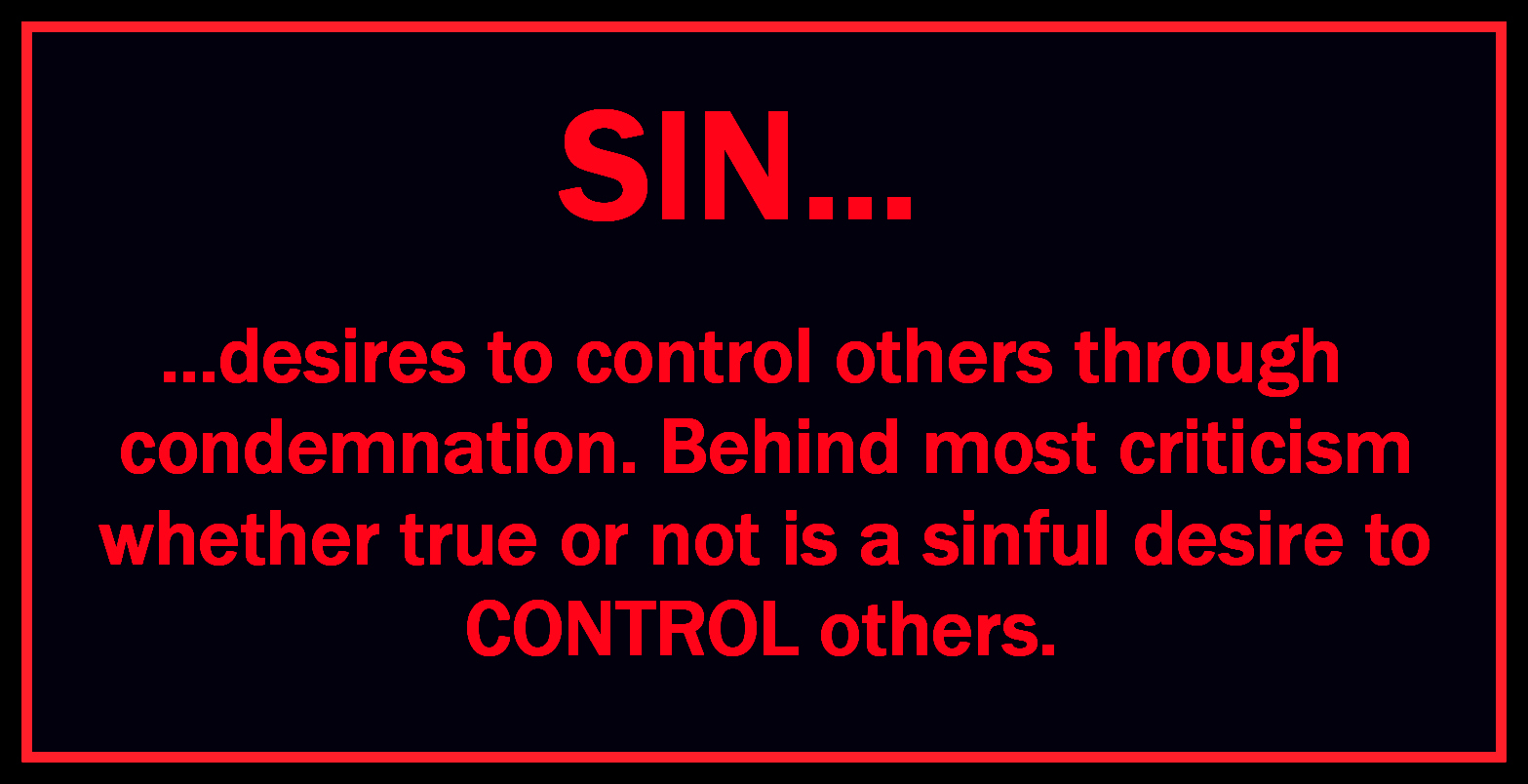
But lest we are careful, the simple truths of this passage and a wiser life will escape us. Sin is described as an entity that has a desire; specifically, a desire to control others. One of the fundamental characteristics of sin is a desire to control others.
Secondly, in this verse, sin’s means of doing so are also described: sin is crouching at the door waiting for us to fail. Sin then seeks to exploit that sin for purposes of control. At least to some degree, sin seeks to use the failure to destroy a true self-assessment and make a case for needed lordship. Certainly, this is how the serpent approached Eve. He wanted to convince her that she was unable to understand God without a mediator. Has God really said…?
At this point, this truth needs more development, but here is a basic building block that we can be sure of: the sin master uses condemnation to enslave, and pays death wages for one’s work:
1 Corinthians 15:56 – Death’s power to hurt [sting] is sin, and the power of sin is the law. 57 But we thank God! He gives us the victory through our Lord Jesus Christ.
58 So my dear [beloved] brothers and sisters, stand strong. Do not let anything move you. Always give yourselves fully to [excel in] the work of the Lord, because you know that your work in the Lord is never wasted [not useless/in vain] (EXB).
This is why Christ came to end the law. Sin crouches at the door waiting to seize the opportunity to condemn, and the more law, the better. The “law of sin and death” empowers sin because the power of sin and its ability to pay death wages is condemnation. When Christ died to end the law, He stripped sin of its power to enslave and pay wages.
Don’t misunderstand; being in Christ does NOT mean that we are not under a law, but it is the “law of the Spirit of life.” Why is it called that? Because the new Master pays life wages for the obedience of love, and that has never been any different:
Deuteronomy 30:15 – “See, I have set before you today life and good, death and evil. 16 If you obey the commandments of the Lord your God that I command you today, by loving the Lord your God, by walking in his ways, and by keeping his commandments and his statutes and his rules, then you shall live and multiply, and the Lord your God will bless you in the land that you are entering to take possession of it. 17 But if your heart turns away, and you will not hear, but are drawn away to worship other gods and serve them, 18 I declare to you today, that you shall surely perish. You shall not live long in the land that you are going over the Jordan to enter and possess. 19 I call heaven and earth to witness against you today, that I have set before you life and death, blessing and curse. Therefore choose life, that you and your offspring may live, 20 loving the Lord your God, obeying his voice and holding fast to him, for he is your life and length of days, that you may dwell in the land that the Lord swore to your fathers, to Abraham, to Isaac, and to Jacob, to give them.”
Nothing has ever been different in regard to the law. When we serve God, it is the law of love that brings life wages; when we “serve other gods” it is the law of sin and death that pays death wages accordingly…
Romans 6:16 – Do you not know that if you present yourselves to anyone as obedient slaves, you are slaves of the one whom you obey, either of sin, which leads to death, or of obedience, which leads to righteousness?
With all of this said, consider the lion’s share of bad marriages. It never fails. Two people, at war, and each with a laundry list of the other’s faults. Check that. Better said, a condemnation list. And of course backed up with many Bible verses; the Bible is either the law of sin and death that condemns, or the law of the Spirit of life that loves.
What’s going on? Answer: sin, and its desire to control using condemnation.
Genesis 3:16 – “I will surely multiply your pain in childbearing; in pain you shall bring forth children. Your desire shall be for your husband, and he shall rule over you.”
This is the same exact grammatical construction found in Genesis 4:6 concerning sin’s desire to control Cain. Sin will manifest its desire in marriages by each spouse desiring to control the other, and using failure to do so. When the failure of a spouse presents itself, the other spouse will use it to make a case for ruling over the other spouse. In essence, “Since you are stupid, I should be running the show in this marriage.”
In Reformed circles, elders make a case for being the rulers because we are all…what? Right, “totally depraved.” Same deal.
If you know this simple Bible fact, you know more than most “expert” counselors. In most bad marriages, both spouses need to repent of being tyrants. They need to stop using the Bible to condemn each other, and start using the Bible to love each other. After all, “love covers a multitude of sins.”
Go and do likewise…you are now an expert Bible counselor.
paul
The Source of Phobias
 I have rubbed shoulders recently with folks who have a phobia thing going on. In one particular case, the person presently employed by a relative of mine would not ordinarily be able to hold down a job.
This is another area where Christians show how confused they are. On the one hand, they get all glassy-eyed and proclaim the simplicity of God’s word, how we should read it as “little children.” But you mark my words: on the other hand, they will proclaim my biblical explanation for phobias here, “Too simplistic.”
The source of ALL fear, according to the Bible, is being under law as opposed to being under grace. I find it hard to believe that if the primary source of fear is gone, that the extreme expressions of it are possible.
According to the Bible, being under law, and specifically its condemnation, is the antithesis of LOVE. Throughout the Bible, fear and love are set in contrast to each other—polar opposites.
To those under law, the Bible is condemnation; to those under grace, the Bible is the discipleship of love. One is a law that continually warns of the wrath to come, the other is instruction regarding love.
This is why Paul said that the sting of death is sin, and the power of sin is the law. Ironically, many denominations keep their followers under law. This is why it is more than possible that professing Christians will suffer from these phobias which is also the case with the aforementioned acquaintance. I also find it curious that said person is of a denomination that emphasizes law. Hence, the person’s known faithful Bible reading will only make the fear worse because of a skewed view of law/gospel.
I am also convinced of this: God’s word states that you are under law regardless of who keeps it; under law is under law. The law must be ENDED for condemnation or you are still under its power. You must be put to death so you are no longer under it, and raised to life so that you may serve the law of love freely. Still being under law with the idea that someone keeps it for you is antithetical to the new birth. You must know that you can no longer be condemned. You are not merely protected from condemnation—condemnation no longer exists.
And therefore, fear can only exist if you allow it for it cannot live without condemnation.
paul
All You Need to Debunk Calvinism is the Lord’s Prayer
 In what is commonly referred to as the “Lord’s Prayer,” we are instructed by Christ to ask for forgiveness from the Father. Who the prayer is addressed to has profound soteriological implications.
Calvinism, and really Protestantism in general, promotes the idea that sin is sin; there is no other perspective on sin other than it condemns. Clearly, Christ is telling us to seek forgiveness from the Father, but on the other hand, the apostle Paul wrote that where there is no law, there is no sin (Romans 3:19, 4;15, 5;13, 7:8, 10:4), so as children of the Father, what are we asking for?
The prayer addresses the Father from whom there is no condemnation for His children (Romans 8:1,34). For those who are not His children, sin does condemn. For those who are in God’s family and born of Him, there can be chastisement for family sin (Hebrews 12:5ff). But for those not in God’s family, sin condemns and our Father is potentially a God of wrath to them.
You are either God’s child or a child of wrath (Ephesians 2:3-5). Obviously, repentance from the sin that condemns can only be a one-time event that cancels out the law’s ability to condemn. You cannot be in God’s family while under condemnation.
These two perspectives on sin are efficacious to a true gospel. One is wrath and condemnation, and the other is love through obedience and possible chastisement for disobedience.
Calvinism clearly teaches a single perspective on the law; the single perspective of condemnation (The Calvin Institutes 3.14.9-11). Therefore, supposedly, Christ came to obey the law perfectly so that the law is continually satisfied. Christians are still under the condemnation of the law, but Jesus’ perfect obedience fulfills the law every time we seek forgiveness for “present sin.”
So, do we ask the Father to forgive us for failing Him, or do we ask forgiveness in order to keep our salvation? How we answer that question determines the validity of our gospel.
paul

 Paul's Passing Thoughts
leave a comment