TANC 2015: Paul Dohse Session 1 – Introduction to Biblicism
Session 1: Introduction to Biblicism
Who do we think we are? Why would Western culture be immune from populous deception? In fact, history, even recent history reveals the dangers of collective logic whether by tradition or some sort of neo-movement. Moreover, examples of bad fruit coming from collective logic can be taken from the best of what Western culture has to offer.
There is one constant that shapes culture; change occurs as a result of bad fruit. The collective pain threshold begins to surpass the threshold of life value. Society then becomes split into two types of people: those with new ideas and those willing to listen.
Tyranny has always been a foolish endeavor by virtue of God’s design of things. The reason is simple: the people always outnumber the rulers, and the rulers need people to have a government, and you can only kill so many people. This is why controlling the way people think is so important; this taps into the human resource without killing the donor.
From the cradle of society, caste was the norm. Unfortunately, the consensus had always been that bad fruit had nothing to do with the system, but only those running it. The American experiment was the first successful challenge to collectivism. The definition of the words and the understanding of them are a matter of life and death on a massive scale. For example, “individualism” does not exclude cooperation and organization for the common good, but rather, asks who will determine what the common good is and how one reaches that conclusion. The assumption that individualism leads to societal chaos has in fact produced chaos in incomprehensible proportions.
Once again, history is repeating itself in many ways, but the particular aspect that TANC focuses on is Protestantism. Once again, fruit demands reevaluation because of the threshold of pain. But this time of historical reevaluation is utterly unique because it is post American Revolution. For the first time in over 500 years, Protestantism faces a reevaluation without the force of state at its disposal.
Nevertheless, Protestantism has done its job well. It yet has no fear of replacement because those who have given up on it believe there is no alternative. Hence, its utter failure has produced no competitors. The Nones and the Dones are just that, none and done. Yet, lest Protestantism would break from protocol and show mercy to its detractors, the Nones and the Dones are declared damned to hell on their way out to the wilderness of hopelessness because being a member in good standing in the institutional church is synonymous with loving Christ and being a legitimate part of His body.
We at TANC reject such an arrogant notion with extreme prejudice, and believe we understand a legitimate alternative—a return to the assembly of Christ and its priesthood of believers. A return to individual gifts, not spiritual collectivism; fellowship, not membership; leadership, not dictatorship; organization, not institutionalization; not many masters, but only one; a body, not a corporation, and finally, freedom of conscience. Individual saints with one word, one Lord, and one body. It’s a body, not a spiritual caste system, and we have but one mediator—the Lord Jesus Christ.
Biblicism
The alternative to Protestant orthodoxy is Biblicism. What is it? Let’s begin with a definition from Wikipedia. This is by far the best definition of Biblicism that I have ever found, and unfortunately listed under an alternative name for Biblicism, “Biblical Literalism.” And, as rightfully noted by Wikipedia, often used as a pejorative. Don’t you know, any Biblicist that has read Matthew 5:30 has cut off his right hand or feels guilty that he hasn’t. Let’s examine the definition:
Alternatively, the term can refer to the historical-grammatical method, a hermeneutic technique that strives to uncover the meaning of the text by taking into account not just the grammatical words, but also the syntactical aspects, the cultural and historical background, and the literary genre. It emphasizes the referential aspect of the words in the text without denying the relevance of literary aspects, genre, or figures of speech within the text (e.g., parable, allegory, simile, or metaphor).
Let me add that Biblicism starts with literalism and the plain sense of the text first, and then utilizes the elements of the historical-grammatical methods as needed to make the rendering consistent with the rest of Scripture. As one person has said, “When the plain sense of Scripture makes common sense, seek no other sense.” Let me also add that Biblicists would normally be impressed with a method of interpretation known as Occam’s razor. Again, we are indebted to Wiki for a definition:
…a problem-solving principle devised by William of Ockham (c. 1287–1347). It states that among competing hypotheses, the one with the fewest assumptions should be selected. Other, more complicated solutions may ultimately prove correct, but—in the absence of certainty—the fewer assumptions that are made, the better.
In context of the lay person, learning is a jigsaw puzzle. I want to use this example of a jigsaw puzzle that is a map of Xenia, Ohio. Let’s say the map, to the degree that it is fitted together, represents knowledge of Xenia. Until the puzzle is completely fitted together with all of the pieces, what do we do with the pieces that we can’t get to fit into the map presently? Answer: we lay those pieces aside for the time being. Dear layman, you don’t need the scholars. In fact, please remember that we live in the Information Age. Study to show yourself approved as a “workman.”
As a parenthesis regarding interpretation, let me offer all the proof you need to know that every verse of Scripture must be interpreted in context of justification or sanctification; Christians, throughout the New Testament, are referred to as “workman.” If justification is not a finished work, the fact that we are participants in it is unavoidable, either by direct participation or intentional non-participation. Intentional non-participation is doing something. If justification is not a finished work, invariably, religious formulas for work works and faith alone works emerge. The problem here is evident: if you can lose your salvation, what do you have to do, or not do, in order to keep it?
The Dirty Little Secret
What we are talking about here is deductive/inductive study of the Bible that begins with the presupposition that man is able to reason. Here is where we must stop and state a huge historical fact in this matter that is irrefutable. Historically, there have only been two schools of thought on Bible interpretation: the historical-grammatical method, and the historical-redemptive method.
But please, if you don’t take anything else away from this first session, please know the dirty little secret in all of this: these are ALSO two different ways of interpreting reality itself. Listen: the Protestant Reformers started first with their interpretation of reality, and then extrapolated that method onto the Bible as well.
If you have been following our TANC series on the first and foundational doctrinal statement of the Reformation, the Heidelberg Disputation, you know that Martin Luther laid the foundations in that document for the historical-redemptive method of interpreting reality and consequently the Bible as well. Luther believed that all of reality is a redemptive metaphysical narrative written by God. Look out the window right now. See that car driving down the street? The only reason that just happened is because God wrote it into the script of the metaphysical narrative, what many of the Reformed call the “divine drama.” Reality is nothing but a story written by God.
Hence, salvation is only an ability to perceive or “see” the story. The unregenerate are defined by those who think they have ANY measure of freewill. To have freewill is the ability to write your own reality. Luther’s assessment of freewill is therefore called “the glory story of man.” Either one confesses that God wrote the story of history and reality, or man is foolishly trying to write his own reality.
Luther received this idea primarily from Saint Augustine and Saint Gregory, established the Protestant Reformation with its premise, and John Calvin later articulated its supposed life application in the Calvin Institutes of the Christian Religion. It called for a repeat of our spiritual baptism throughout the Christian life by progressively seeing/perceiving two things: the depravity of man and the holiness of God. Plunging the depths of our sinfulness supposedly brings about humbleness and self-death resulting in a resurrection of joy regarding our original salvation. Therefore, the joy of our salvation is progressively increased throughout our Christian lives regardless of circumstance. In fact, tragedy only facilitates our ability to see our depravity and the judgement that we deserve. Tragedy is merely a part of God’s prewritten gospel narrative.
Consequently, Spirit baptism is not a onetime event, but is repeated throughout our Christian life. The Bible has one purpose and one purpose only: to aid the “believer” in continually revisiting salvation and the perpetual revisiting of Spirit baptism. This is an official Protestant doctrine called mortification and vivification. Several Protestant organizations use the chart below to illustrate this doctrine and the historical-redemptive use of the Bible:
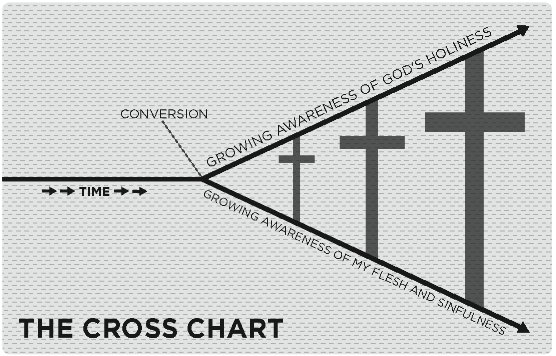
Therefore, God uses circumstances and the Bible to help us in the downward trajectory illustrated by this chart. A contrary perspective on reality is illustrated by another chart widely published by Protestant organizations:
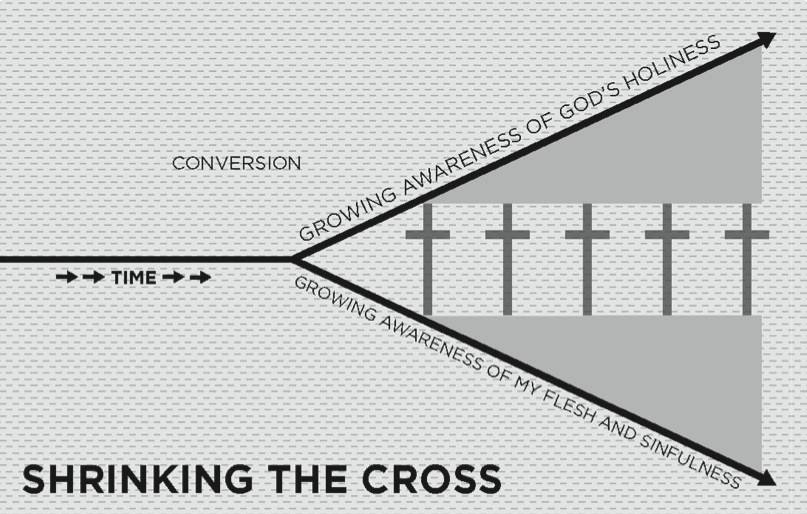
What is behind the popularity of this worldview? Simply, an ability to live a carefree life without fear of unknown circumstances (with the only exception being your eternal destiny). We all know that investing in life can set us up for enhanced disappointments and suffering. This is a worldview that completely separates us from the responsibilities of life and its suffering. Don’t worry, be happy, it’s a just a divine video tape anyway, and what will be, will be. If one of your loved ones dies tragically, don’t sweat it, it’s just part of God’s divine drama prewritten before the foundation of the earth. Besides, God is using this to make the gospel bigger and you smaller. Listen, even Protestants who don’t get this function according to the same worldview: “It’s God’s will.” “I didn’t do it! God did it!” “We are all just sinners saved by grace.” All of these Protestant truisms fit the downward trajectory of the above cross chart.
As far as Biblicism, there is a huge pushback against it. A focal point of the pushback is a book written by Protestant turned Catholic Prof. Christian Smith titled, The Bible Made Impossible: Why Biblicism is Not a Truly Evangelical Reading of Scripture. I must credit the Christian Research Institute with the following review of the book which is endorsed by many evangelical heavyweights such as Rachel Held Evans, and will help us further define Biblicism:
Smith asserts that biblicism is the constellation of ten different assumptions or beliefs: (1) The words of the Bible are identical with God’s words written inerrantly in human language. (2) The Bible represents the totality of God’s will for humanity. (3) The divine will for all issues relevant to Christian life is contained in the Bible. (4) Any reasonable person can correctly understand the plain meaning of the text. (5) The way to understand the Bible is to look at the obvious, literal sense. (6) The Bible can be understood without reliance on creeds, confessions, or historic church traditions. (7) The Bible possesses internal harmony and consistency. (8) The Bible is universally applicable for all Christians. (9) All matters of Christian belief and practice can be learned through inductive Bible study. (10) The Bible is a kind of handbook or textbook for Christian faith and practice.
While some evangelicals may downplay or deny some of these points, Smith suggests as long as you hold to some of these points, you are still a biblicist (pp. 4–5).
Before we address these points for a clearer understanding of what Biblicism is, it shouldn’t surprise us that the only alternative in the book is the Christocentric hermeneutic which is the same thing as the historical-redemptive hermeneutic. It sees the gospel or Jesus in every verse of the Bible as a result of interpreting reality itself through the suffering of the cross. It should be noted that this hermeneutic is crossing over into Catholicism as well.
(1) The words of the Bible are identical with God’s words written inerrantly in human language.
A Biblicist believes no such thing. God used fallible humans to write the Bible over 1600 years in many different languages. Because Christ warned that there would be serious consequences for tampering with God’s word, we can assume many have in fact tampered with it.
The key follows: the Bible is God’s statement on being including metaphysics, epistemology, ethics, and politics. The Bible is not without error in the transmission of these truths, but none of the truths are lost due to God’s oversight and assistance. Included is the way that the Bible was written, or its overall structure of checks and balances. As the “workman” studies to show himself approved, God’s principles become more and more apparent.
(2) The Bible represents the totality of God’s will for humanity.
This point is vague, but one assumes it speaks to the accusation that Biblicists believe the Bible speaks to every detail of life like how to fix our cars etc. While the notion is absurd, the Bible does tell us what kind of car-fixer we should be—not the details of a how-to-manual. The Bible is a manual for how we should love God and others, so while it does not give specific instructions on how to fix our wife’s Toyota, it does convey a principle of love that would prevent us from taking shortcuts on safety issues in order to save money. If it’s our wife’s car, we don’t repair the brake lines with duct tape, etc.
(3) The divine will for all issues relevant to Christian life is contained in the Bible.
This is true, and the reason for the contention is evident: the sole purpose of the Bible should be to show us how wicked we are, not instruction on loving God and others.
(4) Any reasonable person can correctly understand the plain meaning of the text.
True, with the exclusion of the straw man argument that the meaning in every text is always “plain.” The Bible states that individual study is required, and acknowledges that obtaining understanding can be difficult work.
(5) The way to understand the Bible is to look at the obvious, literal sense.
This is true as the primary organizing principle, but gain, the straw man is the assertion that Biblicists believe this is true of every verse.
(6) The Bible can be understood without reliance on creeds, confessions, or historic church traditions.
This is absolutely true because Biblicism rejects spiritual caste systems of all kinds. Teachers are a help, they are a gift to the church for purposes of equipping, NOT an office. But when it gets right down to it, in context of the apostle John addressing the Gnosticism that was wreaking havoc on the 1st century church, he stated, “You have no need for anyone to teach you.” Biblicism is predicated on collective individualism, not group-think overseen by an elite class of those who supposedly possess the “gnosis.”
(7) The Bible possesses internal harmony and consistency.
Absolutely. Again, the complexities of the Bible are used to argue against human reason as a valid epistemology for reasons of selling a redemptive interpretation of all reality.
(8) The Bible is universally applicable for all Christians.
Sure it is. Loving God and others pertains to principles that are universal.
(9) All matters of Christian belief and practice can be learned through inductive Bible study.
In regard to loving God and others, absolutely.
Note the continual distinction being made between love and law. There is a specific reason for that which we will see more of later.
(10) The Bible is a kind of handbook or textbook for Christian faith and practice.
The word “practice” factors in huge here. As previously noted, Protestantism defines salvation as an ability to see/perceive/experience APART from practice. Therefore, the Christocentric approach to interpretation of reality, and consequently the Bible as well, will reject any practice by man to be of any value to God. Therefore, the sole purpose of the Bible is to aid mankind is seeing that all righteousness is an alien righteousness completely outside of man.
So, this is an introduction to Biblicism. In the next session, we will look at the Biblicist gospel, its evaluation of law/gospel, the nature of God, the nature of man, evangelism, and the nature of sin. In the fourth session, we will examine Protestantism and the extreme contrast that it presents. I will conclude this first session with a few more principles of interpretation:
Deuteronomy 29:29 – The secret things belong to the Lord our God, but the things that are revealed belong to us and to our children forever, that we may do all the words of this law.
Deuteronomy 30:11 – For this commandment that I command you today is not too hard for you, neither is it far off. 12 It is not in heaven, that you should say, ‘Who will ascend to heaven for us and bring it to us, that we may hear it and do it?’ 13 Neither is it beyond the sea, that you should say, ‘Who will go over the sea for us and bring it to us, that we may hear it and do it?’ 14 But the word is very near you. It is in your mouth and in your heart, so that you can do it.
Two basic interpretative principles can be drawn from these verses. First, some things we cannot know, but what we can know we are responsible for. Second, we have no need for interpretive mediators between us and God. There is only ONE mediator between God and man—Christ.
Pope Francis’ Culture of Death is Looking a Lot Like Protestantism

“Dear Christian parents, will you save your children from this philosophical culture of death?”
The real difference between Catholicism and Protestantism is philosophical, and by no means a biblically based theological argument. If you want to discuss the difference in regard to orthodoxy for the serfs, there is no difference—both are progressive justification. Both propagate a need for the church to get people from salvation point A to salvation point B.
The functions of both camps are really determined by spiritual elitists who think they are above logic and all things material. Catholic philosopher kings tend to think knowledge beyond the material realm is within every being while Protestant philosopher kings believe all true knowledge is outside of the person.
Both appeal to Christ consciousness as the only immutable true form of goodness and truth. When it gets right down to it, you can barely slip a playing card between their definitions of faith.
Catholics seem to believe that the inner light gives everyone some potentiality for being good, while Protestants believe Christians can only see good and experience goodness that remains completely outside of them. They can experience it, but it is not a part of them. Man cannot be partially good enough to participate in his own salvation; it is a total work by God alone from beginning to end. Catholics believe that people can have enough goodness in them to participate in the finishing of their salvation.
In both cases, salvation is a process that needs the church to finish it. Catholics believe people can be made good enough to participate in the finishing while Protestants reject the idea that man can possess any goodness.
The point here is that they share a common belief that salvation is a process overseen by the church, and that affiliation with the church is efficacious to being saved.
Of late, and more and more, they also share a belief in Martin Luther’s doctrine of death. Both interpret all reality from the standpoint of the cross; i.e., “all wisdom is hidden in suffering.” Both see true discipleship as a complete emptying of self. Both see material as evil and only the invisible as good. Catholics believe inner goodness enables us to see ourselves as worthless, while Protestants believe faith enables us to see ourselves as worthless because we are worthless. Catholics believe good people will want to die to self and this material world, while Protestants believe we ought to die because we deserve nothing but death. But either way, it’s a culture of death.
Also, both believe that self-sacrifice shows forth the glory of the cross because all choices to sacrifice self are “living by the cross” or “walking according to the cross.” Self-denial and self-death demonstrate God’s cross-love and this is when the gospel is presented to people with power from on high. We hear this rhetoric in Protestant circles constantly.
So, what in the world inspired this post? Keep in mind that the following video is a Catholic production, and prepare yourself to be dumbfounded.
The same mentality can also be seen in Pope Francis’ collectivist views on economics and financial equality. Francis, who is loco popular with the Millennials, is leading a whole generation of our youth into socialist ideas. On the other side of the fence, the same. Collectivism gauges the total worth of people based on their ability to contribute to “the group” which is Platonic lingo for society at large.
Another aspect of death culture is the rising popularity of environmentalism among Catholic and Protestant youth. If you are a good Catholic, you know that your evil material body exhales carbon dioxide which pollutes the air, but the good trees absorb the carbon. If you are Protestant, you assume trees are better than humans because humans are totally depraved. In this video, it is suggested that we errantly worry more about ISIS killing people than saving trees.
The video was posted on my FaceBook page by a young Christian, and this was my response:
Well, wouldn’t worry about it too much. Apparently, shortly before the return of Christ there is plenty of earth left to destroy because God destroys it. I also find the notion that trees compensate for human pollution via breathing somewhat disturbing. It’s the idea that trees are important because they filter out the product of human living: trees good–humans bad. Fact is, what we exhale is only about 4% carbon. Also note the unqualified moral equivalency between those who kill people (ISIS) and those who cut down trees. lastly, if those who propagate this message really cared about the environment rather than their ulterior political motives, they would point to the science and example of Israel who have turned that desert terrain into a rich agriculture.
Dear Christian parents, will you save your children from this philosophical culture of death? This May, I will be teaching a series on Martin Luther’s Heidelberg Disputation on Blog Talk Radio. We will exegete this foundational document theses by theses. Let me also recommend our 2015 TANC conference where we delve into these issues as well.
paul
Mom Wants to Know: Why I Don’t Like Mike Huckabee (and Other Adorable People)
 Originally published February 10, 2014
I am very busy and need to combine eight posts into one which is not difficult because it’s all related. I need to write about Mike Huckabee, Joni Eareckson Tada, Boz Tchividjian, K-Love, stuff happens theology, plumbing, Communism, and of course John Calvin, but not necessarily in that order.
Let’s start with a conversation that occurred over at my mom’s house about former Governor Mike Huckabee. Susan and I were over at her house overseeing the repair of her furnace. My study of medieval religion has given me a robust appreciation in regard to American ingenuity and technology. A working furnace is critical for someone my mom’s age in sub-zero weather. The furnace was repaired by a competent young man within hours of us calling, and let me add that he also laughed at my jokes.
Plumbing
When all was accomplished, Susan and I said farewell to mom and then received a call on my cellphone about four miles from her house; she reported a funny hissing sound in the kitchen. We returned, and concluded that a frozen water pipe had broken under the kitchen floor. This was totally unrelated to the furnace repair. There we were, the day well spent, and a broken water pipe shooting out gallons of water by the minute underneath the shallow crawl space of the kitchen.
Another competent repair man to the rescue, even at that hour? Maybe, but my mom is long retired and lives on a limited income. I went down to the basement and turned off the main water supply to the house and also observed the following: much cost was spared in installing shutoff valves, but the kitchen was an isolated run of two copper pipes easily accessible before entering the long and shallow crawl space under the kitchen. It became apparent that those two pipes could be sealed off and the rest of the house would have water until the broken pipe was fixed. The trade of a dishwasher and one faucet for flushing toilets etc. in the rest of the house would be a good trade indeed.
I have some past limited background in plumbing, so Susan and I drove to the nearest Lowes to buy sand paper, a propane torch, two copper end-caps, solder, flux, a small brush, a hack saw, and inner pipe brush. Then we talked to a delightful young man that informed me that American plumbing had indeed changed since fifteen years ago when I was dabbling in it here and there as a builder. He informed us that we would only need two “push fittings” and a mini pipe cutter, and about five minutes.
“Uh, let me get this straight. I just cut the pipe, and push this thing on the end of it, and I am done? ‘Right.’”
Now visualize me looking at the guy like he is the Lowes version of John Calvin as he explained how the simple contraption worked. Remember those weaved tubes that we used to put on our friends’ finger when we were kids back in the days of extreme political incorrectness? The tightness of the device around the finger increased with pull. It was the initiation ceremony of choice for all neighborhood club houses. In this case, the pipe is the finger and the water pressure is the sadistic adolescent.
Huckabee
All of this is why I don’t like Mike Huckabee. After the plumbing repair, we hung around awhile and watched the Mike Huckabee show on the Fox News channel. I informed mom and Susan that I don’t like the guy. Like many, they were astounded that anyone of Christian stripe could dislike that cornball.
“Why don’t you like Huckabee?!”
I really didn’t have an answer at the time. But I thought about it all night and realized that the answer was right under my nose the whole time—so I hereby write.
Tada
Huckabee had the mega storied Joni Eareckson Tada on his show. Both of these people are impressive and adorable. Tada has been a paraplegic since her teen years, but her life accomplishments are over the top. Both are the epitome of American pie and conservative Christianity. The reason Huckabee had Tada on his show was to discuss the “Academy’s rescinding of its Oscar nomination for ‘Best Original Song,’ which appeared in the inspirational American colonial epic, ‘Alone Yet Not Alone,’ when it was discovered that the composer, Bruce Broughton, had sent a short email bringing the song to the attention of Oscar voters.” Tada was the vocalist.
Christians en masse stand in awe of Tada, and Huckabee added to her mystique with his mainstream Christian appeal. And this is the problem with Huckabee: he doesn’t get it. Huckabee is the poster child for the Christian metaphysical treadmill. Tada is very much a part of the New Calvinism movement which is a return to authentic Reformation ideology.
Communism
It is nothing more or less than Communism dressed in Bible verses. This is where the Huck doesn’t get it; as a political/religious conservative, he is representative of many in Christianity who allow their principles to fornicate with contrary ideology. This leads to a never ending endeavor to change society while unwittingly giving credence to the very ideologies that are the source of the problem.
In the same show, Huckabee, prior to Tada’s segment, criticized the opening ceremonies at this year’s winter Olympics in Moscow which promoted the virtues of Communism. He commented that Lenin’s murderous legacy was conveniently left out. Meanwhile, in the next segment, here comes Joni Eareckson Tada who represents a return to John Calvin purism. Granted, Tada’s extensive education came from seminaries that don’t teach the significance of how philosophy progressed through history and how that applies to the doctrine she embraces. Long story short, this leads to a contradictory motif in her own life as she benefits from an array of technological advances that has made much of her success possible (more on that later), but the larger point is that Reformation theology and Communism came from the exact same ideological source along with its presuppositions concerning mankind.
Hence, Huckabee partakes in the same hypocrisy that he criticizes. The Reformers were NO LESS murdering despots than Lenin—that’s conspicuous history plain and simple. In fact, in most cases, Lenin had people shot in the head while the Reformers wouldn’t have tolerated such a quick and painless departure by those whom they disagreed with. Huckabee is the epitome of the well-polished American do-gooder that refuses to come to terms with the fact that the Pilgrims, the Puritans, and the Reformers are not part of the ideology that made America; they are in fact part and parcel with Communist ideology. Putin needs ratings no less than Huckabee does.
The progression of philosophy and how it affects humanity is magnified in the differences between America and Russia. Huckabee, again, in the same show, pointed to the poor quality of life in Russia that is hindering the Olympics. What he doesn’t realize is that it would be much worse if it wasn’t for America. You have to have technology to eventually destroy the Great Satan, but if Russia ever succeeds, technology goes bye-bye, and the mass graves become filled with the Joni Eareckson Tada’s of the world because they can’t “contribute to the greater good of the group.” This is why Russia’s technology will never rival that of American ingenuity: Communists see technology as a necessary evil, Americans see technology as a means to accomplish good.
Really, this can be summarized in the living contradiction that is Joni Eareckson Tada. While promoting Luther’s worm theology and making one statement by God to the apostle Paul the whole enchilada, she continually pontificates, “God’s power always shows up best in weakness.” Communism asserts that the masses are hapless and incompetent; Reformation theology asserts that man defaces the glory of God through his own accomplishments. Both share the same presuppositions in regard to mankind. Tada points to her disability as set against her accomplishments as proof of Reformed doctrine while completely dismissing God’s use of technology invented by those who in many cases could care less about God. Tada has a lot of education in regard to what others told her is in the Calvin Institutes, and conveniently missing are Calvin’s vast discussions of Plato and Aristotle. I dare say that the Reformation had more to do with those two men than “justification by faith alone.”
And by the way, the Reformation wasn’t about that either; it was about cutting man completely out of the salvation process because of Plato’s philosophical presuppositions concerning mankind. This later morphed into Gnosticism.
Stuff Happens Theology
Can we summarize this dilemma with T-shirt theology? “S— Happens.” No, stuff doesn’t just happen (there is a logic that drives everything). And that’s how Huckabee functions because of his metaphysics: stuff happens and you have to relentlessly address that stuff until all of the stuff has been refuted. No, you have to stop fornicating with the logic that creates the stuff. The apostle Paul stated it this way: “A little leaven leavens the whole lump.” If Huckabee wants unleavened bread, he needs to take some culinary philosophy classes. And if you don’t like what you learn, stop criticizing the Communists for editing history.
And by the way, what scares the bejeebers out of me is that the average Communist on the street understands these issues as opposed to American Christians. They know exactly why their country stinks; because mankind and life stinks. Get with the caste program or it will stink even worse. It’s about the best world hospice care possible. The fray between Americanism and Communism really began when the Pilgrims landed at Plymouth Rock. That’s where the rewriting of history for us began as well; “Pilgrim” is a soft term for “Puritan.” These are people who saw the likes of Benjamin Franklin as troublers who stir up the anger of the gods with their big ideas. Now they have to use those same ideas to put an end to the egregious idea that man has worth. That’s Joni Eareckson Tada metaphysics.
Hence, supposedly, technology doesn’t enable us to do more ministry. It would have been better to replace my mother’s furnace with a wood burning stove. It would have been better if my mother would have had to write me a letter about the broken water pipe instead of calling me on my cellphone. See, if we were like the Russians, we wouldn’t need plumbing anyway. For Tada, technology is a necessary evil to spread the word that we all suck. If she thinks that is an absurd evaluation of her metaphysics, she should stop promoting men who believe just that in no uncertain terms. She would know this if her reality wasn’t completely formed by the likes of John MacArthur Jr.
The Republican Party and Mike Huckabee in particular need to wake up to a new reality: New Calvinism has made the American church the New Communist Party. Again, stuff doesn’t just happen; there is a reason why many well-known New Calvinist pastors voted for Obama. Sure, they don’t agree with his stance on abortion and other issues, but there is agreement on the bigger issue at hand: mankind needs the best hospice care possible; unfortunate collateral damage can be dealt with when Calvinism is back in bed with the state. This is why the institutional church is the institutional church and partakes in many things institutional like movie production, formal education etc., etc., ect. The state gave it birth, and it will always gravitate back to its mother. This is why Christ’s assembly was never an institution.
The Boz
Let’s continue now with stuff happens theology and the adorable Boz Tchividjian aka the Boz. The Boz is another impressive guy. How can we criticize the Boz? For crying out loud, he left his station as a district attorney who prosecuted child abusers to start G.R.A.C.E, an acronym for, Godly Response to Abuse in the Christian Environment. The Boz bemoans “the continued culture of silence and protection [for child abusers] in American Evangelicalism.” This is a reality—stuff happens. No, stuff doesn’t just happen. Read the history for yourself. Seriously, people have actually written this ministry and stated, “Evangelicalism is beginning to look like Catholicism in regard to child abuse.” This is stuff happens theology.
Catholicism was founded on Platonism, and Protestantism came from Catholicism, and never left it. Augustine, an avowed Neo-Platonist, is both the father of Reformed theology and a Doctor of Grace in the Catholic Church. Later, Baptists became Protestants when the issue of infant baptism became a “secondary” issue. Apparently, after all of the Anabaptists of the home church variety were executed by a joint effort of Catholics and Protestants, the institutional breed of Baptist was accepted. After all, they paid the tithe tax. In regard to Catholics and their bastard children, there is no heresy more egregious than tax evasion. Evangelicalism became a necessary addition to Protestantism when people could no longer be compelled by force to attend church and tithe.
Again, we criticize the Communists for propaganda, but yet colonial America was a Puritan theocracy that executed people for being theologically incorrect and jailed people for not attending church and tithing. The Puritans were the first to bring slaves to America at Jamestown. The American Revolution was a pushback against colonial tyranny. While the Boz seeks to rectify the child abuse stuff in “Evangelicalism,” he holds fast to the same presuppositions concerning mankind and the divine right of kings that flows from it. He wants to rid “Evangelicalism” of the behavior, but continues to fornicate with the ideology that produces it.
This ministry, which understands Reformed ideology, has therefore continually stated that G.R.A.C.E. cannot help victims of child abuse in the church. This is because the Boz, like all of those in a Calvinist mindset, sees all of humanity as being in the same boat. Peruse if you will all of the G.R.A.C.E . literature, I was not able to find the word “justice” anywhere. And yet, didn’t the Boz come from a justice system? Though God himself demands justice for the maltreated, Calvinism holds justice in contempt because it assumes humanity deserves NOTHING more than eternity in hell.
I have written extensively on the problem of dealing with abuse in the church with Reformed ideology. The difference is the mindset that puts as much value on one life as it does all of life versus collectivism which sees the individual as expendable for the benefit of the group. This is known as collectivism. This is a big player in the Reformation’s Platonist roots. This is about philosophical metaphysics—not the Bible. While the Boz deplores the behavior of child abuse, his remedy requires that the victim and the abuser both recognize that we are all just “sinners saved by grace.” In at least one sense, he believes that the abusers would repent if the victims would admit that they are no better than their abusers. Example: while the Wartburg Watch blog portends to be an advocacy for the spiritual abused, they partner with Pastor Wade Burleson, a Calvinist, who suggested that abuse would be greatly reduced if the church was not guilty of failing to pray for abusers. Here we have yet another example of attempting to bake unleavened bread while adding leaven to the dough.
Furthermore, discernment blogs, like the Boz, have a common goal of purifying the institutional church. This gets right back to collectivism which is always dependent on the state. Plato’s Republic was about the best hospice care for humanity: government must own man and truth so that humanity can be as comfortable as possible while dying. To the contrary, Christ said He came to give eternal life and life more abundantly in the here and now. And the Christian has no fight with those who believe in a limited government that assures humanity’s right to freedom and the pursuit of happiness. This is closer to the priesthood of believers that devalues church as an institution. This is why the New Testament church was primarily home based before being driven underground in oppressive countries by necessity. To the contrary, the American church functions primarily in institutional venues: higher learning; corporate expression; missionary organizations; political organizations; and even movie making. Discipleship and citizenship to the glory of God is barely on the radar screen.
Therefore, the institutional church will always be one step away from a liaison with state. The institution is what the institution does—it collects taxes and tithes, and doesn’t much care for those who don’t contribute to the group.
Yes, all of the above is why I was able to predict the inevitable outcome of G.R.A.C.E.’s involvement in the Bob Jones University abuse scandal months beforehand. It’s a Reformed institution investigating a Reformed institution. Don’t be fooled by the good cop bad cop routine. They are all cops when it is all said and done. BJU’s final sentence of their statement in regard to firing G.R.A.C.E. after the smoke was clear says it all:
We grieve with those who have suffered abuse in their past, and we desire to minister the grace of Christ to them. Our prayer for the abused is that God will be their refuge and strength.
Yes, they ministered G.R.A.C.E. to them alright, and that message is loud and clear lest the discernment bloggers and victims cannot yet see it:
Justice isn’t the issue; who in the hell do you think you are? You think you deserve justice? If you had a smidgen of spirituality you would seek refuge in God and not the justice of men! How dare you threaten the institution wherein salvation is found because you will not accept the will of God! You were raped, big deal! Jesus hung on the cross for your sins! You are the unmerciful servant who received forgiveness but will not forgive!
K-Love
…is a radio station that plays contemporary Gnostic Christian music. Here is what my missionary son in law posted on Facebook a couple of days ago:
We have been listening to the newest Christian music on K-Love as we travel and I am noticing an odd trend: there are several songs that ask for God to break someone or make them lonely with the expected result of being a better person. Having been broken and very lonely a couple times in life I am pretty sure they are not really aware of what they are asking for. You don’t have to be broken in order to listen to God’s voice and indeed if you learn to listen to His voice you will not break or be broken even when you do face difficult times.
It’s not odd really, but is part of the whole all reality than can be perceived with the five senses (which of course includes us) is evil and only the invisible spirit realm is good metaphysics dressed up in Bible verses. We have to understand the ideology that drives all of this stuff and stop focusing on the stuff. It explains the madness behind the music, why a pastor would vote for Obama, why someone like Tada endowed with all sorts of technical power and influence would glory in her “weakness” while being far more empowered than most Americans, and for that matter, why a Buddhist monk would set himself on fire just to make a statement.
John Calvin
…is the epicenter of all that is going on in Christianity right now, and the key to understanding the significance of Calvin and his cultural impact has little to do with the Bible and everything to do with the fact that his ideology is the premise that drives a lot of stuff across the spectrum of life and society. Focusing on the stuff will only delay the inevitable. And per the usual, people will continue to focus on the stuff, because stuff happens, and we like to talk about it—it’s like rubber necking to get the best view that we can of a traffic accident—it’s like flirting with the voluptuous vampiress that just might bite our necks and suck all of our blood. There is no thrill in solutions like traffic safety or a silver bullet.
And what would Mike Huckabee talk about on his show? But others have a choice; we don’t have to strive in baking unleavened bread while allowing leaven. We don’t have to give mere platitudes to the suffering…
we can set them free with real truth, and be a blessing in our own little corner of the world. And when you stand before Jesus, as we all will, it’s better that way. Jesus said that whatever we do for the least of the little ones we do unto Him. With Jesus, love is about the individual—not the collective good.
paul
The Truth About Predeterminism: A Historical and Biblical Evaluation
 Good evening and welcome to False Reformation blogtalk radio. I am your host, Paul M. Dohse Sr.
If you would like to join the discussion tonight and add to what we are learning, call 347-855-8317 and remember to mute the speakers on your laptop or PC. And by the way, the question or comment does not have to pertain to the subject at hand—it can be off-point.
I am very excited to share what my research has yielded since I began this ministry in 2006, working at it part time until April of 2010, and thereafter full time until now. Resources can also be found at tancpublishing.com.
Tonight we will be discussing the subject of predeterminism, otherwise known as God’s election or predestination. Now, I realize that election and predestination primarily speak to God preselecting who will be saved and not saved, while predeterminism deals with the wider spectrum of human events.
Let me set the table for tonight’s discussion. Starting out in Reformed beliefs can be simple enough. God preselected those who will be saved, and left the rest to their own devices. And, there seems to be Bible verses that state this plainly.
You might even believe that election and freewill are both 100% true. You might believe that this is a paradox. I heard Rick Warren tell John Piper that this is his position, since the Bible states both, both are equally true. You could also argue that paradoxes like this exist in science. Let me give you an example from Dr. Bo Grissom as stated in last year’s conference:
Consider, for example, the physics of light where two seemingly contradictory theories are used side-by-side to explain its different properties.
The wave theory is used to understand the oscillation aspects of light (e.g., Polaroid sunglasses), while at the same time the particle theory is employed to explain other applications (e.g., photoelectric solar panels). Although these two theories are totally incompatible, each provides useful information in certain technical applications.
To date, scientists simply use the appropriate theory as needed for a particular design problem. There is no worry about whether light actually exists as a wave, or as a particle, just because it is not yet fully understood. This same approach may be taken in the spiritual realm and is probably the best stance to take in dealing with the apparent contradiction between individual free will and God’s total sovereignty.
When we extend this God’s predeterminism from salvation to every aspect of life, we are not just talking about election and predestination, or whether one is a 1 or 2 or 3 or 4 or 5 point Calvinist, we are now talking about determinism or predeterminism. Hence, the word used in our title tonight. And this is where we must go because Protestantism was founded on hard determinism not soft determinism.
The Protestant tradition is based on Redemptive Historical hermeneutics. What’s that? It is the belief that every facet of human life is predetermined. It is the belief that reality and the state of being is a prewritten story or grand narrative written by God. This is known as metanarrative, or metaphysical narrative, or a grand metaphysical narrative. In regard to authentic Protestantism, all of history is a predetermined gospel, or redemptive narrative also known as the “divine drama.”
This is also the basis of mythology which is NOT superstition. Mythology is merely the most ancient and basic foundations of religion. It is the idea that a force, nature, cosmos, or personal God has prewritten history. The story, as it unfolds, is the state of being. The author of being is always an invisible force who manifests his/her being in the material realm.
Mythology in its various forms also has mediators between the invisible and material. These are elitist guides who have special insight into the invisible realm that cannot be understood by the general populous. Therefore, in order to guide the masses, priests, philosophers, or whatever you want to call them, explain truth to the masses in a way that they can understand it, namely, via a story.
For the most part, people in cultures don’t take the mythological stories literally, they understand that the guides are merely repackaging what they are unable to understand in a way that they can apply it to their lives. Ancient cultures were not stupid people driven by superstition; they understood the mythological narratives to be creeds and catechisms to live by that come from purer truths that only the guides can understand.
Superstition then, is an unreasonable understanding and application of the mythological narrative. That’s what superstition is. It may also include many personal quirks applied to the superstition as well.
So, from the cradle of society comes mythology, and its orthodoxy is metanarrative. This of course requires a spiritual and social caste system or a empirical pecking order. This is why Hinduism is the most ancient of religions—because mythology is the most ancient of religions.
In this ancient construct, everything is predetermined in the story written by the force or personal God, and life is ONLY experienced. It’s like standing in the rain. You feel the rain, you experience the rain, but you have no control over the rain—the rain is a story that you only experience—your part in the narrative is only experienced.
In Hinduism, which is the best example, the spiritual strata is Bhramin, Kshatryia, Vaishya, Sudra, and Untouchables. But listen very careful to what Karma is in Hinduism. THIS IS KEY. I am citing Swami Bhaskarananda: Chapters IX to XI from the book “The Essentials of Hinduism,” Heading; “Predestination”:
Karma is the infant stage of Hinduism where saints believe they are responsible for their own actions, but as growth moves forward, the mature saint…
He becomes convinced that God has been doing everything by using his body, mind, energy and the senses. He feels that he is only an instrument in the hands of God, and whatever God has been doing to him is for his ultimate spiritual good. At this high level of spirituality the doctrine of predestination becomes the only valid doctrine to him. To him the doctrine of karma ceases to be a valid doctrine.
Therefore, these two doctrines, even though apparently contradictory to each other, are valid for people at different stages of spiritual growth.
Hang on to all of this as we are going to plug it back in later. This will all come together for you as we progress.
At this juncture, I am going to inject another key term: the total inability of man. Can we state anything other than the obvious fact that Hinduism representing the foundation of ancient religion is one soul with the total inability of man? Absolutely not.
When I first became a Christian, I was, I guess what you would call Arminian. I only borrow the term to make a point because Christianity is not either Calvinism or Arminianism, that’s perhaps the biggest red herring of all time.
I was later persuaded into believing what is often referred to as sovereign grace. Or, election. I was never crazy about it though I believed it to be true. To me, there were certain Bible verses that made individual election unavoidable.
Fast forward to the TANC Research era. When my research found that Protestantism was founded on the false gospel of progressive justification, I pretty much deemed the election issue as a diversion from the real issue of the gospel, and pronounced the election issue irrelevant.
I then adopted the aforementioned paradox view and stuck it in my back pocket. I am not going to take the time tonight to discuss why I decided to revisit the issue, but I did. And here was my approach:
I found the issue of law and gospel to be very definitive in the Bible, what I call “theological math,” and assumed that a deeper and deeper objective understanding of law and gospel would lead to more understanding of the more subjective and mysterious biblical issues. What we know are building blocks to what we don’t know. If not, conclusions are merely leaps in logic.
Deuteronomy 29:29 makes it very clear that there are things we are responsible for knowing and doing, but to some degree we are not going to understand everything. BUT, we also need to milk the objective cow for all we can get out of it. You stick with what you know positively and see where it leads you.
And here is where I have been led: I believe freewill is a metaphysical pillar. I believe it is one of the major tenets of being. I also believe that it better answers the more difficult questions such as, “Why did God allow sin into the world?” That is, if He did in fact allow it—we must remember that is a presupposition. God is not limited in any way by perceived attributes. Example: God is omniscient, but does that mean God in unable to not know something because of His omniscience? What if God doesn’t want to know something? Is He UNABLE to not know?
I have come to believe God did not elect individuals, but rather elected the means of salvation which includes people groups and Christ Himself. I believe God is sovereign and intervenes in the freewill affairs of men to guarantee predetermined outcomes which DOES NOT include every detail of life and history.
The Bible says that God created hell for the Devil and not man; therefore, men go to hell because they choose to go there against God’s desired will. Though the fall caused man to be ashamed and hide from God—God seeks him out and reasons with him.
This brings us to some very important reasons to consider the truthfulness of predeterminism. First, the primary pundit of predeterminism is the Protestant tradition. As we discussed prior, Protestantism is the false gospel of progressive justification. Therefore, predeterminism is fruit from the poisonous tree.
Secondly, and most importantly, the Reformed tradition has made the sovereignty of God the gospel itself. Don’t miss this; note this term: “sovereign grace.” We must understand that sovereign grace is a specified gospel. It is a soteriology or doctrine of salvation—please don’t miss this. Individual election is not a separate issue from the death, burial, and resurrection of Christ according to the Reformed camp.
A key concept of sovereign grace is the total inability of man. In 2008, Calvinist John MacArthur stated the following at a conference:
The doctrine of human unwillingness and inability is perhaps the most attacked doctrine wittingly or unwittingly. The idea that sinners are completely helpless to redeem themselves or to make any contribution to that redemption from sin and divine judgment is the most attacked because in the big picture, it is the most despised doctrine.
Consequently, it is the most distinctively Christian doctrine, contrary to all non-Christian views of men. All religions in the world are some form of a works righteousness system. And at the foundation of all those religions other than the true faith in the true gospel is the idea that people can be good and good enough to contribute to their salvation, to somehow merit favor with deity and a happy after life.
Because this is the universal foundational doctrine of all false systems of religion, it is therefore the most – because, I should say, the opposite of it is the foundation of all these religions, it is therefore the most attacked Christian doctrine. It is distinctively Christian because it affirms the absolute inability of man to do anything to contribute to his salvation.
That’s a crock. What MacArthur said is the well-traveled narrative and historical motif, but the exact opposite is true. The carte blanche religiosity most prevalent in all of human history is determinism. This has always been true in the secular realm as well. In the secular realm it is known as freewill skepticism. Somebody sent me a great video on this a couple of days ago and I found it most fascinating.
But look, mankind has been so saturated with a propensity towards determinism that its philosophical truisms pepper our speech. Quote, “Don’t tempt fate.” “It’s our destiny.” In sports: this team or that team is a “team of destiny.” “Oh well, I guess it just wasn’t meant to be.” One of the biggest hits ever was Doris Day’s Que Sera, Sera (Whatever Will Be Will Be). In 1964 you couldn’t go anywhere without hearing that song.
So, like the video I was sent the other day, MacArthur who I think represents the general mentality well is proffering the idea that freewill skepticism is counter intuitive—historically, the exact opposite is true. Calvinism is an extremely old shoe. It’s just a chip off the old block of ancient mythology—it follows that tradition.
So, freewill skeptic philosophers as well as Calvinists talk often about free will’s relationship to “American individualism.” And this is the next step to our discussion: determinism goes hand in hand with collectivism, and freewill goes hand in hand with individualism. Let me explain how this works.
If whatever rules the universe in the invisible realm has representatives or mediators in the material realm, that means the majority of humanity cannot know reality. The other alternative is what got Socrates executed. He taught that truth was intuitive to everybody and leveled the playing field which was a really bad idea because only 10% of the population made up the ruling class.
Therefore, his understudy Plato had to get out of Dodge and become a foreign exchange student for a while, but he studied in India and came back to Athens with a much better idea: the philosopher kings are able to obtain the gnosis and teach it to the masses, the warriors inforce the dictates of the philosopher kings, and the sole purpose of the masses is the collective good.
This was never more or less than Plato’s version of the Hindu caste system. The value of an individual is based on their ability to contribute to the common good as judged by the philosopher kings and enforced by the warriors if necessary.
Where did the crux of this system begin? In the garden with the serpent and Eve. The serpent, in essence said, “Eve, you aren’t able to correctly ascertain what God really said, you need me, a spiritually superior being, to properly interpret what God really said.” That’s where all of this starts. It worked well in the garden, why in the world would the construct ever change, right? This also makes mediators the obvious shoe-in for social engineering or societal wellbeing.
Now we have to figure out who the mediators are, right? How do we figure that out? Who is to say? That’s where predeterminism comes in as well. The mediators are always preordained by God before the foundation of the earth. This goes hand in hand with the social class strata.
Social classes determine who the rulers are, the warrior class, and the artisans. It becomes a matter of lineage or pedigree. And as you know, this has never changed in many, many cultures. In many cases upward mobility is forbidden.
Traditionally, collectivism, again, the idea that the worth of an individual is determined by ability to contribute to the common good, is the doctrine that is always associated with determinism and its spiritual caste. The preordained mediators keep the masses in tune with good karma. Immature citizens think they can actually control their fate, while the wiser artisans and producers know that whatever force they worship is completely sovereign. Hey, if the force didn’t want that philosopher king in power, he or she wouldn’t be in power. And of course, some cultures take it a step further and deem the rulers as the actual material manifestations of a god or several gods. Examples of this would be Japanese emperor worship during WWII and the Pope (the “Holy Father” of the Catholic Church).
I am going to pause here and mention how these ancient traditions show up in the contemporary Protestant church. The president of Southern Seminary, Al Mohler, stated at a conference in Florida that pastors are God’s appointed preordained ministers to save His people from ignorance. That’s what he said. In the Puritan tradition, upward mobility was considered a violation of the fifth commandment because it didn’t honor the social class you were born into. Folks, this is all the same stuff! A book written by Calvinist Paul David Tripp, How People Change, is a 200 + page treatise on how to become part of God’s metaphysical divine drama. You are not in control of anything, you just need to be able to see the world through eyes of faith; i.e., all of life is the unfolding of a preordained redemptive narrative (see endnote at end of transcript).
In addition, Calvin’s three-fold election construct that we discussed last week is identical to the election doctrine of Gnosticism, a later version of Neo-Platonism. The hylic coincide with Calvin’s non-elect, the psychic are the partially initiated, or temporarily illumined, and the pneumatic are the fully initiated or Calvin’s lot that persevere till the end. This is all the same stuff.
Now, we are getting ready to close the first segment so anyone wanting to call in can start ramping up while I finish the first segment with individualism which is mostly identified with freewill. Individualists commonly believe that they do not need a mediator to understand God or reality. Secondly, individualists would reject predeterminism out of hand. Thirdly, they would reject social caste out of hand and deem it as tyranny. Fourthly, they believe happiness is found in accomplishment and would reject anything that hinders upward mobility. Fifthly, they would reject total inability.
However, individualism is what is counter intuitive. Individualism is a unique American experiment which finally happened after man suffered unspeakable misery for 10,000 years at the hands of collectivism. EVERYONE agrees that there has never been a country like America in the history of the world. Well, why not? Why did it take so long? Because individualism is not our natural bent—collectivism is. No? After all of the mass graves and misery amassed by collectivism, why are politicians worldwide still hell-bent on implementing it?
Ever heard of the tower of babel? We wouldn’t even have the individualism that we have now unless God confused the languages. Man was continually commanded by God to spread out, fill the whole earth and subdue it. What did they do? They all gathered in a Hindu huddle at the tower of babel.
That’s the first segment. Conclusion: Calvinism is far from being unique. It’s just the same old warn-out collectivism that has been wreaking havoc on mankind since the garden. Determinism is nothing unique, the total inability of man is not unique—IT’S ALL THE WORLD HAS EVER KNOWN UNTILL AMERICA CAME ALONG. Status quo religious books like the Quran are saturated with the idea of predeterminism from the front cover to the back cover. I could go on and on with example after example.
Segment 2
What about the gospel of sovereign grace? This is a gospel that is defined by predeterminism. Apart from predeterminism, all gospels are deemed false—it must have the determinism element. Freewill is tantamount to a false gospel because it leaves room for man to have a role in the salvation “process” that supposedly starts with beginning justification which is experienced subjectively and ends with final justification. It’s a process of salvation instead of the finished work of salvation being applied to the specific point in time when a person believes the gospel. The life of the born again believer now becomes part of the salvation “process.”
Supposedly, saving faith can ONLY ASK to be part of the salvation process via John Calvin’s Sabbath rest where we must rest from our works because the same gospel that saved us also sanctifies us. We must rest from our works in the Christian life because it is now part of the process. Accordingly, no saint can know positively if they are the called class of elect, or the class that perseveres. Again, this is akin to the Gnostic election classes of hylic, psychic, and pneumatic. The called, like the psychic, are temporarily or partially illumined and have no way of knowing whether or not they will persevere until the end. Assurance is clearly ambiguous.
This is authentic Protestantism’s definition of saving faith. Ability to choose in any part of the salvation process is tantamount to the ability of man and therefore akin to works salvation. Not unlike spiritual maturity in Hinduism, as the good Protestant grows spiritually, he/she realizes more and more that they have no real role in the salvation process, but only experience God’s prewritten metaphysical narrative. Spiritual growth is defined by a progression from soft determinism to hard determinism.
In the Protestant “gospel of sovereign grace,” soft determinism is the minimal requirement because having freewill is tantamount to the ability to choose which is considered works salvation. Individuals then grow into their final salvation by evolving into hard determinism. This is by no means unique, but very prevalent among the world’s religions including movements like radical environmentalism.
Do Calvinists believe in total inability? Well, many environmentalists believe the very existence of man is detrimental to the earth!
Hard determinism is comfortable with the idea that there is no assurance of salvation which of course is a direct contradiction to the book of 1John. As far as the Reformed stating this in no uncertain terms, chapter 5 of It’s Not About Election is chock-full of citations from Calvin, Luther, and contemporary Calvinists like John Piper.
However, there is a get out of fate free card, right? What is it? The Reformed power of the keys. Simply stated, if you are a member of a Reformed church and you obey the elders and they like you, if you “humbly” put yourself under their authority with issues of error being beside the point—YOUR’RE IN because whatever they bind on earth is bound in heaven and whatever they loose on earth is loosed in heaven. Do you want to go to heaven? Well then, keep your mouth shut and put your money in the plate.
Now, back to this sovereign grace gospel and the next point about it—it makes God’s sovereignty paramount to the gospel and not God’s love. If man has a choice, or freewill which speaks to ability, this would violate God’s attribute of sovereignty. It would deny God is sovereign in all matters of life and being. In other words, God’s sovereignty and freewill are mutually exclusive. Beside the point that this again limits God because of an attribute assigned to Him, the stated biblical cause of God saving the world because of love is changed to God saving the world because of His sovereignty.
This also posits the idea that sin came into the world because of God’s sovereign will and not His permissive will. The unavoidable conclusion also posits the idea that sin coming into the world was God’s desired will. In contrast, God may have chosen not to know anything about what would come out of freewill as a creative principle. The Bible never states that God knew sin was going to come into the world and decided to permit it for some reason. The Bible states that sin was “found” in Satan at some point (Ezekiel 28:15).
Built-in inherent weaknesses or propensities are not part of God’s creation. Rather, God’s attribute of freewill assumes good results because all that God creates is good. Obviously, Lucifer and Adam were created with freewill, but nevertheless, freewill is not the problem. Reformed soteriology makes freewill synonymous with sin, and makes any kind of ability sin as well.
Many in the Reformed camp deny that they believe God’s sovereignty and freewill are mutually exclusive, but total inability assumes freewill is both impossible and sinful, so they cannot have it both ways. In their minds, man is only free to sin because freewill itself is sinful.
In reality, and according to the Bible, God is capable of being sovereign, but often chooses not to be. Again, he is not limited by any of His own attributes. God flexes His sovereignty in electing outcomes (sovereign will) and keeping promises through intervention, but at times chooses not to be sovereign. There are numerous examples of this throughout the Bible.
The Bible also documents cause and effect throughout. The Bible documents God’s intervention to prevent outcomes caused by the actions of men. The Bible also documents God’s active will, passive will, and permissive will. Cause and effect is also described in context of promises and incentive; if a person does this, God promises He will do that.
Hence, the gospel of God’s sovereign grace logically turns the Bible completely upside down if you interpret it grammatically, and that’s the point. Authentic Protestant tradition does not interpret the Bible literally, but according to a metaphysical redemptive story. Reality is a prewritten metaphysical narrative. This is nothing new—it’s the same old song and dance that’s been going on since the tower of Babel.
Really, what it does, if you really think about it—it makes the literal full counsel of God secondary, and the good news of Protestant authority primary. That’s one reason why incessant theological debate in evangelical circles is acceptable—it’s all theater—if you obey your elders and put your money in the plate you’re going to heaven anyway!
Why, for years, have you stood befuddled in regard to what evangelical elders can get away with saying and doing in the church? Because it’s really about the good news of Protestant authority and nothing more or less.
We are going to close tonight in the book of Genesis. I think we see what effect sin had on man; it made man ashamed and caused him to hide from God. Then we see God seeking man out and confronting Him. Shame does not equal total inability.
And this also affects evangelism. It is our role to seek others out on behalf of God. Why has evangelism always been so anemic among Protestants? This is why: Protestants have been taught that man is not only ashamed, but totally depraved with no ability to choose God once he/she is persuaded by the preaching of the word. The incentive to evangelize is not to see people saved, but to glorify God in both death and life. It is a mere proclamation that glorifies God either way, not an attempt to persuade. God is glorified when people are saved because he chose them, and God is also glorified when people reject the gospel because their greater damnation also glorifies God.
In the same aforementioned conference, John MacArthur referred to this idea of glorifying God in evangelism as a “savor of life to life and death to death.” Either way, it is a “savor” unto the Lord. This idea is not only a disincentive; it’s not biblically true and will therefore not find the Holy Spirt cooperative. MacArthur also stated in the same message that “total depravity or unwilling and unable [is]…a gospel theme.” Again, we see God’s sovereignty and man’s inability as foundational to the gospel, not God’s love.
In fact, many Calvinists argue that any gospel presentation that contains a reference to choice is a false gospel. The gospel is to be presented and the results left to God for His glory. If a person asks, “what shall we do?” they are to be told that they can only ask and hope for the best, but God will be glorified either way.
Also, in the same message, MacArthur stated:
The Spirit and the Son are in agreement that this work is a work of divine, sovereign power. And then, of course, we commented earlier, reading John 6:44, “No one can come to me unless the Father who sent me draws him.” John 8:36, “If the Son shall make you free, you shall be free indeed.” It’s the work of the Son. It’s the work of the Spirit. It’s the work of the Father who draws. In none of these texts, by the way, did Jesus defend the sinner’s ability. In none of these texts did Jesus defend free will. Yes, the sinner has will, and his will is activated by the Spirit in the work of salvation, but his will is not free.
Problems with this view follow: Jesus also said that He would be lifted up in order to draw ALL men to Himself (Jn 12:32). The Spirit also convicts men of sin and the judgment to come (Jn 16:8)—the Spirit works with us in evangelism.
God sovereignly elects the means of salvation and the final outcome of world history, but he does not elect individuals. When saints are called elect, it refers to their identification with a group or purposes elected by God, not the individual per se.
God elected salvation for all men, and the plan of salvation clearly includes an invitation to all of mankind. God sends His Spirit to convict and warn all men while God’s people proclaim His gospel from the word. The goal of evangelism is to “persuade” men to believe the word of God. Faith comes to men through this joint effort between the Spirit and God’s people. The new birth, or regeneration, then comes by faith (Rom 10:17, Gal 3:5).
In contrast, proponents of the gospel of sovereign grace must implement tenets like limited atonement and total depravity to make their case. Many of these tenets are blatant contradictions to the plain sense of Scripture.
And, in regard to Hindus claiming that all religions really agree with them unawares, they just may have a point.
Endnotes
Examples abound. A placard published on Facebook read, “All of your days have been written in God’s book. When you go through disappointment, don’t stop on that page. Stay the course. Keep believing. You may be tired, discouraged and frustrated, but don’t give up on your future.”
Even the late conservative evangelical Adrian Rogers once stated in a sermon:
“When you are surrendered to the will of God, focused on the Word of God, then the Holy Spirit begins to pray in you and through you. He energizes, motivates, and guides your prayer. One of the greatest lessons I’ve learned about prayer is this: the prayer that gets to Heaven is the prayer that starts in Heaven. Prayer is the Holy Spirit finding a desire in the heart of the Father, putting that desire in our heart, then sending it back to Heaven in the power of the cross. The prayer that gets to Heaven is the prayer that starts in Heaven. Our part is just to close the circuit” (online source: http://www.oneplace.com/ministries/love-worth-finding/read/articles/prayer-and-the-will-of-god-11630.html).
You can add to that a sermon by Dr. Devon Berry entitled, How to Listen to a Sermon in which he posits the idea that there is no such thing as edifying personal Bible study. The only thing that counts for receiving progressive grace is sitting under the preaching of elders because they get the word from God in the same kind of cycle described by Rogers. Berry is the chairman of the elders at Clear Creek Chapel in Springboro, Ohio which is a training center for the Christian Counseling and Educational Foundation which controls at least 90% of the biblical counseling going on in the evangelical church.



 Paul's Passing Thoughts
leave a comment