The Laity Must Seize Biblical Counseling From the Spiritually Inept Reformed Clergy
 “If you haven’t received ‘proper training’ don’t try to counsel; you will do more harm than good.” Really? And many laymen buy it: “I don’t try to counsel people; if I told them the wrong thing I could do more harm than good.” How? Have you looked around at the mess called American Christianity in this country? After more than thirty years of an unprecedented biblical counseling movement spearheaded by David Powlison’s “research and development” center at Westminster Seminary, the American church has never been more unimpressive and disrespected. It’s so bad that there are at least three organizations that try to broker reconciliation in order to keep churches out of civil and criminal courts, and it is my understanding that business is booming. The country is saturated with “trained” biblical counselors and training centers, albeit mostly in upper income areas—to the tune of just under 100% according to our research. NANC and CCEF counselors are virtually nonexistent in lower income areas.
Moreover, NANC and CCEF (these two organizations comprise 90% of contemporary biblical counseling) are predicated on progressive justification. This is a gospel that posits the idea that people don’t change. In 1970, the father of the biblical counseling movement, Dr. Jay E. Adams, founded the movement on the idea that Christians can change and are competent to counsel each other. Though the results where dramatic, heretic David Powlison hijacked the movement with Westminster’s version of progressive justification, Sonship Theology. It is perplexing to me that many counselors who saw the results of Adams’ revival now refer to the movement in its present form as a “second generation” biblical counseling that is more “mature.” But where are the results? We now “need” Peacemaker Ministries and G.R.AC.E more than ever.
An example of that is Powlison comrade Pastor Mark Driscoll who claims to see visions regarding those that he counsels. Trust me, we can do better. And the time is ripe because we cannot possibly do worse. Granted, not all are inept, but where ineptness lacks, cowardliness and cronyism fills the void. Said another way; for the most part, they are either heretics or cowards. While the cowards don’t hold to the false gospel of progressive justification, they stand by silent as thousands of people are referred to these counselors daily. Plainly, the gospel really doesn’t matter. Plainly, they lack a deep love for the truth. While they sell their souls to the god of peer acceptance, they preach to others about not having idols in their heart.
Since the Scriptures teach that the average parishioner is competent to counsel, and the clergy have had their chance and completely blown it, the laity needs to get back to “encouraging one another unto good works.” Let’s start there. We are able. Here is what the apostle Paul said about our ability to counsel one another:
Romans 15:14 – I myself am satisfied about you, my brothers, that you yourselves are full of goodness, filled with all knowledge and able to instruct one another.
In contrast, the spiritual brain trust of our day teach that we are still totally depraved, and for some reason, people are perplexed that the totally depraved are acting like they are totally depraved. This has been pounded in the heads of American Christians for almost forty years now. The present-day biblical counseling movement is completely indifferent to this reality because, “It’s not about us being better, it’s about what Jesus has done—not anything we do.” Contrary to this, Paul stated that we are “full of goodness” and able to instruct on one another. It’s all there, when you were saved, you didn’t get a portion of the Holy Spirit—you got all of Him. You have His mind. You have His wisdom. You have His love. You have His goodness. You must appropriate it. That’s our role: learn and apply.
1. You are able.
2. You must learn and apply.
3….
You must trust God’s word as being sufficient. You must never waver from that:
Psalm 1:1 – Blessed is the man who walks not in the counsel of the wicked nor stands in the way of sinners, nor sits in the seat of scoffers; 2 but his delight is in the law of the Lord, and on his law he meditates day and night. 3 He is like a tree planted by streams of water that yields its fruit in its season, and its leaf does not wither. In all that he does, he prospers. 4 The wicked are not so, but are like chaff that the wind drives away.
We have two kinds of counsel here and the results. Where is the third option? Where is the pure milk cut with something as good as Scripture? (1Peter 2:2). Where is the alternative foundation in Matthew 7:24-27? Why is the word “alone” in Matthew 4:4? What great counselor of the day did Jesus cite apart from Scripture? If you have resolute confidence in the word of God—you can help people.
4. You won’t have all of the answers readily available in the beginning. It’s a process. You will lay the foundation, and then work together in the new way. This is discipleship. This is a vessel for building deep friendships. Here is what James stated in regard to this:
James 1:5 – If any of you lacks wisdom, let him ask God, who gives generously to all without reproach, and it will be given him. 6 But let him ask in faith, with no doubting, for the one who doubts is like a wave of the sea that is driven and tossed by the wind. 7 For that person must not suppose that he will receive anything from the Lord; 8 he is a double-minded man, unstable in all his ways.
There can be no thought that there is another way other than God’s word. This is double mindedness. This is hedging your bets. As you pray together, there must be confidence that God shows the way, and that it is the only acceptable way. No answer to prayer for wisdom in the situation should be expected without complete confidence in God’s word. All the other ways are instability in “all his [different] ways.” There are not alternate paths to God’s way.
5. You must know that the trial will end:
James 4:4 – And let steadfastness have its full effect, that you may be perfect and complete, lacking in nothing…. 12 Blessed is the man who remains steadfast under trial, for when he has stood the test he will receive the crown of life, which God has promised to those who love him.
6. You must know that your friend will benefit from the trial, or be separated from the faith. Here is where formal counseling is a great evil in our day. An appointment is made with the uppity pastor’s “counseling secretary.” Your session will be an hour, and then you are sent home till next week’s appointment. Few in the congregation, if any, will be involved in the situation. They aren’t “experts.” They aren’t “trained.” But by and large, the “experts” don’t really take God’s word seriously.
Any Christian who is in a trial is in grave danger of being separated from the faith. While God wants to use the trial to mature you (James 1:3 – for you know that the testing of your faith produces steadfastness), the kingdom of darkness wants to use it to separate you from the faith: “Blessed is the man who remains steadfast under trial, for when he has stood the test he will receive the crown of life, which God has promised to those who love him” (James 1:12). This doesn’t mean we can lose our salvation, but it means that we could end up on a path with an uncertain eternal future:
2Peter 1:9 – For whoever lacks these qualities is so nearsighted that he is blind, having forgotten that he was cleansed from his former sins. 10 Therefore, brothers, be all the more diligent to confirm your calling and election, for if you practice these qualities you will never fall. 11 For in this way there will be richly provided for you an entrance into the eternal kingdom of our Lord and Savior Jesus Christ.
Our goal is a rich entry, not one shrouded with doubt and fear concerning an uncertain eternity. This will cripple us in our faith. Before Peter’s trial of denying Christ after He was taken into custody, Christ told him that Satan had sought permission from God to separate Peter from the faith (a Job-like event). Trials will either make you a stronger Christian, or separate you from the faith. The words “trial” and “temptation” are therefore used interchangeably in the Scriptures. Hence, one should not be confused by what James stated in context:
James 1:13 – Let no one say when he is tempted, “I am being tempted by God,” for God cannot be tempted with evil, and he himself tempts no one. 14 But each person is tempted when he is lured and enticed by his own desire. 15 Then desire when it has conceived gives birth to sin, and sin when it is fully grown brings forth death.
7. You must know that your friend will desire to get out of the trial quickly, and even though God’s wisdom often ends a trial quickly, and circumvents some trials altogether, the world’s way of ending a trial will be crouching at the door:
“…. let steadfastness have its full effect” (James 1:4).
You must stand with your friend against the world’s shortcuts in the midst. Why does it take an expert to understand these things? The last thing a Christian in trial needs is a professional motif with an uppity secretary, a bunch of formal paperwork, and contemporary décor. They need real friends full of goodness. They need real friends who know what’s at stake. This is where true discipleship is set on fire. This is where the rubber of love meets the road.
8. You must not be surprised at the trial type. Christians can find themselves in any kind of trial:
“….when you meet trials of various kinds” (James 1:2).
1Peter 4:12 – Beloved, do not be surprised at the fiery trial when it comes upon you to test you, as though something strange were happening to you.
9. You must not doubt God. The most astounding trials must not be allowed to shake our confidence in God’s purposes and trust in His wisdom to resolve the trial. We must consider doubt an affront to God’s power, promises, and purposes. We must not have a form of godliness while denying the power thereof.
10. You must joyfully anticipate the deepening of relationship between all involved and God:
“….Count it all joy, my brothers, when you meet trials of various kinds” (Ibid).
Go. Go to your friend. Work together with them in encouragement. Discuss what you know, and pray together for wisdom in the rest. Wait on God together. Obey together. Cry together. Trust together, and defend God’s sufficiency together. Study the word together. Make a friendship deeper, and look forward to the day when you can comfort others with the comfort you have been comforted by. These are deep waters. This is where Christ comes in power. This is no place for outsiders.
This is no place for bloviated academics propagating a false gospel.
paul
The “Cross Story” and Sanctified Rape in the Church
“Be sure of it: this is how Calvinists think; this is their worldview.”
“Don’t misunderstand: the problem of ‘victim mentality’ is not even on the radar screen—they have removed the word “victim” from their metaphysical dictionary.”
“Justice necessarily implies victim. Victim necessarily implies worth. All three are conspirators with the glory story.”
Martin Luther had more on his mind than silly Popes when he nailed his 95 Theses to the front door of All Saints’ Church in Wittenberg, Germany. That protest launched the Reformation, but six months later Luther presented the systematic theology of the Reformation to the Augustinian Order in Heidelberg. Luther’s Heidelberg Disputation laid the foundation, and John Calvin later articulated and applied its basic principles to the full spectrum of life in his Institutes of the Christian Religion.
The Cross Story and the Glory Story
Luther’s cross story, or theology of the cross is the crux of the Heidelberg Disputation and introduced in the first sentence of the Calvin Institutes:
Our wisdom, insofar as it ought to be deemed true and solid wisdom, consists almost entirely of two parts: the knowledge of God and of ourselves.
That’s Luther’s theology of the cross: a deeper and deeper knowledge of our putrid humanity as set against God’s holiness. And NOTHING in-between. All of creation, all events, and all reality contribute to deeper knowledge of one of these two, and then both as a deeper knowledge of each gives more understanding to the other; knowledge of both, and the experience of both. Hence, every blessing, including our good works which are done by the Holy Spirit to begin with, lends more understanding of God’s glory. Every evil event, sin, and tragedy lends deeper understanding in regard to our total depravity and worthlessness. But of course your mother is dying of cancer; I am amazed that God would give anyone as many years as He has given her. Who are we to think we deserve even one year of life? And what a wonderful opportunity for her to suffer the way Jesus suffered for us!
This is the cross story. See the illustration below. This is a contemporary depiction from that camp—this is their assessment:

Anything else at all that gives any credit to humanity—Christian or non-Christian is the “glory story.” That would be our glory specifically, and not Christ’s. To the degree that humanity is considered, the glory of Christ is “ECLIPSED.” This is the theses of a book written by John MacArthur associate Rick Holland: Uneclipsing The Son. Everything is perceived as speaking through one of these two perspectives. ANYTHING coming from what is perceived as the “glory story” is summarily dismissed. Be sure of it: this is how Calvinists think. This is their worldview.
In one of the former Resolved Conferences sponsored by John MacArthur and Holland, in one of his messages, Holland extols a letter written to Puritan Christopher Love by his wife as he awaited execution. Holland forgot to mention to those listening that Love was executed for espionage against the English government while letting the audience assume he was executed for loftier spiritual-like reasons. The following is excerpts from the letter:
O that the Lord would keep thee from having one troubled thought for thy relations. I desire freely to give thee up into thy Father’s hands, and not only look upon it as a crown of glory for thee to die for Christ, but as an honor to me that I should have a husband to leave for Christ…. I dare not speak to thee, nor have a thought within my own heart of my own unspeakable loss, but wholly keep my eye fixed upon thy inexpressible and inconceivable gain. Thou leavest but a sinful, mortal wife to be everlastingly married to the Lord of glory…. Thou dost but leave earth for heaven and changest a prison for a palace. And if natural affections should begin to arise, I hope that the spirit of grace that is within thee will quell them, knowing that all things here below are but dung and dross in comparison of those things that are above. I know thou keepest thine eye fixed on the hope of glory, which makes thy feet trample on the loss of earth.
Justice? That implies that humanity has some sort of value. That implies that life itself has some sort of value. That implies that humanity should be protected through threat of punishment. That’s the glory story. Therefore, Calvin stated the following:
Those who, as in the presence of God, inquire seriously into the true standard of righteousness, will certainly find that all the works of men, if estimated by their own worth, are nothing but vileness and pollution, that what is commonly deemed justice is with God mere iniquity; what is deemed integrity is pollution; what is deemed glory is ignominy (CI 3.12.4).
Death by Biblical Counseling
The church must face up to a sobering reality in our day. The vast majority of biblical counseling that goes on in our day is based on this construct—you will be counseled from the perspective of the cross story, and anything that smacks of the glory story will be snubbed. You are not a victim. There is no such thing as a victim. Christ was the only true victim in all of history. Don’t misunderstand: the problem of “victim mentality” is not even on the radar screen—they have removed the word “victim” from their metaphysical dictionary. “Victim” is part of the glory story; Christ as the only victim is the cross story. I am not a victim. That’s impossible because my sin nailed Christ to the cross. Thank you oh Lord that I was raped. Thank you for this opportunity to suffer for you. Thank you for the strength to forgive the one who raped me in the same way you forgave me. What a wonderful opportunity to show forth your gospel!
Hence, when the leaders of a Reformed church came to inform parents that a young man in that church had molested their toddler, this was the opening statement:
Today, we have before us an opportunity to forgive.
The parents were then counseled to not contact the authorities. Those who do are often brought up on church discipline. Justice necessarily implies victim. Victim necessarily implies worth. All three are conspirators with the glory story. And be not deceived: this is the logic that drives Reformed organizations that are supposed to be mediators in the church; specifically, Peacemaker Ministries and G.R.A.C.E. A major player in the Biblical Counseling Movement is Paul David Tripp. In 2006, he wrote a book that articulates the horizontal application of Luther’s theology of the cross: “How people Change.” Of course, the title is a lie; if he really believed people change, that would be the glory story. Notice also that it is, “How People Change” and not, “How Christians Change.” That’s because this bunch see no difference in the transforming power of the new birth and ordinary Christ-rejecting people.
In the book, Tripp, like all who propagate Luther’s theology of the cross, posits the Bible as a “big picture” narrative of our redemptive life. The Bible is a mere tool for one thing only: leading us more and more into the cross story and away from the glory story. This is accomplished by using the Bible to enter into the cross narrative and thereby seeing our preordained part in the “big picture” narrative of redemptive history. Though Tripp is not forthright about it in the book, this is known as the Redemptive Historical Hermeneutic. By seeing our life through the cross story, we are empowered to live life for God’s glory. This is done by seeing ALL circumstances in life (Heat) as preordained in order to show our sinfulness (Thorns) and God’s goodness (Fruit) for the purposes of having a deeper understanding of both resulting in spiritual wellbeing. In other words, all of life’s circumstances are designed to give us a deeper understanding of the cross story: God’s holiness, and our sinfulness. I have taken his primary visual illustration from the book and drawn lines to the cross story illustration to demonstrate the relationship (click on image to enlarge):
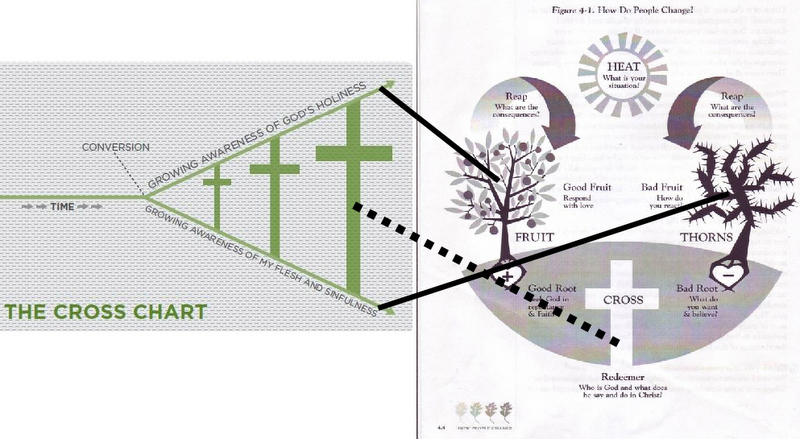
Understanding this lends insight to Tripp citations on the Peacekeepers Ministries website:
Paul Trip wrote a great post over at The Gospel Coalition blog all about the need for pastors to pursue a culture of forgiveness in their ministry. Pastors (and anyone serving Christ) have a choice:
“You can choose for disappointment to become distance, for affection to become dislike, and for a ministry partnership to morph into a search for an escape. You can taste the sad harvest of relational détente that so many church staffs live in, or you can plant better seeds and celebrate a much better harvest. The harvest of forgiveness, rooted in God’s forgiveness of you, is the kind of ministry relationship everyone wants.”
Then he describes three ways forgiveness can shape your ministry. I’ve listed them, but you can read how he explains them in detail.
“1. Forgiveness stimulates appreciation and affection.
2. Forgiveness produces patience.
3. Forgiveness is the fertile soil in which unity in relationships grows.”
He closes with this exhortation:
“So we learn to make war, but no longer with one another. Together we battle the one Enemy who is after us and our ministries. As we do this, we all become thankful that grace has freed us from the war with one another that we used to be so good at making.”
And concerning another author, they also stated:
Last week, Steve Cornell at The Gospel Coalition blog posted some really great insight into the difference between forgiveness and reconciliation. They also offered up some excellent and biblically sound steps in dealing with a situation where an offending party is hesitant to reconcile.
Here he summarizes a key distinction:
“It’s possible to forgive someone without offering immediate reconciliation. It’s possible for forgiveness to occur in the context of one’s relationship with God apart from contact with her offender. But reconciliation is focused on restoring broken relationships. And where trust is deeply broken, restoration is a process—sometimes, a lengthy one”…. His ten guidelines for those hesitant to reconcile are rooted in scripture and, I think, incredibly helpful.
1. Be honest about your motives.
2. Be humble in your attitude.
3. Be prayerful about the one who hurt you.
4. Be willing to admit ways you might have contributed to the problem.
5. Be honest with the offender.
6. Be objective about your hesitancy.
7. Be clear about the guidelines for restoration.
8. Be alert to Satan’s schemes.
9. Be mindful of God’s control.
10. Be realistic about the process.
Notice the overall blurring of distinction between the offended and offender with the subject of forgiveness.
The Cross-centered Anti-justice Pandemic is No longer Exclusively a Reformed Thing
Apart from Calvinism, the redemptive historical cross-centered approach is crossing denominational lines en masse. We at TANC see doctrines that were born of Luther’s theology of the cross in non-Reformed circles constantly; specifically, heart theology (deep repentance), exclusive interpretation of the Scriptures through a redemptive prism, Gospel Sanctification, and John Piper’s Christian hedonism. And we also see the same results. It is not beyond the pale for a pastor who has raped a parishioner to be the one counseling the victim sinner. You know, the “sinner saved by grace.”
God is a God of justice, and throughout the Scriptures He demands that we be people of justice. He demands that we come to the defense of the victim. I close with fitting words from church historian John Immel:
And this is the challenge. This is the challenge that I have as a man who is passionate about thinking: to inspire people to engage in complex ideas that drive tyranny. So here’s my challenge to those who are listening.
Do not be seduced into believing that righteousness is retreat from the world.
Do not be seduced into believing that spirituality is defined by weakness and that timid caution for fear of committing potential error is a reason to be quiet.
Do not be intimidated by vague, hazy threats of failure.
Do not let yourself believe that faith is a license to irrationality. I’m going to say that again to you. This is good. Do not let yourself believe that faith is a license to irrationality.
Do not mistake the simple nature of God’s love for a justification for simple-mindedness.
Do not deceive yourself with the polite notion that you are above the fray, that your right to believe is sufficient to the cause of righteousness. There is no more stunning conceit.
Do not pretend that your unwillingness to argue is the validation of truth.
Know this: Virtue in a vacuum is like the proverbial sound in the forest–irrelevant without a witness. Character is no private deed. To retreat is nothing more than a man closing his eyes and shutting his mouth to injustice.
Virtues are not estimates to be lofted gently against evil.
Virtues are not to be withheld from view in the name of grace.
Virtues are not to be politely swallowed in humble realization that we are all just sinners anyway.
Love is not a moral blank check against the endless tide of indulgent action.
Love is not blind to the cause and effect of reality.
Love is not indifference to plunder and injustice and servitude.
The time is now, you men of private virtue, to emerge from your fortress of solitude and demonstrate that you are worthy of a life that bears your name. The time is now, you men of private virtue, to answer Mick Jagger and all the nihilists that insist we are living on the edge and we cannot help but fall. It is time for you men of private virtue to take up the cause of human existence and think.
~TANC 2012 Conference on Gospel Discernment and Spiritual Tyranny: John Immel; session 1, “Assumptions + Logic = Action.”
paul
Stuart Scott’s Joyful Fellowship With Spiritual Despots is a Microcosm of New Calvinist Reasoning
 “Hence, and don’t miss this, justice is not the point. The concept of justice and fairness digresses from Reformed Calvinistic dualism.”
“….six months after Luther’s 95 Theses launched the Reformation, the true magnum opus of the Reformation was written by Martin Luther; his Heidelberg Disputation to the Augustinian Order. The document reflects Luther’s utter Platonist disdain for humanity.”
“Now, let’s take this information and evaluate why Scott et al are completely indifferent to suffering and injustice.”
Once again, Stuart Scott will break bread with the elders at Clearcreek Chapel (Springboro, Ohio) as he is the featured speaker at this year’s “Family Enrichment” Conference. Clearcreek Chapel having a family enrichment conference is like the Nazis sponsoring an endowment for Judaism. It’s a mockery; the Chapel has ravaged innumerable families and Christian lives since its orchestrated takeover by Russ Kennedy and aided by former Clearcreek elder Greg Cook. Cook brought in a group from another Baptist church which included present Clearcreek elders Chad Bresson and Dr. Dale Evans.
Their attempted takeover of the church they left failed, but their endeavor at the Chapel succeeded—the spiritual carnage notwithstanding. Cook, as the former (?) director of Clearcreek’s counseling program, was giving wives the green light to divorce husbands who had “ruined the family finances” while he himself was just under $200,000.00 in due and owing debt. It is unclear as to whether this revelation led to his stepping down as an elder, or not. Probably not since hypocrisy is a requirement for eldership in our day.
Other present Clearcreek elders have been forced to step down in the past, but have been reinstated; specifically, Mark Schindler who was re-baptized after his prior eldership. Apparently, not being sanctified by justification was the prior cause of his disgrace. Whatever it was specifically, his wife gave testimony that she never considered divorce and was determined to make the marriage work. It’s a pity that such wifely resolve that saved Schindler’s marriage is not encouraged among wives in the counseling rooms of the Chapel in this day. But one must remember that such resolve is only honorable in regard to saving the marriages of New Calvinist philosopher kings.
It all seems insane, until you realize that people act from their logic. Why would Scott give credence to such a camp? Why would he ignore the pleadings of the oppressed? Why is he, like all New Calvinists, utterly indifferent to justice? We get a clue from his book, The Exemplary Husband on page 72. He states the following:
God uses everything in our lives for His perfecting (growing) purposes (Romans 8:28-29; James 1:2-4). As we learned earlier, our growth as Christians toward Christ-likeness is a life-long process, often referred to as sanctification. Because God is so intent on sanctifying us, we know that He will certainly use our most important human relationships to do this.
Right. As I have worn out multiple keyboards emphasizing here on PPT, New Calvinism is a dualist philosophy. Let’s go over this again. Below is THEIR illustration, NOT mine:
Note first that regardless of their verbiage, they don’t believe we really grow, it’s the cross (what it represents) that grows. That’s obviously job one. The endeavor thereof requires a primary focus on two goals and two goals only: a deeper and deeper UNDERSTANDING of our sinfulness, and absolutely nothing else, as set against God’s holiness. Part and parcel with this is also the idea of worthlessness on our part.
The cross represents bigger and bigger salvation which must be manifested more and more until the day when our “final justification” is “revealed.” This occurs as we are sanctified the same way we are saved, by partaking in the realizing of our sinful worthlessness before God and His holiness. The more we understand the difference between the two, the more our salvation is manifested. We don’t change, only the greatness of our salvation changes in order to glorify God. Of course, this obviously redefines the new birth and denies it.
As prorogated in the satanic treatise, “How People Change” by Paul David Tripp, ALL tragic and sinful events in life serve the bottom of the cross chart, and ALL good that occurs in our lives serves the top of the chart. As we contemplate the gospel narrative, the goodness of God is manifested which contributes to more understanding at the top of the chart. Goodness is not our fruit, its God’s fruit only for the purpose of aiding us in understanding His goodness—not ours. Hence, and don’t miss this, justice is not the point. The concept of justice and fairness digresses from Reformed Calvinistic dualism.

The next point is that in the neo-Calvinist gospel schema, the Scriptures serve as a Cross narrative to help us see this dualism in a clearer way. In the mind of the neo-Calvinist, the Scriptures do not define what is right and fair; the Scriptures define Luther’s “cross story.” Here is what the vast majority of Christians do not understand: six months after Luther’s 95 Theses launched the Reformation, the true magnum opus of the Reformation was written by Martin Luther; his Heidelberg Disputation to the Augustinian Order. The document reflects Luther’s utter Platonist disdain for humanity.
In Luther’s Disputation, all reality must be seen through the cross story; i.e., the cross illustration at hand here, and ALL else is the “glory story” or anything at all to do with us—our glory, not the cross story that makes God bigger and mankind smaller. To any degree that we are in the equation, the cross story is diminished.
Now, let’s take this information and evaluate why Scott et al are completely indifferent to suffering and injustice. What did the Clearcreek elders do that is wrong? Nothing because the purpose of the Bible is not to judge the authority of Reformed elders, it is to show forth the cross story, not our story, and injustice is an Us Story kind of thing. Have former parishioners at Clearcreek suffered unjustly at the hands of the elders? Well, that’s a good thing! That suffering shows us the bottom of the chart. And besides, “justice”? If we got what we all deserved, there wouldn’t be any grace! Is this like Paul’s protest in Romans against propagating more evil that grace may abound? Yes, I think so. To the contrary in the minds of neo-Calvinists, we should bow down and thank God for bringing such abuse into our lives.
This is the gospel construct that rules the majority of biblical counseling in our day and is taking over the church in this country. It is a Platonist world view that set Europe on fire for hundreds of years with unspeakable horrors. And it is a story that is playing at a local church near you.
And this weekend, Stuart Scott brings his version of the show to Springboro, Ohio. A celebration of suffering in the name of Christ. But I have news for Scott: the sins of the Clearcreek elders does not cause grace to abound. And his appearance there has nothing to do with grace or love.
If there are any parishioners at Clearcreek (who may be reading this) who are presently there against their will for fear of public humiliation or things revealed in counseling —in your desperation, don’t slip Scott a note—he’s one of them.
paul
Stuart Scott of Southern Seminary is Just Another Wolf in the Pack
Integrity in pastoral ministry is caring about the one as much as the ninety-nine. It’s like the Jewish proverb: “He who saves one life saves the world.” James chastised Jewish leaders for treating a certain class of believers like they were expendable. Most leaders of our day don’t get that.
Once again, Stuart Scott, Director of “Biblical Counseling” at Southern Seminary will speak at Clearcreek Chapel’s (Springboro, Ohio) annual “Family Enrichment” Conference. Scott has been exhorted by me in the past to not lend the Chapel credibility in this way because they have never repented of a litany of unresolved conflict with many former members, some who fled the state of Ohio to get their families as far away from the Chapel as possible. The elders there are also on record in regard to preaching outrageous, cultish concepts.
Indifference to justice and spiritual abuse in the church is part and parcel with being a visible leader in our church culture today. The abused are expendable and underfoot. And unlike Hollywood where a few stars admit that they are Republicans, the spiritual rock stars of our day share no such intestinal fortitude, not even for what is right. Scott’s indifference is just another example among many. Whether Grace Community Church and their seminary in California, or his present tenure at Southern, Scott runs with the best of the wolf packs.
His former boss, John MacArthur, and his present boss, Al Mohler, both endorse /fellowship with CJ Mahaney. Regardless of being entangled in a lawsuit concerning various abuses by Mahaney’s ministry (SGM) including sexual abuse cover-ups, Mahaney will be a featured speaker at the next Together For The Gospel conference (T4G). Mohler, Mark Dever, Ligon Duncan, and CJ Mahaney are the “core four “ of these bi-annual conferences. Mohler, Dever, and Duncan continue to be staunch defenders of Mahaney. At the very least, Mahaney has never confessed his blackmailing of SGM’s co-founder in an effort to prevent him from leaving SGM for doctrinal reasons. Said co-founder tape recorded the attempted blackmail which involved counseling issues being made public. The transcript of the attempted blackmail has been made public.
Mahaney will also be a featured speaker at this year’s TGC conference (the bi-annual compliment of T4G) in April along with Al Mohler and the who’s who of the New Calvinist wolf pack. This conference includes many Emergent church speakers as well as the rankest of mystic heretics such as Tim Keller who propagates New Age spiritual contemplationism in broad daylight.
These people have zero pastoral integrity and absolutely no love for the truth. Scott, who undoubtedly lusts constantly to be a part of the bigger show, must settle for the smaller stages among the spiritual despots of our day; i.e., Clearcreek Chapel.
And that he will do. That is who he is. He is just another wolf in the pack.
paul

 Paul's Passing Thoughts
1 comment