It’s All About the “O”: Mohler, DeYoung, Lucas; We Own You
 “You could be in a church that is subtly indoctrinating your family with the idea that they are owned by the government; in this case, church polity.”
Join a New Calvinist Church if you will, but let it be known: they now own you. Newsflash for the husbands: Calvinist elders believe they have the ultimate say and authority in your home. And another thing: the gospel they hold to rejects synergism in sanctification as works salvation. So, guess what? If your wife buys into that, you are now in what they call a mixed marriage. You are now dangerously close to divorce court as the divorce rate in these churches has skyrocketed.
In our recent TANC 2012 conference, author John Immel nailed it—it boils down to who owns man: in the Christian realm; does Christ own you or Reformed elders? In the secular realm, does man own man or does government own man? Recently, our President stated that government owns man. Recently, in a trilogy of articles by three Reformed pastors published by Ligonier Ministries, it was stated that the church owns Christians, and I will give you three wild guesses as to who represents the authority of the church. That would be the elders.
So it’s all about the “O.” It’s all about “ownership.”
True, elders have authority, but not beyond the Scriptures that call Christians to interpret them according to their own biblically trained consciences. As we shall see, these articles plainly state the Reformed tradition that came from Catholic tyranny. The Reformers never repented of the same underlying presuppositions concerning man’s need to be owned by enlightened philosopher kings. The Reformation was merely a fight for control over the mutton with the Reformers seeing themselves as the moral philosopher kings as opposed to the Romish ones. Their doctrine was just a different take on how the totally depraved are saved from themselves. But both doctrines reflect the inability of man to participate in sanctification.
The three articles posted were: Should I Stay or Should I Go? by Albert Mohler; Where and How Do We Draw the Line? by Kevin DeYoung; and, Who Draws the Line? by Sean Michael Lucas. All linked together for your indoctrination convenience.
Al Mohler states in his ownership treatise that Christians have “no right” to leave one church for another because of preferences. Emphasis by underline added:
Far too many church members have become church shoppers. The biblical concept of ecclesiology has given way to a form of consumerism in which individuals shop around for the church that seems most to their liking at that moment. The issue can concern worship and music, relationships, teaching, or any number of other things. The pattern is the same, however – people feel free to leave one congregation for another for virtually any reason, or no reason at all.
Church shopping violates the integrity of the church and the meaning of church membership. When members leave for insufficient reason, the fellowship of the church is broken, its witness is weakened, and the peace and unity of the congregation are sacrificed. Tragically, a superficial understanding of church membership undermines our witness to the gospel of Christ.
There is no excuse for this phenomenon. We have no right to leave a church over preferences about music, personal taste, or even programming that does not meet expectations. These controversies or concerns should prompt the faithful Christian to consider how he might be of assistance in finding and forging a better way, rather than working to find an excuse to leave.
Where to begin? First of all, while many New Calvinist churches will bring you up on church discipline for leaving because of “unbiblical” reasons, those reasons vary from church to church. So, not only do the reasons for leaving vary among parishioners, but what constitutes proper “biblical…. ecclesiology” in regard to departure varies as well. Mohler states in the same post that doctrine is a valid reason to leave a church, but yet, one of the more prominent leaders of the New Calvinist movement (CJ Mahaney), who is strongly endorsed by Mohler, states that doctrine is not a valid reason to leave a church. CJ Mahaney substantiated that New Calvinist position and clearly indicated what New Calvinists are willing to do to enforce that position when he blackmailed the cofounder of SGM, Larry Tomczak:
Transcript of Phone Conversation between C.J., Doris and Larry Tomczak on October 3, 1997 pp. 10-11:
C.J.: Doctrine is an unacceptable reason for leaving P.D.I.
Larry: C.J., I’m not in sync with any of the T.U.L.I.P., so whether you agree or not, doctrine is one of the major reasons I believe it is God’s will to leave P.D.I. and it does need to be included in any statement put forth.
C.J.: If you do that, then it will be necessary for us to give a more detailed explanation of your sins [ie, beyond the sin of leaving for doctrinal reasons].
Larry: Justin’s name has been floated out there when there’s statements like revealing more details about my sin. What are you getting at?
C.J.: Justin’s name isn’t just floated out there – I’m stating it!
Larry: C.J. how can you do that after you encouraged
Justin to confess everything; get it all out. Then when he did, you reassured him “You have my word, it will never leave this room. Even our wives won’t be told.”
I repeatedly reassured him, “C.J. is a man of his word. You needn’t worry.” Now you’re talking of publically sharing the sins of his youth?!
C.J.: My statement was made in the context of that evening. If I knew then what you were going to do, I would have re-evaluated what I communicated.
Doris: C.J., are you aware that you are blackmailing Larry? You’ll make no mention of Justin’s sins, which he confessed and was forgiven of months ago, if Larry agrees with your statement, but you feel you have to warn the folks and go national with Justin’s sins if Larry pushes the doctrinal button? C.J., you are blackmailing Larry to say what you want!―Shame on you, C.J.! As a man of God and a father, shame on you!
This will send shock waves throughout the teens in P.D.I. and make many pastors’ teens vow, “I‘ll never confess my secret sins to C.J. or any of the team, seeing that they‘ll go public with my sins if my dad doesn‘t toe the line.”―C.J., you will reap whatever judgment you make on Justin. You
have a young son coming up. Another reason for my personally wanting to leave P.D.I. and never come back is this ungodly tactic of resorting to blackmail and intimidation of people!
C.J.: I can‘t speak for the team, but I want them to witness this. We’ll arrange a conference call next week with the team.
Doris: I want Justin to be part of that call. It’s his life that’s at stake.
C.J.: Fine.
(SGM Wikileaks, part 3, p.139. Online source: http://www.scribd.com/sgmwikileaks)
Of course, this example and many others makes Mohler’s concern with the “integrity” of the church—laughable. But nevertheless, Mohler’s post and the other two are clear as to what common ground New Calvinists have on the “biblical concept of ecclesiology.”
Besides the fact that parishioners “have no right” to leave a church based on preference, what do New Calvinists fundamentally agree on in this regard? That brings us to the article by Sean Michael Lucas :
Because the church has authority to declare doctrine, it is the church that has authority to draw doctrinal lines and serve as the final judge on doctrinal issues. Scripture teaches us that the church serves as the “pillar and buttress of the truth.”
So, even in cases where New Calvinists believe that doctrine is an acceptable reason for leaving a church, guess who decides what true doctrine is? “But Paul, he is speaking of doctrine being determined by the church as a whole, not just the elders.” Really? Lucas continues:
In our age, this understanding—that the church has Jesus’ authority to serve as the final judge on doctrinal matters— rubs us wrong for three reasons. First, it rubs us wrong because we are pronounced individualists. This is especially the case for contemporary American Christians, who have a built-in “democratic” bias to believe that the Bible’s theology is accessible to all well-meaning, thoughtful Christians. Because theological truth is democratically available to all, such individuals can stand toe to toe with ministerial “experts” or ecclesiastical courts and reject their authority.
Creeped out yet? Well, if you are a blogger, it gets better:
Perhaps it is this individualistic, democratic perspective that has led to the rise of websites and blogs in which theology is done in public by a range of folks who may or may not be appropriately trained and ordained for a public teaching role. While the Internet has served as a “free press” that has provided important watchdog functions for various organizations, there are two downsides of the new media, which ironically move in opposite directions. On the one side, the new media (blogs, websites, podcasts, Facebook, Twitter) allow everyone to be his own theologian and judge of doctrinal matters. But because everyone is shouting and judging, the ironic other side is that those who are the most well known and have the biggest blogs gain the most market share and actually become the doctrinal arbiters of our electronic age. In this new media world, the idea that the church as a corporate body actually has authority to declare doctrine and judge on doctrinal issues is anathema.
Lucas continues to articulate the Reformed tradition that holds to the plenary authority of elders supposedly granted to them by Christ:
For some of us, again reflecting our individualism, such understanding of the church unnecessarily limits voices and perspectives that might be helpful in conversation. But restricting access to debates and judgments about theology to those who have been set apart as elders in Christ’s church and who have gathered for the purpose of study, prayer, and declaration actually ensures a more thoughtful process and a surer understanding of Christ’s Word than a pell-mell, democratic, individualistic free-for-all. Not only do we trust that a multiplicity of voices is represented by the eldership, but, above all, we trust that the single voice of the Spirit of Jesus will be heard in our midst.
So, bottom line: the priesthood of believers is a “pell-mell, democratic, individualistic free-for-all.” Still not creeped out? Then consider how they answer the question in regard to elder error:
Of course, such slow and deliberate processes do not guarantee a biblically appropriate result. After all, the Westminster Confession of Faith tells us that “all synods or councils, since the apostles’ times, whether general or particular, may err; and many have erred” (WCF 31.3). Sometimes, entire denominations err significantly as they prayerfully consider Scripture and judge doctrine. Such error, however, does not negate Jesus’ own delegation of authority to the church and set the stage for a free-for-all.
This brings us to another issue that DeYoung propogates in his post: since Reformed elders have all authority, their creeds and confessions are authoritative and not just commentaries. Hence, they declared in the aforementioned confession cited by Lucas that even though they error, they still have all authority. Whatever happened to the Apostle Paul’s appeal to only follow him as he followed Christ?
DeYoung:
Those who wrote the ancient creeds, such as the Apostles’ Creed, the Nicene Creed, and the Chalcedonian Definition, were not infallible, but these creeds have served as effective guardrails, keeping God’s people on the path of truth. It would take extraordinary new insight or extraordinary hubris to jettison these ancient formulas. They provide faithful summaries of the most important doctrines of the faith. That’s why the Heidelberg Catechism refers us to the Apostles’ Creed, “a creed beyond doubt, and confessed through the world,” when it asks, “What then must a Christian believe?” (Q&A 22–23).
FYI: If you see something in your own Bible reading that contradicts a Reformed creed or confession, you are partaking in visions of grandeur.
This is the crux of the matter; the question of authority. It is almost crazy that Christians don’t have this issue resolved in their mind before they join a church. You could be in a church that is subtly indoctrinating your family with the idea that they are owned by the government; in this case, church polity.
Let there be no doubt about it, New Calvinists are drooling over the idea of another Geneva theocracy with all the trimmings. And someone shared with me just the other day how this shows itself in real life. “Mike” is a local contractor in the Xenia, Ohio area. He is close friends with a farmer in the area who lives next door to a man and his family that attend a New Calvinist church.
One day, His new New Calvinist neighbor came over to inform him that he needed to stop working on Sunday because it is the Lord’s Day, and the noise of his machinery was disturbing their day of rest. Mike’s friend told him, in a manner of speaking, to hang it on his beak. Mike believes what transpired after that came from the neighbor’s belief that he was a superior person to his friend, and that his friend should have honored the neighbors request by virtue of who he is.
The neighbor has clout in the community, and to make a long story short—found many ways to make Mike’s friend miserable through legal wrangling about property line issues; according to my understanding, 8” worth. It was clear that Mike’s friend was going to be harassed until he submitted to this man’s perceived biblical authority.
New Calvinists have serious authority issues, and you don’t have to necessarily join in official membership to be considered under their authority. A contributor to Mark Dever’s 9 Marks blog stated that anyone who comes in the front door of a church proclaiming Christ as Lord is under the authority of that church.
It’s time for Christians to nail down the “O.” Who owns you? Are you aware of who owns you (or at least thinks so)? And are you ok with that?
paul
Joseph Prince and John Piper Sitting in a Tree, K-i-s-s-i-n-g and Why John MacArthur is a Hypocrite

Kinder, Gentler Calvinist
“Not only that, Prince et al are kinder, gentler Calvinists who wouldn’t dream of endorsing a serial sheep abuser like CJ Mahaney.”
I have seen something for some time that I just haven’t had time to write on: Joseph Prince, the charismatic prince of Singapore, knows the Reformation gospel to a “T” and does a phenomenal job of articulating it from the pulpit. Really, the big boys, Piper et al, can’t touch this guy when he talks about the Reformation gospel of progressive justification from the pulpit. Check out the video series from when Prince preached at Joel Osteen’s church. It is the Reformed Justification by Faith Alone [for sanctification also] par excellent bar none.
Yes, yes, Prince has a different application of that gospel in some areas of life. He uses progressive justification to promote prosperity. It is not true that Prince promotes a “prosperity gospel”—that’s a red herring to throw folks off the scent—his gospel is the Reformed gospel of Justification by Faith Alone [for sanctification also] to a “T.” In fact, Prince’s application of the gospel is actually less harmful than the New Calvinist spiritual despots. And there are no charges of spiritual abuse or control issues coming from Prince’s camp as yet. Indeed, the prosperity Gospel Sanctification camp seems to be a kinder, gentler Reformed theology (by golly, that’s a tweet).
I was given the opportunity to squeeze this post into my schedule via a Facebook conversation I stumbled into yesterday. Jo Bowyer of The Reformed Traveler blog stated the following on her FB page:
The Resurgence [I am assuming the New Calvinist Resurgence blog] now quoting Joseph Prince? Seriously?????!!!! The quote they used is this:
“The law justified no one and condemned the best of us, but grace saves even the worst of us.” – Joseph Prince
I wasn’t the least bit surprised. It’s the same gospel. The New Calvinist crowd then picks and chooses who they will associate with according to the application thereof and other criteria. Certain biblical anomalies are acceptable because such and such “has the gospel right and the other issue is secondary” while some have “secondary” 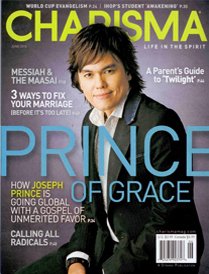 applications that they deem unacceptable. This not only explains the strong ecumenical flavor of New Calvinism, but exposes it for its pervasive hypocrisy.
What better example than John MacArthur who continually rags on Joel Osteen and the likes of Prince while he believes the same gospel. Gag, his hypocrisy makes me sick! Not only that, Prince et al are kinder, gentler Calvinists who wouldn’t dream of endorsing a serial sheep abuser like CJ Mahaney. Like MacArthur does.
Yes, the internet is a wonderful gift from God. While the European oppression of the Scriptures was cured by Gutenberg’s press, the deep deception of Reformed theology is exposed by Google. As Joseph Prince would say, “Thank you Jesus.” I said to self: “Self, I am very busy, what’s the best infogoog for this?” So I typed in, “Joseph Prince John Piper” and came up with a jewel.
It was a post by some Reformed guy objecting to the fact that many people think Justification by Faith Alone “for the baptized as well as the unsaved” is all of Joseph Prince’s idea. He makes the case that the Reformers had the idea first, and posted two videos by John Piper and RC Sproul to prove it. Too rich.
Now look, I am really busy and must move on, but you bloggers out there, with the help Gootenberg, can have a lot of fun with this. Trust me, the infogoog on this is vast.
paul
Why Bloggers Must Stand Against Spiritual Despots
 It’s time to get a grip. Susan and I have been visiting many churches and reading a mass of recommended sermons on, “forgiveness,” “judging others,” “humbleness,” and “pursuing peace” that are saturating the internet. These sermons, like the ones we are hearing Sunday, after Sunday, are geared to control people via the following principles; albeit ever so subtle, and of course, by proof texting:
1. In comparison to Christ, everything on Earth, including life in general, is a pile of dung. So, all the bad things that happen are irrelevant. I mean, what do you expect? God allows these things to happen to draw us closer to Him and wean us from our desires for things on Earth. Oh that we would have no desires whatsoever other than “Christ and Him crucified!” That is our goal. No desires at all other than Christ is the ideal.
2. “Justice?” [add sarcastic smirk that begs the question: are you really that clueless?]. “You want justice? If we all got what we deserved, we would all be in hell!” “In regard to everything in life, remember the Puritan who looked upon a marcel of meat that was his only meal for that day and said, ‘What? Christ?? And this also???!’” Being interpreted: any dissatisfaction with life at all directly relates to your unthankfullness for being one of the chosen ones. Yes, I had a sinful thought the other day: I was thinking about how nice it would be to take Susan on a cruise. Just the two of us out on some boat in the middle of God’s vast ocean. How dare me! Those thoughts could have been better expended on the excellency of Christ!
3. The saints are incapable of righteous indignation because of our total depravity. Righteous indignation is arrogance. All anger is sin. We are always angry because we didn’t get our own way.
4. A sense of accomplishment is pride. Jesus does it all for us. We are totally depraved and every good work we do was preordained by God for His glory, and the rest of our life is left to us to muddle through to teach us not to depend on any of our fleshly “strengths” or “abilities.” It’s all good—both what God has predetermined and our own sins point us back to Christ and His works only, “not anything we would do.” “It’s not our doing—it’s Christ’s doing and dying.”
5. The preordained elders of the church must use the law to control the totally depraved zombie sheep. However, remember, every verse must be seen in the context of the historical Christ event, and this takes a special anointing given to those who have been preordained to lead the zombie sheep to heavenly safety despite themselves. “I’m sorry, you who question the elders, it just so happens that your marriage doesn’t ‘look like the gospel’ so we must tell your wife to divorce you. Yes, I know it seems like a contradiction to the plain sense of Scripture, but you don’t have the special anointing that enables you to see the ‘higher law of Christ’ that we can see.”
6. And remember, even though they are God’s chosen and specially anointed, they are still totally depraved like us. See, this is a huge problem—this whole problem with evangelicals wanting Reformed elders to “be the gospel, rather than preaching the gospel.” In other words, trying to manifest our own behavior, rather than manifesting the gospel; ie., Christ’s “active obedience” that is continually imputed to us in sanctification.
7. Conclusion: Keep your stinking mouth shut, buy the books that translate the Bible into “Chrsitocentric gospel truth,” tithe 10% or else, sit under elder preaching as the only way to manifest the historic Christ event, rejoice that all evil in the church makes the cross bigger, and report people who ask questions.
Certainly, the wholesale brainwashing of the saints in this country, and in our day, may be unprecedented. I see it daily in this ministry through correspondence from battered sheep: “Are my elders wrong in their wrongdoing?” How would we know? They supposedly can see things we can’t see. The rest of the congregation is told to “trust the elders who are close to the situation and know all the facts.” Saints stand perplexed and ask, “How can they do that when it is plainly against the Bible?” The answer is simple: they don’t read their Bibles the same way we do. The “gospel” is an objective truth (by the one word only) that is an unknowable eternal truth that the “knowers” can only know.
The Reformers bought into all this stuff, and it is nothing more than a Gnostic perspective that despises life. The statements that vouch for this are everywhere in the Calvin Institutes and Luther’s commentaries, as well as things spoken by contemporary Neo-Calvinists, but we simply don’t want to believe that they are saying what they are saying. Could they be wrong in their wrong? Could they be erroneous in their error? Is their hatred really hatred? Is their law-breaking really a violation of the law? Where do I even begin here? I had a Reformed elder call and tell me that another elder told him that God will bind in heaven whatever elders bind on earth—even if they are wrong. He then added that he didn’t really believe the guy said it. He was standing there, did he say it or not? And if he did, do they really believe that? Hhhheeeellllooo, yes they do!
This is just all a repeat of history. It all boils down to whether men own men by proxy, or whether God owns man. And if God owns man, to what point does He want us to be responsible for ourselves? To what point does our participation in life matter? How are we to think about the full philosophical spectrum of life? Bottom line: we are letting spiritual despots determine these questions and not our Creator. And yes, what God wants to be accomplished in His kingdom is being affected. The world is watching, and they are not impressed, and the answer is not “keeping it all in the family.” And, “What happens in the church, stays in the church because the world doesn’t understand the ‘historic Christ event.’”
“Deb,” or “Dee,” I forget which, over at, I forget, “The Whatburg blog”? or something like that, got it right: the internet is the modern-day Gutenberg press. Yes, there is a lot of pain out there, but there will be a lot more if what is done in darkness is not exposed to the light. This is exactly what God’s word instructs us to do when professing Christians refuse to repent of serious offences against each other: “TELL IT TO THE CHURCH.” Then what? Those who are aware of it are to “stay aloof” from them. It is a fellowship issue. And the willingness of MacArthur et al to fellowship with serial sheep abusers shows what their true love for biblical truth is: not much, if any.
Do you think I am being extreme? Then explain the following to me:
1. The rampant cover-ups by “respected” church leaders.
2. The utter indifference to abuse by the leaders of our day.
3. The blanket acceptance of ridiculous ideas by the who’s who of national religious leaders; such as, John Piper’s “Scream of the Damned.”
4. The wholesale fellowship of leaders with blatant mystics like Tim Keller.
5. Rape and pedophilia swept under the rug and ignored—an atrocity that was once identified primarily with the Catholic Church.
Whether Rome or Reformed, the behavior is the same because the underlying presupposition is the same: the totally depraved must be enslaved to “enlightened” leaders; supposedly, by God’s approved proxy. And there are a hundred different doctrines that seek to reach that goal—we argue over the correctness of each doctrinal nuance, but the goal of all of them is the same: CONTROL. As author John Immel aptly states, these men speak for God, but the problem is….God is not standing there to personally object. Immel states this as a manner of speaking—God is standing there to object, if the mental sluggards of our day would open the Bible and listen for themselves.
But nevertheless, this is way Reformed theologians want to make the Bible a mystical gospel narrative rather than a full philosophical statement on metaphysics, epistemology, ethics, and interpersonal application to be understood and interpreted by the individual born again believer with the help of elders—not the dictation thereof. The latter is for purposes of control—job one for most churches in this country.
The state’s worst fear is an uncontrolled populous, and religions have always come knocking on their doors offering a belief system that will produce a docile mass, and by the way, “if they won’t believe what we tell them to, you can kill them for us.” Do some historical googling on your own—Rome nor the Reformers have ever been any different on this wise. Oh, and you can add the Puritans to that list as well. They called their place of landing “New England.” New location—same England, complete with witch hunts and persecution of those who disagreed with them. Uh, do you think it is coincidence that their only Bible was the Geneva Bible? Now research the city council archives from Geneva during the time Calvin ruled there. Yes, it really happened. And yes, Rome would do what they have always done if the Enlightenment had not put them in their place. Historically, whether Reformed, or Romish, their tyranny has gone underground when they are contended against. A good illustration of this is the book. “House Of Death and Gate Of Hell” by Pastor L.J. King. Pushed back by the Enlightenment, the Catholic Church merely went underground with the Inquisition. Therefore, all of the whining about the evils of the Enlightenment among the Reformed is no accident. The freedom of ideas has always been the tyrants worst enemy.
“Oh now Paul, you can’t just paint the whole movement with one big brush.” Why not? That’s how Jesus painted the Pharisees. When did Jesus ever say, “Beware of the leaven of the Pharisees, but they aren’t all bad. I can’t just paint the whole movement with a big brush. Some of those guys are ok. We have to take from the shelf what is good and leave the rest where we found it.” See my point on how the Bible is a comprehensive statement on how to live and think for the individual? We can’t use it for that if it is a mystical gospel narrative. And that’s the point: control, by removing our ability to think for ourselves. When we read that Luther despised reason, we don’t think he really meant it just because he wrote it. Oh really?
So, in case you aren’t keeping track, that’s reason number three why discernment bloggers need to keep up the blogging: it’s a call to come out from among them. That’s the biblical model: ducks swim with the ducks and birds fly with the birds. Congregations that support abusive ministries need to be confronted about it, and most certainly, others need to be warned that they shouldn’t support those ministries either. Statistics show that 80% of all parishioners who visit a church will google it—exactly, why should the other side of the story not be told? Because abusive churches are masters of deceit, and centralist doctrine is slowly assimilated into the minds of people like the proverbial frog in boiling water, many people are simply in too deep before they realize what is going on. I deal with people who are simply too spiritually weak (through indoctrination designed to do just that) to do what they have to do to leave a given church. Let me state something in regard to what John Immel calls “private virtue.” If warning a sleeping family that their house is on fire is not a private virtue, which Immel rightly fingers as an oxymoron, neither is blogging about abusive churches. Far from it. There is no place for private virtue in our duty to stand against spiritually abusive leaders.
Another reason that the bogosphere must continue to take a hard stand is because the Bible specifically states that we are to do just that. Consider 2 Corinthians 10:4,5;
The weapons we fight with are not the weapons of the world. On the contrary, they have divine power to demolish strongholds. We demolish arguments and every pretension that sets itself up against the knowledge of God, and we take captive every thought to make it obedient to Christ.
Christians have a duty to contend against EVERY “thought” that is contrary to God’s truth, and they are to use truth to do that. I don’t think much needs to be added to this point.
Like our belief that the Popes of our day wouldn’t repeat the horrors of the inquisition, even though they clearly did up until the early 50’s after being forced underground by the Enlightenment, we imagine that the Neo-Calvinists of our day would never repeat the behavior of the Reformers and Puritans. We are sadly mistaken. The spiritual abuse tsunami that we are seeing in our day is Reformation light. The gallows and the stake stoked with green wood has been replaced by bogus church discipline with excommunication following, character assignation, commanding people to divorce their spouses, ruining people’s careers, and false incrimination. It is now protocol for many New Calvinist church leaders to make a concerted effort to get in tight with local law enforcement in case they would need a “favor.” In my contention with Clearcreek Chapel in Springboro, Ohio, I received a very inappropriate phone call from a police detective who ordered me to do certain things that were clearly outside of his authority. I immediately contacted an attorney and started compiling data because I didn’t know what was coming next. My life was also threatened via email. Whatever the present abuse might escalate to, I think it prudent to do all we can to end it where it is at.
The present-day Neo-Calvinists are absolutely correct: they have “rediscovered” the true Reformation gospel. Ministry themes like “Resurgence,” “Modern Reformation,” and “Resolved” are absolutely correct in their assertion that the true Reformation gospel has been recently rediscovered (circa 1970). But where did it go? “The Enlightenment and Existentialism suppressed It.” Hardly. The Enlightenment and Existentialist movements were a pushback against the tyranny that is part and parcel with the Reformation gospel. The Reformation gospel dies a social death every 100-150 years because of the following:
1. The idea of the plenary inability of man leads to a significant decrease in quality of life.
2. The saints eventually discover that said philosophy imposed an interpretation on the Bible regarding the gospel, instead of a gospel understood from exegesis. Another way of stating it: The Reformation gospel is false, fuses justification and sanctification together so that all works are of God only, denies the new birth, is Gnostic, and is accompanied by bad fruit accordingly.
3. The tranny that cannot help but be a part of this doctrine eventually peaks; ie., the saints finally get fed-up.
4. The Gnostic concept of continually recycling a narrow concept that is supposedly the gateway to higher knowledge eventually gets boring. In this case; gospel this, gospel that, gospel the other, gospel driven marriage, gospel driven music, gospel driven child rearing, gospel driven drivers education, gospel driven weight loss programs, and 52 different versions of the gospel a year parsed out on each Sunday. People also get tired of 7/11 music: seven verses about Jesus repeated 11 times.
5. A narrow sanctification dynamic begins to wreak havoc on the saints; ie., ruined lives become the norm.
6. An air of indifference becomes evident. Everybody starts acting like Dr. Spock.
7. Like its kissing cousin, Communism, it just eventually sucks the life out of people, and they start looking for something else. The doctrine simply does not deliver in the long run.
8. The light bulb finally turns on: when the doctor says: “there is nothing we can do,” that =’s no hope. The saints begin to wonder why the Christian life is any different.
And that’s what we are seeing right now. Big time. And regardless of the various stripes of those who are in the fight—we are united on the following: the tyranny and abuse must stop. And what will stop it is the same thing that has always stopped it: the truth proclaimed from the housetops. An incessant, relentless, tenacious proclaiming of the truth hastens the rightful death of tyranny.
It is true, “the keyboard is mightier than the sword.”
paul
The Doctrine of Centralism Will Save First Baptist Church of Hammond and IFB
 In my recent post, The Doctrine of Centralism and the “Cult” Misnomer, I explain the doctrine of control, or centralism. First, Western culture is predicated on the idea that philosophers should rule over the ignorant masses. This was formulated in the first philosophical think tank and institution of higher learning located in Athens Greece circa 400BC. From there, the philosophy moved forward and made its impact on Western culture through the secular realm and the religious realm.
In the religious realm, Plato’s philosopher kings became popes and Reformation elders. That is why the Reformers and the popes both believed (and still do) in the integration of religion and state for purposes of enforcing “God’s law” on society. The state gets a unifying belief system that unites the populous in the deal, and the philosopher kings get an army to enforce discipline on the totally depraved sheep if necessary. The whole idea that the Reformation was a contention for the true gospel of grace is just really bad history—it was a fight for control of the mutton.
The founding fathers of America were contemporary observers of the results, which have never been good. The U.S. constitution was predicated on the idea of keeping the church separate from state with the latter being in complete servitude to the people. But centralism remains dominate in American religion. However, it can’t enforce its control by the stake or gallows, so it improvises through indoctrination. In years past, popes and the likes of John Calvin did not have to be good at indoctrination because the state enforced their doctrine—contemporary proponents of centralism have to craft their doctrine well in order to gain control of people.
And the Independent Fundamental Baptist (IFB) pastor kings are among the very best. We will now examine the art of centralism indoctrination. Keep in mind that a lot of the indoctrination is already in place via years of “preaching” by Jack Hyles and his recently fired son-in-law who had sex with a sixteen year old girl. We will focus on the centralism being used to deal with this recent scandal, and paving the way for business as usual at the First Baptist Church of Hammond and IFB churches in general.
Because of my busy schedule, I do not have time to document the actual footage I have seen in this situation that fit into the following criteria, but perhaps readers could comment and add the citations for each.
1. The philosopher king has fallen. The emphasis is on the great loss of this vital pastor king whom the totally depraved sinner-saints depend on. He will be mentioned 100 to one in comparison to the victim. “Oh my! The sheep are without a shepherd!”
2. Enlightened, but still of the earth. Remember, though pastor kings are enlightened and “called” of God to lead the totally depraved zombie sheep home through the dark maze of sanctification, they are still SINNERS. These poor souls have been called of God to vex their righteous souls among the totally depraved, and bless their hearts, sometimes they “fall.” How dare we judge them when they have forfeited their rightful place in heaven to lead us amidst this pigpen called Earth!
3. It’s the congregations’ fault. I have heard several comments by IFB big guns who have been brought in to apply the centralism protocol that implements this element, including the interim pastor king. Basically, the idea that because of the inherent selfishness of the zombie sheep, too much pressure was put on Schaap—leading to his “fall.” The kingdom of darkness targets the pastor kings specifically, and the congregation has been an unwitting accomplice with the devil. THEY SHOULD BE ASHAMED!
4. Certification/reassurance by secondary pastor kings. The sub-pastor kings at FBCH reassure the totally depraved zombie sheep that Schaap is still God’s anointed pastor king. They point to his many years of faithful service as proof [this guy was fairly good, it took 11 years to catch him]. As one sub-pastor king noted, “I love this church.” Ah, and if a pastor king loves that church—you must also. Thou pastor king has spoken—let it be written. Who can forget the infamous words of daddy Jack Hyles: “Now I want you to close your Bibles and listen to me.”
5. Dualism. All that IFB does that manifests heaven is a testimony to godly unity, and proof that there is an IFB temple in heavenly Jerusalem. But when something bad happens, it has absolutely NOTHING to do with the heavenly IFB. Because after all, they are “independent” of each other. You idiot, can’t you read the “independent” in “IFB”? In all of their “unity” (IFB has a cooperative network unmatched anywhere on Earth), is heaven manifested on earth, but when they fall get caught, that is a manifestation of the “independent” church’s evil matter. “You can’t just swath a big brush across all of IFB because of this!” Oh yes you can. All IFB affiliated churches run by the same playbook that is driven by the same philosophy. Hence, the results will be duplicated. Look, this prism is exact across all denominational, religious, and cultic lines. It is based a specific presupposition concerning mankind as opposed to a true emphasis on the priesthood of believers. This protocol can be seen to a “T” in the SBC, and especially SGM. Therefore, the massive network based on a given philosophy that produces the behavior is preserved.
6. Us against them. The “world” and competing philosopher kings would love to see the heavenly IFB’s representation on earth fall. Don’t let that happen! Be a team player! “Please, stick with us.”
Yes, much is at stake. IFB philosopher pastor kings could be deprived of the concubines that they so deserve—a small price for us to pay for their sacrifice for us in the evil realm of earthly matter. Fathers should feel privileged and proud as their raped daughters sign confessions for being the devil’s advocates in bringing down the great pastor kings.
And this isn’t just IFB, this is a mirror image of the SBC, SGM, LDS, GARB, etc., etc., etc., etc..
paul

 Paul's Passing Thoughts
15 comments