The Unauthorized Patience of the Elect: 1 Thessalonians 5:12-28
 One of the many callings of believers is to fully embrace and love difficult people who profess to be believers. I believe home fellowships are better equipped to do this than the institutional church by far. This culture is awash with people, many of whom are professing believers, who have personality disorders. These are people who have developed patterns and habits of thinking that cause them to be completely off the tracks socially. Since the government ran out of money and can no longer afford to institutionalize these people, they are among us. If they are older, some can be put in nursing homes where their social security will be confiscated in exchange for medicating them until they die.
Welcome to real believeism. We are not here for our best life now, we are here on assignment. We are ambassadors representing God’s kingdom. We are also literally God’s family. Thy brother may be bi-polar, ahhhmen. We are God’s elect. That doesn’t mean we were elected individually, it means God elected the means of salvation and the types of people he would primarily call. The sterilized institutional church and all of its aristocracy is an usurper—that is not what God elected. Certainly they are welcome if they want to come, but they were never the primary target in regard to what God elected.
For consider your calling, brothers: not many of you were wise according to worldly standards, not many were powerful, not many were of noble birth. 27But God chose [elected] what is foolish in the world to shame the wise; God chose [elected] what is weak in the world to shame the strong; 28God chose [elected] what is low and despised in the world, even things that are not, to bring to nothing things that are, 29so that no human being might boast in the presence of God. 30And because of him you are in Christ Jesus, who became to us wisdom from God, righteousness and sanctification and redemption,31so that, as it is written, “Let the one who boasts, boast in the Lord.”
Look, I have been around church long enough to know that churchians don’t want to deal with the socially awkward, but I think the focus of Christ’s ministry is fairly obvious; He sought out the misfits of the world and all but completely ignored the religious academics of that time. The New Testament documents the indignation of the elitists accordingly. Come now, let’s think about this: Christianity is about conferences in Palm Springs hosted by celebrity pastors and $350.00 entry fees? And Caribbean Cruises hosted by celebrity pastors? Really? Have we lost our minds?
Church is where you get your ongoing salvation, and Christian living that glorifies God is barely on the radar screen. While the church mocks self-sufficiency, its worldly natural selection produces such. What better describes the present-day megachurch culture than, “We are rich and have need of nothing.” And don’t give me a load of crap regarding the institutional church’s token ministries for purposes of window dressing; we all know what its core constituency is. Those prone to lesser death are left to feed the ego of praise bands while those less disciplined are dumped out on the streets via ostracization for the world to deal with…while professing Christ.
So, we have a good reminder in 1Thessolonians 5:12-28 that believeism embraces the elect. That’s our calling. Like Christ, we are not looking to add Jeeesuuuus to mundane suburbia, we embrace difficult people with patience and wisdom. And it will take patience, active love, and good verbal judo. Let’s first take note of who this letter is written to; it is written to all Christians at large, as with all of God’s revelation. God writes letters addressed to mankind, and then religious academics claim that only they can properly interpret the letters. We need to stop buying into this silliness yesterday. Look at the obviousness of this:
We ask you, brothers, to respect those who labor among you and are over you in the Lord and admonish you…See that no one repays anyone evil for evil…I put you under oath before the Lord to have this letter read to all the brothers.
First of all, obviously, this letter, like most from the apostles (note “we” throughout) is not written particularly to the leadership gifted to warn and protect God’s people from the gangrene of doctrinal error. It is written to the saints at large. Christ’s body is a unified body of gifts working together for a common cause with Him being the ONLY authority…period. That’s why God speaks to the whole family. The leaders and doctrinal discerners are merely gifted body parts, not authoritarians. In fact, note the tendency that Paul often addressed among believers at that time to not respect the ministers of the word. Also note that the word translated “over you” is the word “hymōn” which is usually translated “of you,” not “over you.” The word is simply the personal pronoun, “you.” The liberties taken by English translations that mostly come from the Reformers would be hilarious if not so scandalous in making this a case for elder authority. It’s just not there by any stretch of grammatical imagination. The Complete Jewish Bible probably captures a good sense of this verse:
We ask you, brothers, to respect those who are working hard among you, those who are guiding you in the Lord and confronting you in order to help you change.
Also note who has been charged with making sure things are executed correctly: “See that no one repays anyone evil for evil,” viz, EVERYONE is to “see” to it. This same pattern saturates the New Testament. EVERYONE is responsible to see that things are done correctly before Christ—this is not the particular role of elders. I could go on and on here, but I would add counseling to that list as well (Romans 15:14).
And who is charged with making sure this letter is read to all of the brothers? Answer: all of the brothers. Any questions?
The first type of believer Paul notes is the ataktos. They are generally disorganized and unproductive. They are unmotivated in general. Paul, in representing the apostles in this letter, says to noutheteó them. In other words, counsel them. We are to stir their gift up within them. Susan and I are presently working with a precious believer that is presently unmotivated due to some significant trials in her life. One particular trial is defining her whole life. Come to find out yesterday that she is an accomplished piano player. Guess who will soon be receiving a piano? This is how it works. This is our charge.
The second type (for lack of a better term) of believer that Paul addresses is the oligopsuchos—they are faint-hearted, and given to fear. We are to paramutheomai them. That is, we are to encourage them, and make them feel protected, because we do protect them. Home fellowships are ideal environments for these tendencies and needs to be revealed.
Thirdly, Paul says to antechó the asthenés. We are to “hold fast” and “cling to” those who are weak and sickly. But guess what? These will also be prone to lack of motivation and fear. We are to “hold fast” to them. We are to “cling to them.” These characteristics often abide together through cause and effect.
And it will take patience. These are difficult people to deal with as they lash out at the world in fear and confusion. If we are not careful, we will even find ourselves, repaying evil for evil instead of holding fast to them. This is where the rubber of believeism meets the road. This is where we walk in the footsteps of Christ.
This is our calling. This is what makes us the elect. This is family. This is the kingdom. This is our apostolic charge. Aristocracy is most welcome, but check your authority at the door. We have no Lord but Christ, and our only law is love.
paul
The Problem with Authority
 I was reminded just yesterday why believers must begin taking a much closer look at the subject of authority. A client of mine complained that her adolescent’s social services counselor actually suggested that her son should sue her! This immediately brought back to mind something Susan, my wife, had shared with me concerning outside counseling that one of her sons had received prior to our marriage that was also divisive.
Authority is bad for the family unit. A major theme of TANC Ministries of late has been the love versus authority issue. If you give the subject serious thought, it would almost seem like authority is a necessary evil. Remember, the undisputed greatest nation in history, America, was founded on less governmental authority in exchange for individual liberty. It was founded on the idea of self-governance. Until America, freedom of the individual was greatly feared and thought to be a sure catalyst of chaos that would bring an end to human existence.
But authority divides, and can only bring about conformity and nothing else. The apostle Paul said it best:
1 Timothy 1:5 – The aim of our charge is love that issues from a pure heart and a good conscience and a sincere faith. 6 Certain persons, by swerving from these, have wandered away into vain discussion, 7 desiring to be teachers of the law, without understanding either what they are saying or the things about which they make confident assertions. 8 Now we know that the law is good, if one uses it lawfully, 9 understanding this, that the law is not laid down for the just but for the lawless and disobedient, for the ungodly and sinners, for the unholy and profane, for those who strike their fathers and mothers, for murderers, 10 the sexually immoral, men who practice homosexuality, enslavers, liars, perjurers, and whatever else is contrary to sound doctrine…
The law is used lawfully when it is used for love. Love fulfills the whole law (Rom 13:10, Gal 5:14, Jms 2:8, Matt 22:40). The law asks, “Did you sin today?” Lawfulness asks, “Did you love today?” Authority asks, “Did you do what I told you to do?” Love asks, “What do you need today?” One seeks to outdo each other in meeting needs and honoring one another (Rom 12:10 ESV), the other seeks to outdo each other with control. I have been around long enough in pastor clicks to know that the pastors who are respected most “run a tight ship.” The famous Jack Hyles, the “best preacher since the apostle Paul,” once displayed his pastoral savvy by ordering a deacon to stand up and sit down upon his command of which said deacon obeyed on cue. Parishioners sought Hyles’ permission to go on vacation and buy new cars.
The scope of authority and its true usefulness in this age is extremely narrow. Governments are God’s ministers only when they fulfill His purposes of rewarding good and punishing evil. But Romans 13:1-10 reveals something astounding: we owe the government payment for such services before God, but we only owe each other love. Government is an institution—God’s people are a body. We give money according to the needs of others, not an authoritative religious establishment.
However, the main concern of this post is how outside authority divides families and marriages, especially religious authority. In general, when there is strife and division, authority is always lingering in the shadows someplace. And most troubling is the assertion that “If everyone would just obey the Holy See there would be perfect unity.” But herein is the glaring problem: God will judge individuals—NOT institutions. Even in this present age, how many have been hanged on the gallows of justice for following the orders of those in authority? During WWII, an adolescent could totally circumvent their parents’ authority by joining the Hitler Youth movement. The authority of parents over their children was completely usurped by the state.
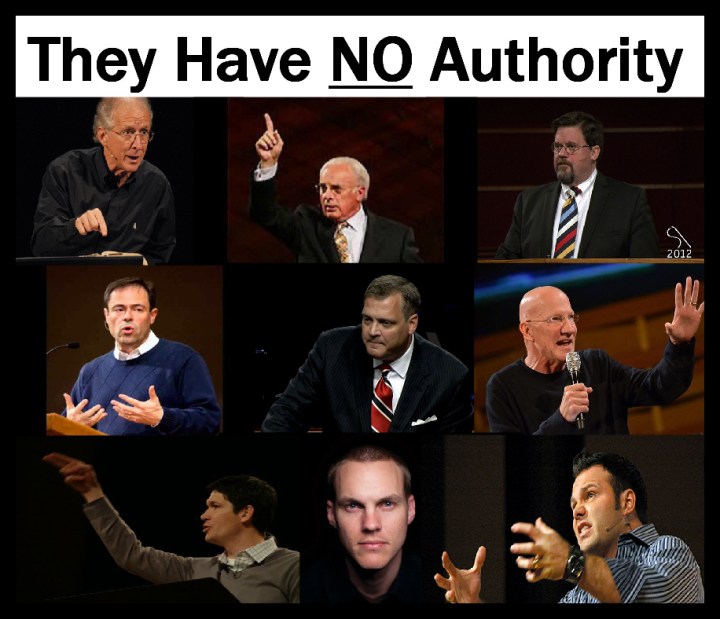
Likewise, due to the New Calvinist movement unmasking the true orthodoxy of the Protestant Reformation, the present-day institutional church openly claims authority over the family unit and labels husbands as sub-elders over their families. Wives who don’t buy in are stripped of their salvation by the completely bogus concept of “church discipline.” Whenever I challenge someone to find “church discipline” in the Bible, they always cite verses that invoke… “Ok, so, where is church discipline in this passage?” Take Matthew 18 for example: where is church discipline in that passage? And for that matter, where are the elders? Most absurdly assert that “tell it to the church” refers to the elders. But in regard to the way “church discipline” functions, it’s always the elders informing (telling) the congregation. So, in order to make Matthew 18 about church discipline, the church is the elders, but when it comes to applying the concept, the elders tell the church. Sigh.
And unfortunately, many husbands are all too eager to buy into the sub-elder concept. As long as they agree with the church’s orthodoxy, the wife either obeys or supposedly loses her salvation. And many of these men have the gall to object to wife spanking that is more prevalent in the institutional church than we would like to admit, but pray tell; what is the logical conclusion of all of this nonsense? Wife spanking or not is merely the difference between authority pizza toppings, plain cheese or supreme.
And it also cuts both ways. Wives who want to get rid of their husbands for whatever reason only need to become Reformation queens. Once they establish themselves as a present-day Joan of Arc, the church would not dare deprive them of having a Reformed Kool-Aid drinking husband. Hence, church sanctioned divorce is presently an epidemic.
Once one is tuned into the authority issue, the senses are flooded with data in the milieu of our culture. After hearing what the client shared with me yesterday, I came home and was channel surfing while eating dinner. A documentary about “conscience” on the EWTN channel (Catholic) caught my attention. It went something like this:
So, there are some things wrong by their very nature…So conscience, since it is a judgment of reason, and not the voice of God, can err…To avoid error, conscience must follow the teachings of the Church. Vatican II did not change this. In Constitution on Divine Revelation #10: “The task of authoritatively interpreting the word of God, whether written or handed on [Scripture or Tradition] has been entrusted exclusively to the living Magisterium of the Church, whose authority is exercised in the name of Jesus Christ.
But again, we stand before Christ individually. I have actually heard people say that they will not stand in the judgment before God, but Christ will stand in for them if they obey the church who represents Him. So, “This is my Son…hear ye Him” is now “Hear the church.” This seems like a really bad idea to me, and obviously results in a plethora of interpretations accordingly. Even if everyone obeys an authority, there will be disagreements among the authorities.
We call that “war.”
paul
Evil in the Church
 “Hence, as we have seen, authority is a major pillar of the church. That is the what, but we must also look at the why?Why is authority so important to the institutional church? As we will see, the reasons for authority propagate evil in the church, the resulting doctrines create evil in the church, and the authority in and of itself creates evil in the church. Stated another way: the core ideology/philosophy creates evil, the theology produced by the ideology creates evil, and the authority claimed also creates evil. Even more specifically, what produces evil in the church is three-fold: it comprises three elements that create evil independently.”
Ephesians 5:22-33: The “Church” is NOT the Bride of Christ nor an Institution
 We often hear references to the “institution of marriage.” However, evangelicals usually shy away from the idea of the “institutional church” because that detracts from the we are family motif that they want to portray. The church continually presents itself as a living body that has the market cornered on love while functioning as an institution.
In Ephesians 5:22-33, a passage often used to make the case that the church is the bride of Christ, the apostle Paul is making the following point: like the body of Christ is one body with many parts, the two married are also one body in the exact same way, like the body of Christ—like marriage.
The institutional churches and their marriages are train wrecks for the following reason: Christ’s body is not an institution, and marriage is not an institution, both are bodies. Evangelicals claim their local temples are bodies, but the smoking gun is authority versus love. Authority is the deal breaker. Consequently, almost every evangelical who reads this passage will interpret it as Christ having authority over His church, and in the same way, the husband has authority over the wife. And likewise, Christ has authority over the church because He is the husband of the bride, viz, the church. NOT.
Where does this passage say those things anywhere?
No, like a real body, Christ is the head of the body in the same way that the husband is the head in the one-body marriage relationship. Um, actually, I use “relationship” in a manner of speaking—marriage is a body. “Head” is not used in regard to someone having authority over someone or something, it refers to the actual head of a body. I mean, read the passage for yourself and note what the words mean. in context.
As the head of your body, if you are wise, you make good choices because, “ For no one ever hated his own flesh, but nourishes and cherishes it, just as Christ does the church, because we are members of his body.”
Get the picture? And look, if you want to say that you have authority over all of your body parts, like your heart, go ahead, but authority isn’t the point—love is. People submitting to your pseudo authority will not bring love to bear. Your heart will do what you want it to do if you, “nourish(es) and cherish(es) it, just as Christ does the church.” That means you eat heart-healthy foods etc.
And that is done with the word of God—the law of love—not condemnation.
Also husbands, if you want to know how to be one, merely study how Christ led his body. When did he ever demand submission? Where is it? Where are the verses? No, He persuaded, He led, He taught, He set the right example, He served need, He…“having cleansed her by the washing of water with the word, so that he might present the church to himself in splendor, without spot or wrinkle or any such thing, that she might be holy and without blemish.”
That’s done by loving leadership, not being the boss.
Because of church orthodoxy, troubled Christian marriages usually come to you for advice with two things: the authority issue and two sets of condemnation lists. You know…“if she would just obey me,” or…“if he would just obey the elders,”…“we would have a good marriage.” Really? Well, that apes the words of every tyrant that ever lived.
Just stop it, and start living this way: “Therefore a man shall leave his father and mother and hold fast to his wife, and the two shall become one flesh.”
Husbands, leave your parents, and especially John Calvin, and cling to your wife. Wives, respect your husband—not the “under shepherds.”
Where are they in this passage?
paul

 Paul's Passing Thoughts
leave a comment