End Time Prophecy that Doesn’t Match Salvation
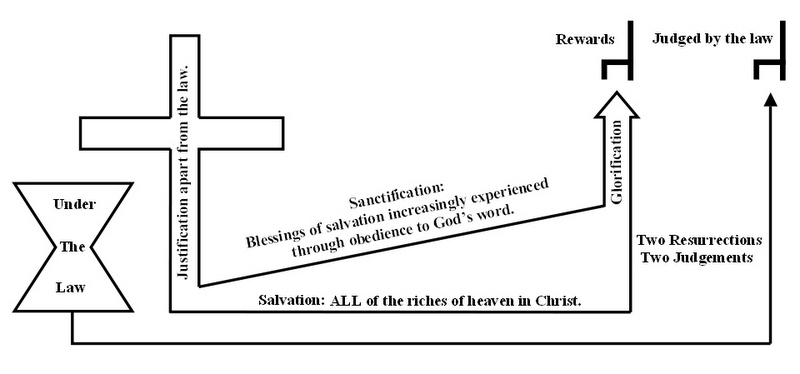
 Popular Sophists of our day like John MacArthur Jr. hold to eschatology (the study of end times) that doesn’t match their soteriology (study of salvation/gospel). Dispensationalists (those who believe God uses different plans in different ages) believe in multiple judgments and resurrections. MacArthur identifies with that camp.
Calvinism fuses salvation (justification) and the Christian life (sanctification) together. Justification is finished for us IF we live our Christian life the same way we were saved (“already, but not yet,” just another Reformed mantra that comforts). So, the goal of the Christian life is to live out sanctification in a justification way (“We must preach the gospel to ourselves every day”). The means of justification are finished, but we must continue to have the perfect righteousness of Christ applied to our Christian life in order to be found righteous at the final judgment. Therefore, Calvin et al believed in one final judgment and one resurrection. That is consistent with their sanctification by faith alone to maintain justification soteriology. Everyone who ever lived shows up at a one final judgment and the sheep are separated from the goats. The sheep are those who successfully lived out their Christian life by faith alone.
This is why most Calvinists are amillennial (no 1000-year reign of Christ on earth from David’s throne in Jerusalem). A millennial construct contradicts one judgment and one resurrection because you have to do something with the mortals who live during that time and the rebellion that occurs at the end.
Multiple judgments and resurrections are consistent with the separation of justification and sanctification including a future for national Israel. The fusion of justification and sanctification is consistent with one judgment and one resurrection.
MacArthur has an eschatology that contradicts his soteriology because he was converted to Calvinism later in his ministry and kept the contradicting eschatology. Many Calvinists that don’t understand Calvin’s soteriology hold to Calvin’s eschatology. They think eschatology is a “secondary issue.”
It is assumed that God’s plan for the end times doesn’t fit with His salvific plan.
There is more than one resurrection because Christians are not under law. They cannot stand in a judgment where law is the measure because it has no jurisdiction over them. Calvin believed the law still has jurisdiction over the Christian and Christ’s perfect obedience has to continually fulfill it through the agency of faith alone. Hence, there is justification, “subjective justification” (sanctification, wink, wink), and “final justification.” This is why Calvinists like MacArthur state that “justification and sanctification are distinct, but never separate.” In other words, a different kind of justification finishes definitive justification.
The other camp says “no.” Justification is completely finished, and sanctification is something entirely different. Therefore, we will not stand at any judgment that has anything at all to do with justification, we will rather stand in a judgment for rewards. Multiple resurrections and judgments facilitate a separation of justification and sanctification as well as a future for national Israel.
Eschatology is NOT a “secondary” issue. It is the gospel.
paul
The Gospel According to Joni Eareckson Tada
Though Joni Eareckson Tada has experienced monumental life setbacks, namely, quadriplegia and breast cancer, she has lived a life of experience and accomplishments that others can only dream of. Also, it cannot be denied that she has propagated a gargantuan mass of good works that has benefited much of the world.
And she is a self-proclaimed Calvinist. THEREFORE, her good works and her life testimony have become an endorsement for Calvinism, because that is what she has proclaimed herself to be. Good works are not a pass for who you are, or how you define yourself, they endorse what you believe. And Tada believes Calvinism. She has even proclaimed that all of her good works, even a smile that she might give someone, flows from her Calvinistic beliefs (Crystal Cathedral: Hour of Power ; May 3rd, 2009).
That’s my point here. Everything Tada is, in turn, sells what she believes—that’s the choice she has made. So, the question/issue becomes the following: is Calvinism true?
The very definition of a Christian is someone who loves the truth (2Thessalonians 2:10). In reality, and regardless of appearances, only truth sanctifies (John 17:17). The greatest errors are closest to the truth, and every landfill full of the dead is located at the end of a road paved with good works.
Tada has stated that shortly after her tragic diving accident that left her paralyzed, she was looking for answers (Scott Larsen: Indelible Ink ; Waterbrook Press 2003, Joni Eareckson Tada, chapter 1):
That was when Joni asked a friend to help her understand God’s sovereignty. Wisely, he gave her meat to chew on~hers was no simple, slightly uncomfortable situation~and started her on Berkhof’s Systematic Theology and John Calvin’s Institutes of the Christian Religion. Still just a few years out of high school, Joni found Calvin too heavy, so her friend replaced it with Loraine Boettner’s The Reformed Doctrine of Predestination.
“Somewhere in its pages I realized I was reading something mansized. Rather, God-sized. Perhaps it expressed the unspoken desire of my soul: to encounter towering biblical doctrine like the Himalayan peaks that rise to the breathtaking height of Mount Everest. To apprehend a God who was much, much bigger than I ever imagined when I was on my feet.”… “I realized that my suffering was the key to unlocking the hieroglyphics of God’s foreordained will. I was about to embark on the adventure of my life.”
Calvinism might have given Tada answers that invigorated her will to live on, but one searches in vain for her concern that Calvin taught a true gospel. And he didn’t. Calvin’s view of God’s sovereignty was the issue, not his gospel. Is there a difference? Obviously there is. Calvin believed that God is completely sovereign, and also believed that we have to ask for forgiveness of daily sins in order to keep ourselves saved:
Secondly, this passage shows that the gratuitous pardon of sins is given us not only once, but that it is a benefit perpetually residing in the Church, and daily offered to the faithful. For the Apostle here addresses the faithful; as doubtless no man has ever been, nor ever will be, who can otherwise please God, since all are guilty before him; for however strong a desire there may be in us of acting rightly, we always go haltingly to God. Yet what is half done obtains no approval with God. In the meantime, by new sins we continually separate ourselves, as far as we can, from the grace of God. Thus it is, that all the saints have need of the daily forgiveness of sins; for this alone keeps us in the family of God (John Calvin: Commentaries on the Catholic Epistles; The Calvin Translation Society 1855. Editor: John Owen, p. 165 ¶4).
Calvinism is no different than any other Christ + something else false gospel. In the case of Calvinism—keeping ourselves saved by perpetual re-repentance for sins in sanctification that remove us from grace:
In the meantime, by new sins we continually separate ourselves, as far as we can, from the grace of God… Thus it is, that all the saints have need of the daily forgiveness of sins; for this alone keeps us in the family of God.
Oh, and by the way, Calvin said such forgiveness can only be found in the institutional church and administered by ordained pastors (CI 4.1.21,22). This Protestant absolution was exemplified by Tada confidant John Macarthur Jr. during the 2013 Shepherds Conference. During a general session, MacArthur shared that a young Aids victim requested that MacArthur seek forgiveness for sins on his behalf. MacArthur agreed to the request accordingly.
During the aforementioned message at Crystal Cathedral’s Hour of Power, Tada stated that God brought said grievous trials into her life so that she would live by the cross daily:
And so God, bless his heart, forces us down the road to Calvary where we are not humanly inclined to go. It’s not our natural inclination to go to the Cross every day. And so God gives us suffering like a sheep dog. It is a sheep dog snapping at your heels, driving you down the road to the Cross where otherwise you might not normally go. You’re driven there by the overwhelming conviction that you just have nowhere else to go. And so God permits the broken heart. He permits the broken home. He permits, he allows, he ordains, he plans even the broken neck until we become broken… Even Jesus himself said blessed are the poor in spirit for theirs is the Kingdom of God. Who are the poor in spirit? Those who come to Jesus every day in empty-handed spiritual poverty, asking him to show them the reason for living that day. Because we’re all richer when we recognize our spiritual poverty.
Come now, are born-again Christians spiritually impoverished? We need to seek God’s purpose for our life daily? Our smiles are not even our own smiles, but we have to get them from God?
“I have no strength for a smile for this woman who’s going to come to the bedroom door in just a moment, and I’ve gotta give her a smile. And Lord, I don’t have a smile… So God, please give me your smile. I have no smile for this woman, but you’ve got a smile. May I please borrow your smile?” And not but a moment goes by and I have a smile. It’s already a miracle. I’ve experienced a miracle before 7:30 a.m. when my girlfriend walks to the door and I can smile, not in spite of my paralysis but because of it. My paralysis has driven me every single morning to the cause of Jesus Christ where I tell him how much desperately I need him. And so that smile is already hard-fought for and hard-won by early morning. That’s the first nugget of wisdom. Begin your day needing Jesus Christ desperately (Ibid).
Is this really the essence of the Christian life? We have to plead and beg God for even a smile? It is, if we also have to go back to the cross daily to beg God for salvific forgiveness. That’s Calvinism; daily resalvation. You have eternal security IF you beg God for smiles every day, and IF you were elected.
You are elected IF you practice a daily application of Christ’s death on the cross. You are elected IF you believe that even the slightest sin in your Christian life separates you from grace.
Tada is sacrificing her stellar life on the altar of Calvinism. Her good works point people to John Calvin who plainly taught a false gospel. What she believes and what she does cannot be separated. There is time to go back to the beginning and once again look for answers.
This time, pick up a Bible, not the Calvin Institutes.
paul
Romans 12:3-8

As we continue in the book of Romans, we begin tonight’s study with 12:3,
For by the grace given to me I say to everyone among you not to think of himself more highly than he ought to think, but to think with sober judgment, each according to the measure of faith that God has assigned.
This shouldn’t surprise us, but the Bible often speaks directly and simply to issues that seem to turn all of culture upside down. For example, phobias are a huge issue in our culture. There are thousands of phobia clinics nationwide treating more than 530 different kinds of documented phobias. Yet, 1John 4:18 states,
There is no fear in love, but perfect love casts out fear.
Love prevents fear and cures fear. Depression is another issue that affects 10% of the American population. The Bible has a lot to say about this issue and documents at least four cases in detail: Cain; Jonah; King David; and Elijah. To Cain God stated,
If you do well, will your countenance not be lifted up?
As we discussed in previous lessons, I am not saying that right doing and right thinking is the cure-all for every instance of depression, but I am saying that the possibility should always be vetted.
From circa 1986 to 1998, the issue of self-esteem raged in the American church. Innumerable books were written on the subject. One camp stated that it was impossible to love others unless you loved yourself. Hence, regardless of the substance of your life, it is imperative that you love yourself and think highly of yourself. Christ died for you because you are worth saving, and also died for all your sins. So, no matter how sinful you are in your own eyes, you are still worth dying for. The essence of life is loving self the way God loves you regardless of the facts. This camp attributed almost every sin known to man to “self-hatred.”
The other camp posited the ideology of the Reformers which of course propagated self-hatred and the idea that self-love is the essence of all sin. This raging debate was fueled by the very folly Paul warned us about in verse two of the chapter we now reside in: don’t be conformed to the passing fads of whatever age you are in. Rather than searching the Scriptures for themselves, the vast majority of Christians chose one camp or the other.
Well, here we are at verse 3, Paul merely states that we should assess ourselves truthfully. Paul doesn’t exclude thinking highly of ourselves—he states that we shouldn’t have an exaggerated assessment regarding the positive. And let me suggest that our assessment of ourselves should not be exaggerated according to the negative as well. That would be no less a lie than the former. We are to assess ourselves according to “sober judgment.” I did a word study on this, and a good paraphrase would be, “right minded estimate.” This gets right back to one of our favorite verses, Philippians 4:8. We are to dwell on what is true.
Also, there is really no debate at all as to whether or not we love ourselves, the simple fact is that we are wired to love ourselves—we are all wired with a desire for self-preservation, no? Is that a bad thing? No, it is an instinct created within us. Turn to Ephesians 5:
25 Husbands, love your wives, as Christ loved the church and gave himself up for her, 26 that he might sanctify her, having cleansed her by the washing of water with the word, 27 so that he might present the church to himself in splendor, without spot or wrinkle or any such thing, that she might be holy and without blemish. 28 In the same way husbands should love their wives as their own bodies. He who loves his wife loves himself. 29 For no one ever hated his own flesh, but nourishes and cherishes it, just as Christ does the church, 30 because we are members of his body. 31 “Therefore a man shall leave his father and mother and hold fast to his wife, and the two shall become one flesh.”
Paul is saying as a statement of fact that men love themselves. He isn’t saying that is bad, it is just a statement of fact. Therefore, we should love our wives as much as we love ourselves because we are one flesh. To not love our wives is an anomaly because we are one flesh and we love ourselves. Christ said to do unto others as we would want them to do to you. This obviously assumes that you want good things for yourself because you think you’re kinda alright, right? Of course, in our day, this is interpreted strictly through grace which means all of us are totally depraved and grace is needed for everything. Do unto others as you would want them to do to you is translated as getting a pass (grace) on everything except asking leadership too many questions. The fact is, we are created to like ourselves. That’s not sin. Imagine if nobody liked themselves! What kind of world would that be? People would be waiting in line to be condemned to hell! No? The challenge is to love others as much as we already love ourselves.
Notice also that we are to assess ourselves according to the faith that we have been gifted with by God. It is interesting that in the Jewish Bible I am using right now, the word “faith” is everywhere translated “trust.” I like that. Faith is equated with trusting God. In evaluating ourselves, it is important that we trust God in regard to verses 4-7:
For as in one body we have many members, and the members do not all have the same function, 5 so we, though many, are one body in Christ, and individually members one of another. 6 Having gifts that differ according to the grace given to us, let us use them: if prophecy, in proportion to our faith; 7 if service, in our serving; the one who teaches, in his teaching; 8 the one who exhorts, in his exhortation; the one who contributes, in generosity; the one who leads, with zeal; the one who does acts of mercy, with cheerfulness.
This is how we evaluate ourselves: we have been gifted to serve a certain function in the body of Christ. As a Christian, you should take that seriously. If you are a kidney, and you are missing, that cripples the body of Christ. Paul used this same illustration in 1 Corinthians 12:
12 For just as the body is one and has many members, and all the members of the body, though many, are one body, so it is with Christ. 13 For in one Spirit we were all baptized into one body—Jews or Greeks, slaves or free—and all were made to drink of one Spirit.
14 For the body does not consist of one member but of many. 15 If the foot should say, “Because I am not a hand, I do not belong to the body,” that would not make it any less a part of the body. 16 And if the ear should say, “Because I am not an eye, I do not belong to the body,” that would not make it any less a part of the body. 17 If the whole body were an eye, where would be the sense of hearing? If the whole body were an ear, where would be the sense of smell? 18 But as it is, God arranged the members in the body, each one of them, as he chose. 19 If all were a single member, where would the body be? 20 As it is, there are many parts, yet one body.
21 The eye cannot say to the hand, “I have no need of you,” nor again the head to the feet, “I have no need of you.” 22 On the contrary, the parts of the body that seem to be weaker are indispensable, 23 and on those parts of the body that we think less honorable we bestow the greater honor, and our unpresentable parts are treated with greater modesty, 24 which our more presentable parts do not require. But God has so composed the body, giving greater honor to the part that lacked it, 25 that there may be no division in the body, but that the members may have the same care for one another. 26 If one member suffers, all suffer together; if one member is honored, all rejoice together.
27 Now you are the body of Christ and individually members of it. 28 And God has appointed in the church first apostles, second prophets, third teachers, then miracles, then gifts of healing, helping, administrating, and various kinds of tongues. 29 Are all apostles? Are all prophets? Are all teachers? Do all work miracles? 30 Do all possess gifts of healing? Do all speak with tongues? Do all interpret? 31 But earnestly desire the higher gifts.
And I will show you a still more excellent way.
As a quick aside, and regardless of how you want to argue what is known as Cessationism (the Charismatic gifts were temporary), “Do all speak with tongues?” is obviously a rhetorical question posed by Paul the apostle, and the assumed answer is, “no.” This flies in the face of Pentecostalism which teaches that all should seek the second blessing of the Spirit witnessed by that gift. That’s a free thought added in here.
Our function in the body is expressed through gifts that God has assigned each of us. This isn’t emphasized in the church, and never has been as far as I have seen in more than thirty years as a Christian. That’s astounding. And note the gifts are listed. Let’s look at them individually:
“if prophecy, in proportion to our faith”
“In proportion to our faith.” What does that mean? It means that faith is a gift that drives the other gifts we are given. Everyone is given a measure of faith. In fact, some are said to have the “gift of faith”:
1Corinthians 13:2 – … and if I have all faith, so as to remove mountains, but have not love, I am nothing.
We are to practice our gifts to the extent of the faith we have been given. How do we know how much of that we have been given? Well folks, there is only one way to find out: put the gift into practice until God stops you. Work out whatever God is working in:
Philippians 2:12 – Therefore, my beloved, as you have always obeyed, so now, not only as in my presence but much more in my absence, work out your own salvation with fear and trembling, 13 for it is God who works in you, both to will and to work for his good pleasure.
One may consider “by testing you may discern what is the will of God” from verse 2 to be applicable here.
We have noted in previous lessons that the Trinity was involved in our salvation, and all members are also involved in our sanctification. The Father, the Son, and the Holy Spirit work in both. “Salvation” is often referred to as the fullness of the Godhead that we receive when we are justified:
Ephesians 1:18 – having the eyes of your hearts enlightened, that you may know what is the hope to which he has called you, what are the riches of his glorious inheritance in the saints, 19 and what is the immeasurable greatness of his power toward us who believe, according to the working of his great might 20 that he worked in Christ when he raised him from the dead and seated him at his right hand in the heavenly places,
The word for prophecy (prophēteia) here has a broad meaning in the New Testament:
…prediction (scriptural or other):— prophecy, prophesying…a discourse emanating from divine inspiration and declaring the purposes of God, whether by reproving and admonishing the wicked, or comforting the afflicted, or revealing things hidden; esp. by foretelling future events.
Used in the NT of the utterance of OT prophets of the prediction of events relating to Christ’s kingdom and its speedy triumph, together with the consolations and admonitions pertaining to it, the spirit of prophecy, the divine mind, to which the prophetic faculty is due of the endowment and speech of the Christian teachers called prophets the gifts and utterances of these prophets, esp. of the predictions of the works of which, set apart to teach the gospel, will accomplish for the kingdom of Christ.
If you look at the monitor on your table, once again we see how we can use the Olive Tree software to see how the same word is used throughout the New Testament. It primarily speaks to the eschatology of Scripture. In our day, I believe this speaks to those who have a special interest and ability to understand Bible prophecy. That’s a wonderful gift, and let us remember that prophecy comprises about 25% of the Bible. As we have seen in previous studies, end time predictions coincides with the gospel that we believe, especially in regard to the number of resurrections and judgments. So, prophecy confirms the gospel we believe. Prophecy should be used to warn, encourage, motivate, and instill hope. It is a wonderful gift, and is primarily a teaching gift. If you look at how the word is used elsewhere, we see that prophesy was also comprised of a temporary gift of short-term predictions in the apostolic church.
“if service, in our serving”
The preposition “in” (en) denotes a fixed position. Paul may be calling for a primary focus on our gifts as a priority. “Service”(diakonia) is similar to the word for deacon (diakonos) and simply means “to serve.” However, if you note 1Timothy 3:8-13 and other passages, qualifications are stated for that particular service as opposed to the service gift stated here in Romans. This is unavoidable, and once again brings us to the subject of what the biggest challenge is for the home fellowship movement: the integration of sound organization and the freedom to practice gifts. In Western culture, sound organization is the monopoly of the institution, and the home is a vacation from that. We have to get past that, and realize that the ONLY difference is what the building is and where it is located. We also have to properly define fellowship and authority in this context. ALL authority resides in the word of God, and ALL unity is experienced to the degree that there is agreement on what the authority states; the one mind of Christ. To the degree that is accomplished, fellowship is determined. At any rate, I find the idea of Christians deciding to go in this direction and hammering all of this out over time horribly exciting. What a rich fellowship in the word that would be.
“the one who teaches, in his teaching”
This is pretty straight forward and refers to the ability or gift to enable people to grasp the truth of Scripture. Both women and men have this gift. But once again, I am going to discuss this in the context of the home fellowship movement. It is my conviction, according to Scripture, that women should not teach men the Scriptures in the assembly, or for that matter, anywhere else. Do I learn things about the Scriptures from Susan’s observations? Absolutely. All husbands should learn from their wives, but in regard to teaching in the assembly of the saints, the Bible is clear on this issue. If you don’t like that, but you can live with it, wonderful, we have fellowship. If you can’t, don’t fellowship with us. Pretty simple.
Can home fellowships that differ on this issue be a part of the same network? Yes, I think so. And when the network comes together corporately, certain fellowships should not expect the others to violate their consciences on that issue. They should practice their perceived freedom in their own group. If they won’t concede that, that’s probably a fellowship issue—simply go and start your own network. A city with multiple home fellowship networks? Wonderful! But what can happen later on is very exciting. Some networks may see that their way of doing things isn’t working out so well and may agree to refellowship with other networks. Can I suggest the “by testing you may discern what is the will of God” in verse 2 one more time? Possibly.
“the one who exhorts, in his exhortation”
I think this is the gift of counseling. I think this is the ability to give good advice and comfort people. It is really the gift of persuasion when it gets right down to it. I think people who have this gift will be marked by great concern for others resulting in a pattern of exhorting others. These are preachy type Christians, but it is out of genuine concern. That should be our assumption.
“the one who contributes, in generosity”
This is the gift of giving, and the word for “generosity” is an interesting word (haplotēs). It means to be single minded, sincere, and not agenda driven. This is where the word “trust” in regard to faith comes in handy. We are to trust God that our reward is in heaven and not down here. Our giving shouldn’t be self-seeking, or double minded.
“the one who leads, with zeal”
This is the gift of eldership. One who “leads” (proistēmi). Turn with me to 1Timothy 5:17.
Let the elders who rule well be considered worthy of double honor, especially those who labor in preaching and teaching.
The word for “rule” is the exact same word for “lead” proistēmi. This would be better translated, “let the elders who lead well be considered worthy of double honor….” This is how several different versions of the Bible translate it. In the eight times that this word is used in the New Testament, five refer to elders and one to deacons. The other two refer to “self-leading” which is interesting.
Like other places in the New Testament, elders are exhorted (counseled) to not lose their zeal ant not lead “under compulsion” (with a complaining spirit) or for money. Obviously, the latter would not be a temptation if leaders of 1st century home fellowships were not getting paid. Also note “For Scripture says, ‘Do not muzzle an ox while it is treading out the grain,’ and ‘The worker deserves his wages’” in 1Timothy 5:18.
“the one who does acts of mercy, with cheerfulness.”
This is the gift of compassion. “Cheerfulness” is a word that means, “cheerful promptness.” I am not sure why Paul attached this exhortation to mercy in the same way he attached single-minded sincerity to giving and zeal to leadership. But we do have a pattern of sorts in Paul’s spiritual gift list:
We are to be part of the body by practicing the gifts given to each of us. We are to exhibit these gifts according to the faith granted to us, and this is revealed by working out the faith God has given us. Some gifts come with temptations that are to be avoided. In addition, while discovering our gifts, we are to serve the church wherever there is need out of love.
And in all, we are to practice our gifts in accordance with the one gift that will not pass away for all of eternity, love. We have been given many gifts and the power to practice them which is the same power that raised Christ from the grave. And on top of all of that, we are able to adorn it all in the eternal gift. That is what we will examine next week.
The James MacDonald White Paper: James MacDonald is Just a Symptom; Post 17 of 20

James MacDonald is a symptom of his false gospel; namely, Calvinism. The Reformed think tank that resurrected authentic Calvinism in 1970 defined it in a way that could be understood, and systematized it in a way better suited for our postmodern age. Their publication, Present Truth Magazine, was the most publicized theological journal in the English speaking world during the 1970’s. The following excerpts from their journal perfectly captures the essence of Calvin’s false gospel. Anyone familiar with biblical justification should be able to pinpoint the grievous error of this gospel:
After a man hears the conditions of acceptance with God and eternal life, and is made sensible of his inability to meet those conditions, the Word of God comes to him in the gospel. He hears that Christ stood in his place and kept the law of God for him. By dying on the cross, Christ satisfied all the law’s demands. The Holy Spirit gives the sinner faith to accept the righteousness of Jesus. Standing now before the law which says, “I demand a life of perfect conformity to the commandments,” the believing sinner cries in triumph, “Mine are Christ’s living, doing, and speaking, His suffering and dying; mine as much as if I had lived, done, spoken, and suffered, and died as He did . . . ” (Luther). The law is well pleased with Jesus’ doing and dying, which the sinner brings in the hand of faith. Justice is fully satisfied, and God can truly say: “This man has fulfilled the law. He is justified.”
We say again, only those are justified who bring to God a life of perfect obedience to the law of God. This is what faith does—it brings to God the obedience of Jesus Christ. By faith the law is fulfilled and the sinner is justified.
On the other hand, the law is dishonored by the man who presumes to bring to it his own life of obedience. The fact that he thinks the law will be satisfied with his “rotten stubble and straw” (Luther) shows what a low estimate he has of the holiness of God and what a high estimate he has of his own righteousness. Only in Jesus Christ is there an obedience with which the law is well pleased. Because faith brings only what Jesus has done, it is the highest honor that can be paid to the law (Rom. 3:31).
~ Present Truth: Law and Gospel ; volume 7, article 2, part 2.
The flesh, or sinful nature of the believer is no different from that of the unbeliever. “The regenerate man is no whit different in substance from what He was before his regeneration.” — Bavinck. The whole church must join the confession, “Have mercy upon us miserable sinners.” The witness of both Testaments is unmistakably clear on this point.
No work or deed of the saints in this life can meet the severity of God’s law. Apart from God’s merciful judgment, the good works of the saints would be “mortal sin” (Luther), and nothing is acceptable to God unless mediated through the covering cloud of Christ’s merits. Because of “indwelling sin,” we need mercy at the end as much as at the beginning, for the old nature is as evil then as ever. Growth in grace, therefore, does not mean becoming less and less sinful, but on the contrary, it means becoming more and more sinful in our own estimation.
It is this conviction of the wretchedness of even our sanctified state—which conviction comes by the law—that keeps sanctification from the rocks of self-righteousness. It keeps the Christian’s little bark constantly pointed toward his only star of hope—justification by faith in a righteousness that stands for him in heaven. The refuge of the sinner must ever also be the refuge of the saint.
~ Present Truth: Sanctification-Its Mainspring ; volume 16, Article 13.

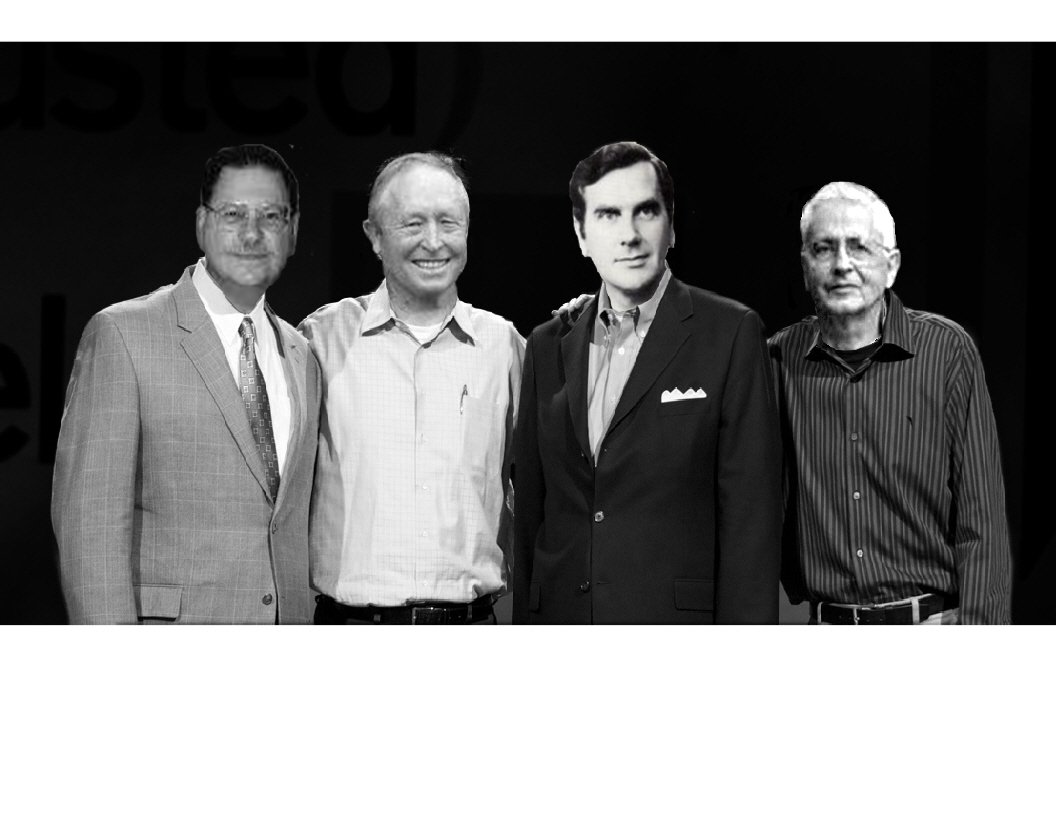
THE ORIGINAL CORE FOUR OF THE AUSTRALIAN FORUM THINK TANK CIRCA 1970

THE REAL DREAM TEAM
Question for Tony Miano: Did Joni Preach?
Yes Julie, Joni not only preached at Strange Fire, she preached a real sermon at Crystal Cathedral, and it was an in-your-face Gospel Sanctification authentic Calvinist message of daily living by the cross.

* * *
Tony Miano, author of Should She Preach?, attended John MacArthur’s Strange Fire conference at Grace Community Church, along with Pastor Chuck O’Neal (suing pastor who had minister’s license revoked and currently in discipline), Phil Johnson, Dr. Steve Lawson, all of whom contributed to Miano’s book.
View original post 416 more words



4 comments