John MacArthur Was Against Reckless Faith Before He Was For It

 The Father of John Kerry theology continues to rack up the contradictions as his legacy wanes. To whom much is given, much is required, and MacArthur has already sold truth for a bowl of New Calvinist fame. At the upcoming 2012 Resolved Conference, he will take his place with the other gods of New Calvinism under the high-tech light show and above a sea of worshippers who can wave arms with the best of them.
He must be there, he can’t help himself, even though he will appear on stage with CJ Mahaney who represents what MacArthur used to call “Chaos” in the Christian life. But now MacArthur has seen the lights; things that used to cause chaos in the Christian life are now “secondary issues” because Mahaney majors on the doctrine contrived by a Seventh-day Adventist who is now an atheist: the centrality of the objective gospel outside of…
View original post 2,064 more words
Is The “Tithe” a Spiritual Scam?

Between TANC and the Potter’s House, there is just a lot going on. In our study on Romans, we have come to Romans 12:11-13:
11 Do not be slothful in zeal, be fervent in spirit, serve the Lord. 12 Rejoice in hope, be patient in tribulation, be constant in prayer. 13 Contribute to the needs of the saints and seek to show hospitality.
The focus of our next message in Romans will be verse 13 which emphasizes giving according to need. Because I am in the middle of a TANC project, namely, the writing of TTANC volume 2, this is a shameless ploy to get some free research for the next Potter’s House message. Please note the comment section at the end of this post.
I have some observations to incite riot accordingly. In these verses, which include the hefty responsibility of being faithful in prayer, Paul passes on mentioning the tithe. Tithe means, 10%. I strongly suspect that the tithe was a sort of tax when the kingdom of God had an earthly substation: Israel. When Israel rebelled, the earthly manifestation of the kingdom was taken from them and will be reestablished in the millennial kingdom. The kingdom of God expressed on earth through Israel had an institutional aspect to it that benefited from a 10% tax.
Such is not the case in this age. The temple isn’t in Israel and attended formally by priests, the temple is each and every believer, and each and every believer is a priest (1COR 3:16,17, 1PET 2:9). That’s my suspicion—Christianity is decentralized and expressed in the gifts granted to each and every believer; believers fellowship in order to maximize their individual gifts. There is no authority among believers per se, but different rolls in a fellowship construct. To the degree that is followed, gifts can be maximized to the eternal benefit of the world around us. I believe the New Testament assembly model is non-institutional and does not require a sanctified tax.
I do not believe in Luther’s two kingdom theology which was a Platonist take on God’s kingdom; i.e., the pure form of God’s kingdom is in heaven, and His kingdom on earth is a shadowy kingdom of the pure form. Hence, the present kingdom has the same Old Testament institutional aspect, and consequently, the tithe. Not so. This is part and parcel with the insistence that there should be a central church government ruling over the earthly church. The Reformers sought to reform the Catholic Church because they agreed that there should be a central ruling institution. Be sure of this: this is the very heart of ecumenicalism; the kindred belief in a central institution that would enforce orthodoxy.
And to the degree that Christians gather under a big tent, civil governments have no choice but to play along. This has always been the big picture from the beginning of time—the consolidation of church and state. That motif in the book of Revelation is very predictable. It started that way, it will end that way.
Lastly, the word “tithe” only appears in the New Testament twice, and those two references pertain to one conversation. So, in reality, the word is used ONCE in the New Testament, and in that one instance, in a negative light. Christ used the word to criticize those who emphasize the tithe and diminish the need for justice in the church.
Well, that’s the contemporary church in a nutshell—long on institution and very short on victim justice.
paul
Robert Jones Will Return to Clearcreek Chapel to Teach a Refresher Course on Controlling Parishioners
 The New Calvinist movement is much attuned to its European Reformed roots. Though the New Calvinists deny a mentality of equal footing between orthodoxy and Scripture, their endearment to Reformed authority is evident. Though documents like the Westminster Confession and the Calvin Institutes are said to be “subordinate truth,” we must remember that these documents are, “orthodoxy,” and orthodoxy is synonymous with “truth” in Western culture. “Heterodox” is the opposite, and commonly refers to those who oppose the commonly accepted creeds and confessions of the Reformed church.[1]
The fact that these documents were drafted under the auspices of church states is a major consideration. For example, The Westminster Confession of Faith includes specific standards for the enforcement of orthodoxy by the state.[2] The most formidable result of the Enlightenment era, the United States of America, changed all of that. What we clearly have now is a desire to follow the dictates of 17th century Reformed orthodoxy in a post Christian era ruled by the separation of church and state. As an aside, it would be wrong to say the Enlightenment era was anti-Christian; in contrast, it championed freedom of Religion by insisting on the separation of faith and force.
The desire to follow in the footsteps of those who believed in the civil enforcement of orthodoxy poses unique problems for the Neo-Calvinist movement. This created a niche consulting market that specializes in teaching churches how to improvise in an open society. One of the first organizations to exploit this need was Peacemaker Ministries. Founded in 1982, the organization equips church leaders to control parishioners under the pretense of “peace making.”
The present-day New Calvinist movement was born in 1970, and from its beginning spawned massive church splits and conflict. By 1982, an emphasis on damage control would have been in high demand, especially in regard to lawsuits provoked by the heavy-handed leadership style of New Calvinists.
The organization strives to help churches “build a culture of peace.” One way of doing that is through “peacemaking teams.” Keep in mind, organizations like Peacemakers are supported by the institutional church and have no vested interest in obtaining a peaceful solution for individual concerns. Peacemaker Ministries routinely turns a blind eye to the out of control misuse of church discipline in Neo-Calvinist church culture. The excuse PM employs for not getting involved would be funny if not so dastardly: they cite the bogus church discipline itself as a reason to not get involved because they only get involved in controversies between Christians. And since the bogus church discipline has declared the offended party an unbeliever—all bets are off. Again, keep in mind who is paying PM.
On their website, it is stated that the purpose of peacemaking teams is to “serve their leaders and to advance their vision to build his church.” So, it is not true reconciliation that is in mind, or gaining brothers between brothers, but rather a team that diffuses controversy that hinders the leaders’ “vision.” This is just another tool in the repertoire of control infrastructures common in Neo-Calvinist churches. What these control structures look like is discussed here.
Once again, Robert Jones of Peacemaker Ministries will teach at the annual “Family Enrichment Conference” held at Clearcreek Chapel in Springboro, Ohio. Jones is scheduled to teach at the 2014 conference. Clearcreek Chapel has a long history of unresolved conflict with many Christians, and is well known for its cult-like heavy-handed leadership style. Since the departure of the founding pastor, Clearcreek has consistently drifted from one conflict to another. The latest controversy involved complaints by parishioners that the Clearcreek elders were teaching “some kind of Christian mysticism.” The Chapel elders recently changed their titles to less controversial words like “overseer” as opposed to “pastor of spiritual formation” etc. In addition, the radical Christian mystic Chad Bresson is no longer on the board of elders, and is seemingly no longer a member there as well.
A Robert Jones tune-up may be well overdue.
paul
1. Webster’s New World Dictionary of the American Language: World Publishers 1959.
2. William Marshall: The Principles of the Westminster Standards Persecuting ; D.D., Coupar – Angus. Edinburgh: William Oliphant & Co. 1873. Specific citations: Paul’s Passing Thoughts .com; Inseparable: The Reformation’s Principles of Persecution and its Gospel; Part One – August 31, 2013.
Update on Missionary Trip to Louisville, Kentucky
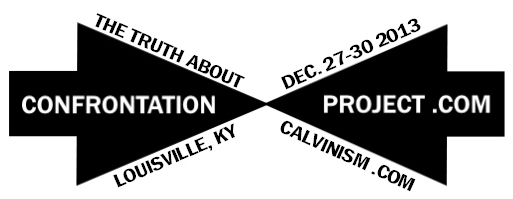
The TANC missionary team has determined the process that will be used to evangelize Calvinists at the 2013 Cross Conference. We will simply obtain a hotel room and interact with the conference attenders as they enter and leave. We will videotape the exchanges as much as possible. We look forward to rich dialogue in regard to Calvin’s false gospel. TANC embraces its calling by God to evangelize Calvinists and save them from their false gospel. We have developed the primary tract that will be used and are very excited about it as it gets right to the primary point. The tract can be viewed here. If you have any suggestions for the tract, please send comments to mail@ttanc.com
Your prayers and financial support for this missionary trip would be greatly appreciated. We would like to print several hundred copies of this tract. Leftover tracts will be distributed for free. Donations can be made via Pay Pal using the same email address, or mail check /money order to TANC, PO Box 583, Xenia, Ohio 45385. If you are interested in being part of the team, email us at the same address: mail@ttanc.com.
Blessings,
The TANC evangelism team.
Simply Stated: Why is Calvinism a False Gospel?
Simply stated, Calvinism is a false gospel because it denies that salvation is a onetime event in the life of the believer. In other words, when a person believes in Christ, all of their sins are not forgiven once and for all time. The sins we commit in our Christian life go against our just standing, so we must continually revisit the same gospel that saved us in order to maintain our just standing. This is a problem because we have to do something to keep our just standing. The Reformers taught that salvation as a onetime finished work is a false gospel.
In our present day which is experiencing a resurgence of the original Reformation gospel, we assume that the mantra, “We must preach the gospel to ourselves everyday” is just a popular opinion about the best way to grow spiritually in our Christian life. Not so. The revisiting every day of the same gospel that saved us is necessary to maintain our just standing before God. “The same gospel that saved us also sanctifies us” is another popular mantra that is deceptive; a re-visitation of gospel is a must for keeping ourselves saved according to the Reformation gospel.
This is why the Reformers redefined the biblical new birth. Instead of the new birth being a onetime event in the life of the believer, making us a new creature, they made the new birth a continual rebirth experience only needed to maintain our salvation. Another way this could be stated follows: a perpetual re-salvation experience. Contemporary Reformed theologians call this “mortification and vivification” in their systematic theology.
paul

 Paul's Passing Thoughts
leave a comment