The Non-Doing Doesn’t Damn Protestants; It’s What They Believe About the New Birth

“Protestantism speaks of being saved from the condemnation of the law to a rest from obedience to the law of the Spirit of life. This is a rejection of the new birth and leaves the Christian enslaved to sin. This denies the good news of the incorruptible seed that Christians are born of. Protestantism makes the case that “the law” cannot produce righteousness, but this totally neglects the true biblical relationship between the believer and the law of the Spirit. A one-dimensional law necessarily rejects the new birth and circumvents the Christians ability to love God and others.”
In the parable of the talents, the slothful servant wasn’t sent to hell because he was lazy, what sent him to hell is the logic that caused the laziness. In other words, his laziness was a symptomatic cause of what he believed about God.
All liars will be thrown in the lake of fire, but it’s not the lying that paves the way—what they believe paves the way. How they act is merely a natural result of what they believe. Likewise, how Abraham lived is not what made him righteous, what he believed made him righteous—his life as set against the weakness of his mortality was the result.
BUT we cannot stop there because what we believe is not the direct thrust of what we do. Yes, it’s a symptom, but not the main thrust. What we believe leads to God recreating us or not recreating us through the new birth. The argument is better defined by behavior flowing from a particular type of human creature: born again of the Spirit or not born again of the Spirit. We must be careful to not say it’s belief alone while excluding the regeneration of the new birth.
It is also very important to know that regeneration is a colaboring with the Spirit that puts us in the love-loop. If we are not truly recreated into new creatures born of God who actually participate in righteous doing, we are not really participating in loving acts. Simple belief only watches the love being performed or manifested by the Spirit with no involvement by us. When Jesus says, “well done faithful servant,” he supposedly isn’t really talking about anything we did other than simply believing, which also ironically includes, “as much as you did it to one of these, you did it to me as well.”
Now let’s use this paragraph to dismiss some stupidity. The title of this post does not include people who consider themselves Protestants, but really have no idea what the Protestant gospel states. But would you go to a Kingdom Hall church because you have points of agreement with them? No, and why is that? Because you know the fundamentals of their gospel are false. So, if the official stated gospel of Protestantism is false, you need to get out of there. And that is the case. Secondly, Protestants like to interpret reality via either/or. This is because it is a Gnostic religion founded on all reality being interpreted by two categories only: material evil or invisible good. What you are discussing, whatever that may be, is one or the other. In contrast, OUR doing is not either evil or good, it can be one or the other, or both. In Protestantism, man’s doing must be totally good, or totally evil according to its Platonist/Gnostic foundations, and it is therefore the latter because man is part of the material world. The Reformers then went to the Bible and stuffed the Bible into that prism come hell or high water.
Protestantism is a false gospel because it redefines the new birth and denies the biblical definition of it. How is this done? We will use Romans 8:2 to explain.
For the law of the Spirit of life has set you free in Christ Jesus from the law of sin and death.
This is not complicated. Protestantism denies the new birth by making the law one-dimensional. The law can only do one thing: condemn. Therefore, you are not set free to “serve,” you are only set free from the condemnation of the law. YOU do not pass from death to life functionally, only positionally. By faith alone in Christ’s death and resurrection, the Spirit performs all of the acts of love described in the Bible in our stead. That becomes the Protestant definition of being free in Christ: Jesus performs all obedience in your stead through the Spirit. The Christian life of faith is a “rest.” As Joseph Prince has stated,
When we work, God rests, when we rest, God works.
And that my friends is good old fashioned authentic Protestant soteriology. That is almost word for word from John Calvin himself.
When the law can only condemn, we must stay clear of it because it demands perfection as a standard for righteousness. Its righteous demands must be fulfilled by the law-giver Himself. And again, there is no dynamic from which any person can please God because they are of the material realm in which only evil can come. Therefore, the new birth must be redefined as a position rather than something that results in a function performed by humanity. A command to love is really a command to see what you are unable to do while watching its manifestation by the Spirit…
When we work, God rests, when we rest, God works.
Rather than the new birth being defined as an actual new creature able to please God through loving obedience to the law, it is defined as a rest that merely perceives the works of the Spirit apart from us. We do not love functionally because belief does not bring about an actual new creature—only an ability to perceive works done by proxy. Christ said, “You MUST be born again”; therefore, a true gospel must properly define the new birth. Is it being set free to rest, or is it being set free to serve as literal new creatures reborn of God?
In the former, note that the law of the Spirit of life is something that the Spirit does and not us according to Protestantism. The law of the Spirit of life is a realm in which the Spirit performs obedient acts of love in our stead. This frees us from the condemnation of the law of sin and death and its demands for perfect obedience. Any attempt to obey the law directly is not of faith—the law must be obeyed for us as a result of complete rest “in Christ.” The law can only condemn.
In Protestantism, some teach that the law of the Spirit of life is a realm, and the law of sin and death is an actual written law while others teach that both are a realm; viz, Spirit realm versus sin realm, or material versus invisible. But either way, the Christian life is a rest.
In addition, according to them, remember that the Christian life must continue by faith alone, the same way we were saved. This necessarily connects the Christian life to our original salvation; in other words, salvation must be maintained the same way it began: by faith alone. If works must be eradicated in the Christian life save the work of faith only, it must be concluded that salvation is an ongoing work. If it wasn’t, we could safely leave the gospel that saved us and move on to something else. The who’s who of Protestantism warn continually that this would be a false gospel.
Start with Christ (that is, the gospel) and you get sanctification in the bargain; begin with Christ and move on to something else, and you lose both (Christless Christianity: published by Dr. Michael Horton in 2008, p.62).
It’s remaining in a rest to keep yourself saved by faith alone, the same way you were saved. Working in the Christian life is made synonymous with works salvation and law-keeping for the same.
Now, let’s look at this from the biblical point of view. In Romans 8:2, in both cases concerning the law of the Spirit and the law of sin, the word is “nomos.”
g3551. νόμος nomos; from a primary νέμω nemō (to parcel out, especially food or grazing to animals); law (through the idea of prescriptive usage), genitive case (regulation), specially, (of Moses (including the volume); also of the Gospel), or figuratively (a principle):— law.
The strict grammar calls for the meaning to be a prescriptive application of principles or regulations. There is a law of the Spirit, and a law of sin and death, and both refer to a prescriptive standard. It is such with a different dimension for the saved and another dimension for the unsaved—one law with two different perspectives and result. To the unbeliever, the law is the law of sin and death because sin within provokes the unbeliever to sin against the law. Therefore, it can only condemn the unbeliever; the power of sin is the law’s condemnation. Sin can provoke the unbeliever to compounded wages of judgment and wrath.
More than likely, “sin” is the seed of the serpent, and those born again of the Spirit have the seed of God within them.
Genesis 3:15 – I will put enmity between you and the woman, and between your offspring [seed] and her offspring [seed]; he shall bruise your head, and you shall bruise his heel.
1John 3:9 – No one born of God makes a practice of sinning, for God’s[b] seed abides in him, and he cannot keep on sinning because he has been born of God. 10 By this it is evident who are the children of God, and who are the children of the devil: whoever does not practice righteousness is not of God, nor is the one who does not love his brother.
1Peter 1:22 – Having purified your souls by your obedience to the truth for a sincere brotherly love, love one another earnestly from a pure heart, 23 since you have been born again, not of perishable seed but of imperishable, through the living and abiding word of God; 24 for
“All flesh is like grass and all its glory like the flower of grass. The grass withers, and the flower falls, 25 but the word of the Lord remains forever.” And this word is the good news that was preached to you.
… 1Peter 2:1 – So put away all malice and all deceit and hypocrisy and envy and all slander. 2 Like newborn infants, long for the pure spiritual milk, that by it you may grow up into salvation— 3 if indeed you have tasted that the Lord is good.
This exchange of seeds is vital. Notice that being born anew with an imperishable seed is actually “the good news preached to you.” Notice also that this gospel preached to us is PAST TENSE. And by the way, the “grow[ing] up unto salvation” is NOT salvation in the justification sense, but salvation in the redemption sense. Justification is a onetime finished act by God, the redemption of the body (glorification) is future. What is telling is that Peter doesn’t say that the gospel IS being preached to you (present continuance). Moreover, Peter states in his second epistle that we are to add several different actions to our faith, not continue in the same faith.
Let me also add this: it is an “imperishable seed.” Once you are born of it, it is irrevocable. The seed doesn’t qualify you to help God finish your justification (Catholicism), it is an eternal seed within you whether you are silly enough to attempt to finish a work that is already finished or not. Granted, if you believe justification has to be finished, you are probably not born of the seed. In addition, to say the seed of God is not in us (Protestantism) is equally egregious.
When the ground of justification moves from Christ outside of us to the work of Christ inside of us, the gospel (and the human soul) is imperiled. It is an upside down gospel.
~John Piper
The new birth and the seed of God within us makes it possible for us to obey God according to the law of His Spirit, which is the Bible—a written standard. Christ said we must love Him by keeping His commandments, and immediately after stating that, He added a very significant caveat: He would send a “helper/counselor” to aid us in doing so. The indwelling Holy Spirit HELPS us, he doesn’t love Himself in our stead. Neither does He grieve Himself by not obeying for us all of the time—that’s our job. To deny that is to deny the new birth and the gospel of the kingdom.
When we died with Christ, the old us that was born with a perishable seed also died. We were then born anew with the same Spirit that raised Christ from the grave. This set us free to SERVE…not rest.
Romans 7:1 – Or do you not know, brothers—for I am speaking to those who know the law—that the law is binding on a person only as long as he lives? 2 For a married woman is bound by law to her husband while he lives, but if her husband dies she is released from the law of marriage. 3 Accordingly, she will be called an adulteress if she lives with another man while her husband is alive. But if her husband dies, she is free from that law, and if she marries another man she is not an adulteress.
4 Likewise, my brothers, you also have died to the law through the body of Christ, so that you may belong to another, to him who has been raised from the dead, in order that we may bear fruit for God. 5 For while we were living in the flesh, our sinful passions, aroused by the law, were at work in our members to bear fruit for death. 6 But now we are released from the law, having died to that which held us captive, so that we serve in the new way of the Spirit and not in the old way of the written code.
Now, please note: “the old way of the written code.” What is that? That was servitude to the Old Covenant which was a will with the inheritance being eternal life. All sins committed against the law were imputed to that covenant.
Galatians 3:21 – Is the law then contrary to the promises of God? Certainly not! For if a law had been given that could give life, then righteousness would indeed be by the law. 22 But the Scripture imprisoned everything under sin, so that the promise by faith in Jesus Christ might be given to those who believe.
23 Now before faith came, we were held captive under the law, imprisoned until the coming faith would be revealed. 24 So then, the law was our guardian until Christ came, in order that we might be justified by faith. 25 But now that faith has come, we are no longer under a guardian, 26 for in Christ Jesus you are all sons of God, through faith. 27 For as many of you as were baptized into Christ have put on Christ. 28 There is neither Jew nor Greek, there is neither slave nor free, there is no male and female, for you are all one in Christ Jesus. 29 And if you are Christ’s, then you are Abraham’s offspring, heirs according to promise.
Hebrews 9:15 – Therefore he is the mediator of a new covenant, so that those who are called may receive the promised eternal inheritance, since a death has occurred that redeems them from the transgressions committed under the first covenant. 16 For where a will is involved, the death of the one who made it must be established. 17 For a will takes effect only at death, since it is not in force as long as the one who made it is alive. 18 Therefore not even the first covenant was inaugurated without blood. 19 For when every commandment of the law had been declared by Moses to all the people, he took the blood of calves and goats, with water and scarlet wool and hyssop, and sprinkled both the book itself and all the people, 20 saying, “This is the blood of the covenant that God commanded for you.” 21 And in the same way he sprinkled with the blood both the tent and all the vessels used in worship. 22 Indeed, under the law almost everything is purified with blood, and without the shedding of blood there is no forgiveness of sins.
The Old Covenant still has a function today. All those who do not know Christ are still provoked to sin against it, enslaved to its condemnation, and all of their sins are imprisoned in it. When they believe in Christ, that law, signified by the marriage covenant of the dead spouse in Romans 7, is ended along with all sins imputed to it and its condemnation. There is then no law to judge us, and where there is no law there is no sin. The Bible never says that the Old Covenant is presently ended for all purposes (Hebrews 8:13).
But now, the newly born spouse is free to “serve” Christ. The Spirit uses His law (word) to counsel us, encourage us, and instruct us in regard to life and godliness. To “serve” (in the new way of the Spirit) is the following word:
g1398. δουλεύω douleuō; from 1401; to be a slave to (literal or figurative, involuntary or voluntary):— be in bondage, (do) serve (- ice). AV (25)- serve 18, be in bondage 4, do service 3; to be a slave, serve, do service of a nation in subjection to other nations metaph. to obey, submit to in a good sense, to yield obedience in a bad sense, of those who become slaves to some base power, to yield to, give one’s self up to.
It is an exchange of seeds from death to life, and an exchange of slavery from sin to righteousness:
Romans 6:5 – For if we have been united with him in a death like his, we shall certainly be united with him in a resurrection like his. 6 We know that our old self[a] was crucified with him in order that the body of sin might be brought to nothing, so that we would no longer be enslaved to sin. 7 For one who has died has been set free[b] from sin. 8 Now if we have died with Christ, we believe that we will also live with him. 9 We know that Christ, being raised from the dead, will never die again; death no longer has dominion over him. 10 For the death he died he died to sin, once for all, but the life he lives he lives to God. 11 So you also must consider yourselves dead to sin and alive to God in Christ Jesus.
12 Let not sin therefore reign in your mortal body, to make you obey its passions. 13 Do not present your members to sin as instruments for unrighteousness, but present yourselves to God as those who have been brought from death to life, and your members to God as instruments for righteousness. 14 For sin will have no dominion over you, since you are not under law but under grace.
15 What then? Are we to sin because we are not under law but under grace? By no means! 16 Do you not know that if you present yourselves to anyone as obedient slaves,[c] you are slaves of the one whom you obey, either of sin, which leads to death, or of obedience, which leads to righteousness? 17 But thanks be to God, that you who were once slaves of sin have become obedient from the heart to the standard of teaching to which you were committed, 18 and, having been set free from sin, have become slaves of righteousness.
This brings us full circle back to Romans 8:2. We are set free from the law of sin and death “in Christ,” that is, His death on the cross to obey “the standard of teaching to which you were committed.” That would be the law of the Spirit.
To deny that the Christian is able to please God through their own obedience aided by the Holy Spirit is to deny the new birth. Christ said we must be born again. Protestantism speaks of being saved from the condemnation of the law to a rest from obedience to the law of the Spirit of life. This is a rejection of the new birth and leaves the Christian enslaved to sin. This denies the good news of the incorruptible seed that Christians are born of. Protestantism makes the case that “the law” cannot produce righteousness, but this totally neglects the true biblical relationship between the believer and the law of the Spirit. A one-dimensional law necessarily rejects the new birth and circumvents the Christians ability to love God and others.
Romans 8:3 – For God has done what the law, weakened by the flesh, could not do. By sending his own Son in the likeness of sinful flesh and for sin,[c] he condemned sin in the flesh, 4 in order that the righteous requirement of the law might be fulfilled in us, who walk not according to the flesh but according to the Spirit. 5 For those who live according to the flesh set their minds on the things of the flesh, but those who live according to the Spirit set their minds on the things of the Spirit. 6 For to set the mind on the flesh is death, but to set the mind on the Spirit is life and peace. 7 For the mind that is set on the flesh is hostile to God, for it does not submit to God’s law; indeed, it cannot. 8 Those who are in the flesh cannot please God.
LOL! John Piper Would Only Change “One Thing” About John Calvin
Originally published May 14, 2012
….and by the way, we are all totally depraved; so you know, stuff happens.
In this video, Piper forgets a lot of history about Calvin. Listen to the short clip, and then read the following excerpt from a church historian. Listen, I’m really busy today, but it’s ok, I know the smartness/intelligence of my readers; they are not going to take Piper’s word that ONE of the people Calvin had murdered taught false doctrine about the Trinity. Remember, New Calvinists believe that emphasizing the other two members of the Trinity as much as Jesus is misguided “emphasis” and therefore a false gospel (please don’t make me dig up the Michael Horton quote on that one).
In preparation for TTANC volume 2, I am studying the teachings of theologians who contended against Calvin in his day. Very interesting, seems that some of them had a problem with Calvin’s view of the relationship between sanctification and justification. Sound familiar?
Furthermore, Piper states that the melding of church and state didn’t serve the Puritan legacy well. Oh really? This ministry is inundated with information that I unfortunately don’t have time to pursue regarding consolidated attempts by the New Calvinist movement to get in bed with the government. Trust me, they would luuuuuuuvvvvvv to silence their critics through law enforcement—starting with bloggers. In fact, the present cases on this are not that hard to find: lawsuits; outrageous defamation of character; bogus church discipline; blackmail; coercion border-lining on outright kidnapping ; etc. On the last one, I know of an actual case right now and am working with the situation. The New Calvinist church is holding an individual hostage (in regard to remaining under their authority via church membership) because of what the person knows about the church. They “have something” on the individual and are using it to control them. Which, by the way, is a criminal act according to the state law where the church is located.
Piper is right about one thing: job one for the founding fathers of America was to make sure the church did not get back in bed with the government on this side of the pond. Particularly, churches of the Reformed type, which were barely less forgiving than Rome towards those who disagreed with them. Also like Rome, the Reformers were a little uncomfortable with the free reasoning of mankind in religious issues. Consider this soundbite from Martin Luther:
“Reason is the Devil’s greatest whore; by nature and manner of being she is a noxious whore; she is a prostitute, the Devil’s appointed whore; whore eaten by scab and leprosy who ought to be trodden under foot and destroyed, she and her wisdom… Throw dung in her face to make her ugly. She is and she ought to be drowned in baptism… She would deserve, the wretch, to be banished to the filthiest place in the house, to the closets.”
—Martin Luther, Works, Erlangen Edition v. 16, pp. 142-148.
“Reason is the greatest enemy that faith has; it never comes to the aid of spiritual things, but—more frequently than not—struggles against the divine Word, treating with contempt all that emanates from God.”
—Martin Luther, Table Talks in 1569.
“Heretics are not to be disputed with, but to be condemned unheard, and whilst they perish by fire, the faithful ought to pursue the evil to its source, and bathe their heads in the blood of the Catholic bishops, and of the Pope, who is the devil in disguise.”
—Martin Luther, Table Talks (as quoted in Religious History: An Inquiry by M. Searle Bates, p. 156).
In other words, Luther would not have thought much of the “NOBLE” Bereans. And again, Piper is right because the founding fathers of America were a product of the Enlightenment era. I’m thinkin’ they didn’t agree with Luther’s attitude toward free thought; unless of course, it was Reformed, and preferably Augustinain, a forefather of Gnosticism.
As the Institutes of the Christian Religion greatly influenced the theology of the Reformation, Calvin’s Ecclesiastical Ordinances greatly affected the structure of many Reformed churches and their relation to the community. One major element of the Ecclesiastical Ordinances was the Consistory, the central church governing apparatus, composed of ministers and elders. Its purpose was to maintain ecclesiastical discipline and theological orthodoxy, but when the social community of the city is identical to the church community, the result is that ecclesiastical discipline and religious heterodoxy have social implications. Very quickly church offenses become civil offenses or at least offenses with civil consequences, as the medieval Church came to see.
The Consistory oversaw the conduct of the believers-citizens of Geneva down to the minutest detail, intervening with disciplinary measures such as public rebuke and excommunication. But because the civil and the ecclesiastical authority were so closely intertwined, condemnation by the Consistory could lead to civil punishments such as public fines and even exile and execution. People were brought before the Consistory for every sort of offense, including petty ones such as singing jingles critical of Calvin, card playing, dancing, and laughing during a sermon. The Consistory also sent out members to each parish to look for transgressors, who, if discovered, were tried by the Consistory. Every household was visited annually, before Easter, to ascertain the status of prospective communicants. If Geneva was the “Rome of the Reformation,” the Consistory was its Inquisition and Calvin its Pope.
Geneva under Calvin’s influence controlled its citizens’ lives, including their private lives, well beyond what the medieval Church did. The individual Christian in the Church of Geneva was “free” to interpret the Bible for himself, provided he interpreted it exactly as Calvin did.
Was Calvin a “dictator”? Surely not in the conventional sense. He held no elected office, nor did he exercise direct political power in Geneva. He was mainly a pastor, not a politician. And yet we mustn’t go as far as some of Calvin’s supporters, who say he was “simply” a pastor. He possessed tremendous influence in the political community, well beyond that of a mere civic leader. And that influence translated directly into civil law strictures and punishments. Geneva was not an absolute State, in the modern sense, but neither was it a free state, except perhaps for those who already accepted its rigid norms of conduct.
A prime example of Calvin’s influence in Geneva is the case of Pierre Ameaux, a member of the city council, who had criticized Calvin as a preacher of false doctrine. The council told Ameaux to retract his statement, but Calvin wanted a harsher punishment. Ameaux was forced to go through town dressed only in a shirt, with a torch in hand.
Ameaux’ fate was a mere embarrassment; the embryonic freethinker Jacques Gruet was executed for criticizing Calvin, for blasphemy and for protesting the stringent demands of Calvin’s Geneva. He was tortured and beheaded. Calvin also got Jerome Bolsec banished for the Frenchman’s disagreement with Calvin regarding predestination, thus proving that, while Geneva was a haven for Protestants throughout Europe who agreed with Calvin, it could be oppressive for those who did not.
But the most celebrated case is that of Michael Sevetus, who didn’t get off as lightly as Bolsec. The Spanish physician-writer took it upon himself to reformulate the doctrine of the Trinity in what were essentially Gnostic categories. But Sevetus made the mistake of sending Calvin an advance copy, which led, by a rather Byzantine route, to Calvin tipping off the Catholic magistrates in Vienna that the heretical Sevetus was practicing medicine in their city. That brought the apparatus of the Inquisition down on him. Sevetus managed to escape and wound up, in all places, Geneva, en route to Naples. Calvin had him arrested, tried and sentenced to death. As an act of mercy, Calvin requested that Sevetus be beheaded, instead of burned, but in this case Calvin’s request was not honored (http://goo.gl/1Y1u5) [sic].
Ministering to a Lawless Church and Society
“The Under Grace bus going to heaven does not have Under Law as a passenger.”
“A single dimension law is a false gospel. It produces works that are anti-law. It replaces love with the traditions of men in Jesus’ name.”
I could write a dozen posts about what has transpired in my life and those close to me in the past couple of weeks, but I think I can stay on-topic and write about the primary subject from which all of these events flow.
Have you ever noticed that Jesus didn’t participate in a large field of theological issues? If you examine Christ’s primary concerns, His positive message was the gospel of the kingdom, and His primary negative concerns were two and two only: the traditions of men and lawlessness.
The present-day church is completely indoctrinated and saturated with lawlessness which results from the traditions of men. The stage is set for the exact same play that was taking place when Jesus was ministering—only the props are different because of technology. The institutional church of that day is the exact same institutional church of today—only the names are different.
Yes, in fact, there is a heretic behind every bush. Yes, in fact, the sheep are without valid shepherds. Yes, in fact, the VAST majority of what comes out of the mouths of Christians is mindless dribble leading to death. We are confused, ignorant, failures in life building, without answers, but yet…
… “Christianity” has never been bigger. Christian movies abound in the secular market; Christian musicians abound in the secular top 40; and dynamic Christian teachers are hanging on trees everywhere in a seemingly utopic evangelical Garden of Eden. “Revival” is in the air. Holy hands are lifted up to GeeeeJussss everywhere. When you ask any Christian anything, they look at you with those glazed-over eyes and psychotic grin while saying, “GeeeJussss.”
And so it was when Jesus was ministering. The religious culture was awash in orthodoxy. What is more obvious than the fact that when Jesus showed up, He completely ignored the institutional leaders of that day and went to the common people? His Sermon on the Mount was a shocking indictment of the orthodoxy prevalent in that day: “You have heard it said…but I say….” The orthodoxy of our day is the same lawless orthodoxy of that day, and Christ deconstructed it point by point. The religious leaders of that day had redefined every word used to convey the thoughts of God.
And so it is today: Christians have a fundamental misunderstanding of every word used to convey spiritual truth. We are so mentally handicapped in our thinking that discussion over “What is the gospel?” is just another discussion. We are not completely undone in sackcloth and ashes that we are still asking that question 2000 years later, but we should be. Think about it: though an astute preserving of the law was a Jewish tradition, when Jesus showed up, the people understood little of it. Why? Orthodoxy, that’s why. Please think about what Jesus said to the who’s who of religious leaders in that day: “You do error concerning the Scriptures and the power thereof.” People observed in awe as the deliberately informally educated Jesus publically rebuked the spiritual brain trust of that day.
Hence, Pastor Jesus brought true revival, and true revival in our day will not happen to the glory of God until we stop listening to men and start listening to Jesus. One man, one Bible. It starts there…because the most innocent of those who lead in this day are simply regurgitating the raw sewage flowing from the broken cisterns of orthodoxy.
I suppose now I can keep my sanity by hating the orthodoxy, but loving the lawless sinner. After all, I am guilty myself of propagating its satanic filth as a former Reformed pastor. I myself helped to create the monsters I despise. I myself quoted the heroes of orthodoxy to make myself look smart as the hordes of hell applauded.
As you read all of this, you might think I have had a rough couple of weeks. You might think it has caused me to ponder. And it has. But I am a very busy man, and it behooves me to discuss the least common denominator here. In my stricken soul what are the words that I want to cry out to the world? What do I want to scream out in love to some and defiant rage towards others? Here it is…
Law is love.
Law is not far from us that we must have the arrogant ascend to heaven in a rocket ship built by their own visions of grandeur to bring it down to us. Law is very close to us, it is in our mouths, and we are able to do it. It is life to us, and its justice even holds all of our sin in escrow. The record is cancelled by the cross, and now, closeness is measured by distance: God’s love for us can only be measured by the distance from the east to the west. The departure of our sins are as infinite as the closeness of God’s love. There is no condemnation from the law of justice—only love. In the huge void that was once our guilt we cry out it in desperation: How can we love such a merciful God! Is there now nothing we can do with the burden removed? Please tell us! Is it wrong to try to please you with our whole being? And then the clamorous storm is calmed with these simple words,
“If you love me, keep my commandments.”
Christ is no longer a Lord of justice to us, He is a Lord that wants His subjects to fulfil His kingdom law of love without condemnation.
Sometime in the cradle of society, the redefining of law by religious minions was hell’s finest hour. They redefined law as having a single dimension, that of justice only. Orthodoxy has but one theme; death. Mankind is enslaved to the condemnation of the law’s perfect standard. The law, for the unbeliever, presently condemns while promising life.
“The very commandment that promised life proved to be death to me.”
Orthodoxy only tells the story of the law’s death, and conceals its herald of wisdom and life:
“ I set before you this day life and death, choose life!”
Law is justice and death to the unbelieving, but life, blessings, and love to those who rightly believe the gospel. Justice is death to the unbeliever, but to the believer—it is an act of love. One thing we mustn’t forget is that Arminianism is part of the Reformation’s orthodoxy. Therefore, it shares the same Calvinistic belief that “Christians” are still under the possible condemnation of the law. Love becomes tricky. But love isn’t tricky—it’s apart from any possible condemnation whatsoever. The loving Christian now experiences the life that the law promises. If you doubt that, read Psalm 119.
So, how do we minister to a lawless church and society? We start by incessantly defining law to God’s people. That’s where it starts. We must say, “You have heard it said, ‘the law can only condemn,’ but we say, ‘the law is the way of love and gives life.’” We must cry out to professing Christians to remove themselves from being under the law and its condemnation. We must also expose the traditions of men and their orthodoxy that sells a false road to heaven while under law. “Under grace” is not salvation while being under law, the two are mutually exclusive. The Under Grace bus going to heaven does not have Under Law as a passenger. The Under Law passenger trying to get on the Under Grace bus with an orthodoxy ticket is like the man who showed up at Christ’s feast without a wedding coat. Such will be rejected.
A single dimension law is a false gospel. It produces works that are anti-law. It replaces love with the traditions of men in Jesus’ name. The traditions of men, whether religious or secular is the only thing that can fill the void where there is no love. ANY thought that replaces an accurate assessment of God’s law is “anomia” a word often translated “lawlessness” in the Bible.
“BECAUSE of anomia, the love of many will wax cold.”
Though a single dimension law speaks of love and “many wonderful works in Jesus’ name,” they are works proffered by lawless orthodoxy defined by the traditions of men. And on one wise, no more slaughter of men has taken place by any other name than orthodoxy’s use of Jesus’ name, and the full measure of wrath slumbereth not accordingly. Be certain that you do not stand in such a camp actively or passively.
In orthodoxy, condemnation remains with the law. It is not enough to proclaim the law good, we must profess that without it we cannot love God and others. We must embrace it as the sum and substance of our own lives. When our precious Lord of love returns, we must offer Him the Holy sacrifices of our members offered up in love, not the body that cancelled the law of sin and death. Why would we offer back His own body and deny Him the sacrifices that we were purchased to perform? Try to dig His body up from the grave as an offering if you will, but it is not there, HE has risen! And if you have not died with Him and left the law of sin and death behind, and embraced the law of the Spirit of life that is your love…your works, or lack of them, will condemn you. Your love does not save you, and your lack of it does not condemn you, it merely shows that you believe that you are still under the condemnation of the law of sin and death—that’s a false gospel that is defined by a one dimensional view of the law.
“We know that we have passed out of death into life, because we love the brothers. Whoever does not love abides in death.”
“There is no fear in love, but perfect love casts out fear. For fear has to do with punishment, and whoever fears has not been perfected in love.”
Love is defined one way, and one way only: a grammatical plain sense interpretation of the law and its life application.
We are all guilty, and thereby suffer the torment by those we have helped to create. We have listened to men and offered a confused gospel that will not produce blessed lives. We are heinous cowards who do not really believe that such a man as Noah really existed. We offer fellowship offerings to the god of orthodox majority—his human credentials intimidate us, and thereby show that we spend little time with Jesus. Our cowardly offerings recognize their use of facts in the commission of treason for fear others will think ill of us.
This is where true ministry to a lawless church and society must begin, with one man and one Bible resulting in one love—the love Christ has called you to fulfil.
Will you be that man or not?
paul
Calvinism’s Parasitic Deception: How the Puritans Hijacked the Great Awakening
 Originally published October 30, 2013
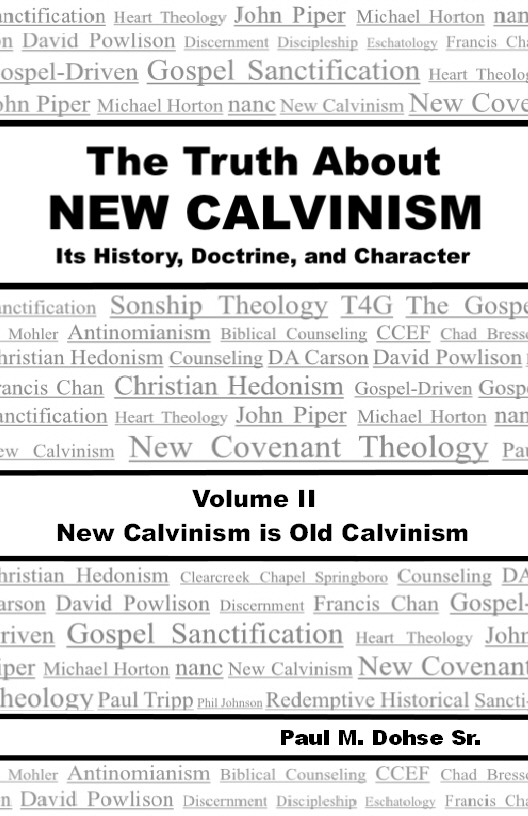
The writing of The Truth About New Calvinism—Volume 2 is in full throttle. From time to time, I would like to share some things that I am stumbling upon as I define my research of the past three years.
Many thanks to those who have helped me define the direction of volumes two and three. Volume 2 is guaranteed to be understandable. This is the unveiling of Calvinism’s fundamental detriment to Christianity and humanity in general. It doesn’t matter whether you understand the doctrine or not; volume 2 will trace and define the logic that formed the doctrine. From there, the assumption that the ideology is dressed up in Bible verses to look, sound, and feel biblical is a correct one. Volume 2 is for the layman, volume 3 will be an in-depth theological evaluation for those who want it. Once the ideology that formed the doctrine is understood in volume 2, volume 3 may be easier to understand.
If it can be confirmed that the Reformers used the Bible to sell an ideology, and it can, and they did, what they came up with is fairly irrelevant. Not only that, volume 2 will examine the fruits of the doctrine which is also telling. In order to sell the ideology, the Reformers proffered a theological treatise from the Bible. Volume 3 will demonstrate why that doesn’t even hold water.
One character trait of New Calvinism is to exploit the overall lack of education concerning its history, ideology, doctrine, and character. New Calvinism, the authentic Reformed article, is looking for a result based on covert assimilation. The result that is sought is CONTROL. This control is sought through justification by faith alone which is a doctrine that is literally justification alone because it eliminates sanctification. Stated in layman’s terms: it emphasizes the work of God while deemphasizing anything the Christian does in salvation or post-salvation. This is done by out of sight, out of mind. If you only teach justification (salvation) to the exclusion of sanctification (the Christian life), the masses will eventually live according to the Reformed version of justification alone. The Reformers were masters at redefining the terms and teaching sanctification in a justification way.
This leads to the Reformed practice of infiltrating religious movements throughout history as a stowaway and then taking over the movement. The prime example is the Great Awakening (1730s – 1790s). The Great Awakening was a pushback against Reformed ideology, not the result of it. The Pilgrims created the need for the Great Awakening. The Pilgrims, a soft idiom for “Calvinistic Puritan political refugees,” brought European tyrannical polity with them. The motif that the Pilgrims came to America for religious freedom is patently false—they came to establish their own vision of a church state. To this point:
Throughout the colonial period, and even in the early years of the independent United States, most colonies or states had established churches—churches legally recognized as the official state church. Different colonies privileged different Christian sects, for example, Congregationalism (the descendent of Puritanism) was the official state church for Massachusetts, Connecticut, and New Hampshire; and Anglicanism was the established faith in most colonies, including Virginia, South Carolina, and Georgia. Along with official recognition came special privileges, like financial support from public taxation. Before the Great Awakening, colonial Americans harbored no expectation that there should be any separation between church and state.[1]
In reality, there are NO religious movements that could be considered legitimate revivals post apostolic church until the Great Awakening which was ignited by the Age of Enlightenment. The Enlightenment was predicated on the ideas of all men being created equal by God, and mankind’s ability to solve problems through reason. This resonated with colonials and slaves alike that were under European tyranny:
Joseph Tracy, the minister, historian, and preacher who gave this religious phenomenon its name in his influential 1842 book The Great Awakening, saw the First Great Awakening as a precursor to the American Revolution. The evangelical movement of the 1740s played a key role in the development of democratic thought, as well as the belief of the free press and the belief that information should be shared and completely unbiased and uncontrolled. [2]
Enlightenment ideas were completely contrary to Reformed thought as exemplified by the Westminster Confession.[3] Most of the Westminster Divines were Puritans. Colonial Puritans believed in slavery according to their extreme European caste mentality, and executed doctrinal detractors. Contra Enlightenment ideas that ignited the Great Awakening can be seen in the present-day New Calvinist movement; for instance, an article written by New Calvinist James MacDonald bearing the title, “Congregational Government is From Satan.”
Nevertheless, Reformed hacks like Jonathan Edwards infiltrated the Great Awakening, and to a large extent hijacked it. The Great Awakening was a revolt against the organized institutional church state, and was a gargantuan human mass of people searching out new ideas. Hence, the thousands who showed up to hear Reformed teachers during that time were not necessarily enthralled by the supposed gatekeepers of the Awakening, but were flocking to hear anyone who had an idea. Edwards et al proceeded to connect the movement to the Reformers of old who were the ones directly responsible for the tyranny that the colonials were experiencing in the first place.
Moreover, the colonial Puritans wasted no time in trying to infiltrate the American Revolution, its founding declarations, and constitution. James Madison fought the infiltration tooth and nail with his Memorial and Remonstrance Against Religious Assessments.
Unfortunately, the colonial Puritans did succeed in identifying Reformation thought with the Great Awakening. The many denominations and groups that were created by the Awakening usually, and unwittingly, identified themselves as Protestants. As a result, the primary Reformed institutions of learning[4] were built with money from the children of the Great Awakening who were really the product of Benjamin Franklin’s contra ideology. Incredibly, and undoubtedly the zenith of historical misrepresentation, those of Reformed thought who hijacked the Great Awakening have been credited with the Abolitionist movement. The Abolitionist movement was nothing more or less than an Enlightenment idea, while the Puritans were the first to bring slaves to the shores of America (ironically, slaves brought many cultic beliefs with them that in part incited the Salem witch trials).[5] The Enlightenment era was directly responsible for the massive conversion of slaves to Christianity shortly after the signing of the Declaration of Independence. The ideas of freedom and reason ignited colonial revivalism, not the contra idealism of the Reformation. Franklin was an abolitionist while he was governor of Pennsylvania, and the epicenter of revivalism among the slave population was Philadelphia.
This form of parasitic deception and covert assimilation is a Reformed hallmark. Those of Reformed idealism, historically, do not build anything. The Pilgrims were utterly inept in fending for themselves in the new world. They latch on to what is alive and feed off of it. Their very institution is a historical Ponzi scheme. A contemporary example is the home church movement in America. Because of the fundamentals that came out of the Great Awakening, the American church remained fundamentally Reformed in its overemphasis on justification because sanctification infers human ability. Therefore, per the usual outcome, a mass exodus from the institutional church began in circa 2000. This resulted in the home church movement. According to the Reformed mode of operation, New Calvinism hijacked that movement as well, primarily for self-preservation. This is the motivation for flock groups and “churches” like Apex. However, they are not purely home churches, and are connected to a central institution in order to maintain control.
A proper understanding of church history is the key. Until then, Reformation thought will continue to suck the life blood out of anything that lives in Western church culture.
Endnotes
1. Shmoop Editorial Team. “Religion in The American Revolution” Shmoop.com. Shmoop University, Inc., 11 Nov. 2008. Web. 30 Oct. 2013.
2. Wikipedia.org: Great Awakening.
3. Paul Dohse: Inseparable: The Reformation’s Principles of Persecution and its Gospel; Paul’s Passing Thoughts .com, August 31, 2013.
4. Columbia University (King’s College, 1754, Anglican), Brown University (Rhode Island College, 1764, Baptist), Rutgers (Queens College, 1766, Dutch Reformed), and Dartmouth College (1769, Congregationalist).
5. 1619: Slavery begins in the colonies, as twenty Africans are brought by a Dutch ship to Jamestown for sale as indentured servants. 1664: Maryland makes lifelong servitude for black slaves legally mandatory. Similar laws are later passed in New York, New Jersey, the Carolinas and Virginia. 1667: The Virginia House of Burgesses passes a law that binds blacks to servitude, even if they convert to Christianity.
Calvinism: The Root of All Evil in the American Church
 Originally posted August 21,2013
Show me the Money.
Why has New Calvinism taken the American church by storm? Because the American church was already primed for it. Before authentic Calvinism was rediscovered by a Seventh-Day Adventist in 1969, America was, and always has been half-pregnant with the Puritan form of Calvin’s Geneva.
Calvinism makes everything about justification while excluding sanctification for a very simple reason: control. If justification is a finished work, and all that is at stake is eternal rewards in heaven, the church would not be nearly the institution that it is today. Why is there big money in religion? Why is there a church every two miles in America with a 500,000 dollar annual budget? Why did 3,000,000 people show up on a beach to see the new Pope? Why does the Catholic Church have so much power? Because salvation is big business my friend. If salvation is found in an institution, it will all but rule the world.
Plain and simple: the Reformers taught that the same forgiveness for sin that saved you needs to be continually sought out to maintain salvation (justification), and that forgiveness can only be found in the Protestant church. Sola Fide indeed, there is no money in sanctification; the big bucks are in justification. From a worldly perspective, Christ had a horrible business plan:
Go therefore and make disciples of all nations, baptizing them in the name of the Father and of the Son and of the Holy Spirit, teaching them to observe all that I have commanded you. And behold, I am with you always, to the end of the age.
There is no money or power in making disciples; the money is in making saved people and requiring them to be faithful to the institution in order to stay saved. In business, we call that RMR (reoccurring monthly revenue).
A finished justification and focus on discipleship empowers the individual, not the institution. Who the Master is—is a settled issue and the focus is preparing for His return by making maximum use of the individual talents given by grace. But when keeping our justification is the focus, individual responsibility to the Master is relegated to the closets. Come now, let’s be honest, how many Christians in the American church even know what their spiritual gifts are? How often do we see church “services” where we “encourage each other unto good works” as opposed to being there to “receive more Jesus.”
The parable of the talents is teaching about a servant who sought to only give back to the Master what he had originally received. And that is exactly what the Reformers promoted. Calvin et al believed that sanctification replaced the Old Testament Sabbath. We will make it to heaven if we “rest” in our salvation.
Enter a conversation I had with a brother not but two days ago:
Ya know Paul, this New Calvinism stuff is supposedly so great, but I have been a member of this church for ten years now, and what? Maybe five people have been saved in that time.
Exactly. Let’s face another fact, people aren’t being saved, if anything, they are just being shuffled around or convinced they were never saved to begin with. The reason for this is simple: Christ said to let our good works shine before men so that our Father in heaven would be glorified. That concept was anathema to Calvin. The fact that sanctification is a Sabbath rest should speak for itself.
The double myth of Arminianism.
Arminianism is another Protestant myth. It centers on the election debate, a doctrine that Calvinists don’t even believe to begin with. The Arminian/Calvinist debate is a double myth. Start thinking for crying out loud, what power and control would there be in election? There is no money in election either. Election portends a settled eternal destiny. If there is election, what do we need the institutional church for? “Election” only gets you into the race for “final justification,” but the race must be run in the church so that you can get your perpetual forgiveness that keeps you in the race. My friend, always follow the money. Always.
While arguing for free will versus total depravity, Arminians have always functioned like Calvinists. Since the Pilgrims Puritans landed on our Eastern shores, we have had Calvinism Lager and Calvinism Light. Arminianism is closet Calvinism. Both devalue sanctification. Calvinism completely rejects sanctification as “subjective justification.” Arminians give tacit recognition to sanctification while completely rejecting it by the way they function. The lager form proudly shows forth Calvin’s doctrine of ecclesiastical justification while Arminians live by John Calvin bumper stickers:
We are all just sinners saved by grace.
This is Calvin’s view of Christians remaining totally depraved while receiving justification in the present-continuance tense.
Just this week, I saw the following John Calvin bumper stickers posted by people who would vehemently deny that they are Calvinists:

This is based on Calvin’s Redemptive Historical hermeneutic and Luther’s Cross Story epistemology. The idea is that the Bible was not written for the purpose of grammatical exegesis, but rather to contemplate the redemptive narrative only leading to subjective, perpetual justification that is necessary to achieve “final justification.” Knowing the Bible factually is Luther’s Glory Story, knowing the Author is Luther’s Cross Story. In other words, every verse in the Bible is about justification and not wisdom for sanctification, the proverbial, “living by lists” and “do’s and don’ts.”
And….

Right, because sanctification is “subjective justification.” Any concern with our outward behavior is, as Calvinist hack Dr. Michael Horton states it, “trying to BE the gospel rather than preaching the gospel.” This fosters the very thing that makes Christianity contemptible to the world—preaching the gospel and not living it. It is the Sabbatical sanctification fostered by John Calvin himself and promoted by Arminians wholesale.
Calminianism is the real reality.
Sanctification?
So ok, the Bible has much to say about justification by faith alone, but where is this standalone subject of sanctification that is a different matter of Christian living altogether? One place among many would be 1Thessalonians 4:3ff:
3 For this is the will of God, your sanctification: that you abstain from sexual immorality; 4 that each one of you know how to control his own body in holiness and honor, 5 not in the passion of lust like the Gentiles who do not know God;
Obviously, sanctification is all about KNOWing HOW to control our bodies. And even more obvious is the fact that justification has nothing to do with that at all. And also obvious is the fact that the two aforementioned Calminian metaphysical bumber stickers totally reject this biblical definition. Let’s have another moment of honesty. How many Christians know more about controlling their body today than they did yesterday? And does that affect how the world sees us, and God?
Fusion and dichotomy.
Sanctification is a continued endeavor to learn more and more how to control our bodies from the Scriptures. Calvinism rejects that as the Glory Story. A focus on controlling our own bodies makes life about us and “eclipses the Son.” It fuses justification and sanctification together while dichotomizing anthropology. The opposite should be true in regard to both categories. Calminianism is an upside down Christian life.
Anthropological concepts; i.e., what makes people tick, are deemed pragmatic and unspiritual. Rather than seeing these subjects as wisdom where Christians ought to be outdoing the world, they are rejected as “living by lists” and “living by do’s and don’ts.” I like what one pastor had to say about those truisms:
They are telling us the following: “Don’t live by do’s and Don’ts.”
A prime example is something that everyone is born with: a conscience. The only Psychiatrist in history that really had a track record of helping people was O. Hobart Mowrer. The main thrust of his therapy was an emphasis on keeping a clear conscience. He believed that most mental illness was caused by a guilty conscience. He cured people by insisting that they deal with unresolved issues of guilt. Mowrer, once the President of the APA along with a long list of distinguished awards and appointments, wrote The Crisis in Psychiatry and Religion. The book rejected the medical model of Psychology and fustigated Christianity for relegating the care of the “mentally ill” to Freudian Psychology. Mowrer was not a Christian.
Nevertheless, he is the one who most inspired the father of the contemporary biblical counseling movement, Dr. Jay E. Adams, who applied Mowrer’s practical approach to biblical counseling. Adams did this because he observed Mowrer’s astounding results while doing an internship with him in the summer of 1965.
This only makes sense. The apostle Paul instructed Christians to “keep a clear conscience before God.” The Bible has much to say about the subject of conscience. Christians should use the Bible to be wiser in all areas of human practicality and should excel at it far beyond those who live in the world. Let’s have another honesty moment: how many sermons do we hear on the importance of practicality in the Christian life? Subjects such as, planning, accountability, etc. Unfortunately, these biblical subjects are dichotomized from the “spiritual” and deemed pragmatic.
At the same time, justification and sanctification are fused together in an effort to live out a Sabbatical sanctification; i.e., sanctification by faith alone. This is nothing new, James rejected the concept in his epistle to the 12 tribes of Israel that made up the apostolic church. It is also a Gnostic concept that sees the material as evil and only the spiritual as good. Therefore, since anthropology is part of the material realm, any practicality thereof cannot benefit the spiritual. Supposedly.
Another concept, along with conscience, is that of habituation. Through discipline, habit patterns can be formed that lead to change, ask anyone who has been in the military. People who inter the military come out as changed people. Because of our Protestant heritage and conditioning, these concepts seem grotesquely pragmatic. But according to the Bible, we are to make use of them.
Sanctification is a many-faceted colaboring with the Holy Spirit, and the Spirit’s power is unleashed through wisdom and obedience (James 1:25). We must know assuredly that justification is a finished work, and absolutely nothing that we do in sanctification can affect it for better or worse. This is what purifies our motives in our love for Christ in sanctification. “If you love me, keep my commandments” has absolutely nothing to do with our justification. It’s for love only, not a working for justification. We are thankful for our justification, but that thankfulness doesn’t save us or keep us saved. Only Christ saves—the new creature now loves Christ because that’s who he/she is. Christ’s love made it possible for us to love Him in sanctification, but nothing in sanctification keeps us saved. Sanctification looks not for a “final justification,” but readies itself for the Master’s return and longs to hear the words, “Well done faithful servant!”
When I was a young boy, I often lived with my grandparents during the summer. My grandfather was a real-life John Wayne type. He worked as a construction foreman for a large company. And he was my hero. Before he left for work in the morning, I would sheepishly await for him to depart before beginning a flurry of tasks around their small farm. I would always have the tasks done well before his arrival home and waited at the end of the drive to hear his truck’s humming wheels come down State Route 125. I would then take him around the property and show him the finished tasks. His smile and compliments were my reward. These are tasks that I didn’t have to do; our love for each other was always something totally different from those tasks. I knew assuredly that he would love me whether I did those tasks or not because I was his grandson—his pride and joy. Some idea that the withholding of serving him in order to elevate the reality of his love for me would have been a ridiculous notion.
Justification and sanctification must be separate. Anthropology and the spiritual must be fused. Our bodies must be controlled and set apart for good works. This will lead to the showing forth of our good works and the glorification of the Father leading to salvation for others, not sheep redistribution.
Spiritual abuse and disdain for justice.
A devaluing of our own holiness for fear that it will eclipse the holiness of God, coupled with salvation being sought in the institutionalized Calminian church, has led to the same indecencies seen in the mother of the Reformers; the Roman Catholic Church. Rome has never repented of its abject thirst for blood, and the fruit does not fall far from the tree.
The family split for the time being, but the Reformers never departed from Rome’s ecclesiastical justification found through absolution by church leaders. When this is the case, any vehicle going to heaven will suffice for heaven’s sake alone. The institution will never be threatened for the sake of the few. To the leaders, their existence and power is threatened, to the parishioners, their salvation is threatened. The institution must be preserved.
This is no new thing, in the minds of the Jewish leaders; Jesus Christ was sacrificed to preserve the Jewish religious system. If even Christ Himself was expendable in this mentality, what will be of the molested and raped? Besides, we are all just sinners saved by grace anyway, right? Is justice therefore anywhere on the radar screen in this discussion? Hardly. Besides, the raped and spiritually abused should be thankful because what they deserve is hell anyway, right? Once this is understood, the landscape we see today in the American church should be no surprise whatsoever.
What is the answer?
The church is a sanctified body and not an institution for final justification. We are in the business of making disciples and not keeping people justified by faith alone in sanctification. The sanctified body doesn’t justify, it is God who justifies. Men must stop worshiping at the altar of ecclesiastical justification. Justification is free to us and finished, sanctification isn’t. Sanctification is where we show our love to the savior as servants, not leaches. Evil men like Paul David Tripp who posit the idea that the Christian’s whole duty is to “rest and feed” and wait for “new and surprising fruit” because Christians only “experience” fruit and don’t participate in it must be rejected with extreme prejudice. Their evil seed was spawned in 1970, but they have been in firm control of the American church for 25 years while proclaiming each year a “resurgence.” What do we have to show for it?
It is time for men and women to recognize their calling, their new birth, their indwelling counselor, their gifts, and the authority of Christ and His word alone. There is NO traceable lineage back to the apostolic church like the genealogy documents burned by Titus. Murdering mystic despots have no claim on any authority of the church.
Godly authority is continued wherever a spirit-filled Christian picks up a Bible and obeys its words. A church is a sanctified, obedient fellowship, not a justified institution drunk with its own visions of grandeur.
paul

 Paul's Passing Thoughts
leave a comment