The Truth About Paul Tripp’s “How People Change”
 How People Change
by Paul David Tripp and Timothy S. Lane
Punch Press: Winston-Salem (2006, 2008)
Reviewed by Donn R. Arms
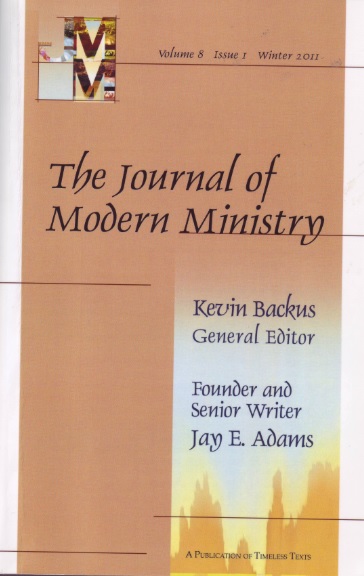
The Journal of Modern Ministry: Volume 8, Issue 1, Winter 2011
Jay E. Adams Founder and Senior Writer; Kevin Backus General Editor
_________________________________________________
The traditional view of the gospel’s relationship to change is that salvation is foundational to change. Once a person is justified before God by believing in Christ’s saving work on the cross, and made a new creature, he then begins the work of co-laboring with God in the growth process, also known as sanctification. The traditional view sees our role, after being made a new creature (born again), as many-faceted in regard to biblical instruction—the primary role being the learning of God’s Word and the application of it to life via obedience in how we think and behave (Matthew 7:24).
The traditional view makes a significant distinction between justification (redemption), sanctification (growing into Christ-likeness), and glorification (complete transformation). It sees justification and glorification as acts of God alone apart from human participation or monergistic, but sees sanctification as synergistic or a cooperative (but none the less dependent) work with God. Obviously, an accurate view and description of our participation is vital to affecting real and lasting change.
For Tripp and Lane, the gospel message is not only for the unregenerate, but efficacious for real and lasting change in the life of a believer. Certainly, as Christians move into our relationship with Christ as not only Savior, but also Lord, we should never leave behind an appreciation for the sacrifice of Christ that saved us. The authors claim, however, that the same elements of justification must be carried forward into sanctification without anything being added. In fact, for believers to even make an effort to align our thinking with Scripture is an act on our part that denies Christ as Savior:
. . . and the Bible does call us to change the way we think about things. But this approach again omits the person and work of Christ as Savior. Instead, it reduces our relationship to Christ to “think his thoughts” and “act the way Jesus would act” (p. 27, 2006 edn).
Throughout the book, the authors embrace parts of the traditional view, but view the traditional elements through a non-traditional prism, and give the traditional elements of change a different meaning. In this case they trade the traditional idea that Christians are to make an effort to align our thoughts with Scripture with the idea that we should do something else instead that leads to biblical thinking as a natural result of the “living Christ” acting on our behalf and apart from our initial efforts. According to the authors, the traditional approach omits the “work” of Christ in our sanctification and omits Christ as “Savior.”
Lane and Tripp do not deny that Christians have a role in the sanctification process. But what exactly is that role? If the traditional view of our exertion (effort in aligning our life with Scripture) in sanctification is out, what is in? Answer: deep repentance, the second major thrust of the book.
Repentance is a form of emptying the heart . . . Along with deep repentance, Scripture calls us to faith that rests and feeds upon the living Christ. He fills us with himself through the person of the Holy Spirit and our hearts are transformed by faith. (p 28)
Our efforts are out; a faith that “rests and feeds” is in. So, like justification, sanctification is limited to the narrow elements of faith and repentance only. We don’t apply effort to align our lives with Scripture in order to be saved, and we don’t for sanctification (real and lasting change) either.
Throughout HPC, Christ is referred to as “the living Christ.” Believers have no ability to perform works, or add works to their faith because believers are still spiritually dead, and the only life within us is Christ. On pages 64 and 65 of the 2006 edition Christians are described as being dead, powerless, enslaved, alienated from God, enemies of God, fools, and those who suppress the truth in unrighteousness. In other words, our condition is not changed from what we were before salvation. Referring to believers, the authors write: “when you are dead, you can’t do anything” (p. 64). Therefore, we can’t do anything leaving only the “living Christ” to perform works on our behalf.
This is a synthesizing of justification and sanctification. Our ability to perform works pleasing to God is in the same context as those who are unregenerate. We are clearly unable. The authors illustrate this with the story of Andy:
In both phases of his Christian life, the work of Christ on the cross was radically minimized by Andy’s own efforts. The first three years evidenced a Christ-less activism that produced pride and self-sufficiency (p. 184, 2006 edn).
Andy’s “own efforts” in “his Christian life” are in direct relation (according to the authors) to how prevalent redemption (“the work of Christ on the cross”) was in Andy’s life. The fact that Andy’s efforts to obey might have been misguided is not the point that the authors are making here. The authors only cite Andy’s “own efforts” in “his Christian life” with no traditional consideration of erroneous efforts to obey that are inconsistent with the Scriptures being rightly divided.
In essence, it resembles an ongoing need to be saved (redeemed) daily through the works of Christ only. Referring to 1 Cor. 10:13-14 the authors state:
What Paul envisions here is not just the change that takes place when we come to Christ, but the lifestyle of change that results from an ongoing sense of our need for redemption (progressive sanctification) [p. 102, 06 edn].
Progressive sanctification is redefined as “an ongoing sense of our need for redemption.” However, the redemption he is speaking of is the same redemption that originally saved us (“when we came to Christ…and the ‘ongoing’ need for it”). Tripp and Lane believe that there is little difference between justification and sanctification. If we can’t do works to be saved, neither can we do works in the sanctification process.
But what about all the commands in the Bible that are obviously directed toward us? Are we not supposed to obey the principles and commands of Scripture? Yes, but . . .
. . . a behavioral approach to change is hollow because it ignores the need for Christ and his (sic) power to change first the heart and then the behavior. Instead, even the Christian version of this separates the commands of Scripture from their Christ-centered, gospel context. [p. 26]
By “Christ-centered, gospel context,” they mean obedience via the cross (works of Christ, not ours). This can also be seen in their view of the use of Scripture as instruction, or “directions” to be read and then followed:
One of the mistakes we make in handling God’s Word is that we reduce it to a set of directions on how we live. We look for directions about relationships, church life, sex, finances, marriage, happiness, parenting, and so on…..This does violence to the very nature of the Word of God and robs it of its power. The Bible is the world’s most significant story, the story of God’s cosmos-restoring work of redemption. The Bible is a “big picture” book. It introduces us to God, defines our identity, lays out the meaning and purpose of life, and shows us where to find help for the one disease that infests us all—sin. If you try to reduce the Bible to a set of directions, not only will you miss its overall wisdom, you will not make sense of the directions. They only make sense in the context of the whole story (p. 92, 2006 edn).
Seeking, then, to find in the Scriptures instruction in Godliness (2 Tim 3:16) “does violence to the very nature of the Word of God and robs it of its power.”
The second tenet advocated by Tripp and Lane is deep introspection, or “deep repentance.”
Repentance is a form of emptying the heart….Along with deep repentance, Scripture calls us to faith that rests and feeds upon the living Christ. He fills us with himself through the person of the Holy Spirit and our hearts are transformed by faith. [p. 28]
Deep repentance, also called “intelligent repentance” by the authors, is a necessarily embellished form of orthodox repentance because of the narrow approach (faith and repentance only as our role) the book’s theory takes in regard to change. Heart idols must first be identified. Then repenting of them leads to the elimination thereof, creating a void that is filled by Christ and the release of His power accordingly.
Elements of deep repentance include asking God to forgive us of our own efforts, i.e, “repenting of righteousness” (p.190, 2006), and “seeing the sin beneath the sins” (p. 190, 2006) which requires an understanding that it is impossible to violate commands 4-10 (of the 10 commandments) without first violating commands 1-3, which are the commands that speak to heart idols. Therefore, you must get to the heart of why you sinned (idols of the heart covered in commands 1-3) before the violation of all other sins can be prevented. On pages 163-165 Lane and Tripp suggest a list of “X-ray questions” to determine types of desires linked to heart idols to aid in this “deep repentance.”
The third tenet is that of “the Bible as a narrative for change.” The authors say that the Bible is a simple story that all Christians can understand, and that God uses creation to write the book in word pictures (p. 93, 2006). The very purpose of the Bible, according to the authors, is to supply believers with a model of change that involves four basic elements: heat, thorns, cross, and fruit (p. 96, 2006). The authors say the Bible is a grand gospel story that encompasses all of the necessary elements needed for life and godliness in regard to our life story. Therefore, God calls us to come to the grand story with our story, and He invites us to place our life story into the grand story, discovering where our experience of life fits into one of the four elements of heat, thorns, cross, and fruit:
This big picture model is the story of every believer. God invites us to enter into the plot!”(p. 94, 2006).
All of Scripture falls under one of these categories, and these categories form the grand gospel story, which is the sole purpose of the Bible—to present a gospel story of real change that reveals God’s grace and provision accordingly.
By seeing our circumstances in heat (circumstances of life), thorns (desires and idols of the heart that cause us to sin), fruit (Christ working in us, or the consequences of sin), and God’s provision for all three (cross), we gain wisdom, encouragement, and a mentality that seeks to know a deeper need and dependence on Christ. Using Scripture for this purpose exalts Christ in our minds, makes us desire Him more, and deepens our sense of dependence on Him. This deepening sense of our dependence on Christ, which results from using the Scriptures in this way, creates a lifestyle of change because we come to realize that we need redemption every day, not just when we were originally saved. Total dependence on Christ becomes synonymous with faith to the exclusion of almost everything else. The Bible, then, is designed for the sole purpose of aiding the believer in faith (total dependence on God) and deep repentance.
How People Change is a pronounced departure from the traditional (or nouthetic) model of biblical change. It starts by synthesizing justification and sanctification, and narrowing our role in spiritual growth to faith and repentance only. The authors then present a “big picture” model of interpretation that describes their view of the proper use of Scripture in the change process, and the role the Bible plays accordingly. Their model presents the Bible as a gospel narrative, and to the exclusion of all other purposes. The authors of HPC present a strange picture of believers who are still dead in trespasses and sins while being indwelled by Christ who is the only life within us, and therefore the only one working in the change process. Accordingly, total dependence on Christ is the key to real change—a Christ Who obeys for us!
Christ referred to the Holy Spirit as our “helper” in John 14:16. Who is he helping? And what is He helping with? The verse begins with a coordinating conjunction that connects it to the idea presented in the preceding verse, which says: “If you love me, you will keep my commandments.” One of the ministries of the Holy Spirit is to help us obey Christ. Let’s teach counselees to do just that.
Self-Esteem, Calvinism, and the Mass Graves of Human History
 Originally posted January 5, 2014
Of course, it is no surprise that God’s creation is most fascinating and teaches us many things about Him. Creation teaches us that God is good, and is a God of order…and good ideas:
“It’s nature’s way of telling you something’s wrong. It’s nature’s way of telling you in a song… Something’s wrong, something’s wrong, something’s wrong.”
Such is creation and its order; hence, Dr. Phil asks the rhetorical question: “How’s that working for you.” God created the Earth to work well when good ideas are implemented. This is the order of creation. God said to multiply and subdue the earth; ie., make it work well with good ideas. In that, God is glorified—good ideas and good results verify that God is a God of order and goodness.
Spiritual abuse in the church is the hot topic of our day. Discernment blogs exploded in 2008 without anyone stopping to ask why. In that same year, a massive covert church subculture was dubbed, “New Calvinism.” Now, a truth is emerging that no one wants to deal with: New Calvinism is a resurgence of the original article of the Reformation. And the discernment blogosphere is a sandbox where we play with toys representing a reality that we would think is hell on earth if we didn’t know better. It is the same difference between a child playing with a toy tank in the back yard versus a tank commander on the ground in Afghanistan. The blogosphere is playing with issues that are better understood by those who were tied to two horses running in opposite directions.
I am presently working through a recent post by church historian John Immel, a much valued friend of this ministry. If you want to partake in relevant “deep repentance,” read his materials and then surf the discernment blogs as well as your own former take on contemporary church history. For certain, I am not charitable enough with some and forget my own former ignorance as a Reformed pastor. I was primarily duped on the issue of self-esteem. Like all good Reformed pastors, I was a proponent of self-death. I was a proponent of ALL love being an outward focus. Like all good Reformed pastors, I despised Dr. James Dobson.
As the saying goes, a clock that doesn’t work is right twice a day. There is some rightness to the idea that others are important. Luther’s self-death will work and free you from the emotional investments of this world—it is VERY effective…and cowardly. As I work through John’s post, I find my red pen underlining and writing, “Luther-Heidelberg Disputation, Luther-HD, HD theses 28,” over and over again. Calvin expanded Luther’s treatise in the Calvin Institutes and presented it to Francis 1 as a political document, a fact never mentioned in our day. The masses thinking well of themselves has never been good news for many governments. Those who think themselves worthless are much easier to control. And when you have a fancy to kill them, they will report to the gallows with joy. Of course, due to their powerful faith in God. Ahhhmen.
Let’s talk Bible. I believe the Bible is God’s full-orbed metaphysical statement to mankind; specifically, to the individual. It is His metaphysics, epistemology, ethic, and politics. It is written to the individual. I am not dismissing the need for teachers, but be sure of this: the you need me to help you understand what God is really saying ploy was first used on Eve in the garden and is the mainstay employed by the kingdom of darkness till this day.
Simply stated, the Bible teaches that we are wired to value ourselves. Wisdom is deep and a matter of Biblical balance. No man is “totally depraved.” Biblically, we are instructed to love others as much as we already love ourselves. That’s not a bad thing; that is how God created us. God even wants us to use that fact to “treat others as you yourselves would want to be treated.” The apostle Paul stated that NO man has ever hated himself—so treat your wife accordingly.
A goal of hating ourselves, the essence of Calvinism and Reformed doctrine in particular, is just a really bad idea with the results following. And it’s NOT Biblical. And it leads to all kinds of goofy ideas that have filled mass graves for centuries. And self-esteem is something we earn—it is a truthful evaluation of ourselves. The apostle Paul wrote: “Do not think of yourselves more highly than you ought.” The Bible calls for a truthful self-evaluation and assumes you are able to do so.
In fact, it gives us confidence that we can love others and help them. James Dobson still isn’t my cup of tea, but you will never find him presiding over a death panel. When I was a Reformed pastor, I despised James Dobson because I was in fact a dangerous person. My ideas were dangerous because I was of the Reformed tradition. Sure, nevertheless a good guy amongst that camp; I would have never manned the ovens at Auschwitz. I would have merely kept my silence and said, “But for the grace of God, there go I.”
What in the world prompted this post? Well, note carefully what a commenter wrote to me on another blog yesterday which is incredibly ironic given that I am still working thorough John’s article:
The problem is with the human heart. We think too highly of ourselves and not highly enough of those around us. Those with power tend to use it to dominate others. (Like males over females) Only through accurately understanding the Gospel can godly humility replace the ugliness of human pride. Boasting in oneself will then cease. We will begin to respect others enough to speak the truth in love and not in arrogance… I’m sorry PPT. I will try to be more careful in the future. However, by focusing on scapegoating Calvinism as the source of this problem (as you are doing), you miss the crucial point that because other groups are also guilty of this abuse, your premise is wrong. I get it that you hate Calvinism, but don’t let that bias blind you to the real cause: the prideful human heart that is not truly humbled by the Gospel. One must be convinced of and transformed by the Gospel in order to produce godly fruit. True humility cannot be faked. Boasting, arrogance, domination of others, are just a few characteristics of an unbelieving heart. It is dangerous to think that such deceitful pride can only affect others and never us.
Truly ironic. The commenter is anti-spiritual abuse, yet holds to the same self-worth = pride philosophy that is the crux of every “gospel” written to the likes of Francis 1. I close with a comment from another on the same stream:
We are missing each other, I think.
The question for me isn’t whether spiritual abuse can happen in any denomination or religion. It does. The REAL question is: Do certain doctrines attract abusers / evil perps? To say that since abuse happens across the board in all religions, so abuse could never be problematic to certain doctrines/religions is a logical fallacy.
The doctrine of total depravity teaches people they don’t have personal responsibility. It is God who orchestrates it all as the grand puppet-master. That is quite problematic, IMO.
Right. If you are worthless, if you haven’t been gifted by God, if you need someone else to interpret reality for you, it is the Staples easy-button of life. It is the easy road trodden by those that sing merrily on the way to the gallows…
…because we have so much faith in God.
paul
Politics and Religion Have the Same Soul
Originally posted September 27, 2012
When I didn’t know any better as a Christian, I was indifferent to politics because it made no sense to me. My problem was the following: I was always focused on outcomes. It never made any sense to me that regardless of outcomes, people would vote the same ideologues into office time and time again. In my frustration I would think, “Politics is a waste of time because people are stupid. Regardless of outcomes, they vote these same people into office time and time again.” This made absolutely no sense to me.
Until recently, church never made any sense to me either. Consider this picture: vast institutions pregnant with ultra-educated people coming up with ideas that plainly contrast Scripture. Again, regardless of the poor outcomes, the SYSTEM remains intact. The system seems to offer a devil that we know, and have become comfortable with, as opposed to a devil that we don’t know.
If you think about it, what is the difference between contemporary Christianity and the slave caste system of the Civil War era? To stand up against injustice is really the same thing as challenging the system. Action is stalled because people hope that the system will change (good luck with that)—that’s easy, changing the system is hard. However, we will fight harder to not change the system, as opposed to changing the system because it’s what we know. Hence, the system takes precedent over God’s justice and is protected by political spin dressed in biblical garb.
But people aren’t stupid, they just prefer whatever the normal is for the day—especially if they aren’t the ones being tied between two horses running in opposite directions. Pathetic, but it is what it is. And both politics and religion are kept alive by the same heart in this regard; the epic question of, “Who owns man?” Ownership is the soul of politics and religion.
Since the day that the framers of the American Constitution posed this question and answered it with the resolve of “Give me liberty or give me death,” be sure of this: the question of who owns man is the soul of American politics and always will be. Whether the American public realizes it or not, those who vote for Obama think government owns man. People who vote for Romney (albeit not their preferred choice) believe that we own ourselves, and are responsible to no other than God for the sum and substance of our life.
That’s the crux, until the day that the former wins the day—then politics will not be necessary because everything is decided in regard to the arena of ideas—there won’t be any arena—the government decides what a good idea is, and what it isn’t.
And religion is no different. That’s because the American framers of the Constitution were home wreckers. They caused the divorce between the European marriage of church and state. In Europe prior to the Enlightenment era that gave birth to the framers; as it was in the government, so it was in the church. There was no arena of ideas save the think tanks that devised efficient machines to eliminate free thinkers with as much pain as possible. Never before in human history has more science been poured into the technology of death machines than in Medieval Europe. And as part of the totally depraved masses, suggesting ideas privately or otherwise was extremely hazardous to one’s health.
It was a very efficient marriage. The church came up with the ideas and controlled them, and the government enforced the churches’ ideas. But there was a problem. The problem can be seen in one Bible verse among God’s full philosophical statement to man regarding truth: “Come, let us reason together saith the Lord.”
Reason. Even God presents His truth in an arena for man’s hearing. In the book of Job, we even find God challenging Satan in that arena. Like no other creatures, we are the ones called to reason—it is how we are wired by God. The results of shutting down man’s ability to think are abundantly evident from European history. Man is created to think. A man who is not allowed to think is exactly like a fish out of water. Eventually, he will start flopping around.
The framers understood this. They knew that any attempt by government to control ideas would only result in a repeat of European history. They also knew that religion is the fundamental gene pool in that regard. But systems die hard. Regardless of the eight-hundred-year European raging fire that could not be extinguished with blood, European religious tyrants who came to setup shop in America could only propagate their system in the government protected American-made arena of ideas.
The divorced couple must play by American rules thus far. In the American political system, it’s communism/socialism. In the religious realm, it’s European Reformed theology. The fight between the Europeans and the yanks continues in the arena of ideas instead of the battlefield. But be also certain of this: every drop of blood spilled in human history has been over ideas. The American framers of the Constitution, for the first time in history, invented a caste system that could implement ethics through politics without blood. Preferable in my book. And I am allowed to say so.
The soul of politics and religion is therefore the same. Who owns man? What could be more obvious? Does government own man? Or does man own man? It could be rightfully argued that God owns man, but even he says, “Come, let us reason together” while the European Reformer Martin Luther called reason a “whore” who should have “dung rubbed in her face to make her ugly.” The separated spouse, government, thinks they know best as well. Thinking, ideas, and reason, in the hands of the masses are supposedly the same as handing an eight-year-old a loaded gun as a play toy. And in the American arena of ideas, many are convinced that this is true.
 Now you know the heart of the election that is now upon us. Obama has clearly stated that it is common sense that man exists for the government, and doesn’t build anything: “I hear business owners say, ‘I built this or that.’ You didn’t build that.” And obviously, the idea that led to the building project had nothing to do with it as well. The contrast can be pointed out in a recent speech by Romney at the Dayton, Ohio International airport in which he said that FREEDOM of IDEAS are critical to the overall American economy and wellbeing. It is also reflected in his recent bemoaning that 47% of Americans are dependent on the government and will not vote for him. Right. Exactly. That’s the crux: who owns man? And is he created to reason and think? And is it ok with God when man’s ideas produce positive outcomes?
What is at stake in this election? You only need to look at the government’s estranged spouse—the church. For the most part, European Reformed theology has won out in the arena of ideas. The caste system formed by the Westminster Confession and rabid Puritans has been embraced willingly by those convinced that the church owns them. Sure, there is rape. Sure, there is the denial of ideas. Sure, there is injustice. Sure, there are no other answers but “the gospel.” Sure, we are still totally depraved and helpless. Sure, church is boring. Sure, the church is full of mindless followers. But what else is there? If not for the system, then what? If not for the system of Reformed “orthodoxy” enforced by church “polity” and executed by various and sundry unpleasantries that replaced the burning stake forbidden by our American forefathers, then what?
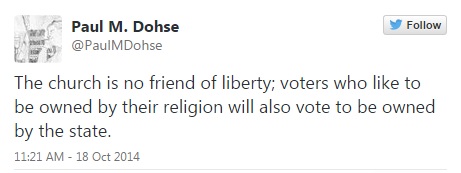
Ownership by government always leads to the same thing. Always. There are no exceptions. Regardless of outcomes, many American voters who like to be owned by their religion will also vote to be owned by the state. I also wonder how much this might be connected to the whole issue of culpability before God. After all, if we are unable to think for ourselves, and our ideas are dangerous to our own wellbeing, how can God hold us responsible? This provokes one to think of Nazi Germany and that people’s refrain, “The government made us do it.”
“One thing we don’t discuss in mixed company is politics and religion.” Right, because there is no doubt; that divorced couple is a volatile subject, especially when the two are poligion. We do know the devil of poligion, but change is hard and inconvenient. Luther suggested that reason be consigned to the “closets of the house” and we have obeyed. And whatever you do, don’t look in the closet—the monster of history is in there.
Nevertheless, when you pull the lever in November, the question isn’t, “Romney or Obama?” The real question is the soul of politics and religion: “Who owns you?”

 Paul's Passing Thoughts
3 comments