Protestantism: So Many Flavors, but It’s All Ice Cream
 Protestantism has many different denominations and interpretations of the Bible, and let me explain why that’s the case. Protestantism was founded on the idea that the law of God has a single dimension. That’s the foundation, and that fleshes itself out in one way or the other across all denominational lines.
For purposes of keeping this simple, we will focus on how this applies according to what is in vogue presently: the law can only condemn; the law can only provoke us to sin; the law demands perfection or all bets are off; the standard for being justified is perfect law-keeping.
What to do about law? That fundamental question is what divides all sects of Protestantism. It is what drives all the bickering between Calvinists, Arminians, free grace (Zane Hodges), and the anti-lordship salvation crowd which is mostly made up of the free grace crowd
This is why Protestants can’t seem to get it together on Christian living. Trying to make a single dimension law work in the Christian life causes all kinds of confusion. Staying in the same vein of simplicity, let’s use Romans 8:2 in an attempt to understand the problem:
Romans 8:2 – For the law of the Spirit of life has set you free in Christ Jesus from the law of sin and death.
That’s two different relationships to the same law. To the born again believer, the Spirit uses the law to sanctify the believer (John 17:17). To walk in the Spirit is to learn and obey the word of God which is life. This is a colaboring with the Spirit in the truest sense.
To the unbeliever, the law can only condemn, and sin within uses the law to provoke the unbeliever to sin. To the unbeliever, the law can only bring death. Hence, “the law of sin and death.”
In what way does the law set us free to “serve another”? When we believe its testimony, it sets us free from being condemned by it, and frees us to obey it as a way of loving God and others. This isn’t a difficult concept: if we listen to wisdom we live; if we reject wisdom we die, but it’s the same wisdom.
Again, for purposes of making a simple point in this post, I am not going into how this all fits together with the believer being truly righteous, and able to please God through obedience while falling short of perfection. You aren’t going to understand any of that till you get this basic point anyway.
The following prompted this post: I stumbled upon an anti-lordship salvation kind of guy named Jack Smack who believes Calvinists, Arminians, and proponents of lordship salvation are all going to hell. Again, this all boils down to differences in how you get the square peg of a single dimension law into the round hole of Christian living and the gospel. Note what he states in the video:
Now what is Lordship salvation? It’s the idea that you have to live a certain way, you have to prove you are saved by your works. You got to obey God; you got to repent of your sins, and it’s all of this jargon. And there’s a lot, there’s a few other things they say: the lot of them will tell you, you know, you can’t live any way you want to and all this, well, they’re trying to control you. They’re trying to put you under the law. They’re doing exactly what these Jews were doing. It says, “why compest thou the Gentiles to live as do the Jews?” Okay…
15 We who are Jews by nature, and not sinners of the Gentiles,
16 Knowing that a man is not justified by the works of the law, but by the faith of Jesus Christ, even we have believed in Jesus Christ, that we might be justified by the faith of Christ, and not by the works of the law: for by the works of the law shall no flesh be justified. 17 But if, while we seek to be justified by Christ, we ourselves also are found sinners, is therefore Christ the minister of sin? God forbid.
Now look at this: Lordship Salvation, they’re people trying to get you to sin – they want you to sin! They teach lawless, that lewd antinomianism, because if you get down to it, they’re trying to put you back under a law. And all the law can do is cause you to sin.
18 For if I build again the things which I destroyed, I make myself a transgressor.
So actually, in all reality, ironically, a Lordship Salvationist claims like they don’t want people to keep on sinning, but the reality of what they teach, it’s going to make you go on sinning, according to that verse. So yes, Lordship Salvation proponents are antinomian. Regardless of whether or not they will admit this, the bible says they are. Any time you try to put somebody under a law, you are making them into a bigger sinner PERIOD.
19 For I through the law am dead to the law, that I might live unto God.
So, it’s all I have. Lordship Salvation makes you into a bigger sinner because you’re imposing laws on people that they just can’t obey on their own, and um…that’s exactly what these people are doing. So I , you know, believe in, I teach Free Grace. I teach that we’re justified freely by His grace through the redemption that is in Christ Jesus.
Now you have to understand Free Grace, or you cannot serve God; and you cannot, you know, obey God. You have to understand what’s been done on your behalf: Jesus Christ died for your sins. He was buried and rose again. He gives eternal life as a free gift. So, on the basis of that, we should want to serve God and to live right. And that’s what I teach. People that are teaching law, lordship, they’re the antinomians because the reality of what they teach leads to uh..transgression.
In the Bible, there are only two kinds of people: under law (lost), and under grace (saved). But what is missed in Protestantism is that being under grace doesn’t exclude being under law, it’s just not the law of sin and death. The law informs us as to what people need to do to be free from being condemned by the law, resulting in being free to use the law for loving God and others. If we want to know what to do in order to not die for lack of wisdom, we go and ask Lady Wisdom, right?
When we are saved by believing the law’s testimony about Christ, we are set free from its condemnation in a one time, completed transformation from death to life. We are now free to serve the law unto life more abundantly. Freedom from the law of condemnation is a gift, but obedience to the law as a born again believer yields rewards in the present life and the life to come. Hence, “For I through the law am dead to the law, that I might live unto God.” But living to God doesn’t exclude the law; Matthew 4:4 couldn’t be clearer on that.
Nevertheless, notice how Smack states that the relationship of the law of sin and death remains the same for the believer. This keeps believers “under law,” which is the very definition of a lost person. He states that a demand for Christians to obey the law only causes them to sin more! Woe! But frankly, this take on law is the same problem with Protestantism in general across the board.
The obvious question becomes: how do I obey the law as a Christian in a way that won’t cause me to sin more or condemn me? Of course, this has caused much confusion among Protestants. The remedy is usually a confusing system of some sort that imputes the perfect obedience of Jesus to our life in the same way His righteousness was imputed to us by faith alone. These systems range from outright denial of the law in the Christians life to a “relaxing of the law.”
Here is what Christians need to come to grips with: the two uses of the law in Romans 8:2. That is the key.
paul
Acts Lesson 44
Tuesday Night Bible Study
February 3, 2015
Study of the Book of Acts
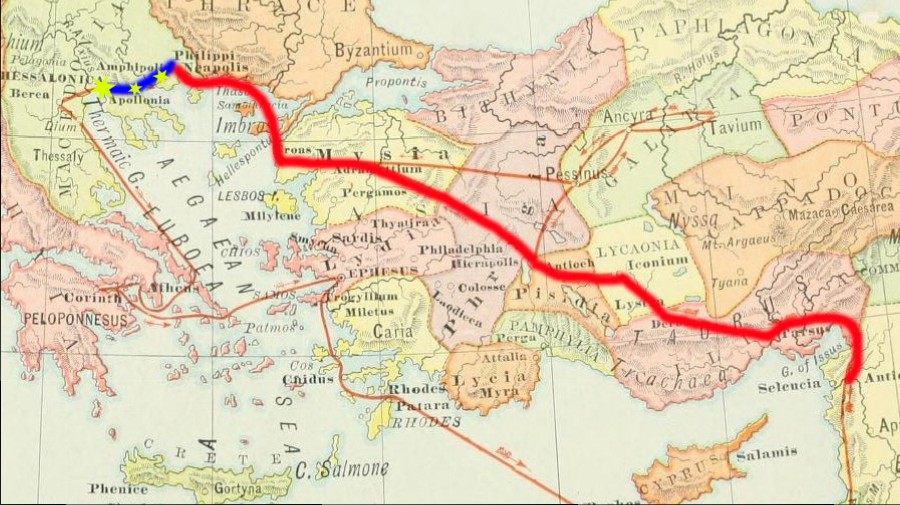
Tonight’s Text – Acts 16:35 – 17:9
Brief review
I. Concluding thoughts on Philippi
– Commentary on Acts 16:35-40
II. Events in a Thessalonian synagogue
A. Paul’s manner
B. Paul’s appeal to reason
– Definition of “reason”
1. A cause, explanation, or justification for an action or event.
2. The power of the mind to think, understand, and form judgments by a process of logic.
C. Necessary facts regarding Messiah
δει (die) – it is necessary or it was necessary
– To suffer
– To die
– To rise from the dead
D. The Biblical significance of suffering
– Psalm 22
III. People’s response to Paul
A. The positive
– Some Jews believed (most did not)
– Large number of devout Greeks
– “Chief women”
B. The negative
– “Moved with envy”
– Riot at the house of Jason
– False testimony to the city rulers
Notes:
Susan Dohse: Colonial Puritanism; TANC 2014 Sessions 1-3
SUSAN 2014 SESSION 1
Do any of you remember the popular show Myth Busters? Well, Myth Busters was a popular show at our house, and the goal of that team of men was to disprove popular myths by using a scientific, investigative approach. And often, they would take legend, superstition, or even a stunt that had been re-done on television to see if it could really happen without the effects of Hollywood. And they would break it up into a scientific investigative approach and then determine if the myth was definitely a myth, could probably happen or that it would occur all the time.
Now I would like to provoke you to take on the role of a myth buster and rather than accept what’s in our textbooks or what you read on your online blog spots and what you hear from the pulpit, rather than accept that as factual, biblical or true. And this is why we call TANC a discernment ministry. It’s a ministry that encourages believers to become Bereans, searching the Scripture daily to verify what is taught from the authority of God’s word.
Well, the topic that I have chosen to present to you is based on a historical research approach, and I have selected three myths that I would like to try to bust. And I assure you that I could have and should have delved deeper into my topic, but I allowed time restraints to hinder me–cooking, cleaning, playing with the grandbaby. But I did read eight books and twelve inches of material that I printed from online resources. But what I want to do really is just to plant a seed. I want to plant a seed and hopefully provoke you to germinate that seed. You take my point of view, you look at my references, and then you go and research for yourself and see if you come up with the same or similar conclusions that I have.
Well, there’s a plethora of myth surrounding the early history of America, some from secular humanist research, many from the Christian historians, but you have to be careful. You have to be careful when you elevate historical figures to the rank of hero and you begin hero-worshiping historical figures without knowledge. Or you hold a group of people in such high regard that we are encouraged or we are told to encourage our children to emulate them. So therefore, it was important for me to frame any research that I did with dependable historical records, direct quotes from personal writings, sermons and speeches. Now the word “dependable” is – I glean that from a colonial historian who wrote the book The Times of Their Lives: The Life, Love, and Death in Plymouth Colony by James Deetz – Now he said that if three or more historical documentations from firsthand accounts–court and church records, personal diaries, pamphlets and books–if three or more of those documentations agree fully or mostly, then the assumption can be made that that source is probably reliable, more reliable than not reliable. So I try to do the same as Mr. Deetz in preparation for this talk. I tried to look at historical documents, church and court records, personal diaries, pamphlets and books.
There is a resurgence of interest and emphasis on the Puritans today–their beliefs and their practices. In our Christian schools, heavy in the homeschool movement, and in our churches, there is a push to pattern how we study the Bible, their theology and how to contend for the truth from the Puritans in order to make significant changes that will reap eternal results. I quote from a professor at Southern Baptist Seminary, “No greater tribute to them could be made than to follow their example in this regard.” And “in this regard” is referring to how to study the Bible, their theology and how to contend for the truth. Well, that emphasis is causing me to have some grave concern, because there is a lack of foundation based on fact and true historical perspective. Myths are being presented as facts, and the same criticism that’s heaped upon those secular humanists who want to shape America’s history by eliminating and covering its Christian roots need to apply to those who try to shape America’s history by eliminating and covering its Calvinist roots.
Here are the three myths that I would like to bust. And if I don’t bust them, at least poke a hole in the balloon. Myth number one: “The Puritans came to New England because of religious persecution and a desire for religious freedom.” Myth number two: “God could make any people his chosen.” And myth number three: “The Puritans have a biblical worldview.” These are three key foundational truths to what the Puritans believed. They believe they – why they came to New England, that God could make them his chosen, and what their worldview was.
Well, myth number one, the Puritans came to the New World because of religious persecution and a desire for religious freedom. The Puritans immigrated to establish God’s commonwealth on earth, a community of visible saints following the Bible and to found churches on a congregational model. The king gave permission for the migration in order for England to acquire new materials, to check the power of Spain, to find a new route to the Orient, and to convert the Indians. It’s very important to remember what was in their charter, the Massachusetts charter that was given to those colonial-minded people. Acquire new materials, particularly gold and silver, to check the power of Spain, to find a new route to the Orient, and to convert the Indians.
Now English history reports that the Puritans back in England wanted to purify the Church, the Church of England. And that’s how they got that nickname “Puritans.” The pilgrims, who were called separatists, chose to break away from the Church of England and many even left England for Holland. The pilgrims of Plymouth are not the same as the Puritans of Massachusetts. Both were Calvinists, but they were not the same. The pilgrims of Plymouth were Puritans, seeking to reform their church, and the Puritans of Massachusetts were innocent pilgrims who moved to this land because of religious conviction, not persecution. The name Puritan, it was initially an insulting moniker, very much like when the believers in the New Testament were first called Christians. It was really not a praiseworthy title. It was to make fun of them. Well, the same was the title Puritans. That title was to poke fun at them. (more…)
Basic Principles of Sanctification
1. Sin and weakness are not the emphasis, love is. 1Peter 3:8
2. No fear in regard to justification or condemnation; fear of consequences in sanctification. James 5:9, Philippians 2:12,13, 1John 4:16-19
3. We are truly righteous and good. 1John 3:9, Romans 15:14
4. Rewards for obedience in this present life. Philippians 4:9
5. Justification is a gift, we earn rewards in sanctification. Hebrews 6:10
6. Obedience is love. John 14:15
7. The Holy Spirit is our HELPER, not one who obeys for us. John 14:16
8. Sanctification is NOT a rest. Galatians 5:7, Hebrews 4:9-11
9. Our soul is saved, we await the redemption of the body. Romans 7:24 (“wretched” means: one who is persevering in affliction, NOT personal wickedness). Also Romans 8:23
10. Prayers can be hindered by disobedience. 1Peter 3:7
11. Strive for a clear conscience. Acts 24:16
12. You become enslaved to what you obey. Romans 6:16
13. Sanctification is wisdom for controlling your body. 1Thessalonians 4:3
14. We are resurrected to a reward, not a judgment. Luke 14:14
15. We use the body for Holy purposes: Romans 12:1
16. We desire what we invest in. Matthew 6:21
17. Scripture application to life leads to a life built upon a rock. Matthew 7:24-27
18. Those who do good love life. 1Peter 3:10-12, Psalms 34:12-16
19. The power is in the doing. James 1:25
20. Learning to hate evil and love good. Romans 12:9
21. Practice of truth leads to more understanding. John 17:17, Hebrews 5:14
22. Adding biblical truth to our lives bolsters a feeling of assurance. 2Peter 1:10
23. Our goal is a rich entry. 2Peter 1:11
24. Sin uses desire to tempt us. We must define sinful desires versus godly desires. James 1: 14
25. Teachers are a help, but not efficacious to individual learning. 1John 2:27
26. There is only one judge that we are individually accountable to. Romans 14:12
27. Put off the old habits of the dead you, learn the ways of the new man, and apply them to life. Ephesians 4: 20-24
28. Our practice is “true” righteousness—it is really us doing it. We are “truly” righteous beings. Ephesians 4:24
29. Faith works through love in sanctification. Our faith doesn’t work for salvation of the soul, it works for love. Galatians 5:6
30. Our ultimate goal is the new heavens and new earth. This is the full consummation of The Promise. 2Peter 3:13
31. All three Trinity members help us in our sanctification. Philippians 2:12,13, John 14:16
32. Our sanctification is powered by the same power of the Holy Spirit that raised Christ from the grave. Ephesians 1:18-20
33. Some things are a mystery, but we are individually responsible to learn and obey the majority of Scripture. Deuteronomy 29:29.



leave a comment