John MacArthur was for Baptismal Regeneration before he was against it
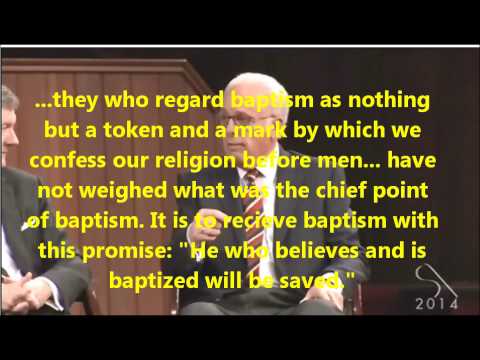 Video post by @PaulMDohse.
Source: John MacArthur was for Baptismal Regeneration before he was against it
God Predetermines Hope, Not the Fate of Individuals; Genesis 11:1-9
 The primary problem with Bible interpretation is the simplicity of its truth. The Bible itself notes that diligent study is needed by every believer, but the Bible’s call to study assumes that individual understanding is the outcome (2Pet 3:16, 2Tim 3:15).
The whole seer thing and hierarchy of understanding are a scam that started in the garden with Eve’s conversation with the serpent and has dominated the world ever since. Obviously, the serpent presented himself as an additional mediator to aid in her understanding. This is what makes America so unique in human history: its tacit nod towards individualism has made it the greatest nation ever, and even at its worst, the greatest defender of freedom and a formidable foe of tyranny’s blood-lust.
And, determinism has always been a major pillar of the caste worldview; it is the premise for caste authority, and it saturates the psyche of humanity. In a stunning rewriting of historical truth, contemporary evangelicals like John MacArthur Jr. claim determinism is a ultra-unique Protestant distinctive. According to them, the nature of mankind continually clamors to be free of authority and is helplessly self-willed. Therefore, especially among the New Calvinist leadership, Americanism, and individualism, in particular, are disdained.
However, Protestantism is just another spiritual caste system like the ones that have dominated human history from the beginning. Again, the Protestant claim of uniqueness is an absurd rewriting of history. From the beginning, mankind has been plagued with fear and condemnation leading to the pursuit of pseudo-comfort in other men. Mankind has always struggled with trusting in the one Mediator alone and instead seeks counsel from the so-called experts, or sub-mediators, aka, the traditions of men. The Bible continually exhorts people to not put their trust in princes and the wisdom of men. The traditions of men, always a dumbed-down version of the law of love or, at least, the relaxing of it is the means to fulfill the righteousness of God via spiritual caste. Read the book of Galatians, that’s what Paul was addressing. While Protestants claim to be the antithesis of the Judaizers, they are in fact a prototype.
Freewill is a major pillar of God’s created state of being, and for the most part, God only predetermines an overall outcome of His choosing. Therefore, when necessary to obtain His desired outcome, He intervenes and overrides the freewill of men when necessary. We see this throughout the Scriptures, and Genesis 11:1-9 is no exception. In this passage, how can the contrast between individualism and collectivism be denied? Protestants claim that a one-world religion would be bad unless it’s Protestantism. This should make us very uncomfortable because it is also the claim of all other religions; in other words, Protestantism is just another party among many seeking control of the world…, but of course, for the “collective good and God’s glory.” Buyer beware. Please note that many of the major Protestant confessions were written for, and addressed to, world leaders. There is a reason for that.
Determinism is so entrenched in Western culture that reading the Bible for what it really says, and plainly so, is a daunting mental exercise in overcoming presuppositions. The Protestant Platonist philosopher kings have totally redefined almost every Bible word and completely co-opted the terminology. When we read the word, “elect” in the Bible, we read it as synonymous with individual choosing, rather that what it is: a classification. God predetermined the hope of salvation for all men, that’s election. The means and purpose of salvation were elected, not individuals. This is the only construct that unifies the Bible…period. Without this construct, the Bible is thrown into total confusion.
Let’s look at an example. In Romans 8:30, Paul states that whomever God calls, He justifies and glorifies. But in Matthew 22:14, we find that many are called, but few are chosen. Huh? If you look at this from individual election or choosing, it is an outright contradiction. John Calvin dealt with this contradiction by teaching that there is a class of temporarily elected who suffer a greater condemnation for God’s glory. That’s a fact that many Calvinists conveniently leave out of the conversation.
In contrast, this is understood via the major context of Romans: the mystery of the gospel. What’s that? Oh my, this is soooo simple. Ephesians 3:6 ESV starts with, “This mystery is….” Any questions? It’s a definitive definition of the mystery of the gospel:
…that the Gentiles are fellow heirs, members of the same body, and partakers of the promise in Christ Jesus through the gospel.
In other words, Paul was telling the Gentiles at Rome that if God called the Gentiles into the commonwealth of Israel (Eph chapter 2), that it was a legitimate invitation with no strings attached. The call to the Jews and Gentiles was, and is, without favoritism or respecting of some people over others. The calling is without regret by God on any wise regarding the Gentiles—they are not a lower class of elect. Paul uses the letter to the Romans to articulate the Jew/Gentile relationship to justification in painstaking detail. The calling regards a call to full and complete adoption into the family of God as equal heirs. All who are called are justified and glorified the same way.
Now Matthew 22 makes perfect sense. God invites Jew and Gentile both into the commonwealth of Israel, but only those who accept the invitation are the elect. Many, meaning both Jew and Gentile are called, but only those who accept the invitation to the wedding feast become the elect. In other words, they accept the invitation to become part of God’s elected plan of salvation and therefore are of the elect. Jesus was also making the point that being a Jew did not guarantee your salvation as was often taught by the Pharisees. They got the point and didn’t like it much. Read Ephesians 2, Romans 8, and Matthew 22 together and the clarity of this is stunning. Then start reading your Bible with this context in mind, and it becomes clearer and clearer. The common English rendering of “many called, few chosen,” should rather read, “many called, but few elect ones.” In other words, many are called, but few Jews will accept the invitation. This didn’t go over well at all.
God predetermines outcome; that is, hope and salvation for mankind and invites them accordingly. They either accept or reject the invitation via their own freewill. God, or His gospel, is not boxed in by man’s definition of Him; that is, God is supposedly limited by His intrinsic sovereignty. Though God applies His sovereignty, He is not defined by it; the love of His gospel is what defines Him…“God is love.”
paul
Evil in the Church
Reformed ideology assumes evil, its gospel demands it for unbelievers/believers both, and its history/behavior exemplifies evil accordingly.
— Paul M. Dohse (@PaulMDohse) March 4, 2016
Achieving Total Conquest Over Depression, Part 7: Paul and Susan Christian Living Series on Blogtalk Radio Program 9

Live Broadcast link for Friday 3/4/2016 @ 6pm:
Links open in separate pages so you can view without going back and forth reopening pages.
Paul and Susan will have a conversation regarding practical ways to overcome depression. They will also summarize the primary points from last week and discuss the following article:
https://paulspassingthoughts.com/2011/05/06/wed-night-bible-study-makes-jay-adams-look-
Video of broadcast from the Potter’s House:
https://livestream.com/accounts/17669550/events/4914055

Loving Ourselves
Does the Bible ever state that to love ourselves is a sin? I don’t believe so. In fact it never even suggests that we are to love others MORE than ourselves. We are to love others AS MUCH AS we love ourselves.
“For no man ever yet hated his own flesh; but nourisheth and cherisheth it…” ~ Ephesians 5:29
“For all the law is fulfilled in one word, even in this; Thou shalt love thy neighbour as thyself.” ~ Galatians 5:14
“If ye fulfil the royal law according to the scripture, ‘Thou shalt love thy neighbour as thyself,’ ye do well:” ~ James 2:8
“Owe no man any thing, but to love one another: for he that loveth another hath fulfilled the law.” ~ Romans 13:8
“But as touching brotherly love ye need not that I write unto you: for ye yourselves are taught of God to love one another.” ~ 1 Thessalonians 4:9
“Ye have heard that it hath been said, ‘Thou shalt love thy neighbour, and hate thine enemy.’ But I say unto you, love your enemies, bless them that curse you, do good to them that hate you, and pray for them which despitefully use you, and persecute you; that ye may be the children of your Father which is in heaven: for he maketh his sun to rise on the evil and on the good, and sendeth rain on the just and on the unjust.” ~ Matthew 5:43-45
“ ‘Master, which is the great commandment in the law?’ Jesus said unto him, ‘Thou shalt love the Lord thy God with all thy heart, and with all thy soul, and with all thy mind. This is the first and great commandment. And the second is like unto it, Thou shalt love thy neighbour as thyself. On these two commandments hang all the law and the prophets.’ ” ~ Matthew 22:36-40
To love yourself is to recognize your own value. If you do not recognize your own worth then you cannot recognize the value of others.
There is application here for just about all of the problems we see in the institutional church. What is the historical orthodoxy? What has been taught about man? The metaphysical premise is man’s depravity. Man is taught that self-loathing is a virtue. Believers have been discouraged from striving for obedience to the law. The law has been replaced with orthodoxy (tradition). This is the definition of anomia; lawlessness. Jesus told the religious leaders of His day that by replacing the law with their traditions that they made the law useless. The result would be that love would grow cold.
This is what such thinking produces. And this is exactly what we are seeing in this day. Is it any wonder? If one is taught that they cannot keep the law because of their own depravity, how can he possibly love himself? Why are there so many cases of divorce, depression, and mental illnesses found in the institutional church? Why do we act shocked when we learn about these sorts of things happening in the institutional church? For the believer, he is taught that an ever-increasing awareness of sin brings about an ever-increasing knowledge of God’s holiness. The Christian life is to be one of dwelling on sinfulness; not on value. How can we expect justice for sexual abuse and other physical or spiritual abuses? If one believes he has no value, how can he possibly love others? Others have no value. Others then are nothing more than objects to be used for one’s own end.
Do you realize that if we spent our time focusing on loving others, we wouldn’t have to worry about breaking any laws? Think about that for a second. When it comes right down to it, isn’t the breaking of any law really a violation of the rights of another? It says, “I don’t value you.” Why don’t we steal? Is it because God said, “thou shalt not steal?” Or is it because we recognize that we would not want our things stolen? This ought to reveal our own sense of self-worth, which flies in the face of religious orthodoxy in direct opposition to the notion of total depravity. And in recognizing this self-worth, we then project that onto others. We recognize the value of others because we recognize our own value. God’s law teaches us that we have value!
Andy



leave a comment