Moving On As a Contemporary Child of God; All Those Who Do So Have Their Own Blessed Broken Road
 “The Protestant teachers proudly proclaim themselves as bad people and even laugh about it, but yet the simplicity of cause and effect somehow escapes us.”
“In all cases, orthodoxy is the knowledge handed down to the spiritual peasants to inform them on how to be progressively saved by the institution.”
“…in the final judgment followers will stand alone before God.”
Recently, the host and domain address for eldersresolution.org came up for renewal. With everything I have going on with TANC Ministries the due date slipped between the cracks and the site is temporarily down although there are other extensions of the site online (clearcreekchapel.com).
Looking through the information that the site documents was a defining moment and one of deep reflection. I decided to renew the domain address and move it to another site that I will develop sometime in the near future. Perhaps this very post will be the centerpiece.
Before I move on to the primary ideas of this post, let me say that eldersresolution.org, which can now be found in pdf format at http://clearcreekchapeleldersresolution.weebly.com/ was the work of my son-in-law, Pastor David Ingram, and pioneered the concept of using websites to hold the institutional church accountable in a public way. He came up with the idea as a way to take a stand in my situation (circa 2008), and to my knowledge there were no such sites on the internet at that time. It would seem that the Bangladesh missionary kids (https://bangladeshmksspeak.wordpress.com/) were also innovators in regard to the concept early on. In 2009, the concept went viral in response to the heavy-handed leadership mode of the New Calvinist movement which had finally come of age after 39 years of covert growth; what many called the “Quite Revolution” (http://founders.org/library/quiet/).
Reviewing the information made me cringe as it revisited what a weak and confused person I was at the time. With that said, it was also a major turning point in my life that I find impossible to regret. How many times did I dismiss the numerous and serious problems I saw in the church with, “What else is there?” For 27 years I struggled to find relevance in the church.
The turning point was the New Calvinist movement, and specifically the New Calvinists that covertly obtained control of Clearcreek Chapel (Springboro, Ohio). I had been a member there for 20-years-plus and a former elder. As these leaders began transforming Clearcreek from Reformation Light to Reformation Lager, I wondered if I had finally stumbled upon the answers to why Protestant sanctification is so anemic, illogical, and irrelevant.
Like the Protestant leaders I had rubbed shoulders with in the past, they couldn’t answer the hard questions, but this time I really pressed the issue because they were just adding more confusion to the confusion I had found a way to live with. That was troubling to me. Then, when they started responding to my persistence with passive forms of aggression, and later not so passive, I figured I was on to something.
Funny, one question I kept asking publically in Sunday school seemed to be the lightning rod: “How do we know when we are trying to please God ‘in our own efforts’ and what exactly does that mean to begin with? How should we do effort?” It was very obvious to the congregation that they didn’t want to answer the question, but I kept pushing the issue and that’s when all of the trouble started. It would seem that in my search for Protestant relevance, I had finally found the right question. If Christians are to rightly partake in a right effort versus a wrong effort, how is that determined?*
And of course, now I know why they didn’t want to answer the question. Protestantism teaches that sanctification is a “Sabbath rest” in which we “rest in what Jesus has done—not anything we do.” This is what Protestant Light formally criticized as let go and let God theology. But of course in the scheme of things, the folly of this construct is fully realized: not doing things is a metaphysical impossibility; so, what we are talking about is two different types of works. That would be, not working work and working work. Or if you may, faith alone works and work work.
This boils down to Protestant orthodoxy classifying works according to the traditions of men. They determine what faith alone works are as opposed to works that are “self-justifying.” It boils down to the following: obedience to their definitions determine your salvation. Non-self-justifying works pertain to Protestant ritual that keeps you saved. And of course, the sacrament of tithing keeps the money pouring in for infrastructure that bolsters the aurora of authority. What will people pay for their eternal salvation? Observe the splendor of Protestant temples and institutions that pollute the landscape everywhere.
Eldersresolution.org is merely a documenting of the symptoms. The domain will always be there, but I am not really sure why it is a good idea. It was originally constructed to warn others about the Clearcreek Chapel elders who had supposedly distorted Protestant orthodoxy and done really bad things to other people. What I know now is that Protestantism itself is the bad thing. Bad things happen in church because church is bad. In fact, one of the premier leaders of the present-day Protestant church, Dr. John Piper, brags about being bad (https://youtu.be/6-GxkAJ1OBU). The Protestant teachers proudly proclaim themselves as bad people and even laugh about it, but yet the simplicity of cause and effect somehow escapes us.**
Other mediators other than Christ necessarily demand institutional salvation based on what is supposedly God’s authority by proxy. This is why the body of Christ is a literal family and NOT an institution in any way, shape, or form. It is a literal family that one is literally born into by the baptism of the Spirit otherwise known as being “born again.” It is the literal “household of God” and the family of God the Father—not an institution any more than any family is an institution. Christ’s mandate to His assemblies is to be carried out through a family format—the literal family of God. Any vestige of institutionalism will cripple the cause of Christ to the degree that it exists within the assemblies of Christ expressed where families dwell: in homes, not institutional purpose buildings.
ALL institutional churches and religions have these things in common: mediators other than Christ or mediators in addition to Christ. There is a claim of authority other than Christ or a shared authority with Christ, and finally, there is always a gnosis caste system; the haves and have-nots in regard to the ability to know truth owned by the institution. In all cases, orthodoxy is the knowledge handed down to the spiritual peasants to inform them on how to be progressively saved by the institution.
False religion is always a broken road, but unfortunately, the pain of that road will rarely lead people to other places. But when it does, the pain of that road becomes an irrelevant and distant concern. It is a pain that is finished and its purpose completed. It is swallowed up by the experience of where the road has taken you. The story of your broken road will rarely warn others of danger or save anyone; people will forgive or look the other way in many, many things in order to gain eternal life. In the minds of the “good Germans” during WWII Germany was not perfect, but what else was there? In their minds; nothing.
In the mind of a good Protestant or Catholic what else is there? Nothing. It may be a nasty bus, but it’s the only bus going to heaven because the authority of men says so. But in the final judgment followers will stand alone before God.
And so it is. The broken road has led me to a place that makes its potholes and highway robbers a distant and irrelevant memory. Their work is finished. When experience teaches you a new way, and you begin to live in that new way, that’s healing.
Staying on the broken road and revisiting its experiences will never heal. Never. When pain is a finished work…you are healed. It is little different than Christ’s obedience to the cross which He despised and bore for the joy that was set ahead.
It is finished.
paul
*Chad Bresson, an elder at Clearcreek Chapel once prayed before the congregation: “Lord, we know that we have tried to please you in our own efforts this week, please forgive us.”
**The father of the Reformation, Martin Luther, stated in a letter to Philip Melanchthon: “If you are a preacher of mercy, do not preach an imaginary but the true mercy. If the mercy is true, you must therefore bear the true, not an imaginary sin. God does not save those who are only imaginary sinners. Be a sinner, and let your sins be strong, but let your trust in Christ be stronger, and rejoice in Christ who is the victor over sin, death, and the world. We will commit sins while we are here, for this life is not a place where justice resides.”
Be Careful About What Protestantism Allows You to Assume.
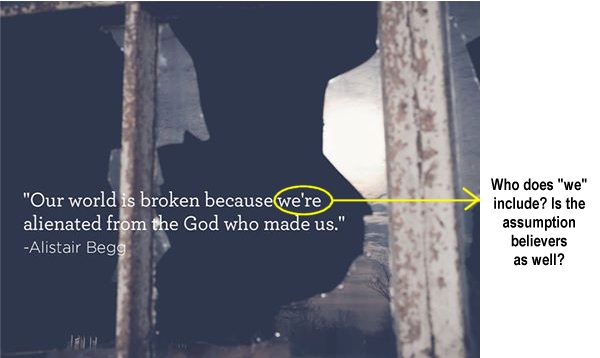
“Wherefore remember, that ye being in time past Gentiles in the flesh, who are called Uncircumcision by that which is called the Circumcision in the flesh made by hands; That at that time ye WERE without Christ, being aliens from the commonwealth of Israel, and strangers from the covenants of promise, having no hope, and without God in the world: BUT NOW in Christ Jesus ye who sometimes were far off are made nigh by the blood of Christ. For he is our peace, who hath made both one, and hath broken down the middle wall of partition between us; Having abolished in his flesh the enmity, even the law of commandments contained in ordinances; for to make in himself of twain one new man, so making peace; And that he might reconcile both unto God in one body by the cross, having slain the enmity thereby: And came and preached peace to you which were afar off, and to them that were nigh. For through him we both have access by one Spirit unto the Father. Now therefore ye are no more strangers and foreigners, but fellowcitizens with the saints, and of the household of God;“
~ Ephesians 2:11-19
Praise God!
Andy
What a Protestant Would Say to the Mentality Disabled Guy
 A close friend of mine shared something with me witnessed in a residential care facility that happened recently. My gig in the world of home health care (HHA) is not in the realm of mental health, but I enjoy hearing how our trade applies there.
At any rate, a lot of God-happenings occur in both realms. As readers here at PPT know, one reason among many that I chose this career is to facilitate a greater knowledge of Christian living (sanctification) which is devalued in Protestantism by design. Protestant orthodoxy dismisses the idea that Christians have a separate life that is Christ-like-in-kind because we have the same Father, and propagates the idea that we have NO life apart from Christ’s life. In other words, Protestantism redefines biblical new birth and is therefore a false gospel.
As the children of God exit the church and begin fellowshipping in a home setting; i.e., family-of-God setting, viz, “household of God” setting, we will see people actually being saved not the reshuffling of sheep within the denominational/institutional church. It’s all about Christ’s mandate to make disciples.
This is where the event shared with me is apt in furthering this point. As the friend walked through a mental health facility, one resident said to another: “You aren’t going to come over here where I am because you know I will kick your ass.” It is not uncommon for some mentality disabled persons to be aggressive in nature. According to my friend who witnessed the event, the other resident responded, “No, no, I prayed to God this morning that He would help me be perfect today. So, I am not paying you any mind; I am not going to get sucked into your sin.”
This event is barely less than a perfect opportunity to illustrate the difference between the Protestant false gospel of progressive justification and the true biblical gospel. The Protestant would show this precious soul a “better way” as follows:
No, no, God is not going to HELP you be perfect because it is impossible for any person to be perfect—saved or unsaved. But, in fact, you must be perfect in order to be accepted by God. You must be perfect to be justified. This is why Christ came to die: to pay the penalty for our sin. ALSO, He lived a PERFECT life according to the law so that your imperfect life could be substituted for His.
Therefore, you must presently live life by faith alone in what “Jesus has done, not anything you do.” You must be faithful to church and its sacraments, and other faith-alone-works that fulfill the law through what Jesus has done, not anything you do…except faith alone works. Whatever works Christ wills to do through you will then be manifested according to His will…Not yours.
At this point, we may imagine for illustration purposes that a truly born again believer joins the conversation. It might go something like this:
Excuse me, but I must object to what the Protestant has just told you. First of all, he has redefined the word “perfect” as defined by the Bible. In the Bible, “perfection” is not defined by flawless law-keeping, but rather means, “maturity.” It also pertains to those who are already justified/righteous/saved. So, you were actually praying to be something that you already are; you are already perfect. This is why the Bible calls believers “holy” in many places…because we are.
Let me show you a better way to pray—pray that God would help you to love Him with all that is in you and love others the same way as well. We obtain reward in this life and the life to come for doing so. Unfortunately, we also reap consequences for failing to love because we are “weak,” but not “wicked.” We do not remain as “sinners” which is the biblical definition for the unregenerate. This is where the Protestant has also redefined “sin.” He interprets the word “sin” from a single perspective. Sin is the same for the saved or the unsaved: it condemns according to the law’s “righteous demands.” In contrast, the believer has a willing spirit to love, but the flesh is “WEAK” not inherently sinful. This is why the believer can use their bodies for holy purposes or what the Bible calls living sacrifices acceptable to God.
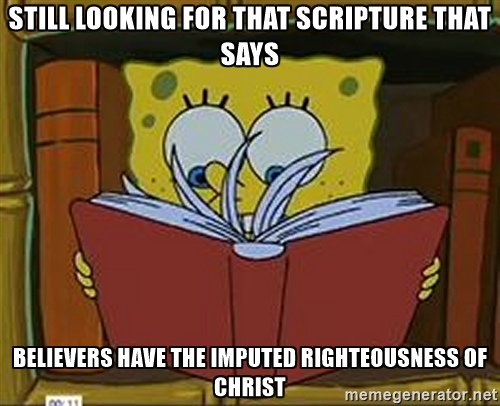
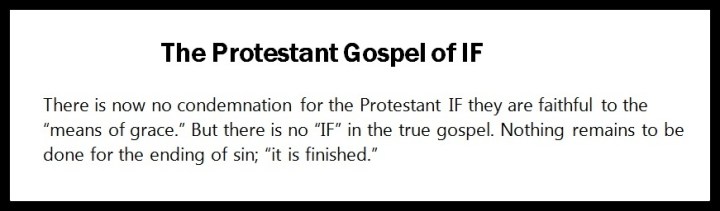
Because the believer has been literally born again, he/she has died with Christ and is no longer judged by the law. There is now no condemnation for the believer. A continual imputation of Christ’s payment for sin and good works are not needed for the believer because there is no law to judge him or her. Christ died to end the law and its condemnation for all those who believe.
The believer is also resurrected to new life with Christ, and this results in a different relationship to the law. Instead of being under its condemnation and therefore needing the continual imputation of Christ’s death and obedience to the law via “the means of grace” according to Protestant orthodoxy, the law is now something the believer is endeared to for purposes of wisdom in loving others. What was previously used by the Spirit to condemn is now used (in cooperation with the believer) to mature or perfect the believer in love.
Your goal is not perfection according to the law; your goal is maturing in love. You are under grace NOT under law and a perpetual imputation of Christ’s love in substitution for your obedient love is not only unneeded—it is a FALSE gospel that denies the new birth. Protestants remain as “sinners” yet under law and therefore need to continually return to the cross for “double imputation.”
One does well in asking God for perfection according to mature love, but not a love that is substituted for the fulfilment of a law that is ended.
We are under grace, not law. You don’t fear the law; you love the law. That doesn’t mean there is no law in grace it means that it is a law for love NOT condemnation.
paul

 Paul's Passing Thoughts
leave a comment